Three Arafundi Languages
A Sociolinguistic Proile of Andai, Nanubae,
and Tapei
A Sociolinguistic Profile of Andai, Nanubae, and Tapei
Alison Kassell, Bonnie MacKenzie, and Margaret Potter
SIL International
®2017
SIL Electronic Survey Report 2017-003, December 2017 © 2017 SIL International®
ii
Between February 8 and 22, 2005, Alison Kassell, Bonnie MacKenzie and Margaret Potter of SIL-PNG Branch conducted a sociolinguistic survey of the speech varieties along the Arafundi River, East Sepik Province, Papua New Guinea (PNG). They were accompanied by a speaker of the nearby Alamblak language who was involved in language development in Alamblak. The goals of the survey were to define the dialect and language boundaries, to investigate language vitality, to collect data on religious institutions in the area and to investigate whether a language development programme would be appropriate. This was achieved with the use of sociolinguistic interviews, interviews with community and religious leaders, the collection of wordlists and recorded text testing (RTTs).
The team concluded that the speech varieties previously included in the Arafundi [arf] language are in fact three languages, which are not mutually intelligible.1 Two of the languages, Tapei and Andai, have strong linguistic vitality, and the third, Nanubae, has strong linguistic vitality in the dialect spoken in Wambrumas and Yamandim villages, but not in the dialect spoken in Imanmeri village.2 It is therefore recommended that a language development programme be initiated in Tapei, Andai and the
Wambrumas-Yamandim dialect of Nanubae.
1 Since Arafundi has been split into three languages, the code [arf] has been retired.
6 Recommendations
Appendix A: Lexical similarity Appendix B: Recorded text tests Appendix C: Religious organisations Appendix D: Wordlists
1
1 Introduction
1.1 Goals of the survey
A survey of the Arafundi River area of the East Sepik Province was requested in 2004 by the SIL-PNG regional assistant director for the Sepik Region. The goals of the survey were the following:
• Determine how many dialects or languages are spoken in the Arafundi area.
• Investigate language vitality in order to help determine the potential for language development in any of the speech varieties in the Arafundi area and, assuming there is a need for language development work, assess the priority for work in this area.
• Collect data on the religious institutions active in the Arafundi area.
• Collect other information potentially relevant to outsiders who may visit the area.
The specific questions researched in order to meet the above goals, along with the methods used to conduct the research and the results of the survey are stated in their respective sections. Dialect and language boundaries are addressed in section 2, language vitality in section 3, religious organisations in section 4 and other information in section 5. The remainder of section 1 provides background
information on the languages surveyed and a summary of the work completed in each village.
1.2 Language name and classification
The Fifteenth edition of the Ethnologue (Gordon 2005) lists one language for the Arafundi area, referred to as Arafundi, coded [arf]. The entry for Arafundi reports that the language is spoken on the Arafundi River, and includes a note that Meakambut may either be a dialect or a separate language.
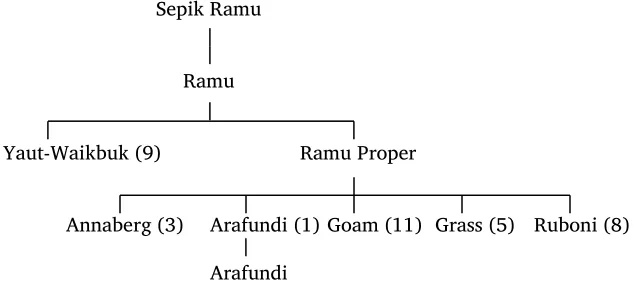
Arafundi is classified by the Fifteenth edition of the Ethnologue as Sepik-Ramu, Ramu, Ramu Proper, Arafundi. It is the only member of the Arafundi language family. Older texts list Arafundi (Alfendio) and Meakambut as separate languages in the Arafundi family/stock (Laycock 1973:39–40). Figure 1 gives the classification as it is found in the 2005 version of the Ethnologue. Numbers in parentheses indicate the number of languages included in each grouping.
Sepik Ramu
Ramu
Yaut-Waikbuk (9) Ramu Proper
Annaberg (3) Arafundi (1) Goam (11) Grass (5) Ruboni (8)
Arafundi
Figure 1. Arafundi linguistic classification.3
3 Figure 1 gives the linguistic classification of Arafundi at the time of the survey. Arafundi has since been split into
Many people in the Arafundi area, particularly along the main Arafundi River, perceive that everyone from Wambrumas up to Kupini speaks the same language. Speakers in the river villages of Yamandim, Imboin and Awim refer to this language as Mem or Mim (which means “talk” or “talking straight”). Residents in Imanmeri used the name Tuaimunda, which means “main talk”, to refer to this group.
The name Penale is the name of an area rather than of a language, covering both the mountain and the river villages.4 The name Penale is largely used by the neighbouring Maramuni language group to refer to the Arafundi people, and may also include the Mongolo people (see below).
After studying the linguistic and sociolinguistic situation in the area, the survey team concludes that there are at least three distinct speech varieties in the Arafundi area which may be considered separate languages (see section 2).5 The three proposed languages will be referred to in this report as outlined below. Each name was chosen by the survey team because it was one of the names given by at least some of the members of the group to refer to themselves, rather than being a name used only by
outsiders, and was exclusive to each group (and so did not include any villages considered by the survey team to be part of a different language).
• Andai: the villages of Kaiyam, Kupini, Awarem, Namata, Andambit and some speakers in Imboin. This name was given in the Kaiyam camp of Ndumbut. The people there did not recognise any other name as referring to their language.
• Nanubae: the villages of Yamandim, Wambrumas and Imanmeri. Speakers in Wambrumas and Yamandim called their language Nanubae, or Kapagmai, which covers themselves and Kurijan and may also be the name of their land. Residents of Imanmeri referred to their language as Tuaimunda, with the alternative name of Aunda, which means “no”.
• Tapei: the village of Awim and some speakers in Imboin. This name was given by speakers in Awim as referring to themselves in contrast to the mountain villages or other river villages.
There is reportedly an additional group of approximately 50–60 people by the name of Mongolo, who live to the east of the Arafundi River. The survey team was unable to meet with these people, though reports from the other villages indicate that this is a separate language group. Meakambut was the name of one of the Mongolo people’s former villages, and is therefore sometimes used to refer to these people. However, the Meakambut area corresponds geographically to the area covering the mountain peoples referred to in this report as Andai (see Kassell 2005).
1.3 Language location
Four maps display the geographical region. The Arafundi area is located in the far south of East Sepik Province, as shown on map 1.
4 People in Wambrumas were the only group to give a smaller scope to this name, saying that it referred only to the
mountain villages.
5 The Mongolo language could be considered a fourth variety. However, although it seems likely that this is
Map 2 shows the language boundaries in the Arafundi language area. Language names and codes are from the Ethnologue (Simons and Fennig, 2017). Kanosemei is thought to be part of the Tabriak language but this is not certain and therefore has not been placed within the Tabriak language group.
Map 2. Language boundaries in the Arafundi area
Map created by the authors.
[AFK]
[AFP]
Map 3 shows the phylum, sub-phylum, super-stock and stock boundaries for the languages in the Arafundi language area.
Map 3. Phylum, sub-phylum, super-stock and stock boundaries
Map 4 shows the location of the villages in the Arafundi area. They are spread across the government wards of Imanmeri, Awim, Yamandim and Imboin, which all are part of Karawari Rural District.
The Nanubae villages of Wambrumas and Yamandim are located along the main Arafundi River, south of the Yimas lakes. The third village in the Nanubae group, Imanmeri, is located to the northeast of these lakes.
The Andai villages of Namata, Kupini, Andambit and Kaiyam are located in the foothills at the head of the Arafundi River, towards the border with Enga Province. The village of Awarem is located at the head of the Karawari River (Wagupman Tributary), to the southwest of the Arafundi area.
Imboin, a village with a mixed population of Andai and Tapei speakers, is located along the Arafundi River. The Tapei village of Awim is located on a small stream that joins the Arafundi between Yamandim and Wambrumas.
Ndumbut, Piyagambit and Baikam are bush camps and do not have separate populations from the villages to which they belong. Rather, people from these villages will occasionally go and live in the camp while they look for sago. Ndumbut and Piyagambit are bush camps from Kaiyam, while Baikam is a bush camp from Awim.
The Mongolo people are semi-nomadic, moving every year or so. At the time of the survey, they reportedly lived at the head of the Mambungam River, to the east of Namata and Andambit. Travelling south from Imboin, people pointed to the mountains visible down the Mambungam River and said that was where the Mongolo people were living. However, it is also possible that they may be as far south as the next ridge of mountains, towards the watershed for the Maramuni River.
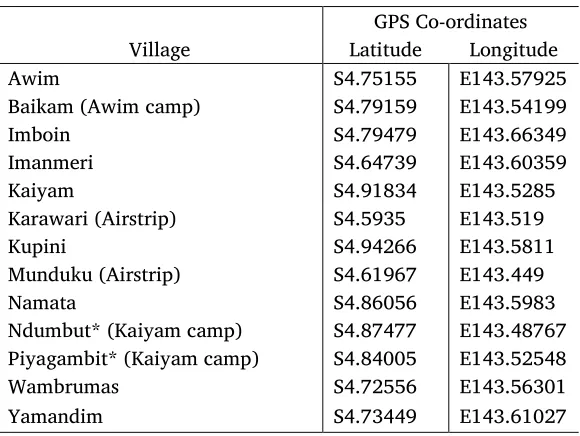
Table 1 gives the GPS coordinates for the Arafundi villages. Points for Kaiyam, Karawari, Kupini, Munduku and Namata are from the PNG National Mapping Bureau. All other points were taken by the survey team.
Table 1. Coordinates for Arafundi area map
GPS Co-ordinates
Village Latitude Longitude
Awim S4.75155 E143.57925
Baikam (Awim camp) S4.79159 E143.54199
Imboin S4.79479 E143.66349
Imanmeri S4.64739 E143.60359
Kaiyam S4.91834 E143.5285
Karawari (Airstrip) S4.5935 E143.519
Kupini S4.94266 E143.5811
Munduku (Airstrip) S4.61967 E143.449
Namata S4.86056 E143.5983
Ndumbut* (Kaiyam camp) S4.87477 E143.48767 Piyagambit* (Kaiyam camp) S4.84005 E143.52548
Wambrumas S4.72556 E143.56301
Yamandim S4.73449 E143.61027
1.3.1 Village names
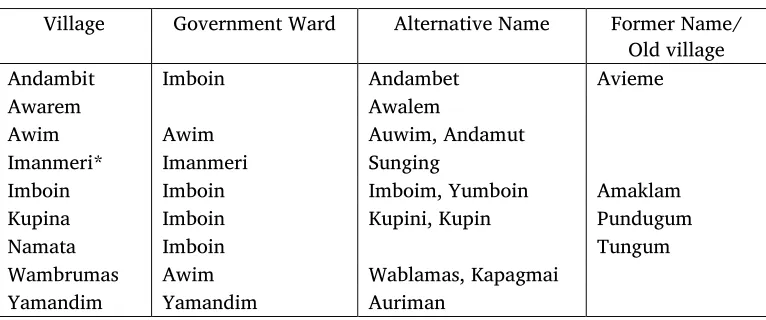
Table 2 gives the government ward for each village and lists alterative names as well as former names or old villages.
Table 2. Village names
Village Government Ward Alternative Name Former Name/ Old village
Andambit Imboin Andambet Avieme
Awarem Awalem
Awim Awim Auwim, Andamut
Imanmeri* Imanmeri Sunging
Imboin Imboin Imboim, Yumboin Amaklam
Kupina Imboin Kupini, Kupin Pundugum
Namata Imboin Tungum
Wambrumas Awim Wablamas, Kapagmai
Yamandim Yamandim Auriman
* Imanmeri is divided into four areas, each comprised of several smaller hamlets under the umbrella of Imanmeri: Kundimban, Yabalman, Yangaraman and Kurijan.
1.3.2 Population
Table 3 gives the population figures for each village, both from the 2000 census and as reported in 2005 for this survey.
Table 3. Population figures
2000 Census Figures 2005 Reported Figures Language Village Households Population Households Population
Nanubae
Imanmeri 116 654 79 900
Wambrumas 12 66 12 60
Yamandim 13 113 28 306a
TOTAL 832 1266
Tapei Awim 23 142 26 246
Andaib
Namata 18 94 17
Kupina 19 102 8c
Kaiyam 8 48 10 150d
Andambit 7 51 9
Awareme n/a 17 40
TOTAL 335
Imboin 19 92 11 102
aThe village of Yamandim conducted a very detailed count using the census book. bFigures for Andai were reported by people from Kaiyam.
cPeople from Kaiyam reported there to be 8–10 houses in Kupina village, with a lot of people having
split off and living on their own or with one other family in the bush. Thus the census figures are probably accurate.
dThe people at the Kaiyam camp were not certain about the total population for Andai. Based on the
number of houses, 150 seems an over-estimate.
The most accurate population figures for each of the language groups are most likely to be 1266 for Nanubae (366 for the Wambrumas/Yamandim dialect), over 395 for Andai and 286 for Tapei. The figure of 1266 for Nanubae and 246 for Tapei was based on reported figures from these villages. The figure for Andai of 335 is based on the 2000 census. Respondents in Kaiyam were not able to give population figures for the other Andai villages, only the number of houses, which by-and-large correlate to the numbers given in the census. Since Imboin is a mixed village, its population with regards to language groups should be divided between Tapei and Andai. It was reported that there were more Namata (Andai) people than Awim (Tapei) people living in Imboin. Thus, the population of 92 could be split 32/60, which would increase the Tapei population to 278, and the Andai total to 395.
1.3.3 Accessibility and transport
There is an airstrip near the Karawari River at Munduku (S4.61967, E143.449). From Munduku, the Arafundi area is accessed by travelling by boat to the east and then south along the Arafundi River. There is also an airstrip at Karawari (S4.5935, E143.519), to the east of the mouth of the Arafundi River. The Lutheran church is currently coordinating the construction of an airstrip at Kaiyam (S4.91834, E.143.5285).
The villages of Wambrumas, Imboin and Yamandim are located on the main Arafundi River. The village of Awim can be reached by following a small stream off to the southwest of the Arafundi River. The villages of Namata, Kupina, Andambit and Kaiyam can be reached by foot from Imboin. However, during rainy season the river between Imboin and Namata frequently floods to the extent that river crossing is impossible. Kaiyam can be reached by following the Karawari River to the south and continuing upriver (south) on the Wagupman, and then by hiking approximately one hour inland. The village of Awarem can be reached by continuing further up the Wagupman.
1.4 Previous research and linguistic work
1.4.1 Published works
In 1966, Dye, Townsend and Townsend (1966:154) wrote that “a closely inter-related group of languages is spoken by over 1,000 people in the region of the Arafundi River, a tributary of the Karawari…. No wider linguistic relationship has been established.”
The first literature on the Arafundi Stock is a paper by Haberland (1966), cited by Laycock (1973:39), who published five wordlists from the Arafundi area (Dye, Townsend and Townsend 1969:154). Haberland treated Arafundi and Meakambut as one language (Laycock 1973:39).
Laycock, however, claims that whilst Arafundi and Meakambut are closely related, his data suggests a language boundary between them, and a stock boundary between them and other members of the Ramu sub-phylum.
It appears in all these published works that when referring to Meakambut the authors are referring to the mountain villages of Andai. Laycock lists the villages of Alfendio (Arafundi) as Auwin, Imanmeri, Imboin, Warlamas and Yamandim. He lists the villages of Meakambut as Avieme, Isangan, Pundugum, Tungum and “uncensored villages at the head of the Arafundi River” (1973:40). In Laycock’s map showing linguistic relations, the Meakambut area coincides with the current location of Andai villages. Several of the villages Laycock lists as belonging to Meakambut are elsewhere listed as old names for the present-day Namata and Kupina (or as former villages which may now be part of present-day Kupina and Namata).
1.4.2 Nete, Penali and Yaut survey
information about the Penali (Penale) area. They found that there was a population of 100 in Kupini and 80 in Namata.
Villages in the Penali area are listed as Kupina (Kupini), Namata, Imboin, Awim, Mongolo and Yalom (near the Karawari). Villages in the same language but different dialect are listed as Yamanta (Yamandim), Wanbormas (Wambrumas), Imanmeri and Kanjamai.6
SIL standard wordlists, abridged to 106 items, were elicited in each of the four language areas visited: Nete, Alfendio (Penali), Erem and Maramuni Enga. Of these, six items were eliminated; thus the final comparison was made from a list of 100 items. Three further wordlists from Bisorio, Iniai and Lembena, found in the SIL Ukarumpa library, were also used in the comparison. Alfendio was found to have between zero and two cognates with each of the other wordlists. Thus the report concludes that Alfendio shows “no relationship to any of the other languages and is therefore relegated to a separate phylum” (Edminston 1986:12).
The report from this survey notes that the Alfendio language is used in the home by residents in Kupini, but Tok Pisin is also used together with the vernacular in Namata. It was noted that people in Kupini, along with Nete and Yaut villages closer to Enga Province, tended towards bilingualism with Enga, whereas residents of villages towards East Sepik Province tended to be bilingual with Tok Pisin. However, residents in Namata village did not display a preference for the use of Tok Pisin over the local language in either children’s education or church activities. There was a Community Education School in Kupini at the time. Testing for comprehension of the Enga Scriptures in Kupini was recommended.
1.4.3 Manuscripts
Wordlists elicited by Dye in 1967 show that separate wordlists were taken in Imboin, with informants from Imboin, Gaynsemay (Kansomai in Tok Pisin) and Wamblamas (Wambrumas). Dye refers to Imboin and Avambro (from Kansomai) as dialects of Arafuni (Arafundi).7 All the wordlists were incomplete (in general less than 100 words) and their accuracy was noted as poor due to several of the participants being monolingual, and there being no time for checking (with the exception of the Wamblamas wordlist, which was checked in Yamandim).
A further wordlist manuscript is available in the SIL Ukarumpa linguistics library filed under Arafundi. It has no author name. It lists the villages speaking the language as “Awim, Yumboin, Yahmbut, Tungum (Namata), Andambet and Pindeng(o)m (Kupini).” It also notes that Awim and Amboin are on the Arafundi River but adds that they are a mixed language area. There is also a note saying that Meakambut is on the Arafundi River.
1.4.4 Other information
Further information for the planning of this survey was given by A. L. who had recently spent time in the area on a medical patrol. The information given proved invaluable in the planning stage and the survey team wishes to express their appreciation for his help.
1.5 Village sampling
The survey team visited all of the villages located along the flat area of the Arafundi River: Wambrumas, Awim, Yamandim, Imboin and Imanmeri.8
6 The map accompanying the report places Awim close to the current location of Kaiyam. The map also places
Awinim where the current-day Awim is, and Yamanta where Yamandim is located.
7 Said to be midway between the Arafundi River and upper Karawari.
8 Imanmeri is actually up on a ridge to the northeast of the Yimas lakes. Imanmeri has several smaller villages which
Efforts to visit the mountain villages (Kupini, Namata, Kaiyam, Andambit and Awarem) were severely hampered by flooding of the main Arafundi River. This meant the team was unable to hike from Imboin to Namata since the river was over head-high and needed to be crossed at least four times.
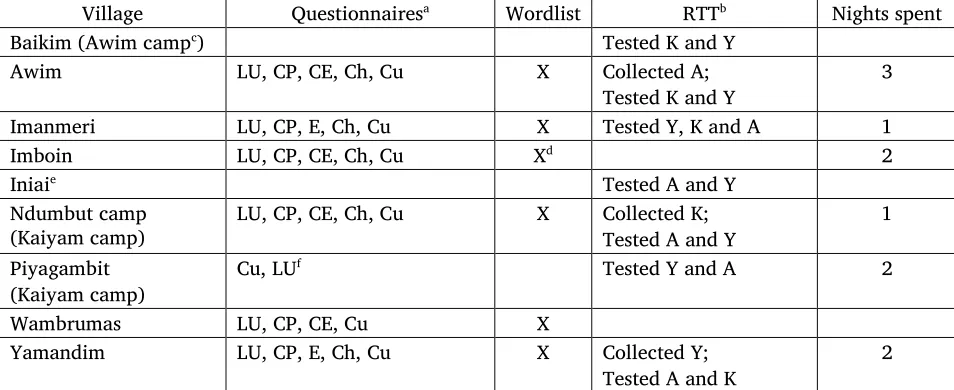
The team attempted to reach Kaiyam by travelling along the Karawari River, but once again this proved impossible, due to low water levels. Furthermore, the team was informed by a Kaiyam man that most people had left Kaiyam to look for sago. He reported there were only two families left in Kaiyam, with a larger camp of four Kaiyam families that could be reached back along the main river. The team was able to stay one night in this camp, called Ndumbut camp. Two nights were also spent (one on the way up the Karawari, and another on the way back) in another Kaiyam camp of two houses, known as Piyagambit camp.
The team had intended to visit the Mongolo area. However, there was not enough time, given the difficulties of getting to the mountain Andai area. Information in this report about the Mongolo people is therefore based on reported data gathered in the other villages, in particular in Imboin and the Kaiyam camps, which have the most contact with the Mongolo people.
In total, three nights were spent out of the area being studied, two in Munduku (one on the way back from the Kaiyam area and the other during the last night of the survey), and one in Simbut (Alamblak), where guides were collected for the attempted trip along the Karawari River to Kaiyam.
Table 4 lists the work completed in each village or camp.
Table 4. Work completed
Village Questionnairesa Wordlist RTTb Nights spent
Baikim (Awim campc) Tested K and Y
a Codes for questionnaires: Ch = Church Interview; CE= Community Education Questionnaire; CP = Contact
Patterns Questionnaire; Cu = Culture Questionnaire; E= Education interview with teacher; LU = Language Use Questionnaire
b Codes for RTT: A = Awim; K = Kaiyam; Y = Yamandim c On the Karawari River.
d Two wordlists were taken in Imboim, one with an Awim man, another with a Namata man, thus reflecting the two
different speech varieties spoken here. These men had both grown up in Imboin but were considered to represent the Awim and Namata speech varieties as spoken in Imboin.
e On the way back to the Arafundi area, after visiting the Kaiyam camp, it was reported that a Kaiyam man was on
his way back from town and in Iniai, so the team stopped to test him.
2 Dialect and language boundaries
2.1 Explanation of goal and methodology
The first goal of the survey was to determine the dialect and language boundaries in the Arafundi area. Recognising that there are numerous factors, both linguistic and social, which may affect how one defines a dialect or language, the survey team sought to establish such boundaries in the Arafundi area on the basis of reported identification, linguistic similarity and comprehension. These points were examined with the use of (1) SIL Language Use Interviews, to learn about language attitudes and reported comprehension and identification; (2) SIL-PNG Standard Wordlist (190 items), to elicit words and phrases for comparison of linguistic similarity; and (3) RTTs (recorded text tests), to test
comprehension.
In addition to the three points identified above (identification, similarity and comprehension), the team also researched language and dialect attitudes, to investigate what attitudes are held by the different groups towards each other. The team investigated attitudes with the use of the sociolinguistics questionnaire and the post-RTT questions.
It was not the goal of the survey team to be able to draw a strict geographical line between dialects, nor should any resulting maps be considered an indication of land ownership by the speakers of the language or dialect.
2.2 Reported dialect and language boundaries
Many people in the Arafundi area, particularly along the main river, perceive that everyone from Wambrumas up to Kupini speaks the same language. There is general consensus, however, that there are many differences in pronunciation, sounds and vocabulary, such that people from one end of the river cannot understand those at the other end.
The survey team found it difficult to interpret how much of a difference people perceived there to be, and whether these differences were considered to mean that the other group was a separate dialect or a separate but similar language. There was difficulty in the interpretation of the Tok Pisin words
tokples (usually translated “language”) and nek (literally “neck” but also means tune or melody and is usually used to refer to accent or dialect), which appeared to be used with differing values. Sometimes people would say tokples Awim to refer specifically to how people speak in Awim without necessarily meaning it to denote they were talking about a language separate from their own. A typical reply when asked about the speech of another area could be “Tokples em i narapela, tasol em i no narapela tumas, nek i wankain, tasol liklik senis” meaning “The language is another (one), but it’s not too much of another (one), the neck is the same, but some small changes.”
However, despite the difficulties in interpretation, specifically whether people considered another speech variety to be a different language or dialect from their own, there was consensus among certain villages that their speech is more similar to each other than it is to other villages in the area.
The river villages of Yamandim, Wambrumas and Imanmeri group themselves together.9 People in Wambrumas and Yamandim referred to themselves and Imanmeri as Nanubae or Kapagmai. Residents of Imanmeri referred to their language as Tuaimunda, with the alternative name of Aunda, but they also agreed that they are part of the same group as Yamandim and Wambrumas. Yamandim and Wambrumas insisted there are no differences between their speech and that of Imanmeri, but people in Imanmeri said there are small differences between themselves and Yamandim and Wambrumas. One example given was the word for betel nut, which is [mut] in Imanmeri, but [mui] in the other two villages.
9 Some references in other villages were made to the village of Kurijan near Imanmeri, but this was said to be part of
Residents from Kaiyam reported that the mountain villages of Kupini, Namata, Awarem, Kaiyam, Andambit and Imboin are a separate language group from other villages along the Arafundi River. They gave the name for this group as Andai and reported that the speech of all these villages is identical.10
Both the Andai and the Nanubae groups recognise that the speech of the other group differs from their own, though they vary in whether they see this as denoting a dialect or a language boundary. Kaiyam residents insisted that Yamandim, Wambrumas and Imanmeri were a different language from themselves, but residents in these latter three villages were less sure in return whether to include the Andai villages as a separate language, or as a different variety but part of their own language. In Wambrumas, respondents considered the Andai villages to be part of the same language as themselves, but referred to them by the separate name of Bundungum, or Wangkai. Wangkai was also used by people in Yamandim to refer to the Andai people, which they did not initially list as part of their language. However, when asked, respondents in Yamandim said that while there is a name, Mem, which refers to Andai people as well as themselves, their speech was very different such that they do not really
understand them. Similarly, in Imanmeri, respondents said that the Andai villages were covered under the same language name of Tuaimunda, but that they really were a different language, using the word Pundungum to refer to them.
The village of Awim recognised the two aforementioned groups as having different speech from themselves and from each other, but placed themselves together with both these groups in one language. They used three different words for “what” to refer to themselves (Tapei), the mountain people (Andai) and the river villages (Kambai). The only village they reported to speak exactly like them was Imboin, and even then it seems likely they were only including the Awim people who live in Imboin.
In Imboin, people considered themselves a mixed village, with three varieties: Awim, Namata and Karamba. The Karamba people came from near Kansomai, which is near Konmei Creek. These people have since intermarried with Awim and Namata people in Imboin, such that there are only a few men left who speak Karamba. Karamba is a separate language. People in Imboin more readily associated themselves with Awim and the Andai villages than with the Nanubae villages. There were reported to be more Namata people than Awim people in Imboin.
The Andai villages included Imboin in their language, but not Awim, although they acknowledged that the difference with Awim was not as great as with the other river villages. It seems when including Imboin, they were including the Namata people of Imboin, and not the Karamba or the Awim people. In Wambrumas and Yamandim, people treated Imboin and Awim as separate from the Andai villages, and as a dialect of the same language as themselves, referring to them as Kambai. However, respondents in Imanmeri placed Awim and Imboin as part of the Andai group, initially saying that their dialect was a bit different, but then saying that it was very different.
Yamandim people initially mentioned Kansomei (Kanjimai) as being part of their language. However, later they said it was actually part of another language. Respondents in Imanmeri reported that Kansomei people sound more like people from Biwat, so it seems possible that it is actually part of the Biwat language to the northeast, or part of Tabriak to the north.11
There were differing reports about the inclusion of Mongolo as part of any of the language groups in the Arafundi area. In Imboin, the village that has the most contact with the Mongolo people, people initially listed Mongolo as part of their language. However, they later reported that Mongolo people have their own language, which only some of the older men in Imboin can understand. In Kaiyam, people initially included Mongolo as part of their language, but then said that it wasn’t part of their language, and the words and sounds were completely different, such that only some men could understand them. In fact, they concluded, it was completely different.
In summary, speakers of the varieties in question perceive the speech of all the Arafundi varieties to be in some way related, particularly in contrast to neighbouring languages such as Alamblak and Yimas.
10 Geographically, Imboin is a river village, but the people of Imboim identified themselves more with the mountain
villages than with the other river villages, with the exception of Awim.
11 Although Kanjimai is listed in the 2000 census, no further references can be found to it in any of the linguistic
However, within this larger grouping, different villages identify their speech more with certain villages than with others. It seems that the mountain Andai people consider themselves a separate language. However, since only people from two Kaiyam camps were visited, it is not certain whether the villages such as Namata (which is closer to the Nanubae area) would make such a sharp distinction. There is definitely a grouping of the Nanubae villages (Yamandim, Wambrumas and Imanmeri), although within this group the residents of Imanmeri were more inclined to make a distinction between themselves and Yamandim and Wambrumas than vice versa. Imboin is a mixed village, and as such identifies both with Awim and with the Andai village of Namata. Awim residents identified themselves both with the mountain villages (Andai) and the river villages (Nanubae).
2.3 Linguistic similarity
2.3.1 Methodology
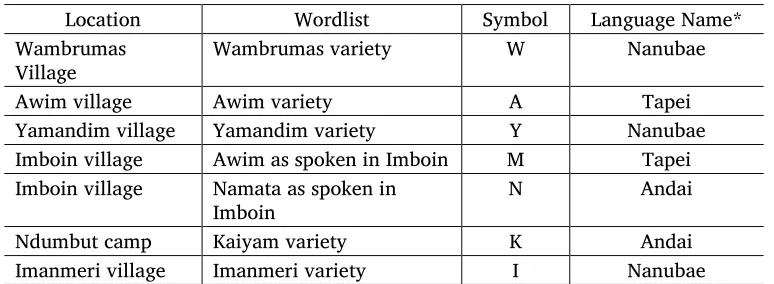
The standard SIL-PNG 190-item wordlist, which contains 170 words and twenty phrases (1999 revision), was elicited in all of the villages visited during the survey. In Imboin, wordlists were taken in the same sitting from residents of Imboin who identify themselves as Awim people and others who identify themselves as Namata people. All of the wordlists were elicited by the same member of the survey team, for consistency in elicitation and transcription. Table 5 idemtifies the wordlist collected in each village or camp.
Table 5. Wordlists collected
Location Wordlist Symbol Language Name*
Wambrumas Village
Wambrumas variety W Nanubae
Awim village Awim variety A Tapei
Yamandim village Yamandim variety Y Nanubae
Imboin village Awim as spoken in Imboin M Tapei
Imboin village Namata as spoken in Imboin
N Andai
Ndumbut camp Kaiyam variety K Andai
Imanmeri village Imanmeri variety I Nanubae
* There was not complete consensus on the name for each variety (see discussion in section 2.2 for explanation of why these were chosen). On the wordlists, the varieties spoken in Wambrumas and Yamandim were called Nanubae, but in Imanmeri the name Aunda was given. When the wordlists in the Awim variety, Imboin-Awim variety, Imboin-Namata variety, and Kaiyam variety were elicited, the name Mem was given. Kaiyam speakers also accepted the term Penale.
The lists were elicited from a small group of informants, which included both men and women and both older and younger individuals, whenever possible. One mother-tongue speaker, who had grown up in the village and whose parents were also from the village, was chosen as the main informant and primary voice to be recorded.
The wordlists were compared to give an insight into the linguistic similarity between the seven varieties. Review of the wordlists provided a glimpse into the phonology, morphology and grammar, as well as lexical similarity between the varieties.
forms be somewhat similar. When readily identified, affixes were excluded from comparison, as were reduplication and two cases of metathesis.12
A few other adjustments were made in applying the criteria based on the apparent phonology of the languages and to reduce the effect of possible inconsistencies in transcription. Forms were not considered dissimilar due to an [i] or [j] which occurs with another vowel in one form and is missing in the other. Voiced and voiceless plosives at the same place of articulation were considered identical/very similar, as speakers sometimes varied between the voiced and voiceless plosive in two utterances of the same word. Labialised and non-labialized plosives were also treated as identical/very similar, because speakers were not always consistent in using one or the other in the same form. Correspondences which were shown to be regular were also considered identical or very similar. A few examples of correspondences are
addressed in section 2.3.2.
Of the 170 words on the SIL standard wordlists, two of the glosses were changed. The word “bean” (gloss 134) was replaced with “sago” as they do not traditionally plant beans and thus do not have a vernacular word and the word “hand” (gloss 14) was replaced with “arm” as it seemed that “hand” and “foot” might be the same.
Thirteen items were not used in any comparison. In one case, there was no word in any of the languages (gloss 119, “horn”). Nine items were disqualified because the same form was given for another item on the list. Three more items were disqualified by a combination of the two previously mentioned reasons and Tok Pisin words being given in one or more variety. For twenty-six items, the form from one or more lists was excluded from comparison for the same reasons, without the whole item being
disqualified. The number of comparisons between each pair of wordlists therefore varied. A list of these glosses can be found in table 17 in the appendix.
For twenty items, some forms were grouped as similar, although they do not meet Blair’s standard. For six of those items, the form on one or more lists appears to be missing a morpheme and in three of those cases (#6, 7, and 24), the morpheme appears to be a variation of [-un] (for one form on one list it is [-unum]). This morpheme also appears in item 21, but does not violate the criteria. The other three appear to be [-am] (22) and [-in]/[-inim] (74 and 143). It is possible that these are just cases of reduplication with some assimilation. For another four items, one or more forms appear to have a missing vowel either initially or between two nasals (26, 38, 78, and 116).
Three of the glosses where exceptions to Blair’s standard were made have a nasal followed by a plosive at the same place of articulation, in one form, and one or both segments missing in the other (18, 20, 46). A similar situation occurs in a number of other items, which still meet the criteria because the forms are longer. It is possible that these are actually pre-nasalized plosives and should be treated as one segment rather than two, or that they are a separate morpheme. In Yamandim, [mikiamba] and [mikia] were both given for item 82 and for item 35, [amai] was called a “shortcut” for [amandi], which gives some precedent for treating pairs of forms like these as similar.
All of the forms given for item 35 were grouped as similar, although they did not meet the criteria. One list had a form similar to the long form (see previous paragraph) and three others had forms similar to the short form, and the last two did not meet the criteria, but are possibly “shortcuts” as well. Again, for item 11, Yamandim gave two forms (stating that they were for different persons). All the other forms were lexically similar to one or the other, except the Imboin-Namata form, which has an extra vowel. All the forms for this item were treated as lexically similar. A full list of the non-complying items can be found in table 17 in the appendix.
12 There were only two cases of apparent metathesis, items 87 and 135. Both occur in syllables which start with a
2.3.2 Results
2.3.2.1 Phonology
Table 6. Possible consonantal phones in Nanubae, Tapei, and Andai
Pulmonic Bilabial Labio-dental Dental Alveolar Palatal alveolar Post Velar Glottal
Plosive p b t d k ɡ ʔ
Nasal m n ɲ ŋ
Trill
Tap or flap ɾ
Fricative v s ʃ ʒ ɣ
Approximant w j
Lat. approx. l
The wordlists also had examples of labialised plosives [pw], [bw], [kw], [gw], and [mw], but these did not appear to be in contrast with the non-labialized plosives, as speakers sometimes fluctuated between productions of the same item.
There also seemed to be fluctuation between voiced and voiceless plosives at the same place of articulation. The voiced ones occurred most often word-medially, particularly following a nasal,
although they did occasionally occur word-initially. Voiceless plosives occurred most often word initially or finally and voiceless ones medially and occasionally initially. There may be free variation between [dʒ] and [tʃ]/[s]. At least once (item 141 in Yamandim), the same form was pronounced once with [dʒ] and the second time with [s]. According to Laycock and Z’Graggen (1975), the absence of a
voiced/voiceless distinction in consonants is common in languages of the Sepik-Ramu Phylum. In at least one item (13 on the Imanmeri list) a fluctuation between [l] and [ɾ] was noted, so it is possible that they are not separate phonemes.
Based on the wordlists, the phonetic inventories seem to be quite similar between the three varieties and thus are shown on the same charts. With the exception of Kaiyam, the glottal stop was relatively rare. This may be due to transcription error or may be an actual difference between the varieties. The palatal nasal was not very common on any of the lists and it is possible that it was an alveolar nasal followed by a palatal approximant. Although the relationship between [l] and [ɾ] is unclear, it should be noted that [l] occurs much more frequently on the Imboin-Namata and Kaiyam lists than on the others. [v] only occurred on the Wambrumas list and only for two items. [ɣ] was also very rare and is probably not a phoneme.
A correspondence was found between word-final [k] in Imanmeri, [l] in Kaiyam and Imboin-Namata, and a vowel or null in Wambrumas, Awim, Imboin-Awim, and Yamandim (items 39, 44, 58, 91, 136, and 154, though not every list for every item). Two identical vowels separated by a glottal stop in Kaiyam were found to correspond to a single vowel on the Imboin-Namata list (items 68, 76, 86, and 97). For items 53, 99, 106, and 139, Imboin-Namata and/or Kaiyam had [n] where the other lists had [j].
Table 7. Possible vocalic phones in Nanubae, Tapei, and Andai
Front Central Back
Close i
ɪ ɨ u ʊ
Close-mid e o
Mid ə
Open-mid ɛ ʌ
Note, these are possible phones. It is unlikely that all of these vowel phones are phonemes. [i], [e],
[ɛ], [ɑ], [o], and [u] do occur in all of the varieties but no comparison has been made to see if they are
contrastive. [ɪ] occurs on all of the lists except Wambrumas and [ɨ] occurs on all of the lists except Kaiyam. [ʊ] occurred once in Wambrumas, Imanmeri, Kaiyam, and Imboin-Awim, but was not very common, nor was the schwa. [ʌ] only occurred in Imboin-Awim and Imboin-Namata.
2.3.2.2 Stress
Stress was only marked on Wambrumas list, and even there, MacKenzie did not indicate stress on every word. As a result, only tentative conclusions about stress can be drawn. It appears that stress was generally on the ultimate syllable. If there is a suffix or it is a compound word, the last syllable of the stem is stressed and there may be secondary stress on the last syllable of the second morpheme.
2.3.2.3 Morphology
Body parts are marked to indicate possession or to whom they are attached. However, there was some confusion over which person was being given. Also, in some cases more than one form was given, and it appeared that there was a change to the stem as well. On Imboin list A (Imboin residents who identified themselves as speaking the Awim variety), MacKenzie attempted to get a complete paradigm for item 1, “head.”
my head his head our head (excl.) our head (incl.) your head (pl./dl?)
kɑbɨk kɑbɨn kɑbɨŋ kɑbɨs kɑbɛn
Verbs change depending on whether they refer to a current action, something that happened yesterday or will happen tomorrow. More research is needed to determine whether tense is in fact what is being marked. The following examples are from Imanmeri:
nuŋɡumdʒɑ ɑmbɨn nuŋɡumdʒɑ mɪnɪs nɨmbɨn
man/person go-PRES man/person sago eat-PRES
“The man goes.” (item 177) “The man eats sago.” (item 180)
nuŋɡumdʒɑ nɑi ɑnɑn nuŋɡumdʒɑ nɑi mɪnɪs nɑn
man/person yesterday go-PAST man/person yesterday sago eat-PAST “The man went yesterday.” (item 178) “The man ate sago yesterday.” (item 181)
nuŋɡumdʒɑ pɪndi ɑniŋan nuŋɡumdʒɑ pɪndi mɪnɪs niŋan
man/person tomorrow go-FUT man/person tomorrow sago eat-FUT “The man will go tomorrow.” (item 179) “The man will eat sago tomorrow.” (item 182)
Some verbs appear to have reduplication on the present tense form, such the Awim form in the examples from item 180 in the next section. This type of reduplication also appears to occur in one or more forms for item 53, 54, 56, 63, and 75. Further research is needed to determine the function of this reduplication.
2.3.2.4 Grammar
Nanubae (Yamandim village) Tapei (Awim village)
nuŋɡumdʒa ɛjɪm nɨmbɨn nuŋɡum kaik nɨmbɨbɨn
person yam eat person banana eat
“The man is eating the yam.” (item 180) “The man is eating the banana.” (item 180)13
Andai (Kaiyam list)
numbwɑm waŋ nɨmbɨbɾɨn
person yam eat
“The man is eating the yam.” (item 180)
The structure of the elicited phrases in the three varieties was quite similar. For the remaining examples, only one variety will be presented, but it can be considered representative of the grammar of the others as well.
Numbers and other adjectives follow head nouns, as shown in the following examples from the Kaiyam list.
numbwɑ kɑndɑndɑ jalɛpɛn
person one stand
“One man stands.” (item 174)
numbwɑ kɑmin jalɛpɛn person two stand “Two men stand.” (item 175)
nuŋɡum nan tɑum kindʒɑ pokol
man big dog little hit
“The big man hit the little dog.” (item 185)
2.3.3 Lexicostatistics
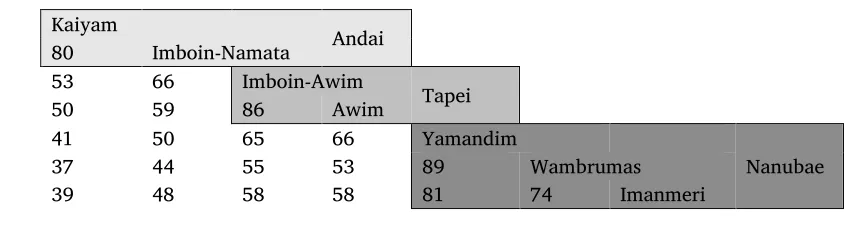
The percentage of lexically similar items between the seven wordlists is shown in table 8 below. See table 9 for the likely range of error (above or below the figure in the percentage matrix) within which the true percentage of lexically similar items fall. The range of error or variance is calculated from the lexical similarity percentage, the number of words compared, and the reliability codes14 entered in the WordSurv program for each wordlist (Wimbish 1989:59–60).
Table 8. Lexical similarity matrix
Kaiyam
Andai
80 Imboin-Namata
53 66 Imboin-Awim
Tapei
50 59 86 Awim
41 50 65 66 Yamandim
Nanubae
37 44 55 53 89 Wambrumas
39 48 58 58 81 74 Imanmeri
13 Banana has been substituted for yam.
14 All of the wordlists from this survey were given a reliability code of D (average survey situation), due to
Table 9. Variance matrix
The similarity percentages in table 8 point towards the presence of three languages in the Arafundi area, rather than one as is currently listed in the Ethnologue (Gordon 2005). This data is in line with the perceptions of speakers. In some cases, the percentages are somewhat lower than one might expect. For example, people in Yamandim stated that residents of Imanmeri speak exactly the same way they do, but there was only 81 percent lexical similarity. This perhaps explains why people in Imanmeri said that while they were in the same group as Yamandim, there were some differences in their speech. However, the two varieties are significantly more similar to each other and Wambrumas than either of them is to the Andai or Tapei lists.
According to Wurm and McElhanon (1975:152), speech varieties are generally regarded as dialects of the same language if their similarity percentages are mostly above 81 percent, and as separate languages if they are mostly below 78 percent. The similarity percentage between the two Andai wordlists and between Imanmeri and Yamandim are rather close to that threshold, but acceptable. The similarity between Imanmeri and Wambrumas raises questions as to whether Imanmeri belongs to the same language as Wambrumas and Yamandim. However, considering that both Imanmeri and
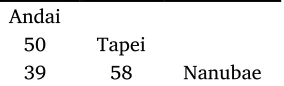
Wambrumas have higher percentages with Yamandim, it is reasonable to group them together as separate dialects of the same language. Considering the variance, the similarity with Wambrumas may actually be as high as 81.4 percent. When averaged together, Yamandim and Wambrumas share 78 percent lexical similarity with Imanmeri. It should be noted as well that wordlists were not taken in all of the Andai villages and that if they had, it is likely that some of the similarity percentages within the language would be higher than the comparison between Kaiyam and Imboin-Namata. Average
percentages between the three groups are shown in the following table.
Table 10. Average lexical similarity
Andai
50 Tapei
39 58 Nanubae
Beyond the villages that might be postulated as belonging to the same language, each variety shares the most lexical similarity with those others with which it is closest or has the most contact. The Imboin-Namata and the Imboin-Awim speakers clearly have frequent contact and they share 66 percent lexical similarity. Awim and Yamandim are relatively close to each other geographically and children from Awim go to school in Yamandim, and they also share 66 percent similarity.
2.4 Reported comprehension
Beyond what can be predicted based on lexical similarity, the survey team gained an idea of comprehension between the varieties by asking people how well they understand each other. Comprehension of Yamandim, Awim and Kaiyam varieties was measured using recorded text tests.
People in Imanmeri reported that adults can understand the speech of Wambrumas and Yamandim, but children might not. Since people in Wambrumas and Yamandim reported that the speech of
Imanmeri was exactly like their own, they were not asked if they would have a problem understanding the speech of people from Imanmeri. People in Yamandim, Wambrumas and Imanmeri all agreed that the speech of the Andai villages was hard to understand; they could only grasp simple words and would in general use Tok Pisin to talk with these people. However, they reported fairly good comprehension of Tapei (Awim and Imboin); indeed, in Yamandim people said they could understand everything from Awim and Imboin. In the Nanubae village of Imanmeri there was less reported comprehension of Awim and Imboin. In fact, they said the speech from Awim and Imboin was as hard for them to understand as Andai was.
The Kaiyam people in the bush camps that were visited said they could understand the Namata people from Imboin, but not the Awim ones, since they could not understand anything from Awim or any of the other river villages (Wambrumas, Yamandim and Imanmeri).
People in Awim reported good comprehension of both Andai and Nanubae. People in Imboin reported that they could understand everything from Awim and Andai. They reported some level of comprehension of the river villages, but said they certainly would not understand everything.
People everywhere said they could not understand the Mongolo people; only some of the old men who knew some of the Mongolo language could understand them.
When asked if a six-year-old child would understand the speech of other areas it was generally agreed that they would not. This would imply that comprehension by adults is largely based on contact, rather than inherent intelligibility. In Awim it was said that some children could understand the speech of other villages, and in Imanmeri people reported that the children might be able to “hear”
(understand) some of the speech from Awim, but could certainly not reply.
In conclusion, there is no one speech variety that all people reported comprehending. Reported comprehension of Awim was common in several places along the river.
2.5 Recorded text testing
Recorded text tests (RTTs) were used to measure inherent intelligibility (that is, understanding based on knowledge of one’s own variety without needing to learn the other variety) between varieties spoken in Awim, Imanmeri, Kaiyam and Yamandim. The survey team followed the procedure described in Survey on a Shoestring (Blair 1990:73) with a few modifications. Deviations from Blair’s standards are explained below.
2.5.1 Test design
2.5.1.1 Record text and devise comprehension questions
Short stories were recorded in Awim, Ndumbut (a Kaiyam bush camp), and Yamandim.15 All of the storytellers were men between the ages of thirty and fifty-five.
There were some technical difficulties with the recording itself. The volume on the Kaiyam story was low, which did not appear to affect comprehension by Kaiyam people. However, people from other
15 The Awim story was two and a half minutes long, the Kaiyam story two minutes long, and the Yamandim story
language areas sometimes complained that the Kaiyam recording was not loud enough. In transferring the Awim recording between minidiscs, there were brief moments of static interspersed throughout the text. However, it did not seem that the static made key points of the story unintelligible, as ten Awim people scored either 90 percent or 100 percent on their hometown test, even with the static.
After each story was recorded, it was transcribed phonetically and translated phrase by phrase. Then the survey team designed trial comprehension questions based on the text. The recording was divided into tracks so that after each track, the playback could be paused and a question asked. There were sixteen trial questions for the Awim text, fourteen questions for the Kaiyam text, and fifteen questions for the Yamandim text.16 Ideally, there should not be long stretches of text between each question. However, storytellers included much repetition in their stories, and some longer sections of text were impossible to divide. After the pilot tests (see below) and subsequent removal of some trial questions, text length between questions varied between two and fifty-two seconds.
During the Awim pilot test, the survey team attempted to follow the procedure described by Blair, where comprehension questions are recorded in the vernacular, in a voice distinct from the storyteller’s voice, and inserted into appropriate places in the text. However, this method was problematic for the following reasons:
• Subjects often repeated the question rather than answering the question.17
• Subjects sometimes thought that the second voice was a second storyteller interacting with the first storyteller.
• Translation of the questions from Tok Pisin into the vernacular was not entirely accurate. Thus the survey team had no assurance that the content of the translated questions would be the same.18 Due to these difficulties, the questions were asked directly by a surveyor in Tok Pisin for all testing (including pilot testing) following the Awim pilot test (the first test of the survey). If a subject did not understand Tok Pisin, an interpreter was available to translate. However, most subjects were able to speak Tok Pisin well enough to take the test without assistance. This process was much less confusing for people.
2.5.1.2 Record practice test
A short story was also recorded in the Awim, Kaiyam and Yamandim varieties to serve as a practice test. There were five brief sections, each followed by a question in Tok Pisin. The purpose of this test was to orient the subject to the procedure. The practice story content was always dictated by a surveyor, then translated into the vernacular and recorded by a local person. Each subject took a practice test before taking any other test (pilot or hometown).
16 Standard RTT procedure requires fifteen trial questions, but the team was only able to devise fourteen questions
due to lack of content in the text.
17 This difficulty was also encountered by Rueck and Jore on the survey of Dima language in Milne Bay Province
(2001:7). Since that time, it has been standard practice for the PNG survey team to ask RTT questions in the trade language, with the help of an interpreter, if necessary. We attempted Blair’s procedure again on this survey, hoping to be able to use traditional RTT methods, but this procedure seemed to be equally confusing for Awim residents as it had been for Dima speakers.
18 It is impossible to accurately score a test if the questions asked in one test location differ from the questions asked
2.5.1.3 Pilot testing
Each text and series of comprehension questions was pilot tested with between nine and eleven speakers of the same variety as the text.19 The goal was to eliminate any ambiguous or confusing questions and identify correct answers. The responses of the pilot test-takers were used to judge responses in the target language areas; if a person from a target language area answered the same as local language speakers, then the answer was considered correct.
Ideally, test subjects should be able to answer all pilot test questions accurately. However, no ten questions were answered correctly by all subjects. For the Awim RTT, three questions were chosen that had been missed by one person each during pilot testing, two questions that had been missed by two people, and one question that had been missed by three people.20 For the Kaiyam RTT, five of the questions chosen were answered incorrectly by one subject, and one question was selected that had been missed by two people. For the Yamandim RTT, three questions were chosen that had been missed by one person during the pilot testing.
According to Blair, good questions should ideally produce test scores of 100 percent when given to the local speakers, and a test that yields an average score of less than 90 percent should not be used. Once the bad questions were removed, subjects’ average scores were as follows: Awim 93 percent, Kaiyam 93 percent, Yamandim 97 percent.
It should be noted that the Kaiyam pilot test served as the hometown test for subjects from the Andai area due to lack of people available to take the test. Each subject took the pilot test, and answers to all 14 questions were noted. Immediately following the pilot test, they took the other tests (Awim and Yamandim). After all subjects finished the pilot test, answers were compared and correct answers identified. Problematic questions were thrown out, and then the test was scored to serve as the
hometown test. Only one subject had to be disqualified based on a low hometown test score.21 Before the pilot testing was complete, the survey team visited an Awim bush camp called Baikam, where two subjects took the Kaiyam RTT with all 14 pilot test questions. After the Kaiyam pilot testing was finished in another village farther down the river, the problematic questions were eliminated from the Baikam subjects’ answers, and their tests were scored as though they had taken the test only with the final ten questions.
2.5.2 RTT sampling
2.5.2.1 Macro-level sampling
Recorded text tests were designed and tested in each of the linguistic varieties reported in the area covered by the survey. In the Nanubae group, Yamandim was chosen over Wambrumas because its population was large enough to make testing feasible and because it was unclear until after the survey was in progress whether or not Imanmeri belonged to the language group.
Awim was chosen over Imboin to represent the Tapei dialect because the survey team was informed that most residents of Imboin were out in the bush at the time of the survey, thus making it difficult to find enough subjects to participate in the testing. Subsequently, the team learned that Imboin is a linguistically mixed community with high levels of contact between the variety spoken in Awim and the variety spoken in Namata. Thus, Imboin would have been a poor choice for a location to develop an RTT.
19 In the Andai area, it was only possible to have nine people participate in the pilot testing, even though standard
procedure requires ten participants. The Kaiyam story was pilot tested with people from Kaiyam, Andambit, Awarem, Namata and Piyagambit. All of these villages are in the same dialect area as Kaiyam.
20 Two of the subjects may have answered this question incorrectly because of inaccurate translation of the recorded
questions. With only one exception, subjects who had the question clarified in Tok Pisin answered correctly.
21 Although this subject’s parents were both from Kaiyam and he was a resident of Kaiyam, he spent most of his life
The survey team originally planned to develop the Andai RTT in Namata, but were unable to go to Namata due to flooding. Due to difficult travel conditions and time constraints, it was impossible to reach either of the other main villages in the mountain area (Kaiyam and Kupini). The survey team visited Ndumbut, one of the Kaiyam bush camps, developed the RTT there, and pilot tested the text with subjects in that camp as well as another nearby camp. They tested one additional Kaiyam man in Iniai, who was visiting friends in another language area.
2.5.2.2 Micro-level sampling
The survey team planned to test at least ten people in each village where testing was conducted, as ten is the minimum number generally accepted for an RTT sample. Since the goal of the RTT was to test inherent intelligibility rather than bilingualism, it was necessary to find subjects with a low level of contact with the other languages/dialects. Due to a variety of constraints, the survey team was unable to meet these ideals.
Eleven subjects were tested in Awim, including two subjects staying in an Awim bush camp called Baikim. Nine Andai subjects were tested on one text and nine on another text in the Andai area.22 Nine subjects were tested in Yamandim, and eight subjects in Imanmeri. These low numbers were due to: • People’s absence from the village. Many people were away from their villages because they were
harvesting sago or cutting lumber to sell for profit. In Ndumbut (Kaiyam bush camp), there were very few possible subjects due to low population.
• People’s reluctance to participate in the testing. Many people refused to take the test, even after the importance of having ten subjects from each location was explained. Women were especially hesitant to take the test. Many hid in their houses, and some took off running when they saw a surveyor approaching to ask them to take the test. In one village, the kaunsil (an elected local level government official, responsible for a ward area) explained that it was not women’s custom to listen to stories, and that was part of the reason they did not want to participate. Others said that women were afraid because they could not speak Tok Pisin. When it was explained to them that an
interpreter was available, most still refused to participate. With the exception of Yamandim (where five of the subjects were male and five female) there were more male than female subjects. Total numbers of females tested and not disqualified were: Awim 1, Andai 3, Imanmeri 2, Yamandim 5. • Subjects’ difficulty in understanding the test procedure. Before taking a test on another language or
dialect, each subject first took the test of their own variety, called “hometown test.” The purpose of the hometown test was to screen out those who have difficulty taking tests. Generally, it is best to test only subjects who score 90 percent or above on their hometown test. If necessary, subjects who score 80 percent on their hometown test may be tested on the other texts. Of those who were willing to participate in the testing, eight subjects in Awim and three subjects in Yamandim scored below 80 percent on their hometown test and were thus unable to take the other tests. It seemed that subjects with little or no education were less likely to understand the test procedure, probably because they were unfamiliar with a question/answer test format. Subjects’ education levels are listed in appendix 8.3.
• Problems with the hometown test in Imanmeri. Throughout the survey, it was consistently reported that Imanmeri and Yamandim belonged to the same group, with only slight differences (if any) between the speech varieties of the two villages. It was therefore assumed that the Yamandim RTT could be used as the hometown test for Imanmeri. However, seventeen people in Imanmeri scored below 70 percent on the Yamandim test. This suggests that there is significant difference between the dialects and/or that most people did not understand the test procedure. Blair (1990) states that subjects who score as low as 70 percent may be included in the sample, so people who scored 70
22 The nine subjects in table 18 do not include the storyteller himself (subject B15), because his good score on the
percent or 80 percent on the Yamandim text were included in the sample.23 Unfortunately, by the time it became clear that the Yamandim hometown test was inappropriate for use in Imanmeri, there was not enough time to create an Imanmeri hometown test.24
2.5.3 Influence of contact
It was impossible to find ten willing subjects in each area who had little or no contact with the other areas where tests were developed. As discussed above, finding subjects at all was challenging, leaving no opportunity to be selective about contact. Each subject’s contact level is listed in Appendix B.2.
In the Andai area, eight subjects correctly identified the Awim storyteller as being from Awim, but only one correctly mentioned his name. One subject incorrectly identified the Awim storyteller as being from Yamandim. Four subjects correctly identified the storyteller as being from Yamandim, though none mentioned his name, and five people incorrectly identified the storyteller’s home village. Four of these thought he was from outside the Yamandim dialect area (either from Awim or Imboin), while one guessed he was from Wambrumas. This suggests low contact between Yamandim and the mountain area.
In Awim, seven subjects correctly identified the Kaiyam storyteller as being from Andai, and four could identify him by name, indicating a high level of contact between the groups. 25 All eleven subjects correctly identified the Yamandim storyteller as being from Yamandim, and five knew him by name. This suggests a high level of contact between Awim and Yamandim.
In Yamandim, all nine subjects correctly identified the Awim storyteller as being from Awim, although none identified him by name. Only two subjects correctly identified the Kaiyam storyteller as being from Kaiyam, and no one identified him by name. Three thought he might be from Namata, one guessed Awim, two said Imboin, one person said in the Meakambut area at the head of the river, and one person said they didn’t know.26
In Imanmeri, seven of the eight subjects correctly identified the Yamandim storyteller’s home village as Yamandim, and one mentioned him by name. The other subject thought the storyteller was from Wambrumas. All eight subjects correctly identified the Awim storyteller as being from Awim, but none mentioned him by name.
Since subjects with medium and high contact levels were included in the sample, it is likely that the test results reflect some amount of bilingual overlay in addition to inherent intelligibility. In any case, it may be assumed that the level of inherent intelligibility is not higher than the level of intelligibility enhanced by bilingualism.
2.5.4 Test administration
Order of tests:
1. Practice test. A subject could listen to the recording of the practice text more than once, questions could be repeated, and the process reviewed until the surveyor felt that the subject was familiar enough with the test-taking procedure to proceed to the hometown test.
2. Hometown test. Subjects scoring below 80 percent (70 percent in Imanmeri) did not participate in further testing.
3. Other dialect/language tests. Order of the tests was varied to control for effects that the order of tests could potentially have on average scores (e.g. subject fatigue).
23 Only one person achieved this score. No one in Imanmeri scored above 80 percent on the Yamandim text. 24 During the RTT questions, five subjects in Imanmeri said the Yamandim story was easy to understand, while three
said it was hard. Two said that the storyteller’s way of speaking was exactly the same as theirs, while the remaining six said it was a little bit different. This is another indication that it would have been good to have a unique hometown test for Imanmeri residents, if time had permitted.
4. Post-questions. After each test (except for the practice test), the surveyor asked a few questions (see section 2.6) to gauge people’s attitudes toward the language spoken in the story.
2.5.5 Results
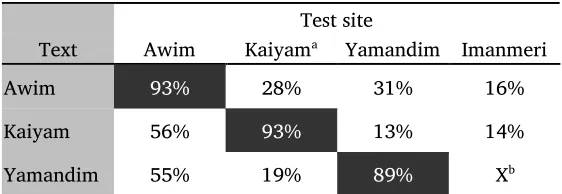
Recorded text tests are designed to measure inherent intelligibility between languages or dialects. The level of inherent intelligibility gives some indication of how well speakers of two different varieties can understand each other. As discussed in section 2.5.3, the results of the RTTs from this survey probably reflect inherent intelligibility with some bilingual overlay, since many participants had contact with speakers of the other varieties being tested. In any case, it may be assumed that the level of inherent intelligibility is not higher than the level of intelligibility enhanced by bilingualism. The results of the RTTs are shown in table 11.
Table 11. Recorded text test results
Test site
b It is not possible to include an intelligibility score for Imanmeri on
the Yamandim text, since there was no adequate hometown test in Imanmeri. In Imanmeri, those who scored 70% or above on the Yamandim RTT were considered competent test takers and were tested on the other RTTs.
The shaded boxes in the table above represent subjects’ average score on their hometown text. As one would expect, these scores are high.
ILAC conference recommendations (1991) indicate that an RTT score of 75 percent is the lowest acceptable indicator of comprehension. Joseph Grimes states that at 85 percent or above, “it is reasonable to speak of the dialect cluster as a single language from the linguistic point of view…. In between, 70 percent to 85 percent, is an area of marginal intelligibility where some communication is satisfactory and some is not” (1995:22). The scores reflected in table 11 are well below these accepted thresholds, suggesting that the varieties spoken in Awim, Kaiyam and Yamandim should be considered three distinct languages. These villages correspond to the three groups identified in section 2.2: Tapei (Awim), Andai (Kaiyam) and Nanubae (Yamandim).
The variety spoken in Imanmeri is clearly a distinct language from the varieties spoken in Awim and Kaiyam. No definitive statement can be made about inherent intelligibility between Yamandim and Imanmeri, since there was no RTT from Imanmeri itself. However, the difficulty in finding subjects in Imanmeri who were able to score even 70 percent on the Yamandim RTT suggests that there is significant difference between the two speech varieties.
Most of these results correlate with the reported data in section 2.2. People tested in villages that reported not being able to understand each other, or only minimally (Yamandim and Imanmeri with Kaiyam and vice versa) scored less than 20 percent on average. This could be due to the fact that most respondents for the language use interviews were older men, who have had more contact with Awim, whereas those tested were primarily younger or middle aged men and women. Respondents in Imanmeri were accurate in their assessment that the speech of Awim was as difficult for them to understand as that of Kaiyam, scoring on average 16 percent and 14 percent on the respective texts. It appears that