C
ornell
I
nternatIonal
a
ffaIrs
r
evIew
Editor-in-Chief Jack Carlos Mindich ‘21Managing Editors, Content Laura DeMassa ‘21 Seyda Takis ‘21 Managing Editor, Notes
Graduate Editors Senior Editor Content Editors Notes Editors Undergraduate Editors Executive Board President Vice President Benjamin Wang ‘22 Michael Kriner Cameron Mailhot Angie Torres Hoang Vu Peter Anderson ‘20 Lucas Boyce ‘22 Madison Kang ‘23 Billie Koffman ‘23 Asha Patt ‘23 Peter Mao ‘22 Lin Poyraz ‘23 Risa Sunakawa ‘22 Michael Tyrrell ‘23 Carolyn Hale ‘22 Fletcher Levin ‘22 Margaret Lim ‘22 Sergio Limandibhratha ‘22 Sabrina Lourie ‘20 Eric Miranda ‘22 Basia Van Buren ‘21 Daniel Vebman ‘23 Ian Lam ‘20
B
oard
of
a
dvIsors
Dr. Heike Michelsen, Primary AdvisorAssociate Director for Assessment and Grant Writing, Mario Einaudi Center for International Studies Professor Ross Brann, Department of Near Eastern Studies
Professor Raymond Craib, Department of History Professor Gustavo Flores-Macias, Department of Government
Professor Durba Ghosh, Department of History Professor Christopher Way, Department of Government
e
merItus
B
oard
m
emBers
Professor Robert Andolina, Johnson School of Management Professor Matthew Evangelista, Department of Government Professor Peter Katzenstein, Department of Government
Professor Isaac Kramnick, Department of Government
Professor David Lee, Department of Applied Economics and Management Professor Elizabeth Sanders, Department of Government
Professor Nina Tannenwald, Brown University
C
ontents
letterfromthe edItor
Jack Carlos Mindich, Cornell University 4
the transformatIve PotentIal of hIgh-level gender equalIty: the relatIonshIPBetweengenderedlawsandPerCePtIonsIn rwanda
Elena Ortiz, Georgetown University 5
PolItICal reInCorPoratIon of female farC–eP ex–ComBatants: the CreatIon of vICtIms, heroes, and threats
Ashley Ehasz, University of Oxford 39
ChIna’s neoColonIalIsmInthe PolItICal eConomyof a.I. surveIllanCe
Ishan Sharma, Cornell University 94
twItter and IndIa’s 2019 lok saBha eleCtIon: ComParIng IndIan natIonal PartIes’ CamPaIgn strategIeson twItter
Xiaoli Jin, Middlebury College 155
This work is licensed under CC BY 4.0. To view a copy of this license, visit https://creativecommons.org/ licenses/by/4.0
The Cornell International Affairs Review, an independent student organization located at Cornell University, produced and is responsible for the content of this publication. This publication was not reviewed or approved by, nor does it necessarily express or reflect the policies or opinions of, Cornell University or its designated representatives.
Cover Photo Attribution:
Rishi, Paras. Twitter Post. April 4, 2020, 5:57 AM.
l
etter
from
the
e
dItor
To state the obvious, we are living in unprecedented times. Not in my life, not in my parents’ lives, not even in my grandparents’ lives has the country experi-enced an upheaval that has been both so total and so protracted. With the explosion of the coronavirus, hundreds of thousands have died globally, unemployment has soared, and social life has been upended.
Despite all of the chaos, we are proud to publish this semester’s edition of CIAR. To me, the process was a reminder of both the difficulties the virus and quarantine create as well as the small silver linings we can find. This publication is incredibly rewarding, even more that usual, because we, as a group, battled new tech-nological and logistical challenges to create a truly substantial piece of work. In this issue, Elena Ortiz evaluates the impacts of public policy promoting gender equality in Rwanda on gender perceptions, Ashley Ehasz studies the recent Colombian recon-ciliation process’ impact on former female FARC combatants, Ishan Sharma applies neo-colonialist theory to China’s export of surveillance technology, and Xiaoli Jin ana-lyzes political parties’ use of Twitter during India’s recent parliamentary elections. I am incredibly proud of the work that authors and editors of CIAR have accomplished this semester and I believe that the final product is, without exaggeration, the best we have ever produced.
CIAR does not organize the issues by theme—we simply pick the best submissions we receive—but, if we did ascribe one, I think this semester’s would be “unexpected complexity.” Our pieces, though different in scope and in topic all demonstrate that, whether in public policy, international treaties, or even social me-dia, there is more than what meets the eye and that multiple conflicting ramifications can be borne from the same root cause. Our cover, showing the Himalayas visible in the distance from Pathankot, India applies that lesson to the issue of our day. Quar-antine slowed the city enough that the usual pollution completely dissipated, reveal-ing the landscape on the horizon. In the midst of all the death and despair around us, such small wonders are worth holding on to. Even coronavirus has its marginal silver linings.
This process has been one of those. The effort that everyone involved in the journal has put forth is both incredible and humbling. I am honored, now more than ever, to have served on CIAR’s editorial board the past three years and, as my time of active involvement in the publication draws to a close, so too does one of the most meaningful chapters of my life. I hope you enjoy this issue as much as I do.
Jack Carlos Mindich Editor-in-Chief
t
he
t
ransformatIve
P
otentIal
of
h
Igh
-
level
g
ender
e
qualIty
:
The relationship between gendered
laws and perceptions in Rwanda
1
Elena Ortiz
2aBstraCt
As part of its reconstruction process following the 1994 genocide
against the Tutsi, Rwanda introduced several laws and policies protecting gender equality, which contradicted traditional patriarchal norms. This study focuses on the relationship between institutional gender reform and local perceptions. Specifically, it explores the extent to which perceptions of gender have caught up to legal changes and identifies where the greatest gaps exist across political, social, and economic spheres. Data collection occurred in two parts: quantitatively, a multiple-choice survey was distributed to 76 Rwandan adults investigating their perceptions of gender in political, social, and economic contexts. Qualitatively, structured interviews were conducted with three Rwandan gender experts in order to supplement and better explain survey findings. Both quantitative and qualitative results indicated that the greatest gaps between gender-related laws and perceptions exist at the social level, with the smallest in economic contexts. Analysis also revealed that overall, level of education was associated with more congruity between gendered laws and perceptions, while both sex and age were independent of responses. Based on these findings, this study provides recommendations for aligning gendered laws and perceptions.
1 This work is licensed under CC BY 4.0. To view a copy of this license, visit https://creativecommons.
org/licenses/by/4.0
2 Elena Ortiz is a junior at Georgetown University’s Walsh School of Foreign Service, where she is
pursuing a major in International Politics and Security Studies with a minor in Diplomatic Studies. She currently works at the Georgetown Institute for Women, Peace and Security and spent the fall of 2019 in Rwanda, where the research for this paper was conducted.
IntroduCtIon
After the 1994 genocide against the Tutsi, Rwanda embarked on a reconstruction process that completely renovated the country’s social, political, and economic institutions. Rwanda’s project of post-conflict development focused not only on physical infrastructure, but also on rebuilding a national identity after polarized ethnicities drove Rwanda into civil war and ultimately, to genocide. A strong emphasis on gender equality was incorporated into Rwanda’s long-term reconstruction vision, standing in stark contrast to the highly patriarchal society that dominated Rwanda before the genocide. Goals for gender equality and women’s empowerment across state-level institutions represent a tremendous leap forward. For example, Rwanda leads the world in women’s representation in government, with 61 percent of the lower house of parliament being female and the highest
women’s employment rate in Sub-Saharan Africa.3
Instituted during Rwanda’s reconstruction process, provisions safeguarding gender equality are enshrined in the country’s formal legal code. In 2003, Rwanda ratified a new constitution (revised again in 2015) guaranteeing gender equality and equal protection before the law. The law also instituted proactive measures by mandating a 30 percent quota of female representation in government and gender mainstreaming throughout all state institutions.4 Several laws passed since
the 2003 constitution have furthered the agenda of legal gender equality. For example, organic laws 22/1999, 08/2005, and 43/2013 gave women equal rights to inheritance, land ownership, and co-ownership of joint property shared with their husbands.5 Other post-genocide laws concerning women’s rights include
equal pay, the prohibition of workplace harassment, protection and punishment for gender-based violence, gender-sensitive budgeting across the public sector, and paid maternity leave.
3 Jeni Klugman et al., “Women, Peace and Security Index 2019/20: Tracking Sustainable Peace
Through Inclusion, Justice, and Security For Women” (report, Georgetown Institute for Women, Peace and Security and Peace Research Institute Oslo, Washington DC, 2019), 60, https://www. prio.org/Publications/Publication/?x=12117
4 Gender mainstreaming refers to the conscious consideration of how policies affect different
genders, and ensures that these different impacts are taken into account during the policy-creation process. For details on the quota law, see Constitution of the Republic of Rwanda of 2003 Revised in 2015, Official Gazette of the Republic of Rwanda [O.G.] Special, December 24, 2015, 1-158 (Rwanda), art. 75 and 80.
5 Pamela Abbott, Roger Mugisha, and Roger Sapsford, “Women, Land and Empowerment in
Rwanda,” Journal of International Development 30.6 (2018): 1007. https://doi.org/10.1002/ jid.3370
In 1999, the Ministry of Gender and Women in Development was reorganized and launched, and the 2003 constitution established the Gender Monitoring Office to oversee institutional compliance with gender mainstreaming and standards, further reinforcing state-level efforts towards gender equality.6
researCh ProBlemand oBjeCtIves
Women’s legal possession of rights does not necessarily equate to the ability to exercise them. Although gender equality in Rwanda underwent dramatic legal reforms after the 1994 genocide against the Tutsi, the extent to which perceptions around gender have evolved is less clear. It is thus important to measure the consistencies or inconsistencies that exist between gendered laws and perceptions because visions for full gender equality cannot be realized without congruity between the two. Although Rwanda has made remarkable progress with respect to gender equality at the institutional level, gaps within norms and perceptions of gender roles endure, raising questions of where and on what scale these incongruities exist.
Thus, this study aims to achieve the following two objectives:
1. To explore the extent to which legal provisions protecting gender equality in Rwanda are consistent with Rwandan perceptions of gender.
2. To identify key political, social, and economic areas where gaps exist between legal provisions and Rwandan perceptions of gender equality.
researCh methodology
Falling under the domain of sociology, this study specifically focuses on gender, social institutions, and their relationship to the law. Data was gathered in two parts: the first was quantitative and collected through a survey given to a random sample of seventy-six Rwandan adults. The survey, originally written in English and then translated into Kinyarwanda, comprised sixteen survey questions (fifteen questions, one of which had two parts, for a total of sixteen), each corresponding to a specific law in Rwanda’s legal code.7 Questions were
written as statements, to which respondents answered by selecting one of 6 Jennie E. Burnet, “Gender Balance and the Meanings of Women in Governance in
Post-Genocide Rwanda,” African Affairs 107.428 (2008): 367.https://doi.org/10.1093/afraf/adn024
five possible answers. Nine questions were on a Likert scale, and informants checked one of the following boxes for each question: “strongly agree,” “agree,” “neither agree nor disagree,” “disagree’’, or “strongly disagree.” The remaining four questions provided five multiple choice answers for different ranges of time. All questions on a Likert scale were formatted so that agreement indicated the most congruity with the law, while disagreement indicated the least. All questions with possible answers as ranges of time included one answer option that reflected exactly the law. Thus, survey answers helped identify where gaps exist between legal provisions and perceptions; questions with more agreement indicated smaller gaps between laws and perceptions, while questions with more disagreement identified greater gaps.
In order to identify specific areas where gaps exist between legal provisions and Rwandan perceptions of gender equality, survey questions were categorized as either political, social, or economic.
The second part of data collection was qualitative and took the form of structured interviews with 3 gender experts in Rwanda. The purpose of these interviews was to gain complementary insight into the social dynamics of gender in Rwanda. While survey results identified where gaps exist, interviews with experts helped explain why they may exist where they do. All experts gave permission for their identities to be published in this study.
lIterature revIew Social and Gender Norms
Gender norms are a type of social norm and are exceptionally resilient. Patriarchal values can be embedded within fundamental social structures and relegate women to inferior and less powerful positions in society compared to men. Gender norms are often taught at the family level and reproduced generationally, potentially perpetuating and deepening patriarchal values across all levels of society. Patriarchal structures can also enable violence against women.8
The process of transitioning to new gender norms is not linear; new and old can co-exist and overlap, while segments of the population progress
at different rates than others. Muñoz Boudet et al. find that the most powerful
8 Melinda R. York, Gender Attitudes and Violence Against Women (El Paso, TX: LFB Scholarly
accelerating agent in normalizing gender equality is education for girls, which expands opportunities for social mobility and economic empowerment.9
Gender in Pre-genocide Rwanda
Pre-genocide Rwanda was defined by strong patriarchal norms and
institutions, confining women to inferior societal positions both privately and publicly. At the household level, a strong gendered division of labor was starkly visible, with women commonly working informally within the domestic sphere to take care of children, cook, and clean while men adopted the traditional breadwinner role. Rwandan women often married at a young age, inhibiting their full access to education.10Testimonies from a study conducted by Kagaba reveal
that husbands beating their wives was not uncommon, and that it was a practice nobody questioned, reflecting strong male authority.11 The threat of violence
paired with strong norms of male power deterred women from challenging their husbands’ decisions, leaving little latitude for personal agency in the home.12
Norms of patriarchal dominance were reinforced by laws marginalizing women. Legally, women had no claim to inherit property and lacked the right to seek paid employment or open a bank account without the permission of their husbands.13 In cases where women did work formal paying jobs, it was common
for their husbands to control their income.14 The 1992 family code formally
recognized men as the heads of Rwandan households, reinforcing patriarchal power within family units and in greater society.15
Politically, women represented just 5 percent of the top branch of the MRNDD (National Republican Movement for Democracy and Development),
9 Ana María M. Boudet et al., On Norms and Agency: Conversations about Gender Equality with
Women and Men in 20 Countries (Washington DC: World Bank Publications, 2013), 211.
https://doi.org/10.1596/978-0-8213-9862-3
10 Lisa A. Doan, “Rwandan Women and the 1994 Genocide: The Effect on Their Social and
Political Roles” (Master’s thesis, Georgetown University, 2010), 9.
11 Mediatrice Kagaba, “Women’s Experiences of Gender Equality Laws in Rural Rwanda: The
Case of Kamonyi District,” Journal of Eastern African Studies 9.4 (2015): 581, https://doi.org/10. 1080/17531055.2015.1112934
12 Sara E. Brown, Gender and the Genocide in Rwanda: Women as Rescuers and Perpetrators (New
York: Routledge, 2018), 33. https://doi.org/10.4324/9781315173078
13 Marie E. Berry, “When ‘Bright Futures’ Fade: Paradoxes of Women’s Empowerment in
Rwanda,” Signs 41.1 (2015): 2, https://doi.org/10.1086/681899
14 Burnet, “Gender Balance and the Meanings of Women in Governance,” 384.
15 Sara E. Brown, “Reshaping Gender Norms in Post-Genocide Rwanda,” Genocide Studies
the Hutu-led ruling party of Rwanda during the years leading up to genocide. The party also actively repressed women’s rights movements, which were perceived as threats to the country’s patriarchal society and non-democratic leadership.16
As the foregoing examples illustrate, pre-genocide Rwanda was steeped in patriarchal norms, attitudes, and institutions. From both the top and
bottom levels of society, men enjoyed privileged positions of power that limited women’s access to power and agency.
The Effect of Conflict on Gender: The Case of Rwanda
Intrastate conflict disrupts traditional systems and erodes preexisting
social institutions. In the case of Rwanda, several factors contributed to
the successful integration of gender equality into legal and constitutional frameworks. Firstly, women had been prominently involved in the armed struggle of the RPF (Rwandan Patriotic Front), the rebel force that ultimately liberated Rwanda from the Hutu extremists and ended the genocide in 1994.17
The RPF was formed out of mostly Tutsi exiles based in Uganda and led by current Rwandan President Paul Kagame. The RPF had a history of supporting Museveni’s National Resistance Movement (NMR) in Uganda, and adopted much of their gender mainstreaming model which incorporated women into high-level cabinet, ministerial, and other decision-making positions.18 After
RPF victory in 1994, Rwandan women were appointed as ministers, justices, and cabinet members.19 This state-level endorsement of women in leadership
roles allowed for greater attention to gender in institutional reforms. Secondly, the genocide killed a disproportionate number of men, skewing Rwanda’s population to 70% female in mid-1994.20 While many husbands were either
killed or imprisoned, women often became the heads of households,21 reflecting
a family and community-level shift in authority. This shift away from traditional gender roles also anticipated institutional changes as the relatively larger female population was better positioned to advocate for their rights and needs during 16 Brown, Gender and the Genocide in Rwanda, 32.
17 Burnet, “Gender Balance and the Meanings of Women in Governance,” 367. 18 Ibid.
19 Ibid.
20 Myriam Gervais, Eliane Ubalijoro, and Euthalie Nyirabega, “Girlhood in a Post-Conflict
Situation: The Case of Rwanda.” Agenda: Empowering Women for Gender Equity 79 (2009): 15, www.jstor.org/stable/27868943
the reform process. Under pre-genocide patriarchal structures, “women were discouraged from voicing their opinions.”22 Thirdly, and in conjunction with
women’s new roles, the post-genocide period saw a spike in action from local women’s organizations.23 Originally, these organizations were formed by female
survivors and widows in order to provide collective support and aid during community-level reconstruction processes, but these cooperatives also advocated strongly for the consideration of gender within the development of new legal frameworks, a process made easier by the existing set of female RPF leadership in government. For example, local women’s organizations collaborated closely with policymakers to pass the 1999 inheritance law granting women full rights to enter contracts, employment, open a bank account, and own property without the permission of their husbands.24 Conjoined efforts such as that created space
for women’s organizations to advocate for women’s rights during the constitutional development process of the early 2000s.
Brown concludes that “Rwanda would not have achieved such an impressive paradigm shift in so short a time without the breakdown of gender roles that occurred during the genocide.”25 However, these shifts in gender dynamics
were products of necessity, a large absence of men, and post-conflict situational instability that challenged the entire state system of Rwanda. They were not caused by organic changes in grassroots values and beliefs, foreshadowing the existence of gaps between institutionally led reform towards equality and perceptions of gender roles.
The Relationship between Laws and Norms in Rwanda
While, on one hand, women obtained greater agency in post-conflict Rwanda, a number of limitations interfered with the full realization of gender equality at top and bottom levels. Transformative potential measures the capacity to access and exercise existing rights and is reportedly low in many sectors of Rwandan society. 26 These incongruities are consistent with Muñoz Boudet et
al.’s observations that contexts change much faster than corresponding norms,
22 Petra Debusscher and An Ansoms,“Gender Equality Policies in Rwanda: Public Relations or
Real Transformations?” Development and Change 44.5 (2013): 1114, https://doi.org/10.1111/ dech.12052
23 Burnet, “Gender Balance and the Meanings of Women in Governance,” 368. 24 Ibid., 376-377.
25 Brown, “Reshaping Gender Norms,” 243.
inhibiting full transformative potential.27As Abbott and Sapsford state, “deeply embedded cultural values and practices that continued to construct women as ‘naturally’ inferior,” presenting paralyzing barriers to the implementation of gender equality laws.28 A study by Wallace, Haepfer, & Abbott on attitudes towards gender roles in Rwanda found that older men harbored the most resistance to gender equality and overwhelmingly believed, for example, that men were better suited for positions of political leadership, access to education, and economic responsibility.29 Men are more likely to view gender equality as
a zero-sum game or attack against their traditional power, thus posing greater resistance and corroborating the findings of Wallace, Haepfer, and Abbott.30
Some men, as Kagaba finds, have even harmfully retaliated against gendered changes in society through refusing to speak to their wives and inflicting other forms of psychological abuse.31
In addition to enduring patriarchal perceptions, Debusscher & Ansoms identify five categorical trends that threaten a fully transformative gender equality policy in Rwanda.32 The first is the dominance of an underlying economic
rationale behind gender equality: as articulated through Rwanda’s Vision 2020 and National Gender Policy, equality is encouraged as a means to maximizing economic output and productivity; its emphasis is extrinsic as opposed to intrinsically valuing equality as a human right. Secondly, national policies neglect ‘invisible labor’ that is disproportionately dominated by women in the areas of agriculture and childcare. The third, fourth, and fifth trends criticize the macro-level operationalization of gender equality reform and limited options for civilians to participate in decision-making.
Despite advances in women’s legal protections and rights, assessments of implementation are mixed and ridden with gaps, generating conflicting images of gender equality. Legal rights and female political participation are necessary, but insufficient in fully realizing transformative potential; they do not eliminate
27 Muñoz Boudet et al., On Norms and Agency, 211.
28 Abbott, Mugisha, and Sapsford, “Women, Land and Empowerment in Rwanda,” 1017. 29 Claire Wallace, Christian Haerpfer, and Pamela Abbott, “Women in Rwandan Politics and
Society,” International Journal of Sociology 38.4 (2008): 117-119, https://doi.org/10.2753/ IJS0020-7659380406
30 Kagaba, “Women’s Experiences of Gender Equality Laws,” 575. 31 Ibid., 576.
the masculine regime, norms, and structures that produce gender equality.
Research finds that structurally equalizing gender must begin with youth and is particularly effective when integrated into education frameworks.34
Expected Findings
Based on literature describing norms, gender, and the social climate in
Rwanda, expected findings include the existence of significant gaps between gendered laws and perceptions. Discrepancies are expected to be particularly wide within the social dimension, given previous evidence found of enduring patriarchal power within the home and the dominant macro-level, economic focus of gendered reform.35 Sex, age, and level of education are also expected to influence
perceptions; greatest opposition to gender equality is expected to come from older men, based on Wallace, Haerpfer, and Abbott’s findings, while perceptions from individuals with higher levels of education are expected to more closely reflect the law, based on research from Boudet et al.36
PresentatIon, analysIs, and InterPretatIonof data Demographic Summary of Survey Respondents
Survey data came from 76 Rwandan adults with diverse backgrounds. Men and women were represented in roughly equal proportions, with 40 male respondents slightly outnumbering 36 female respondents.37 Participants’ ages
ranged from 25 to 63 years, with the majority being concentrated around 25 to 44 years. Education ranged from no formal education at all through advanced university degrees. However, the vast majority of participants had completed some higher education. Table 1 summarizes demographic information collected from respondents.
33 Berry, “When ‘Bright Futures’ Fade,” 4.
34 Pranita Achyut et al., “Building Support for Gender Equality among Young Adolescents in
School: Findings from Mumbai, India” (report, International Center for Research on Women, CORO for Literacy, and TISS, New Delhi, India, 2011), 10, https://www.icrw.org/wp-content/ uploads/2016/10/GEMS-Building-Support-for-Gender-Equality-Adolescents.pdf
35 See Abbott, Mugisha, and Sapsford, “Women, Land and Empowerment in Rwanda”; Boudet
et al., On Norms and Agency; Kagaba, “Women’s Experiences”; Debusscher and Ansoms, “Gender Equality Policies,” 1119-1121.
36 Wallace, Haerpfer, and Abbott, “Women in Rwandan Politics and Society,” 123; Muñoz
Boudet et al., On Norms and Agency, 211.
Table 1: Demographic Summary of Survey Respondents by Sex, Age, and Education38
Trends in Political, Social, and Economic Perceptions of Gender
When broken down by politically, socially, and economically categorized survey questions, economic statements drew the most agreement among respondents on average, reflecting strong congruity between Rwandan perceptions and laws, while social questions drew the least.39 Figure 1 shows the
percent distribution of Likert answers across categories, found by summing the total number of answers for each option on the scale of agreement.
38 Demographic data on ethnicity was not collected because it is inappropriate and insensitive to
ask. As part of Rwanda’s state reconstruction efforts, a singular Rwandan identity has replaced Hutu and Tutsi tribal identities.
39 Please see the section titled “Research Methodology” for further details on survey design.
Total respondents = 76
Breakdown by sex Breakdown by age Breakdown by education
Sex Percentage of total
respondents Age range Percentage of total respondents Level of education Percentage of total
respon-dents
Male 52.63 25 - 34 44.74 Have had primary
school education or less
3.95
Female 47.37 35 - 44 31.58 Have had
sec-ondary school education
14.47
Total 100
45 - 54 19.74 Have obtained or
are in the process of obtaining a Bachelors or Masters degree 81.58 55 - 64 3.95 Total 100 Total 100
Figure 1: Percent Distribution of Answers for Likert Scale Survey Questions
In all three categories, the most common answer was “strongly agree,” with at least half of responses indicating alignment between laws and perceptions of gender in Rwanda. Economically categorized questions yielded most agreement on average, with more than 96 percent of answers being either “strongly agree” or “agree” and less than 3 percent of answers reflecting disagreement. Politically grouped questions received an average of about 88 percent agreement or strong agreement, while about three quarters of socially oriented questions reflected agreement.
The generally consistent agreement seen in economic survey responses reflects Rwanda’s approach to gender equality reform, which has been mostly macroscopic and economically motivated. As outlined in Rwanda’s National Gender Policy and Vision 2020, gender equality policies are motivated by a strong underlying economic rationale, justifying reform based on productive potential. This way of framing gender equality could explain survey results and the strong support for gender equality in service of national economic benefits which increase the wellbeing of everyone in society.
On the other hand, the lack of state-led emphasis on gender equality within the home could explain why gaps between gender-related laws and
0 20 40 60 80 100 Economic Social Political Strongly disagree Disagree
Neither agree nor disagree Agree
perceptions within the social sphere were far greater. This is also consistent with the economically focused national framework for gender equality, suggesting that top-down efforts have not been sufficient in fundamentally dismantling patriarchal norms at their roots within households and communities. Deeper analysis of politically, socially, and economically driven survey data is further explored in the following subsections.
Analysis of Political Data
Overall, data from political survey questions and interviews suggest that political perceptions of gender are mostly aligned with Rwandan law, but not completely; gaps were significantly wider for some questions than for others. However, the individual question with the most agreement came from this category; more than 98 percent of total respondents agreed that “men and women should equally participate in official conflict prevention, peacebuilding, and reconciliation processes.” Figure 2 shows the distribution of answers for this question.
Figure 2: Percent Distribution of Answers to Question 3: “Men and women
should equally participate in official conflict prevention, peacebuilding, and reconciliation processes” 0 20 40 60 80 100 Strongly disagree Disagree
Neither agree nor disagree Agree
Strong support for gender equality in peacebuilding efforts also reflects the dominating narrative that gender equality is important for macroscopic development and prosperity. During the period immediately after the genocide, women represented the majority of Rwandans and pioneered early peacebuilding efforts. Data from this question reflect strong acceptance of gender parity in peacebuilding initiatives 25 years after circumstances forged greater inclusion in these processes.
Although strong support is evident for female participation in post-conflict peace processes, relatively high resistance was exhibited toward the 30 percent quota of female representation in government. Overall, nearly 1 in 5 respondents disagreed with the 30 percent quota. Figure 3 shows the distribution of responses to the statement, “women should occupy at least 30% of decision-making positions in government, including in the Chamber of Deputies and the Senate.”
Figure 3: Percent Distribution of Answers to Question 2: “Women should occupy
at least 30% of decision-making positions in government, including in the Chamber of Deputies and the Senate”
Although agreement still outweighs disagreement towards the 30 percent quota, disagreement here is much higher than it is towards women in peacebuilding
0 20 40 60 80 100 Strongly disagree Disagree
Neither agree nor disagree Agree
initiatives, as shown in Figure 2. Interestingly, twelve respondents agreed that women should participate in peacebuilding initiatives in equal proportions to men but disagreed that women should represent at least 30 percent of parliamentary seats. Interview insights from Ninette Umurerwa, an expert in both legal and gender affairs in Rwanda, highlight that people are generally more resistant towards women in positions of power as the status of those positions increases, offering one possible explanation for why more respondents supported female representation in peacebuilding processes than in parliament.40
Umurerwa also noted that women still hesitate to run for office due to traditional patriarchal norms that discourage women from assuming positions of power.41 Iyakaremye adds that the gender quota is enforced by the government
because it is relatively low-cost and is emblematic of Rwanda’s top-level narrative of gender equality and female empowerment, but doesn’t necessarily reflect changed norms concerning women in power.42 Relatively high resistance was also
seen towards equal suffrage, with nearly 1 in 5 respondents disagreeing that men and women should be able to equally vote for government representatives. This disparity with the law is also likely derived from social roots that dissociate women from important decision-making. As seen in the cases of women’s parliamentary representation and voting powers, social norms penetrate the political sphere. The next section will more thoroughly examine data collected on perceptions of gender within social contexts, which are least congruent with the law.
Analysis of Social Data
Responses to social survey questions yielded the most disagreement of all three categories. The three questions within this group demonstrating the greatest discrepancies between laws and perceptions were all focused around marital relationships; specifically concerning a husband’s ability to determine his wife’s access to employment and the principal of marital rape.
As shown in Figure 4, nearly half of total respondents disagreed with the statement that husbands should not be able to determine their wife’s access to employment, indicating that they believed husbands are entitled to that decision.
40 Ninette Umurerwa, interview by the author, Kigali, Rwanda, November 21, 2019. 41 Ibid.
Figure 4: Percent Distribution of Answers to Question 10: “Husbands should not
be able to determine their wives’ access to employment.”
Responses shown in Figure 4 reflect an uneven power dynamic between husbands and wives that favors male authority. Male dominance within the home also characterized pre-genocide Rwanda, exhibiting the continuity of patriarchal norms within marital relationships from the pre-genocide era. Despite high-level reform since the genocide, data collected from question 10 exposes one area where gendered perceptions have not made significant progress and large gaps between norms and laws endure. Iyakaremye noted that men still mainly decide how money is allocated and spent and make the majority of household decisions.43
Marital rape reinforces the persistence of strong patriarchal norms within the family unit. As figure 5 shows, disagreement was relatively high towards the notion that marital rape should be a matter of legal concern; less than half of responses indicated agreement while nearly 36 percent of respondents answered with “disagree” or “strongly disagree.”
43 Ibid. 0 20 40 60 80 100 Strongly disagree Disagree
Neither agree nor disagree Agree
Figure 5: Percent Distribution of Answers to Question 6: “Having sex with your spouse without their consent should be legally forbidden.”
Even among respondents who agreed that marital rape should be a legal concern, opinions on appropriate punishment for perpetrators were significantly less extreme than the law, which mandates that marital rapists can face between 6 months and 2 years in prison.44 Of the 37 respondents who agreed that martial
rape should be legally forbidden, about three quarters indicated that they thought perpetrators should receive either less than 6 months in prison or no jail time at all. Figure 6 shows the full distribution of what respondents (only those who agreed that marital rape was a legal crime) perceived to be just punishments for marital rape.
44 Law no. 59/2008 of 10/09/2008 on Prevention and Punishment of Gender-Based Violence,
O.G. 14, April 6, 2009, 81-105 (Rwanda).
0 20 40 60 80 100 Strongly disagree Disagree
Neither agree nor disagree Agree
Figure 6: Percent Distribution of Answers to Question 6A: “If you selected “strongly agree” or “agree” to statement 6, how long should they (perpetrators of marital rape) go to jail for?”
0 20 40 60 80 100
more than 5 years 2 - 5 years
6 months - 2 years Less than 6 months
No Jail time
Note: According to Rwandan law, the designated punishment for marital rape is between 6 months and 2 years.
Less than 15 percent of responses in Figure 6 were on par with the law, exposing a large gap between legal provisions and perceptions. Over 88 percent of participants either disagreed that marital rape should be legally forbidden or believed perpetrators should be punished through a sentence less extreme than the law. While general perceptions of marital rape far underestimated the law, survey responses indicated much more serious attitudes toward general rape. The full distribution of perceptions on just prison sentences for perpetrators of rape is shown below in Figure 7.
Figure 7: Percent Distribution of Answers to Question 8: “How long should perpetrators of rape be imprisoned for?”
Note: According to Rwandan law, the designated punishment for rape is between 10 and 20 years.
Although the most common perception of just punishment for rape was 5 – 10 years in prison, an amount less than what the law mandates, about 41 percent of respondents supported a sentence as severe or more severe than the law. Comparing perceptions of general rape to marital rape is particularly interesting. Relative to the 88 percent of respondents whose perceptions on marital rape far underestimated the law, the much higher support for severe prison punishment for rape suggests that the two forms of sexual violence are thought of differently. Marital rape is either not considered rape, or it is somehow perceived as significantly less problematic than when rape occurs outside the home. Iyakaremye clarified this discrepancy by commenting on the fact that the concept of marital rape is not widely accepted as wrongdoing, and that women are taught before marriage that they should never refuse sex from their husbands.45 This reiterates the enduring patriarchal climate within the home,
45 Iyakaremye, interview. 0 20 40 60 80 100
More than 20 years 10 - 20 years
5 - 10 years 6 months - 5 years
with men assuming decision-making power and greater control over marital relations. According to Rutayisire, the 2009 Gender-Based Violence law, in which the punishment for marital rape is stated, “threatened the manhood” of many Rwandan men, reflecting a culture of “negative masculinity” that is particularly powerful within the home.46 Interestingly, survey answers for both questions
on rape were not significantly correlated with respondents’ age, sex, or level of education, suggesting that these cultural norms are so deeply engrained in the cultural conscience of Rwanda that they cut across demographics.47
Survey results indicate that the issue of land and gender is far more aligned with Rwandan law. Specifically, 91 percent of respondents agree that women should be able to own and manage their own land regardless of marital status, while approximately 95 percent of answers indicated agreement with equal land inheritance for sons and daughters. However, information gathered from Iyakaremye, Umurerwa, and Rutayisire emphasized that incongruities between laws and perceptions around land are some of the most visible. Rutayisire highlighted that there is a problem of awareness around the 1999 land law, which outlines equal ownership and inheritance rights for men and women.48 Thus, many
Rwandans still operate according to traditional norms of male ownership and management of land because they are not properly informed about changed laws. Umurerwa adds that, in her professional experience with legal disputes, the most common spousal conflicts arise from land.49 She emphasized that the land law faces
a huge implementation gap because of cultural norms endorsing male authority and decision-making power. According to Umurerwa, issues of land management “create a dilemma for women between their rights and their marriage.”50 In other
words, women often fear challenging their husbands’ authority regarding land, even if they have a legal right to, because it may jeopardize her marriage and relationship with her family. This dilemma highlights a critical barrier to the transformative power of women’s land rights; although the law formally protects these rights, the ability to exercise them is hindered by enduring patriarchal norms that endorse male authority within the home.
As seen in the cases of household decision-making, marital rape, and 46 Fidele Rutayisire, interview by the author, Kigali, Rwanda, November 26, 2019.
47 Found using the Chi Squared test for independence. Demographic analysis is further explored
under the section titled “Relationships between Demographics and Perceptions of Gender” on page 30.
48 Rutayisire, interview. 49 Umurerwa, interview. 50 Ibid.
matters of land, large gaps exist at the family and community levels between perceptions of gender and gender equality in the law. The location of these gaps within the social dimension corroborates a key criticism of Rwanda’s approach to reform: it has been too driven toward macro-level objectives around productivity and growth but has not focused on dismantling the fundamental norms of patriarchal power at their core. The extrinsically motivated narrative and justification for gender equality has glossed over negative masculinity and patriarchal power embedded deeply within Rwandan social norms, offering one potential explanation for why gaps between laws and perceptions are widest at the social level.
Analysis of Economic Data
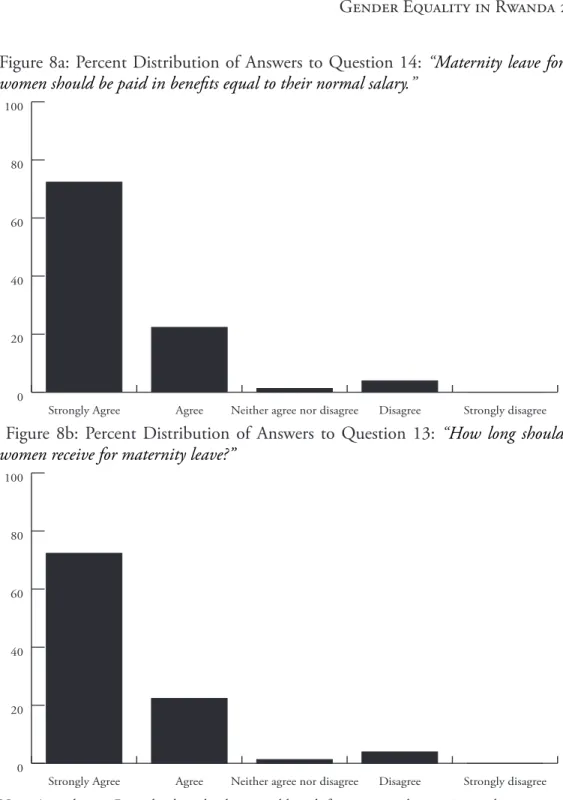
Economically categorized survey questions received by far the most overall agreement; 96 percent of all answers to economic questions were either “strongly agree” or “agree,” highlighting particularly strong alignment between laws and perceptions for this group. For example, more than 97 percent of respondents agreed that men and women should be paid equally for the same work. Further, 95 percent agreed that women on maternity leave should be compensated in benefits equal to their normal salary while nearly 90 percent believed the length of maternity leave should be either as long as or longer than what the law mandates, which is 3 months of paid leave.51 Figure 8a and 8b show
the distribution of agreement for paid maternity leave and opinions on duration of maternity leave.
51 A survey question on paternity leave was not included because Rwanda’s legal code mentions
Figure 8a: Percent Distribution of Answers to Question 14: “Maternity leave for women should be paid in benefits equal to their normal salary.”
Figure 8b: Percent Distribution of Answers to Question 13: “How long should women receive for maternity leave?”
Note: According to Rwandan law, the designated length for maternity leave is 3 months.
0 20 40 60 80 100 Strongly disagree Disagree
Neither agree nor disagree Agree Strongly Agree 0 20 40 60 80 100 Strongly disagree Disagree
Neither agree nor disagree Agree
Agreement for paid maternity leave and chosen length of leave were independent of respondents’ age, sex, and level of education, suggesting that strong support for paid maternity leave is universal.
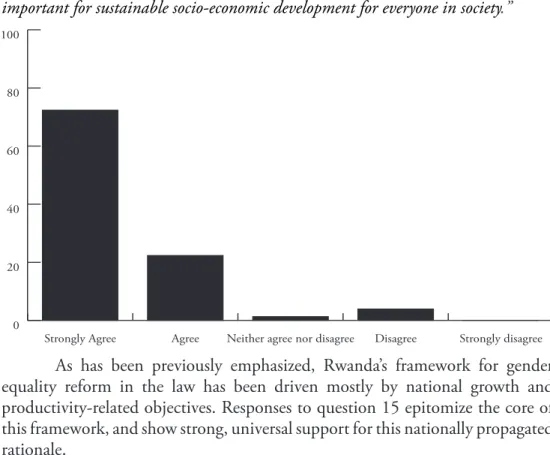
The vast majority of respondents also agreed that gender equality is important for the sustainable socio-economic development of everyone in society, with only about 1 percent disagreeing. Data for this question are particularly important because they shed light on overall survey trends between political, social, and economic questions on perceptions of gender. The distribution for this question on gender equality and national development is shown in Figure 9. Figure 9: Percent Distribution of Answers to Question 15: “Gender equality is important for sustainable socio-economic development for everyone in society.”
As has been previously emphasized, Rwanda’s framework for gender equality reform in the law has been driven mostly by national growth and productivity-related objectives. Responses to question 15 epitomize the core of this framework, and show strong, universal support for this nationally propagated rationale. 0 20 40 60 80 100 Strongly disagree Disagree
Neither agree nor disagree Agree
Relationships between Demographic Information and Perceptions of Gender
Interestingly, demographic information collected from survey informants was mostly independent of answers. Determined by the chi-squared statistical test for independence, the variation of agreement and disagreement across survey responses overall was independent of respondents’ sex or age. The one exception was level of education; the chi-squared test concluded that informants with more education were more likely to agree or strongly agree to survey questions overall, suggesting that an association exists between higher levels of education and agreement with gender equitable laws. The corroborates the literature on changing social norms, which generally finds that individuals with more education are more exposed to diverse ideas and thus more open-minded about non-traditional norms.52
However, when considering questions within the political, social, and economic categories, level of education was independent of agreement or disagreement. This shows that, although education overall is associated with greater congruence to Rwandan law around gender equality, it is not necessarily the case within each of the three categories. More specifically, education was completely independent of responses to the most disagreed-with questions concerning perceptions around marital rape, punishment for marital or general rape, and the power that husbands have to determine their wives’ access to employment. Within the political, social, and economical survey questions, both age and sex were also independent of responses.
For statements with the most agreement, such as those about equal participation in peacebuilding mechanisms and the importance of gender equality for national development, neither sex nor age nor education were associated with agreement or disagreement.
What these trends show is that overall, patterns of agreement and disagreement cut across various demographics in Rwandan society. The gaps between gendered laws and perceptions seem to be wide in some areas, such as those concerning marital relationships, regardless of demographic background. This implies that certain cultural values are deeply embedded within a resilient cultural schema, and thus are not easily affected by variations in sex, age, and education. Rwanda’s approach to gender equality, which has been branded according to the economic objectives equality can produce, reinforces this. The national framework 52 Muñoz Boudet et al., On Norms and Agency, 211; Achyut et al., “Building Support for Gender
of reform has focused far less at dismantling the fundamental patriarchal power structures that exist at the root of Rwandan society within homes and families. Thus, while perceptions have clearly evolved within economic and some political contexts, social norms have not caught up to the same extent.
ConClusIons
Evidence from quantitative and qualitative data suggests asymmetric progress on the alignment between gendered laws in Rwanda and local perceptions of gender. Perceptions demonstrated the most similarity to the law economically, the second most similarity politically, and the least similarity socially.
Expected findings for this study were partially borne out in the data. As predicted, gaps were widest within the social dimension, corroborating the criticism that the approach to gender reform was too focused on economic objectives and failed to dismantle patriarchal perceptions at their root, within family and communal spaces. However, although level of education was associated with greater congruity between laws and perceptions, respondents’ sex and age were independent of answers, presenting findings different than expected. Inferred reasoning for this, as previously explored, is also tied closely to the macroscopic and economically tied motivation for gendered reform, that is criticized for neglecting structures of patriarchal powers within grassroots-level, social spaces.
Recommendations for Closing Gaps between Gendered Laws and Perceptions
Insights from both literature and interviews reveals that closing gaps between gendered laws and perceptions, particularly within the social sphere, requires a multidimensional approach. Realizing the transformative potential of equal rights demands systematic renovations; both top and bottom-level, formal and informal mechanisms must be activated to change collective beliefs at local levels and dismantle entire social structures that endorse patriarchal power. Thus, a number of recommendations arise: First, raising awareness of existing laws protecting gender equality is a prerequisite for attitude change. Citizens, particularly women, must be aware of the rights they have in order to exercise them.53 Second, men must be engaged in the journey toward equality. They must
play an active role in advocating for change and bringing women forward. When 53 Rutayisire, interview.
men are engaged, they are less likely to feel that gender equality jeopardizes their power or produces loss for them.54 Dialogue is an especially important mechanism
in this process, as it brings members of the community together to openly talk about rights and injustices. Third, the Rwandan government should invest heavily in quality childcare so that “women have the freedom to do what men are doing.”55
Greater access to economic participation, often hindered by traditional childcare duties, would help change norms about stereotyped gender roles and empower women to pursue fully their professional ambitions. Fourth, investments need to be made in rural Rwandan women in the form of skills training and adult education.56 Farming is an industry heavily dominated by women, that often
traps women in cycles of poverty. Thus, empowerment efforts need to reach all communities to ensure a symmetrical and equal rise, instead of just benefitting an urban elite.
aPPendICes Appendix 1: Survey Results
Table 2a: Percent Distribution of Answers for Likert Scale Survey Questions
54 Iyakaremye, interview; Umurerwa, interview. 55 Ibid.
56 Ibid.
Question
Number Statement Cate-gory Strongly Agree (%) Agree (%) Neither Agree nor Disagree (%) Disagree (%) Strongly Disagree (%) Total (%)
1 All adult men and women should be able to vote for government
repre-sentatives.
Political 56.58 18.42 6.58 17.11 1.32 100.0
2 Women should oc-cupy at least 30% of decision-making
positions in gov-ernment, including
in the Chamber of Deputies and the
Senate.
Political 56.58 23.68 2.63 13.16 3.95 100.00
3 Men and women should equally par-ticipate in official conflict prevention, peacebuilding, and reconciliation processes. Political 84.21 14.47 0.00 1.32 0.00 100.00
4 National institu-tions, such as the Gender Monitoring Office and National Women’s Council,
are important and should exist
to monitor and advocate for gender
equality.
Political 63.16 32.89 1.32 2.63 0.00 100.00
5 Boys and girls should be given access to a basic, 9-year education.
Social 88.16 9.21 1.32 1.32 0.00 100.00
6 Having sex with your spouse with-out their consent should be legally
forbidden.
Social 22.37 23.68 18.42 30.26 5.26 100.00
7 Adult women should be able to manage their own land, regardless of marital status.
Social 64.47 26.32 3.95 3.95 1.32 100.00
9 Daughters and sons should be able to inherit land equally.
Social 77.63 17.11 1.32 3.95 0.00 100.00 10 Husbands should not be able to determine their wives’ access to employmen Social 19.74 25.00 7.89 39.47 7.89 100.00
12 Men and women should get paid
equally for the same work.
Eco-nomic 88.16 9.21 0.00 2.63 0.00 100.00 14 Maternity leave
for women should be paid in benefits equal to their normal salary. Eco-nomic 72.37 22.37 1.32 3.95 0.00 100.00 15 Gender equality is important for sus-tainable socio-eco-nomic development for everyone in society. Eco-nomic 75.00 22.37 1.32 1.32 0.00 100.00
Table 2b: Percent Distribution of Answers for Survey Questions with Time Range Options
Question
Number Question Cate-gory No jail time (%) Less than 6 months (%) 6 months - 2 years (%) 2 - 5 years (%) More than 5 years (%) Total (%) 6A If you selected “strongly agree” or “agree” to statement 6, how long should they go to jail for? (If you didn’t answer with “strongly agree” or “agree,” leave this question blank).
Social 37.84 37.84 13.51 8.11 2.70 100.00
8
Question Category Less than 6 months (%) 6 months - 5 years (%) 5 - 10 years (%) 10 - 20 years (%) More than 20 years (%) Total (%) How long should
perpetrators of rape be imprisoned for?
Social 5.26 14.47 39.47 9.21 31.58 100.00
Appendix 2: Survey Questions and Corresponding Laws
The survey used in data collection contained 16 combined statements and questions. 12 of the 16 survey items were statements while 4 were questions. For each statement or question, respondents were given 5 multiple choice answers to select from. Survey statements, listed in Table 3a along with their corresponding laws, were answered on a Likert scale where respondents selected one of the
11 Question Category No jail time (%) Less than 6 months (%) 6 months - 2 years (%) 2 - 5 years (%) More than 5 years (%) Total (%) How long should
perpetrators of workplace sexual harassment be imprisoned for? Eco-nomic 1.32 5.26 14.47 28.95 50.00 100.00 13
Question Category No time
(%) 1 month or less (%) 2 months (%) 3 months (%) More than 3 months (%) Total (%) How long should
women receive for maternity leave?
following options: “strongly agree,” “agree,” “neither agree nor disagree,” “disagree,” or “strongly disagree.” The survey questions, listed in Table Y along with their corresponding laws, were answered based on a selection of different ranges of time. Specific ranges for each question are mentioned below each question.
For the purpose of data analysis, survey statements and questions were categorized as either political, social, or economic, as labeled in the second column of Table 3a and Table 3b.
Table 3a: Survey Questions Answered on a Likert Scale and Corresponding Laws
State-ment Num-ber State-ment Cate-gory
Survey Statement Corresponding Law/Policy
1
Politi-cal All adult men and women should be able to vote for government representatives.
Article 2 of the Rwandan Constitution of 2003 (revised in 2015) which states, “all Rwandans, both men and women, fulfilling the require-ments provided for by law, have the right to vote and to be elected.”57
2
Politi-cal Women should occupy at least 30% of deci-sion-making positions in government, including in the Chamber of Dep-uties and the Senate.
Articles 75 and 80 of the Rwandan Constitu-tion of 2003 (revised in 2015) which state, “at least thirty percent (30%) of Deputies must be women” and “at least thirty percent (30%) of elected and appointed Senators must be women,” respectively.58
3
Politi-cal Men and women should equally participate in official conflict preven-tion, peacebuilding, and reconciliation processes.
Article 4.5.3 of Rwanda’s National Gender Policy pledges “to ensure that women and men equally participate in conflict prevention peace building and reconciliation mechanisms.”59
57 Const. Republic of Rwanda, art. 2. 58 Ibid., art. 75, 80.
59 “National Gender Policy,” (policy document, Ministry of Gender and Family
Promotion, Republic of Rwanda, July 2010), 25, https://www.ilo.org/dyn/natlex/docs/ ELECTRONIC/94009/110188/F-1576743982/RWA-94009.pdf
4
Politi-cal National institutions, such as the Gender Monitoring Office and National Women’s Council, are important and should exist to monitor and advocate for gender equality.
Article 5.1.4 of Rwanda’s National Gender Policy outlines the mandate of the Gender Monitoring Office which includes “monitoring progress to-wards gender equality.” Article 5.1.5 of Rwanda’s National Gender Policy outlines the mandate of the National Women’s Council, which includes “advocating for women’s rights and gender equality.”60
5 Social Boys and girls should be given access to a basic, 9-year education.
Article 1.3 of Rwanda’s National Gender Policy affirms that “nine-year basic education is under implementation and will facilitate full access to education by both boys and girls.”61
6 Social Boys and girls should be given access to a basic, 9-year education. Having sex with your spouse without their consent should be legal-ly forbidden.
Article 5 of Law no. 59/2008 on the Prevention and Punishment of Gender-based Violence states that “it is forbidden to make sex with one’s spouse without one’s consent.”62
7 Social Adult women should be able to manage their own land, regardless of marital status.
Article 4 of Law no. 43/2013 Governing Land in Rwanda states that “all forms of discrimination, such as that based on sex or origin, in relation to access to land and the enjoyment of real rights shall be prohibited.”63
9 Social Daughters and sons should be able to inherit land equally.
Article 54 of Law no. 27/2016 Governing Mat-rimonial Regimes, Donations and Successions states that “legitimate children of the de cujus succeed in equal portions without any discrimi-nation between male and female children.”64
10
Eco-nomic Husbands should not be able to determine their wives’ access to employ-ment.
Article 4 of Law no. 59/2008 on the Prevention and Punishment of Gender-based Violence states that “it is forbidden to harass to deprive one’s spouse of the right to property and to employ-ment.”65
60 Ibid., 28-29. 61 Ibid., 11, art. 1.3.
62 Law no. 59/2008 of 10/09/2008 on Prevention and Punishment of Gender-Based Violence,
chap. 2, art. 5.
63 Law no. 43/2013 of 16/06/2013 Governing Land in Rwanda, O.G. Special, June 16, 2013, 8-62
(Rwanda), chap. 1, art. 4.
64 Law no. 27/2016 of 8/07/2016 Governing Matrimonial Regimes, Donations, and Successions,
O.G. 31, August 1, 2016, 3-66 (Rwanda), chap. IV, §1, art. 54.
65 Law no. 59/2008 of 10/09/2008 on Prevention and Punishment of Gender-Based Violence,
12
Eco-nomic Men and women should get paid equally for the same work.
Law no. 13/2009 Regulating Labor in Rwanda pursues the International Labour Convention n° 100 of June 29, 1951 concerning Equal Re-muneration for Men and Women Workers for Work of Equal Value” and states that “it shall be forbidden to directly or indirectly make any discrimination aiming at denying the worker the right to equal opportunity or to the salary especially when the discrimination is based upon the following... sex, marital status or family responsibilities.”66
14
Eco-nomic Maternity leave for women should be paid in benefits equal to their normal salary.
Article 11 of Law no. 003/2016 Establishing and Governing Maternity Leave Benefits Scheme guarantees paid maternity leave and states that “maternity leave benefits are equal to the last woman’s salary.”67
15
Eco-nomic Gender equality is im-portant for sustainable socio-economic devel-opment for everyone in society.
Rwanda’s National Gender Policy states that “the Government of Rwanda attaches great impor-tance to the promotion of gender equality and equity as a prerequisite for sustainable develop-ment.”68
Table 3b: Survey Questions Answered with Ranges of Time and Corresponding Laws State-ment Num-ber State-ment Cate-gory
Survey Question Corresponding Law/Policy
6A Social If you selected “strongly agree” or “agree” to statement 7, how long should they go to jail for? (If you didn’t answer with “strongly agree” or “agree,” leave this question blank). Possible answers: “no jail time,” “less than 6 months,” “6 months – 2 years,” “2 – 5 years,” or “more than 5 years”
Article 19 of Law no. 59/2008 on the Prevention and Punishment of Gender-based Violence states that “any person who coerces his/her spouse to sexual intercourse shall be liable to imprisonment of six (6) months to two (2) years.”69
66 Law no. 13/2009 of 27/05/2009 Regulating Labour in Rwanda, O.G. Special, May 27, 2009,
3-120 (Rwanda), chap. 3, §3, art. 9.
67 Law no. 003/2016 of 30/03/2016 Establishing and Governing Maternity Leave Benefits
Scheme, O.G. Special, April 20, 2016, 3-17 (Rwanda), chap. 3, art. 11.
68 “National Gender Policy,” 10.
69 Law no. 59/2008 of 10/09/2008 on Prevention and Punishment of Gender-Based Violence,
8 Social How long should perpetrators of rape be imprisoned for?
Possible answers: “less than 6 months,” “6 months – 5 years,” “5 – 10 years,” “10 – 20 years,” “more than 20 years”
Article 16 Law no. 59/2008 on the Prevention and Punishment of Gender-based Violence states that any person who is guilty with rape shall be liable to imprisonment of ten (10) years to fifteen (15) years. Where rape has resulted in a bodily or a mental illness, the person guilty with rape shall be liable to imprison-ment of fifteen (15) years to twenty (20) years and medical care fees for the person raped shall be borne by him/her.”70
11
Eco-nomic How long should perpetrators of workplace sexual harassment be imprisoned for?
Possible answers: “no jail time,” “less than 6 months,” “6 months – 2 years,” “2 – 5 years,” “more than 5 years”
Article 24 of Law no. 59/2008 on the Prevention and Punishment of Gender-based Violence states that “Any employer or any other person guilty of exercising sexual harass-ment by way of orders, intimidation and terror over a person he/she leads shall be liable to imprisonment of two (2) years to five (5) years.”71
13
Eco-nomic How long should women receive for maternity leave? Possible answers: “no time,” “1 month or less,” “2 months,” “3 months,” “more than 3 months”
Article 8 of Law no. 59/2008 on the Prevention and Punishment of Gen-der-based Violence states that “Upon delivery, a woman shall have the right to a maternity leave of three (3) months.”72
Appendix 3: Interview Questions
All three interviewees were asked the following five questions:
1. What is your area of expertise around gender and what kind of work do you do with gender in Rwanda?
2. Do you think most Rwandans have a general understanding of legal provisions concerning gender equality under Rwandan law?
3. In which political, social, and economic areas do you think the greatest gaps exist between legal provisions concerning gender equality and norms and perceptions around gender in Rwanda?
4. Why do you think these gaps exist where they do? 70 Ibid., chap. 3, art. 16.
71 Ibid., chap. 3, art. 24. 72 Ibid., chap 2, art. 8.
5. In your opinion, what would be the most effective mechanisms in changing gender perceptions to be more aligned with legal gender equality across political, social, and economic spaces?
referenCes
Abbott, Pamela, Roger Mugisha, and Roger Sapsford. “Women, Land and Empowerment in Rwanda.” Journal of International Development 30.6 (2018): 1006-1022. https://doi.org/10.1002/jid.3370
Achyut, Pranita, Nandita Bhatla, and Sujata Khandekar et al. “Building Support for Gender Equality Among Young Adolescents in School: Findings from Mumbai, India.” Report, International Center for Research on Women, CORO for Literacy, and TISS, New Delhi, India, 2011. https://www. icrw.org/wp-content/uploads/2016/10/GEMS-Building-Support-for-Gender-Equality-Adolescents.pdf
Berry, Marie E. “When ‘Bright Futures’ Fade: Paradoxes of Women’s Empowerment in Rwanda.” Signs 41.1 (2015): 1-27. https://doi. org/10.1086/681899
Burnet, Jennie E. “Gender Balance and the Meanings of Women in Governance in Post-Genocide Rwanda.” African Affairs 107.428 (2008): 367. https:// doi.org/10.1093/afraf/adn024
Brown, Sara E. Gender and the Genocide in Rwanda: Women as Rescuers
and Perpetrators. New York: Routledge, 2018. https://doi.
org/10.4324/9781315173078
———. “Reshaping Gender Norms in Post-Genocide Rwanda.” Genocide
Studies International 10.2 (2016): 230-250. https://doi.org/10.3138/
gsi.10.2.06
Constitution of the Republic of Rwanda of 2003 Revised in 2015, Official Gazette of the Republic of Rwanda [O.G.] Special, December 24, 2015, 1-158 (Rwanda).
Debusscher, Petra, and An Ansoms. “Gender Equality Policies in Rwanda: Public Relations or Real Transformations?” Development and Change 44.5
(2013): 1111-1134. https://doi.org/10.1111/dech.12052
Doan, Lisa A. “Rwandan Women and the 1994 Genocide: The Effect on Their Social and Political Roles.” Master’s thesis, Georgetown University, 2010. Proquest Dissertations and Theses Global (No. 1483562).
Gervais, Myriam, Eliane Ubalijoro, and Euthalie Nyirabega, “Girlhood in a Post-Conflict Situation: The Case of Rwanda.” Agenda: Empowering Women for
Gender Equity 79 (2009): 13-23. www.jstor.org/stable/27868943
Kagaba, Mediatrice. “Women’s Experiences of Gender Equality Laws in Rural Rwanda: The Case of Kamonyi District.” Journal of Eastern African Studies 9.4 (2015): 574-592. https://doi.org/10.1080/17531055.2015.1112934 Klugman, Jeni, Amie Gaye, and Marianne Dahl et al. “Women, Peace and Security
Index 2019/20: Tracking Sustainable Peace Through Inclusion, Justice, and Security For Women.” Report, Georgetown Institute for Women, Peace and Security and Peace Research Institute Oslo, Washington DC, 2019. https://www.prio.org/Publications/Publication/?x=12117
Law no. 003/2016 of 30/03/2016 Establishing and Governing Maternity Leave Benefits Scheme, O.G. Special, April 20, 2016, 3-17 (Rwanda).
Law no. 13/2009 of 27/05/2009 Regulating Labour in Rwanda, O.G. Special, May 27, 2009, 3-120 (Rwanda).
Law no. 27/2016 of 8/07/2016 Governing Matrimonial Regimes, Donations, and Successions, O.G. 31, August 1, 2016, 3-66 (Rwanda).
Law no. 43/2013 of 16/06/2013 Governing Land in Rwanda, O.G. Special, June 16, 2013, 8-62 (Rwanda).
Law no. 59/2008 of 10/09/2008 on Prevention and Punishment of Gender-Based Violence, O.G. 14, April 6, 2009, 81-105 (Rwanda).
Muñoz Boudet, Ana M., Patti Petesch, and Carolyn Turk. On Norms and
Agency: Conversations about Gender Equality with Women and Men in 20 Countries. Washington DC: World Bank Publications, 2013. https://doi.
org/10.1596/978-0-8213-9862-3
Promotion, Republic of Rwanda, July 2010. https://www.ilo.org/dyn/ natlex/docs/ELECTRONIC/94009/110188/F-1576743982/RWA-94009.pdf
Wallace, Claire, Christian Haerpfer, and Pamela Abbott. “Women in Rwandan Politics and Society.” International Journal of Sociology 38.4 (2008): 111-125. https://doi.org/10.2753/IJS0020-7659380406
York, Melinda R. Gender Attitudes and Violence Against Women. El Paso, TX: LFB Scholarly Pub, 2011.