..
7 th international seminar on vernacular settlement
re-assesrnent of
vernacular architecture:
, theory
and practice
15 17
october
JQ
r0 0 0 0 0 0 0 0 0 0 0 0 0 0 0 0 0 0 0 0 0 0 0 0 0 0 0 D
7:
0ISVS
-
00 0
7th International Seminar on Vernacular Settlements- 2014
o
0 0
RE-ASSESMENT OF VERNACUlAR ARCHITECTURE: theory and practice
o
TRADITIONS, IDENTITIES AND GLOBALIZATION
°
15th -17th October 2014: Istanbul Technical University, Turkey
0 07 t h international seminar on vernacul ar settlements
re-assesment of
vernacular
architecture :
theory and practiceVolume
I
7th lntern;:~tion;:~l Semin;:~r on Vern;:~cul;:~r Settlements- 2014
ISVS-7
RE-ASSESMENT OF VERNACULAR ARCHITECTURE: theory and practice
TRADITIONS, IDENTITIES AND GLOBALIZATION
15th -17th October 2014: Istanbul Technical University, Istanbul, Turkey
Proceeding book of the conference orginized by Architectural Design and Typology Working Group, Hosing
Research and Education Center and Faculty of Architecture, Istanbul Technical University, Istanbul, Turkey
ISBN Volume
1:
978-975-561-447-2
ISBN Set: 978-975-561-446-5
First edition: October2014, istanbul
Printed by:
Cenkler Press, istanbul, Turkey
Publication Team:
Meltem Baslo, Elmira Gur, Dilek Y1ld1z, A.irem Mollaahmetoglu
Web and all Design Work (Book, Poster, etc.):
A.irem Mollaahmetoglu
Cover Design:
A.irem Mollaahmetoglu
isvs-7 contact adress:
istanbul Technical University, Deparment of Architecture, istanbul
Email: [email protected]
copyright©2014 by isvs-7
istanbul Technical University, Deparment of Architecture, istanbul
Tel: +90 212 293 13 00
All rights reserved. Apart from brief refence and citation, this publication may not be reproduced by any means without the prior permission of the publisher. Authors are responsible for the content and the language of their respective papers.
7th International Seminar on Vernacular Settlements- 2014
ISVS-7
RE-ASSESMENT OF VERNACUlAR ARCH ITECTURE: theory and practice
TRADITIONS, IDENTITIES AND GLOBALIZATION
15th -17th October 2014 : Istanbul Technical University, Turkey
Organized by
Architectural Design and Typology Working Group
AD/TRG
Housing Research and Education Center
ITU-HREC
Faculty of Architecturelstanbul Technical University, Istanbul, Turkey
Conference Chair
Yurdanur DUigeroglu YUksel
Member of Housing Research and Ed ucation Center
ITU-HREC
Istanbul Technical University, Turkey
Conference Secretariat
Meltem Baslo
Mem ber of Housing Research and Education Center
ITU-HREC
Istanbul Technical University, Turkey
Elmira GUr
Faculty of Architecture, Istanbul Technical University, Turkey
7th International Seminar on Vernacular Settlements- 2014
ISVS-7
RE-ASSESMENT OF VERNACULAR ARCHITECTURE: theory and practice
TRADITIONS, IDENTITIES AND GLOBALIZATION
Zeynep Ahunbay NurAkm Nezar Alsayyad Berrin Alper Giiliz Bilgin Altmoz James Davisdon How ard Davis Yiiksel Demir Elvan Altan Ergut
15th -17th October 2014: Istanbul Technical University, Turkey
Gul~in Pulat Gokmen Nuran Zeren Giilersoy Orhan Hac1hasanoglu Vegan Kahya Omer Khattab Onder Ku~ukerman
Ahsen Ozsoy Atillio Petruccioli H1fsiye Pulhan
v
Organizing Committee
Yurdanur Diilgeroglu Yiiksel Ahsen Ozsoy Aytanga Dener Yiiksel Demir Elmira Giir Yasemis Alk1~er Bregger Dilek Y1ld1z l;igdem Eren Meltem Baslo irem Mollaahmetoglu Sinan Ozgen Dila Gokalp
Hanorary Chair
Mehmet KaracaConference Advisory Board
Pratyush Shankar
Giil~in Pulat Gokmen Ahsen Ozsoy H1fsiye Pulhan
Scientific Committee
-7th International Seminar on Vernacular Settlements- 2014
ISVS-7
RE-ASSESMENT OF VERNACULAR ARCHITECTURE: theory and practice
TRADITIONS, IDENTITIES AND GLOBALIZATION
15th -17th October 2014: Istanbul Technical University, Turkey
Sponsored by
c;uhadaroglu Aluminium Systems
Turk Ytong Sanayi
A~.Mak-Yol Cor.struction, Industry, Tourism and Trade Inc.
Deniz Ktlavuzluk
A~.The Scientific and Technological Research Council Of Turkey
Turkish Airlines
Emlak Konut Real Estate Investment Company Inc.
Istanbul Technical University
7th International Seminar on Vernacular Settlements- 2014
ISVS-7
RE-ASSESMENT OF VERNACULAR ARCHITECTURE: theory and practice
TRADITIONS, IDENTITIES AND GLOBALIZATION
15th -17th October 2014: Istanbul Technical University, Turkey
Welcome Note
We happily welcome you to the ISVS-7 Conference ir. Istanbul on the theme of VERNACULAR ARCHITECTURE: to take place during the period between 15-17th of October, 2014. It is preceeded by an architectural trip organized by Istanbul Chamber of Architects and followed by post-conference trips to several Anatolian cities where vernacular housing settlements are unique. In addition
there wil be thematic tours within the city during the Conference itself. The conference is structured around 6 keynote speeches, and 7 sessions with parallels, all to take place in Ta~k1~la, a city Campus of ITU Complex. Over 130 abstracts were submitted to the conference, from 23 different countries, covering such global regions as Asia, Middle-East, Africa, Europe, and North and Central America , and Canada.
e ish o express our thanks to all participants of the conference. Furthermore, we are honoured to acknowledge all those valuab le peop le, starting with the members of the. scientific committee to all the keynote speakers- Nezar Alsayyad, Ferhan Yurekli, Miki Desa i Et i Akyuz Levi, Attilio Petruccioli, Nigan Bayaz1t; and ~engul Oymen Gur for undertaking the responsibility to lead the closing pane l. We would like to express our gratitude to Mehmet Karaca, the rector of ITU and Sinan M.~ener, the dean of the ITU Faculty of Arch itecture and the members of the conference advisory board-Pratyush Shankar, Gulc,:in Pulat Gokmen, Ahsen Ozsoy, H1fsiye Pulhan-; Yurdanur Dulgeroglu Yuksel, chair of ITU-HREC and Pratyush Shankar, Secretary of ISVS. We are very grateful for their encouragement and the support they have given us.
We al$0 need to thank to the sponsors who have supported this conference. Among them are istanbul Teknik Oniversitesi the Scientific Research Projects Unit, <;uhadaroglu Aluminium Sistemleri, Turk Ytong Sanayi A~., Makyol in~aat Sanayi Turizm ve Ticaret
A~., Deniz Kdavuzluk A~., Turkiye Bilimsel ve Teknolojik Ara~t1rma Kurumu, Turkish Airlines, and Emlak Konut Investment Trust. Finally our thanks goes to many other supporters icluding our families and colleagues who even though their names are not in the organizing committee.
We hope to enjoy the energy springing from the ideas of diverse scholars, participants and expect the ISVS7 becomes fruitful and enriching experience for all of us. The local organizing committee will help you in anyway it can during our conference to make life easy for you during your stay in Istanbul. ..
ISVS-7 Conference Organization Committee
-7th International Seminar on Vernacular Settlements- 2014
ISVS-7
RE-ASSESMENT OF VERNACULAR ARCHITECTURE: theory and practice
TRADITIONS, IDENTITIES AND GLOBALIZATION
15th -17th October 2014: Istanbul Technical University, Turkey
Welcome Note
ISVS as a movement started from Indonesia in 1999, has been a remarkable achievement to promote aware ness and research o Vernacular traditions and the Sixth International Seminar on Vernacular Settlements which is hosted by the Eastern Medite rranea . University in April, 2012 has aimed to contribute to this accumulation of knowledge, research and practice with the the e. Contemporary Vernaculars : Places, Processes and Manifestation. The last seminar, ISVS-5 held in Colombo, Sri Lanka focused o Vernacular Futur~s provided a great opportunity to explore the future of the vernacular traditions resulting in a suggestion that i:-e survival and continuity of vernacular traditions may lie in ordinary informal buildings which are usually not regarded as verna cu a• Building upon this insight, ISVS-6 in 2012 lead the debate on vernacular traditions of contemporary societies and their bui lding a-c settlement forms which display the same characteristics of the conventionally conceptualized 'vernacular' .
Pratyush Shankar
Secretary-ISVS
Associate professor, Faculty of Architecture CEPT University
CONTENTS
VOLUME I
WELCOME NOTE
By Organizing Committee
vii
By Pratyush Shankar
viii
PREFACE
1-4
Yurdanur Dl.ilgeroglu Yuksel
KEYNOTES
FROM THE VERNACULAR TO THE GLOBAL: DWELLINGS, SETTlEMENTS AND THE END OF TRADITION
7-14
Nezar AISayyad
MODERN ARCHITECTURE-VERNACULAR ARCHITECTURE
15-25
Ferhan Yurekli
VERNACULAR AND TRADITIONAL ARCHITECTURE AND ITS CRAFTS IN GLOBALISING SOCIO-ECONOMIC
SCENARIO An Indian Perspective
27-41
Miki Desai
ix
SUSTAINABILITY OF THE TRADITIONAL
43-54
VERNACULAR ARCHITECTURE AND TYPOLOGY
55-67
Attilio Petruccioli
SOCIAL AND CULTURAL CHANGE OF TRADITIONAL SAFRANBOLU HOUSES IN 35 YEARS
69-88
Nigan Bayaz1t
THEORY, PHILOSOPHY AND PRACTICE: KNOWLEDGE FORMATION
FROM VERNACULAR BODY TO VERNACULAR LANDSCAPE AT
~OMAKDAG-KIZILAGA~
VILLAGES
91-99
B. Deniz
c;ah~Kural
HETEROTROPO FINDING AT SETTLEMENT OF KARATON KASUNANAN SURAKARTA-CENTRAL JAVA
(INDONESIA)
101-114
Naniek Widayati Priyomarsono
USE OF TECTONIC ELEMENTS IN THE CONCEPT OF ENVIRONMENTAL SUSTAINABILITY Technology and New
Materials: Climate, Ecology, Recycling, Saving Of the Resources
115-124
Oznem Sahali
"URBAN-VERNACULAR" A PARALLEL APPROACH IN SPONTANEOUS ARCHITECTURAL SOLUTIONS IN DHAKA
CITY Subtitle _A parallel approach in spontaneous architectural solutions in Dhaka City
125-136
Ashik Vaskor Mannan
EXTENDING KEVIN LYNCH'S THEORY OF IMAGEABILITY IN THIRD SPACE READING Case study of kampungs,
Surabaya- Indonesia
137-147
Rully Damayanti, Florian Kossak
NATURAL STRUCTURALISM IN THE VERNACULAR
149-159
Fatma KolsaL Berna Ostlin
HETEROTROPO FINDING AT SETTLEMENT OF KARATON KASUNANAN SURAKARTA-CENTRAL
JAVA(INDONESIA)
Nanle~~.
Widayati Priyomarsono
Lecturer from Architecture Department of Tarumanagara University, Jakarta, Indonesia
Abstra ct 0 0 0 0 0 0 0 0 0 D 0 0 0 0 0In early f ormation of keratanwas established by Paku Buwana II, settlement of Karaton functioned as "betweenanddefence space", besides it was D
one of components from governmental structure and power of karaton . After the Independence of Indonesia in 1945 "Royal Town" changed its D
political status to be part of democracy town managed in accordance with statutes stipulation based on classification . The alteration took impact
o
on settlem ent existence in vicinity of Karaton, from Magersari system to village administration .Research is with qualitative method and on 0
grounded way. Research is focussed on interview of informants and society living in settlement, historical search, as well as spatial observation. 0 Data gained is coupled with Foucault's theory on Heterotopia, and Harjoko's theory on Tropotopia .Result of analysis, in macro is spatial formed and (l does not chan ge since there is fort restraint surrounding the settlement, but its life has changed, the latter can be meant as heterotropia. Spatial micro order has ch anged in irregularity (tropotopia) . The conclusion is there finds the heterotropo in settlement of Karaton . 0
Keywords:
Settlement of karaton; heterotopia; tropotopia; heterotropo.
INTRODUCTION
Background Of The Research
0 0 0 0 0 0 0
One of governmental program of Republic of Indonesia regarding building sustainability and cultural object conservation has been o quoted into Act of Republic of Indonesia No 11 of 2010 on Cultural Conservation. There it manages all regulation, orders, as well as o procedures of implementation already described clearly, but in realization in the field there are much things not commensurate with o expectation of the Act.One of impartiality/imbalance oc::urs practically in procedures of building conservation in environment of o Karaton Surakarta after Karaton underwent the fire that had damaged symbols and myths of Karaton namely the burned buildings o of Sasana Parasedya, Sasana Sewaka, Sasana Handrawina,
Dalem
Prabasuyasa, Dayinta, and Paningrat in the night of Friday Wage oon 31 Januariy 1985 at 21.00 pm1. o
Governmental attention in relation to sustainability and conservation in environment of Karaton,has not been yet sufficient. This is 0 seen from governmental concern on the implemented conservation . Conservation effort is more aimed to area of kedhaton as 0 king' s residence merely, and does not connect with environment of Karaton that is supposed to do for inclusion . Based on its 0 termino logy,
karaton
includes; king's courtyard , encompassing area incepuri
(namely a circle-shaped wall in inner side that 0 surrounds the yard) added with settlement surround ing Karaton restrained by circle-shaped wall that is out side, and added with 0 town square . Lack of governmental concern on scope and range of conservation in environment of karaton recently exclude success 0 of conservation in general. Not getting environment of Karaton settlement involved as significant part of karaton region,indeed 0 worsens sustainability of karaton in general. In order to do karaton conservation, it takes at first the comprehension of other 01
elements of Karaton . Starting from the concern, th is research is implemented, so that it grants contribution furnishing The Act of Republic of Indonesia No 11 of 2010 on Cultural Con servation.
Settlement of karaton as urban village in region of Su rakarta cityand kept by karaton Ka sun ana n Surakarta can be said as one of " karaton villages"2, located in south of Jl. Slamet Riyadi street, that is main road of Surakarta City. Settelemtn of karaton is part of region of Surakarta culture consisting of Kraton Kasunanan Surakarta, North and South Town Square, Masjid Agung, and Pasa r Klewer. Internally, settlement of karaton is cultural node kept by Surakarta city .Morphologically, settlement of karaton in the beginning was influenced by concept of Mataram kingdom's (Java) royal town spatial order influenced by Dutch town spatial order holding grid shape. In the spatial order there are 4 (four) characteristics forming concept of spatial order of Mara ram (Jawa) country, namely: system of Javenese traditional symbolic
classification sacredness gradation pattern, defense area, and ritual movement
pattern .
From visual aspect, settlement of karatonis established from configuration of area identity-forming element (Lynch, 1950L namely : paththat is area circulation channel,
edgesthat
are forts,districtthat
is da/emand villages,nodesthat
is area activity knot, andJandmarkthat
iskaraton,
building ofdalem ,
and settlement of karaton itself.Kampung karaton or vill agekaraton
withmagersari
system, established when karaton as governmental centre, where the king as the ruler.When in era of Indonesian Independence there is no power in kingdoms all around the Archipelago including Kasunanan Surakarta, since the power turns to Union State of Republic of lndonesia.AII power of karaton started to take over by the Government.Karaton is no longer a government centre but as a cultural centre.Therefore settlement of karaton with all the contents indeed gets involved to undergo alteration, either the societal structure or its settlement structure.This affects directly and indirectly on land ownership status in environment of karatonsettlement .
Problems
Change in political status of this karaton region also affects the existence of settlement in vicin ity of karaton . Administratively and politically it is part of administration system of Solo city. Thus settlement of karaton obtains administrative status as RT (Ruku n Tetangga or Neigbor Harmony) dan RW (Rukun Warga or Citizen Harmony) from Kalurahan Baluwerti (that is village administration of karaton settlementL Kacamatan Pasar Kliwon (or Pasar Kliwon subdistrict administration). This affects directly and indirectly to status of land ownership such as; a). Inhabitant of karaton settlement starts to strive for their each settlement land certification processes. b). This certification process also takes effect on community process of their residential building. Now they can sell land and building to the inhabitant outside Karaton environment. c) . Hiring some of their settlem~nt space, d). Changing their home building order. As '3forementioned, there is indication that society formerly integrating with Karaton and getting acquaintaned closely with co-dweller, becomes individual society whose relationship with Karaton is increa singly distant. This causes changes spatially to their settlement.
Problem Formulation
Once presented on development of Karaton settlement whose their existence in the midst of Surakarta city, thus there comes up research questions: What and how was and is the settlement of Karaton at that time of king ruled and at the present time?. In order to respond, it takes studies at first to an3wer basic questions, namely:
1) How was condition of Karaton settlement at that time of kingdom as government/administration centre (or
City state)
and as cultural centre(Nation State)?
Viewed from sides of social, econom ics, politics as well as spat ial re lation with Karaton?2). Hew is spati al impact happening at the pre sent time ?
2
Different with common village/kampung is; royal "kampong" usually uses Magersari system (society living in that "kampung" do not pay bu ildi ng hire and land hire, but serve for land exploration for the king) .
The Objective and Benefit::. uf Reseo~rh
The research aims to expose architectural objects of Karaton settlement as part of Karaton Kasunanan Surakarta, and expectantly it can reveal the hidden meaning through process search of karaton settlement establishment, thus it can enrich research method of
strategy grounded theory research on architectural field. Another objective is to re-expose the ruling role of king related to establishment of settlement ofkaraton based on historical data that was preceded since the leaving of Karaton from Kartasura to Surakarta in 1745.And lastly it exposes inconsistency of last king's descent of Mataram in karaton Surakarta taking effect on architecture, potentially decreases image of super into the ruin .
Expectantly it can enrich discourse of space, knawledge,and power,through establishment of karaton settlement due to role of king's power as myth. Yet research outcome through this strategy grounded theory research, viewed from aspects of historicity, cuiture, and architecture, hopefully can benefit; Firstly, giving knowledge about role of the ruler in creating, as well as maintaining environment of Karaton. Secondly, inspiring the ruler includes actor of government today in applying for Policies of Act of Republic of Indonesia no 11 of 2010 on Cultural Conservation. Thirdly, substantive theory yielded from this work can enrich architectural theory in settlement sector that is Karaton typical as remnant of settlement track in karaton fort.Faurthly, expectantly it can enrich architect of karaton settlement as part of Architect of Archipelago.
THE R P SPEKTIVE
To answ er that above question namely relation between social-cultural alteration of a society toward their recycle space thus theory very re evant includes especially theory from Foucault about Space-Knowledge-Power. It takes to select Foucault's theory since it para I els w 'th ing' s power absolute with a term "Sabdo Pandito Ratu or King's Wish", and "Ratu Gung Bhinatara", what pronounced by he kin g ·s ega\ foundat ion to his people. King's power is used as means to grant knowledge for his people . In this regard it is a power to w ard sett lement created to protect himself, besides as a space between kedhaton and environment outside karaton.
Michael Foucau lt3 in his article entitled Of Other Spaces, said that space related to contradiction way is twofolds namely types of utopia and heterotopia. Yet the description is as follows:
Utopia-Utopia
They are sites with place-less real, space presents society themselves in form perfectened or converts into the falling-down. This utopia is real spaces, can be found in. the culture, represented in togetherness, tested, and reversed.
Places outside all the places, even though indicate location in reality without presence, called as heterotopias. Yet the sorts are; 1). Ut0pia of .irror
Qualities of both types of location, namely mirror, thus it is place without a place. There in it, I see on my own where I am not present, there in it there is me but without my presence. In space not real and opening potentially outside the surface; I am under there where I am not there, a type of shadow making my performance can be visible for myself, enabling me to see myself where I am not present there. Thus mirror functions as heterotopia .
2). Heterotopia
Truth has effect type returning back to the place that I dwell :starting from it. As a matter of fact, I find myself not present from the place where I am there, therefore I see myself there, I am not present there. Since then, mirror functions as heterotopia,
3
Michel Foucault and Jay MiskowiecSource:
Of
Other Spaces. Author(s): Diacritics, Vol. 16, No. 1 pp. 22-27Published by: The Johns Hopkins University PressStable URL: http://wwvJ.jstor.org/stable/464648 .Accessed: 17/02/2014 01:12Your use.(Spring, 1986).
-The types are:
a. Heterotopiasof crisis type; this includes a forb idden or sacred or speecialised/idiosyncrasied place ordered for individual whose finds himself in crisis condition by pertain ing to society or erwironment where he stays: the teens, the female during menstruationor those in period of labor, period of elder, and so forth.
b. Heterotopias with deviation : dwelled by ind ividualswhose behavior deviates from standard . For instance; psychiatric clinics, prisons, houses of the elder.
c. Heterotopias of society as history; having function in detail and certain in society and heterotopia similar, and according to cultural correspondence where heterotopia occurs, can have orne function or other functions . Heterotopia of cemetry is queer example . Cemetry is a place however having link with citystate, or society, or village, and so forth. In the 18th century cemetries were in the city, but started from the 19th century the cemetry has been sudah located outside the city . Death as "sick condition", the dead brings from sick condition to living one, it is presence and closeness from the dead with the living. Th is closeness which spreads the dead itself.
d. Heterotopiaswilling to capable in parallel in real place; Persian traditional garden is sacred place square-formed with centra l dot that is spring, or
cowan.
All plants are in this space, in type of microcosmic. The matis reproduction from garden able to move across the space . Garden has become heterotopia happy and universal since the beginning era ofpurbakala.
e. Heterotopias frequent relates to cuts of time;
Heterokronis= for symetry.
Cemetry is hetroic place, lost of life, with ete rnity where a permanent load namely cessation or disappearance . Heterotropias with time that accumulate are not lim ited . For instance; museum, library. This is appropriate for west culture of the 19th century. The opposition is heterotropiasaga inst the time, not oriented to the eterna l, having tempo absolutely. Such as fair or exhibition, snake woman, the wrestler etc.f. Heterotopia usually reckoning opening and closing system; In general heterotropic site can not be accessed freely like pu blic place. Obligatory to get into the entrance, like barrack, or a prisoner. Last function of heterotropia has function in relation to space. This function opens and reveals between extreme pattern, for instance; Brothel and colonies are two types of heterotopia. Boat is part of spacefloating. Heterotopia is a place without place, existant with itself, namely closed itself and at the same time it is given to indefinite sea. From harbor to harbor, passes in the distance of colony seeking for most prescious equity/property hiden in gardens.
It is conclusion that Heterotopia is a place physically same but embodify differently/human being dwelling has experienced thinking alteration or the feel or mood toward that place; or place of soul is same but entity (or
wujud)
is different .3).
TropotopiaTriatno Yudo Harjoko4, in
"Urban Kampung ". Its Genesis and Transformation into Metropolis, with particular reference to
Penggilingan in Jakarta,
in 2003 focuses on urban village in Penggilingan Jakarta . Harjoko succeeded to reveal theory of tropotop ia namely a place never fixed in entity and its form (storing content changing continuously that is commensurate with the developing values), as well as heterotopia namely place in entity is same but soul/embodiment differently; or place of soul same but entity is different. Theory is used in analysing alteration physically or not physically for villages ofabdi
dalem/ servantor houses ofabdi
dalem/servantin settlement of Karaton .
4
Harjoko, Triatno Yudo. "Urban Kampung". Its Genesis and Transforrnation into Metropolis, with particular reference to Penggilingan in Ja kart.
SCOPE OF RESEARCH AND STUDY AREA
To expose spatial transformation and architectural shape and architectural form, research will focus on aspec of human "act", social-cultural change, and politics in environment of Karaton and specially in environment of its Karaton.
RESEARC!-l METi-lOD AND RESEARCH
Seeing situation in the field, exposing the meaning in architectural presence process, require way of searching "a thing" that is tak teraga or fixed as typical strategy to obtain metaphysic data, as well as obtaining spatialness on its architectural object, thus an appropriate method selection is with strategy grounded theory rese_arch. Method of strategy grounded theory research or research gives a strong base of a theory. Research is focussed on actors actively or passively relevant and involved in transformation process of karaton settlement, one "grounded" is change in architectural shape and its spaces through actors getting involved.Data accumulated is "Investigation Focus" and directed to actors influencing that alteration internally or externally. Bases doing the investigation is data itself without guidance of certain theory. There are two main flow of onvestigation:
1). Accum ulating physical data of Karaton environment and specially environment of karaton data in relation to actor giving alteration contribution in the settlement; interview at depth through direct observation to inhabitant and actors taking role in fluencing the alteration of karaton settlement.
2). Archive study, kingdom history and Karaton Surakarta and Surakarta City after the Independence of Indonesia.
Strateg o ~ our-: ... ed Theory Research
From the above conclusion, the right method for the research is qualitative with way of strategy grounded theory research. The latter is due to reason that one researched is not merely building physic but human being occupying that research field together with its cu lture. Strategy grounded theory research done is more directed to Anselm Strauss since it is more than data accumulation of metaphysic valued to have sufficient characteristic, mainly way of collecting metaphysic data enabled to collect inductively (repetitively it is line a qualifying process).
In field researcher does space observation on field already stipulated so that he can feel the meaning implicated in it. Besides doing documentation, there are interviews at depth with informants staying in research area. Interview with experts expert in that area. Data of recording is structurized into article or writing. Those texts are meant hermeneutically. Article of meaning, is equalized with visual data in the field. Here there is change in interview result data with field visual data . This difference result is intertwined with literature, and theory of gayut namely heterotopia and tropotopia in order to mean in hermeneutic way, then sorted to obtain new substantive theory.
SETTLEMENT OF KARATON IN HISTORY
Settlerr.ent of Karaton is part of main structure of karaton Kasunanan Surakarta in which the development process is insepere1ble from royal adminsitration period of the ruling kings namely administration period from II to Paku Buwana XIII. The latter is due to reason that every king who governed had self policies in spatial arrangement ot settlement surrounding its kedhaton . In understanding of Javanese society the king is truly "ratu gung binathara, bau dhenda nyakrawati, berbudi bawa /eksana ambek adil para marta) meaning, there is terminology holding 4 dimensions namely the first two, "ratu gung binathara" meaning, king is great like god, " bau dendha" menaing that there is power, and " nyakrawati" meaning world ruler. Other two dimension, enco mpassing explanation how is king shall implement power that he has, namely "Iuber" meaning that king must have character, "bawa leksana"
meaning that he keeps words solidly (sabda pandita ratu tan keno wo/a-wali), as well as "ambek adil paramarta" meaning that his character is fair and generous. This relates to how the settlement is formed with a very long process.
Review of Sosio Religion
Religious viewpoint of Javanese society is society living in order of Javanese kingdom that is concept of Manunggaling Kawula ion
Gusti. In this concept, King is trusted as a representative of God in the world, thus dubbed as Khalifatullah, as mighty center in his
country. King is trusted as balancer of two universes (macrocosmos and microcosmos) and able to approach power of God. Therefore, keratonis built as miniatur of universe itself (balancer of Keraton and universe). This concept is known with concept of cosmic country, namely state concept closely relates to concept of king that is god (king is assumed as god descent) or in Javane se terminology it is known with concept of Raja Gung Binathara.
Dynamics of Nagari
In period of Paku Buwana II the king entroned, the first region to build was Kedhatonas a settlement palce for king and fam ily, as well as dwelling place named Lumbung. That place was used as food storage place mainly rice . Spatially the allocation was still outside the environment of kedhaton. Whilst soldiers from Kartasura, living in simple houses grouping in the vicinity of ditches or
jagang. Whilst border fence was still made from bamboo. The soldiers started gradually to develop and occupy spaces still vacant
surrounding the kedhaton. Yet placement way is commensurate with the duty.
Settlement Shape and Settlement Structure
In era of Paku Buwana II it was commenced by building kedhatonand 2 dalem Pangeran namely; dalem Purwadiningratan, dalem Suryohamijayan in north of kedhaton, Lumbung was located still outside of bamboo fence (a place for logistic storage), settlement of Tamtaman, market, settlement of Gondorasan (residence of cook of kedhaton), its locatio11 was in the east of kedhaton. I hus settlement shape is still spots of settlement (not to integrate).
In era of Paku Buwana Ill there was widening of region border by integrating Lumbung into border fence, by adding one complex of settlement called as Carangan locating in position in the east of kedhaton and in the south of Tamtaman.Settlement shape is spots not becoming one entity. Royal administration period of Paku Buwana IV there was building of private school for Baluwerti residents with Dutch teacher and Priyayi, meanwhile school name is Pamardi Siwi (school equal to Kindergarten), and Pamardi Putri namely a school for female where there is female skill education.
Era of Paku Buwana V,there was attempt to finish circle-fort wall, following the former king but it was not succesful since the short periode of royal administration thus the employment was not complete. There was increase in settlement named Wirengan located in south of kedhatonand Gambuhan located in west of kedhaton. In royal admi;1istration of Paku Buwana VI there was no increase in space but some regulation enacted by king for Baluwerti are such as: (1) Building was not allowed to have wall; (2) Building was white colored; (3) House fence was herbal-planted; and (4) Building must be without storeys.There is increment of settlement named by the Dutch as Hordenasan, kampung is allocated for Javanese soldiers with Dutch soldier uniform and with long rifle . Location of settlementis in the west of kedhaton, in the near vicinity with settlementof Gambuhan. There was opening of small door
(butulan), at the fort of the northwest. Settlement shape united to surround kedhaton.Structure of settlement started to manage in
toponimy.
In royal administration of Paku Buwana IX there started building of gate/portal at comple xes of karaton, making door/kori Brajanala
Kulonand door/kori Brajon a/a Wetan . Door of Paseb;m Kidul/wingking. Small door bu ilt on Kali La rangan at entry of compl ex at
Gambuhan openned in administration period of Paku Buwana V it started to close. Building school of Kesatriyan for the ma le, Pamardi Putri was for female and Pamardi Siwi was for kindergarten female. All teachers are Dutch but there are Javanese too . Shape of karaton settlement becomes complete with facilities. Whilst its settlement structure with magersari system. Paku Buwana
X open ned area of karaton settlementand augmented with two doors of Brajanala Barat established on date of 19 .A.pril 1906, with declined in complex distance border of 30 metre toward outside the complex, thus Gambuhan was wider village. Door of Brajanala Timur established in 9 September 1907, by widening environment street in Carangan was adjusted with width of door of Brajanala Timur. Due to street wiodening thus building along the street became GSB=O. Building school by combining west curriculum, and trad itional curriculu m (Kejawen), as well as Islam ic religion namely School Mambaul Ulum meaning that "science center" in south of Masjid Agung mosqu e (still in karaton area outside Baluwerti) .Dwelling structure with magersari system. Period of Paku Buwana Xi, karaton underwent financial decadence, the latter was due to the willing to be a king, Paku Buwana XI was eager to give His factories and productive forest to the Ducth, king only received salary from Ducth government. There were no development at all either in Kedhaton or Karaton Settlement.
In period of Paku Buwana XII, it is transition era of keraton starting to be part of Union of Republic of Indonesia (NKRI), financial condition of karaton started to drop thus there was no development at all . Karaton Settlementwas ignored so that slowly there was change in its spatial order.ln period of Paku Buwana XIII, condition of karaton was increasingly not condusive with two kings, and fami!ial conflict had been continuous. Government started to reconciliate by making 2 kings, called as Dwi Tunggal Kepemimpinan, thus only one 1 king and 1 Panembahan Agung (Patih). Physical condition started to decrease and potential to ruin.
FINDING OF RESEARCH
After doing analysis toward a number of research data applied in strategy grounded theory research, therefore there is a finding of new theory namely: Arrogance of King's Power in his descents takes impact on creation and spatial degradation. In research there is existence of karatonsettlement created asking's power symbol, as well as there is degradation in quality orquantity at that time due to king's power in descent generation .
Settlement of karaton as space in fort does not experience alteration physically and significantly, however society occupying that space 'their spirit'has changed. They are not no longer 'part of karaton' but as common society living in the settlement. In other words, settlementof karaton overall can be as a heterotopia.5 Spaces in each house in settlement of karaton have changed and it is accordance with function need required recently, taking impact on change in facadeof houses, shapes, societal lifestyle. That situation like that, in micro finance can be as a thing already undergoing tropotopia. In other words, settlementof karaton can be said to undergo "heterotropo" or "independent settlement".
That such spatial sh<Jpe alteration is caused by the king and family of karaton no longer keeping the trust and message of the ancestry teaching how to be a leader, explained in 4 (four) main dimension, namely the first two, "ratu gung binothara" meaning that king is great like god, "bau dendha" meaning to have power, and "nyakrawati" meaning as a world ruler. Other two dimension, encompassing explanation on how king must implement power he has, namely 'Iuber' meaning that king must be good character,
'bawa leksana ' meaning that keeping words solidly (sabda pandita ratu tan keno wo/a-wali), and 'ambek adil paramarta' meaning
that fair as well as generous. It means a king must be fair and wise in management of state life (panatapraja), religion life
(panatagama), warship commander (senopati ing nga/aga) and representative of God on the earth (ka/ifatullah), able to
serve/ngayomi, ngayemi, ngayani (people experience secured, harmonious, and prosperous/gemoh ripah /oh jinawi}.ln case
reviewed in detail, actors of karaton in this regard king and family are still far from education world , as weli as still growth of rooted feodal ism mentalamong them . Behavior eager to live easily and other persons must serve a person are still existent today. Besides there occurs internal conflict between daughters and sons of Paku Buwana XII up to present not attaining to retrieval point.
- - - - " - - - - -~ - - -
-King's power in descent generation inh is karaton , as w el l as attempt of making karaton as residential room from generation to generation (living monument), make karaton and t here is settlementof karaton in it has dependence fully on king and generation . Due to power arrogance, and feoda!ism mental sti ll root ing up to now causes settlementof karaton today "are no longer as settlementofkaraton " but " as independent settlement".
IMPLEMENTATION, AND CO NTINUOUS RESEARCH SUGGESTION
Expectantly result of this research work can be applied as guidance to escort the Act of Republic of Indonesia no.ll of 2010 on Cultural Conservation, instruction State obligatory to conserve building to be asset of Cultural Conserved Object, one of which is karaton . King's as well as family's arrogance do not execute instruction as karaton leader (culture leader), expectantly it does not obstruct the running of conservation, thus instruction of that Act can be implemented favorably . This dissertation literature is not merely accommodated for karaton Surakarta, but massively for entire karaton all around Archipelago requiring conservation, and even it is enabled to widen so that it can guide conservation in environment of presidential palaces with anticipation of each leadership alteration.Research at dept is necessary to keep up the sustainability of complex karaton, must include foundat ions of cultural anthropology basically keeping, supporting (sustainability) annd presence of karaton and Baluwerti as "the way as it is supposed to be" .
Figure 1: Overview showing of Urban Structure at Kasunanan Surakarta(Source: Indonesia Map and Drawn by the author)
POLA ORIENTASI BANGU N A N I
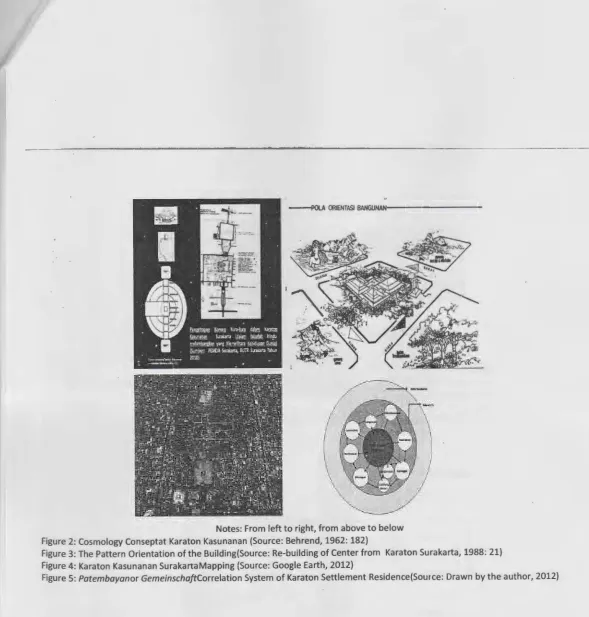
-Notes: From left to right, from above to below Figure 2: Cosmology Conseptat Karaton Kasunanan (Source: Behrend, 1962: 182)
Figure 3: The Pattern Orientation of the Building(Source: Re-building of Center from Karaton Surakarta, 1988: 21) Figure 4: Karaton Kasunanan SurakartaMapping (Source: Google Earth, 2012)
Figure 5: Patembayanor GemeinschaftCorrelation System of Karaton Settlement Residence(Source: Drawn by the author, 2012)
Notes: From left to right
V , . . - - - 1 - H I I \ 1 ... ...._
...
Figure 6: Division of Environment, Pillars of Citizens, and the Neighborhood in Karaton Settlement after the Palace became part of the Repub!ic of Indonesia (Source: Drawn by the author, 2013) Figure 7: Residents Relationship Patterns Karaton Settlement with System
Gesellschaft
Under Government Order Surakarta (Source: Drawn by the author, 2013)
TATANAN RUMAH SAUDAGAR
TATANAN RUMAH JAWA
I
PABRIK BATIKRUANG SERVISE
c
RUANG SERVISE..
cr.
I SENTHONGI
z
<l:
z
z
z
52
z
Ada tambahan dan 0cr.
<l: 0"
;2 ::::; 52z
::::;0
"
perubahan ruar.g~
"
;2>
0
0
08
ii
z
8
<( 0 ... z ...
(9 z z <l: z
<l: w (9 z w
\')
0
<(0
--' (9 --'
I
PENDAPAI
PENDAPAI
Figure 8: Changes in the spatial formation of Dalem Pr!nce to Merchant's House (Source: Personal Data, 2012)
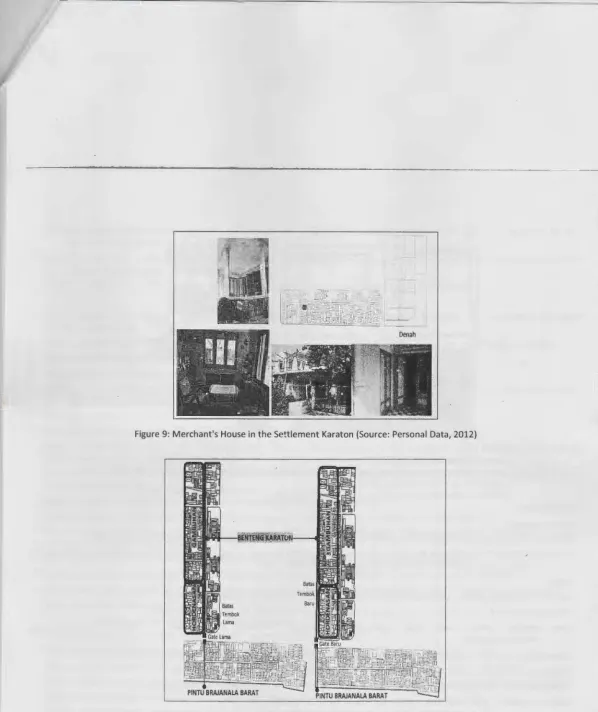
Figure 9: Merchant's House in the Settlement Karaton (Source : Personal Data, 2012)
Figure 10: Shifting door Brajanala West 30 feet to the outside to make the Palace Fortress next Westerners too sh ifted to the new location of the door, (Source: Personal DoLU mentation, 2012)
- - - -- - -
-REFERENCES
Journal article
Notes: From left to right
Figure 11: Open spacethatformerlylangensariforhorse ridingexercisetheCrownPrince andKing, nowleasedforCatering. (Source: Personal Documentation, 2012)
Figure 12 : Changes due to the inheritance of 1 to 3 homes (Source: Personal Documentatiof"l, 2012)
Sukandar, Philipus Agus. 2005. "Kajian Teori Heterotopia dalam Ruang Jawa" . Mintakat Jurnal Arsitektur, 6:1, 537-546.
Widayati, Naniek. 2012, Historical Review of "Kampung" Baluwerti in Karaton Palace as "Evidence" of Java Villages Development in Surakarta, Journal of US-China Public Administration, 9:9, 1084-1096.
Book
Becker, Carl, 1968. Looked is Evidence dalam Winkes, Robin (ed), The Historian as Detective. Harper.
Behrend, Timothy E. 1.989. Kraton and Cosmos in Traditional Java, Volume 37. Pp. 173-187. In: Archipel.
Bloor, Michael, Wood, Fiona. 2006. Keywords in Qualitative Methods: A Vocabulary of Research Concepts. Sage Publications, London.
Borden, lain, dkk. 1995. Architecture and the Sites of History. Hartnolls Limited, Bodmin, Cornwall, Great Britain.
Bochenski, J.M. 1968. The Methods of ContemporaryThought. Harper Torchbooks, New York.
Casey, EdwardS. 1997. The Fate of Place: A Philosophical History. University of California Press, Cal ifornia.
Coleman, James, S. 1994. Foundations of Social Theory. Harvard University Press, USA.
Creswell, John W, 1968. Qualitative Inquiry and Research Design, Choosing Among Five Traditions . California : Sage Publication .
Cuth bert, Alexander R. 200 6. The For m of Citi es. Blackwel l Publish ing, Malden .
Dawson, Barry. 1994. The Traditional Architecture of Indonesia. Thames and Hudson Ltd, London .
• c e, Miskowiec, Jay. Author(s), 1986 (pp 22-27). Of Other Spaces. Source: Diacritics, Vol. 16, No. 1, Published by: The ns opkins University Press, USA.
Fouca u c el. 2007. Order of Thing . An Archaeology of the Human Sciences (terjemahan) . Pustaka Pelajar.ledge. French: Editions Ga limard, Yogyakarta .
Fu Tuan, Yi. 1981. Space and Place. The Perspective of Experienc e. The University of Minnesota Press, USA.
Glaser, Barney G. L Strauss, Anselm. 2010. The Discovery of Grounded Theory : Strategies for Qualitative Research. AldineTra nsaction, USA.
Giddens, Anthony. 1984. The Constitution of Society: Outline of the Theory of Structuration. University of California Press, USA.
Groat, Linda and Wang, David, 2002. Architectural Research Methods. John Wiley & Sons, Inc, USA.
Guinness, Patrick. 1986. Harmony and Hierarchy in a Javanese Kampung. Oxford University Press, Singapore.
Habraken, N J, edited by Jonathan Teicher. 2000. The Structure of the Ordinary, Form and Control in the Built Environment. Cambridge, Massachusetts, The MIT Press. London, England.
Hadisiswaya, A.M . 2009. Keraton Undercover. Pinus Book Publisher, Yogyakarta.
Hall, Edward T. 1966. The Hidden Dimension. Doubleday&Company Inc, USA.
Harjoko, Triatno Yudo . 2003 . Urban Kampung. Its Genesis and Transformation into Metropolis, with particular reference to Penggilingan in Jakarta. Canberra . VDM (Verlag Dr. Muller Aktiengesellshaft) . Publishing House Ltd, USA.
---. 2008. "Tropotopia": Between Materialistis, Representationand Daily Practices from Cities Settlement Form. Fakultas Teknik Universitas Indonesia, Depok.
Heidegger, Martin. 1996. Being and Time. State University of New York Press, Albany.
Houben, Vincent, J.H. 1994. Kraton and Kumpeni . Surakarta and Yogyakarta 1830-1870". KITLV Press, Leiden.
Karaton Kasunanan Surakarta . 1997. Preliminary Conceptual Development for a Visitor Management Plan for Keraton Kasunanan Surakarta in Solo-Central Java. lmaginvest, Surakarta .
Kusumadilaga, M. W. R (n.d.) Transfer of Kraton Kartasura to Surakarta. Radya Pustaka Library, Surakarta.
Kostof, Spiro. 1991. The City Shaped: Urban Patterns and Meanings Through History. Thames and Hudson Ltd, London .
Laksono, P.M. 1990. Tradition In Javanese Social Structure Kingdom and Countryside. Gadjah Mada University Press, Yogyakarta .
Lynch, Kevin. 1960. The Image ofThe City. The MIT Press, USA.
---. 1984. Good City Form . The MIT Press, Cambridge.
Me Donough, William, dkk. 2002. Cradle to Cradle. North Point Press, New York.
Miksic, John N. 2012. The Court of Surakarta. BAB Publishing Indonesia, Jakarta.
Papageorgiou, Alexander, 1971. Continuity and Change. Publisher, Inc, New York.
Schulz, Christian Norberg. 1984. Genius Loci: Towards a Phenomenology of Architecture. Rizzoli International Publications Inc, USA.
Southall, Aidan dkk. 1985. City and Society. Leiden Development Studies no 1, Leiden.
Spradley, James P. 1079. The Etnographic Interview. Wadsworth Publishing Company, Belmont California .
Strauss, Anselm. Corbin, Juliet. 1990. Basics of Qual itative Resea rch: Grou nded Th eory Procedures and Tech niqu es. Sage Publications, USA.
Tonnies, F. 1887. Gemenschaft und Gese!lschaft.Fues's Verlag, Keipzig
Waterson, Roxana. 1997. The Living House: An Anthropology of Architecture in South-East Asia . C.S. Graphics, Singapore.
Book chapter
Lizzaralde G., Johnson C. and Davidson C. 2010, Rebuilding after Disasters, in: G. Lizarralde, C. Johnson, C. Davidson (Eds) Rebuild ing After Disasters : From Emergency to Sustainability, Taylor & Francis, London, UK.
Unpublished dissertation
Widayati, Naniek, 2014, Baluwertiaim toindependent settlement(Study for Settlement Karaton Servant at Kasunanan Surakarta),Unpublished Ph .D. dissertation, Indonesia University, Jakarta, Indonesia.
Report
IAPS-CSBE Network. 2001. Trad itional Environments in a New Millenium . lstambul Technical University, Turkey
Website
Mich el Foucault and Jay Miskowiec Source: Of Other Spaces. Author(s) : Diacritics, Vol. 16, No. 1 pp . 22-27 Publ ished by: The Johns Hopkins University Pre ~s Stable URL: http:/ /www.jstor.org/stable/464648 . Accessed : 17/02/2014 01 :12 Your use. (Spring, 1986) .