A
–
4
An application of Max Plus Algebra in Cryptography
Musthofa
Math Education Department Yogyakarta State University
Max plus algebra has been applied in many areas, such as transportation, manufacturing and information technology. In this paper we discuss an application of matrix over max plus algebra to build a password for keeping secret information. The algorithm used in this method adopt from Stickel's key exchange protocol.
Key Words : Max plus algebra, matrix, Stickel's key exchange protocol.
INTRODUCTION
The rapid development in information and technology force us to ensure that our information is secure. Cryptography as a way for keeping secret information has been developed by many expert. There are two famous systems in cryptography, symmetric and asymmetric cryptography.
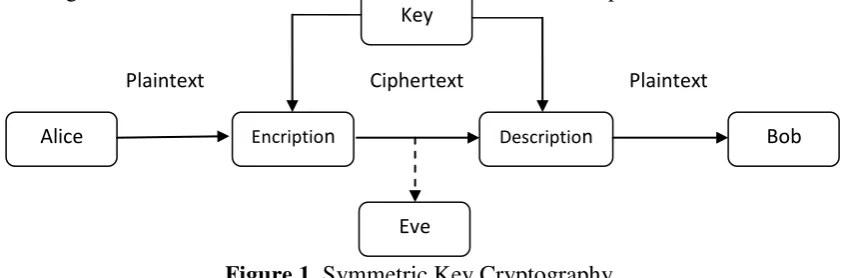
Symmetric cryptography is a method of cryptography that use the same key in encryption and description processes. Therefore, key or password is very important in this system. All parties, who want to exchange secret information must agree on the same key. Because of the importance of the key, several methods based on group, semiring and matrix and other mathematical systems have been produced.
Figure 1. Symmetric Key Cryptography
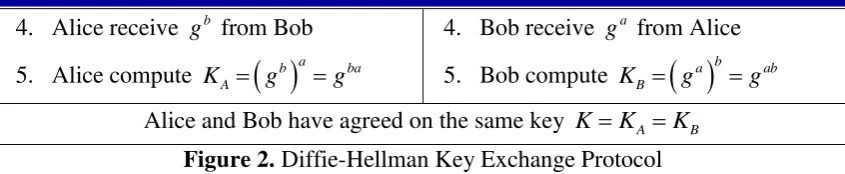
In symmetric cryptography, one of the famous methods to establish the shared secret key was invented by Whitfield Diffie and Martin Hellman in 1976. The Diffie– Hellman key exchange method allows two parties to establish a shared secret key over an insecure communications channel.
Alice or Bob published finite cyclic group with generator gG.
Alice Bob
1. Alice select a
2. Alice compute ga
3. Alice send ga to Bob
1. Bob select b
2. Bob compute gb
3. Bob send gb to Alice
Alice Encription
nn
Description Bob Key
Eve
4. Alice receive b
g from Bob
5. Alice compute
b a baA
K g g
4. Bob receive a
g from Alice
5. Bob compute
a b abB
K g g
Alice and Bob have agreed on the same key K KAKB
Figure 2. Diffie-Hellman Key Exchange Protocol
Following the methods, the secret key K has been agreed to use to perform the encryption-decryption process. On the other hand, Eve as the attacker can only determine the value of g, ga and gb. To get the key that Alice and Bob have agreed, she must determine the value of a or b. In other words, she must resolve the discrete logarithm problem in G, therefore the security of Diffie-Hellman key agreement protocol based on the discrete logarithm problem in the cyclic group[1].
The concept of a key agreement protocol which uses a non-commutative group has been discussed in [2]. Stickel (2005), proposed key agreement protocols based on commutative group. Stickel key agreement protocol scheme based on non-commutative groups as in [..] is as follows:
Let G be a public nonabelian finite group, a, b ∈ G public elements such that ab _= ba. The key exchange protocol goes as follows. Let N and M be the orders of a and b, respectively.
1. Alice picks two random natural numbers n < N,m <M and sends u = anbm to Bob.
2. Bob picks two random natural numbers r < N, s < M and sends v = arbsto Alice.
3. Alice computes KA = anvbm= an+rbm+s. 4. Bob computes KB = arubs= an+rbm+s.
Thus, Alice and Bob end up with the same group element K = KA = KB which can serve as the shared secret key.
DISCUSSION
An example of groups that can be applied on Stickel Key Exchange Protocol is a group of matrix multiplication over a field. Furthermore, this group can be generalized as semigroup or semiring. In this study, we apply Stickel Key Exchange Protocol on semiring : the set of all n n matrices over the integers with the addition operation and mulitiplication defined over a max-plus algebra.
Max-Plus Algebra
Maxplus Algebra is the set R {-}, with R is the set of all real numbers completed by maximum operation() and addition operation( ). Moreover, ( R {-}, , ) denoted as Rmax and {-} denoted as .
In Rmax, 2 3 = 3 and 2 3 = 5. Based on the algebraic structure of Rmax, It can be classified as semifield, since :
2. (R {-}, ) is commutative group. 3. The Operation and is distributive
4. The neutral element satisfying absorption property, that is aRmax , a = a =
Matrices over Rmax
The operation of and on matrices over max plus algebra defined as follow: Implementation on Key Exchange Protocol
Now, based on the properties of matrix operation over max plus algebra, we can construct an algorithm following the Stickel Key Exchange Protocol as below:
Alice or Bob 1 published A, B( Rmax )n × n
2. Alice compute u =
Now, Alice and Bob have the shared secret key
Encryption Process
Suppose Alice want to send secret message : PLEASE GO TODAY BRO The encryption process is as follow :
1. Break the message into blocks, each consist of 4 characters: PLEA-SEGO- TODA-YBRO
2. Convert each block into number using specific rule, for example using the table below:
Thus Alice convert the message into : 15-11-4-0; 18-4-6-14; 19-14-3-0; 24-1-17-14. 3. Convert the message into matrices :
4. Encrypt the message using the secret key K to get cipher text.
(K + p3) mod 26 = text to be sent: GEZXJHBLKHYXPUML.
Description Process
After receiving the message from Alice, Bob must do some steps to read the message as below:
1. Divide the message into 4-blocks as follows GEZX-JHBL-KHYX-PUML. 2. Convert the message into matrices :
3. Using secret key (K), Bob can read the message as below:
P1 = mod26
4. Finally, Bob get the original message : PLEASE GO TODAY BRO
CONCLUSION
In this paper, we discuss the possibility of applying the concept of matrix multiplication for key exchange protocol based on Stickel’s Algorithm. Nevertheless, we do not discuss the result for other aspect such as computation aspect related to complexity. Finally, we hope this idea can be applied in practical used in cryptography.
REFERENCE
[1] Myasnikov Alexei, Vladimir Shpilrain and Alexander Ushakov. 2008. Group-based Cryptography. Basel Switzerland: Birkhauser Verlag.
[2] Grigoriev,D and Vladimir S.. Tropical Crypthography. Downloaded at 12th April 2013.
[4]Musthofa, Dwi Lestari. The Password Agreement Method Based on Matrix Operation Over Min Plus Algebra for Secret Information safety .2013.