14
Marketing
Management
PHILIP KOTLER
Northwestern University
KEVIN LANE KELLER
Dartmouth College
Prentice Hall
Boston Columbus Indianapolis New York San Francisco Upper Saddle River
Executive Editor:Melissa Sabella
Development Editor:Elisa Adams
Director of Editorial Services:Ashley Santora
Editorial Project Manager:Kierra Bloom
Editorial Assistant:Elizabeth Scarpa
Director of Marketing:Patrice Lumuba Jones
Senior Marketing Manager:Anne Fahlgren
Senior Managing Editor:Judy Leale
Production Project Manager:Ann Pulido
Senior Operations Supervisor:Arnold Vila
Text and Cover Designer:Blair Brown
Lead Media Project Manager:Lisa Rinaldi
Editorial Media Project Manager:Denise Vaughn
Full-Service Project Management:Sharon Anderson/BookMasters, Inc.
Composition:Integra
Printer/Binder:Courier/Kendallville
Cover Printer:Lehigh-Phoenix Color/Hagerstown
Text Font:9.5/11.5, Minion
Credits and acknowledgments borrowed from other sources and reproduced, with permission, in this textbook appear on appropriate page within text.
Copyright © 2012, 2009, 2006, 2003, 2000 Pearson Education, Inc., publishing as Prentice Hall, One Lake Street, Upper Saddle River, New Jersey 07458.All rights reserved. Manufactured in the United States of America. This publication is protected by Copyright, and permission should be obtained from the publisher prior to any prohibited reproduction, storage in a retrieval system, or transmission in any form or by any means, electronic, mechanical, photocopying, recording, or likewise. To obtain permission(s) to use material from this work, please submit a written request to Pearson Education, Inc., Permissions Department, One Lake Street, Upper Saddle River, New Jersey 07458.
Many of the designations by manufacturers and seller to distinguish their products are claimed as trademarks. Where those designations appear in this book, and the publisher was aware of a trademark claim, the designations have been printed in initial caps or all caps.
Library of Congress Cataloging-in-Publication Data
Kotler, Philip.
Marketing management/Philip Kotler, Kevin Lane Keller. — 14th ed. p. cm.
Includes bibliographical references and index.
ISBN 978-0-13-210292-6
1. Marketing—Management. I. Keller, Kevin Lane, 1956- II. Title. HF5415.13.K64 2012
658.8—dc22 2010046655
– PK
This book is dedicated to my wife, Punam, and my two daughters,
Carolyn and Allison, with much love and thanks.
About the
Authors
iv
Authors
Philip Kotler
is one of the world’s leading authorities on market-ing. He is the S. C. Johnson & Son Distinguished Professor of International Marketing at the Kellogg School of Management, Northwestern University. He received his master’s degree at the University of Chicago and his Ph.D. at MIT, both in economics. He did postdoctoral work in mathematics at Harvard University and in behavioral science at the University of Chicago. Dr. Kotler is the coauthor of Principles of MarketingandMarketing: An Introduction.HisStrategic Marketing for Nonprofit Organizations, now in its seventh edition, is the best seller in that specialized area. Dr. Kotler’s other books include Marketing Models; The New Competi-tion; Marketing Professional Services; Strategic Marketing for Educational Institutions; Marketing for Health Care Organizations; Marketing Congregations; High Visibility; Social Marketing; Marketing Places; The Marketing of Nations; Marketing for Hospitality and Tourism; Standing Room Only—Strategies for Marketing the Performing Arts; Museum Strategy and Marketing; Marketing Moves; Kotler on Marketing; Lateral Marketing: Ten Deadly Marketing Sins;and Corporate Social Responsibility.In addition, he has published more than one hundred articles in leading journals, in-cluding the Harvard Business Review, Sloan Management Review, Business Horizons, California Management Review,theJournal of Marketing,theJournal of Marketing Research, Management Science,theJournal of Business Strategy,and Futurist.He is the only three-time winner of the coveted Alpha Kappa Psi award for the best annual article published in the Journal of Marketing.
Professor Kotler was the first recipient of the American Marketing Association’s (AMA) Distinguished Marketing Educator Award (1985). The European Association of Marketing Consultants and Sales Trainers awarded him their Prize for Marketing Excellence. He was chosen as the Leader in Marketing Thought by the Academic Members of the AMA in a 1975 survey. He also received the 1978 Paul Converse Award of the AMA, honoring his original contribution to marketing. In 1995, the Sales and Marketing Executives International (SMEI) named him Marketer of the Year. In 2002, Professor Kotler received the Distinguished Educator Award from the Academy of Marketing Science. He has received honorary doctoral degrees from Stockholm University, the University of Zurich, Athens University of Economics and Business, DePaul University, the Cracow School of Business and Economics, Groupe H.E.C. in Paris, the Budapest School of Economic Science and Public Administration, and the University of Economics and Business Administration in Vienna.
Professor Kotler has been a consultant to many major U.S. and foreign companies, in-cluding IBM, General Electric, AT&T, Honeywell, Bank of America, Merck, SAS Airlines, Michelin, and others in the areas of marketing strategy and planning, marketing organiza-tion, and international marketing.
He has been Chairman of the College of Marketing of the Institute of Management Sciences, a Director of the American Marketing Association, a Trustee of the Marketing Science Institute, a Director of the MAC Group, a member of the Yankelovich Advisory Board, and a member of the Copernicus Advisory Board. He was a member of the Board of Governors of the School of the Art Institute of Chicago and a member of the Advisory Board of the Drucker Foundation. He has traveled extensively throughout Europe, Asia, and South America, advising and lecturing to many companies about global marketing opportunities.
Marketing at the Tuck School of Business at Dartmouth College. Professor Keller has degrees from Cornell, Carnegie-Mellon, and Duke universities. At Dartmouth, he teaches MBA courses on marketing management and strate-gic brand management and lectures in executive programs on those topics. Previously, Professor Keller was on the faculty of the Graduate School of Business at Stanford University, where he also served as the head of the marketing group. Additionally, he has been on the marketing faculty at the University of California at Berkeley and the University of North Carolina at
Chapel Hill, been a visiting professor at Duke University and the Australian Graduate School of Management, and has two years of industry experience as Marketing Consultant for Bank of America.
Professor Keller’s general area of expertise lies in marketing strategy and planning, and branding. His specific research interest is in how understanding theories and con-cepts related to consumer behavior can improve marketing strategies. His research has been published in three of the major marketing journals—the Journal of Marketing,the Journal of Marketing Research,and the Journal of Consumer Research.He also has served on the Editorial Review Boards of those journals. With over ninety published pa-pers, his research has been extensively cited and has received numerous awards.
Professor Keller is acknowledged as one of the international leaders in the study of brands and branding. His textbook on those subjects, Strategic Brand Management, has been adopted at top business schools and leading firms around the world and has been heralded as the “bible of branding.”
Actively involved with industry, he has worked on a host of different types of marketing projects. He has served as a consultant and advisor to marketers for some of the world’s most successful brands, including Accenture, American Express, Disney, Ford, Intel, Levi Strauss, Procter & Gamble, and Samsung. Additional brand consulting activities have been with other top companies such as Allstate, Beiersdorf (Nivea), BlueCross BlueShield, Campbell’s, Colgate, Eli Lilly, ExxonMobil, General Mills, GfK, Goodyear, Intuit, Johnson & Johnson, Kodak, L.L.Bean, Mayo Clinic, Nordstrom, Ocean Spray, Red Hat, SAB Miller, Shell Oil, Starbucks, Unilever, and Young & Rubicam. He has also served as an academic trustee for the Marketing Science Institute.
A popular and highly sought-after speaker, he has made speeches and conducted marketing seminars to top executives in a variety of forums. Some of his senior manage-ment and marketing training clients have included such diverse business organizations as Cisco, Coca-Cola, Deutsche Telekom, GE, Google, IBM, Macy’s, Microsoft, Nestle, Novartis, and Wyeth. He has lectured all over the world, from Seoul to Johannesburg, from Sydney to Stockholm, and from Sao Paulo to Mumbai. He has served as keynote speaker at conferences with hundreds to thousands of participants.
An avid sports, music, and film enthusiast, in his so-called spare time, he has helped to manage and market, as well as serve as executive producer for, one of Australia’s great rock and roll treasures, The Church, as well as American power-pop legends Dwight Twilley and Tommy Keene. Additionally, he is the Principal Investor and Marketing Advisor for Second Motion Records. He is also on the Board of Directors for The Doug Flutie, Jr. Foundation for Autism and the Montshire Museum of Science. Professor Keller lives in Etna, NH, with his wife, Punam (also a Tuck marketing professor), and his two daughters, Carolyn and Allison.
v
Brief
Contents
vi
Preface xvi
PART 1
Understanding Marketing Management
2
Chapter 1 Defining Marketing for the 21st Century 2 Chapter 2 Developing Marketing Strategies and Plans 32
PART 2
Capturing Marketing Insights
66
Chapter 3 Collecting Information and Forecasting Demand 66 Chapter 4 Conducting Marketing Research 96
PART 3
Connecting with Customers
122
Chapter 5 Creating Long-term Loyalty Relationships 122 Chapter 6 Analyzing Consumer Markets 150
Chapter 7 Analyzing Business Markets 182
Chapter 8 Identifying Market Segments and Targets 212
PART 4
Building Strong Brands
240
Chapter 9 Creating Brand Equity 240
Chapter 10 Crafting the Brand Positioning 274 Chapter 11 Competitive Dynamics 298
PART 5
Shaping the Market Offerings
324
Chapter 12 Setting Product Strategy 324
Chapter 13 Designing and Managing Services 354
Chapter 14 Developing Pricing Strategies and Programs 382
PART 6
Delivering Value
414
Chapter 15 Designing and Managing Integrated Marketing Channels 414 Chapter 16 Managing Retailing, Wholesaling, and Logistics 446
PART 7
Communicating Value
474
Chapter 17 Designing and Managing Integrated Marketing Communications 474
Chapter 18 Managing Mass Communications: Advertising, Sales Promotions, Events and Experiences, and Public Relations 502
Chapter 19 Managing Personal Communications: Direct and Interactive Marketing, Word of Mouth, and Personal Selling 534
PART 8
Creating Successful Long-term Growth
566
Chapter 20 Introducing New Market Offerings 566 Chapter 21 Tapping into Global Markets 594
Chapter 22 Managing a Holistic Marketing Organization for the Long Run 620
Appendix: Sonic Marketing Plan A1
Endnotes E1
Glossary G1
Image Credits C1
Name Index I1
Company, Brand, and Organization Index I4
Contents
vii Preface xvi
PART 1
Understanding Marketing
Management
2
CHAPTER 1 Defining Marketing for the 21st Century 2
The Importance of Marketing 3 The Scope of Marketing 5
What Is Marketing? 5 What Is Marketed? 5 Who Markets? 7
Core Marketing Concepts 9
Needs, Wants, and Demands 9 Target Markets, Positioning, and
Segmentation 10 Offerings and Brands 10 Value and Satisfaction 10 Marketing Channels 11 Supply Chain 11 Competition 11
Marketing Environment 11
The New Marketing Realities 12
Major Societal Forces 12 New Company Capabilities 14 Marketing in Practice 15
MARKETINGINSIGHTMarketing in an Age
of Turbulence 16
Company Orientation toward the Marketplace 17
The Production Concept 18 The Product Concept 18 The Selling Concept 18 The Marketing Concept 18
The Holistic Marketing Concept 18
MARKETINGMEMOMarketing Right
and Wrong 19
Relationship Marketing 20 Integrated Marketing 20 Internal Marketing 21 Performance Marketing 22
The New Four Ps 25
Marketing Management Tasks 26
Developing Marketing Strategies and Plans 26
Capturing Marketing Insights 26
MARKETINGMEMOMarketers’ Frequently
Asked Questions 26
Connecting with Customers 27
Building Strong Brands 27 Shaping the Market Offerings 27 Delivering Value 27
Communicating Value 27
Creating Successful Long-Term Growth 27 Summary 28
Applications 28
CHAPTER 2 Developing Marketing Strategies
and Plans 32
Marketing and Customer Value 33
The Value Delivery Process 33 The Value Chain 34
Core Competencies 35
A Holistic Marketing Orientation and Customer Value 36
The Central Role of Strategic Planning 36
Corporate and Division Strategic Planning 37
Defining the Corporate Mission 38 Establishing Strategic Business Units 39 Assigning Resources to Each SBU 42 Assessing Growth Opportunities 42 Organization and Organizational Culture 45 Marketing Innovation 45
MARKETINGINSIGHTCreating Innovative
Marketing 46
Business Unit Strategic Planning 47
The Business Mission 48 SWOT Analysis 48 Goal Formulation 50 Strategic Formulation 50
MARKETINGMEMOChecklist for Performing
Strengths/Weaknesses Analysis 52 Program Formulation and
Implementation 53 Feedback and Control 53
Product Planning: The Nature and Contents of a Marketing Plan 54
MARKETINGMEMOMarketing Plan
Criteria 55
The Role of Research 55 The Role of Relationships 55 From Marketing Plan to Marketing
Action 55 Summary 56 Applications 56
Insights
66
CHAPTER 3 Collecting Information and Forecasting Demand 66
Components of a Modern Marketing Information System 67
Internal Records 70
The Order-to-Payment Cycle 70 Sales Information Systems 70
Databases, Data Warehousing, and Data Mining 71
Marketing Intelligence 71
The Marketing Intelligence System 71
Collecting Marketing Intelligence on the Internet 72
Communicating and Acting on Marketing Intelligence 73
Analyzing the Macroenvironment 74
Needs and Trends 74
Identifying the Major Forces 74 The Demographic Environment 75
MARKETINGINSIGHTFinding Gold at the
Bottom of the Pyramid 76 The Economic Environment 77 The Sociocultural Environment 78 The Natural Environment 80 The Technological Environment 81
MARKETINGINSIGHTThe Green Marketing
Revolution 82
The Political-Legal Environment 84
Forecasting and Demand Measurement 85
The Measures of Market Demand 85 A Vocabulary for Demand
Measurement 86
Estimating Current Demand 88 Estimating Future Demand 90 Summary 92
Applications 92
CHAPTER 4 Conducting Marketing
Research 96
The Marketing Research System 97 The Marketing Research Process 99
Objectives 99
Step 2: Develop the Research Plan 100
MARKETINGMEMOConducting Informative
Focus Groups 102
MARKETINGMEMOQuestionnaire Dos and
Don’ts 104
MARKETINGINSIGHTGetting into the
Heads of Consumers 106
MARKETINGINSIGHTUnderstanding Brain
Science 108
Step 3: Collect the Information 110 Step 4: Analyze the Information 111 Step 5: Present the Findings 111 Step 6: Make the Decision 111
MARKETINGINSIGHTBringing Marketing
Research to Life with Personas 112
Overcoming Barriers to the Use of Marketing Research 112
Measuring Marketing Productivity 114
Marketing Metrics 114 Marketing-Mix Modeling 116 Marketing Dashboards 116
MARKETINGINSIGHTMarketing
Dashboards to Improve Effectiveness and Efficiency 117
Summary 118 Applications 119
PART 3
Connecting with
Customers
122
CHAPTER 5 Creating Long-term Loyalty
Relationships 122
Building Customer Value, Satisfaction, and Loyalty 123
Customer Perceived Value 124 Total Customer Satisfaction 128 Monitoring Satisfaction 128
MARKETINGINSIGHTNet Promoter and
Customer Satisfaction 129 Product and Service Quality 131
Quality 132
Customer Profitability 133
Measuring Customer Lifetime Value 134
Cultivating Customer Relationships 134
MARKETINGMEMOCalculating Customer
Lifetime Value 134 Customer Relationship
Management 135 Attracting and Retaining
Customers 139 Building Loyalty 141 Win-Backs 143
Customer Databases and Database Marketing 143
Customer Databases 143
Data Warehouses and Data Mining 143 The Downside of Database Marketing and
CRM 145
MARKETINGINSIGHTThe Behavioral
Targeting Controversy 146
Summary 147 Applications 147
CHAPTER 6 Analyzing Consumer
Markets 150
What Influences Consumer Behavior? 151
Cultural Factors 151 Social Factors 153
MARKETINGMEMOThe Average U.S.
Consumer Quiz 155 Personal Factors 155
Key Psychological Processes 160
Motivation: Freud, Maslow, Herzberg 160 Perception 161
Learning 163 Emotions 163 Memory 163
MARKETINGINSIGHTMade
to Stick 165
The Buying Decision Process: The Five-Stage Model 166
Problem Recognition 167 Evaluation of Alternatives 168
ix
Moderating Effects on Consumer Decision Making 173
Behavioral Decision Theory and Behavioral Economics 174
Decision Heuristics 174
MARKETINGINSIGHTPredictably
Irrational 176 Framing 177 Summary 177 Applications 178
CHAPTER 7 Analyzing Business Markets 182
What Is Organizational Buying? 183
The Business Market versus the Consumer Market 183
Buying Situations 185
Systems Buying and Selling 187
Participants in the Business Buying Process 188
The Buying Center 188 Buying Center Influences 189
Targeting Firms and Buying Centers 190
MARKETINGINSIGHTBig Sales to Small
Businesses 191
The Purchasing/Procurement Process 193
Stages in the Buying Process 195
Problem Recognition 196
General Need Description and Product Specification 196
Supplier Search 196 Proposal Solicitation 198 Supplier Selection 198
MARKETINGMEMODeveloping Compelling
Customer Value Propositions 199 Order-Routine Specification 201 Performance Review 201
Managing Business-to-Business Customer Relationships 201
The Benefits of Vertical Coordination 202
MARKETINGINSIGHTEstablishing
Corporate Trust, Credibility, and Reputation 203
Institutional and Government Markets 205
Summary 207 Applications 208
CHAPTER 8 Identifying Market Segments and
Targets 212
Bases for Segmenting Consumer Markets 214
Geographic Segmentation 214 Demographic Segmentation 216
MARKETINGINSIGHTTrading Up, Down,
and Over 218
Psychographic Segmentation 225 Behavioral Segmentation 227
Bases for Segmenting Business Markets 230 Market Targeting 231
Effective Segmentation Criteria 231 Evaluating and Selecting the Market
Segments 232
MARKETINGINSIGHTChasing the Long
Tail 235
Summary 236 Applications 237
PART 4
Building Strong
Brands
240
CHAPTER 9 Creating Brand Equity 240
What Is Brand Equity? 241
The Role of Brands 242 The Scope of Branding 243 Defining Brand Equity 243 Brand Equity Models 245
MARKETINGINSIGHTBrand Bubble
Trouble 248
Building Brand Equity 249
Choosing Brand Elements 250
Designing Holistic Marketing Activities 251 Leveraging Secondary Associations 252 Internal Branding 253
Brand Communities 253
Measuring Brand Equity 255
MARKETINGINSIGHTWhat Is a Brand
Worth? 257
Managing Brand Equity 258
Brand Reinforcement 258 Brand Revitalization 259
Devising a Branding Strategy 260
Branding Decisions 261 Brand Portfolios 262 Brand Extensions 263
Customer Equity 267
MARKETINGMEMOTwenty-First-Century
Branding 267
Summary 268 Applications 269
CHAPTER 10 Crafting the Brand Positioning 274
Developing and Establishing a Brand Positioning 275
Determining a Competitive Frame of Reference 276
MARKETINGINSIGHTHigh Growth Through
Value Innovation 278
Identifying Optimal Points-of-Difference and Points-of-Parity 280
Choosing POPs and PODs 283 Brand Mantras 284
Establishing Brand Positioning 286
MARKETINGMEMOConstructing a Brand
Positioning Bull’s-eye 287
Differentiation Strategies 289
Alternative Approaches to Positioning 291
Positioning and Branding a Small Business 293
Summary 294 Applications 294
CHAPTER 11 Competitive Dynamics 298
Competitive Strategies for Market Leaders 299
MARKETINGINSIGHTWhen Your
Competitor Delivers More for Less 300
Increasing Market Share 304
Other Competitive Strategies 305
Market-Challenger Strategies 305 Market-Follower Strategies 307 Market-Nicher Strategies 308
MARKETINGMEMONiche Specialist
Roles 309
Product Life-Cycle Marketing Strategies 310
Product Life Cycles 310
Style, Fashion, and Fad Life Cycles 311 Marketing Strategies: Introduction Stage and
the Pioneer Advantage 312
Marketing Strategies: Growth Stage 313 Marketing Strategies: Maturity Stage 313 Marketing Strategies: Decline Stage 315
MARKETINGINSIGHTManaging a Brand
Crisis 316
Evidence for the Product Life-Cycle Concept 316
Critique of the Product Life-Cycle Concept 317
Market Evolution 317
Marketing in an Economic Downturn 318
Explore the Upside of Increasing Investment 318
Get Closer to Customers 318 Review Budget Allocations 319 Put Forth the Most Compelling Value
Proposition 319
Fine-tune Brand and Product Offerings 320
Summary 320 Applications 321
PART 5
Shaping the Market
Offerings
324
CHAPTER 12 Setting Product Strategy 324
Product Characteristics and Classifications 325
Product Levels: The Customer-Value Hierarchy 326
Product Classifications 327
xi
Services Differentiation 330
Design 332
Product and Brand Relationships 333
MARKETINGINSIGHTMarketing Luxury
Brands 334
The Product Hierarchy 336 Product Systems and Mixes 336 Product Line Analysis 337 Product Line Length 337
MARKETINGINSIGHTWhen Less Is
More 339
Product Mix Pricing 342 Co-Branding and Ingredient
Branding 344
MARKETINGMEMOProduct-Bundle Pricing
Considerations 344
Packaging, Labeling, Warranties, and Guarantees 346
Packaging 346 Labeling 348
Warranties and Guarantees 349 Summary 349
Applications 350
CHAPTER 13 Designing and Managing
Services 354
The Nature of Services 355
Service Industries Are Everywhere 356 Categories of Service Mix 356
Distinctive Characteristics of Services 358
The New Services Realities 361
A Shifting Customer Relationship 362
Achieving Excellence in Services Marketing 365
Marketing Excellence 365 Best Practices of Top Service
Companies 366
Differentiating Services 368
MARKETINGINSIGHTImproving Company
Call Centers 369
Managing Service Quality 370
MARKETINGMEMORecommendations for
(SSTs) 375
Managing Product-Support Services 375
Identifying and Satisfying Customer Needs 376
MARKETINGMEMOAssessing E-Service
Quality 376
Postsale Service Strategy 377 Summary 378
Applications 378
CHAPTER 14 Developing Pricing Strategies and Programs 382
Understanding Pricing 383
A Changing Pricing Environment 384
MARKETINGINSIGHTGiving It All
Away 384
How Companies Price 386 Consumer Psychology and
Pricing 386
Setting the Price 389
Step 1: Selecting the Pricing Objective 389
Step 2: Determining Demand 390 Step 3: Estimating Costs 392
Step 4: Analyzing Competitors’ Costs, Prices, and Offers 395
Step 5: Selecting a Pricing Method 395
Step 6: Selecting the Final Price 402
MARKETINGINSIGHTStealth Price
Increases 403
Adapting the Price 403
Geographical Pricing (Cash, Countertrade, Barter) 404
Price Discounts and Allowances 404 Promotional Pricing 405
Differentiated Pricing 406
Initiating and Responding to Price Changes 407
Initiating Price Cuts 407 Initiating Price Increases 408 Responding to Competitors’ Price
Changes 409 Summary 410 Applications 410
CHAPTER 15 Designing and Managing Integrated
Marketing Channels 414
Marketing Channels and Value Networks 415
The Importance of Channels 416 Hybrid Channels and Multichannel
Marketing 416 Value Networks 417
The Role of Marketing Channels 418
Channel Functions and Flows 418 Channel Levels 420
Service Sector Channels 421
Channel-Design Decisions 422
Analyzing Customer Needs and Wants 422 Establishing Objectives and
Constraints 423
Identifying Major Channel Alternatives 424 Evaluating Major Channel Alternatives 426
Channel-Management Decisions 427
Selecting Channel Members 427 Training and Motivating Channel
Members 428
Evaluating Channel Members 429 Modifying Channel Design and
Arrangements 429
Channel Modification Decisions 429 Global Channel Considerations 430
Channel Integration and Systems 431
Vertical Marketing Systems 431
MARKETINGINSIGHTChannel Stewards
Take Charge 432
Horizontal Marketing Systems 433 Integrating Multichannel Marketing
Systems 433
Conflict, Cooperation, and Competition 435
Types of Conflict and Competition 435 Causes of Channel Conflict 436 Managing Channel Conflict 436 Dilution and Cannibalization 438 Legal and Ethical Issues in Channel
Relations 438
E-Commerce Marketing Practices 438
Pure-Click Companies 439 Brick-and-Click Companies 440
M-Commerce Marketing Practices 441
Summary 442 Applications 442
and Logistics 446
Retailing 447
Types of Retailers 448
The New Retail Environment 451 Marketing Decisions 453
Channels 454
MARKETINGMEMOHelping Stores to
Sell 458
Private Labels 459
Role of Private Labels 460
Private-Label Success Factors 460
MARKETINGINSIGHTManufacturer’s
Response to the Private Label Threat 461
Wholesaling 461
Trends in Wholesaling 463
Market Logistics 464
Integrated Logistics Systems 464 Market-Logistics Objectives 465 Market-Logistics Decisions 466 Organizational Lessons 469 Summary 469
Applications 470
PART 7
Communicating Value
474
CHAPTER 17 Designing and Managing Integrated
Marketing Communications 474
The Role of Marketing Communications 476
The Changing Marketing Communications Environment 476
MARKETINGINSIGHTDon’t Touch That
Remote 476
Marketing Communications, Brand Equity, and Sales 478
The Communications Process Models 480
Developing Effective Communications 482
Identify the Target Audience 482 Determine the Communications
Objectives 482
Design the Communications 484
MARKETINGINSIGHTCelebrity
Endorsements as a Strategy 486
Select the Communications Channels 486
xiii
Deciding on the Marketing Communications Mix 490
Characteristics of the Marketing Communications Mix 490 Factors in Setting the Marketing
Communications Mix 492
Measuring Communication Results 494
Managing the Integrated Marketing Communications Process 494
Coordinating Media 495 Implementing IMC 496
MARKETINGMEMOHow Integrated Is Your
IMC Program? 496
Summary 497 Applications 497
CHAPTER 18 Managing Mass Communications:
Advertising, Sales Promotions, Events and Experiences, and Public Relations 502
Developing and Managing an Advertising Program 504
Setting the Objectives 504
Deciding on the Advertising Budget 505 Developing the Advertising Campaign 506
MARKETINGMEMOPrint Ad Evaluation
Criteria 509
Deciding on Media and Measuring Effectiveness 510
Deciding on Reach, Frequency, and Impact 511
Choosing among Major Media Types 512 Alternate Advertising Options 512
MARKETINGINSIGHTPlaying Games with
Brands 516
Selecting Specific Media Vehicles 516 Deciding on Media Timing and
Allocation 517
Evaluating Advertising Effectiveness 518
Sales Promotion 519
Objectives 519
Advertising versus Promotion 519 Major Decisions 520
Creating Experiences 526
MARKETINGMEMOMeasuring High
Performance Sponsorship Programs 526
Public Relations 527
Marketing Public Relations 527 Major Decisions in Marketing PR 528 Summary 530
Applications 530
CHAPTER 19 Managing Personal
Communications: Direct and Interactive Marketing, Word of Mouth, and Personal Selling 534
Direct Marketing 535
The Benefits of Direct Marketing 536 Direct Mail 538
Catalog Marketing 539 Telemarketing 539
Other Media for Direct-Response Marketing 539
Public and Ethical Issues in Direct Marketing 540
Interactive Marketing 540
Advantages and Disadvantages of Interactive Marketing 540
Interactive Marketing Communication Options 541
MARKETINGMEMOHow to Maximize the
Marketing Value of E-mails 543
MARKETINGMEMOSegmenting Tech
Users 545
Word of Mouth 546
Social Media 546
Buzz and Viral Marketing 549 Opinion Leaders 551
MARKETINGMEMOHow to Start a Buzz
Fire 552
Measuring the Effects of Word of Mouth 552
Designing the Sales Force 553
Sales Force Objectives and Strategy 554 Sales Force Structure 555
MARKETINGINSIGHTMajor Account
Management 555
Managing the Sales Force 556
Recruiting and Selecting Representatives 556 Training and Supervising Sales
Representatives 557 Sales Rep Productivity 557
Motivating Sales Representatives 558 Evaluating Sales Representatives 559
Principles of Personal Selling 560
The Six Steps 561
Relationship Marketing 562 Summary 562
Applications 563
PART 8
Creating Successful
Long-term Growth
566
CHAPTER 20 Introducing New Market
Offerings 566
New-Product Options 567
Make or Buy 567
Types of New Products 568
Challenges in New-Product Development 568
The Innovation Imperative 568 New-Product Success 569 New-Product Failure 570
Organizational Arrangements 570
Budgeting for New-Product Development 571 Organizing New-Product
Development 572
Managing the Development Process: Ideas 573
Generating Ideas 573
MARKETINGMEMOTen Ways to Find Great
New-Product Ideas 574
MARKETINGINSIGHTP&G’s New Connect ⫹ Develop Approach to Innovation 574
MARKETINGMEMOSeven Ways to Draw
New Ideas from Your Customers 576
MARKETINGMEMOHow to Run a
Successful Brainstorming Session 577 Using Idea Screening 578
Concept Development and Testing 579 Marketing Strategy Development 582 Business Analysis 583
Managing the Development Process: Development to Commercialization 585
Product Development 585 Market Testing 585 Commercialization 588
The Consumer-Adoption Process 589
Stages in the Adoption Process 589 Factors Influencing the Adoption
Process 589 Summary 590 Applications 591
CHAPTER 21 Tapping into Global Markets 594
Competing on a Global Basis 595 Deciding Whether to Go Abroad 597 Deciding Which Markets to Enter 597
How Many Markets to Enter 598
Developed versus Developing Markets 598
MARKETINGINSIGHTSpotlight on Key
Developing Markets 600
Evaluating Potential Markets 602
Deciding How to Enter the Market 603
Indirect and Direct Export 603 Licensing 604
Joint Ventures 605 Direct Investment 605
Deciding on the Marketing Program 606
Global Similarities and Differences 606 Marketing Adaptation 607
MARKETINGMEMOThe Ten
Commandments of Global Branding 608 Global Product Strategies 608
Global Communication Strategies 610 Global Pricing Strategies 611
Global Distribution Strategies 613
Country-of-Origin Effects 614
Building Country Images 614 Consumer Perceptions of Country of
Origin 614
Deciding on the Marketing Organization 616
Export Department 616 International Division 616 Global Organization 616 Summary 617
Applications 617
xv
Organization for the Long Run 620
Trends in Marketing Practices 621 Internal Marketing 623
Organizing the Marketing Department 623
MARKETINGMEMOCharacteristics of
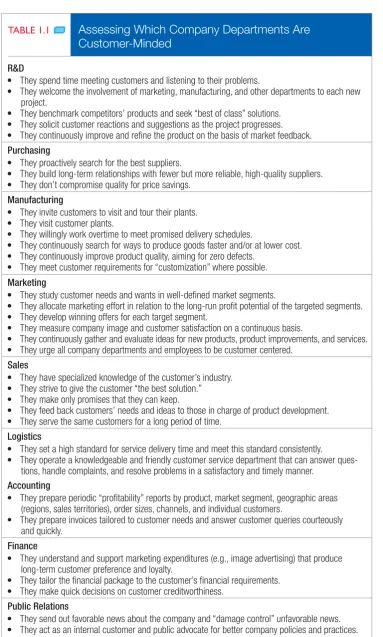
Company Departments That Are Truly Customer Driven 624
Relationships with Other Departments 627 Building a Creative Marketing
Organization 628
MARKETINGINSIGHTThe Marketing
CEO 628
Socially Responsible Marketing 629
Corporate Social Responsibility 630
MARKETINGINSIGHTThe Rise of
Organic 633
Socially Responsible Business Models 634 Cause-Related Marketing 634
MARKETINGMEMOMaking a Difference:
Top 10 Tips for Cause Branding 637 Social Marketing 638
Marketing Implementation and Control 640
Marketing Implementation 640 Marketing Control 641
Annual-Plan Control 641 Profitability Control 642 Efficiency Control 642 Strategic Control 643
The Future of Marketing 643
MARKETINGMEMOMajor Marketing
Weaknesses 647
Summary 648 Applications 648
Appendix Tools for Marketing Control 650
Appendix Sonic Marketing Plan A1
Endnotes E1
Glossary G1
Image Credits C1
Name Index I1
Company, Brand, and Organization Index I4
Preface
xvi
What’s New in the 14th Edition
The overriding goal of the revision for the 14th edition ofMarketing Managementwas to create as comprehensive, current, and engaging MBA marketing textbook as possible. Where appropriate, new material was added, old material was updated, and no longer relevant or necessary material was deleted.Marketing Management,14th edition, allows those instructors who have used the 13th edition to build on what they have learned and done while at the same time offering a text that is unsurpassed in breadth, depth, and relevance for students experi-encingMarketing Managementfor the first time.
The successful across-chapter reorganization into eight parts that began with the 12th edi-tion ofMarketing Managementhas been preserved, as well as many of the favorably received within-chapter features that have been introduced through the years, such as topical chapter openers, in-text boxes highlighting noteworthy companies or issues, and the Marketing Insight and Marketing Memo boxes that provide in-depth conceptual and practical commentary.
Significant changes to the 14th edition include:
• Brand new opening vignettes for each chapter set the stage for the chapter material to
fol-low. By covering topical brands or companies, the vignettes are great classroom discussion starters.
• Almost half of the in-text boxes are new. These boxes provide vivid illustrations of chapter
concepts using actual companies and situations. The boxes cover a variety of products, services, and markets, and many have accompanying illustrations in the form of ads or product shots.
• The end-of-chapter section now includes two Marketing in Action mini-cases highlighting
innovative, insightful marketing accomplishments by leading organizations. Each case in-cludes questions that promote classroom discussion and analysis.
• Dramatic changes in the marketing environment have occurred in recent years—in particular,
the economic, natural, and technological environments. Throughout the new edition, these three areas are addressed, sometimes via new subsections in chapters, with emphasis on marketing during economic downturns and recessions, the rise of sustainability and “green” marketing, and the increased development of computing power, the Internet, and mobile phones. These new marketing realities make it more important than ever for marketers to be holistic in what they do, the overriding theme of this text.
• Chapter 19, on personal communications, received a significant update with much new
material to reflect the changing social media landscape and communications environment.
• Forecasting has been moved to Chapter 3 where it fits well with the material on the
market-ing environment.
• Chapter 5 was re-titled as “Creating Long-Term Loyalty Relationships” to better reflect its
stronger area of emphasis.
• Chapters 10 and 11 were reorganized and material swapped. Chapter 11 was also re-titled
as “Competitive Dynamics” to acknowledge the significant material added on marketing in an economic downturn.
What Is
Marketing Management
All About?
Firms now sell goods and services through a variety of direct and indirect channels. Mass ad-vertising is not nearly as effective as it was, so marketers are exploring new forms of communica-tion, such as experiential, entertainment, and viral marketing. Customers are telling companies what types of product or services they want and when, where, and how they want to buy them. They are increasingly reporting to other consumers what they think of specific companies and products—using e-mail, blogs, podcasts, and other digital media to do so. Company messages are becoming a smaller fraction of the total “conversation” about products and services.
In response, companies have shifted gears from managing product portfolios to managing customerportfolios, compiling databases on individual customers so they can understand them better and construct individualized offerings and messages. They are doing less product and service standardization and more niching and customization. They are replacing monologues with customer dialogues. They are improving their methods of measuring customer profitabil-ity and customer lifetime value. They are intent on measuring the return on their marketing investment and its impact on shareholder value. They are also concerned with the ethical and social implications of their marketing decisions.
As companies change, so does their marketing organization. Marketing is no longer a company department charged with a limited number of tasks—it is a company-wide undertaking. It drives the company’s vision, mission, and strategic planning. Marketing includes decisions like who the company wants as its customers, which of their needs to satisfy, what products and services to of-fer, what prices to set, what communications to send and receive, what channels of distribution to use, and what partnerships to develop. Marketing succeeds only when all departments work together to achieve goals: when engineering designs the right products; finance furnishes the required funds; purchasing buys high-quality materials; production makes high-quality products on time; and accounting measures the profitability of different customers, products, and areas.
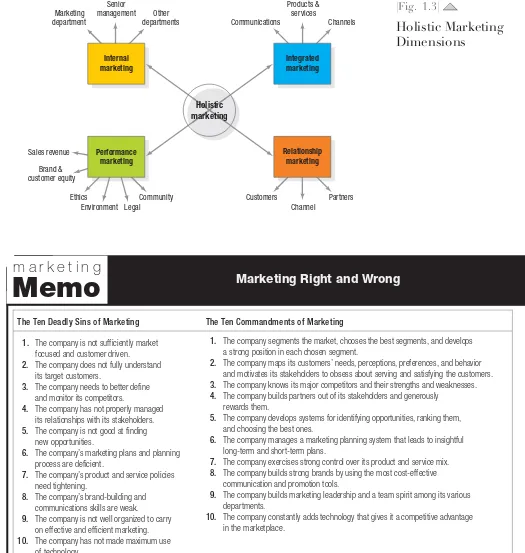
To address all these different shifts, good marketers are practicing holistic marketing. Holistic marketing is the development, design, and implementation of marketing programs, processes, and activities that recognize the breadth and interdependencies of today’s market-ing environment. Four key dimensions of holistic marketmarket-ing are:
1. Internal marketing—ensuring everyone in the organization embraces appropriate
market-ing principles, especially senior management.
2. Integrated marketing—ensuring that multiple means of creating, delivering, and
commu-nicating value are employed and combined in the best way.
3. Relationship marketing—having rich, multifaceted relationships with customers, channel
members, and other marketing partners.
4. Performance marketing—understanding returns to the business from marketing activities
and programs, as well as addressing broader concerns and their legal, ethical, social, and en-vironmental effects.
These four dimensions are woven throughout the book and at times spelled out explicitly. The text specifically addresses the following tasks that constitute modern marketing manage-ment in the 21st century:
1. Developing marketing strategies and plans
2. Capturing marketing insights and performance
3. Connecting with customers
4. Building strong brands
5. Shaping the market offerings
6. Delivering and communicating value
7. Creating successful long-term growth
the Marketing Leader?
Marketing is of interest to everyone, whether they are marketing goods, services, properties, persons, places, events, information, ideas, or organizations. As it has maintained its respected position among students, educators, and businesspeople,Marketing Managementhas kept up-to-date and contemporary. Students (and instructors) feel that the book is talking directly to them in terms of both content and delivery.
Marketing Managementowes its marketplace success to its ability to maximize three dimen-sions that characterize the best marketing texts—depth, breadth, and relevance—as measured by the following criteria:
• Depth. Does the book have solid academic grounding? Does it contain important
theo-retical concepts, models, and frameworks? Does it provide conceptual guidance to solve practical problems?
• Breadth. Does the book cover all the right topics? Does it provide the proper amount of
emphasis on those topics?
• Relevance. Does the book engage the reader? Is it interesting to read? Does it have lots of
compelling examples?
The 14th edition builds on the fundamental strengths of past editions that collectively dis-tinguish it from all other marketing management texts:
• Managerial Orientation. The book focuses on the major decisions that marketing
man-agers and top management face in their efforts to harmonize the organization’s objectives, capabilities, and resources with marketplace needs and opportunities.
• Analytical Approach. Marketing Managementpresents conceptual tools and frameworks
for analyzing recurring problems in marketing management. Cases and examples illustrate effective marketing principles, strategies, and practices.
• Multidisciplinary Perspective. The book draws on the rich findings of various scientific
disciplines—economics, behavioral science, management theory, and mathematics—for fundamental concepts and tools directly applicable to marketing challenges.
• Universal Applications. The book applies strategic thinking to the complete spectrum of
marketing: products, services, persons, places, information, ideas and causes; consumer and business markets; profit and nonprofit organizations; domestic and foreign companies; small and large firms; manufacturing and intermediary businesses; and low- and high-tech industries.
• Comprehensive and Balanced Coverage. Marketing Managementcovers all the topics an
informed marketing manager needs to understand to execute strategic, tactical, and admin-istrative marketing.
Student Supplements
mymarketinglab
Mymarketinglab gives you the opportunity to test yourself on key concepts and skills, track your progress through the course and use the personalized study plan activities—all to help you achieve success in the classroom.
Features include:
• Personalized Study Plans—Pre- and post-tests with remediation activities directed to help
you understand and apply the concepts where you need the most help.
• Current Events Articles—Concise, highly relevant articles about the latest marketing
re-lated news with thought provoking short essay questions.
• Critical Thinking Challenge Question—These questions measure core critical-thinking
skills through the context of marketing applications. To answer these questions, you will need to recognize assumptions, evaluate arguments, identify relevant issues, draw infer-ences, spot logical flaws, and recognize similarities between arguments. Knowledge of mar-keting content picked up through the text and the class will help you zero in on the correct issues, but you will still need to exercise critical judgment in order to get the correct answer.
Marketing Management Cases
Prentice Hall Custom Business Resources can provide instructors and students with all the cases and articles needed to enhance and maximize learning in a marketing course. Instructors can create Custom CoursePacks or Custom CaseBooks. Resources include top-tier cases from Darden, Harvard, Ivey, NACRA, and Thunderbird, plus full access to a database of articles. For details on how to order these value-priced packages, contact your local representative or visit the Prentice Hall Custom Business Resources Web site at www.prenhall.com/custombusiness.
Marketing Management Video Gallery
Make your classroom “newsworthy.” PH has updated the Marketing Management video li-brary for the 14th edition. A full lili-brary of video segments accompany this edition featuring issue-focused footage such as interviews with top executives, objective reporting by real news anchors, industry research analysts, and marketing and advertising campaign experts. A full video guide, including synopses, discussion questions, and teaching suggestions, is available on the IRC (online and on CD-ROM) to accompany the video library.
The Marketing Plan Handbook,
4th edition,
with Marketing Plan Pro
Marketing Plan Pro is a highly rated commercial software program that guides you through the entire marketing plan process. The software is totally interactive and features 10 sample marketing plans, step-by-step guides, and customizable charts. Customize your marketing plan to fit your marketing needs by following easy-to-use plan wizards. Follow the clearly out-lined steps from strategy to implementation. Click to print, and your text, spreadsheet, and charts come together to create a powerful marketing plan. The new The Marketing Plan Handbook,by Marian Burk Wood, supplements the in-text marketing plan material with an in-depth guide to what student marketers really need to know. A structured learning process leads to a complete and actionable marketing plan. Also included are timely, real-world exam-ples that illustrate key points, sample marketing plans, and Internet resources.
Acknowledgments
xx
T
he 14th edition bears the imprint of many people.From Phil Kotler:My colleagues and associates at the Kellogg School of Management at Northwestern University continue to have an important impact on my thinking: Nidhi Agrawal, Eric T. Anderson, James C. Anderson, Robert C. Blattberg, Miguel C. Brendl, Bobby J. Calder, Gregory S. Carpenter, Alex Chernev, Anne T. Coughlan, David Gal, Kent Grayson, Karsten Hansen, Dipak C. Jain, Lakshman Krishnamurti, Angela Lee, Vincent Nijs, Yi Qian, Mohanbir S. Sawhney, Louis W. Stern, Brian Sternthal, Alice M. Tybout, and Andris A. Zoltners. I also want to thank the S. C. Johnson Family for the generous support of my chair at the Kellogg School. Completing the Northwestern team is my former Dean, Donald P. Jacobs, and my current Dean, Dipak Jain, both of whom have provided generous support for my research and writing.Several former faculty members of the marketing department had a great influence on my thinking when I first joined the Kellogg marketing faculty, specifically Richard M. Clewett, Ralph Westfall, Harper W. Boyd, and Sidney J. Levy. I also want to acknowledge Gary Armstrong for our work on Principles of Marketing.
I am indebted to the following coauthors of international editions ofMarketing Manage-mentandPrinciples of Marketingwho have taught me a great deal as we worked together to adapt marketing management thinking to the problems of different nations:
• Swee-Hoon Ang and Siew-Meng Leong, National University of Singapore • Chin-Tiong Tan, Singapore Management University
• Friedhelm W. Bliemel, Universitat Kaiserslautern (Germany)
• Linden Brown; Stewart Adam, Deakin University; Suzan Burton, Macquarie Graduate
School of Management; and Sara Denize, University of Western Sydney (Australia)
• Bernard Dubois, Groupe HEC School of Management (France); and Delphine Manceau,
ESCP-EAP European School of Management
• John Saunders, Loughborough University and Veronica Wong, Warwick University (United
Kingdom)
• Jacob Hornick, Tel Aviv University (Israel)
• Walter Giorgio Scott, Universita Cattolica del Sacro Cuore (Italy)
• Peggy Cunningham, Queen’s University (Canada)
I also want to acknowledge how much I have learned from working with coauthors on more specialized marketing subjects: Alan Andreasen, Christer Asplund, Paul N. Bloom, John Bowen, Roberta C. Clarke, Karen Fox, David Gertner, Michael Hamlin, Thomas Hayes, Donald Haider, Hooi Den Hua, Dipak Jain, Somkid Jatusripitak, Hermawan Kartajaya, Neil Kotler, Nancy Lee, Sandra Liu, Suvit Maesincee, James Maken, Waldemar Pfoertsch, Gustave Rath, Irving Rein, Eduardo Roberto, Joanne Scheff, Norman Shawchuck, Joel Shalowitz, Ben Shields, Francois Simon, Robert Stevens, Martin Stoller, Fernando Trias de Bes, Bruce Wrenn, and David Young.
My overriding debt continues to be to my lovely wife, Nancy, who provided me with the time, support, and inspiration needed to prepare this edition. It is truly our book.
xxi
• Jennifer Barr, Richard Stockton College
• Lawrence Kenneth Duke, Drexel University LeBow
College of Business
• Barbara S. Faries, Mission College, Santa Clara, CA
• William E. Fillner, Hiram College
• Frank J. Franzak, Virginia Commonwealth University
• Robert Galka, De Paul University • Albert N. Greco, Fordham University
• John A. Hobbs, University of Oklahoma • Brian Larson, Widener University
• Anthony Racka, Oakland Community College, Auburn
Hills, MI
• Jamie Ressler, Palm Beach Atlantic University
• James E. Shapiro, University of New Haven • George David Shows, Louisiana Tech University
We would also like to thank colleagues who have reviewed previous editions ofMarketing Management:
Homero Aguirre, TAMIU
Alan Au, University of Hong Kong Hiram Barksdale, University of Georgia Boris Becker, Oregon State University Sandy Becker, Rutgers University
Parimal Bhagat, Indiana University of Pennsylvania Sunil Bhatla, Case Western Reserve University Michael Bruce, Anderson University
Frederic Brunel, Boston University John Burnett, University of Denver
Lisa Cain, University of California at Berkeley and Mills College
Surjit Chhabra, DePaul University Yun Chu, Frostburg State University
Dennis Clayson, University of Northern Iowa Bob Cline, University of Iowa
Brent Cunningham, Jacksonville State University Hugh Daubek, Purdue University
John Deighton, University of Chicago Kathleen Dominick, Rider University Tad Duffy, Golden Gate University Mohan Dutta, Purdue University
Barbara Dyer, University of North Carolina at Greensboro
Alton Erdem, University of Houston at Clear Lake Elizabeth Evans, Concordia University
Barb Finer, Suffolk University Chic Fojtik, Pepperdine University Renee Foster, Delta State University
Ralph Gaedeke, California State University, Sacramento Robert Galka, De Paul University
Betsy Gelb, University of Houston at Clear Lake Dennis Gensch, University of Wisconsin, Milwaukee David Georgoff, Florida Atlantic University
Rashi Glazer, University of California, Berkeley Bill Gray, Keller Graduate School of Management Barbara Gross, California State University at Northridge Lewis Hershey, Fayetteville State University
Thomas Hewett, Kaplan University Mary Higby, University of Detroit–Mercy Arun Jain, State University of New York, Buffalo Michelle Kunz, Morehead State University Eric Langer, Johns Hopkins University
Even Lanseng, Norwegian School of Management Ron Lennon, Barry University
Michael Lodato, California Lutheran University Henry Loehr, Pfeiffer University–Charlotte Bart Macchiette, Plymouth University Susan Mann, Bluefield State College Charles Martin, Wichita State University H. Lee Matthews, Ohio State University
Paul McDevitt, University of Illinois at Springfield Mary Ann McGrath, Loyola University, Chicago John McKeever, University of Houston
Kenneth P. Mead, Central Connecticut State University Henry Metzner, University of Missouri, Rolla
Robert Mika, Monmouth University Mark Mitchell, Coastal Carolina University Francis Mulhern, Northwestern University Pat Murphy, University of Notre Dame Jim Murrow, Drury College
Zhou Nan, University of Hong Kong Nicholas Nugent, Boston College
Young-Hoon Park, Cornell University Koen Pauwels, Dartmouth College Lisa Klein Pearo, Cornell University Keith Penney, Webster University Patricia Perry, University of Alabama
Mike Powell, North Georgia College and State University Hank Pruden, Golden Gate University
Christopher Puto, Arizona State University Abe Qstin, Lakeland University
Lopo Rego, University of Iowa
Richard Rexeisen, University of St. Thomas William Rice, California State University–Fresno Scott D. Roberts, Northern Arizona University Bill Robinson, Purdue University
Robert Roe, University of Wyoming
Jan Napoleon Saykiewicz, Duquesne University Larry Schramm, Oakland University
Alex Sharland, Hofstra University
Dean Siewers, Rochester Institute of Technology Anusorn Singhapakdi, Old Dominion University Jim Skertich, Upper Iowa University
Allen Smith, Florida Atlantic University Joe Spencer, Anderson University Mark Spriggs, University of St. Thomas Nancy Stephens, Arizona State University
xxii
Thomas Tellefsen, The College of Staten Island–CUNY Daniel Turner, University of Washington
Sean Valentine, University of Wyoming Ann Veeck, West Michigan University R. Venkatesh, University of Pittsburgh
Edward Volchok, Stevens Institute of Management D. J. Wasmer, St. Mary-of-the-Woods College Zac Williams, Mississippi State University Greg Wood, Canisius College
Kevin Zeng Zhou, University of Hong Kong
A warm welcome and many thanks to the following people who contributed to the global case studies developed for the 14th edition:
Mairead Brady, Trinity College
John R. Brooks, Jr., Houston Baptist University Sylvain Charlebois, University of Regina Geoffrey da Silva, Temasek Business School Malcolm Goodman, Durham University Torben Hansen, Copenhagen Business School
Abraham Koshy, Sanjeev Tripathi, and Abhishek, Indian Institute of Management Ahmedabad
Peter Ling, Edith Cowan University Marianne Marando, Seneca College Lu Taihong, Sun Yat-Sen University
The talented staff at Prentice Hall deserves praise for their role in shaping the 14th edition. We want to thank our editor, Melissa Sabella, for her contribution to this revision. We also want to thank our project manager, Kierra Bloom, for making sure everything was moving along and falling into place in such a personable way, both with regard to the book and supplements. We benefited greatly from the superb editorial help of Elisa Adams, who lent her considerable tal-ents as a development editor to this edition. We also want to acknowledge the fine production work of Ann Pulido, the creative design work of Blair Brown, and the editorial assistance of Elizabeth Scarpa. We thank Denise Vaughn for her work on the media package. We also thank our marketing manager, Anne Fahlgren.
Philip Kotler
S. C. Johnson Distinguished Professor of International Marketing Kellogg School of Management Northwestern University Evanston, Illinois
Kevin Lane Keller
Cha
pter
1
In This Chapter, We Will Address
the Following
Questions
1. Why is marketing important?
2. What is the scope of marketing?
3. What are some core marketing concepts?
4. How has marketing management changed in recent years?
5. What are the tasks necessary for successful marketing management?
One of the key factors in Barack Obama’s victory in the 2008 U.S. presidential election was a well-designed and well-executed marketing program.
Chapter
1
|
Defining Marketing for the 21st Century
Formally or informally, people and organizations engage in a vast number
of activities we could call marketing. Good marketing has become increasingly vital for success. But what constitutes good marketing is constantly evolving and changing. The election of Barack Obama as the 44th President of the United States was attributed, in part, to the adoption of new marketing practices.The “Obama for America” presidential campaign combined a charismatic politician, a
powerful message of hope, and a thoroughly integrated modern marketing program.
The marketing plan needed to accomplish two very different goals: expand the
elec-torate via broader messages while targeting very specific audiences. Multimedia tactics
combined offline and online media, as well as free and paid media. When research
showed that the more voters learned about Obama, the more they identified with him, the campaign
added long-form videos to traditional print, broadcast, and outdoor ads. The Obama team—aided by
its agency GMMB—also put the Internet at the heart of the campaign, letting it serve as the “central
nervous system” for PR, advertising, advance work, fund-raising, and organizing in all 50 states. Their
guiding philosophy was to “build online tools to help people
self-organize and then get out of their way.” Technology was a means to
“empower people to do what they were interested in doing in the first
place.” Although social media like Facebook, Meetup, YouTube, and
Twitter were crucial, perhaps Obama’s most powerful digital tool was a
massive 13.5 million–name e-mail list. What were the results of these
online efforts? About $500 million (most in sums of less than $100)
was raised online from 3 million donors; 35,000 groups organized
through the Web site, My.BarackObama.com; 1,800 videos posted to
YouTube; the creation of Facebook’s most popular page; and, of
course, the election of the next President of the United States.
1Defining Marketing
for the 21st Century
The Importance of Marketing
The first decade of the 21st century challenged firms to prosper financially and even survive in the face of an unforgiving economic environment. Marketing is playing a key role in addressing those challenges. Finance, operations, accounting, and other business functions won’t really matter without sufficient demand for products and services so the firm can make a profit. In other words, there must be a top line for there to be a bottom line. Thus financial success often depends on marketing ability.
Good marketing is no accident
,but a result of careful planning and execution using state-of-the-art tools and techniques. It becomes both an art and a science as marketers strive to find creative new solutions to often-complex challenges amid profound changes in the 21st century marketing environment. In this book, we describe how top marketers balance discipline and imagination to address these new marketing realities. In the first chapter, we lay the foundation by reviewing important marketing concepts, tools, frameworks, and issues.Marketing’s broader importance extends to society as a whole. Marketing has helped introduce and gain acceptance of new products that have eased or enriched people’s lives. It can inspire en-hancements in existing products as marketers innovate to improve their position in the market-place. Successful marketing builds demand for products and services, which, in turn, creates jobs. By contributing to the bottom line, successful marketing also allows firms to more fully engage in socially responsible activities.2
CEOs recognize the role of marketing in building strong brands and a loyal customer base, in-tangible assets that contribute heavily to the value of a firm. Consumer goods makers, health care insurers, nonprofit organizations, and industrial product manufacturers all trumpet their latest marketing achievements. Many now have a chief marketing officer (CMO) to put marketing on a more equal footing with other C-level executives such as the chief financial officer (CFO) or chief information officer (CIO).3
Making the right marketing decisions isn’t always easy. One survey of more than a thousand senior marketing and sales executives revealed that although 83 percent felt that marketing and sales capabilities were a top priority for their organization’s success, in rating their actual marketing effectiveness, only 6 percent felt that they were doing an “extremely good” job.4
Marketers must decide what features to design into a new product or service, what prices to set, where to sell products or offer services, and how much to spend on advertising, sales, the Internet, or mobile marketing. They must make those decisions in an Internet-fueled environment where consumers, competition, technology, and economic forces change rapidly, and the consequences of the marketer’s words and actions can quickly multiply.
Domino’s
When two employees in Conover, North Carolina, posted a YouTube video showing themselves preparing sandwiches while putting cheese up their noses and vio-lating other health-code standards, Domino’s learned an important lesson about PR and brand communications in a modern era. Once it found the employees—who claimed the video was just a gag and the sandwiches were never delivered—the company fired them. In just a few days, however, there had been more than a million downloads of the video and a wave of negative publicity. When research showed that perception of quality for the brand had turned from positive to negative in that short time, the firm aggressively took action through social media such as Twitter, YouTube, and others.5As Domino’s learned, in an era of connectivity, it is important to respond swiftly and decisively. While marketers were coming to grips with this increasingly wired world, the economic recession of 2008–2009 brought budget cuts and intense pressure from sen-ior management to make every marketing dollar count. More than ever, marketers need to understand and adapt to the latest market-place developments. At greatest risk are firms that fail to carefully monitor their customers and competitors, continuously improve their value offerings and marketing strategies, or satisfy their employees, stockholders, suppliers, and channel partners in the process.
Skillful marketing is a never-ending pursuit. Consider how some top firms drive business:
• OfficeMax promoted a new line of products by professional organizer Peter Walsh with Web videos and in-store events featuring local experts demonstrating his OfficeMax-branded organizing system.
• eBay promoted its “Let’s Make a Daily Deal” holiday promotion by recreating the famous 1970s TV game show Let’s Make a Dealin Times Square, adding an online component so people outside New York City could play.
• Johnson & Johnson launched BabyCenter.com to help new parents. Its success is thought to have contributed to subscription slumps experienced by parenting magazines.
Good marketers are always seeking new ways to satisfy customers and beat competition.6
The Scope of Marketing
To prepare to be a marketer, you need to understand what marketing is, how it works, who does it, and what is marketed.
What Is Marketing?
Marketingis about identifying and meeting human and social needs. One of the shortest good definitions of marketing is “meeting needs profitably.” When eBay recognized that people were unable to locate some of the items they desired most, it created an online auction clearinghouse. When IKEA noticed that people wanted good furnishings at substantially lower prices, it created knockdown furniture. These two firms demonstrated marketing savvy and turned a private or social need into a profitable business opportunity.
The American Marketing Association offers the following formal definition:Marketing is the activ-ity, set of institutions, and processes for creating, communicating, delivering, and exchanging offerings that have value for customers, clients, partners, and society at large.7Coping with these exchange processes calls for a considerable amount of work and skill.Marketing managementtakes place when at least one party to a potential exchange thinks about the means of achieving desired responses from other parties. Thus we see marketing managementasthe art and science of choosing target markets and getting, keep-ing, and growing customers through creatkeep-ing, deliverkeep-ing, and communicating superior customer value.
We can distinguish between a social and a managerial definition of marketing. A social defini-tion shows the role marketing plays in society; for example, one marketer has said that marketing’s role is to “deliver a higher standard of living.” Here is a social definition that serves our purpose:
Marketing is a societal process by which individuals and groups obtain what they need and want through creating, offering, and freely exchanging products and services of value with others.
Managers sometimes think of marketing as “the art of selling products,” but many people are surprised when they hear that selling is notthe most important part of marketing! Selling is only the tip of the marketing iceberg. Peter Drucker, a leading management theorist, puts it this way:
There will always, one can assume, be need for some selling. But the aim of marketing is to make selling superfluous. The aim of marketing is to know and understand the cus-tomer so well that the product or service fits him and sells itself. Ideally, marketing should result in a customer who is ready to buy. All that should be needed then is to make the product or service available.8
When Nintendo designed its Wii game system, when Canon launched its ELPH digital cam-era line, and when Toyota introduced its Prius hybrid automobile, these manufacturers were swamped with orders because they had designed the right product, based on doing careful marketing homework.
What Is Marketed?
Marketers market 10 main types of entities: goods, services, events, experiences, persons, places, properties, organizations, information, and ideas. Let’s take a quick look at these categories.
GOODS
Physical goods constitute the bulk of most countries’ production and marketing efforts. Each year, U.S. companies market billions of fresh, canned, bagged, and frozen food products and millions of cars, refrigerators, televisions, machines, and other mainstays of a modern economy.SERVICES
As economies advance, a growing proportion of their activities focuses on the production of services. The U.S. economy today produces a 70–30 services-to-goods mix. Services include the work of airlines, hotels, car rental firms, barbers and beauticians, maintenance and repair people, and accountants, bankers, lawyers, engineers, doctors, software programmers, and management consultants. Many market offerings mix goods and services, such as a fast-food meal.EXPERIENCES
By orchestrating several services and goods, a firm can create, stage, and market experiences. Walt Disney World’s Magic Kingdom allows customers to visit a fairy kingdom, a pirate ship, or a haunted house. There is also a market for customized experiences, such as a week at a baseball camp with retired baseball greats, a four-day rock and roll fantasy camp, or a climb up Mount Everest.9PERSONS
Artists, musicians, CEOs, physicians, high-profile lawyers and financiers, and other professionals all get help from celebrity marketers.10Some people have done a masterful job of marketing themselves—David Beckham, Oprah Winfrey, and the Rolling Stones. Management consultant Tom Peters, a master at self-branding, has advised each person to become a “brand.”PLACES
Cities, states, regions, and whole nations compete to attract tourists, residents, factories, and company headquarters.11Place marketers include economic development specialists, real estate agents, commercial banks, local business associations, and advertising and public relations agencies. The Las Vegas Convention & Visitors Authority succeeded with its provocative ad campaign, “What Happens Here, Stays Here,” portraying Las Vegas as “an adult playground.” In the recession of 2008, however, convention attendance declined. Concerned about its potentially out-of-step racy reputation, the Authority took out a full-page BusinessWeekad to defend its ability to host serious business meetings. Unfortunately, the 2009 summer box office blockbuster The Hangover, set in a debauched Las Vegas, likely did not help the city position itself as a choice business and tourist destination.12PROPERTIES
Properties are intangible rights of ownership to either real property (real estate) or financial property (stocks and bonds). They are bought and sold, and these exchanges require marketing. Real estate agents work for property owners or sellers, or they buy and sell residential or commercial real estate. Investment companies and banks market securities to both institutional and individual investors.ORGANIZATIONS
Organizations work to build a strong, favorable, and unique image in the minds of their target publics. In the United Kingdom, Tesco’s “Every Little Helps” marketing program reflects the food marketer’s attention to detail in everything it does, within the store and in the community and environment. The campaign has vaulted Tesco to the top of the UK supermarket chain industry. Universities, museums, performing arts organizations, corporations, and nonprofits all use marketing to boost their public images and compete for audiences and funds.INFORMATION
The production, packaging, and distribution of information are major industries.13Information is essentially what books, schools, and universities produce, market, and distribute at a price to parents, students, and communities. The former CEO of Siemens MedicalFor a city like Las Vegas that thrives on tourism, good market-ing is essential.
Solutions USA, Tom McCausland, says, “[our product] is not necessarily an X-ray or