CROSS-LINGUISTIC INFLUENCE ON ENGLISH WRITTEN PRODUCTION
Anita Triastuti
FBS Universitas Negeri Yogyakarta Email: [email protected]
ABSTRAK
Penelitian ini bertujuan untuk menyelidiki pengaruh sistem bahasa Indonesia (bahasa sumber) terhadap tulisan mahasiswa dalam bahasa Inggris (bahasa target) dalam hal struktur kata dan penyusunan kalimat. Penelitian ini menggunakan metode analisis konten inferensial. Data penelitian adalah tulisan mahasiswa Prodi Pendidikan Bahasa Inggris, Fakultas Bahasa dan Seni, Universitas Negeri Yogyakarta 2005/2006 di 4 (empat) kelas yang dipilih secara acak. Data dikumpulkan dengan teknik baca-catat dan diolah dengan tahapan-tahapan: 1) presentasi data, 2) kategorisasi data, 3) tabulasi data, dan 4) inferensi data. Hasil penelitian menunjukkan bahwa perbedaan sistem representasi antara bahasa Indonesia sebagai bahasa sumber dan bahasa Inggris sebagai bahasa target telah menjadi kendala utama bagi tulisan mahasiswa.
Kata kunci: bahasa sumber, bahasa target, struktur kata, dan struktur penyusunan kalimat
A. INTRODUCTION
Language processing phenomena have been an interesting issue to discuss in English
Language Teaching since those phenomena strongly relate to several wider issues in the field
of applied linguistics. The first issue underlying one‟s language competence in processing the
source language (SL) into the target language (TL) is second language acquisition. This issue
has particularly highlighted the idea of how second language learners acquire the TL. This
idea presents the notion that the influence of the source language (L1) to the production of
the target language (L2) is in a continuum. This means that learners without sufficient target
language skills and knowledge will tend to revert to the syntactic rules of the source language.
However, their dependence on L1 eventually decreases when they gradually gain proficiency
in L2 (Newmark, 1983 in Richard-Amato, 2003). In the process of developing their
dependence on L1, learners will produce interlanguage, the idea that learners‟ production in
the TL represents the learners‟ acquisition level in the TL. In this level, learners‟ language
production appears to be neither the SL nor the TL, which is so called “in between language”
The second issue influencing language processing competence is the organization of
ideas above the sentence level. This issue refers to text-linguistics, discourse analysis or the
study of genre. The challenge behind this competence is the ability to produce stylistically
authentic texts which requires learners to obtain as many exposures as possible to various
authentic texts. This textual competence does not only demand the ability to comply with the
organization of the text, but also to take into account the points of view of linguistic structure
and lexis. Last but not least is the issue of the description of levels of language competence.
This issue reflects the idea that learners‟ output in the target language demonstrates learners‟
awareness on the setting of standards in the way that learners are expected to be aware of
lexical and syntactic structures and language equivalents in the TL.
Of all the complexities of these issues, this research focuses on the investigation of
the influence of different language representations in the source and target language. The
particular main investigation is on the identification of the patterns of linguistic system of the
SL that bases the research subjects in expressing their written works in the TL. The
discussion on the research findings will further outline how the SL system influences the
representation of expressions in the TL. At the end, the conclusions and the
recommendations on the research findings will highlight the interplay between the mentioned
issues above in forming learners‟ language processing competence and how the teaching of
writing in the English Education Study Program can finally increase students‟ level of
language competence on their written works.
1. Background of the Study
In the world of English language teaching, the development of the four basic English
skills has always encountered different complexities and challenges. These complexities and challenges will finally become learners‟ problems if there is no scientific investigation and solutions offered and done by teachers or lecturers. Of the four basic English skills, writing is
mostly considered difficult by the vast majority of English language learners. This is because
this skill requires learners not only to master the English language system as the target
language, but also to disentangle the interference of the different representation of the source
language system in their language production. This requirement is even worsened by learners‟
themselves to a sufficient number of English input texts or English exposures. The
accumulation of this condition will finally create immature writing works.
This study was born from a deep concern on the insufficient writing performance
exhibited by English Education study program students. Various poor writing works are
frequently made. It is, therefore, very crucial to find out the root of the problems underlying students‟ poor written production. Of the potential issues underlying students‟ language processing competence, this study emphasizes on the identification of the syntactic and
lexical conceptual structure in processing the source language to be the target language; what
kinds of different representations in the source language and in the target language that
potentially create interlanguage on students‟ writing works. This identification will hopefully
be of any advantage for the ongoing improvement of the writing class quality in the study
program. A writing instruction which integrates language learning strategy training and the
development of language processing competence can hopefully be conducted in the future. A
skillful way of blending of such important integrations as the different representations in
lexical and syntactic conceptual structure between Indonesian and English so as to diminish
the phenomena of interlanguage, the practice of textual competence into discourse level, and
the training of language learning strategies that enables students to develop their writing
skills and to autonomously get as many authentic English exposures as possible should be of
any discovery in the nearest future.
2. Research Objectives
Having been in line with the background of the study, this research was aimed at
identifying the patterns of the lexical and syntactic conceptual structure of Indonesian
language as the SL that influence students‟ English representations on their writing works.
This identification is important to help students recognize the patterns of the SL system that
shape their writing errors in the TL. In the next step, some worth-doing recommendations to
minimize the interference of the SL system and to teach students how to think in English in
writing classes will be outlined to help lecturers anticipate the influence of the different
3. Literature Review
3.1. Language Processing Competence and Writing
English productive skills, i.e. speaking and writing, are inseparable with several notions underlying learners‟ language processing competence. The main notion related to the process of learning the target language is the theories of second language
acquisition that cover the discussions on contrastive analysis, error analysis, and
interlanguage development. The other relevant notions are in the areas of the organization
of ideas on the sentence and above the sentence level.
The main notion on the process of learning a second language has examined the
difference between contrastive analysis and error analysis. Contrastive analysis relies on
the principle of behaviorism that considers the first language (L1) to be the main
interference to the mastery of the second language (L2) (Richard-Amato, 2003). Thus, in
order to obtain proficiency in L2, the habits and interference of L1 must be terminated.
On the other hand, error analysis is based on developmentalism which takes into account
errors as part of language learning and the development of language (Richard-Amato,
2003). The crucial difference between these two perspectives is that the former does not
consider L1 as a beneficial factor in forming learners‟ language proficiency. While, the
latter acknowledges the contribution of L1 to the development of L2. Error analysis holds
on the principle that the dependence of language learners to L1 structures and even
vocabulary to get meaning across will be less and less as learners gain proficiency in L2.
In the progression toward L2 proficiency, the interlanguage phenomena occur. Ellis
(1997) associates the term „interlanguage‟ to the variable progression through which each
language learner constructs a system of abstract linguistic rules. This progression process
manifests the systematic development of the syntax, semantics, and pragmatics of the
second language. This progression is not necessarily to be linear. Learners move forward
and back, moving forward to the proficiency of L2 even though they may regress
frequently. Richard-Amato (2003) finally concludes that interlanguage is manifested in
the form of neither L1 nor L2. It does not only share each other‟s features, but also has
The next issue underlying language processing competence is the ideas of how
language learners are capable of organizing their thoughts on the sentence and above
sentence level. The organization on the sentence level requires language learners to pay
attention to the linguistic elements in discourse. A written production is connected by
means of text cohesion elements that regulate the grammatical and lexical density. This
textual competence on the sentence level, however, must be supported by that above the
sentence level. The textual competence above the sentence level demands language
learners to be aware of how to make sense written language as part of discourse. Activating learners‟ knowledge of finding appropriate equivalents in word, grammatical, semantic, and pragmatic levels will prevent the occurrence of meanings deviation when
conveying meanings of the source language into the target language. In so doing, a linear
language processing in which the source language is immediately transformed into the
target language without looking at several acceptable equivalents can be avoided.
3.2. Cross-Linguistic Constraints
As having been outlined before that the contrast between the SL and the TL
always brings its own impacts. Brown (2000) states that these effects or impacts are
called cross-linguistic influence. The effects that are particularly brought by the
interference of the first (source) language system will yield a taxonomy of linguistic
contrast between the two language systems, which needs to be identified to help language
learners overcome the difficulties as a result of the different linguistic system. A model
called a hierarchy of difficulty was then proposed to predict the areas of difficulty
(Stockwell, Bowen, and Martin, 1965 in Brown, 2000). These areas of difficulty range
from the difficulty in grammatical structures, phonological criteria with the dimensions of
structural correspondence and functional/ semantic correspondence.
In addition to this model, a number of lexical studies (Atkins, et.al, 1986 and 1988;
Ard and Gass, 1987; Fisher, 1994 in Priyono, 2005: 230) concludes that the main area of
difficulty that is potentially to be the main problem experienced by foreign or second
language learners is lexical constraints. The lexical constraints in this case are related to
the Lexical Conceptual Structure; a conceptual structure which refers to the knowledge of
how to pronounce the word, 2) how to spell it, 3) what its lexical meaning is, 4) syntactic
patterns where the word can go together, and 5) the other words that can co-occur with.
3.3. Translation Model in Language Processing
Translation has been defined as „the expression in another language of what has been expressed in another or source language, preserving semantic and stylistic equivalences‟ (Bell, 1991:5 in Priyono, 2005:229). The principle of preserving equivalents in translation study can be adopted to teach students how to minimize the
influence of the source language system. This principle basically trains students or
learners how to think in English by activating their textual competence; the competence
to organize ideas on the sentence level (including linguistic elements in discourse) and
above the sentence level (making sense discourse by considering some equivalents in the
target language). Thus, textual competence, which is also the basis in translation study,
requires students or learners to think in the framework of text. A model of thinking that
realizes the idea of preserving equivalents was then proposed (Nord, 1994 in Setyadi,
2004). This model promotes a top-down approach that introduces the concept of thinking
in the target language by taking into account several equivalents: 1) equivalent at word
level/lexical equivalents, 2) grammatical equivalent, 3) syntactic equivalent, 4) semantic
and pragmatic equivalents, and 5) cultural equivalent. This model is depicted as follows:
Text function-in-situation
Cultural norms and conventions
Linguistic structures
Context
The five steps in the model above are elaborated as follows:
Step 1: The source language is analyzed in accordance with the context
interpretation in the target language.
Step 2: The student or the learner then makes some decisions how to preserve the
cultural norms and conventions in the target language by keeping
equivalents.
Step 3: The decisions on the selection of the linguistic elements that become the
language features of the text are determined.
Step 4: The selection of the linguistic elements is then adjusted with the context
interpretation of the text.
Step 5: The student or the learner transforms the organization of ideas into the
target language appropriately.
B. RESEARCH METHOD
The design of this study employed an inferential content analysis research method.
The inferential content analysis was chosen since this study attempted to infer the patterns of
the source language system that potentially become the source of the problems for students in
expressing their written ideas in the target language.
The unit of sampling that became the samples of the study was the authentic writing
works written by the students of English Education Study Program taking Writing III classes
in the academic year of 2005/2006. A number of 255 sentence units taken from 140 writing
works was analyzed in terms of their equivalents in the syntactic and lexical structures. The
sentence units serving as the unit of analysis were taken purposively with the consideration
that the selected unit of analysis would represent the categories of unit analysis.
The data collection technique was done by reading and taking notes of the sentence
units as the unit of analysis. The unit of analysis was then recorded, categorized, and
analyzed. The results of analysis were used as the basis to make inferences concerning the
patterns of errors made by the students on their written production as a result of the
The validity of the study relied on construct validity. This validity measures to what
extent the analysis procedure relates to the data. This measurement technique then
determines the validity of inferences made in this study. Thus, the validity of inferences in
this study was guaranteed by evidences derived from the data, relevant theories, verifications
from an expert in Indonesian language, and personal experiences as the native speaker of
Indonesian language.
C. RESEARCH FINDINGS AND DISCUSSION 1. Research Findings
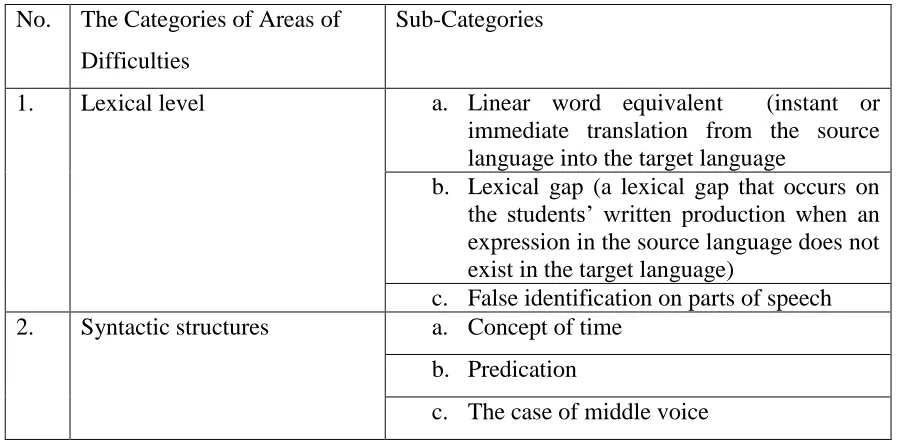
The sentence units that were collected were grouped and categorized on the basis of
the predicted areas of difficulty or potential problems. The analysis of the data was grouped
according to two main areas of difficulties with several sub-categories for each area of
[image:8.612.100.550.365.586.2]difficulty.
Table 1. The Categories of the Areas of Difficulties No. The Categories of Areas of
Difficulties
Sub-Categories
1. Lexical level a. Linear word equivalent (instant or immediate translation from the source language into the target language
b. Lexical gap (a lexical gap that occurs on the students‟ written production when an expression in the source language does not exist in the target language)
c. False identification on parts of speech 2. Syntactic structures a. Concept of time
b. Predication
c. The case of middle voice
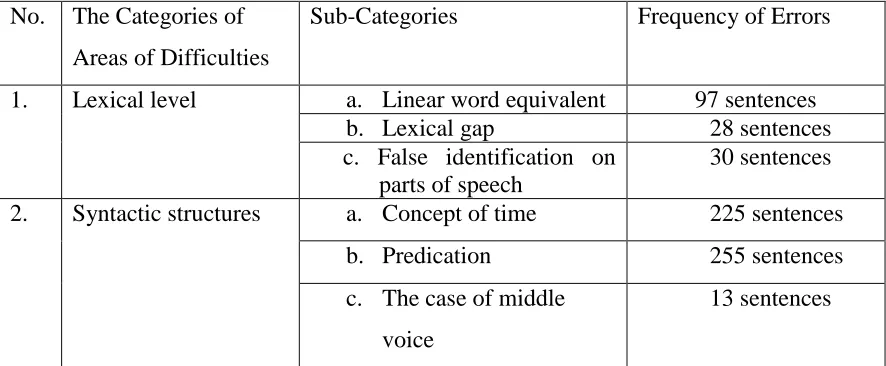
The following is the results of the data analysis in terms of the frequency of errors
Table 2. The Frequency of Errors on the Areas of Difficulties
No. The Categories of
Areas of Difficulties
Sub-Categories Frequency of Errors
1. Lexical level a. Linear word equivalent 97 sentences
b. Lexical gap 28 sentences
c. False identification on parts of speech
30 sentences
2. Syntactic structures a. Concept of time 225 sentences
b. Predication 255 sentences
c. The case of middle
voice
13 sentences
The data analysis shows that all the sentence units on the students‟ writing works are
very much influenced by Indonesian language system. These sentences absolutely do not
undergo an appropriate language processing which takes into account linguistic and
non-linguistic equivalents. As a result, the language produced is simply the manifestation of a
linear translation in which the input in the SL is immediately or instantly changed into the
output in the TL. Here are some examples of the sentence units taken from the students‟
written production:
1. Although my parents, my brother, and my friends so far from me, they never forget to express “congratulation” to me (Meskipun orang tuaku, saudara laki-lakiku, teman-temanku sangat jauh dariku, mereka tidak pernah lupa mengucapkan selamat kepadaku).
2. We are very close friend, so if between us have a problem we must there (Kami adalah
teman dekat, jadi kalau diantara kami mempunyai masalah kami harus disana).
3. I also have a scary mum, that‟s why I spend more time to go outside (Aku juga
mempunyai seorang ibu yang menakutkan, itulah sebabnya aku lebih banyak
menggunakan waktuku untuk pergi keluar).
4. After long time, I‟m very happy to control it to animal doctor and give some medicine
(Setelah waktu yang lama, aku sangat gembira membawa anjingku control ke dokter
5. One day me and my friend went to looking for a boarding house to Karangmalang area
(Suatu hari aku dan temanku mencari kos-kosan di daerah Karangmalang).
6. Suddenly, in the street I look dog big black, our feeling so scare (Tiba-tiba di jalan aku
melihat anjing besar hitam, perasaan kami sangat takut).
These few samples on the sentence units also clearly expose the other areas of
difficulties as identified in table 1. Thus, one sentence unit suffers from several other areas of
difficulties as the consequence of the students‟ incapability in finding out the attributes of the
language equivalents. This leads to the literal and linear transformation of the source into the
target language, which turns to the emergence of the interlanguage phenomena. The
discussion on how the different representation of expressions in the SL influences the output
in the TL will be further outlined in the next part.
2. Discussion
The students‟ incapability in transferring the entire elements of discourse on their written production has brought an inappropriate language transformation which contains
linguistic and non-linguistic constraints. These constraints are visualized in terms of the areas
of difficulties in which the students demonstrated the interlanguage. This part will highlight
in details how the different representations of expressions in the source and the target language intertwine in shaping the students‟ way of thinking when producing their written production.
2.1. The Influence of the Lexical Equivalent Representation in the Source Language
One of the areas of difficulties detected from the selected sentence units is the ability
to figure out an acceptable lexical equivalent. The failure to do so will therefore create linear
word translation and lexical gap. In the former case, the intake of lexical input in the source
language is simply translated into lexical output in the target language without analyzing
their acceptable lexical equivalents. While, lexical gap occurs when an expression in the
lexical gap is how to express the lexical input in the source language into the target language
when the equivalent expression does not exist. To solve this problem, awareness of different
senses of a word with its lexical properties is required. Priyono (2005: 234) exemplifies how
different lexical items in Indonesian can be transformed in the same lexical item in English
by looking at the lexical properties inherent in that word:
a. Hatinya dipenuhi dengan perasaan bersalah.
b. Sekarung beras di bawah tumpukan.
c. Dengan muatan di kendaraannya …
d. Untuk memasukkan kain wool ke kendaraan …
e. Isi trailer kita dengan kayu.
f. Kalau kendaraannya tidak memuat/membawa …
g. Walaupun beban kerjanya berat …
Those input sentences in Indonesian are well-represented in English as follows (ibid):
a. Her heart sank under a fearful load of guilt.
b. A bag of rice in the bottom of the load.
c. With a load on his wagon …
d. To load up some wool on a wagon …
e. Load our trailer with wood.
f. If the van did not load the food …
g. Despite his heavy work load …
It can be inferred from the examples above that the lexical item “load” in the target language can represent the different lexical items in the source language by considering the
lexical properties and the extension of meanings of the word.
The data analysis of this study shows that writing errors in the lexical level occur in
three areas of difficulties with different frequencies. Of 255 sentence units that had been
analyzed, 97 sentences are classified as writing errors in the sub-category of linear word
false identification of parts of speech. The following are the examples of writing errors in the
three sub-categories of the areas of difficulties:
1. At first I couldn‟t see it, until suddenly I stumbled and falled in front of many people. I
was shy.
The lexical item “malu” in Indonesian can be represented by 3 (three) possible words in English, i.e. shy, ashamed, and embarrassed. The lexical property in terms of their lexical
meanings indicate that these three words have their own contextual meanings. Thus, of those
three possible words, the best word equivalent that is supposed to be chosen is the word
embarrassed since the lexical meaning of this word refers to an uncomfortable feeling in a
particular situation; an uncomfortable feeling which is not because of a wrongdoing. This
sentence unit, therefore, represents the writing error in the first sub-category, linear word
equivalent.
2. I‟m still remember when my friends and I went to Sundak beach last August yesterday.
This sentence unit obviously finds a difficulty in finding the best representation for the expression “kemarin”. The pragmatic meaning of the expression “kemarin” in the source language refers to an uncertain period of time. It is then unnecessary to translate the expression “kemarin” in Indonesian into English for its lexical meaning is not well-represented by the expression “yesterday” in English. For this reason, this sentence unit creates a lexical gap.
3. He is clever and patience studies me.
This sentence unit contains a wrong identification of parts of speech. The lexical input “sabar” (adjective) in the source language is transferred into “patience” (noun) in the target language without paying attention to its part of speech equivalent.
2.2. The Influence of the Concept of Time Representation in the Source Language
The different representation for the concept of time in the source language influences the students‟ written production significantly. This finding is supported by most of the analyzed sentence units (225 sentences) which demonstrate inconsistency in transferring the
input of the concept of time in the SL into the one in the TL. The surface structure of the
different representation of the concept of time. The concept of time in Indonesian is not as
complicated as the one in English. In Indonesian, the concept of time is only signaled by the
adverbial of time, such as dulu, sekarang, besok, nanti, tahun lalu, tahun depan, etc., and it is
not necessary to adjust the predication of the sentence. While, in English an equivalent in the
concept of time must be initiated by adjusting the predication (verbs or to be with auxiliaries)
with the correct equivalent patterns of the corresponding concept of time (English tenses).
Here are the examples of the sentence units which contain errors and inconsistency in the
transfer of the concept of time.
1. At that time, I didn‟t know why I feel so ashamed to be happy to welcome my birthday.
2. Finally, I get my job. It was surprising for my friends and my family.
3. It was difficult for me because I spend most of my time outside and take a rest only four
until five hours a day.
4. I remember at the moment with them, when I played with them, when I clean their cage,
when I give them carrot everyday.
5. During SMP she was a bright child. She always occupy the first ranking in her class.
2.3. The Influence of Predication in the Source Language
The structure of predication in Indonesian is less complicated than the one in English.
This is because the predication in Indonesian does not correspond to any tenses as it does in
English. In addition, the predication structure for S + Adjective does not have any marker as
the use of the simple predicate (to be) in English. This is exemplified as follows:
1. Saya makan nasi tiap hari.
2. Dia sangat cantik.
This is different from the structure of English predication which must be adjusted
with the tense marker, either the predication structure for S + Action or the one for S +
Adjective, as shown in the following sentences:
1. She eats rice everyday.
The other complexity of the English predication structure is the use of auxiliaries
which is classified into: 1) tense auxiliaries – be, have/has, will, shall; 2) do auxiliary; and 3)
modal auxiliaries. The tense auxiliaries perform structural function only. Be corresponds to
the-ing present participle in the progressive forms of the tenses and with the –ed past participle
in the passive forms of the tenses. Have/has is used for the perfect tenses; while, shall and will
are used for the future tense. The do auxiliary is followed by the simple form of the verb. It is
used in the simple present tense (do or does) and in the simple past tense (did). The last type of
auxiliary verbs, modal auxiliaries, is used to express semantic components, such as ability,
obligation, possibility, etc.
The analysis on the sentence units shows that the students‟ writing works fail to apply the English predication structure. The structure is inconsistent and simply transfers the inputs
in Indonesian. As a result, the predication structure shown in the analyzed sentence units does
not correspond to any rules of English predication as having been outlined above. Here are the
examples:
1. I‟m very sad because the dog that I’m very loved had been died.
2. A person who can speak Mandarin well is not always can read its writing.
3. I’m still remember when my friends and I went to Sundak beach last August
yesterday.
4. Finally, we choosed for go to home.
5. Suddenly, when we were laughing out loud there were some teachers came in.
2.4. The Influence of the Passive Voice in the Source Language
The influence of the passive voice structure in Indonesian has a great impact to the students‟ way of transferring their ideas in the target language. This transfer is then visualized in the form of the English passive voice. However, the representation of the
passive voice in the source language is not always transformed in the English passive
voice since it is possibly supposed to be transferred into the English middle voice (the
structure between the active and passive voice). Thus, not all the ideas in the Indonesian
passive voice, which is marked by the prefixes “ter- and di-”, are necessarily changed
1. Tanganku terbakar (I burnt my hand) instead of (My hand was burnt).
2. Kecelakaan itu terjadi sebulan yang lalu (That accident happened last month) instead
of (That accident was happened last month).
The data analysis indicates that the case of middle voice is only represented by a
small frequency (13 sentences). However, this finding has become an evidence that the
case of middle voice has been a common error made by English learners in Indonesia; an
error which is very much influenced by the concept of passive voice in the Indonesian
language system. The following are the examples of the case of middle voice found in the
selected sentence units.
1. I was really sad because this event is happened in my birthday and my father‟s
birthday, but I thanks to God because now my father has been recovered.
2. This language is easier to be learned than English.
3. Learning process is not only happened in a formal school but also in our daily life.
4. It is always happen in children.
5. It is an abnormal fright that is difficult to be explained.
D. CONCLUSIONS AND RECOMMENDATIONS
The different representations of expressions between Indonesian and English have indeed influenced the students‟ way of transferring their ideas on their written production. The data analysis on the selected sentence units shows that all the sentences taken as the unit
of sampling in this study are greatly influenced by the system in Indonesian language as the students‟ source language. The senses of the sentences, the pragmatic and semantic meanings, the lexical and syntactic structure of the sentences portray the linear language transfer. Thus,
the textual competence which demands the ability to comply with the organization of the text,
the linguistic and non-linguistic components is something that is not acquired yet by the
subjects of this study. Therefore, some ways to solve this problem must be part of the future
improvement plans.
In regard to the findings of this study, the teaching of writing in the English
the interference of the Indonesian language system. The areas of difficulties that are
potentially be students‟ problems in putting their ideas on their writing works must be
emphasized when discussing the linguistic elements of the texts. At the same time, language awareness by developing the students‟ sensitivity in preserving language equivalents, as proposed by Nord (1994) in the translation study, can be adopted and used to ease the
language transformation process. In so doing, students are trained how to think in English
and minimize the influence of the SL system to the representation of expressions in the TL.
The second point that needs to ponder in relation to the improvement of the quality of the
writing classes in the English Education Study Program is the idea of a text-based teaching in
the writing classes. This is very important to provide students with as many authentic written
exposures as possible to develop and enrich their textual competence. Students can therefore
learn how ideas are organized on and above the sentence level. The idea of incorporating a
grammar-learning strategy training in the writing classes is also a worth-doing
recommendation. Though, this portion should be done in the structure classes, the
instructional design in the writing classes must be able to integrate this training since the
findings of this study have clearly shown that the students‟ writing works do not demonstrate
sufficient grammatical mastery. By facilitating the required elements of the writing process,
such efforts are hopefully be able to support the quality improvement of writing classes in the
future.
REFERENCES
Bhela, Baljit. 1999. “Native Language Interference in Learning a Second Language: Exploratory Case Studies of Native Language Interference with Target Language Usage”. International Education Journal, V.I, N.1.
Brown, H. Douglas. 2000. Principles of Language Learning and Teaching. New York: Addison Wesley Longman, Inc.
Campbell. Stuart. 1998. Translation into the Second Language. New York: Addison Wesley Longman Inc.
Frank, Marcella. 1972. Modern English: A Practical Reference Guide. New Jersey: Prentice Hall, Inc.
Priyono. 2005. “Lexical Constraints in Translation and Learning English as a Foreign Language in Indonesia”. TEFLIN Journal, V.16, N.2, 2 August 2005, TEFLIN Publication Division, c.o. English Department, Faculty of Letters, State University of Malang.
Reid, Joy M. 1993. Teaching ESL Writing. USA: Prentice Hall Regents.
Rasinger, Sebastian. 1999. “Be or Not Be? First Language Interference in Second Language Learning”. http://www.susx.ac.uk
Richards, Jack C. (et.al). 1992. Language Teaching and Applied Linguistics Dictionary. England: Longman Group UK Limited.
Richard-Amato, Patricia A. 2003. Making It Happen: From Interactive to Participatory Language Teaching – Theory and Practice. New York: Pearson Education, Inc.