B O R D E R
L I B E RT I E S
A N D
L O YA LT I E S
North-East England,
c
c
.1200 –
c
c
.1400
Border Liberties and Loyalties
North-East England,
c
. 1200–
c
. 1400
M. L. Holford and K. J. Stringer
© M. L. Holford and K. J. Stringer, 2010 Edinburgh University Press Ltd 22 George Square, Edinburgh www.euppublishing.com Typeset in Minion and Gill Sans
by Servis Filmsetting Ltd, Stockport, Cheshire and printed and bound in Great Britain
CPI Antony Rowe, Chippenham and Eastbourne A CIP record for this book is available from the British Library
ISBN 978 0 7486 3278 7 (hardback)
Th e right of M. L. Holford and K. J. Stringer to be identifi ed as authors of this work has been asserted in accordance with the Copyright, Designs and Patents Act 1988.
Contents
List of Maps and Tables v
Preface vi
Authors’ Notes viii
List of Abbreviations ix
List of Manuscript and Record Sources xvi
Map 1 xxiv
Introduction 1 Matthew Holford and Keith Stringer
PART I THE ECCLESIASTICAL LIBERTIES
1. Durham: History, Culture and Identity 17
Matthew Holford
2. Durham: Government, Administration and the Local
Community 58 Matthew Holford
3. Durham: Patronage, Service and Good Lordship 96
Matthew Holford
4. Durham under Bishop Anthony Bek, 1283–1311 138
Matthew Holford
5. Hexhamshire and Tynemouthshire 172
BORDER LIBERTIES AND LOYALTIES
PART II THE SECULAR LIBERTIES
6. Tynedale: Power, Society and Identities, c. 1200–1296 231 Keith Stringer
7. Tynedale: A Community in Transition, 1296–c. 1400 291 Keith Stringer
8. Redesdale 359
Keith Stringer
Conclusions and Wider Perspectives 413
Matthew Holford and Keith Stringer
Maps and Tables
Maps
1. Th e Greater Liberties of North- East England xxiv 2. Th e Liberty of Durham ‘between Tyne and Tees’ 18
3. Th e Liberty of Hexhamshire 174
4. Th e Liberty of Tynemouthshire 204
5. Th e Liberty of Tynedale 233
6. Th e Liberty of Redesdale 360
Tables
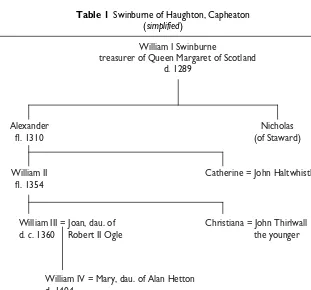
1. Swinburne of Haughton, Capheaton 356
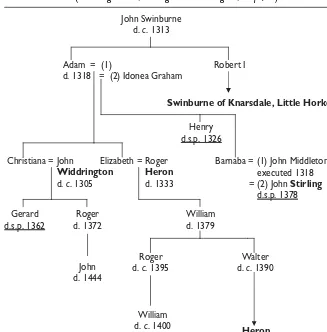
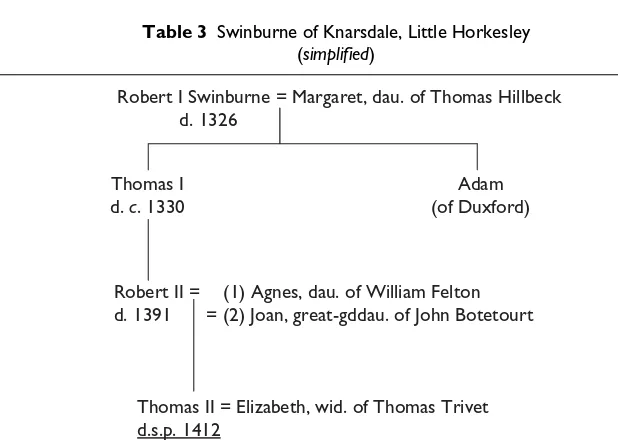
2. Swinburne of Haughton, Little Swinburne 357 3. Swinburne of Knarsdale, Little Horkesley 358
Preface
Th is book could not have been written without the good offi ces of the Leverhulme Trust, which generously funded the research project on which our work is based. Th e project, entitled ‘Border Liberties and Loyalties in North- East England in the Th irteenth and Fourteenth Centuries’, was con-ducted under the joint direction of Michael Prestwich and Keith Stringer as a collaborative venture between the universities of Durham and Lancaster. It was also associated with the North- East England History Institute when it was supported as a Research Centre by the Arts and Humanities Research Council. We are indeed most grateful to all these bodies for their interest and assistance. It is likewise a pleasure to acknowledge that the publication of our fi ndings has been facilitated by an award from the Marc Fitch Fund.
PREFACE
Authors’ Notes
1. As a rule, modern surname forms are used where they exist; otherwise surnames representing identifi able place- names are given according to Ordnance Survey spellings. Th roughout all surnames normally appear without any preceding ‘de’ or ‘of’.
2. Knights are not styled ‘Sir’ on their every occurrence, though their status is made clear whenever it is germane to the argument, and all knights are recorded as such in the Index.
3. Considerations of space have prohibited the inclusion of a full bibliog-raphy of relevant printed material, but the key publications consulted are listed in the Abbreviations.
Abbreviations
AA Archaeologia Aeliana
Acta 1153–95 English Episcopal Acta 24: Durham
1153–1195, ed. M. G. Snape (Oxford,
2002)
Acta 1196–1237 English Episcopal Acta 25: Durham
1196–1237, ed. M. G. Snape (Oxford, 2002)
Acta 1241–83 English Episcopal Acta 29: Durham
1241–1283, ed. P. M. Hoskin (Oxford, 2005)
Bek Recs Records of Antony Bek, Bishop and
Patriarch, 1283–1311, ed. C. M. Fraser (SS, 1953)
BF Th e Book of Fees commonly called Testa de
Nevill (London, 1920–31)
BL British Library
Bodl. Bodleian Library, Oxford
Brand, Newcastle J. Brand, Th e History and Antiquities of . . . Newcastle upon Tyne (London, 1789) Brinkburn Cart. Th e Chartulary of Brinkburn Priory, ed.
W. Page (SS, 1893)
CChR Calendar of the Charter Rolls, 1226–1516
(London, 1903–27)
CCR Calendar of the Close Rolls (London,
1892–)
CCW 1244–1326 Calendar of Chancery Warrants,
1244–1326 (London, 1927)
CDS Calendar of Documents relating to
Scotland, ed. J. Bain, G. G. Simpson and J. D. Galbraith (Edinburgh, 1881–1986)
CFR Calendar of the Fine Rolls (London,
BORDER LIBERTIES AND LOYALTIES
Chron. Lanercost Chronicon de Lanercost, ed. J. Stevenson
(Bannatyne Club, 1839)
CIMisc. Calendar of Inquisitions Miscellaneous
(London, 1916–)
CIPM Calendar of Inquisitions Post Mortem
(London, 1904–)
CPL Calendar of . . . Papal Letters (London,
1893–)
CPR Calendar of the Patent Rolls (London,
1891–)
CR Close Rolls of the Reign of Henry III
(London, 1902–38)
CRO (Carlisle) Cumbria Record Offi ce, Carlisle
CRO (Kendal) Cumbria Record Offi ce, Kendal
CRR Curia Regis Rolls (London, 1922–)
CWAAS Cumberland and Westmorland
Antiquarian and Archaeological Society
Davies, Lordship and Society R. R. Davies, Lordship and Society in the March of Wales, 1282–1400 (Oxford, 1978)
DCL Durham Cathedral Library
DCM Durham Cathedral Muniments (now
housed in Durham University Library, Archives and Special Collections)
DCRO Durham County Record Offi ce, Durham
‘Durham assize rolls’ ‘Two thirteenth- century assize rolls for the county of Durham’, ed. K. C. Bayley, in Miscellanea II (SS, 1916)
EHR English Historical Review
FA Inquisitions and Assessments relating
to Feudal Aids, 1284–1431 (London, 1899–1920)
Fasti Dunelm. Fasti Dunelmenses, ed. D. S. Boutfl ower
(SS, 1927)
Foedera Foedera, Conventiones, Litterae, ed. T.
Rymer, new edn by A. Clark et al. (Record Commission, 1816–69)
FPD Feodarium Prioratus Dunelmensis, ed. W.
ABBREVIATIONS
Fraser, Bek C. M. Fraser, A History of Antony Bek, Bishop of Durham, 1283–1311 (Oxford,
1957)
G&B W. Greenwell and C. H. H. Blair,
Catalogue of the Seals in the Treasury of the Dean and Chapter of Durham, fi rst published in AA, 3rd ser., pp. 7–17 (1911–20), and then separately (1947)
GEC Th e Complete Peerage by G. E. C[okayne],
revised by V. Gibbs et al. (London, 1910–59)
Gesta Dunelm. ‘Gesta Dunelmensia, A.D. MCCC’, ed. R.
K. Richardson, in Camden Miscellany XIII (Camden Th ird Series, 1924)
Gibson, Tynemouth W. S. Gibson, Th e History of the Monastery Founded at Tynemouth (London, 1846–7)
Greenwell Deeds Th e Greenwell Deeds, ed. J. Walton (Newcastle, 1927)
Hartshorne C. H. Hartshorne, Feudal and Military
Antiquities of Northumberland and the Scottish Borders (London, 1858), Appendix III, ‘Iter of Wark’ [the 1279–81 Tynedale eyre roll]
Hatfi eld Survey Bishop Hatfi eld’s Survey, ed. W. Greenwell (SS, 1857)
HC Th e House of Commons, 1386–1421, ed.
J. S. Roskell, L. Clark and C. Rawcliff e (Stroud, 1992)
Hexham Priory Th e Priory of Hexham, ed. J. Raine (SS, 1864–5)
HN J. Hodgson, A History of Northumberland
(Newcastle, 1820–58)
JBS Journal of British Studies
Laing Chrs Calendar of the Laing Charters, ed. J.
Anderson (Edinburgh, 1899)
Lapsley, Durham G. T. Lapsley, Th e County Palatine of Durham (New York, 1900)
Lucy Cart. Lucy Cartulary (xvi cent.), Cockermouth
BORDER LIBERTIES AND LOYALTIES
NAR Th ree Early Assize Rolls for the County of
Northumberland, ed. W. Page (SS, 1891)
NCH A History of Northumberland
(Northumberland County History Committee, Newcastle, 1893–1940)
NCS Northumberland Collections Service,
Woodhorn (formerly Northumberland Record Offi ce, Gosforth)
NDD Northumberland and Durham Deeds from
the Dodsworth MSS., ed. A. M. Oliver (NRC, 1929)
NER Th e Northumberland Eyre Roll for 1293,
ed. C. M. Fraser (SS, 2007)
Neville, Violence C. J. Neville, Violence, Custom and Law: Th e Anglo- Scottish Border Lands in the Later Middle Ages (Edinburgh, 1998)
Newcastle Deeds Early Deeds relating to Newcastle upon
Tyne, ed. A. M. Oliver (SS, 1924)
Newminster Cart. Chartularium Abbathiae de Novo
Monasterio, ed. J. T. Fowler (SS, 1878)
NH Northern History
NLS Th e Northumberland Lay Subsidy Roll
of 1296, ed. C. M. Fraser (Society of Antiquaries of Newcastle upon Tyne, 1968)
Northern Pets Northern Petitions Illustrative of Life in
Berwick, Cumbria and Durham in the Fourteenth Century, ed. C. M. Fraser (SS, 1982)
Northumb. Fines, i Feet of Fines, Northumberland and Durham, ed. A. M. Oliver and C. Johnson (NRC, 1931)
Northumb. Fines, ii Feet of Fines, Northumberland, A.D. 1273–A.D. 1346, ed. C. Johnson (NRC, 1932)
Northumb. PDBR Northumbrian Pleas from De Banco Rolls
[1272–80], ed. A. H. Th ompson (SS, 1950)
Northumb. Pets Ancient Petitions relating to
ABBREVIATIONS
Northumb. Pleas Northumberland Pleas from the Curia
Regis and Assize Rolls, 1198–1272, ed. A.
H. Th ompson (NRC, 1922)
Notts. Archives Nottinghamshire Archives, Nottingham
NRC Newcastle upon Tyne Records Committee
NYCRO North Yorkshire County Record Offi ce,
Northallerton
‘Offi ce- holders’, i M. L. Holford, ‘Offi ce- holders and political society in the liberty of Durham, 1241–1345 (part 1)’, AA, 5th ser., 36 (2007), pp. 93–110
‘Offi ce- holders’, ii M. L. Holford, ‘Offi ce- holders and political society in the liberty of Durham, 1241–1345 (part 2)’, AA, 5th ser., 37 (2008), pp. 161–82
Parl. Writs Parliamentary Writs and Writs of Military
Summons, ed. F. Palgrave (Record Commission, 1827–34)
Percy Cart. Th e Percy Chartulary, ed. M. T. Martin
(SS, 1911)
PQW Placita de Quo Warranto, ed. W.
Illingworth (Record Commission, 1818)
PROME Th e Parliament Rolls of Medieval
England, 1275–1504, ed. C. Given- Wilson (Woodbridge, 2005)
PSAN Proceedings of the Society of Antiquaries of
Newcastle upon Tyne
Raine, North Durham J. Raine, Th e History and Antiquities of North Durham (London, 1852)
Reg. Corbridge Th e Register of Th omas Corbridge, Lord Archbishop of York, 1300–1304, ed. W. Brown (SS, 1925–8)
Reg. Giff ard Th e Register of Walter Giff ard, Lord Archbishop of York, 1266–1279, ed. W. Brown (SS, 1904)
Reg. Gray Th e Register, or Rolls, of Walter Gray, Lord
Archbishop of York, ed. J. Raine (SS, 1872) Reg. Greenfi eld Th e Register of William Greenfi eld, Lord
BORDER LIBERTIES AND LOYALTIES
Reg. Langley Th e Register of Th omas Langley, Bishop of Durham, 1406–1437, ed. R. L. Storey (SS,
1956–70)
Reg. Melton Th e Register of William Melton,
Archbishop of York, 1317–1340, ed. R. M. T. Hill et al. (Canterbury and York Society, 1977–)
Reg. Melton Register of Archbishop William Melton
of York (1317–40), Borthwick Institute, York, Reg.9A–B
Reg. Neville Register of Archbishop Alexander Neville
of York (1374–88), Borthwick Institute, York, Reg.12
Reg. Newark Th e Register of Henry of Newark, Lord
Archbishop of York, 1296–1299, ed. W. Brown(SS, 1917)
Reg. Romeyn Th e Register of John le Romeyn, Lord
Archbishop of York, 1286–1296, ed. W. Brown (SS, 1913–17)
Reg. Th oresby Register of Archbishop John Th oresby
of York (1352–73), Borthwick Institute, York, Reg.11
Reg. Wickwane Th e Register of William Wickwane, Lord
Archbishop of York, 1279–1285, ed. W. Brown (SS, 1907)
Reg. Zouche Register of Archbishop William Zouche
of York (1342–52), Borthwick Institute, York, Reg.10
RH Rotuli Hundredorum, ed. W. Illingworth
(Record Commission, 1812–18)
RLC Rotuli Litterarum Clausarum in Turri
Londinensi Asservati, ed. T. D. Hardy (Record Commission, 1833–4)
Rot. Scot. Rotuli Scotiae in Turri Londinensi . . .
Asservati, ed. D. Macpherson, J. Caley and W. Illingworth (Record Commission, 1814–19)
Royal Letters Royal and Other Historical Letters
ABBREVIATIONS
RPD Registrum Palatinum Dunelmense: Th e
Register of Richard de Kellawe, Lord Palatine and Bishop of Durham, 1311– 1316, ed. T. D. Hardy (RS, 1873–8)
RS Rolls Series
Scriptores Tres Historiae Dunelmensis Scriptores Tres, ed. J. Raine (SS, 1839)
SS Surtees Society
Stevenson, Docs Documents Illustrative of the History of Scotland, 1286–1306, ed. J. Stevenson (Edinburgh, 1870)
Storey, Langley R. L. Storey, Th omas Langley and the Bishopric of Durham, 1406–1437 (London, 1961)
Surtees R. Surtees, Th e History and Antiquities of
the County Palatine of Durham (London, 1816–40)
TCE Th irteenth Century England
TCWAAS Transactions of the Cumberland
and Westmorland Antiquarian and Archaeological Society
TRHS Transactions of the Royal Historical
Society
Tynemouth Cart. Tynemouth Priory Cartulary (xiv cent.),
Alnwick Castle, Northumberland, MS D.XI.1
VCH Victoria History of the Counties of
England
YASRS Yorkshire Archaeological Society Record
Manuscript and Record Sources
National Repositories
Th e National Archives: Th e Public Record Offi ce
(Unless otherwise specifi ed, all unpublished sources cited in this book are housed in Th e National Archives.)
Admiralty
ADM 75 Royal Greenwich Hospital: Deeds
Chancery
C 1 Six Clerks Offi ce: Early Proceedings
C 44 Common Law Pleadings, Tower Series
C 47 Miscellanea
C 49 Parliamentary and Council Proceedings
C 54 Close Rolls
C 66 Patent Rolls
C 67 Supplementary Patent Rolls
C 76 Treaty Rolls
C 81 Warrants for the Great Seal, Series I
C 133–9 Inquisitions Post Mortem
C 143 Inquisitions Ad Quod Damnum
C 145 Miscellaneous Inquisitions
C 146 Ancient Deeds, Series C
C 241 Certifi cates of Statute Merchant and Statute Staple
C 255 Miscellaneous Files and Writs
C 260 Recorda
Common Pleas
CP 25/1 Feet of Fines
CP 40 Plea Rolls
MANUSCRIPT AND RECORD SOURCES
Duchy of Lancaster
DL 27 Deeds, Series LS
DL 29 Accounts of Auditors, etc.
Exchequer
E 32 Justices of the Forest
E 36 Treasury of the Receipt: Miscellaneous Books
E 40 TR: Ancient Deeds, Series A
E 42 TR: Ancient Deeds, Series AS
E 43 TR: Ancient Deeds, Series WS
E 101 King’s Remembrancer: Accounts Various
E 122 KR: Customs Accounts
E 142 KR: Extents, etc., of Forfeited Lands
E 149 KR: Escheators’ Files
E 159 KR: Memoranda Rolls
E 179 KR: Subsidy Rolls
E 198 KR: Feudal Tenure and Distraint of Knighthood
E 199 KR and Lord Treasurer’s Remembrancer: Sheriff s’ Accounts, etc.
E 202 KR: Writs, Original Series
E 210 KR: Ancient Deeds, Series D
E 326 Augmentation Offi ce: Ancient Deeds, Series B
E 329 AO: Ancient Deeds, Series BS
E 358 Pipe Offi ce: Miscellaneous Enrolled Accounts
E 359 PO: Account Rolls of Subsidies and Aids
E 368 LTR: Memoranda Rolls
E 372 PO: Pipe Rolls
Itinerant Justices
JUST 1 Eyre Rolls, etc.
JUST 3 Gaol Delivery Rolls
King’s Bench
KB 9 Indictments Files, etc.
KB 27 Coram Rege Rolls
Palatinate of Durham
DURH 3 Chancery Court: Cursitor’s Records
DURH 13 Assizes and Court of Pleas: Plea and Gaol Delivery Rolls
BORDER LIBERTIES AND LOYALTIES
Special Collections
SC 1 Ancient Correspondence
SC 6 Ministers’ and Receivers’ Accounts
SC 8 Ancient Petitions
Other Sources
IND Indexes to Various Series
PRO Domestic Records of the Public Record Offi ce (including transcripts)
British Library
Additional Charters
Cotton Roll XIII.8 Earl of Northumberland’s Retinue- list, 1385 Egerton Charters
Harley Charters MSS Additional
8835 Wardrobe Book, 1303–4
28024 Beauchamp Cartulary, xv cent.
MSS Cotton
Claudius D.IV Durham Priory: Historical Collections, xv cent. Faustina A.VI Durham Priory Register, xiv cent.
Nero C.VIII Wardrobe Accounts, 1310–37
Tiberius E.VI St Albans Abbey Register, xiv–xv cent. Vitellius A.XX Historical Collections, xiii cent.
MS Harley 4843 Durham Priory: Historical Collections, xvi cent. MSS Lansdowne
397 Durham Priory: Miscellaneous Collections, xiv
cent.
902 Transcripts, xviii cent.
MSS Stowe
553 Wardrobe Book, 1322–3
930 Durham Priory Register, xiii–xiv cent.
Other Repositories
Alnwick Castle, Northumberland
MS D.XI.1 Tynemouth Priory Cartulary, xiv
cent.
MANUSCRIPT AND RECORD SOURCES
Balliol College, Oxford
E.4 Stamfordham and Heugh
Bodleian Library, Oxford
MSS Dodsworth 45, 78, 94, 149 Transcripts, xvii cent.
MS Eng. c. 7032 Towneley Papers, xvii cent.
MS Laud. Misc. 748 Durham Priory: Historical Collections, xv cent.
MS Tanner 197 Wardrobe Accounts, 1311
MS Top. Yorks. e. 8 Transcripts, xviii cent.
Borthwick Institute, York
Reg.9A–B Register of Archbishop William Melton (1317–40)
Reg.10 Register of Archbishop William Zouche (1342–52)
Reg.11 Register of Archbishop John Th oresby (1352–73) Reg.12 Register of Archbishop Alexander Neville (1374–88)
Castle Howard, Yorkshire
A1 Dacre and Greystoke
Cockermouth Castle, Cumbria
D/Lec/301 Lucy Cartulary, xvi cent.
Cumbria Record Offi ce
(a) Carlisle
D/Ay Aglionby
D/HA Hough, Halton and Soal of Carlisle
D/HC Howard of Corby
D/HGB Blencow of Blencowe
D/Lons/L Lowther of Lowther, Earls of Lonsdale
D/MBS Mounsey, Bowman and Sutcliff e of Carlisle
DMH Mounsey- Heysham
D/Mus Musgrave of Edenhall
BORDER LIBERTIES AND LOYALTIES
D/Wyb Wybergh
MS Machell 5 Transcripts, xvii cent.
(b) Kendal
WD/Crk Crackanthorpe of Newbiggin WD/Ry Le Fleming of Rydal Hall
Durham Cathedral Library
MS Raine 52 Transcripts, xix cent. MSS Randall 3, 5 Transcripts, xviii cent.
Durham County Record Offi ce, Durham
D/Gr Greenwell Deeds
D/Lo Londonderry Estates
D/Sa Salvin of Croxdale
D/Sh.H Sherburn Hospital
D/St Strathmore Estate
Durham University Library, Archives and Special Collections
(a) Palace Green
HNP/N Howard Family: Northumberland
SGD 54 Littleburn, Holywell and Naff erton
(b) 5 Th e College
Durham Cathedral Muniments Original Deeds, etc.
Elemos. Elemosinaria
Finc. Finchalia
Haswell Deeds
Loc. Locelli
Misc. Ch. Miscellaneous Charters
Pont. Pontifi calia
Reg. Regalia
Sacr. Sacristaria
SHD Sherburn Hospital
MANUSCRIPT AND RECORD SOURCES
Other Sources Bursar’s Accounts
Cart. I–IV Cartularia, xv cent.
Cart. Vet. Cartuarium Vetus, xiii cent. Reg. II Priory Register, xiv–xv cent. Reg. Hatfi eld Register of Bishop Th omas Hatfi eld
(1345–81)
Rep. Mag. Repertorium Magnum, xv cent.
Essex Record Offi ce, Chelmsford
D/DBy/T27 Miscellaneous Deeds
Guildhall Library, London
MS 31302 Skinners’ Company
John Rylands Library, Deansgate, Manchester
Latin MS 236 Accounts of Queen’s Household, 1357–8
PHC Phillipps Charters
Lancashire Record Offi ce, Preston
DDTO Towneley of Towneley
Levens Hall, Cumbria
Medieval Deeds
Lincolnshire Archives, Lincoln
Dean and Chapter Muniments
Dij/62/iii Lincolnshire Churches
Merton College, Oxford
BORDER LIBERTIES AND LOYALTIES
Northamptonshire Record Offi ce, Northampton
Stopford- Sackville Muniments
Northumberland Collections Service, Woodhorn
324 Blackett- Ord of Whitfi eld
SANT/TRA Society of Antiquaries of Newcastle upon Tyne: Transcripts of Records
Waterford Charters
ZBL Blackett of Matfen
ZMI Middleton of Belsay
ZSW Swinburne of Capheaton
North Yorkshire County Record Offi ce, Northallerton
ZAZ Hutton of Marske
ZBO Bolton Hall
ZIQ Meynell of Kilvington
ZQH Chaytor of Croft
Nottinghamshire Archives, Nottingham
DD/4P, 6P Portland of Welbeck, 4th and 6th Deposits
DD/FJ Foljambe of Osberton
Nottingham University, Manuscripts and Special Collections
PL/E11 Dukes of Portland: Northumberland Estates
St George’s Chapel Archives and Chapter Library, Windsor Castle
XI.K. Ancient Deeds
Shakespeare Birthplace Trust, Stratford- upon- Avon
MANUSCRIPT AND RECORD SOURCES
Society of Antiquaries, London
MS 120 Wardrobe Book, 1316–17
MS 121 Wardrobe Book, 1317–18
York Minster Library and Archives
Introduction
Matthew Holford and Keith Stringer
T
his book is the first full- length modern study of lordship and society in the North- East of England in the thirteenth and fourteenth cen-turies. In part it explores the workings of political life in the English Borders in ways that may usefully advance research into the structures and dynamics of medieval frontierlands. More particularly, by address-ing the institutions and political cultures of medieval England beyond its metropolitan heartlands, it aims to achieve fresh perspectives on the real-ities of power and politics that underlay Westminster- centred orthodox-ies about the English experience of ‘state- making’. And, above all, it seeks to illuminate the significance of the greater north- eastern liberties – that is, largely self- regulating territorial jurisdictions – for local authority and governance and for socio- political cohesion and identification. Similarly, while the North- East had its own setting and history, we hope that our findings will have a wider bearing on the relevance of medieval England’s liberties for people’s lives and loyalties, and will thereby contribute to the mainstream of ongoing debates about ‘state’, ‘society’, ‘identity’ and ‘community’.1It is a commonplace that in our period England consolidated its position as the most centralised ‘state’ in the medieval West. Indeed, even by about 1250 the authority of the English monarchy was ‘ubiquitous and, on its own terms, exclusive’.2 Yet a closer look at how power was distributed and
asserted in the mid- thirteenth- century kingdom is instructive. Much local government was exercised not solely by the crown and its offi cers, but in diff erent degrees through power- structures enjoying so- called ‘franchisal
1 For a broader conceptualisation, see K. J. Stringer, ‘States, liberties and communities in medieval Britain and Ireland (c. 1100–1400)’, in M. Prestwich (ed.), Liberties and Identities in the Medieval British Isles (Woodbridge, 2008), pp. 5–36.
BORDER LIBERTIES AND LOYALTIES
rights’.3 Th us liberties of various sorts (ignoring hundredal and lesser
juris-dictions) peppered the countryside from the English Channel to the Scottish Border. Th e most typical were those with ‘return of writs’, which allowed liberty- owners to execute all the normal duties and powers of the king’s sheriff s, and to hold courts equivalent to county courts, whose competence was much inferior to that of full royal courts, but much superior to that of ordinary honour or manor courts. Several earls and many bishops claimed this prerogative, as did numerous religious houses such as the abbeys of Abingdon, Chertsey, Cirencester, Evesham, Waltham and Westminster. Return of writs was likewise a routine perquisite of privileged boroughs – in 1255–7, for example, no fewer than twenty- two towns received royal con-fi rmations of this right – and it could also be held over large areas, including the Isle of Wight, the Soke of Peterborough, Holderness, Richmondshire, and most of Cambridgeshire and Suff olk.4 All fraunchise, as Chief Justice
Scrope was to state in 1329, ‘is to have jurisdiction and rule over the people’;5 and such liberties had a real eff ect on the processes of local
govern-ance and control. Th ey therefore provide one important frame of reference within which the operation of local power can be understood; and they were in fact so widespread that none of the king’s counties was a uniform legal and administrative unit under the sheriff ’s direct supervision. Each dissolves on examination into a jumble of jurisdictions.6
During the course of Henry III’s reign (1216–72), a select number of liberties were also formalising their rights to dispense royal justice in their own courts. Th ey claimed cognisance of the civil pleas usually tried before the king’s justices; their criminal jurisdiction covered the crown pleas withdrawn from the king’s sheriff s by Magna Carta of 1215. Most of these liberties were located at ecclesiastical centres such as Battle, Beverley and Ripon; and in some cases, as at Bury St Edmunds, Ely, Glastonbury and Ramsey, no crown offi cer took any part in the hearing of pleas. Even these latter examples, however, did not represent the highest level of local autonomy and authority: justice and administration were conducted by liberty offi cers, but oft en on the basis of royal commands; and royal writs were necessary to initiate the possessory assizes and other actions
3 Useful surveys include S. Painter, Studies in the History of the English Feudal Barony (Baltimore, 1943), Chapter 4.
4 A key study is M. T. Clanchy, ‘The franchise of return of writs’, TRHS, 5th ser., 17 (1967), pp. 59–82.
5 Quoted in A. Harding, Medieval Law and the Foundations of the State (Oxford, 2002), p. 214.
INTRODUCTION
concerning freehold estates.7 In contrast, the emergent ‘royal liberties’,
‘regalities’ or (ultimately) ‘counties palatine’ lay more completely outside the orbit of crown jurisdiction, and were defi ned primarily by the maxim that ‘the king’s writ does not run there’. Th us in principle they were dis-tinct self- governing entities, and in practice the king and his ministers normally recognised their independent existence. Th ey possessed their own separate ‘royal’ institutions, which were staff ed by their own person-nel and replicated in microcosm the apparatus through which the ‘state’ could assert itself. Each liberty naturally had its own shire organisation; crown and civil pleas were sued before the lord’s justices and by his own writs; and it was already assumed that ‘regal jurisdiction’ included exemption from parliamentary taxation. Th e lord himself was the main focus of rule and law within the liberty, and it was his peace, not the king of England’s peace, that was enforced locally. He also enjoyed broader powers of lordship and patronage similar to those exercised by the crown elsewhere in the kingdom; and his governmental and political authority exceeded that of all other English liberty- owners save the ‘lords royal’ of the March of Wales. Medieval England’s regalities included the earldom of Chester and the palatinate of Lancaster (1351–61 and from 1377); the other concentration was in the North- East.
Th e various kinds of liberty just described have long attracted scholarly attention; yet, with the notable exception of Chester, the heyday of their historiography was in the fi rst two- thirds of the twentieth century.8 Th e
resulting studies, many of continuing value, are not easily summarised. But beginning with Gaillard Lapsley’s pioneering book on Durham, pub-lished as A Study in Constitutional History in 1900, they generally centred on institutional theory and forms; and thanks mainly to Helen Cam’s writings in the 1940s and 1950s, there was a marked predisposition to set the history of liberties fi rmly within a power- map defi ned by the English crown according to its own specifi cations. So it was that historians in essence accepted the neat- and- tidy view of the world held by century royal lawyers such as Henry Bracton, who took it for granted that all jurisdiction derived from the crown and was exercised exclusively in its name. Indeed, Cam wrote of ‘the king’s government as administered by the
7 M. D. Lobel, ‘The ecclesiastical banleuca in England’, in Oxford Essays in Medieval History (Oxford, 1934), pp. 122–40; and, most recently, A. Gransden, A History of the Abbey of Bury St. Edmunds, 1182–1256 (Woodbridge, 2007), Chapter 20.
BORDER LIBERTIES AND LOYALTIES
greater abbots of East Anglia’: liberty- owners were thus to be regarded as royal surrogates and servants, while their offi cials were also characterised as ‘the king’s ministers and bailiff s’.9 Likewise something of a Bractonian
consensus emerged that medieval ‘state- formation’ depended not on any dynamic of governmental pluralism but on the integrating force of central authority and institutions. Accordingly a paradigm was constructed of the linear expansion of crown power and centralisation, so that even ‘royal liberties’ were relegated to the historical sidelines on the grounds that they became much like standard counties. ‘Th eir infl ated reputations’, Jean Scammell observed, ‘falsify many assessments of the eff ectiveness of mon-archy and the possible extent of immunities in medieval England’; and she went on to conclude that Durham should be seen as little more than ‘an enormous estate situated in a remote part of England’.10 In similar vein,
James Alexander categorised Chester, Durham and Lancaster as ‘puny local quasi- autonomies’, and believed that, so far as Edward I and Edward III were concerned, ‘the reality of power they shared not’.11
Th is was a far cry from the view of Robin Storey (echoing Lapsley) that the bishops of Durham ‘exercised an authority equal in its scope to that of the King elsewhere in the realm’.12 Rather, liberties of all types were merely
‘cogs’ in the ‘magnifi cent machine’ of medieval English royal governance.13
Or, as Eleanor Searle argued in her work on Battle, a liberty’s place in the local governmental and political order was decided by the king’s decree.14
Th ere was thus much less interest in the actual powers of liberty- owners over those whom they might call their ‘subjects’; or in how a liberty’s insti-tutional and political frameworks might have benefi ted local society and shaped its behaviour, values and loyalties. And traditional approaches have indeed cast a long shadow. Robert Palmer, for instance, set his analysis of the relationship between the jurisdictions of county courts and liberty courts largely within the context of their integration into a single ‘national’
9 H. M. Cam, Liberties and Communities in Medieval England, new edn (London, 1963), pp. 183–204, and her ‘Shire officials: coroners, constables, and bailiffs’, in J. F. Willard et al. (eds), The English Government at Work, 1327–1336 (Cambridge, MA, 1940–50), iii, p. 149.
10 J. Scammell, ‘The origin and limitations of the liberty of Durham’, EHR, 81 (1966), pp. 452, 473. Cf. R. B. Dobson, Church and Society in the Medieval North of England (London, 1996), p. 89: ‘the capacity of the bishops . . . of Durham to play an autonomous role on the Anglo- Scottish Border was virtually non- existent’.
11 J. W. Alexander, ‘The English palatinates and Edward I’, JBS, 22 (1983), p. 22. 12 Storey, Langley, p. 52; cf. Lapsley, Durham, p. 76.
13 Cam, Liberties and Communities, pp. 207, 216.
INTRODUCTION
justice system.15 More recent work by legal historians has tended, directly
or indirectly, to endorse such formulations and conclusions.16 Th ey
like-wise sit easily with some current interpretations of the late- medieval English constitution. Th us, to cite Helen Castor, ‘the hierarchies of govern-ment, both formal and informal, depended fundamentally on the universal and universally representative authority of the crown’.17
Admittedly conceptions of this sort have not gone unchallenged. Rees Davies urged us to recognise that medieval government was everywhere less uniform and unipartite than étatist story- lines presuppose. ‘We should’, so we learn, ‘beware of reifying the state, of accepting its own defi nition of, and apologia for, itself.’18 For later medieval England, Gerald
Harriss has made clear the complexities of the interplay between the ‘public’ and the ‘private’ aspects of local power, and how the ‘private’ could mesh with, parallel or rival the ‘public’.19 More particularly, some historians
of England’s liberties have explicitly called into question the homogenising capacity of the crown’s superiority and control. Edward Miller cautioned against the notion that the thirteenth century saw ‘a taming of liberties, a harnessing of their machinery to the machinery of the state’.20 We have
also been reminded that individual liberty- owners might jealously defend their prerogatives against royal encroachment by insisting that they were independent local rulers, who enjoyed a lawful jurisdiction ‘from time out of mind’.21 Nor did Simon Walker doubt that John of Gaunt, as duke
of Lancaster, was ‘the only source of justice and patronage within his palatinate’, or that his lordship was ‘almost unrestrained by the exercise of royal power’.22 Even lesser liberties, in Rodney Hilton’s opinion, were
signifi cant nodes of local governance since what mattered in ‘an inevitably decentralized state’ was the law as administered by the immediate lord.23
15 R. C. Palmer, The County Courts of Medieval England, 1150–1350 (Princeton, 1982), Chapter 9.
16 Compare, for example, the important review of A. Musson and W. M. Ormrod, The Evolution of English Justice (London, 1999), by C. Donahue, Jr, in Michigan Law Review, 98 (2000), pp. 1725–37.
17 H. Castor, The King, the Crown, and the Duchy of Lancaster (Oxford, 2000), p. 306. 18 R. R. Davies, ‘The medieval state: the tyranny of a concept?’, Journal of Historical Sociology,
16 (2003), p. 289.
19 G. Harriss, Shaping the Nation: England, 1360–1461 (Oxford, 2005), especially pp. 163–75.
20 E. Miller, The Abbey and Bishopric of Ely (Cambridge, 1951), p. 242.
21 For example, A. Gransden, ‘John de Northwold, abbot of Bury St. Edmunds (1279–1301), and his defence of its liberties’, TCE, 3 (1991), pp. 91–112.
22 S. Walker, The Lancastrian Affinity, 1361–1399 (Oxford, 1990), p. 179, and his ‘Lordship and lawlessness in the palatinate of Lancaster, 1370–1400’, JBS, 28 (1989), p. 328. 23 R. H. Hilton, A Medieval Society: The West Midlands at the End of the Thirteenth Century
BORDER LIBERTIES AND LOYALTIES
New work has gone a stage further by powerfully disputing the concept of an inexorable growth of crown regulation and administrative uniformity over the long duration. Th us important studies of Cheshire and Durham by Tim Th ornton and Christian Liddy have highlighted the continued governmental vitality of these liberties, the extent to which the monarchy respected their status as entities distinct from the rest of the kingdom, and the resilience of regional autonomy as a potent and enduring idea into the early modern era.24
Moreover, some scholars have pointed directly to the roles liberties might play in moulding common attitudes, interests and allegiances. When Nigel Saul referred to fourteenth- century Sussex as ‘a county of communi-ties’, and Tony Pollard found in fi ft eenth- century Yorkshire ‘“counties” within the county’, they based their assessments on brief if revealing analy-ses of how each county’s ‘rapes’ or ‘shires’ infl uenced its social and political structures.25 Robert Somerville took the view that Lancashire’s palatinate
courts created a deep and abiding sense of local attachment because they were prized sources of speedy and familiar justice.26 Majorie McIntosh’s
study of the hundredal liberty of Havering in Essex, and Andy Wood’s long look at privileged mining communities such as that of Alston Moor in Cumberland, have stressed the signifi cance of relatively minor jurisdictions for socio- legal solidarities.27 Relatedly, Alan Harding has argued for the
importance of ‘franchises’ as sources of people’s rightful customs and per-sonal freedoms, so that ‘the meaning of liberties [shift ed] from the powers of the prelates and barons to the rights of individual subjects’.28 No less
pro-foundly, Th ornton’s work on Cheshire, and Liddy’s on Durham, have
sug-24 Thornton: Cheshire and the Tudor State, 1480–1560 (Woodbridge, 2000); century Durham and the problem of provincial liberties in England and the wider ter-ritories of the English crown’, TRHS, 6th ser., 11 (2001), pp. 83–100; ‘The palatinate of Durham and the Maryland charter’, American Journal of Legal History, 45 (2001), pp. 235–55. Liddy: ‘The politics of privilege: Thomas Hatfield and the palatinate of Durham, 1345–81’, Fourteenth Century England, 4 (2006), pp. 61–79; The Bishopric of Durham in the Late Middle Ages (Woodbridge, 2008).
25 N. Saul, Scenes from Provincial Life: Knightly Families in Sussex, 1280–1400 (Oxford, 1986), p. 60; A. J. Pollard, North- Eastern England during the Wars of the Roses (Oxford, 1990), p. 153.
26 R. Somerville, ‘The palatinate courts in Lancashire’, in A. Harding (ed.), Law- Making and Law- Makers in British History (London, 1980), pp. 54–63.
27 M. K. McIntosh, Autonomy and Community: The Royal Manor of Havering, 1200–1500 (Cambridge, 1986); A. Wood, ‘Custom, identity and resistance: English free miners and their law, c. 1550–1800’, in P. Griffiths, A. Fox and S. Hindle (eds), The Experience of Authority in Early Modern England (London, 1996), pp. 249–85. On the Alston miners, see further below, especially Chapter 6, pp. 238–40, 275, 279.
INTRODUCTION
gested how major liberties might foster independent political cultures and act as ‘imagined worlds’ around which local identities could crystallise.29
Such insights, it would seem, invite historians to rethink traditional assumptions about the taxonomy of the medieval English ‘state’ or, to be more precise, the manner in which diff erent governance systems interacted with society, their relative signifi cance for power, loyalty and identity, and the extent to which England’s ‘local polity’ was in reality a polycentric order of multiple local polities. Yet despite some questioning of earlier views, the fact remains that the central issues in recent scholarship have been the institutions of ‘bureaucratic monarchy’ or, more particularly, govern-ment and political society as organised around the king’s counties.30 So it
is that liberties in their own rights have rarely fi gured in the work done over the last decade and more on such seminal themes as the interaction of law and society, the origins and development of ‘bastard feudalism’, and the emergence of the gentry. Rather, the emphasis has been on deepening our understanding of a legal system and culture presided over by the king and his justices; of the ability of individual magnates (or, more oft en, their inability) to dominate county politics; and of the role played by the county as a focus for a rising gentry class in terms of service, advancement and identifi cation.31 Not least the existence and nature of ‘county communities’
have been keenly argued, largely in relation to a county’s administration and its encounters with the crown, and in ways that take little account of the sum of local jurisdictions within, or co- existent with, county jurisdictions.32
Such approaches have therefore had only limited relevance for registering the possible or actual signifi cance of alternative institutional frameworks for local governance and society.33 And, certainly, they do not provide
ready- made models for illuminating the history of the medieval
North-29 Thornton, Cheshire and the Tudor State, Chapter 2; Liddy, Bishopric of Durham, Chapter 5.
30 Recent reinforcements of state- centred paradigms include A. Jobson (ed.), English Government in the Thirteenth Century (Woodbridge, 2004).
31 See respectively (and most accessibly), A. Musson, Medieval Law in Context (Manchester, 2001); M. A. Hicks, Bastard Feudalism (London, 1995); P. Coss, The Origins of the English Gentry (Cambridge, 2003).
32 For an influential survey, see C. Carpenter, ‘Gentry and community in medieval England’, JBS, 33 (1994), pp. 340–80. The latest contributions include J. Freeman, ‘Middlesex in the fifteenth century: county community or communities?’, in M. A. Hicks (ed.), Revolution and Consumption in Late Medieval England (Woodbridge, 2001), pp. 89–103; A. Polden, ‘The social networks of the Buckinghamshire gentry in the thirteenth century’, Journal of Medieval History, 32 (2006), pp. 371–94.
BORDER LIBERTIES AND LOYALTIES
East, which had more in common with the highly fragmented governmen-tal landscapes of the March of Wales and of English Ireland than with much of midland and southern England.
Such a statement requires some amplifi cation. In 1352 reference was made to ‘royal liberties’ in Ireland ‘like Durham and Chester [that] take from the king not only great profi ts, but much of the obedience of the persons enfranchised’.34 Strictly speaking, this assessment exaggerated the
legal- constitutional status of the Irish liberties: aft er all, their courts were rarely entitled to hold all crown pleas, their church lands were supposed to come under the jurisdiction of the king’s sheriff s, and their inhabitants were liable to the king’s taxes.35 A closer parallel for the greater north- eastern
liberties is supplied by the Welsh March. Th e prerogatives and rule- making powers of the Marcher liberties were undoubtedly more exclusive, so that they remained in a remarkable sense beyond the reach of the English mon-archy and its agents. But it is the magisterial work of Rees Davies on these liberties that has provided the key contextual basis – and the main inspira-tion – for the present study.36 Indeed, for all that the March was atypical
and distinctive, his analyses of how liberties fi tted into and infl uenced the organisation of governance and loyalties have set an agenda that is gener-ally applicable to the institutional and political confi guration of the English polity as a whole. And, in fact, it was Davies’s scrutiny of the March that in due course prompted his reappraisal of the anatomy of the medieval ‘state’, including that of ‘crown- centred’ England itself. For there, too, power might well be characterised by its ‘alternative nodal points’, its ‘multiplex nature’ and its ‘plurality and overlapping context’.37
What then were the local coordinates of government and justice in the medieval North- East? A composite snapshot is provided by the Hundred Roll inquests of 1274–5, the Northumberland eyre rolls of 1279, and the Quo Warranto inquiries of 1293.38 Th e English crown’s direct power in
the region was based on the county of Northumberland. Its eff ective gov-ernmental boundaries were much narrower than those of the modern
34 CCR 1349–52, p. 461.
35 R. Frame, ‘Lordship and liberties in Ireland and Wales, c. 1170–c. 1360’, in H. Pryce and J. Watts (eds), Power and Identity in the Middle Ages (Oxford, 2007), pp. 131–3.
36 See especially Davies, Lordship and Society, and his The Age of Conquest: Wales, 1063– 1415 (Oxford, 1991), Chapters 4, 10, 15. Rees Davies’s final book, Lords and Lordship in the British Isles in the Late Middle Ages (Oxford, 2009), appeared as our work went to press.
37 Davies, ‘Medieval state’, pp. 290–1.
INTRODUCTION
pre- 1974 county;39 and there were no hundreds or wapentakes, or regular
frankpledge and tourn, through which the sheriff ’s authority could be articulated. Th e shire proper was divided into eight wards, which were primarily administrative- fi scal units; and within them lay numerous baro-nies, which exercised a hundred- type jurisdiction. Th us their lords had by long usage gallows and infangthief, and the assizes of bread and ale; they might also claim, oft en by royal grant, rights of chase, warren, market and fair. Such powers were signifi cant forms of local authority: infangthief, for instance, allowed the lord to hang thieves caught red- handed on his lands. But they were scarcely the hallmarks of major jurisdiction, and for pur-poses of royal administration the baronies were normally treated as regular parts of the county. It was, however, a diff erent matter for the borough of Newcastle and the earl of Lancaster’s barony of Embleton, whose rights to return of writs excluded the sheriff . Newcastle also elected its own coroners, and both liberties long retained distinct identities as separate tax- paying communities.40 Yet neither compared in independence with the fi ve
structures that had not been absorbed into, or were largely detached from, the routine systems of county and royal governance. Th ese were the liber-ties recorded in 1279 and in 1293 as entitled to hear all crown and other pleas at their own eyres; and together they dominated much of the East, both territorially and governmentally. Durham ‘between Tyne and Tees’, with Bedlingtonshire, Islandshire and Norhamshire, was controlled by the bishop; Hexhamshire by the archbishop of York; Redesdale by the Umfravilles, an old- established Northumbrian family; Tynedale – for most of the thirteenth century – by the king of Scots; and Tynemouthshire by the prior of Tynemouth. Th ese liberties, it is true, were not equally privi-leged. Redesdale and Tynemouthshire were ‘merely’ superior return- writs jurisdictions like Battle, Beverley and Ripon; it was therefore only in Durham, Hexhamshire and Tynedale that the king’s writ was said not to run. Nevertheless Redesdale and Tynemouthshire had developed wide powers by the later thirteenth century, and both deserve to be considered, as they are in this book, alongside the north- eastern regalities.
Our priority is to assess the capacities of each of these liberties as a local polity in the fullest sense of that term. Th us we examine the nature of the liberty- owner’s rights and rule; the extent to which loyalty to the lord
39 According to the ampler claims made for the crown’s jurisdictional supremacy, the medi-eval county embraced the entire region between the Tees and the Tweed; but we are here concerned with actual practice, not abstract theory.
BORDER LIBERTIES AND LOYALTIES
overrode other allegiances; and how far his tenants were tied to the liberty by their landed interests and social relationships, by its mechanisms of gov-ernance and justice, and by involvement in offi ce- holding. No less impor-tantly, how eff ectively did each liberty shape or affi rm local identities and solidarities by serving the common needs of local society, by forging a sense of collective commitment to its institutions and freedoms, and by develop-ing its own specifi c culture, customs and traditions? Moreover, to what degree did the power and demands of the ‘state’ endanger or strengthen a liberty as a unit of government and social organisation, and how did their impact vary over time? In what measure were a liberty’s authority and cohe-sion aff ected by broader processes of political and socio- economic change? Th e thirteenth and fourteenth centuries are the obvious and critical periods for addressing such matters. Th e available documentation, notably from the 1250s to the 1340s, is relatively rich. Th e Durham archive is of course outstandingly important; but archiepiscopal registers covering Hexhamshire, Tynedale eyre rolls and the Tynemouth Priory cartulary give insights into liberty- society interactions of the sort that are rarely possible at other times. Again, these two centuries represented the most formative era in the liberties’ histories, especially as regards their relations with the English monarchy. Richard Kaeuper’s distinction between the century ‘law- state’ and the fourteenth- century ‘war- state’ is a construct that does not entirely convince, but it can usefully be adopted the better to get our bearings.41 In the thirteenth century, when the crown’s supervisory
authority dramatically increased even in England’s northern outskirts, it was the ‘law- state’ that tested the rights and powers of liberties, be it through the expansion of the king’s justice or by rigorous Quo Warranto scrutiny of the claims of liberty- owners. In the event, this kingdom- wide renegotiation of central and local power involved give and take on both sides; but it naturally brings the greater north- eastern liberties into sharper focus, and facilitates assessment in some detail of their strengths and limita-tions as hubs of governance and social cohesion. Th e ‘law- state’ was hardly a spent force in the fourteenth century: while there would be no parallel to the systematic inspection of liberties of 1274–93, the growing appeal of the central royal courts posed fresh challenges.42 Arguably, however, aft er the
outbreak of the Scottish wars in 1296 it was the pressures and problems of the ‘war- state’ that had the most decisive eff ects on the development of the north- eastern liberties. With war came intensifi ed military- fi scal and
politi-41 R. W. Kaeuper, War, Justice and Public Order: England and France in the Later Middle Ages (Oxford, 1988).
INTRODUCTION
cal demands from the crown, a new cohort of royal offi cials, and increased opportunities for employment and reward in the king’s service. No more than in the thirteenth century would ‘state centralisation’ lead inescap-ably to serious erosion of a liberty’s institutional authority and relevance; paradoxically it may sometimes have reinforced them. Yet war did bring the north- eastern liberties into closer contact with the crown in ways that might deeply aff ect traditional patterns of power and leadership. In addi-tion, the failures of the ‘war- state’ resulted in further changes and diffi cul-ties, which serve in their turn to highlight the evolving history of individual liberties and their roles in society.
We approached each liberty with the same terms of reference; but inevi-tably our researches evolved in diff erent ways, partly because of the nature of the relevant historiography. Good general studies exist for Durham, Hexhamshire and Tynemouthshire, while Durham’s consti-tutional and legal development has received detailed attention.43
medieval Durham’s government, landed society and ‘community’ have also been addressed in Christian Liddy’s recent monograph.44 Such
contribu-tions thus made it feasible to concentrate on key themes or episodes where the impact of these three liberties on society could be explored in particular depth. By contrast, the historiographical bases for Tynedale and Redesdale proved to be much less helpful and secure.45 Moreover, since these were
secular liberties, and also lacked major religious houses, the documentation is much less extensive: indeed, the entire corpus of surviving medieval deeds for both liberties can be counted in the low hundreds, whereas by them-selves the ‘Miscellaneous Charters’ in the Durham Cathedral Muniments, most of which predate the Reformation, number some 7,300 items. So Tynedale and Redesdale have required more groundwork treatment, and in other respects the scope of the analyses provided refl ects what is possible in the circumstances. Tynedale’s 1279–81 eyre roll, for example, gives such a unique insight into the liberty’s socio- political culture that it receives much closer analysis than any comparable roll from Durham.
43 For Durham, special mention should also be made of Constance Fraser’s work: notably Fraser, Bek, pp. 79–99; ‘Edward I of England and the regalian franchise of Durham’, Speculum, 31 (1956), pp. 329–42; ‘Prerogative and the bishops of Durham, 1267–1376’, EHR, 74 (1959), pp. 467–76; and (with K. Emsley) The Courts of the County Palatine of Durham (Durham, 1984).
44 To minimise overlap with Dr Liddy’s work, the chapters on Durham in this book deal in a relatively cursory fashion with the period after Bishop Bury’s death in 1345.
BORDER LIBERTIES AND LOYALTIES
Th e available sources have also in part determined that the follow-ing chapters are largely studies of ‘gentry’ societies. We use the term as a convenient way of describing potential or actual members of political society between the baronage and the richer peasantry. Th ey might be knighted or unknighted, and armigerous or non- armigerous; they were oft en offi ce- holders; and as regards landed wealth, though not necessarily, in our experience, as regards involvement in local politics and governance, a distinction can normally be made between greater and lesser gentry.46
Sometimes, however, it has been possible and in fact essential to look more widely and deeply into local society and political life – as, for instance, in thirteenth- century Tynedale where one magnate family, the Comyns, took a major role; or in Durham where clergymen were prominent in secular administration; or in Hexhamshire where most landowners had few claims to ‘gentility’. In essence, though, local gentry are our dramatis personae.
It is therefore chiefl y from their perspective that we have attempted to establish how far each liberty supplied – or failed to supply – a strong basis for ‘identity’ and ‘community’. Th ese concepts are notoriously elusive and contested, as is refl ected by the vast literature they have generated in history and the social sciences.47 Clearly it would be wrong to search for
identi-ties by presupposing that they were any less multi- centred and ambigu-ous in the medieval past than they are today. But we do not consider such a search to be futile, as long as it recognises the possible pitfalls. Formal proclamations of solidarity, for example, can rarely be taken at face value, and it is important wherever practicable to delve behind the rhetoric in order to explore its political context and content. Nor can it automatically be supposed that ‘the community of the liberty’ was incompatible with other senses of ‘community’ or, indeed, anything other than contingent. In assessing such questions, the medievalist almost inevitably turns to the analysis of networks of socio- political association, on the assumption that their patterns off er the surest guide to where people’s attachments and
46 For a recent review of the historiography of medieval England’s gentry, see P. Coss, ‘Hilton, lordship and the culture of the gentry’, in C. Dyer, P. Coss and C. Wickham (eds), Rodney Hilton’s Middle Ages (Past and Present Supplement, 2, 2007), pp. 37–52.
INTRODUCTION
allegiances lay.48 But the impersonal nature of so much of the evidence
– mainly legal and estate records – also prioritises the signifi cance of land-ownership and related connections at the expense of less tangible aspects of identifi cation; and we have thus tried to acknowledge both the concrete and the conceptual bases of ‘identity’ and ‘community’.49
Finally, though it is not our purpose here to summarise all the issues raised by this study of the North- East’s major liberties, it may be helpful for future reference to stress that at root each liberty’s relevance for individual or collective interests, rights and loyalties depended in equal measure on its institutional resources and its political modalities. Th e legal and judicial apparatus had to be able to maintain good order and local harmony, and be suffi ciently attractive to fend off competition from the royal courts. Much likewise hinged on the ability of a liberty’s privileges, administratively, fi s-cally or otherwise, to benefi t its tenants and residents by shielding them from unwelcome external interference and impositions; and that rested in turn on its effi ciency in mediating between the locality and the ‘state’. Also crucial was how far a liberty’s governmental authority and structures gave coherence to local society by providing for communal participation and representation. Beyond these (and other) considerations lies the vital ques-tion of the characterand styleof the liberty- owner’s rulership. From the viewpoint of local society, he was expected to govern with due regard to the common rights and customs of the liberty; he was likewise under a general obligation to be a good lord by acting as a focus of service, protection and reward. But governance and lordship were also matters of personality and practice; and, more especially, there was no guarantee that the lord’s rule would be masterful and fair.
Th e dynamics of liberty- society relationships were thus complex and unpredictable. If a liberty was well placed to meet local aspirations and expectations, it might well cement loyalty to its autonomy and traditions, mobilise an awareness of ‘community’, and develop its own political ethos. If the converse was true, alternative power- sources and competing affi liations were likely to become more signifi cant, to the general detri-ment of a liberty’s governdetri-mental and socio- political integrity. Equally, however, inadequate lordship might prompt collective action, notably in the form of appeals to a liberty’s privileges as touchstones of communal ‘liberties’. As such comments may serve to indicate, there were therefore
48 For the methodologies involved, see in particular C. Carpenter, Locality and Polity: A Study of Warwickshire Landed Society, 1401–99 (Cambridge, 1992), pp. 281–346. 49 Compare, for example, A. Paasi, Territories, Boundaries and Consciousness (Chichester,
BORDER LIBERTIES AND LOYALTIES
PART I
1
Durham: History, Culture and Identity
Matthew Holford
D
urham was by some distance the largest of the north- eastern liberties, even not counting its detached members of Crayke (Yorkshire) and Bedlingtonshire, Islandshire and Norhamshire (Northumberland). Its core, ‘the bishopric of Durham between Tyne and Tees’, covered almost 1,000 square miles; and in terms of privileges, as well as of size, Durham was eminent. By the beginning of the thirteenth century, it was well established as an area where ‘the king’s writ does not run’; by the end of that century, the bishops claimed even more substantial privileges. They were accorded by 1293 the exalted, if ill- defined, style of ‘earl palatine’, and thereafter the title of ‘county palatine’ continued to be brandished.1 As early as 1352, andthroughout the fifteenth century, Durham, alongside Cheshire, was under-stood to represent the most highly privileged liberty in England.2
Partly because of its importance, Durham has been by far the most studied of the north- eastern liberties; and, since Lapsley’s pioneering work at the beginning of the last century, it has been central to modern discus-sions of liberties and their place in the medieval ‘state’. Study of the liberty has also been stimulated by its extensive surviving documentation, now largely shared between Th e National Archives and the Dean and Chapter Muniments of Durham Cathedral. Both the copious evidence and the volume of earlier writing on the liberty make a detailed chronological narrative at once impractical and superfl uous; and the four chapters on Durham in this book therefore adopt a largely thematic approach. Naturally they explore the same key questions as those addressed elsewhere in the
1PROME, i, p. 591; D. J. Seipp, ‘An Index and Paraphrase of Printed Year Book Reports, 1268–1535’ (www.bu.edu/law/seipp/index.html, accessed 18 May 2007), 1321.034; Year Books of the Reign of King Edward the Third: Year XVII, ed. L. O. Pike (RS, 1901), pp. 472–5. On the origin and meaning of these expressions, see J. W. Alexander, ‘The English palatinates and Edward I’, JBS, 22 (1983), pp. 1–22; J. Scammell, ‘The origin and limita-tions of the liberty of Durham’, EHR, 81 (1966), pp. 450–2.
BORDER LIBERTIES AND LOYALTIES
BORDER LIBERTIES AND LOYALTIES
present study: the liberty’s position in relation to the crown, the strength of its institutions, the structure of lordship and society, and the impact of the ‘law- state’ and ‘war- state’. But they also attempt to do justice to the features that distinguished Durham from the other north- eastern liberties – notably its well- developed cultural traditions, and the prominence of what contem-poraries called ‘the community of the liberty’. Th is fi rst chapter outlines the liberty’s privileges, the structure of its landed society, and its relations with the ‘state’; it then focuses on the historical traditions associated with the liberty, the ‘imagined communities’ they nurtured, and how they helped the liberty’s privileges to be maintained and developed. Th e second chapter on Durham looks in more detail at ‘the community of the liberty’, particularly in relation to the liberty’s institutions and government; the third examines the sources of good lordship in the liberty, and the shift ing opportunities that law and war came to off er within and outside it; and the fourth is a detailed study of the regime of Bishop Anthony Bek (1283–1311). Th is fi nal chapter is, in part, a study of heavy lordship, that is, the development and exploitation of the bishops’ powers over their subjects. It also reveals the strength of local community, and the increasing reach of the crown, and thus draws together the conclusions of the preceding chapters.
Th e focus throughout is on the liberty ‘between Tyne and Tees’, which is referred to variously as the liberty of Durham or the bishopric of Durham, following contemporary usage.3 In some ways Crayke, Bedlingtonshire,
Islandshire and Norhamshire were integral parts of this liberty, and shared its privileges. But their geographical separation from the liberty gave them their own distinctive histories; and this was particularly true of Norhamshire and Islandshire, which were exposed to unique pressures by their position on the Scottish Border. Th e outlying members of the liberty will therefore receive only incidental mention; like the lesser Yorkshire liberties of the bishops of Durham, Allertonshire and Howdenshire, they require independent treatment.4
Because a narrative thread is not always prominent in these chapters, a brief sketch of the liberty’s history from around 1200 to 1350 will be helpful. At the beginning of our period, the liberty had assumed its fullest territorial extent, essentially that of pre- 1974 County Durham; for the wapentake of Sadberge, on the north bank of the Tees, had been acquired from the crown
3 The ‘bishopric’ must be distinguished from the diocese of Durham, which covered – with some exceptions – the modern counties of Durham and Northumberland.
DURHAM: HISTORY, CULTURE AND IDENTITY
by the bishop of Durham in about 1189. However, episcopal rights in this wapentake were not fully established, and had to compete with the claims of local magnates, notably the families of Balliol and Bruce of Barnard Castle and Hartness respectively. Th e thirteenth century, broadly speak-ing, saw the expansion of episcopal lordship in Sadberge and in the liberty as a whole, as the bishops’ powers as ‘lords royal’ became increasingly well defi ned and elaborated. To review some key achievements, the right to initiate legal pleas by writs from the episcopal chancery was established, aft er challenges in the early 1200s, under bishops Richard Marsh (1217–26) and Richard Poore (1228–37). In 1267 Henry III, acknowledging the ‘royal rights’ that the bishops enjoyed in Durham, released to Bishop Robert Stichill (1260–74) his claim to the manor of Greatham, forfeited by Peter Montfort for rebellion against the king. Bishop Robert Lisle (1274–83) obtained royal confi rmation of his claim to prerogative wardship in the liberty, and under Edward I this claim became more fi rmly established, with the recognition that the crown’s rights of prerogative wardship did not extend ‘between Tyne and Tees’. Finally, under Bishop Anthony Bek (1283–1311), it seems that the bishops established the right to restrict alien-ation of lands held of them in chief, as the king did outside the liberty.5
Th ese developments in episcopal lordship were one of the factors leading to the rebellion of ‘the community of the liberty’ against Bishop Bek in the early years of the fourteenth century, which formed a pivotal period in the liberty’s history. Edward I became involved in the dispute between bishop and community; he took the liberty into royal hands, and confi scated the lordships of Barnard Castle and Hartness because they were held by Scottish rebels. Th e lordships were granted to royal followers, to be held of the crown, and despite the best eff orts of bishops Richard Kellawe (1311– 16), Lewis Beaumont (1317/18–33) and Richard Bury (1333–45), they stayed only partly under the liberty’s jurisdiction. In this respect Scottish war dramatically heightened royal interference in the liberty. But other eff ects of war, while equally profound, were more complex. On the one hand, service to the crown became increasingly important for the liberty’s gentry, and this sometimes meant that the crown’s infl uence in the liberty was increased. Conversely, the crown’s demands for men and resources from the bishopric prompted unprecedented action from ‘the community of the liberty’, the Haliwerfolk, which was able to establish its immunity from compulsory military service. Th is ‘community’ became a real force in the fi rst half of the fourteenth century, in response not only
BORDER LIBERTIES AND LOYALTIES
to royal demands, but to the recurrent threat of Scottish attack. It was also ‘the community’ that took action, around the 1340s, to reform the liberty’s legal system.6
By 1345 the liberty looked very diff erent from its predecessor of 1200, not only because of war, but because of legal and administrative develop-ments. Paradoxically Durham’s governmental structures were becoming increasingly aligned with those of the wider realm; but its privileges were also becoming increasingly well defi ned, and perhaps even more substan-tial, and its local community remained assertive. On the one hand, the years around 1345 saw the liberty’s legal system reformed, with the assent of the king in Parliament, to bring it into closer alignment with the royal courts. On the other, they saw the development of the so- called ‘palatinate seal’ of the liberty, which was modelled on the royal great seal to emphasise the bishop’s regalian powers; and they saw ‘the community of the liberty’, the Haliwerfolk, refusing to act on the basis of a royal writ. Aspects of the liberty had been transformed, and loyalties had been reshaped; but the ‘royal liberty’ remained an area where ‘the king’s writ does not run’, and a powerful focus for identities.7
It is also necessary to introduce at the outset the liberty’s aristocratic fami-lies.8 At the top of the liberty’s political society was a handful of magnate
families with substantial interests in the bishopric. In the early thirteenth century, the greatest powers were the cross- Border families of Balliol of Barnard Castle and Bruce of Hartness, and the families of Bulmer of Brancepeth and Fitzmeldred of Raby. Less powerful, but still of consid-erable importance within the liberty, were the Amundevilles, with lands scattered around the south and west of the bishopric; the Daudres, whose principal properties lay at Coxhoe, Croxdale, and Mordon near Sedgefi eld; and the Hansards, with estates around Evenwood and Walworth.9
By the end of the thirteenth century, the picture was very diff erent. Th e families of Amundeville and Hansard had declined in importance: the former remained lords of Witton- le- Wear, but had alienated Coatham Mundeville and Stillington, while the Hansards had sold the barony of Evenwood. Th e family of Daudre ended with Walter (d. before 1260), most of whose estates were inherited by his son- in- law Roger Lumley (d. 1279).
6 Below, pp. 28, 38, 42–3; Chapter 2, pp. 73, 81–95; Chapter 3, pp. 122–35; Chapter 4. 7 Below, pp. 43, 51–2; Chapter 2, pp. 73, 81.
8 The structure of landed society in the liberty (c. 1345–1437) is described in much greater detail in C. D. Liddy, The Bishopric of Durham in the Late Middle Ages (Woodbridge, 2008), Chapter 2.