Role of Dairy Cooperative Services on Dairy
Development in Indonesia
A Case Study of Daerah Istimewa Yogyakarta Province
Endang SULASTRI
Graduate Student, Graduate School for International Development and Cooperation Hiroshima University, 1-5-1 Kagamiyama, Higashi-Hiroshima 739-8529, Japan
E-mail: [email protected]
Keshav Lall MAHARJAN
Associate Professor, Graduate School for International Development and Cooperation Hiroshima University, 1-5-1 Kagamiyama, Higashi-Hiroshima 739-8529, Japan
Email: [email protected]
Abstract
Various efforts had been made to promote dairy development as a major instrument for rural develop-ment in Indonesia. In general, the objectives of the policies and programs are to increase milk produc-tion, improve nutritional standards, and improve the economy of small farmers.
Dairy cooperatives have an important role on dairy development in Indonesia, such as milk collection and improving milk marketing facilities, adopting measures; credit, feed supply, veterinary aid, artificial insemination and cows insurance to promote milk production, undertaking more farmers oriented research and studies on the socio economic aspects of dairy business, expanding dairy education and extension services, and enhancing government role in integrated dairy development. The role of dairy cooperative services on dairy development is discussed in this paper with the case study of Daerah Istimewa Yogyakarta Province.
1. Introduction
A large number of people in rural Indonesia depend on agriculture for their livelihood. But the con-siderable development that have taken place in Indonesian agriculture have not brought many benefits to these people, and have had little impact on alleviating rural poverty. In a densely populated country such as Indonesia, the problem of rural poverty cannot possibly be resolved by redistribution of land that is in short supply. Thus, one of the viable alternatives at this stage would be to concentrate on develop-ing efforts that would require less resource and have a short income-generatdevelop-ing span. Dairy farmdevelop-ing is such an alternative. It contributes in household income among landless people and small farmers by providing gainful employment opportunities. It also plays an important role as the domestic source of milk. According to Indonesia Central Bureau of Statistics (1997), total production of milk in Indonesia
remains low, and was estimated to have reached approximately 400,000 tons in 1996. Average growth of domestic milk production during the period 1993-1995 was less than 6% per year, while the growth of domestic milk consumption increased by approximately 35% per year. Hence, Indonesia has to import milk to meet the domestic needs.
Thus, the dairy farming, which can play a key role in improving the socio economic status of the large percentage of the rural people, has a good scope for development in Indonesia. Unfortunately, most of dairy farmers lack capital and proper technology to conduct the dairy farming individually. Government has introduced the cooperative system to overcome these limitations and provided various services to improve dairy farming as a whole. By joining the cooperative, farmers are able to raise funds through savings or credit activities and improve dairy farming through the services provided by the cooperatives. Hence, the main focus of this paper will be to assess the role of dairy cooperative services in dairy development in Indonesia, with a case study of Daerah Istimewa Yogyakarta (hereafter, DIY Province).
2. Objectives and Research Method
The main objectives of the study are, 1) to grasp the situation of dairy farming and dairy cooperative in Indonesia, especially DIY Province and 2) to see the relationship of dairy cooperative and dairy farm-ing and assess the role of dairy cooperative services on dairy development and its contribution on house-hold income of the farmers.
The case study of dairy cooperative in DIY Province was considered for the positive analysis, under-taking research survey of cooperative that represent different regencies; Sleman Regency (mountain area), Bantul Regency (costal and sub urban area) and Yogyakarta Municipality. The number of dairy farming households in DIY Province were 1,175 and 114 farming households, about 10 %, were
domly selected for the in depth study. Data were collected by interview with dairy cooperative officials and the farmers through a structured questionnaire, on site observation and participatory appraisal.
3. Development of Dairy Farming and Dairy Cooperative in Indonesia
Dairy farming was first introduced in Indonesia on the island of Java in 1905 by Dutch to fulfill their need for milk and milk product (cheese). First, they introduced dairy cows in the state farm in the mountainous areas in Central Java (Boyolali, Salatiga and Ambarawa) and then expanded to West Java (Bandung area near to Jakarta) and East Java (Nongkojajar, Malang and Batu). But the dairy farming was undertaken by the local farmers only after the independence when Holstein Friesian dairy cows were distributed to the small farmers in East Java (Pasuruan, Malang and Batu), Central Java (Semarang, Boyolali, Salatiga, Ambarawa and Solo) and West Java (Pasarminggu, Bogor, Sukabumi, Cianjur and Bandung). After some years its development in some special areas, such as Malang, Boyolali and Bandung were better than other areas and presently, these areas are the main areas of dairy farming in Indonesia.
Dairy farming is being promoted in Indonesia mainly to supply adequate quantity of milk at domestic market and enhance the per capita milk consumption, which is 128.5 gram per day, as of 1999 (Union of Indonesia Dairy Cooperative, 2000) far short of the 210 grams per head per day as the minimum requirements recommended by the Nutritional Advisory Committee. This still compares much unfavor-ably with the per capita daily milk consumption of 714 grams in Switzerland, 637 grams in New Zealand, 623 grams in United States and 509 grams in United Kingdom. Thus, the dairy farming has much scope in Indonesia. It is also promoted to provide viable subsidiary occupation to unemployed rural poor so as to raise their income earning capacities. But, many efforts are needed in dairy farming to enhance the milk production. Dairy cooperative is one of such efforts.
sec-ond Five Years Development Plan (1969-1979) artificial insemination and feed improvement program was introduced to enhance the milk production. These cooperatives at various provinces in Indonesia collaborate under the Union of Indonesia Dairy Cooperatives (hereafter, UIDC), a national organization of dairy cooperatives that formulates different services of the cooperative for dairy farming, i.e., dairy cow supply, fresh milk marketing, technical support, animal feed production, basic animal medicines, milk equipment, road tankers, milk processing and training. It was introduced in 1978 to strengthen per-sonnel the cooperative system and upgrade the services rendered by the cooperative to the dairy farmers. The pricing of milk based on SNF and fat contains was introduced by UIDC to attain higher level of milk production and maintain milk quality. Periodically dairy cows were imported from Australia and New Zealand by Indonesia, supplied them to the farmers.
During the third Five Years Development Plan (1979-1984), Indonesia Government along with UIDC made the obligatory for the milk processing industry to buy the milk produced by the small farmers and support dairy farming. In 1981 UIDC started to give credit in the form of equipment (cooling units, milk cans, tanks and motor cycles) to the cooperative to enhance the quality of service in milk collection and encourage the dairy farmers.
Since 1982 three ministerial decrees by Minister of Industry Affairs, Minister of Agriculture and Minister of Trade and Cooperative were issued in order to increase production, processing and domestic marketing of milk. The implementing group for the above-mentioned joint decrees is the dairy technical team. This team is responsible for coordination between the milk processing industry and the Union of Indonesia Dairy Cooperatives in order to determine the milk purchasing price from the dairy farmers and to determine the ratio of absorption of such milk produced by the farmers and the volume of pow-dered milk which could be imported by the milk processing industry (UIDC, 2000). UIDC also started to get involved in reviewing the milk price every six months.
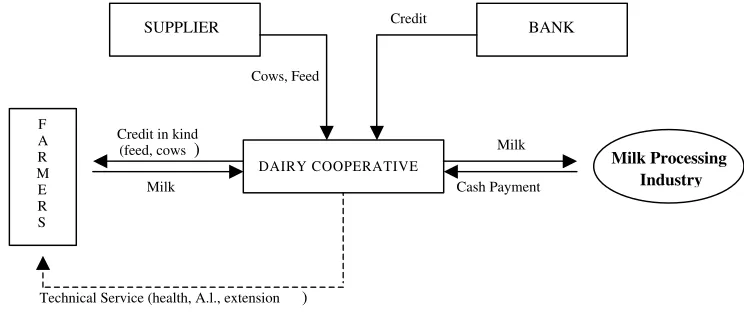
Dairy cooperatives aid dairy farming by providing credit in kinds of cows, feed and technical service to the dairy farmers and collect milk from them and sell it to the milk processing industry. This package program known as "Cooperative Model" was started in 1983. The credit activities of the dairy
coopera-Source: Kartadihardja, 1988
Figure 2. Cooperative Model in Dairy Development in Indonesia.
SUPPLIER BANK
DAIRY COOPERATIVE F
A R M E R S
Milk Processing Industry
Milk
Cash Payment Credit in kind
(feed, cows )
Milk
Credit
Cows, Feed
tives was supported by credit from commercial banks at the nominal interest rate of 12% to buy dairy cows and distribute to the members. The farmers repay their credit in installments deduce from their milk payments (Figure 2). With the effective implementation of this model, the dairy farming took roots in Indonesia. The price of the milk was also raised to 300-328 rupiahs per liter. The milk produc-tion also increased up to 227.2 million liters in 1984. However, this amount was far below the total milk consumed (622.8 million liters) the same year.
During fourth Five Years Development Plan (1984-1989), Indonesia Government made a target by the end of 1989 domestic milk production would fulfill 50% of the total milk requirement by reducing importation milk and increasing domestic milk production. In 1985 in order to reach the target, the Indonesia President made a Declaration of Presidential Decree regulated national dairy development by linking seven ministries: Ministries of Agriculture, Industry and Trade, Cooperative, Health, Home Affairs and Investment Coordination Board. Government also provided some support facilities by establishment of artificial insemination center in Lembang (West Java) and Singosari (East Java), dis-ease investigation center in DIY Province and dairy training center in Batu (East Java) and Baturaden (Central Java). The target could not be met and Indonesia produced only 292.8 million liters but the domestic milk requirement was 761 million liters in 1989.
During fifth Five Years Development Plan (1989-1994), target to increase domestic milk production to fulfill 50% of the need for domestic milk consumption was still the issue of dairy development in Indonesia. This target also could not be also met in 1994, the domestic milk consumption was 862.1 million liter, whereas domestic milk production was only 361.7 million liters and still imported 602.8 million liters equivalent milk powder.
During sixth Five Years Development Plan (1994-1999) also target to produce 50% of milk domestic need was an issue. Even though in 1999 there were 80,931 dairy farmers, 324,719 dairy cows and the domestic milk production increased up to 378.9 million liters, Indonesia imported 509.5 million liters equivalent milk powder in order to fulfill the national consumption of 966.7 million liters.
Thus, it can be said dairy farming took off during early 80's is going through transformation period during late 80's and 90's.
4. Development of Dairy Farming and Dairy Cooperative in DIY Province
DIY Province lies on the altitude between 100 m - 499 m above sea level, has tropical climate with an average rainfall of 0.6 mm - 457.3 mm per month, influenced by the dry and the rainy seasons. Dairy farming management requires a lot of water1. Water availability constitutes an asset to develop the dairy farming in DIY Province.
According to the Meteorology Station of Adisucipto the average temperature in DIY Province during 1999 was 26.1ºC, the maximum temperature was 33.1ºC and the minimum temperature was 21.6ºC. The humidity was recorded 22% - 98%.
Holsteins and Jerseys could tolerate the average temperature in DIY Province.
Dairy farming in DIY Province was also introduced before independence Indonesia in 1945. First, dairy cows were introduced in Yogyakarta Municipality in 1930s. Then after independence, in 1940s dairy cows were introduced in Bantul Regency. In accordance with the Indonesian Government to pro-mote the dairy cooperatives throughout Indonesia to enhance dairy farming, Warga Mulya Dairy Cooperative was established in DIY Province in 1979. Warga Mulya Dairy Cooperative started with 35 members in Bantul Regency and Yogyakarta Municipality of the province and provided the services of milk collection, credit and extension and training to its members in line with the policies formulated by UIDC. It also received credit of BRI in the form of 100 dairy cows at 12% interest rate. These dairy cows were loaned to the farmers at 16% interest rate. Similarly, it also received 200 dairy cows loaned from BRI in 1980, which were passed to the farmers in Yogyakarta Municipality and Bantul Regency. In order to expand the area of this cooperative, government also promoted dairy farming in Sleman Regency in early 1981 by giving 150 credit dairy cows to the farmers. The farmers who received the credit simultaneously became cooperative members. Sleman Regency has a big potential for the dairy farming, as there are plenty of upland forest needed for fodder of the dairy cows. The local government of DIY Province also gives an emphasis on dairy development in Sleman Regency. The dairy farming in DIY Province developed steadily thereafter in line with cooperative model. In 1981, first government gave the subsidy worth 450,000 rupiahs and UIDC credited the equipment of 5 cooling units, 100 milk can and 4 motorcycles to the cooperative. In 1982-1984 it received loan in the form of 1,037 dairy cows so the number of dairy farmers in DIY Province increased up to 682 in 1982, 841 in 1983, 983 in 1984 and 1002 in 1985. In order to maintain dairy cow from disease and increase the milk production, gov-ernment established disease investigation center and the cooperative started to provide the veterinary aid service to the members in 1985. Dairy farming in DIY Province saw a step growth with Warga Mulya dairy Cooperative and its services during the period of 1979-1985. This is the first phase of dairy farm-ing in DIY Province and can be understood as early development period. Figure 3shows the develop-ment of dairy farming in DIY Province during 1979 and 2000 in terms of dairy cows, dairy farmers (cooperative members) and milk production.
In 1986 there were 560 dairy farmers in DIY Province and they raised 1,583 dairy cows. Animal Husbandry Service gave 100 doses of semen to Warga Mulya dairy Cooperative free of charge and farmers of DIY Province benefited by this semen. The annual milk production was about 2,3 million liters. In 1987 the number of dairy farmers, dairy cows and milk production decreased but in 1988 the number of dairy cows increased because the cooperative got credit of 339 million rupiahs from private bank to buy dairy cow and credited to the farmers.
unfortunate incidence in dairy farming in DIY Province due to communication gap among the farmers and cooperative personnel.
Government gave 75 million rupiahs grant to calf raising unit through Agriculture Department to strengthen the dairy farming. Consequently number of dairy cows, dairy farmers and milk production grew again. But in 1995 and 1996 the number of dairy farmers decreased because some dairy farmers in Yogyakarta Municipality had difficulties to improve their enterprises primarily because of lack of land. Also the family labors that were involved in dairy farming were very limited. They preferred to work in non agriculture activities that were available rather easily in the municipality. Thus, many of the dairy farmers in Yogyakarta Municipality left dairy farming. This trend continued until 1998. However, dairy cows and milk production was again increasing slowly even during this period. During this period of 1988-1998, dairy farming in DIY Province experienced various ups and downs. After passing through early development period the dairy cooperative also experienced difficult challenges and had setbacks, as well. But by and large government was supporting dairy cooperative and dairy farming in DIY Province. This is the second phase of dairy development in the province and can be regarded as the transformation period.
In 1997, cooperative made linkage in its services to the farmers. It collected milk from the farmers and instead of paying the farmers in cash for their milk, supplied feed and other maintenance services at the door level. This service proved very good for rural farmers, especially farmers in Sleman Regency and became a good motive for the farmers there. In 1999, the number of dairy farmers, dairy cow and milk production increased because the cooperative received credit of 485 million rupiahs from PT. Bogasari which it was used for buying dairy cows worth 350 million rupiahs and credited to the farmers, mostly in Sleman Regency. The rest was used for buying equipment of milk pasteurization. Cooperative also established the cows feed unit to fulfill the need of concentrate demanded by the farm-ers to maintain the milk production. Thus, once again dairy farming was showing a growth after the decade of transformation period. The performance of Warga Mulya Dairy Cooperative was so good that it was the best cooperative in among all kind of cooperatives in DIY Province during the year of
1999-Figure 3. Number of Dairy Cows, Dairy Farmers and Milk Production in DIY Province, 1979-2000
0 500 1000 1500 2000 2500
1979 1980 1981 1982 1983 1984 1985 1986 1987 1988 1989 1990 1991 1992 1993 1994 1995 1996 1997 1998 1999 2000
2001.
As of year 2000, Warga Mulya Dairy Cooperative covers the area of Sleman, Bantul Regencies and Yogyakarta Municipality. All the dairy farmers in the province are the members of this cooperative, whose current number is 1,175; Sleman Regency 1,133 members, Bantul Regency 22 members and Yogyakarta Municipality 20 members. It produced 1,9 million liters of milk and had 1,446 dairy cows. From 1999, dairy farming has entered the third phase of steady development after coming through the transformation period of ups and downs and difficult challenges both in dairy farming and dairy cooper-ative management.
4.1. Dairy Farming of the Cooperative Members
The average number of dairy cows holding by the farmers in DIY Province is 4 and nearly half of them are currently lactating. The average lactation period is 290.4 days and total milk production is 2,000 liters per head per year (Table 1).
The rest is composed of equal share of currently dry and heifer, would be lactating in time of 2-12 months, and calves, would be lactating after 24 months with normal rearing. Out of 452 cows surveyed, more than half (152) is provided by cooperative, about one third (128) is produced in self farm by artifi-cial insemination and very few (72) comes from other sources including cooperative of West Java and Central Java through middle man. This composition of cows per farm and the stable sources are vital for dairy development and are regarded as good prospects for future, as well.
The average lactation period and milk production should be increased by improving breed and feed quality. In order to improve breed quality, artificial insemination has been implemented using almost 860 doses of good quality bull semen in 2000. However, necessary steps will be taken to raise the effi-ciency of using artificial insemination and selection emphasis on high milk yield of satisfactory compo-sition and good quality will continue to be the breeding goal in the future. Selection for high milk pro-duction is still the most important factor for assuring high economic returns to dairy farmers. Therefore, the primary goal of genetic improvement should be directed to increase the annual production of milk per cow and to select for desirable quality and satisfactory milk composition. According to Devendra (1988), improving nutritional management is important factor for economic and high milk yield of good quality. It should be stressed that the energy and protein concentrates for lactating cows are needed more.
Table 1. Dairy Cows Holding and Milk Production among the Dairy Farmers in DIY Province
Number Description
4.0 1.8 0.6 0.5 1.1 Average dairy cows holding per household/or farm (head)
Lactating Dry Heifer Calves
290.4 Average lactation period (days)
2,000 Yearly milk production per head (liters)
Source: Field Survey, 2001
There are no farmers who raise seed bull in DIY Province due to the provision of artificial insemina-tion by cooperative and Animal Husbandry Service. The non necessity of raising a seed bull allows the farmers to raise more number of cows, consequently produce more milk. Whenever a male calf is born farmers sell this to the cooperative to pay their credit.
4.2. Cooperative Services
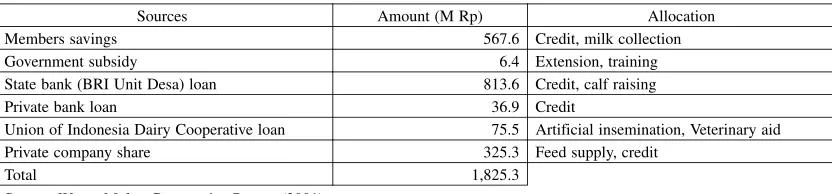
In order to provide these services to the members, Warga Mulya Dairy Cooperative allocates its vari-ous resources, such as, members' savings, government subsidy, loan and private company share as shown in Table 2. Members' savings activity was started at the beginning of the cooperative establish-ment in 1979. The cooperative received the governestablish-ment subsidy every year since 1981. At the first time the government subsidy was 450,000 rupiahs and in 2000 it was 6.4 million rupiahs. Since 1979 the cooperative has received the kind of loan from BRI, private bank and UIDC. BRI loan was first time given in 1979 in form of 100 dairy cows. In 1981 UIDC gave loan in the form of 5 cooling units, 100 milk cans and 4 motorcycles. Private bank were involved in the giving of loan since 1988 by giving of 339 million rupiahs to the cooperative. There are two private companies having the part taking in Warga Mulya Dairy Cooperative activities. They are Sari Husada Milk Processing Industry and PT. Bogasari. Sari Husada Milk Processing Industry has share in the cooperative since 1989 worth 68 mil-lion rupiahs and PT. Bogasari since 1999 worth 485 milmil-lion rupiahs. In 2000, the cooperative had 1,825 million rupiahs for use from different sources. About 814 million rupiahs was from state bank loan used for credit disbursement and calf raising. This was followed by members' savings, amounting to 568 mil-lion rupiahs, also used for credit disbursement and milk collection. Private company shares used for credit disbursement and feed supply amounted to 315 million rupiahs. Loan from UIDC (76 million rupiahs) was used for artificial insemination and veterinary aid while that from private bank (37 million rupiahs) was used for credit only. Government subsidy (6 million rupiahs) was used for extension and training.
Cooperative provides various services related with dairy activities to the members as shown in Table 3. More than 80% of the farmers received all these services.
Milk Collection
This service was started at the beginning of the cooperative establishment in 1979. All the farmers use Table 2. Warga Mulya Dairy Cooperative Resources and Their Allocation
Allocation Amount (M Rp)
Sources
Credit, milk collection 567.6
Members savings
Extension, training 6.4
Government subsidy
Credit, calf raising 813.6
State bank (BRI Unit Desa) loan
Credit 36.9 Private bank loan
Artificial insemination, Veterinary aid 75.5
Union of Indonesia Dairy Cooperative loan
Feed supply, credit 325.3
Private company share
1,825.3 Total
Source: Warga Mulya Cooperative Report (2001)
the milk collection service provided by cooperative and sell their milk to cooperative. The payment for milk by cooperative is made on the basis of the quality of milk instead of merely on quantity basis. It is expected that the milk should have a minimum stipulated standard of 3.3% fat and 7.7% Solid Non Fat (SNF) since 1982. Such milk is priced 1,280 rupiahs per liter. This standard is maintained by system of premium and penalty of 14 rupiahs on increase and decrease of 0.1% of fat and/or SNF contains, respec-tively. The dairy plants also insist on this minimum standard to control the milk quality as a whole. The price is reviewed every six months by a technical team, representative from ministry of agriculture, Indonesia Union of Dairy Cooperatives and milk processing industry.
The advantage of joining milk collection service is that the farmers get routine payment of milk. The payment of milk to the members was made twice a month. In general, the mode of payment of milk is cash. However, since 1997 Warga Mulya Dairy Cooperative also pays in kind by providing cows feed and veterinary health care facilities to the members for proper feeding and maintenance of dairy cows. Because of this service it became easier for the farmers to get animal feed (concentrate) and veterinary health care from the cooperative. They do not need to pay in cash for these purposes.
Cooperative sells this milk to Sari Husada Milk Processing Industry at 1,538.3 rupiahs per liter. Warga Mulya Dairy Cooperative handled about 1.9 million liters of milk in 2000 and made profit about 490.8 million rupiahs. However, farmers in Bantul Regency and Yogyakarta Municipality; having access to other buyers (hotels, hospitals, restaurants, etc), sell a portion of their milk, produced in the morning, directly to them at a relatively better price.
Feed Supply
The basic dairy cows feeding system is grass with concentrate supplement. Concentrates are essential part of the rations in addition to dry matter roughages to increase the capacity of milk production per cow. To fulfill farmers' needs of the concentrates, Warga Mulya Dairy Cooperative established a Cows Feed Unit in 1999. Due to the easier of buying concentrate, there was an increasing of dairy cows hold-ing by the farmers, dairy farmers (cooperative members) and milk production in 1999 and 2000.
The production of concentrates is about 11 ton per day. A regular supply of concentrates to the mem-bers is maintained throughout the year by supplying it at their farm gates at, 550 rupiahs/kg, cheaper than the market price. In 2000, it sold 4,014 ton of concentrates worth 2,207.7 million rupiahs.
Cooperative also promotes the use of green fodder, kinggrass (Pennisetum purpuides), leucaena Table 3. Cooperative Services for Dairy Farming in DIY Province
Percentage
(Leucaena leucoucephala) and gliricidia (Gliricidia sepium) the cheapest source of nutrient (including protein) enhancing the milk yield at an economical cost. Farmers have the desires to increase milk pro-duction, especially by increasing green fodder that would result in lowering the cost and increase the profit. Hence, 90% of farmers make use of this service given by the cooperative.
When the cooperative promotes the use of good animal feed, fodder supply for dairy cows comes mainly from agricultural waste products such as garbage, soybean hulls, sweet potato leaves, young corn leaves and sugarcane top leaves. Farmers also practice grazing under plantation crops, roadside tables and canal bunds, on natural grasses and weeds of varying quality. In using concentrate, the farmers mix the component of concentrate themselves because the price in market was very expensive. In order to minimize the farmer's problem of the expensive price of concentrate, the farmers are allowed to pay the price for concentrate in milk. Components of concentrate are usually rice bran, coconut (Cocos nucifera), palm cake, maize (Zea mays L), molasses, and cassava (Manihot utilisima).
Veterinary Aid and Artificial Insemination
The livestock diseases cause economic loss in dairy business. Bae (1993) mentioned that while pre-ventive care is necessary, it would still be economical to treat the animals due to their high cost. It was also observed that treatment of diseased animal was costly and hence, the veterinary aid service is aimed at the preventive measures in order to reduce the economic losses and the cost.
Cooperative employs the veterinarians and trained stockmen and ensures that every member obtain veterinary aid at his door for his animals since 1985. Veterinarians route in weekly visits arranged for each group of farmers. The farmers are pre-informed about these visits so that they can avail themselves of the services. The treatment of animals during such weekly veterinary visits is free of cost. Apart from the weekly services, emergency services are also provided at very reasonable charge and varying according to the nature of the required service. The cost of emergency treatments is deducted from the sales of the milk. Almost all the farmers make best use of this service.
Artificial insemination gives a better result by improving genetic quality for the next generation and contributes in milk production. It is also regarded as easier method for conceiving than natural mating with one successful pregnancy in every four artificial inseminations (Warga Mulya Dairy Cooperative, 2000). Artificial insemination service was started in 1986. Animal Husbandry Service introduced the using of artificial insemination through the extension activities. At that time the cooperative was collab-orating with Animal Husbandry Service in order to hold the extension. In the same year, the govern-ment through Animal Husbandry Service gave free of 100 dozes of semen to the cooperative. In 2001 almost all the farmers (90%) use this service, even though the charge of artificial insemination is high (7,500 rupiahs). Farmers also prefer artificial insemination for management efficiency; no need to raise bull would mean economizing of resources that can be used for raising female cows producing milk. The farmers sell male calves to cooperative to pay credit. Price of calf (3 months old) is 800,000 rupi-ahs.
Cow Insurance and Calf Raising
120,000 rupiahs per cow per year and receive 1,800,000 rupiahs, enough to buy a young cow with first pregnancy, when a dairy cow is dead. Defective cow (unable to conceive and lactate) is changed with a new one without any charge. But the farmers thought, it was very expensive and cooperative is consid-ering the cows insurance charge based on the milk yield.
To fulfill the need of replacing all and non-productive dairy cows and maintain the cows population, the cooperative established calf raising unit in 1989. The new born calf owned by the breeder are pur-chased by the cooperative and raised in the calf raising unit and are sold or credited to farmers after they are grown up and pregnant. In order to support the development of this unit, the government has given loan worth 75 million rupiahs to the cooperative through BRI in 1993. In 2000, Warga Mulya Dairy Cooperative sold and credited 137 dairy cows worth 291,2 million rupiahs to the members. It helps the dairy farmers in reducing the capital constraint on the dairy farming.
Extension and Training
Warga Mulya Dairy Cooperative had considered providing the extension and training program since the beginning of cooperative establishment. The extension program has a great importance in the dairy development in the adoption of better dairy business. Two extension workers provide extension ser-vices in the focus area of the cooperative by undertaking activities such as; animal health campaign (pre-ventive vaccination, pregnancy diagnosis and treatment of infertility), milk yield (improving the produc-tivity and maintaining high yielding cow), feeding practices, propagation of fodder cultivation (advan-tages and methods of cultivation of fodder crops) and breeding improvement (artificial insemination in order to promote a good breed).
Training was designed to address priority needs of members and aimed at giving the members the proper orientation on scientific dairy management and the role of cooperative. Most of the farmers (88%) mentioned that the training has helped them to get new information related with their dairy activi-ties. They hope that the cooperative organizes the training monthly to get more information. But cur-rently cooperative has only two extension workers and are unable to meet this demand of the farmers. Recently, cooperative is collaborating with Sari Husada Milk Processing Industry (seeking stable supply of milk from cooperative) and/or Gadjah Mada University in order to deliver the training needs of the farmers. Strong research-extension linkages and good support services are essential for dairy develop-ment. Training field programs and demonstration centers are essential for providing education on all aspects of mixing feeds, improved methods of feeding animal and management of animal.
According to Devendra (1988), for inputs to be used to advantage and for proven technology to be transferred successfully, extension assistance needs to be engaged in demonstration work that not only proves the point, but also motivates the farmers into participation and progress. Self-reliance is implicit, and the motivation of farmers is also enhanced by periodic training, timely inputs and creation of mar-keting opportunities. Successful appropriate technologies are those that would allow the fullest possible use of local resources and would contribute to particular development objective for dairy production.
Credit
intermediary institution by systematically encouraging the members to save and generate capital. Since 1979 Warga Mulya Dairy Cooperative channels the loan from bank, private company and Union of Indonesia Dairy Cooperatives to the farmers. Cooperative receives loan from BRI and private company (milk processing industry, animal feed industry) and lends money to the members for dairy farming, with a margin in interest rate to bear its service cost. Union of Indonesia Dairy Cooperative gives the credit in the form of equipment to the cooperative. Table 3shows that 81% of the farmers are making effective use of this service.
Warga Mulya Dairy Cooperative gives loan to the dairy farmers for buying cows and concentrates on the condition of regular supply of milk to the cooperative. It determines that the payback period of loan to be 18 months to be paid in daily installments from the sale of the milk (10% of its milk produce). But the low milk production causes the longer payback period of loan. According to Annual Cooperative Report, 2000, the average of payback period of loan was 29 months in 1999.
Recently, the cooperative is considering to form a link between the members savings and the coopera-tive loans and use the information for lender's screening process. By observing the savings behavior of members, the cooperative can judge their credit worthiness and capacity to manage debt, and thus, pre-vent the cooperative indebting a member with over loans.
Some farmers in Bantul and Sleman mentioned that the cooperative credit helps them free from extor-tionate usury and the pernicious ijon system2. Usually, the small farmers pawned their rice-fields or their pekarangan(gardens) that produces coconuts (Cocos nucifera L), salacia (Salacia L), mangoes (Mangifera indicaL), jack fruit (Artocarpus heterophyllusLam), and so on, for getting loan for buying animal feed and cows from tukang ijon(money lender). As a result, even before the crops on the field have ripened, their ownership has already fallen into the hands of the tukang ijon. By means of the cooperative credit, an attempt has been made to be free the members from this intolerable extortion and to prevent those who were free from their debts from being ensnared once more by the tukang ijon.
4.3. Dairy Farming Situation After Becoming a Cooperative Member
The dairy farmers in DIY Province are the small farmers and the average number of dairy cows hold-ing is 4. Warga Mulya Dairy Cooperative is involved in the acquisition of dairy cows. More than half of dairy cows are provided by the cooperative. Cooperative also provides various services related with the dairy activities to the members, such as, milk collection, feed supply, veterinary aids and artificial insemination, cows insurance and calf raising, extension and training and credit.
In order to understand the role of dairy cooperative services on dairy development in term of number of dairy cows, milk production, quality of milk, technology, management and labor use and the conse-quences at the farm level a detailed field study was conducted in the three dairy farming regencies of DIY Province. The data and the information for the analysis were collected from the farmers by sam-pling method. The questionnaire for this purpose was designed and the personal interview surveys were conducted through the use of this questionnaire.
infor-mation if they remember the matter. These limitations were solved by cross checks with the cooperative data, observation or re-interviews. Secondary data was also needed to support the primary data.
Of all the benefits that accrue from the development of dairy cooperatives, the economic incentives, yielding direct and tangible returns, are the ones mostly recognized by the dairy farmers. The direct impact of the dairy cooperatives on the dairy households are various, such as, improvement of milk quality, better technology, better management, improvement of milk production, increase in the number of dairy cows and labor use for dairy farming.
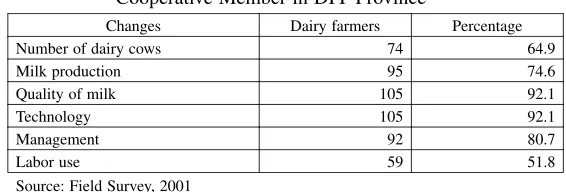
About 65% of the farmers mentioned that they are raising more number of dairy cows than before becoming cooperative members. About 75% claimed that milk production per cow increased and 92% said the quality of milk has improved (Table 4). They said that the cooperative helps to overall improve the dairy farming. About 81% of the farmers consider that dairy farming management has improved by training and extension services of the cooperative and 92% of them apply the new technologies which are using of hay, silage and artificial insemination in their farming, eventually contributing in increasing income from dairy farming. As the number of dairy cows increased, 52% of the farmers use more labor, mostly surplus family labor, in their dairy farming. The contribution of dairy income to the total house-hold income will be discussed in the next section.
4.4. Contribution of Dairy Income to the Household Income
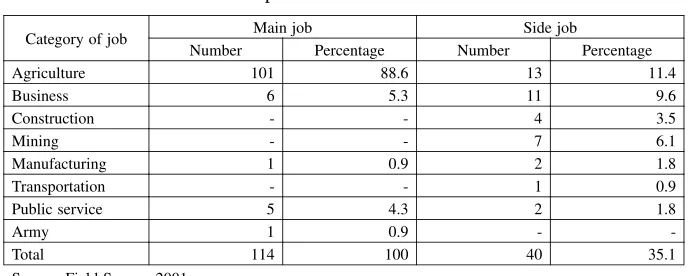
A very high share of agriculture primary employment (88.6%) can be found in the study area. It means that agriculture activity is backbone of income in the rural areas of DIY Province. But in reality, some households have no access to land and a large number of households, who have access to land, are engaged in non-agriculture activities as a secondary activity. There are also some farmers (11.4%) engaged in agriculture as secondary activity. They work in business (5.3%), manufacturing (0.9%), public service (4.3%) and army (0.9%) as the primary occupation (Table 5).
The average land holding per household is 2,849.2 m2 and consist of wet land (sawah) 607.3 m2, household compounds (pekarangan) 985.2 m2, dry land (tegal) 1,091.8 m2 and fodder land 164 m2 (Table 6). In the study area, the most common wet land cultivation pattern is three crops a year includ-ing two rice crops (February - May and October - January) and one intermediary crop or palawija(June - September): usually soybeans (Glycine max(L) Merr.) or maize (Zea maysL). By far the most com-mon system of sharecropping is the so-called maro system, whereby the cultivator and the landlord receive half of the crop and pay half of the total cost each. This system has been traditionally in use in
Table 4. Improvement in Dairy Farming after Becoming a Cooperative Member in DIY Province
Percentage Dairy farmers
Changes
64.9 74
Number of dairy cows
74.6 95
Milk production
92.1 105
Quality of milk
92.1 105
Technology
80.7 92
Management
51.8 59
Labor use
Source: Field Survey, 2001
wetland areas of the DIY Province. In contrast, the so-called mertelu sharecropping arrangement, whereby a third of the harvest goes to the cultivator and the rest to the landlord and the 'cultivator pays all cost' (Hardjono, 1987), is virtually absent from these wetland communities3.
Other main crops are tree crops grown in pekarangan. Abdullah (1991) defines the household com-pounds as "a subsystem within larger food procurement system which aims at production of household consumption items, either not obtainable through permanent shifting agriculture, hunting, gathering, fishing, livestock husbandry, or wage earning. Household compounds supply and supplement subsis-tence requirements and generate secondary direct or indirect income. They tend to be located close to permanent or semi permanent dwellings for convenience and security."
The crops frequently grown in pekaranganare fruits (such as, salacia (SalaciaL), banana (Musa par-adisiacalL), papaya (Carica papayaL), citrus (Citurs reticula Blanco), mango (Mangifera indicaL), avocado (Persea Americana Mill), durian (Durio zibethinus Murr) and sapodilla (Manikara zapota)), vegetables, coconut (Cocos nucifera), cassava (Manihot utilisima), and clove (Eugenia caryophyllus). Most households in Sleman Regency supplement their income by selling salacia (SalaciaL) fruits of the
pekarangan.
Also as a consequence of the unavailability of permanent irrigation, there is tegal, apart from the
pekarangan. Maize (Zea maysL), soybeans (Glycine max(L) Merr) and cassava (Manihot utilisima) are the crops that grown in tegal. Some farmers use tegal for cultivating fodder to fulfill the need of fodder for the dairy cows. There is also the farmers who use wetland for cultivating fodder (kinggrass
Table 5. Occupation Structure in DIY Province.
Side job
Note: Total number of samples is 114.
Table 6. Average Land Holding per Household in DIY Province.
Percentage
Household compounds (pekarangan)
38.3
(Pennisetum purpuides), Leucaena lecoucephala, and Gliricidia sepium). The land used for cultivating fodder contributes 7.5% to the household income. In Sleman Regency, farmers sell the surplus produc-tion of fodder to the farmers in Yogyakarta Municipality or Bantul Regency.
The land related with dairy activities is wetland, fodder land and household compounds. The waste product for agriculture that produced on wetland and grass that cultivated on fodder land are the main sources of animal feed. The farmers established the stable on house compounds. According to Hermanto (1991), it is traditional for Javanese people to keep their animals in the household compounds, to keep their animals safe and to ensure that the animals are managed easily.
Table 7presents estimated the gross income from milk production, selling cows, selling calves, and selling manure. The total gross income from dairy activities per household is 13.5 million rupiahs per year. The highest share is from milk production (48.1%) followed by selling cows (32.6%). In the man-agement efficiency of the dairy enterprise, the farmers cull some dairy cows, which have low produc-tion, injury, reproductive problems, and then sell them. Farmers also sell the male calf to pay the install-ments of cooperative credit. The other reason is that farmers do not need to raise a bull for breeding since the cooperative provides artificial insemination service.
Some farmers raise poultry (chicken and duck), goat, sheep, cows and also fish in fishponds in the
pekaranganand gain some income, as well.
Dairy farming contributes significantly to the household income amounting to 13.5 million rupiahs per year. Table 8 shows that the total share of dairy income is more than half (56.3%) of the total household income, much more than the share of crop production (17.5%) and non-agriculture work (25.4%). However, the income from non dairy livestock is small (0.2%) and has no significant
contribu-Table 7. Gross Income from Dairy Farming per Household in DIY Province.
Percentage
Note: Total number of samples is 114. Rupiah (Rp) is Indonesian currency; 78 rupiahs = JP Yen 1
Table 8. Share of Dairy Farming in Household Income in DIY Province
Percentage
tion to the total household income.
The average share of crop to household income among the farmers in DIY Province is 17.5% and came from crop production in the vari0us kinds of land held by the farmers; sawah, pekarangan, tegal
and fodder land. The share of income from non-agriculture to the household income is 25.4% (Table 8)4.
5. Conclusion
The dairy cooperative was introduced in Indonesia in early 60's with the introduction of dairy cooper-ative in East Java which serviced the coopercooper-ative members by collecting milk. But it could not take roots them. It started to take off only systematic under the umbrella of UIDC during early 80's after the introduction of various other services under the 'Cooperative Model' in 1983 and continues government support. Then it went though the transformation period of ups and downs during late 80's and 90's. The cooperatives under UIDC system are functioning well and providing systematically various services need for development of dairy farming. Accordingly, cooperative members, dairy cows and milk pro-duction have increased recently in Indonesia. Dairy farming is on the way to sustainable growth after 1999. Similar trends are observed in DIY Province, where dairy farming is served by Warga Mulya Dairy Cooperative with all the dairy farmers being its members. Here, the dairy farming has very stable composition of cows at household level with good future prospects and produces 2,000 liters of milk per head per year. Warga Mulya Dairy Cooperative allocates effectively its various resources from different sources for the services to its members. Most of the farmers make best use of all the services provided by the dairy cooperative and improve their dairy farming. Dairy farmers are also well satisfied with the cooperative services and perceive that their dairy farming management has become better in almost all the aspects. The performance of Warga Mulya Dairy Cooperative was so good that it was the best coop-erative in among all kind of coopcoop-eratives in DIY Province during the year of 1999-2001. Consequently the income from dairy farming has a very high share, more than half, in the household income of the cooperative members, significantly raising their total household income.
Thus, it can be said that dairy cooperative is instrumental in directly alleviating the income of its members and also benefits indirectly the rural region at large, by generating substantial employment and investment opportunities in animal feed industry, bank and other related activities. However, there are still problems that cause the slow development of dairy farming. Frequent government policy changes and over dependence of the cooperatives on such policies are some of them5.
The milk production is far away from fulfilling the domestic demand and much has to be done in pric-ing policy to give incentive to the farmers. On the issues of fair pricpric-ing of milk, the balance should be struck between the interest of the consumer and that of the dairy farmers. In this regard, government needed to decide to what extent in was willing to support prices and this would depend largely on how much government funds were available to undertake a program such as a subsidy scheme.
Appendix 1. Chronology of Dairy Farming and Dairy Cooperatives in Indonesia
Dairy Cooperatives Dairy Farming
Year
Dutch introduced dairy cows in Java island. 1905
Holstein Friesian dairy cows distributed to the local farmers in East Java, Central Java and West Java.
1940s | 1950s
First dairy cooperative established in Pujon (East Java).
1962
Dairy cooperative established in Nongkojajar and Pasuruan (East Java).
1967
Dairy cooperative established in Pangalengan and Sukabumi (West Java).
1969
Introduction of services i.e., artificial insemination and feed improvement program to increase dairy production during first and second Five Years Development Plan by Indonesia Government
1969 | 1979
Dairy cooperative established in Bogor (West Java). 1970
Dairy cooperatives established in Grati, Ungaran, Boyolali and Solo (Central Java) and Garut (West Java).UIDC was established.There were 11 dairy cooperatives with 2,800 cooperative members and 48,600 dairy cows in Indonesia.
Pricing of milk based on fat and SNF contains introduced by UIDC.Annual milk production was 62.3 million liters.Farm get price of milk was 40 - 80 rupiahs per liter.
1978
Warga Mulya Dairy Cooperative established in Daerah Istimewa Yogyakarta.
Indonesia imported 3,800 dairy cows from Australia and New Zealand.
1979
. During third Five Years Development Plan Indonesia Government worked together with Union of Indonesia Dairy Cooperatives and made the obligatory for the milk processing industry to buy the milk produced by the small farmers 1979
| 1984
UIDC started to give credit in form of equipment of cooling units, milk cans, and motorcycles to the dairy cooperatives.
Indonesia imported 36,200 dairy cows from Australia and New Zealand.
1981
UIDC was involved in the reviewing of milk price every 6 months.
Dairy Technical Team which consist of Minister of Industry Affairs, Ministry of Trade and Cooperatives and Ministry of Agriculture was established in order to:
1. Determine the milk price purchasing price agreement between the milk processing industry and the dairy cooperatives.
2 Determine ratio between domestic milk production absorption and the volume of powdered milk, which could be imported.
Indonesia imported 36,200 dairy cows from Australia and New Zealand.
1982
"Cooperative Model" introduced. The result of dairy Technical Team establishment was
increasing of milk price 300 - 328 rupiahs per liter.
Indonesia imported 67,000 dairy cows from Australia and New Zealand.
1983
Milk production was 227.2 million liters. Milk consumption was 622.8 million liters. 1984
During fourth Five Years Development Plan, the target to fulfill 50% of the total milk requirement through domestic production by 1989 was set.
Declaration of Presidential Decree Number 2 regulated national dairy development by linking seven ministries: Ministries of Agriculture, Industry and Trade, Cooperative, Health, Home Affairs and Investment Coordination Board. Government provided support facilities to increase livestock productivity:
1. Establishment of artificial insemination center in Lembang (West Java) and Singosari (East Java). 2. Establishment of disease investigation center in
DIY Province.
3. Establishment of dairy training center in Batu (East Java) and Baturaden (Central Java).
1985
Target could not be met. The total milk consumption was 761 million liters but the domestic milk production was only 292.8 million liters.
1989
During fifth Five Years Development Plan, target to increase domestic milk production to fulfill 50% of the need for domestic milk consumption.
1989 | 1994
The target during 1989 - 1994 could not be met and Indonesia still imported 602.8 million liters (more than 50% of the need for domestic milk consumption).
National milk consumption was 862.1 million liters and domestic milk production was 385.5 million liters.
1994
During sixth Five Years Development Plan also target to produce 50% of domestic need.
1994 | 1999
There are 4 main dairy cooperatives in Indonesia, namely Sinau Anadadni Ekonomi (Pujon, East Java), Kemusuk (Boyolali (Central Java), Bandung Selatan (Pangalengan, West Java) and Warga Mulya
(DIY). There were 80,931 dairy farmers and 324,719 dairy cows in Indonesia.
The target of domestic milk production should be achieved 50% of the total milk need could not be realized.
Appendix 2. Chronology of Dairy Farming and Dairy Cooperative in Daerah Istimewa Yogyakarta Province
Dairy Cooperative Dairy Farming
Year
Dairy cows introduced in Yogyakarta Municipality. 1930s
Dairy cows introduced in Bantul Regency. 1940s
Warga Mulya Dairy Cooperative established. Its areas were Yogyakarta Municipality and Bantul Regency. Cooperative office was located in Yogyakarta Municipality. Services provided by the cooperative were milk collection, extension and training, and credit. Warga Mulya Dairy Cooperative joined in UIDC. Warga Mulya Dairy Cooperative received credit from BRI in the form of 100 dairy cows.
There were 35 dairy farmers in Yogyakarta Municipality and Bantul Regency.
1979
Warga Mulya Dairy Cooperative received credit of 200 dairy cows from BRI and passed them to farmers in Yogyakarta Municipality and Bantul Regency.
1980
Warga Mulya Dairy Cooperative received credit of 150 dairy cows and passed them to farmers in Sleman Regency.
Areas of the cooperative were Yogyakarta Municipality, Bantul and Sleman Regency.
First, the government gave subsidy to the cooperative worth 450,000 rupiahs.
UIDC credited 5 cooling units, 100 milk can and 4 motor cycles to the cooperative.
Dairy cows were introduced in Sleman Regency by giving credit of 150 dairy cows to the farmers.The number of dairy farmers was 193.
1981
Warga Mulya Dairy Cooperative received credit of 327 dairy cows from BRI.
Pricing of milk based on the fat and SNF contains was introduced in DIY.
The number of dairy farmers was 682. 1982
Warga Mulya Dairy Cooperative received credit of 310 dairy cows from BRI.
The number of dairy farmers was 841. 1983
Warga Mulya Dairy Cooperative received credit of 400 dairy cows from BRI.
The number of dairy farmers was 983. 1984
Cooperative started to provide the veterinary aid service to the members.
Disease Investigation Center was established in DIY in order to increase livestock production.
The number of dairy farmers was 1002. 1985
Animal Husbandry Service gave free of 100 dozes of semen to the cooperative.
Artificial insemination was introduced in DIY.
There were 560 dairy farmers and 1583 dairy cows. Milk production was 2.3 million liters
1986
There were 520 dairy farmers and 1,139 dairy cows. Milk production was 1.8 million liters.
1987
Cooperative received credit of 339 million rupiahs from private bank (Bukopin bank).
There were 514 dairy farmers, 1,338 dairy cows and milk production was 1.8 million liters.
1988
Cooperative received credit of 250 dairy cows from BRI
and passed them to the farmers in Sleman Regency. Cooperative established the calf raising unit and Sari Husada Milk Processing Industry contributed share of 68 million rupiahs in this unit.
Farmers in Sleman Regency received the second credit from BRI.
There were 788 dairy farmers, 1,737 dairy cows and milk production was 1.7 million liters.
1989
There were 615 dairy farmers, 1,009 dairy cows and milk production was 1.3 liters.
1990
Cooperative office was moved to Sleman Regency. There were 779 dairy farmers, 1,984 dairy cows and milk
BRI through the cooperative took back dairy cows credited to farmers in Sleman Regency in 1989 because farmers never paid the reimbursement of credit, due miscommunication.
There were 847 dairy farmers, 1325 dairy cows and milk production was 1.4 million liters.
1992
Government through Agriculture Department gave grant worth 75 million rupiahs to support the calf raising unit. There were 861 dairy farmers, 1,375 dairy cows and milk
production was 1.4 million liters. 1993
There were 895 dairy farmers, 1,415 dairy cows and milk production was 1.5 million liters.
1994
There were 611 dairy farmers, 1,360 dairy cows and milk production was 1.4 million liters.
1995
There were 554 dairy farmers, 1,417 dairy cows and milk production was 1.5 million liters.
1996
Cooperative made a link between the services; collect milk from the farmers and pays in kinds by supplying feed and maintenance of dairy cows.
There were 592 dairy farmers, 1,639 dairy cows and milk production was 1.7 million liters.
1997
There were 677 dairy farmers, 1,180 dairy cows and milk production was 1.6 million liters.
1998
Cooperative established Cows Feed Unit to fulfill farmers' need of concentrate and also established cows insurance service.
PT. Bogasari contributed share in the cooperative worth 485 million rupiahs. It was used for buying dairy cows credited to the farmers and equipment of milk pasteurization.
Cooperative provides the pasteurization milk to the consumers.
The number of dairy farmers, dairy cows and milk production increased as the consequences of establishment of cows feed unit and receiving credit for buying of cows by Warga Mulya Dairy Cooperative.
There were 1138 dairy farmers, 1,409 dairy cows and milk production was 2.1 million liters.
1999
Warga Mulya dairy Cooperative was the best cooperative among all kind of cooperatives in DIY Province. 1999
| 2001
Cooperative handled 1.9 million liters of milk and made profit 490.8 million rupiahs.Cooperative sold 4,014 ton of concentrate worth 2,207.7 million rupiahs.
Cooperative sold and credited 137 dairy cows worth 291.2 million rupiahs from calf raising unit.
There were 1,175 dairy farmers, 1,466 dairy cows and milk production was 1.9 million liters.
Endnotes
1For the milk production, farmers clean the dairy cows, feeding area, stable area, and the milk equipment
them-selves.
2Ijon systemis the credit system very commonly practiced in rural areas of Indonesia. The interest rate is 20% per
month.
3 The mertelusharecropping system can be found in communities with dry land where the supply of productive
farmland is limited. In such communities, cultivators sharecropping dry land are forced to be less demanding (Rotge, 2000).
4It should be mentioned that DIY Province had been selected for sugar cultivation the year preceding the
imple-mentation of the fieldwork. This occurs once every five years. During such periods, wetlands are rented out by the Madukismo sugar company which carries out the cultivation work. As a result, household members probably have to find alternative employment while household income might be below its normal average when the rice is cultivated.
5This issue is also identified by Baswir (1997). References
Abdullah, Oekan S. (1991), Definition and Ecology of Homegarden, M.E. Daw, K.V.A. Bavappa and Effendi Pasandaran eds., Proceeding on Pekarangan Land: Development Possibilities and Their Contribution to Farmers' Welfare, Bali, Organized by Center for Agro-Socioeconomic Research, Ministry of Agriculture with Food and Agriculture Organization of United Nations (FAO), 49-59.
Bae, Sang-Ho. (1993), Control of Animal Health and Diseases, Tokyo, Asian Productivity Organization Study Meeting.
Baswir, Revrisond. (1997), Indonesia Cooperatives, Yogyakarta, Badan Percetakan Fakultas Ekonomi (BPFE). (in Indonesian)
Devendra C. (1988), Feeding and Nutrition, Tokyo, Asian Productivity Organization Study Meeting.
Etgen, William M. and Reaves, Paul M. (1987), Dairy Cattle and Management, 6th Ed., New York, John Wiley & Sons, Inc.
Hardjono, Joan. (1987), Land, Labour and Livelihood in a West Java Village, Yogyakarta, Gadjah Mada University Press.
Hermanto. (1991), The Role and Performance of Pekaranganin the Farm-Household System in East Java, M.E. Daw, K.V.A. Bavappa and Effendi Pasandaran eds., Proceeding on Pekarangan Land: Development Possibilities and Their Contribution to Farmers' Welfare, Bali, Organized by Center for Agro-Socioeconomic Research, Ministry of Agriculture with Food and Agriculture Organization of United Nations (FAO), 179-194.
Indonesia Central Bureau of Statistics. (1997), Statistical Yearbook of Indonesia, Jakarta, Government of Republic of Indonesia.
Kartadihardja, Erwin Soetirta. (1988), Dairy Farming in Asia, Tokyo, Asian Productivity Organization Study Meeting.