• Tidak ada hasil yang ditemukan

Vocabulary Learning Problems at The Tenth Grade Students of SMK Kesehatan Maranatha Palangka Raya - Digital Library IAIN Palangka Raya

N/A
N/A
Protected

Academic year: 2018

Membagikan "Vocabulary Learning Problems at The Tenth Grade Students of SMK Kesehatan Maranatha Palangka Raya - Digital Library IAIN Palangka Raya"

Copied!
55
0
0

Teks penuh

(1)

11 A. The Previous Study

There are some previous studies that discussed the similar object with the

writer‟s study. These previous studies were taken as the comparison for this study.

The first is the study conducted by Ayuningsih entitled “The Students‟ Problems In Mastery of English Islamic Vocabulary By The Tenth grade Students of MAN Maliku Pulang Pisau”. The result of the study show that:

1. The student‟s problems In Mastery of English Islamic Vocabulary were caused by:

a. The students‟ problem in pronunciation

b. The students‟ get difficulties in remembering the words

c. The students‟ get difficulties in reading

d. The students‟ seldom to use the English Islamic vocabulary. So, this was main

cause the students‟ problem in mastery English Islamic vocabulary.

(2)

students to applied vocabulary in sentences. It was in order to make the students easy to memorize vocabulary.15

The second is the thesis by Erniati entitled “The Students‟ Problems in

writing Recount Text”. They were: (1) There were some main problems that faced by

the students‟ got problems in writing recount text, as follow: content, organisation,

writing expression and grammar or mechanic: (2) the factors influenced the students in writing recount text so they had problems in writing recount text as follow: intellegence, attention, interest, aptitude, motive, maturity, and readiness: (3) the strategies used the english teacher to solve the cases faced by the students in writing recount text, as follow: the teacher explained the material more than one time, made

a content vocabulary and made discurs the students‟ problems.16

The third is the thesis by Khunavi entitled “The Students‟ Difficulties In Learning Speaking English For The Second Year Students At MAN Model Palangka Raya ”. The research finding told that: (1) the problems encourage by the students in preparation to speak. They were, vocabularies, ungrammatical phrases or sentences, and absurd ideas: (2) the problems encountered by the students in learn speaking English. They were, they much time to answer and ask question, vocabulary and grammar shortages: (3) the problems encountered by the students in learn speaking

English. They were, English and Indonesia is different, they didn‟t like English, they

15

Ika Putri Ayuningsih, The Students‟ Problems In Mastery of English Islamic Vocabulary By The Tenth grade Students of MAN Maliku Pulang Pisau, Thesis, Palangka Raya: STAIN, 2010, p.61.

16

(3)

didn‟t have supportive environment. The problems still existed although the teachers were very experienced and well prepared in teaching.17

The problem of students in making simple present tense, they didn‟t understand the sentence pattern deeply. However, when they had answered the question without looking up the grammar book or dictionary, it was hard for them.

The students‟ problems in using simple present tense were when the students must ring the words to be a sentence that has the meaning in Indonesia. The students just waited meaning words from their teacher. And when forgot with the tense would learned and when the sentence more using formula others. The teachers‟ efforts to solve the problems simple present tense, at the longest in applying there were problems so the writer would have to fill up the long time however smallest to increase or repair that material not yet teach. Using dictionary and to adapt the describing in the sentence with environment around.18 It means that the students were still not able in apply simple present tense.

The fourth is from the International Journal thesis by Khuat Thi Thu Nga entitled “ The Effectiveness of Learning Vocabulary Through Games”. Based on the result, the Vietnamese students usually feel bored in vocabulary lesson because they have not changed their learning habits, such as writing words on paper, trying to learn by heart or learning passively through the teachers‟ explanations. To help students find language classes, especially vocabulary lesson more interesting, and to achieve more from games, the writer conducted action research to find the answer to

17 A‟am Rivaldi Khunavi. The Students‟

difficulties in learning speaking English for the second year students at MAN Model Palangka Raya, Thesis, Palangka Raya: STAIN, 2009, p. 76.

18

(4)

the question, “Do games help students learn vocabulary effectively, and if so, how?”.

Most academic review start from an assumption that games, bundled with other aspects of learning, e.g., CALL, are beneficial. However the writer singled out the component of games to study that in isolation. After reviewing academic opinions on this specially focused matter, of which there are relatively few, the writer began action research which included applying games in our own classes, observing other

teachers‟ classes, and interviewing both teachers and learners so as to elicit students‟

reactions, feelings and the effectiveness games in vocabulary learning. The research shows they are effective in helping students to improve their vocabulary building skills.19

The fifth is the thesis by Nhung entitled “Difficulties in Teaching and Learning Vocabulary in The Textbook (English For Food Production Staff) For The Second Year Students of Pre-intermediate level at Hanoi Tourism College. The result of study in learning a foreign language is the key to success. Without vocabulary, it is so difficult to convey anything. Thus, to teach vocabulary efficiently to students is the desire of any teachers. In the context of Hanoi Tourism College, teaching and learning English vocabulary for Food Production cope many difficulties, which needs a lot of discussion. The aims of the study are to find out some difficulties facing the students and teachers in the process of teaching in learning vocabulary of Food Production and purpose some solutions to these problems as well. The study was carried out among the ESP teachers and the second years students of Food Production at Hanoi Tourism College. The statistic revealed

19

(5)

that most of the students and teachers are coping with many difficulties. The students have not had right English learning strategies or good motivation in the study and lack of ESP vocabulary as well while the teachers have shortage of specialized knowledge, various teaching technique or teaching aids and reference materials are very poor. Some solutions are suggested to reduce these difficulties including

improving specialized knowledge for ESP teachers, teacher‟s activities and teaching

facilities; encouraging students to develop their self-study to become more active learners. The result of the study can be useful for those who teach ESP in general and those who teach vocabulary to students of Food Production at Hanoi Tourism College in particular.20

The sixth is the thesis by Istianah entitled “The Students Accuracy in Reading

English Text (A Study on The Students‟ of English Educational Program of the

Second Semester at STAIN Palangka Raya)”. The result of study about the problem

of accuracy of the second semester students of english education program at STAIN Palangka Raya in reading English text are about the intonantion (it can be said as voice quality) and unfamiliar words.21

Different from those previous studies, the objective of this study is the

students‟ problems in English learning, especially in learning vocabulary The purpose of this study to know and describe the students‟ problems in learning vocabulary basicly that caused the students difficult in english learning.

20

Mai Tuyet Nhung, Difficulties in Teaching and Learning Vocabulary in The Textbook (English For Food Production Staff) For The Second Year Students of Pre-intermediate level at Hanoi Tourism College, Thesis, Vietnam: University Of Language and International Studies, 2011.

21

(6)

B. Learning English As Foreign Language

In contemporary dictionaries, learning is acquiring or getting knowledge of a subject or a skill by study, experience or instruction. According to seels and Richey, learning as evidenced by a change in knowledge, skills or attitudes, is the criterion for instruction.22 Additionally, According to Cronbach, learning is shown by a change in behavior because of experience.23

From the definition above can conclude learning is a combination activities or a ware activity that do by someone and get change in themselves like increasing of knowledge, if the students did not change experience of knowledge or positive attitude so that can say the learning is perfect yet.

Teaching English as a Foreign Language (TEFL) is described as tried and

tested way for people to see the world while earning a living. So, that‟s why TELF

become a tool to overseas the international network.

The role of English is considered as a second language or a foreign language in each country all over the word. As a second language, English has an essential role in national and social life through communication aspect. Meanwhile, as foreign language, English is taught in schools and courses. It does not play as essential role in national or social life. However, the role of English is great. Mostly we find it in developing country.24

22

Syafaruddin And Irwan Nusation, Manajemen Pembelajaran, ttp: PT. Ciputat Press, 2005, p. 35.

23

Sudirman Am, Interaksi dan Motivasi Belajar Mengajar, Jakarta: Raja Grafindo Persada, 1996, p. 22.

24

(7)

1. Factors Affecting in Learning

Condition of learning is a condition that can influence the learning process

and achievement of the students. According to Gagne in his book “Condition of

Learning” (1977) states “the occurrence of learning is inferred from a difference in

human being‟s performance before and after being placed in a learning situation.25 Besides that Gagne also divide the condition of learning into two categories, they are:

a. Internal condition is an ability that has been present in the individual before he learned something new. The internal condition is generated by a set of transformation.

b. External condition is a stimulant situation that has been present in outside of a student. Learning condition that needed to learn is different in each case. Different types of learning abilitiy will require different learning skill previously and external conditions are different too.26

From the statements above, learning is very influenced by internal factor and external factor.27

a. Internal factor is the factor arises from physiology and psychology aspect. In physiology aspect, it relates of condition of physic and condition of five sense function. They can influence the spirit and intensity of the students in learning process. Whereas psychology aspect, it relates of condition of the students psychology, they are like talent, interest, intelligent, motivation, and attitude.

25

Dra. Eviline Siregar, M. Pd And Hartini Nara, M.Si, Teori Belajar Dan Pembelajaran, Bogor: Ghalia Indonesia, 2010, p. 171

26Ibid

, p. 171-172

27

(8)

b. External factor is the factor arises from the student self external. External factor is divided two aspects; they are social environment and non social environment. Social environment consist of family, teacher, and society. Whereas non social environment consist of learning facilities, are like school, curriculum, learning time, home, and nature.

2. Students’ Problem

Students are unique organisms that develop according to the stage of its development. Child development is the development of all aspects of his personality, but the tempo and rhythm of development of each child in every aspect is not always the same. The learning process can be affected by the development of children who are not equal it, in addition to other characteristic inherent in children.

(9)

gave up on the job, whereas perseverance is a person who has strong powers of concentration and focused and never give in completing the work: (e) Competitiveness / Collaborativeness; Views on competitiveness is a measure of his achievements with others and difficult to work with others, while collaborativeness is a very addicted people to other people and can not work alone.28

While Entang and Joni in Majid classifies student management issues into two categories, namely the problem of individual and group problems. Students management action who carried out by the teacher will be effective if he could identify the exact nature of the matter at hand, so in turn he can select appropriate coping strategies as well.29

Individual problem arise because in the individual there is a need to be accepted and the group wants to achieve self-esteem. If those needs can no longer be met through normal ways acceptable to society, then the individual will strive to achieve in other ways. In other words an individual will do no good. Actions to achieve goals in a way that is not good that by Dreikurs and Cassel who copied by Joni classified into four, namely: (a) Behavior that other people want to get attention (attention getting behaviors). For example, the class clown or slow to do so need to get extra help: (b) Behavior that want to show the strength (power seeking behaviors), for example, always arguing, losing control of emotional (angry, crying) or always forget the important rules in the classroom: (c) Behavior aimed at hurting other people (Revenge seeking behaviors). For example, hurt others with a mocking,

28

Abdul Majid, Perencanaan Pembelajaran, Bandung:Rosdakarya, 2008, p. 113.

29

(10)

beating, biting and so forth. Demonstration incompetence (passive behaviors), which is absolutely refuses to try to do anything for fear of failure.30

According to Maman Rahman, of the four individual measures above as proposed by Rodolf will result in the formation of four patterns of behavior that often appears in children of school age are: (a) Active pattern is a pattern of constructive behavior extreme, ambitious to become a super star in its class and tried to help teachers with full of vitality and heartfelt: (b) Active pattern of destructive behavior patterns are realized in the form of making jokes, like the angry, hostile and rebellious: (c) Passive constructive pattern is a pattern that showed a slow form of behavior with the intention to always helped and expect attention: (d) Detruktif passive pattern of behavior patterns that pointed to laziness (lazy nature) and stubborn.31

Two main categories of student management issues, namely the problem of individual and group problems. The classification is a bit much to bear risk, because the problem of individual and group problems, as well as the management problems of teaching and classroom management, often linked. However, this classification is very useful.

a. Individual Problems

Category of individual problems in the management of students according to Dreikurs and Cassel is based on the assumption that human behavior has the sole purpose. Every individual has a basic need to be and feel useful. If the individual is

30Ibid

, p. 114

31

(11)

feeling desperate in developing a sense of self-esteem through the socially acceptable ,he will behave poorly.

There are 4 types of behavior that is not good, namely (1) behavior to attract attention, (2) behavior to seek power, (3) behavior to wreak revenge, and (4) behavior that shows the incompetence.32 The students who did not raise his status in a way acceptable to the environment, will usually find another way, either through actions to attract, the attention of active and passive. Active form of attention seeking that is destructive, such as self-style, droll, screw up, become juvenile delinquents, children who constantly ask questions or fussy. Passive form of attention seeking that is destructive for example, coercion or want to get the attention of others by asking for help continues.

Behavior to seek power almost equal to the case of the above measures, but is more powerful that is seeking attention destructive. Search powers, Active usually like to argue, lie, bat, character-have irritable, refusing orders, and really would not submit. Passive seeker of power is the laziness of people is very real, which normally would not work at all. Pupils like this is very forgetful, stubborn, and refused to obey.

Pupils who seek revenge impingement caused despair and confusion to find success in a way, hurt others, physically attacking (scratching, hitting, kicking), hostile to his friends, forcing the power. They are children who do not have the pain and lack of sportsmanship. Usually the child pelampiasannya more actively than

32

(12)

passively. Liveliness they described as the son of a cruel and hateful, while those who passively described as being sullen and defiant.

Pupils who behave poorly is a very personal despair, pessimism in achieving success, and only experienced continuous failure. Feelings of worthlessness and helplessness accompany students proscribed conduct and "drop-outs", which equates participation with further failures. Demonstration of this inability to always have a passive form.

To distinguish the four types above, can be done through observation of symptoms. Dreikurs and Cassel propose in Majid that a relatively simple technique to detect these symptoms, with the following parameters: (1) If the teacher feels disturbed by the actions of students, possibly student objective is to seek attention: (2) If the teacher feels defeated or threatened, the student's goal may be to seek power: (3) If the teacher felt very offended, the goal may be to seek an outlet revenge: (4) If the teachers feel powerless, the goal may be to show the inability of children 33.

Dreikurs and Cassel further asserted that teachers must correctly identify and understand the purpose of the child so that effective action can be managed.

b. Group Problem

Johnson and Bany in Majid that identified seven issues in the management of group classes, namely (1) lack of unity, (2) acts of disobedience against the standards and procedures, (3) negative reaction to the private members, (4) recognition of the class of teacher behavior, (5) tendency of interference, jamming the job, and

33

(13)

up behavior, (6) inability to adjust to environmental changes, and (7) low morale and a hostile attitude.

Lack of unity, marked by conflicts between individuals and sub groups. For example, the conflict between sex and or race with a pupil of gender or other races. The atmosphere of such class is characterized by conflict, hostility, tension. Pupils feel Puss with the group and believes the group is not attractive. Finally, students do not support each other.

Negative reaction to the private members of the class is marked with the impression of hostility towards children who are not accepted by the group, which deviate from the rule group, or a blocking group effort. The peculiarity of this problem is the action group to make the individual conform to the group.

Approval of the class of ugly action arose when the group encourage and support someone who was an unacceptable behavior class groups. The most common example where class groups support the "class clown". If this case happens, we can classify the case had become a problem at once is a matter of individual groups. In fact, the problem is most serious problem that must be addressed.

Problems arise when the group completed the task group tend to jam up activities. The group was overreacting to minor disturbances and let the small problems that interfere with productivity group that refused to handle the task is a typical example. This situation is characterized by the presence of uncertainty and anxiety.

(14)

overcome. Impressions of resistance is generally very vague. Repeated requests of task clarity, pencil lost, forgotten homework, small complaints is an example of a typical group problem. But such acts of hostility, and aggressive acts are the less common.

Group classes that give a bad reaction when there are new regulations, emergency situations, group member changes, schedule changes, or change of teachers, an inability to adapt to environmental changes. In general, these groups react to pressure, they viewed the change as a threat to the unity of the group. A very common example is a class that is usually well-behaved, but behaved very badly to a substitute teacher.

3. Teaching-Learning English at Vocational School

Teaching is the process to give guidance or help the students to do learning process.34 From the teaching learning process, a teacher is supposed to develop the

students‟ skill, change their attitude and guide them to do something and make them to understand about knowledge that has been taught. Furthermore, Suwarna states

that “Teaching is working helping someone to learn how to do something, giving

instructions, guiding in the study of something, providing with knowledge, causing

to know and understand”.35

Talking about teaching learning English of vocational school students, based on the curriculum, the purpose of English learning for students are order to have ability as follow; (1) Master the basic knowledge and skills to support the achievement of English language competency skills program; (2) Applying the

34

Syaiful Bahri Djamarah, Strategi Belajar Mengajar, Jakarta: Rineka Cipta, 2002, p. 45

35

(15)

abilities and mastery of English language skills to communicate either verbally or in writing at the intermediate level.36

Related the purpose above, those meant that Vocational education teaches and trains students to master the competencies and other competencies. It is needed as a capital to develop them in the future. This is what underlies the differences in the preparation and development of vocational education curriculum and other high

school that conform to students‟ respective fields. However, the difference is a systematic curriculum that adjusts to their respective fields and supporting facilities. But in a general subjects are all the same because it is also a supporter of subjects and must be implemented in every educational institution, such as English, Science, Social Studies, Mathematics, and others. However, problems often occur in subjects that are considered very difficult for students is learning English. Because of the difficulty for them is the first language differences they have. Whereas the English language lessons also needed to support their vocational program competencies, especially to support the English skills by improve the students problem in learning vocabulary.

4. Second Language Acquisition (SLA)

Second language acquisition (SLA) is a complex process, involving many interrelated factors. This chapter will examine the main issues that have arisen in this

study of this process. It will begin by considering what is meant by „second language

acquisition‟ and then go on to discuss briefly the issues that have preoccupied SLA

36

(16)

researchers. Finally, a framework will be set up for the discussion of these issues in the rest of the book.

In order to investigate SLA, it is important to establish clearly what is meant by the term, a number of key questions need to address so that the reader is clear what positions researches have taken up in order to study how a second language (L2) is learnt. The points considered below are all central to an understanding of how researchers have set about examining SLA. They underlie the various perspectives that inform the subsequent chapters of this book.

SLA is not a uniform and predictable phenomenon. There is no single way in which learners acquire knowledge of a second language (L2). SLA is the product of many factors pertaining to the learner on the one hand and the learning situation on the other37. It is important, therefore to star by recognizing the complexity and diversity that result from the interaction of these two sets of factors. Different learners in different variability and individuality of language learning need to be emphasized, the study of SLA assumes interest only if it is possible to identify aspects that are relatively stable and hence generalizable, if not to all learners, then,

at least, to large groups of learners. The term „second language acquisition‟ is used to

refer these general aspects. This book will examine both what seems to be invariable and what is apparently variable about the process of acquisition.

a. SLA vs First Language Acquisition

Second language stands in contrast to first language acquisition. It is the study of how learners learn an additional language after they have acquired their

37

(17)

mother tongue. The study of language-learner language began with the study of first language (L1) acquisition. SLA research has tended to follow in the footsteps of L1 acquisition research, both in its methodology and in many of the issues that it has treated. It is not surprising that a key issues has been extent to which SLA and L1 acquisition are similar or different processes.

b. Second Language Acquisition vs Foreign Language

Second language acquisition is not intended to contrast with foreign language acquisition. SLA is used as a general term that embraces both untutored (and

„naturalistic‟) acquisition and tutored (or „classroom‟) acquisition. It is, however, an

open question whether the way in which acquisition proceeds in these different situations is the same or different.

Generally, In English teaching learning process there are four skills that must teach by the teacher, these are the writer will give definition about four skills of English.

1. Listening

Listening competence is universally “larger” than speaking competence.38

In the case the writer will explain why is the listening skill is important to the students as a beginner learner in foreign language.

According to Asher in Fauziati, sees three different processes as central in natural process: (1) Children develop listening competence before they develop the ability to speak at the early stage of first language acquisition. They can understand complex utterances that they cannot spontaneously procedure or imitate: (2) Children

38

Brown H. Dougles, Teaching by Principles an Interactive Approach to Language Pedagogy

(18)

ability in listening comprehension in acquired because children acquired to respond physically to spoken language in the form of parental commands: (3) Once of foundation is listening comprehension has been established, speech evolves naturally and effortlessly out of it.39

From the statement above, why listening skill is important to give to the beginner. It is because the first step of listening comprehension is the psychomotor process of receiving sound waves though the ear and transmitting nerve impulses to the brain, but that in just the beginning of what is clearly an interactive process, as the brain acts on the impulses, bringing to ear a number of different cognitive and affective mechanisms.40

To be concluded, listening is process of translating information before the object it by their opinion. This activity can be said as the encoding mental process that is the process of registering information in memory.

2. Speaking

Speaking actively engages the students in interaction personal and other audiences. The students who have been provided with supportive, collaboration environment and speaking experiences are more likely to have the confidence needed to go public with their ideas and information.

According to Hornby, “speak is to talk or say something and to know and be

able to use a language”.41According to Fauziati,”to must people, mastering the art of

speaking is the single most important aspect of learning a second or forign language,

39

Endang Fauziati, Teaching of English, p. 61-62.

40

Brown H. Dougles, Teaching by Principles, p. 249.

41

(19)

and the success is measured in terms of the ability to carry out a conversation in the

language”.42

From definition, it can be said that speaking is a vital component and the single most important aspect of the English language. In communication spoken is a way to make us easy to show our mind in the front of other people. Speaking is one-way people make connection with each other. To speak confidently and fluently in a variety situation it is an important for people need and an important goal of education. By speak people can express their personal feeling, ideas, view of point, to tell a story, to joking, to describe something, and to clarify.

3. Reading

Reading is a process of decoding written symbols, working from smaller units (individual letters) to larges ones (words, clauses, and sentences).43 Reading is an interactive and interpretative process.44 The readers process their background knowledge and interpretative printed using text, using specific skills and strategies to form expectations and predictions about the text, selecting, and using the most productive cues to confirm or reject those predictions.

In conclusion, reading is an active process of words identification involving the writer and the reader. Reading is not only process of receiving information, but

also process of making and saving the data in the reader‟s brain. As the result of

reading, it can be seen that the readers need feedback. Thus, understand what they read.

42

Endang Fauziati, Teaching of English, p. 126.

43

David Nunan, Lenguage Teaching Methodology, New York: Printice Hall, 1989, p.17.

44

(20)

Fauziati defines comprehension as comprehending a text, that is an interactive

process between the reader‟s background knowledge and text.45

Thus, requires the

ability ta relate the textual material to one‟s own knowledge.

In conclusion, comprehension is as the goal of reading instruction, that is understanding of what meanings, ability to find the meaning from group of words or the text, and ability to draw inferences.

4. Writing

Writing is the representation of language in a textual medium with sign of symbols. Writing as a noun, the thing is written, and writing as a verb, which designates the activity of writing. It refers to inscription of characters on a medium, thereby forming, word, and longer units of language, known as texts. It also refers to the creation of meaning and information thereby generated.46

Dullay states that writing is only mode in which both linguistics manipulation task and communication task have been given.47 According to Fauziati also gives statement that writing as a process is oriented to wards work in progress and the development of new skills, rather than merely evaluative task, the classroom practices, therefore, will vary from each other.48 In the other words, Nunan also states that writing activity as commonly conceived, is a highly sophisticated skill combining a number of diverse elements, only of which are strictly linguistic.49

45Ibid

, p. 138

46

Jonathan Crowther, Oxford learner‟s Dictionary of Current English, New York: Oxford University press, 1995, p. 1385.

47

Heidi Dullay, et al. Language Two. New York: Oxford university Press. 1982, p. 226.

48

Endang Fauziati, Teaching of English, p. 151.

49

(21)

Based on the statement, it can be concluded that writing is an act or process to produce some information in their mind that should be expressed into writing form. Writing will be the best if the students guide on rules defined. It usually refers to contents, style, grammatical structure, mastery on vocabulary an so on.

5. Grammar

The discussion of grammar serves us with a wide range of meaning.

According to Hornby “grammar is the rules in language for changing the form of

word and combining them into sentences”.50

In addition, William states that “grammar is a term used to mean many different things. When teachers and administrators grow frustrated over errors in

studying writing, they often call for a return to “the basic” which they define as

grammar. And English teacher know very well what the response will be when they

tell anyone what they do for a living: “oh. I better what watch what I say”. In this

situation, grammar is being defined as how one speaks.51

Besides that, Hatwell organizes some of these different meaning in an attempt to clarify our understanding of grammar by offering five different definition, summarized here: (1) A let of formal patterns in which the words of a language are arranged to convey a large meaning: (2) The branch of linguistics concerned with the description analysis, and formulation of formal language pattern: (3) Linguistics

50

A.s Hornby, Oxford Advanced , p. 517

51

(22)

etiquette: (4) School grammar or the means of the parts of speech: (5) Grammatical terms used in the interest of teaching writing.52

Furthermore, Djiwandono states that “grammar as part of language discussion related to the ability of words in the scope of morphology, and the ability of sentence in the scope of syntax.53

C. Vocabulary

All languages have words. A language emerges first as words, both historically, and in terms of the way each of us learned our first and any subsequent languages According Vigotsky in Thornbury, A word is a microcosm of human consciousness.54

Language is constructed with words. It is vocabulary, which is needed to construct a sentence to communicate to others. Words are a major interest for our students. They all want to learn more "vocabulary words" because they see expanded vocabulary as the key to improved communication. And, of course, they are right. But our interest here isn't in vocabulary in the way that students typically use that term. In grammar, word study is focused on how words can be analyzed into groups based on grammatical characteristics rather than the word lists that students often have in mind when they talk about their need for more vocabulary.

Vocabulary is the key to learn new language or second language. Learning foreign language is essentially a matter of learning vocabulary of that language. According to Djiwandono, vocabulary is a part of language components. Vocabulary

52Ibid 53

M. Soenardi Djiwandono, Tes Bahasa Dalam Pengajaran, Bandung:ITB, 2008, p. 131

54

(23)

consists of the words that are used in language communication either spoken or written. In addition, in communication, vocabulary is very important element. The meaning of an expression mostly is determined by the vocabulary which used. From the vocabulary, the meaning of the expression is gained, besides from other elements such as intonation and stressing.55

In English learning, vocabulary is important to be learned. It is a process of helping a learner to learn about words that have meaning for particular language. If the student does not have enough vocabulary, he or she will be difficult to understand the second language what he or she learns. Especially in developing four skills of English language. According to Hornby, vocabulary is; (1) The total number of words in language; (2) all the words known to a person or used in a particular book, subject, etc; (3) a list of words with their meanings especially one that accompanies a textbook in foreign language.56 Additionally Krashen states that “vocabulary is a basic in communication; it is also very important for the acquisition process of the

target language proficiency”57

.

From the definition above, it can be concluded that vocabulary is words used in a language as a part of language component. It is very important to be learned.

Because vocabulary has a complex function in human being‟s life. Vocabulary is a

form of all the words that human being use to communicate each other. People can interact to others if they have any list of words they want to speak.

55

M. Soenardi Djiwandono, Tes Bahasa, p. 42-43

56

A.s Hornby, Oxford Advanced, p. 1331

57

(24)

1. Kinds of Vocabulary

According to Djiwandono, vocabulary can be divided into active vocabulary and passive vocabulary. Active vocabulary is vocabulary actually used. While passive vocabulary is vocabulary understood.58 Active vocabulary is words that the students can understand pronounce correctly and use appropriately in speaking and writing. While passive vocabulary is the words which the students can recognize and understand when they occur in a context, but they cannot produce or use correctly in speaking and writing.

A particular word can become a productive or active vocabulary if a learner knows how to use it actively and appropriately in a correct context. The transition of a passive or receptive vocabulary to a productive or active can happen but usually gradually. The change of receptive or passive vocabulary into active vocabulary can happen because of listening or reading the words repeatedly. There are five essential steps in learning vocabulary, they are:

- Having sources for encountering vocabulary new words - Getting a clear image

- Learning the meaning of words - Making a strong memory of words - Using words in sentences

58

(25)

a. Word classes

The words play different roles in a text. They fall into of eight different words classes:59

Like, like many words in English, can belong to two or more words classes. The unrepresented class are the determiners-words like a, the, some, this, last.

In terms of the meaning associated with words classes, we can make a crude division into two groups. On the one hand, there are words like for, and, them, to that mainly contribute to the grammatical structure of the sentence. These are called grammatical words (or function words) and are generally prepositions, conjunctions, determiners and pronouns. On the other hand, there are the content words, those that carry a high information load. Content words are usually nouns, verbs, adjectives and adverbs. The sense of a text is more or less recoverable using these words alone.

Like looking bits pieces old second-hand record players doing up look new compare this with:

I for and like and them to like

59

(26)

Typically, where space is at a premium, such as in text messages, newspaper, headlines, and road signs, it is the content words alone that do the job: RAIL STRIKE TALKES END. Content words are an open set: that is, there is no limit to the number of content words that can be added to the language. Here are a few that have been added recently – airbag, emotion, carjacking, cybersex, and quark. Grammatical words, on the other hand, are a closed set. The last time a pronoun was added to the language was in the early sixteenth century. (It was them).

Traditionally, grammatical words belonged to the domain of grammar teaching, while the teaching of vocabulary was more concerned with content words. However, the rigid division between grammar and vocabulary has become blurred recently. The interdependence of these two systems is a key tenet of what has been called the lexical approach.

b. Words Families

(27)

addition of an affix to a root, and which has a different meaning from the root, is called a derivative:60

Play Play + er Re + play Play + ful

So, while plays, played and playing are inflexions of play, the words player, replay and playful are each derivatives of play. Inflexions and derivatives are both formed by the process of affixation. Note that –er and –ful are end- of- word affixes, or suffix, while beginning – of – word affixes, like re-, un-, pre-, de-, etc. are called prefixes.61

We can know talk about words as belonging to families. A word family comprises the base word plus its inflexions and its most common derivatives. To take another example, the base form understands includes the following members in its family:

Understands Understanding Understood Understandable Misunderstand Misunderstood

60Ibid,

p. 4

61

(28)

Research suggests that the mind groups these different forms of the same word together. Therefore, rather than talk about the number of individual words a person knows, it makes more sense to talk about the number of word families.

c. Word Formation

Affixation is one of the ways new words are formed from old. Another one is compounding-that is, the combining of two or more independent words, as in the case of second-hand, word processor, paperback, and so on. The fact that many compounds started life as two separate words is evident from their variant spellings. Thus: dish-washer, dishwasher; and wild-flower, wildflower. This is one reason why it is tempting to consider record player as one compounded word rather than two single words.

Another reason to consider record player a single word is that this kind of compound pattern – noun + verb + -er-is a very common, and highly productive, one in English: a record player is a machine that plays records. Likewise dishwasher, hairdryer, bus driver, goalkeeper, typewriter; they all are formed according to the same principle. New words that follow this pattern are constantly joining the language: screensaver, trains potter, particle accelerator, mail server. Another common pattern is the noun + noun pattern, as in matchbox, classroom, teapot, mouse mat, etc. of course, the two patterns – noun + noun and noun + verb + er – can re-combine to form even more complex compound: dump truck-driver, candlestick-maker, windscreen-wiper, and so on.

(29)

co-opted from one part of speech and used as another, a process called conversion.

Typically nouns are converted into verbs (or „verbed‟) as in the sell impacted against

a brick wall; lets brunch tomorrow. But other parts of speech can be converted as well: she upped and left (preposition – verb) ; a balloon flight is an absolute must (verb-noun). Finally, new words can be coined by shortening or clipping longer words: flu (from influenza), email (from electronic mail) and dorm (from dormitory).

d. Multi-word unit

Even when words are not joined to form compounds, we have seen that group of more than one word, such us bits and pieces, do up, look for, can function as a meaningful unit with fixed or semi-fixed form. Technically these are known as multi-words units, but they are often called simply lexical chunk. For example, in the following extract (in which two workers) are discussing the Australian car industry – a Holden is an Australian car). The lexical chunks are in italic:

Keith : it‟s amazing how the bleeding car industry‟s swung round. It‟s Holden for years and now Fords have got it. Well and truly. [….] year after year they are laying more off towards the end of the year so they know this was coming –it wasn‟t out of the blue.

Jo : I think that they shipped a lot of the accessory overseas too. Before they did a lot of the bits and pieces themselves.

(From Slade, D. The Texture of Casual Conversation)

(30)

or out of the green, for example. I well and truly and bits and pieces (as we have seen) are also fixed, but less idiomatic. Year after year, on the other hand, is only semi-fixed. It allows a limited amount of manipulation: we can say month after month and day after day. Note that both a lot of and for years are typical of the enormous number of chunks that are used to express vague quantities and qualities: loads of, that sort of thing, more or less, now and again.

A set of semi-fixed multi-word units that function as sentence frames: they

provide a structure on which to „hang‟ a sentence, and especially useful in reducing

planning time in rapid speech.

Especially common in informal language are compounds of verb + adverb (like swung round), or verb + preposition (look after). These are known as either or phrasal verbs multi-part verbs. Because they are often idiomatic (like lay of) and can sometimes be separated (laying more workers off) and laying of more workers), they present a formidable challenge to learners.

To handle the fact that there are multi-word items that behave like single words, the term lexeme was coined. A lexeme is a word or group of words that function as a single meaning unit.

e. Collocations

(31)

Collocation is not as frozen a relationship as that of compounds or multi-word units, and two collocates may not even occur next to each other – they may be separated by one or more other words.

Types of Collocation:

There are several different types of collocation made from combinations of verb, noun, adjective etc. Some of the most common types are:

- Adverb + Adjective: completely satisfied (NOT downright satisfied) - Adjective + Noun: excruciating pain (NOT excruciating joy)

- Noun + Noun: a surge of anger (NOT a rush of anger) - Noun + Verb: lions roar (NOT lions shout)

- Verb + Noun: commit suicide (NOT undertake suicide)

- Verb + Expression With Preposition: burst into tears (NOT blow up in tears) - Verb + Adverb: wave frantically (NOT wave feverishly).

f. Homonyms

Word that share the same form but have unrelated meaning are called homonyms. For historical reason, English is rich in homonyms: well, bat, left, fair, etc. Thus, while fair in the sense of beautiful pleasing comes from an Old English word (fager) fair, as in skip ton fair, comes from Latin feria by way of French foire. While homonyms provide a headache for the learner, their ambiguity is a rich source

of humor. Like the joke about the duck who went to a chemist‟s to buy lip-salve.

„Will you be paying by cash or credit card? Asked the pharmacist. „Just put it on my

(32)

Another potential source of confusion are the many words in English that sound the same but are spelt differently: horse and hoarse, meet and meat, tail and tale, discrete and discreet, aloud and allowed. These are called homophones (literally same sound). There are also words that are pronounced differently but spelt the same: a windy day, but a long and windy road; a live concert, but where do you live; a lead pipe, but a lead singer. These are called homographs (literally same writing).

g. Polysemes

As if homonyms, homophones, and homographs weren‟t enough, another

potential source of confusion for learners-and a challenge for teachers – is the fact that very many words in English have different but overlapping meanings. Take fair, for example. Clearly these two senses of fair are homonyms:

She had long fair hair

My pig won first prize at skipton fair. But what about these?

This isn‟t fair on anyone, but it does happen.

We have a fair size garden and we may as well make use of it. She was only a fair cook

The sun‟s rays can be very harmful, beating on unprotected fair skin.

The fair city of ours….

It will be fair and warm.

(33)

are related. Try substituting pleasing, for example, and you will find that it more or less fits most of these contexts. Dictionary writers (lexicographers) classify words like fair as being polysemous – that is, of having multiple but related meanings, each of which is called a polyseme. Hold is another good example of a polysemous word:

I held the picture up to the light. I was held overnight in a cell. You need to hold a work permit

Mrs. Smith is holding a party next week

Marxist holds that people are all naturally creative He was finding it a strain to hold his students‟ attention

They‟ll probably hold the London train if we‟re late in

The theatre itself can hold only a limited number of people. Will you tell her the offer still holds?

These books hold the bed up.

If the polysemous nature of English vocabulary provides challenge to dictionary compilers, it is a complete headache for learners. At what point can you be said to know a word such as fair or hold – when you know its most basic meaning, or when you know the different shades of meaning represented by all its polysemes? This is when o an issue we will return to when we look at the teaching of word meaning.

(34)

The meanings and the words must have the same spelling and pronunciation and they must have the same origin.

h. Synonyms and antonyms

Synonyms are words that share a similar meaning. Thus: old, ancient, antique, aged. Elderly, are all synonyms in that they share the common meaning of not young/new. However, there the similarity ends. We are more likely to talk about an old record player and even an antique one than an elderly record player or an aged one. Synonyms are similar, but seldom the same. Even between words that seem interchangeable, such as taxi and cab or aubergine and egg-plant, one will be preferred over the other in certain contexts and by particular speakers.

Noticed we were forced to define old in terms of what it is not: not young/new. Words with opposite meanings – like old and new are called antonyms. Again like synonyms, the relation between such opposites is not always black and

white (to use two antonyms) and the very notion of „oppositeness‟ is troublesome.

The opposite of an old woman is a young woman, but the opposite of an old record player is a new one, not a young one. Your old boyfriend however could be either the boyfriend who is not your young boyfriend or the one who is not your new boyfriend. Nevertheless, like synonyms, antonyms have a useful defining function and are therefore a convenient teaching resource.

i. Hyponyms

(35)

hammer is a hyponym of tool; kiwi is a hyponym of bird (and fruit). Co-hyponyms share the same ranking in a hierarchy: hammer, saw, screwdriver\are all co-hyponyms; tool is the superordinate term. But saw also has a superordinate relation to different kinds of saw; Fretsaw, chainsaw, jigsaw, etc. we can illustrate these relation like this:

A similar kind of relationship is a part of: as in a keyboard is a part of a computer. Notice that this is quite different from saying a keyboard is a kind of computer. In this poem by William Carlos Williams, the words that have this kind of relationship (called metonymy) are underlined, while co-hyponyms are in italics:

Under a low sky This quite morning Of red and

Yellow leaves- A birds disturbs

No more than one twig Of the green leaved Peach tree

Tool

Hammer Screwdrive

r

Chainsaw Jigsaw

Fretsaw

(36)

Thus, leaves and twigs are parts of trees, while red, yellow and green are kinds of colours.

j. Lexical fields

In the following passage (from a short story by David Guterson) there are a number of words that are connected to the idea of Christmas (Christmas Eve, the [Christmas] tree, lights, and carols):

We were at my sister‟s house for Christmas Eve, fire a fireplace, light on the

tree, Christmas carols playing on the stereo. Outside the window a light snow blew down. Icicles hung from the gutters and in the yard the grass looked sprinkled with powder. By morning everything would be white.

As Christmas-themed words, snow, icicles and fireplace could also be included, since they all belong to a mental scenario associated with northern hemisphere charismas celebrations. Words that have this kind of thematic relationship are said to belong to the same lexical field. Tree, carols, fireplace, and lights all belong to lexical field of „Christmas‟- although all of them, with the possible exception of carols – belong to other lexical fields as well. Notice that the text also contains a lexical field of weather-related words that partly overlaps with the Christmas words (snow, blew, icicles, powder, white), as well as words connected with the house theme (fireplace, stereo, window, gutters, yard, grass).

2. The Vocabulary Knowledge of Science

According to Satrio Nugroho the vocabulary knowledge of science is;62

62

(37)

1. Religion vocabulary

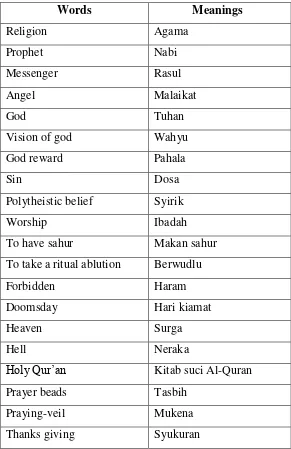
Religion vocabularies are the words that use relate only in it they are: Table of Religion Vocabulary

Words Meanings

Religion Agama

Prophet Nabi

Messenger Rasul

Angel Malaikat

God Tuhan

Vision of god Wahyu

God reward Pahala

Sin Dosa

Polytheistic belief Syirik

Worship Ibadah

To have sahur Makan sahur

To take a ritual ablution Berwudlu

Forbidden Haram

Doomsday Hari kiamat

Heaven Surga

Hell Neraka

Holy Qur‟an Kitab suci Al-Quran

Prayer beads Tasbih

Praying-veil Mukena

Thanks giving Syukuran

(38)

2. Education Vocabulary

Education vocabularies are the words that use only in its group they are: Table of Educational Vocabulary

Words Meanings

Education Pendidikan

The educate Mendidik

The educator Pendidik

The formal education Pendidikan formal The informal education Pendidikan informal

Teacher Guru

Lecture Dosen

Head master Kepala Sekolah

Removing class Kenaikan kelas

Graduation Wisuda

Law and order Tata tertib

Achievement Prestasi

Final test Ujian akhir

3. Health and diseases vocabulary

Health and diseases vocabularies are the words that use only in it they are: Table of Health and Diseases Vocabulary

Words Meanings

Healthy Sehat

Sick/ill Sakit

Infectious disease Penyakit menular

A Headache Sakit kepala

A toothache Sakit gigi

(39)

An earache Sakit telinga

A convulsion Kejang

A brain concussion Gegar otak An influenza Sakit flu

A nose bleed Mimisan

Herbal tonic Jamu

Prescription Resep dokter

Maternity hospital Rumah sakit bersalin

3. The Important Of Vocabulary

Without grammar very little can be conveyed, without vocabulary nothing can be conveyed. This is how the linguist David Wilkins summed up the important of vocabulary learning.63 This shows that learning vocabulary is almost more important rather than learning grammar. By looking at the importance illustrated by Thornbury, it must be realized that teaching vocabulary must be interesting to students for it to reach the goal.

Vocabulary has an important role in four language skill both active vocabulary and passive vocabulary. In the reading ability, gives an ease in comprehending the text. The students who have more vocabulary can recognize and understand the content of text. In writing ability, vocabulary gives an ease for the learners to expand their ideas based on the topic sentences that they want.

In speaking ability, vocabulary gives an ease for the learners to explain their idea orally and can speak more fluently if they have more vocabularies. While in listening ability, vocabulary gives an ease for the students to comprehend what other

63

(40)

people speak. They can find and know the topic of speaking from other person easily.

However, vocabulary teaching has not always been very responsive to such problems, and teachers have not fully recognized the tremendous communicative advantaged in developing an extensive vocabulary.

From the explanation above, it can be understand that vocabulary has a very important role in developing of the language skills. Having more vocabulary, the learners can comprehend the content of scientific text book easily and having more vocabulary both active and passive vocabulary, the learners can practice it in useful skills.

4. Vocabulary learned

Knowing a word is one thing – but how is that knowledge acquired? In learning their first language the first word that children learn are typically those used for labeling – that is, mapping words on to concepts – so that the concept, for example, of dog has a name, dog. Or doggie. But not all four legged animals are dogs: some may be cats, so the child then has to learn how far to extend the concept of dog, so as not to include cats, but to include other people‟s dogs, toy dogs, and even pictures of dogs. In other words, acquiring a vocabulary requires not only labeling but categorizing skills.

(41)

that items like black and white, or finger and toes, or family and brother are interconnected. Network building serves to link all the labels and packages, and lays and groundwork for a process that continues for as long as we are exposed to new words (and new meanings for old words) – that is, for the rest of our lives.

In what ways is the development of the second language (L2) lexicon any different from that of the first language (L1)? Perhaps the most obvious different is the fact that, by definition, second language learners already have a first language. And not only do they have the words of their first language, but they have the conceptual system that these words encode, and the complex network of associations that link these words one with another. Learning a second language involves both learning a new conceptual system, and constructing a new vocabulary network – a second mental lexicon.

To achieve the kind of outcomes, the learner needs not only to learn a lot of words, but to remember them. In fact, learning is remembering.64 Unlike the learning of grammar, which is essentially a rule-based system, vocabulary knowledge is largely a question of accumulating individual items.

With the best will in the world, students forget words. As a rule, forgetting is rapid at first, but gradually slows down. This is true in both the short term (e.g. from lesson to lesson) and in the long term (e.g. after a whole course). It has been estimated that up to 80 percent of material is lost within 24 hours of initial learning, but that then the rate of forgetting levels out. 65

64Ibid

, p . 23

65

(42)

Forgetting the words may be caused both by interference from subsequent learning and by insufficient recycling. With regard to interference. Most teachers will

be familiar with the symptoms of „overload‟, when the price for learning new language items is the forgetting of old ones. This same to be particularly acute if words are taught that are very similar to recently acquired words. The new words

have the effect of „overwriting‟ the previously learned material.

Anyone who has learned a second language will know that some words seem easier to learn than others. Easiest of all are those that are more or less identical, both in meaning and form, to their L1 equivalents. When this is due to the fact that they derive from a common origin, they are called cognates.66 Thus Catalan vocabulary, French vocabulaire, Italian vocabulario, and English vocabulary are all cognates and hence relatively easily transferable from one language to the other. The global spread of English has also meant that many English words have been borrowed by other languages. Examples of such loan words in Japanese are shanpu (shampoo), shopping (shopping), and sunakku (snack. Cognates and loan words provide a useful

„way in‟ to the vocabulary of English, and are worth exploiting. Other factors that make some words more difficult than others are:

a. Pronunciation: research shows that words that are difficult to pronounce are more difficult to learn. Potentially difficult words will typically be those that contain sounds that are unfamiliar to some groups of learners- such as regular and lorry for Japanese speakers. Many learners find that words with clusters of consonants, such as strength or crisps or breakfast, are also problematic.

66

(43)

b. Spelling: sound-spelling mismatches are likely to be cause of errors, either of

pronunciation or of spelling, and can contribute to a word‟s difficulty. While

most English spelling is fairly law-abiding, there are also some glaring irregularities. Words that contain silent letters are particularly problematic: foreign, listen, headache, climbing, bored, honest, cupboard, muscle, etc.

c. Length and complexity: long words seem to be no more difficult to learn than short ones. But, as a rule of thumb, high frequency words tend to be short in English, and therefore the learner is likely to meet them more often, a factor

favoring their „learn ability‟. Also, variable stress in polysyllabic words – such as in word families like necessary, necessity, and necessarily.

d. Grammar: also problematic is the grammar associated with the word, especially if this differs from that of its L1 equivalent.

e. Meaning: when two words overlap in meaning, learners are likely to confuse them. Make and do are a case in point: you make breakfast and make an appointment, but you do the housework and do a questionnaire. Words with multiple meanings, such us since and still, can also be troublesome for learners. Having learned one meaning of the word, they may be reluctant to accept a second, totally different, meaning. Unfamiliar concepts may make a word difficult to learn. Thus, culture – specific items such as words and expressions associated with the game cricket ( a sticky wicket, a hat trick, a good innings), will seem fairly opaque to most learners and are unlikely to be easily learned. f. Range, connotation, and idiomaticity: words that can be used in a wide range of

(44)

narrower range. Thus put is a very wide-ranging verb, compared to impose, place, position, etc. likewise, thin is a safer bet than skinny, slim, slender. Words that have style constrains, such as very informal words (chuck for throw, swap for exchange), may cause problems. Uncertainty as to the connotations of some words may cause problems too. Thus, propaganda has negative connotation in English, but its equivalent may simply mean deviant. Finally, words or expressions that are idiomatic (like make up your mind, keep an eye on….) will generally be more difficult than words whose meaning is transparent (decide, watch). It is their idiomaticity, as well as their syntactic complexity, that makes phrasal verbs so difficult.

5. Mistakes of Vocabulary

Given the kinds of difficulty, it is not surprising that learners make mistakes with words. In fact, the researcher Paul Meara estimates that lexical errors outnumber other types of error by miore than three to one. Here is a sample of lexical errors (underlined):67

1. I hope after biggening English studing I shell not have a free time at all. 2. I‟d like to spend a couple of week somewhere on a peoples island. 3. I like watching flowers and inhaling their lovely smell

A lexical errors are instances of a wrong choice of form – whether a spelling errors (e.g. biggening, shell), or a suffix error (peoples), or the wrong word altogether (hope, watching, inhaling). However, for convenience we can categories errors into two major types:

67

(45)

- Form-related - Meaning-related

Form-related errors include mis-selection, misinformation, and spelling and pronunciation errors. A miss-selection is when an existing word form is selected that is similar in sound or spelling to the correct form-the equivalent to a

native speaker‟s malapropism. For example: My girlfriend was very hungry with me

(for angry). Or, he persuaded me to have a noise operation (for nose).

Misformations often result from misapplying word formation rules, producing non-existent words, as in a peopless island, or his hopeness of peace. Sometimes misinformation will show a clear influence from the learner‟s mother tongue, as in the people looked emocionated – from the Spanish emocionade (excited). Whole words may be combined wrongly to form non-existent combinations: Most of time I just watched shop‟s window (for go window-shopping). Idioms and fixed expressions are vulnerable to this kind of mix up: A strike could kill the gold eggs goose and cause the ruin of a country.

Spelling mistakes result from the wrong choice of letter (shell for shall), the omission of letters (studing for studying), or the wrong order of letters (littel for little). Pronunciation errors may result from the wrong choice of sound (leave for live), addition of sounds (eschool for school), omission of sounds (produk for product) or misplaced word stress (comFORtable for comfortable).

(46)

inhaling their lovely smell. While watching belongs to the set of verbs related to seeing it is inappropriate for relatively static objects like flowers. Similarly, tends to be used for smoke or gas, and not smell. That is to say, inhaling doesn‟t collocate with smell. Many wrong word‟ mistakes are in fact wrong collocates. For example: I have fifteen years experience as a particular professor (rather than a private teacher).

Meaning-related wrong choice errors may derive from the learners‟ L1, where the meaning of an L1 word may not exactly match its L2 equivalent. A common example made by Spanish speakers is: I‟m live with my father in Mexico City. In Spanish, the plural of padre (father) means parents.

Learners may also be unaware of the different connotations of related words, causing wrong-choice errors such as: I have chosen to describe Stephen Hawking, a notorious scientific of our century. Wrong choice may result in clashing styles, as in the letter by Japanese student to the accommodation bureau at my place work:

Dear Sirs/Madams,

I‟m so harry because I may leave Japan at the end of January. I‟m gonna stop by Ny and go to Esparia. Please get busy!

Indiscriminate dictionary use may be the cause of this stylistic error by a Russian Learner: May be I‟ll stay here and keep on my bodiernal work (where boidernal is an archaic synonym for day-to-day).

Gambar

Table of Religion Vocabulary
Table of Health and Diseases Vocabulary

Referensi

Dokumen terkait

38 In this study, writer has purpose to and measure the different significant on learning style (visual, auditory, and kinesthetic) towards vocabulary mastery

Vocabulry is central to English language teaching because wthout sufficient vocabulary students cannot understand others or express their own ideas. Vocabulary in writing

in their vocabulary learning. Teaching vocabulary plays an important role in language acquisition because the mastery of vocabulary will help students to master

Kharisul Khafid, Thesis “The Effectiveness of English Children Songs in Improving Students’ vocabulary at the Fourth Grade Students of MIS -Muslimat N U Palangka Raya”.STAIN

The first study was imply that flashcard media is an effective media in vocabulary teaching, and the second study imply that English vocabulary learning using

This thesis entitled THE EFFECT OF USING MNEMONIC DEVICE IN LEARNING ENGLISH VOCABULARY AT THE SECOND GRADE STUDENTS OF MTsN MALIKU.. ZainiMiftah, M.Pd (...)

the effect of using the Cooperative Learning, especially the effect of using team games tournament (TGT) model in teaching vocabulary mastery the writer used.

The writer has done the interview to two students each room that has lowest score to get information clearly about their problem generally in English subject and especially in