i
COMPARATIVE STUDY ON THE LEARNING STYLES (VISUAL,
AUDITORY, AND KINESTHETIC) TOWARDS VOCABULARY MASTERY OF THE TENTH GRADE STUDENTS OF SMK N 1 PALANGKA RAYA
THESIS
Presented to the Language Education Department Education of the Faculty of Teacher Training and Education of the State Islamic Institute ofPalangka Raya
in Partial Fulfillment of the Requirements for the Degree ofSarjanaPendidikanIslam
By:
NORMA YUWANTI
SRN. 1101120676
STATE ISLAMIC INSTITUE OF PALANGKA RAYA
FACULTY OF TEACHER TRAINING AND EDUCATION
LANGUAGE EDUCATION DEPARTMENT
STUDY PROGRAM OF ENGLISH EDUCATION
v ABSTRACT
COMPARATIVE STUDY ON THE LEARNING STYLES (VISUAL,
AUDITORY, AND KINESTHETIC) TOWARDS VOCABULARY MASTERY OF THE TENTH GRADE STUDENTS OF SMK N 1 PALANGKA RAYA
The writer has chosen the learning style to master vocabulary to find the comparison the learning style in the students’ vocabulary score.The objective these studies were (1) to know the learning styles of class A of the tenth grade students of SMK N 1 of Palangka Raya in mastering vocabulary, (2) to know the learning styles of class B of tenth grade students of SMK N 1 of Palangka Raya in mastering vocabulary, (3) to know the significance difference that achieved by the class A and class B of the tenth grade students of SMK N 1 Palangka Raya.
The type of study was Expose-Facto research and the writer used quantitative approach in finding out the answer of the problem of study. The population of this study was all of the tenth grade students of SMK N 1 Palangka Raya. There were two classes becoming sample of study namely class A consist of 40 students and class B consist of 40 students of the tenth grade students of SMK N 1 Palangka Raya. In taking sample, the writer used proportional cluster random sampling. The collected data were taken from questionnaire, test, and documentation.
The writer used t-test calculation with manual and SPSS 21.0 calculation to test hypothesis. The result of t-test with SPSS 21.0 calculation found the calculated value (tobserved) was greater than ttableat 1% and 5% significance level or 2.00 < 6.898 > 2.66. It was interpreted that alternative hypothesis (Ha) stated that there was significant difference between means of variables was accepted and null hypothesis (Ho) stated that there was no significant difference means of variables was rejected. It meant there was significant difference between the result of learning style’s class A in mastering vocabulary and learning style’s class B in mastering vocabulary.
vi ABSTRAK
PERBANDINGAN GAYA BELAJAR (VISUAL, AUDITORY, AND KINESTHETIC) TERHADAP PENGUASAAN KOSA-KATA PADA KELAS X
DI SMK N 1 PALANGKA RAYA
Penulis telah memilih gaya belajar dalam penguasaan kosa-kata, untuk mendapatkan perbandingan dari gaya belajar dalam nilai penguasaan kosa-kata. Tujuan penelitian ini adalah (1) untuk mengetahui gaya belajar siswa kelas X A di SMK N 1 Palangka Raya dalam menguasai kosa-kata, (2) untuk mengetahui gaya belajar siswa kelas X B di SMK N 1 Palangka Raya dalam menguasai kosa-kata, (3) untuk mengetahui perbedaan yang signifikan pada siswa kelas X A and Kelas X B di SMK N 1 Palangka Raya dalam menguasai kosa-kata.
Jenis penelitian ini adalah penelitian Ekspos Fakto dan penulis menggunakan pendekatan kuantitatif untuk menemukan jawaban dari penelitian. Populasi penelitian ini adalah semua kelas X di SMK N 1 Palangka Raya. Terdapat dua kelas yang menjadi sampel penelitian yaitu kelas A yang terdiri dari 40 siswa dan kelas B yang terdiri dari 40 siswa. Penentuan sampel penelitian dengan menggunakan teknik proporsikluster random sampling. Ada 3 cara yang digunakan dalam pengumpulan data yaitu kuesioner, tes, dan dokumentasi.
Penulis menggunakan perhitungan uji-t menggunakan hitungan manual dan program SPSS 21.0 program untuk pengujian hipotesis. Hasil dari perhitungan uji-t dengan perhitungan program SPSS 21.0 menunjukkan nilaithitung lebih besar daripada ttable pada 1% and 5% tingkat signifikasi atau 2.00 < 6.898 > 2.66. Hasil pengujian menunjukkan bahwa Hipotesis Alternative (Ha) yang menyatakan bahwa ada perbedaan signifikan antara nilai mean dari variabel-variabel diterima dan Hipotesis Nul (Ho) yang menyatakan bahwa tidak ada perbedaan signifikan antara nilai mean dari variable-variabel ditolak. Interpretasi tersebut menjawab permasalahan penelitian bahwa ada perbedaan signifikan dalam gaya belajar kelas A untuk penguasaan kosa-kata dangan gaya belajar kelas B untuk penguasaan kosa-kata untuk penguasaan kosa-kata.
vii
ACKNOWLEDGMENT
Firstly, the writer gave her high grateful for Allah SWT. The writer would like to give her greatest grateful to:
1. Dr. IbnuElmi A.S. Pelu, S.H., M.H., as Rector of the State Islamic Institute of Palangka Raya (IAIN), for his direction and encouragement of conducting this research;
2. Drs. Fahmi, M. Pd., as The Dean of Faculty of Teacher Training and Education of State Islamic Institute of Palangka Rayathanks for his permission so that the writer can complete the requirements for writing this thesis;
3. Dra. Hj. RodhatulJennah, M.Pd., as the Vice Dean of Academic, thanks for his permission so that the writer can complete the requirements for writing this thesis; 4. Ahmadi, M.Si., as The Chairman ofLanguage Education Department who has given
permission of this research;
5. SantiErliana, M.Pd., as The Secretary of Language Education Department who has given permission of this research
6. M. ZainiMiftah, M.Pd., as the Chief of the English Education Study Program, for his guidance encouragements that provided the writing of this research project and as the second advisor for the guidance, encouragement, and suggestion during composing this thesis;
7. M. ZainalArifin, M.Hum., as the first advisor for his valuable guidance, suggestion, and encouragement in conducting this study;
8. All of the lecturers of English Education Study Program that have given time to teach us;
9. All of the lecturers of the State Islamic Institute of Palangka Raya have given us everything that with religion and education;
10.All of the employee of the State Islamic Institute of Palangka Raya that have helped in my study until finishing this thesis;
11.The Head of SMK N 1 Palangka Raya, thanks for your permission to do research in SMK N 1 Palangka Raya.
viii
13.All of the teachers at SMK N 1 Palangka Raya for their supports.
14.The writer’s thank also for friends of TBI 2011 for their helps in writing this thesis. 15.The writer also expresses her thanks for beloved parents, sister, and brother who
ix
DECLARATION OF AUTHENTICATION
In the name of Allah
I myself make declaration that this thesis entitles COMPERATIVE STUDY ON THE LEARNING STYLES (VISUAL, AUDITORY, AND KINESTHETIC) TOWARDS VOCABULARY MASTERY OF THE TENTH GRADE STUDENTS OF SMK N 1 PALANGKA RAYA is truly my own writing. If it is not my own writing so, it is given a citation and shown in the list of references.
If my own declaration is not right in this thesis one day, I am ready to be given academic sanction namely the cancellation of the degree of this thesis.
Palangka Raya, Oktober 2015 My Own Declaration
x
DEDICATION
This thesis dedicated to :
1. My beloved Father, Mother and all of my familieswho
always give me support, love, affectionandtheirpray in all of
my way.
2. Mr. M. ZainalArifin, M.Hum., as my first advisorand
Mr.M.ZainiMiftah, M.Pd., as my second advisorwho has
given me guidelines and advices during this thesis done.
3. My beloved sisterNorhasanah and brother Hermansayah
who always give me support and pray for finishing this
thesis.
4. My best friendYuwinda, GalihRatnasari, Tri Lidyawati, Sri
HarumPerwani,WeniRahmayanti, Bella Yuanito F,
SiskaWulandari , and BayuDzulmiwho always motivate me
in finishing of this thesis.
5. And all of my friends in Language Education Department
of English Study Program in academic year 2011 who always
give me support.
THANK YOU FOR YOUR HELPING
xi
MOTTO
And fear Allah; And Allah teaches you.
xii
TABLE OF CONTENTS
Page
COVER PAGE ... i
APPROVAL OF THE THESIS ADVISORY COMMITEE ... ii
OFFICIAL NOTE ... iii
LIST OF LEGALIZATION ... iv
ABSTRACT ... vi
ACKNOWLEDGEMENT ... vii
DECLARATION OF AUTHENTICATION ... ix
DEDICATION ... x
CHAPTER I INTRODUCTION A. Background of Study ... 1
CHAPTER II RELATED OF REVIEW LITERATURE A. Previous Study ... 12
B. Definition of Learning ... 14
C. Definition of Learning Style ... 14
1. Visual Style ... 15
xiii
CHAPTER III RESEACRH METHOD A. Time and Place of the Study ... 31
B. Research Type ... 31
C. Research Design ... 32
D. Population and Sample ... 32
E. Research Instrument ... 35
F. Data Collection Procedure... 36
G. Research Instruments Try Out ... 39
H. Research Instruments Reliability ... 41
I. Research Instruments Validity ... 43
J. Data Analysis ... 46
K. The Result of Instrument Try Out ... 48
CHAPTER IV RESEARCH FINDINGS AND DISCUSSION A. Data Presentation ... 57
1. The Pre Analysis Questionnaire ... 57
2. The Result of Questionnaire Score ... 57
xiv
4. The Result of First Test Score ... 65 5. The Result of Second Test Score ... 79 6. The Result of Data Normality and
Data Homogeneity ... 92 B. The Result of Data Analysis ... 98 C. The Comparison between the Result of Learning
Style ... 106 D. Discussion ... 110 CHAPTER V CLOSING
A. Conclusion ... 114 B. Suggestion ... 115 REFFERENCES
xv
LIST OF TABLES
Table ... Page
2.1 Level of Vocabulary ... 22
2.2 Example of Word Classe ... 26
3.1 The Population Number of Tenth Grade Students at SMK N 1 Palangka Raya ... 32
3.2 The Sample Number of Population the Tenth Grade Students of SMK N 1 Palangka Raya ... 34
3.3 Specification of Test Items ... 36
3.4 The Standard of Valuation ... 40
3.5 The Content Specification of Items Research Instrument... 45
3.6 The Result of Questionnaire Items on the Try Out 1 ... 49
3.12 The Analyze of Index Difficulties of Instrument Try Out 1 ... 53
3.13 The Analyze of Index Difficulties of Instrument Try Out 2 ... 54
3.14 The Analyze of Index Difficulties of Instrument Try Out 3 ... 54
3.15 The Analyze of Index Discrimination of Instrument Try Out 1 ... 56
3.16 The Analyze of Index Discrimination of Instrument Try Out 2 ... 56
1.1 The Data Description of Class A Students’ Questionnaire Score .... 57
1.2 The Data Description of Class B Students’ Questionnaire Score .... 59
1.3 The Data Description of Students’ Visual Style ... 60
1.4 The Data Description of Students’ Auditory Style ... 62
1.5 The Data Description of Students’ Kinesthetic Style ... 63
1.6 The Data Description of another Students’ Learning Style ... 64
xvi
1.8 The Frequency Distribution of First Test Score of the Class A ... 66 1.9 The Calculation of Mean, Median, and Modus of First Test
for Class A ... 68 1.10 The Calculation of the Standard Deviation and Standard Error
of First Test Score for Class A ... 69 1.11 The Table of Calculation of Mean, Median, Modus, Standard
Deviation, and Standard Error of First Test of Class A Using
SPSS 21.0 Program ... 71 1.12 The Description of First Test the Data Achieved by the Students
in Class B ... 72 1.13 The Frequency Distribution of First Test Score of the Class B ... 73 1.14 The Calculation of Mean, Median, and Modus of First Test
for Class B ... 75 1.15 The Calculation of the Standard Deviation and Standard Error
of First Test Score for Class B ... 77 1.16 The Table of Calculation of Mean, Median, Modus, Standard
Deviation, and Standard Error of First Test of Class B Using
SPSS 21.0 Program ... 78 1.17 The Description of Second Test the Data Achieved by the Students
in Class A ... 79 1.18 The Frequency Distribution of Second Test Score of the Class A .. 80 1.19 The Calculation of Mean, Median, and Modus of Second Test
for Class A ... 82 1.20 The Calculation of the Standard Deviation and Standard Error
of Second Test Score for Class A ... 84 1.21 The Table of Calculation of Mean, Median, Modus, Standard
Deviation, and Standard Error of Second Test of Class A Using
SPSS 21.0 Program ... 85 1.22 The Description of Second Test the Data Achieved by the Students
xvii
for Class B ... 89 1.25 The Calculation of the Standard Deviation and Standard Error
of Second Test Score for Class B ... 90 1.26 The Table of Calculation of Mean, Median, Modus, Standard
Deviation, and Standard Error of Second Test of Class B Using
SPSS 21.0 Program ... 92 1.27 Test of Normality Distribution Test on the First Test Score
Class A and Class B ... 93 1.28 Test of Normality Distribution Test on the Second Test Score
Class A and Class B ... 95 1.29 Test of Homogeneity of Variance Result of the First Test Score
Class and Class B ... 97 1.30 Test of Homogeneity of Variance Result of the Second Test Score
Class and Class B ... 97 1.31 The Standard Deviation and Standard Error X1 and X2 ... 99 1.32 The Result of ttest ... 101 1.33 The Standard Deviation and the Standard Error of X1 and X2
using SPSS 21.0 Program ... 102 1.34 The Calculation of T-test Using SPSS 21.0 ... 103 1.35 The Result of T-test Using SPSS 21.0 ... 104 1.36 The Comparison of The First Test of the student in Class A
and Class B ... 105 1.37 The Comparison of The Second Test of the student in Class A
xviii
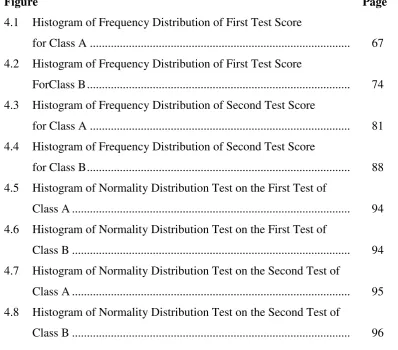
LIST OF FIGURES
Figure ... Page
4.1 Histogram of Frequency Distribution of First Test Score
for Class A ... 67 4.2 Histogram of Frequency Distribution of First Test Score
ForClass B ... 74 4.3 Histogram of Frequency Distribution of Second Test Score
for Class A ... 81 4.4 Histogram of Frequency Distribution of Second Test Score
for Class B ... 88 4.5 Histogram of Normality Distribution Test on the First Test of
Class A ... 94 4.6 Histogram of Normality Distribution Test on the First Test of
Class B ... 94 4.7 Histogram of Normality Distribution Test on the Second Test of
Class A ... 95 4.8 Histogram of Normality Distribution Test on the Second Test of
xix
LIST OF ABBREVATIONS
SD : Standard Deviation
SE : Standard Error
M : Mean
Mo : Modus
xx
LIST OF APPENDICES
Appendix 1 : Research Schedule
Appendix 2 : Instrument for Questionnaire Try Out 1 and Try Out 2 Appendix 3 : Instrument for Questionnaire Try Out 3
Appendix 4 : Instrument for Questionnaire Test
Appendix 5 : Instrument for Try Out Test 1 and Try Out 2 Appendix 6 : Instrument for Try Out Test 3
Appendix 7 : Instrument for Test Appendix 8 : Key Answer of Test Items
Appendix 9 : The Result of Validator’s Recommendation for Try Out 3 Appendix 10 : The Description of Questionnaire Try Out in the Class C Appendix 11 : The Calculation of Try Out Score
Appendix 12 : The Description of Instrument Test Scores of The Multiple Choice Items Achieved The Students In Try Out of Class C
Appendix 13 : The Result of Questionnaire Try Out Test 1 Appendix 14 : The Result of Questionnaire Try Out Test 2 Appendix 15 : The Result of Questionnaire Try Out Test 3 Appendix 16 : The Result of Instrument Try Out Test 1 Appendix 17 : The Result of Instrument Try Out Test 2 Appendix 18 : The Result of Instrument Try Out Test 3
xxi
Appendix 22 : The Calculation of Index Difficulties of Try Out Test 2 Appendix 23 : The Calculation of Index Difficulties of Try Out Test 3 Appendix 24 : The Calculation of Index Discrimination of Try Out Test 1 Appendix 25 : The Calculation of Index Discrimination of Try Out Test 2 Appendix 26 : The Result Questionnaire of Respondent in Class A
Appendix 27 : The Result Questionnaire of Respondent in Class B Appendix 28 : Students’ First Test Score of Class A
Appendix 29 : Students’ Second Test Score of Class A Appendix 30 : Students’ First Test Score of Class B Appendix 31 : Students’ Second Test Score of Class B Appendix 32 : Documentation of the Study
xxii REFFERENCE
Asnawir and Usman.MediaPembelajaran.Jakarta: Ciputatpers, 2002.
Ary Donald, Lucy Cheser Jacobs, Chris Sorensen, and AsgharRazavieh, Introduction to Research in Education Eight edition.
Cemeron,Keith, Computer Assisted Language Learning, New Jersey: Intellect Limited. 1989.
Djiwandono , M. Soenardi, TesBahasadalamPengajaran
Dorrney,Zoltan, Research Method in Applied Linguistics Quantitative, Qualitative A Mixed Methodologies.
Dunn, Rita and Shirley A Griggs, Practical Approach to Using Learning Style in Higher Education, English: Library Congres Cataloging in Publication Data. 200
Gerlach in ArifSadiman at all Media Pengantar, Pengembangan, danPemanfaatannya.Jakarta: CV Rajawali, 1990.
Gilakjani, Abbas Pourhessein, Visual, Auditory Kinesthetic Learning Styles and Their Impact on English Language Teaching Journal.Iran: Islamic Azad University, 2012.
H. Douglas Brown, Teaching by Principles an Interactive Approach to Language Pedagogy (Second Edition).
H.Douglas Brown, Principle of Learning and Teaching fourth edition, New York: Longman. 2000
Heaton, J. B, Language Testing, 1982.
Heaton, J. B, Writing Language English Test, London: Longman. 1974
Hiebert, Elfrida H, and Michael L. Kamin, Teaching and Learning Vocabulary, New Jersey: Lawrence Elbaurn Associates. 2005.
Hornby.Oxford Advanced learner’s Dictionary, Oxford: Oxford University Press,1995, p.727.
KhafifudinNur, The Influence of Learning Styles (Visual, Auditory, and Kinesthetic) towards Vocabulary Mastery at the Second Year of MAN Salatga, Thesis, Salatiga: STAIN, 2013
xxiii
NilaDini, Improving Mentally Retarded Students’ Vocabulary Mastery Through Visual, Auditory, Kinesthetic And Tactile (Vakt) Method Used by the Students of the Bachelor degree of English Education Study Progran of Pakuan University. Nisa,EsnaHallatun, A Study On English Vocabulary Teaching Techniques to Fourth and
Fifth Grade Students Of SD Plus DarulUlumJombang Academic Year 2008/2009, Thess of State Institue for Islamic Studies of English Department Faculty of Tarbiyah, Surabaya: SunanAmpel State Institue for Islamic studies, 2009.
Nunan,David,Research Methods in Language Learning.New York: Cambridge University Press. 1992.
Rudy BretzAsnawir and Usman, MediaPembelajaran.Jakarta: CiputatPers, 2002. Suharto, G, MetodologyPenelitianDalamPendidikanBahasASuatuPengantar.
DepartmenPendidikandanKebudayaan, 1998
Thornbury, Scott, How to Teach Vocabulary, England: Pearson Education Limited. 2000.
xxiv
CURRICULUM VITAE
Norma Yuwanti was born on October 22, 1992
in Pangkalan Bun, Central of Kalimantan. She was the last child from three children of Mr. Kaspul Anwarand Mrs. Arba’atunSyadiah. She has one old sister is Nurhasanah and one old brother isHermansyah.Her hobbies are listening to the music, singing, traditional dancing, having a family time, travelling, and many more.
She began her study when she was seven years old at theState Elementary School (SDN) 1 MendawaiSeberang, Pangkalan Bun. Then she continued her study to Junior High School at SMP Negeri 4 Arut Selatan, Pangkalan Bun, Centralof Kalimantan from 2005 till 2008 and to Senior High School at SMK Negeri1 Pangkalan Bun, Central of Kalimantan from 2008 till 2011.