Volume 01 No. 01 June 2016 ISSN : 2502 – 5465 / e-ISSN: 2443 – 3859
Analisa
Journal of Social Science and Religion
Accredited by LIPI Number: 543/AU1/P2MI-LIPI/06/2013
Analisa is a peer-reviewed journal published by Oice of Religious Research and Development Ministry of Religious Afairs Semarang Indonesia. It specializes in these three aspects; religious life, religious education, religious text and heritage. Analisa aims to provide information on social and religious issues through publication of research based articles and critical analysis articles. Analisa has been published twice a year in Indonesian since 1996 and started from 2016 Analisa is fully published in English as a preparation to be an international journal. Since 2015, Analisa has become Crossref member, therefore
all articles published by Analisa will have unique DOI number.
Advisory Editorial
Koeswinarno
Religious Research and Development, Ministry of Religious Afairs, Semarang, Indonesia
Editor in Chief
Sulaiman
Religious Research and Development, Ministry of Religious Afairs, Semarang, Indonesia
International Editorial Board
Florian Pohl, Emory University, United State of America Alberto Gomes, La Trobe University, Melbourne Australia Nico J.G. Kaptein, Leiden University, Leiden the Netherlands David Martin Jones, University of Queensland, Brisbane Australia
Patrick Jory, University of Queensland, Brisbane Australia Dwi Purwoko, The Indonesian Institute of Science, Jakarta Indonesia
Heddy Shri Ahimsa, Gajah Mada University, Yogyakarta Indonesia Irwan Abdullah, Gajah Mada University, Yogyakarta Indonesia Iwan Junaidi, Semarang State University, Semarang Indonesia Komarudin Hidayat, Syarif Hidayatullah State Islamic University, Jakarta
Bani Sudardi, Surakarta State University, Surakarta Indonesia Muslich Shabir, Walisongo State Islamic University, Semarang Indonesia
Editors A.M Wibowo
Religious Research and Development, Ministry of Religious Afairs, Semarang, Indonesia
Samidi
Religious Research and Development, Ministry of Religious Afairs, Semarang, Indonesia Zakiyah
Religious Research and Development, Ministry of Religious Afairs, Semarang, Indonesia Siti Muawanah
Religious Research and Development, Ministry of Religious Afairs, Semarang, Indonesia Umi Mozayanah
Religious Research and Development, Ministry of Religious Afairs, Semarang, Indonesia Umi Masiah
Religious Research and Development, Ministry of Religious Afairs, Semarang, Indonesia
Assistant to Editor Muhammad Purbaya
Mustolehudin Musyafak Arda Arief Ridhafa
Mailing Address
Oice of Religious Research and Development, Ministry of Religious Afairs, Semarang, Indonesia jl Untungsurapati Kav 70 bambankerep Ngaliyan
Semarang
Analisa Journal of Social Science and Religion Volume 01 No 01 June 2016
INTRODUCTION FROM THE EDITORIAL BOARDS
The advancement of information and technology in this era has encouraged the editorial boards of Analisa Journal of Social Science and Religion to change some aspects of the journal for the better. The irst changing is the name of the journal since 2015, from “Analisa Jurnal Pengkajian Masalah Sosial Keagamaan” to be “Analisa Journal of Social Science and Religion”. As a consequnce, there is alteration on the ISSN 1410-4350 to be 2502-5465. Furthermore, at this time, it is a must that a journal is published electronically, as it is stated in the rule issued by PDII LIPI (the Indonesian Institute of Science). Tehrefore, in 2015, Analisa started the electronic journal with E-ISSN 24443-3853, while the printed edition has been published since 1996 and continued until now. Along with the changing of the name, Analisa began the publication in English started vol.1.no.1 2016 as part of the preparation for being an international journal. There are various articles submitted to Analisa in the beginning of 2016. These include Islamic fundamentalism, terrorism, culture, Islam and Islamic education in Turkey. An article written by Tauseef Ahmad Parray talking about Islamism is placed as the opening of this volume. He argues that the incidence of 9/11 2011 in World Trade Center USA became a turning point for Western country to stereotype Islam as terrorist. Furthermore, after that tragedy Islam is perceived as fundamentalist religion, extremist, conservative Islam, radicalisms, and other negative stereotypes. In this article, he suggests that it is necessary to evaluate the Western perspectives on Islam in which they labeled Islam as extremists.
The next article is entitled “The Chronicle of Terrorism and Islamic Militancy in Indonesia” written by Zakiyah. This paper provides data and deep analysis on the series of bombing and terror happened in Indonesia from 2001 to 2012. After the fall of President Soeharto in 1998, there were a series of bombing and terror in some part of the country which caused hundreds casualties and great number of property damages. This year was also a time for some extremists coming back to Indonesia after a long period of exile abroad. These extremist igures then began their activities in Indonesia and they also disseminated the radical ideology, establishing network, recruiting new members and preparing for terror and violent action. Some of the terrorists and suspected of the bombing actions were indicated having connection with the Islamic radical group which means that there is an Islamic militancy in Indonesia
The radical ideology was also spread at prominent university in Yogyakarta Indonesia. This theme is discussed by Arifudin Ismail. He mentions that this ideology is not only spread by jihadists but also by some activists in certain campuses. For instance, there are some discussions and discussion groups existed in Gadjah Mada University, Sunan Kalijaga Islamic State University, Yogyakarta Muhammadiyah University, and Indonesia Islam University. In such activity, there is an indication that there is discussion on “the radical ideology”. He focused his study on the exclusive students movement in Gadjah Mada University especially related to how the religious doctrine (Islam) disseminated and perceived by students. Besides the discussion of the Islamism, terrorism and radical movement as the phenomena happened in Indonesia and in the world, this volume also ofers other insights of Indonesia. Betty Mauli Rosa Bustamn explores the Minangkabau tradition. She describes in her article how the local people (Minangkabau) adopted Islamic values into their tradition from generation to the next generation. In this paper, it can be seen that Islam and local culture are living in harmony. In addition, Asep N Musadad talks about the assimilation and acculturation process between local traditions of Sundanese community with Islam. He describes that the harmony between them can be seen on the literature; there is a cultural change as a picture of how Islam and local tradition met and assimilated. Besides, in the folklore as he mentions that some incantations used by shaman (panayangan) contain some symbols of Islam
Analisa Journal of Social Science and Religion Volume 01 No 01 June 2016
transformed and disseminated through electronic media such as television; this can be read at the next article. Siti Solihati wrote a paper about how Islamic symbols are used by a soap opera broadcasted in a national television. In this article, she found that there are some ideologies embedded in such program namely; (1) ideology of materialistic-capitalist, (2) ideology of patriarchy, and (3) violent domination.
Napsiah and her colleagues wrote an article about how the people living in surrounding the Merapi Mountain cope with the disaster especially when the eruption occurred and its aftermath. Community living in Pangukrejo village near the mountain helps each other dealing with their disaster related problems. They are hand in hand in re-building their villages without looking at their religious background. All people participate in those activities since they feel that Merapi is their home and their source of convenience and safety, therefore this honorable symbol should be preserved at all cost. They argue that the eruption is the destiny from God, thus it is undeniable fact. At that time, they were at the bottom level condition, so that to wake up from that situation they need to help each other (gotong royong).
The last article in this volume is about the transformation of Islamic education at Imam Hatip School in Turkey. This paper is written by Mahfud Junaidi. He describes that the curriculum in this school aims to transfer the traditional norms based on the Islamic values. It is expected that by implementing Islam, this will contribute to the development of society and nation-state in Turkey.
Please enjoy reading articles in this volume.
Analisa Journal of Social Science and Religion Volume 01 No 01 June 2016
ACKNOWLEDGMENTS
Analisa Journal of Social Science and Religion would like to thank you to all international editorial boards for their support and their willingness to review articles for this volume. Analisa would also like to thank you to all authors who have submitted their articles to Analisa, so that this volume is successfully published.
Analisa do hope that we would continue our cooperation for the next editions.
Analisa Journal of Social Science and Religion Volume 01 No 01 June 2016
TABLE OF CONTENT
Volume 01 No 01 June 2016 Pages 1 - 138
ISSN : 2502 - 5465 / e-ISSN: 2443 - 3859
Analisa
Journal of Social Science and Religion
Accredited by LIPI Number: 543/AU1/P2MI-LIPI/06/2013
Introduction from the Editorial Boards :: i Acknowledgments :: iii
Table of Content :: v
RECENT SCHOLARSHIP ON “ISLAMISM” DISCOURSE: AN EVALUATION AND ASSESMENT
Tauseef Ahmad Parray :: 1-18
THE CHRONICLE OF TERRORISM AND ISLAMIC MILITANCY IN INDONESIA Zakiyah :: 19-40
NEW RELIGIOUS MOVEMENT ON CAMPUS: A ROLE OF CAMPUS’ MOSQUES IN RAISING EXCLUSIVITY
(A Case at Gadjah Mada University, Yogyakarta) Arifuddin Ismail:: 41-58
THE SOCIETY OF MINANGKABAU IN TULIS SUTAN SATI’S SENGSARA MEMBAWA NIKMAT: BETWEEN LOCAL TRADITIONS AND ISLAMIC TEACHINGS
Betty Mauli Rosa Bustam :: 59-74
TRACING THE “CULTURAL CHANGES” IN SUNDANESE LOCAL INCANTATIONS Asep Nahrul Musadad :: 75-90
THE USES OF RELIGIOUS SYMBOLS TO REPRESENT ISLAM (A Study on Religious Soap Opera “Bukan Islam KTP”)
Siti Sholihati, Heddy Shri Ahimsa-Putra, Heru Nugroho :: 91-104
VALUE RATIONALITY OF PEOPLE LIVING ON THE SLOPE OF MERAPI IN YOGYAKARTA Napsiah, Budhi Gunawan, Oekan Soekotjo Abdoellah, dan Munandar Sulaeman :: 105-120
IMAM HATIP SCHOOL (IMAM HATIP LISESI): Islamic School in Contemporary
Secular Turkey
The Uses of Religious Symbols to Represent Islam (A Study on Religious Soap Opera “Bukan Islam KTP”) Siti Sholihati1, Heddy Shri Ahimsa Putra2, Heru Nugroho3
INTRODUCTION
The background of the study
The development of communication technology has inevitably caused a new demand for every elements of society to make an adaptation to the rapid movement of media culture. As a part of social system, Islam especially feels the needs of appropriate media as potential tools to transfer Islamic values to the wider audiences. Amids the variety of modern media, so far, television has become the reasonable choice, it seems to be the most popular and the most widely accepted among the people compared to other types of media.
The way television uses religious symbols to represent Islam has been carried out in various
media nature that, to some extent, causes the religious teaching to be subtly mixed up with media culture. As there is a mixture between media and religious symbols, therefore, it could be understandable that the content of religious portrayal on television may raise multiple interpretations among the people. Before portraying religious programs, television usually takes a religious consultant as its reference concerning the on-going issues. In this case, religious consultant referred by the television has a certain pattern in interpreting the teaching, so that it makes the multi-process of interpretation becomes more complex matter. There are at least three steps of interpretation occur in religious
THE USES OF RELIGIOUS SYMBOLS
TO REPRESENT ISLAM
(A Study on Religious Soap Opera “Bukan Islam KTP”)
SITI SHOLIHATI
1,
HEDDY SHRI AHIMSA PUTRA
2, HERU NUGROHO
3Analisa Journal of Social Science and Religion Vol 01 No.01 June 2016 Website Journal: http://blasemarang.kemenag.go.id/journal/index.php/analisa DOI: http://dx.doi.org/10.18784/analisa.v1i1.242
1Walisongo State Islamic University
2Gadjah Mada University
Jln. Sosio Humaniora, Yogyakarta [email protected]
3Gadjah Mada University
Jl. Teknika Utara,Yogyakarta
Paper received: 30 November 2015 Paper revised: 27 February – 1 March 2016 Paper approved: 16 May 2016
Abstract
This study is entitled “The Uses of Religious Simbols to Represent Islam (A Study on Religious Soap Opera ‘Bukan Islam KTP’)”. The background of the research is based on the facts of the arbitrary use of symbols in representing Islam which are shown on Indonesian televisions. The pattern of the use of religious symbols, either verbal or non-verbal, symbols are generally explicit, but when they are examined using appropriate methods, they actually contains some implicit meanings. The purpose of this study was to discover how Islam is represented on television religious soap
opera using religious symbols and to ind out the dominant ideology behind the
representation techniques. To analyze the soap operas which consisted of twenty episodes, the researcher used a semiotic approach of John Fiske on television codes. The results of this study are: (1) the use of verbal symbols to represent Islam
potentially creates multiple interpretations when they are spoken by diferent
characters, (2) some religious terminologies are often used by antagonist players to express anger and disappointment, (3) the soap opera is dominated by verbal violence used by both protagonist and antagonist players, while antagonist player
use violence both in verbal and non-verbal forms. The indings about ideology
embedded in the soap opera are: (1) capitalist-materialistic ideology, (2) ideology of patriarchy, and (3) violence domination.
Analisa Journal of Social Science and ReligionVolume 01 No. 01 June 2016 pages 91-104
programs on television. First, the interpretation
by the messengers toward the normative religious symbols is potentially faceted as their beliefs.
Second, the result of this interpretation is
transformed to the media practices in such a way which also may result another faceted knowledge.
Third, based on messengers’ legitimation on
the matter, television uses all the mean of art, aesthetics, and the market demands to create another form of Islamic symbols which has been naturalised in the media culture.
The diversity in the use of religious symbols in representing Islam can at least be seen on religious television shows in the forms of entertainment, for example on religious soap operas. In general, representation of Islam by using religious symbols in religous soap operas can be identiied from the way in which the religious attributes are used, the sacred texts are exploited, the dialogue are spelled out, and in a problem is solved at the end of the whole narration. The uses of religious symbols in representing Islam in such a way, to some extent, could lead to the simpliication of the substance of religious values so that it would be easier for the audience to understand religious teachings. The uses of religious symbols either on television soap operas or movies could not be separated from the media construction of religious teaching to represent in such a way so that it becomes an easy consuming program. By doing so, the idea of Islamic teaching could be more easily accepted by the audience from various levels of religious knowledge.
The use of religious symbols in such a simple way to represent Islam seems to be inevitable as naturally television has its own way to convey a message to its viewers. Based on the contents, Indonesian private televisions have actually given a relatively large portion in portraying Islam. This can be seen especially on television shows during the month of Ramadan as well as on some special events concerning Islamic holy days. Regarding the claim that some television programs have tended to discredit Islam which bring about multi interpretation at any rate, it is important to note here that it could be one of the side efects of the
work system existing in media institutions. The multi interpretation about television contents can be understood as a way of working system in the media that generally has a complex process. According to van Dijk (1985: 18) the media performance is shaped by several factors such as the interests of the owners, the interest of market, and the pressures from an outsider faced by media organizations. Meanwhile Irianto (2005: 520) suggests that television does actually like to play around in the realm of representation of reality in depicting Islam, so that the viewers have a picture of Islam in an artiicial form. Religious phenomena which are artiicially displayed in the media can be seen on some religious programs represented by television during the month of Ramadan using religious symbols that creates an artiicial reality about Islam.
In fact, television is only one form of media existed in Indonesia, but for some Indonesian Moslem community television has become not only an important source of information but also become source of entertainment. The media, therefore, take the advantage of people’s dependence on it to sell products in the form of information package. By doing so, television has established its strategic position as an agent of distributing cultural issues among the society. As an agent of distributing cultural issues, television strives to include as many elements of culture as possible into the audience needs, including about religion in cultural perspective. Television seizes opportunities of people’s need for information as well as entertainment by presenting popular programs to attract as many viewers as possible so that it can convince more advertisers to get into bussiness (Burton, 2008: 96). In this case, the cultural aspects of society embedded on television programs has only served as an object of media commodity using the principles of demand and supply. Popularity concept complements the claim that television is a form of popular culture, which is according to Storey, has appeared in the early 20s (Storey, 2007: 11).
The Uses of Religious Symbols to Represent Islam (A Study on Religious Soap Opera “Bukan Islam KTP”) Siti Sholihati1, Heddy Shri Ahimsa Putra2, Heru Nugroho3
visualize ideas through a program on the screen using construction techniques in such a way, in order to give the impression of the real for the sake of its viewer interest. Recently the programs ofered in Indonesian private television have showed the notion toward resemblance to each other. When a certain station has succeeded in portraying a particular theme, then it is immediately followed by other stations in presenting a program with similar theme. Religious-themed soap opera tends to follow this trend as well, beginning with Rahasia
Ilahi in TPI (now MNCTV) in early 2004, which
is soon followed by other stations using slightly image of Islam can also be seen in religious soap opera “Bukan Islam KTP” SCTV. The eforts of the medium to represent the reality of Islam in this soap opera becomes an interesting object to study, especially because these symbols are presented in a comedian format. Based on previous experience in observing the fact of how religious symbols are used to represent Islam on television religious-themed soap opera, the writer feels an urge to conduct a close study to the main theme on the representation of Islam using religious symbols on soap opera entitled “Bukan Islam KTP” in SCTV. Research Questions
When Islam is conveyed through television as a mean of mass communication in the form of an entertainment program, the use of symbols to represent Islam is potential to cause a diferent image about it. Through this study, the writer is trying to take a close look on how television represents the image of Islam in the religious soap opera, the uses of religious symbols, and the ideology hidden behind it. In order to get a clear picture on media reality about Islam as well as how this reality is represented on television, the writer proposes the main questions as followed:
a. How is Islamic teaching represented on television using religious symbols?
b. What are the ideologies behind the uses of religious symbols in representing Islam?
Literature Review
Some researches on television content concerning the uses of religious symbol are hardly found. In this part, the author classiied previous research into three categories. First, there is a research which corresponds with study objection on television content using semiotic approach done in 2013 by Feralina. In her research, Feralina tried to ind out the meaning of non-verbal symbol used in cigarette advertising using semiotic approach of Peirce. She deined non-verbal symbols into three areas: facial expression, gestural move, and postural appearance (Feralina, 2013: 359). The inding of her research was that every non-verbal symbol used in the advertising portrayed on television has actually conveyed certain meaning in various ways. Second, a research that corresponds to the focus of the study on representation, it was carried out by Yohana (2013) who studied ilm representation about polygamy. The aim of Yohana’s study was to ind out how the ilm represents the practice of polygamy. She employed discourse analysis by Sara Mills. Yohana did not speciically make a clear deinition about the terminology of representation. Using Mills approach on discourse analysis Yohana found out that the way ilm represented polygamy was based on women’s perspective. (Yohana, 2013: 53)
Analisa Journal of Social Science and ReligionVolume 01 No. 01 June 2016 pages 91-104
This previous researches relating to symbolic paradigm showed that television uses certain religious symbols as a manifestation of political representation to create an image about certain religion. The diference of these previous studies from the recent lays on the treatment towards religious symbol itself. In this study, the author focused on not only how religious symbols are used to represent Islam, but also the attempt to close look closely at the meaning of each symbol by studying its literal meaning.
Theoretical Framework
The word symbol is sometimes percieved in some diferent ways in accordance with the context in which it is used. In Collin Cobuild dictionary, symbol is deined as: (1) “a shape or design that used to represent something such as an idea”, (2) “something that seems to represent society or aspects of life, because it is very typical of it “(Collins Cobuild, 1987: 1482). While in the dictionary of Sociology (Jary and Jary, 1991: 645) symbol is deined as: (1) a sign, in which the connection between the meaning and the sign is conventional rather than natural”, (2) an indirect representation of an underlying meaning, syndrome, etc, as in religious symbolism and ritual”. Because of the relationship between meaning and sign of a more conventional nature, therefore, a symbol not always contains universal meaning, but it depends on the communities where the symbol is used.
According to Morris, the terminology of the symbol was often used to mean everything from signs that are very simple to use to describe a complicated picture of a story often used for philosophical arguments (http://www.iu.edu/~ Morriss). Furthermore, Morris explains: “a symbol is any sign which also inherent connection to that greater thing or image to which it points”. In this case the term symbol is also used in graphic design, the myth, the events, even so a picture of people and places. In explaining the deinition of symbol, Morris uses Fontana’s argument which states that “symbols are more than just cultural artefacts in their correct contexts as they still speak powerfully to us, simultaneously addressing our intellect,
emotions, and spirit”. Although the symbol is not solely regarded as a cultural artefact, it can be used to convey a message of culture (Liliweri, 2009: 180). Liliweri argues that symbol is “a sign to mean something” which could provide more than one meaning (for example: the ring is a symbol of marriage).
It is obvious that actually human life can not be separated from the world of symbols, and that all aspects of human life consists of not only the production but also the consumption of symbols. Discussing about symbol, it is worth to notice the thesis made by Cassirer that is “man is animal symbolicum” (quoted in Verene, 1979). In this study, the word “symbol” is deined as everything related to the product such as the form of images, speech, writing, attitude, and people behavior, as representation of all aspects of human life. The deinition of symbol used in this study refers to the terminology used by Turner (1983: 19), that is “objects, activities, relationships, events, gestures, and spatial units” which empirically has been used as instruments to observe the ritual community of Ndembu that were illed by symbolic events.
A symbol can also be used to distinguish the type of human activities, for example, whether about something, and to express human behavior that are considered to have important social values. Symbols are also used as a means of human expression in explaining their behavior that could mean either they ‘want something’ or ‘prevent and reject anything’.
The Uses of Religious Symbols to Represent Islam (A Study on Religious Soap Opera “Bukan Islam KTP”) Siti Sholihati1, Heddy Shri Ahimsa Putra2, Heru Nugroho3
who have a common sense as well as a shared perception about certain things. For example, the symbol of human expression which is associated with ghosts and human soul may vary due to diferent spiritual experiences of each individual. Cassirer emphasized that basically people do not have the ability to understand the whole world in a coherent way, but rather human understanding of the world is fragmented into the area of thought as well their cutural domain. Therefore, people’s understanding about the world is carried out by marking every area of thought in a particular way so that they form activities and some object of lives into certain symbols. Cassirer’s conception of symbolic forms of human life is divided into aesthetic and scientiic forms (in Verene, 1979: 28). At the beginning, the movement of human consciousness emerges from their expression of anxiety in line with the aesthetic concerns of their religious myth, which arises from philosophical and scientiic awareness.
Based on previous dicussion about symbol, the term ‘religious symbol’ in this study means all attributes, phenomena, and signs which are used to notify the presence as well as the characteristics of a religion, including the system of values and belief systems. Beattie (1964) proposes that in religious practice, religious symbols are often faced with social and cultural practice so that the form of religious practices may vary in accordance with it. This also stated by Broos (1987) that religion and religious symbol is supposed to be the oldest symbol created by human kind.
Symbol in Islam is deined in permanent forms that it is less likely to be changed in accordance with the perspective of symbols interpreters (Ridwan, 2004: 132). Islamic symbol has been changed in such various way, that to some extend has caused the shift of meaning from the original teachings. The changes of meaning becomes apparently clear and more diverse as a result of media encounters in the case that religiuos symbols are mixed up with popular culture of media products. Irianto (2005: 520) argues that the depiction of Islam in the media (especially on television) is not essentially a relfection of true Islamic teaching, rather, it is no
more than a form of image about Islam.
Religious life is not only manifested in the form of symbols and attributes, but also in the form of religious attitudes and behavior. Therefore, to describe Islam in its context, rigorous studies on religious symbol need to be established. In this study, Islamic symbol is divided into two categories: (1) the normative symbol including the verses of Quran and the hadith, and (2) cultural symbols in the form of religious attitudes and behavior as well as the attributes used by Muslims.
When a religious symbol is represented in the media, it gives a chance to anyone to do the interpretation. This interpretation may vary from one person to another, as a result of diferences of their belief system. In addition, the interpretation of religious symbols is also inluenced by the process of its production so as to make the circuit of symbol interpretation more complex.
Regarding the description of the complexity of symbol production in the media, David Morley (2007: 284) explains that there are at least three things worth to consider:
1. Production of the message is a problematic work, as the events can be encoded in diferent ways by message producer, so it could produce diferent meanings
Analisa Journal of Social Science and ReligionVolume 01 No. 01 June 2016 pages 91-104
meaningful if it is viewed from three aspects: (a) Context (in terms of what, when, and where it
is used). It means that a message could have diferent meaning if it is used in diferent social contexts
(b) Contact (the relationship between the sender and the recipient). It means that a message can be interpreted diferently depending on the intensity of the relationship between the sender and the recipient
(c) Code (symbol used). It means that the message or sign language (icons, symbols) either verbal or non-verbal also afects the meaning of a message.
The example of religious symbols that have undergone a process of social construction is as such presented in religious television soap opera. Terminology “soap opera” is generally understood as a short term of electronic serial cinema shown on television. Indonesian television soap opera is basically a duplication of the soap opera that has been aired on foreign television. Soap opera is a continuation of the electronic cinema that means a copyright work of art and culture made by cinematographic professionals which is recorded on video tape through electronic processes and aired through television stations (Endah, 2008, Arimbi, 2009: 202). The term ‘religious soap opera’ in this study is, therefore, means electronic cinema products which is televised using religious symbols, either it explicitely mentioned in the form of the program or it is manifested in its content.
It is obvious, therefore, that a critical study in order to understand how religious symbols are used to represent Islam on television entertainment need to be conducted. Burton proposes some ideas about how a message is culturally constructed so as to form a new reality (2007: 37) by using several key concepts such as by looking at the ideology, the concept of co-modiication, the representations and the modes. In understanding the reality of religious teachings it is important to take a close look at the object especially by observing the structure of an icon, a symbol, and a sign system. On the other hand, religious realities presented in
front of television audience can be regarded as a ‘constructed reality’ or pseudo-reality because it has undergone a few modiications in the name of aesthetic and the market reasons.
The main story of religious-themed soap opera is generally made with the concept of easy consuming so that the embodied religious messages can be accepted easily by the viewer, without having to use complex thought. Easy consuming concept in representing religious teachings by using religious symbols (Islam) in the form of entertainment program, to some extent has resulted this program becomes an enjoyable viewing.
Method
Object of Study
The data of this research is the television serial of religious soap opera entitled “Bukan Islam KTP” which consisted of twenty episodes. This soap opera is portrayed daily at 18:30 on SCTV channel, started on November 18, 2011. This soap opera is a unique viewing because it is presented using comedy format so that religious messages are conveyed in a way that looks ridiculous and funny. Besides the comedic aspect, another interesting thing in this soap opera is the contradiction between the content of the message about Islamic teachings and its narration which is dominated by scenes of verbal violence. The scenes of verbal violence are apparently not only demonstrated by antagonist players but also by the protagonists who are supposed to deliver the main ideas of Islamic teaching.
The Uses of Religious Symbols to Represent Islam (A Study on Religious Soap Opera “Bukan Islam KTP”) Siti Sholihati1, Heddy Shri Ahimsa Putra2, Heru Nugroho3
started from understanding the meaning and the way of constructing it, then inding the dominant ideology embodied in the content.
It is important to make a limitation to the area of the study in order to keep the research on the track. This study focused on the uses of these religious symbols, either in the form of verbal or non-verbal, to represent the image of Islam. Some religious symbols used in this soap opera including the quotation of Quranic verses of and its translation, some Islamic terminologies which are deined as verbal symbols. While clothing used by the players, accessories, and worship utensils such as rosarrio and praying carpet are deined as non-verbal symbols.
Data Collecting
This study used recorded soap opera as the primary data, therefore the process of data collecting was based on the type of the data. a. Documentation. Documentation technique
was used to get the data straight away from television when the program was aired. To make easier for the research process, the recorded soap opera were transferred into compact disk as a raw data. Documentation technique was practiced through writing up every dialogue used as an access of verbal symbols. The script was collected and used as raw data for analysing verbal symbols.
b. Observation. Observation technique was used in form of close watching for the recorded soap opera. During this process, the researcher noted carefully every gesture, facial expression, clothing, camera shoot, and the setting. Through this process, the researcher collected all information that were needed for non-verbal symbols.
Data Analysis
In order to ind the appropriate answer to the research questions stated earlier, this study employed semiotic approach to ind out the meaning of the text. As a media text, soap opera that presents Islamic teachings using religious
symbols is assumed as an open text, so that it can be interpreted diferently by diferent researchers. In order to keep the consistence of the study, so that it would not out of the methodological framework, the researcher used semiotic approach adopted from John Fiske on television codes. Fiske (1987: 13) explains that to assess the meaning of the television text, it is important to underpin television and its program as a potential meaning instead of its aspects of commodities.
An efort to see how television represents Islam using religious symbols, therefore, should be equipped with a tool of analysis includes the analysis of political representation, such as a camera and lighting technique as well casting techniques. This type of analysis is meant to show not only how religious symbols are used in representing Islamic teaching, but also to discover the ideology behind the use of symbols. In this regard, this study requires semiotics for cinematography that could explain about inter-textual study in the ilm show (soap operas). Television codes initiated by John Fiske (1987) explains that the ideology contained in an actual movie could be known of how to use the symbol, players selection, the tone of voice, as well as camera techniques used.
Television code is a rule-governed system of signs which shared among the member of community and is used to distribute the meaning among members of the community. Fiske (1987: 4) argues that “codes are links between producers, texts, and audiences, and are the agents of inter-textuality through which texts interrelate in a network of a meaning that constitutes our cultural world”. The concept of the structure of the television code begins from social realism which, according to Fiske (1987: 23), should be presented by the television in the form of a narrative of the events that are personal, where the event must contain a social problem and there must be the solutions. Besides, the narrative also must show an easily recognizable igure and use a natural setting and the present time.
Analisa Journal of Social Science and ReligionVolume 01 No. 01 June 2016 pages 91-104
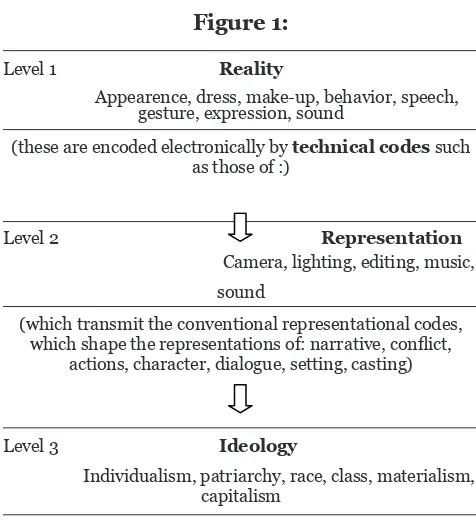
codes are then formed as dominant meanings and are distributed to the audience. The structure of Fiske’s television code consists of three levels: (1) reality which shows player performance, which are technically presented in the form of (2) representation which is arranged coherently to be accepted socially or representational codes, in
the form of (3) ideology or ideological codes. The
structure of television code can be explained in the following chart:
Figure 1:
Level 1 Reality
Appearence, dress, make-up, behavior, speech, gesture, expression, sound
(these are encoded electronically by technical codes such
as those of :)
Level 2 Representation
Camera, lighting, editing, music,
sound
(which transmit the conventional representational codes, which shape the representations of: narrative, conlict,
actions, character, dialogue, setting, casting)
Level 3 Ideology
Individualism, patriarchy, race, class, materialism, capitalism
(which are organized into coherence and social acceptability by the ideological codes )
Source: Fiske (1987: 4)
The Findings and Discussion
Soap opera entitled “Bukan Islam KTP” is a religious program which tries to bring forward the aspect of religio-comedy as a dominant narration. Some normative aspects in Islamic teaching are represented in an easy form as well as a light absurd dialogue. The techniques of representation Islamic teaching using arbitray religious symbols which rise to multiple interpretations. Representation techniques used in this soap opera is manifested in the use of religious symbols, either in the form of verbal symbols or non-verbal symbols.
The main story of “Bukan Islam KTP” The main theme of this soap opera is multiple conlicts among poor society in small part of
Betawi people. The people live in poverty and bad behavior. The people do bad things for living such as becoming thieves, pick pockets, burglars, gamblers, and drug users. People always live in some kinds of conlicts between them. Therefore this supposed to be soap opera is dominated with violence scene. The conlict happens in every level, such as internal conlict within families and external conlict between the rich and the poor. Every conlict can be solved by a man whose profession is as a religious book seller, and often preach the people about how to be good Moslems. This man has a unique character because often mocks and underscores people while speaking about religion.
In the poor village, lives a very wealthy man (antagonist) who has gone pilgrim for 7 times with a beautiful wife (protagonist). The husband is a bad mannered, mean, snobbish, arrogant, egoist, and non-religious person. On the other hand, the wife is very nice, good mannered, helpful, and religious. The man is a trouble maker and always out looking for trouble with everyone, and this is contradictory with his wife. Using religion as a legitimation, he treats his wife as a slave. He speaks in high tone and rude sentence to everyone he meets. This man treated the poor people in the way he likes. On the contrary, those people always ready to do whatever he said. It seems that those poor people are economically dependent on him. He has half-bother who lives in poverty who becomes his routine enemy.
Among this society, there is a 10 years old boy who is looked after by his poor grandfather. This boy has an obsession of becoming a preacher, and he tries to preach every time he meets people who have the wrong doing. He acts like a professional preacher on stage, and always uses rude words in reminding other people without considering their ages.
The Uses of Religious Symbols to Represent Islam (A Study on Religious Soap Opera “Bukan Islam KTP”) Siti Sholihati1, Heddy Shri Ahimsa Putra2, Heru Nugroho3
with a rude words. This makes people cornered and feel under pressure, but the people who are narrated as uneducated seem to be dependent on his religious knowledge.
Apparently, this soap opera makes a clear cut about the character of people, that is good people and bad people. There are three main ideas which can be concluded from this ilm narration; they are (1) rich people have the power to control the poor in every way they would like to, (2) well educated people have the power to control the uneducated in every way they would like, and (3) man can use religious teaching as an excuse to dominate women.
The uses of religious symbols
Looking at the types of religious symbols used by the players, there are two phenomena that could be explained here:
a) The types of non-verbal symbols are apparently represented by all categories of players, either the protagonist or antagonist characters. Non-verbal symbols in the form of dress such as head cap and koko, for example, can be worn by men of both antagonist and protagonist character as the type of clothing is culturally worn by Betawi people. While muslim’s dress for women such as long dress and veil our apprently worn by muslim.
b) The types of verbal symbols in the form of verses of the Koran are used by the protagonist characters. In each scene, the majority of the verses are delivered using the original language (Arabic) and partly delivered by citing its translation, while religious terminologies are used by both antagonist and protagonist characters.
After studying closely about religious soap opera package containing twenty episodes, the author ind out four domains in the use of religious symbols, both verbal and non-verbal symbols, to represent Islamic teaching. The same symbols can create diferent meaning when they are used by diferent people, in diferent ways and diferent objectives..
Representation using verbal symbols
a. One of verbal symbols used in this soap opera is religious terminologi. In using religious terminology, there are some terms used diferently between players based on their character, for example:
1) The sentence assalamu alaikum, which has
meaning as a greeting and good wishes given to the other, in this soap opera is sometimes pronounced with a high tone, rough voice, and unfriendly facial expression. The other diference is the matter of word completion in which sometimes it is used in incomplete sentences. According to Daud (2014: 427) representing this religious terminology and the functional use of these symbols, then the greeting sentence is constructed as a cultural symbol in which its functions is no more as a wish prayer for the safety of the other person, but as a sentence for opening and closing a conversation.
2) The sentence astaghirullah al-adzim
has terminological meaning “I ask for forgiveness to God the supreme”. In this soap opera the word is used in a diferent context by diferent players, in accordance with the character they are supposed to perfom. This sentence is represented in three kinds of facial expressions, that are (1) an expression of regret, (2) an expression of dissappointment, and (3) an expression of harassment. Expression of regret is represented by protagonist characters, whereas expression to show the anger and the abuse are represented by the antagonist character.
Analisa Journal of Social Science and ReligionVolume 01 No. 01 June 2016 pages 91-104
for diferent objectives. The diferences in using this word can be seen in the cast of characters who use it, the way how they use this word includes the tone of voice and facial expressions, the purpose of the use, and the setting of the uses. The protagonist characters exclaim the word Allahu akbar
with facial expressions that indicate a sense of admiration, as well as using soft tone of voice. While antagonist character pronounces this word with loud tone of voice, facial expression that indicates anger (upset), and follows it with rude words addressed to other people.
4) The sentence laa haula wa laa quwwata
illa billah which terminologically means ‘no
power and no strength except it only belongs to Allah’ is supposed to be the expression of a submission as well as resignation of human toward their creator. This sentence is used in diferent way, by diferent people in diferent contexts and diferent objectives. Antagonist character used this sentence in an efort to release the pressure from the strength of another human being with a loud tone of voice and cranky face, while protagonist characters used this sentence as a submission to the power of God with a soft tone of voice and a soft facial expression. b. The verbal symbols in the form of verses of the
Qur’an are sometimes used out of context as well out of content. In one occasion, the verse is arbitraryly used by a 10 years old boy when he passed through the place where four older men are gambling. The boy quoted the verse in such a way so it looks like he was at the stage of public speech. This representation could be interpreted that some one could quote any verse and address it to other people without considering whether it is done in a proper place and in a proper way of expression. In addition, the meaning of the quoted verse is sometimes used to refer to something on surface and physical that could mean a diferent thing, and therefore shows something banal. For instance the context of the word adzab in one of the verse
which is supposed to mean as the “punishment” from God for the people who have done some evil doing, is simply presented on this soap opera by exemplify a scene to show a kind of “shame” experienced by a family who have been ighting in front of other neighbors.
Furthermore, the verses are pronounced in an awkward voice as well as facial expression, which shows that the characters who used them are eventually lack of luency and do not seem to understand the meaning of the verses. In other words, religious symbol in form of the verses of the Koran seems to be used as merely an accessory on this soap opera in order to give an image that this soap opera would be looked by its audiences as a real religious program.
Representation using non-verbal symbols In using non-verbal symbols, the emergence of multiple interpretations of meaning as a result of technical representation is manifested in two areas related to the clothing and accessories worn by the players, including the make-up for women players.
a. The use of the symbol of fashion (the kind of dressing) and the make-up by the (female) players in this soap opera shows the way of presenting the reality of Muslim fashion as a diferentiator of social identity. Nice and fancy dress is used by the rich female players as their daily clothing which is worn in all places and almost all the time, like when they are cooking in the kitchen, washing the dishes, and going to Islamic events. The embeded meaning that could arise in the use of the religious symbols of this dress is that a beautiful and rich woman should wear nice and beautiful clothes to enhance the beauty and to show of their wealth. While the poor women are depicted by using a simple of clothes and a simple (almost without) make-up, with a simple model. Therefore, by simply looking at the clothing, it will be easy for other people to diferentiate between the poor and the rich women.
The Uses of Religious Symbols to Represent Islam (A Study on Religious Soap Opera “Bukan Islam KTP”) Siti Sholihati1, Heddy Shri Ahimsa Putra2, Heru Nugroho3
in the form of fashion and accessories worn by male characters is manifested in the form of turban worn by Muslim men who are described as have already performed the pilgrimage (the hajji). The narrative tries to urge the audience that only the hajji is allowed to wear the turban. As the common sense in social live proves that only the rich could be possibly become the hajji, therefore, this way of using religious symbol led to the meaning that the turban is a type of accessories which serve as a symbol of social identity among male Muslim, whether or not they have the title of hajji and whether they are rich or poor. The way of representing people clothing in this soap opera seems to correspond with Barnard (2011) who argues that actually the clothing can be used to identify social status of the people. In these endeavors, the igure of Hajji is described as an arrogant rich man, so turban (scarf) has become one of the signs of wealth as well. While religious accessories in the form of beads carried by one of the player are not used in accordance with its basic function as calculators for a Muslim to do wirid, but
only indicated as a complementary fashion accessories. On this soap opera eventually the actor who brings the accessories has never been described of how to use these tools. Such way of depictions can also be seen in the use of symbols in the form of turban that has been constructed as a cultural symbol and social status symbol.
Representation in Comedy Format in Religious Program
The religious soap opera entitled “Bukan Islam KTP” that conveys some important religious messages can be categorized as a religio-comedy show. Comedy element is visible in several aspects such as the selection of the player which is visually evident in their physical appearance and facial expression, the use of the contents (material for conversation) of funny and silly dialogue, as well as the behavior of the players in each scene which looks like being in a stage of stand-up comedy. There are some examples of scene that show indications of how this soap opera seems to make
fun of religious symbol. One of the scenes shows an element of comedy represented on this soap opera is depicted though the symbol which is performed by a player in a funny and ridiculous way, as if he is joking instead of praying. By using the symbol in such a way, the symbol creator tries to create an image that prayer can be performed by playing around. Accordingly, prayer means an expression of people needs towards their God and that people are willing to ask for help and the mercy from God. When people do the prayer it means they ask for blessing, therefore, as suggested by Abdurrahman (2014: 5) that prayer is about submission to God and should be done in sincere way. Nonetheless, the scene of prayer on this soap opera tries to tell another side of prayer, that the people who pray could also make fun on their God.
Meanwhile, messages containing about religion (Islam) is generally delivered with a patronizing tone by using sharp sentences, where a messenger was in a position to be more educated and more competent about religion than his interlocutor. It seems unavoidable that the main concept in comedy ilm, is making fun of the others. Hayward (2006: 91) argues that there always be a sense of domination in comedy ilm where the weaker is being sacriiced as the victim, while the stronger always dominates the stage. Moreover, if it looked from its content, a comedy ilm usually close to violence which is known as an aggressive humour.
Representation of Violence
Analisa Journal of Social Science and ReligionVolume 01 No. 01 June 2016 pages 91-104
stronger impression in characterising. Ironically in this soap opera, the violent behavior is not only represented by antagonist character but also by protagonist characters who are supposed to play their roles as the messengers of islamic teaching.
The dominant aspects of violent behavior in religious soap opera done by both antagonist and protagonist characters could create negative image not only about Islam but also of how its teaching is delivered. Through the uses of violent symbols, Islam is constructed the media as no more of the religion of peace. This representation is itself contradictory with the concept of non-violence communication in which the nature of communication is supposed to be a tool to build understanding with other people and not to hurt the others (Liliweri, 2011: 987).
The following is the depiction of violent behavior in representing Islam using two groups of characters: (1) For the purpose of delivering islamic teaching the protagonist players use verbal violence as well as verbal abuse, and (2) antagonist players perform both verbal and non-verbal violence. The non-verbal violence is used one after another with religious terminologies by both antagonist and protagonist characters.
Ideology
By using the structure of Fiske’s television codes in looking at the contents of messages (that is the television reality) and the representation techniques, it can be known the dominant ideologies embeded in religio-comedy program “Bukan Islam KTP” in SCTV. These dominant ideologies embeded in this soap opera are:
a. Through the whole episodes observed, it seems clear that this religious soap opera tries to make dominant of the rich in some ways. The rich people are represented to be undefeatable in their relationships with the poor. Therefore it can be said that the produser tries to devote this product to the materialistic capitalist ideology. Rich group is represented to have the power to win public devotion as they are able to control and regulate the poor in the way they like by using their wealth, while the poor
group is economically dependent. Rich people are represented in a certain way using certain symbols such as ine and looks expensive clothings, good housing, well mannered, well educated, ine tone of voice (for the protagonist character), and ine make-up for women character. On the contrary, the poor people are represented using certain symbols such as: ordinary (almost poor) clothings, rough mean to be dominant in nature, while women have every mean to be in submission toward them (Walby: 1990). The dominant idea in representing the relationships between man and woman is that by using religious doctrines as an excuse, man (husband) tends to dominate his wife and demands for her total submission. In this case, Islamic teaching has been used as a mask for man to take control over his wife. In observing this, there are two interesting facts found in this representation: (1) the relationships established within the rich family follows a man dominated culture, and (2) the relationships within the poor family is much more egalitarian.
The Uses of Religious Symbols to Represent Islam (A Study on Religious Soap Opera “Bukan Islam KTP”) Siti Sholihati1, Heddy Shri Ahimsa Putra2, Heru Nugroho3
there is a patriarchy ideology embodied in this representation. This can be seen from the representation of the way men dominate women’s lives. Male was described as being superior in the name of religion to gain compliance and obedience of women.
Figure3:
F. Conclusion
The encounters between Islam and modern media is unavoidable, as Islam needs to be spread out in every means of tool. The things that need to be reconsidered is how to ind an appropriate form so that negative image about Islam as a result of the intervention of media culture could be minimalised. It’s understandable that the nature of media is tended to be more concerned with market interest rather than moral as well as social cost aspects. Therefore, it obviuosly becomes a collective homerwork for all muslems in charge.
The inding of this research is only one of the many facts that eventually become media phenomena. Islam has become one of media commodities, so that it should be represented in such away to ill the market place. Unfortunetely, the eforts to represent Islam using religious symbols has resulted a diferent image as it should have been. The nuance of entertaining people of the media constructions has shifted Islamic values towards a new look as well as a new image about this religion.
At last, based on these facts and the indings of this study, the author keeps big hope that there will be many other studies done by many more
researchers exploiting better methods.
R
EFERENCESAbdurrahman, T. 2014. Do’a, Dzikir, dan
Shalawat. Yogyakarta: Fortune.
Arimbi, D.A. 2009. Representation, Identity and Religion of Muslim Women in Indonesian
Fiction. Amsterdam: ISAC.
Barnard, M. 2011. Fashion Sebagai Komunikasi: Cara Mengomunikasikan Identitas Sosial,
Seksual, Kelas, dan Gender. (terj. Idy Subandy
Ibrahim dan Yosal Iriantara). Yogyakarta: Jalasutra.
Beattie, J. 1966. Other Cultures: Aims, Methods
and Achievements in Social Anthropology.
London: Routledge.
Broos, A. D. J. 1987. Creating Culture: Proiles in
the Study of Culture. Sydney: Allen Unwin.
Bungin, B. 2001. Imaji Media Massa: Konstruksi dan Makna Realitas Sosial Iklan Televisi
dalam Masyarakat Kapitalistik. Yogyakarta:
Jendela.
Burton, G. 2008. Membincangkan Televisi:
Sebuah Pengantar Studi Kepada Televisi.
(terj. Laily Rahmawati). Yogyakarta: Jalasutra. Cassirer, E. 1987. Manusia dan Kebudayaan:
Sebuah Esei Tentang Manusia. (terj. Alois A.
Nugroho). Jakarta: Gramedia.
Cobuild, C. 1987. English Language Dictionary. London: Collin Publisher.
Daud, A. I. A. 2014. Ensiklopedi Dakwah: Bekal
Juru Dakwah (terj. Munirul Abidin). Jakarta:
Adz-Dzikr.
Endah. 2008. “Sinetron sebagai Media Dakwah” (makalah tidak diterbitkan).
Fiske, J. 1987. Introduction to Communication
Studies. Routledge: London.
Hayward, S. 2006. Cinema Studies: The Key
Concept. London: Routledge
Analisa Journal of Social Science and ReligionVolume 01 No. 01 June 2016 pages 91-104
Berperang menuju Spiritualitas untuk
Berdialog. Yogyakarta: Jalasutra.
Jary, D. and J. Jary. 1991. Collins Dictionary of
Sociology. London: Collins Publisher.
Liliweri, A. 2009. Makna Budaya dalam
Komunikasi Antarbudaya. Yogyakarta: LKiS
---, A. 2011. Komunikasi Serba Ada Serba
Makna. Jakarta: Prenada Media.
Morley, D. 2007. The Nationwide Television
Studies. London: Routledge.
Pawito. 2008. Penelitian Komunikasi Kualitatif. Yogyakarta: LKiS.
Ridwan, N. K. 2004. Agama Borjuis: Kritik Atas
Nalar Islam Murni. Yogyakarta: Ar Ruzz.
Storey, J. 2007. Cultural Studies dan Kajian Budaya Pop: Pengantar Komprehensif
Teori dan Metode (terj. Laily Rahmawati).
Yogyakarta: Jalasutra.
Syahputra, I. 2011. Rahasia Simulasi Mistik
Televisi. Yogyakarta: Pustaka Pelajar.
Turner, B. S. 1983 . Religion and Social Theory: A
Materialist Perspective. London: Heinemann
Educational Books.
Van Dijk, T.A. 1985 . Discourse and Communication: New Approaches to the Analysis of Mass
Media Discourse and Communication. New
York: Walter de Gruyter.
Verene, D. P. 1979. Symbols, Myth, and Culture:
Essays and Lectures of Ernst Cassirer. U.S.A:
Yale UP.
Walby, S. 1990. Theorizing Patriarchy. U.K.:
Blackwell.
JOURNAL
Feralina, N. “Analisis Semiotika Makna Pesan Non-Verbal dalam Iklan Class Mild Versi “Macet” di Media Televisi. Jurnal Ilmu Komunikasi. Vol. I (4). Pp: 353-365.
Yohana, N. “Representasi Poligami dalam Film
Berbagi Suami”. Jurnal Ilmu Komunikasi.
Vol. 2. No. 2. September (2013). Pp: 47-56
INTERNET