Three Selected Fable Books.
Introduction
There are many ways to encourage children in learning English, one of them is reading bilingual story books. Many bilingual books have good translations, but some of them do not. Many people
think that translation is similar to replace words in source language (SL) text with words in target language (TL) text. They merely change the words in SL text into the words in TL text only by looking at the words in dictionaries. As a result, the translation has
Abstract
A translation product can be analyzed from linguistic aspects, especially on the grammatical aspect. One of the translation products can be found in a bilingual fable book. This research analyzed three selected fable books which were written by Puput Mugiati and published by Cahaya Agency. Since the sentences of the books had grammatical mistakes, it was necessary to investigate, analyze, and revise them into more appropriate sentences. This analysis was based on the theory of grammar which analyzed the English version of the books, particularly, it focused on the grammatical mistakes of the sentences. This research was carried out by using qualitative method, and the data were collected by documentary study. The data had totally 66 sentences which consist of: book (1) had 27 sentences, book (2) had 22 sentences, then book (3) had 17 sentences. Next, the data were processed by selecting the ungrammatical sentences of the books, which were found 47 ungrammatical sentences. It means that there are 47 sentences which were analyzed in this research. The analysis in this research used descriptive method. The result of investigation of grammatical mistakes showed that there were only seven types of mistakes found in the data, they were the mistakes of word choice, incomplete elements, tenses, subjective pronoun, word order, possessive adjective, and plurality. Then the sentences were claimed as incorrect or mistake because they had inappropriate grammatical rules, such as the inappropriateness in ordering the structures of sentences, the inappropriateness in selecting words, and the inappropriateness in completing the forms of sentences. The mistakes had been corrected to be more appropriate translation text.
Keywords: Translation Product, Grammatical Analysis, Grammatical Mistakes. Abstrak
Suatu produk terjemahan dapat dianalisis dari aspek bahasa, terutama dalam hal gramatika (tata bahasa). Salah satu produk terjemahan dapat ditemukan di buku cerita binatang versi dua bahasa. Penelitian ini menganalisis tiga buku cerita pilihan yang ditulis oleh Puput Mugiati dan diterbitkan oleh Cahaya Agency. Selama kalimat kalimat dalam buku tersebut mengandung unsur kesalahan gramatika, maka kalimat tersebut perlu diteliti, dianalisa, dan direvisi agar menjadi kalimat yang lebih tepat. Penelitian ini berdasarkan pada teori gramatika, terutama fokus pada kesalahan gramatika dalam kalimat kalimat yang terdapat pada data. Penelitian ini diangkat dengan menggunakan metode kualitatif, dan data dalam penelitian ini dikumpulkan dengan menggunakan studi dokumentasi. Jumlah data total mencapai 66 kalimat yang terdiri dari: buku pertama terdapat 27 kalimat, buku kedua terdapat 22 kalimat, dan buku ketiga terdapat 17 kalimat. Kemudian data tersebut diproses dengan memilih kalimat kalimat yang mengandung kesalahan gramatika, yang mana ditemukan 47 kalimat yang tidak sesuai dengan tata aturan gramatika. Hasil dari penelitian ini menunjukkan bahwa hanya terdapat tujuh tipe kesalahan gramatika yang ditemukan di data, yaitu kesalahan dalam pemilihan kata, ketidak lengkapan unsur kalimat, tenses, kata ganti subjek, penyusunan urutan kata dalam kalimat, kata kepemilikan, dan plurality. Data tersebut dinyatakan salah karena tidak sesuai dengan aturan gramatika, seperti ketidak sesuaian dalam menyusun struktur kalimat, ketidak sesuaian dalam pemilihan kata, dan ketidak sesuaian dalam melengkapi bentuk kalimat. Kesalahan kesalahan tersebut telah diperbaiki menjadi teks terjemahan yang lebih tepat.
Kata kunci : Produk Terjemahan, Analisa Gramatika, Kesalahan Gramatika. Imraatus Shalihah, Sukarno, Indah Wahyuningsih
English Department, Faculty of Letters, Jember University Jln. Kalimantan 37, Jember 68121
E-mail: [email protected]
THE GRAMMATICAL ANALYSIS ON THE INDONESIAN-ENGLISH
TRANSLATION OF PUPUT MUGIATI'S THREE
Three Selected Fable Books.
ungrammatical structures, even it can mislead the readers to a different message, because the meaning of TL text is different from that of SL text, as it was found in some fable books written by Puput Mugiati. Those fable books have many grammatical mistakes in the English translation text (TL text). Therefore those books were chosen as the source of data in this research.
There were three selected fable books investigated and discussed in this research. There were many grammatical mistakes found in the books, such as the mistake of word choice, verb form, tenses, incomplete elements, etc. This study was very important to revise the translation text of those books into a better grammatical translation.
Some common grammatical mistakes found in the bilingual fable books become a problem of this research. The mistakes were about word choice, incomplete elements, verb form, the use of subjective pronoun, etc., which could cause misunderstanding when the readers read the translation text.
In accordance with the phenomena, the current study identified the grammatical mistakes in the three selected fable books. It aimed to answer the following questions:
(1) What kinds of ungrammatical elements can be found in the translation text of the three selected fable books?
(2) Why are they incorrect and what correct translation can be suggested?
Concerning with the research questions, this study had two purposes. They were:
(1) To give clear description about the ungrammatical elements in the English translation text of the three selected fable books.
(2) To find the reasons why they are claimed as ungrammatical sentences, and to correct them to be the appropriate ones.
Research Methodology
This research constituted qualitative research since the data were in the form of words or sentences which were taken from fable books, as suggested by Denscombe that qualitative data take the form of words (spoken or written) and visual images (observed or creatively produced) (2010: 273). Afterwards, the data were explained descriptively, and also they were associated with document as the method of research. The data of this research were
Puput Mugiati and which were published by Cahaya Agency. The data in this research were collected by documentary study. It is called document because the data were collected from written text. There were three books as the source of data. They had totally 66 sentences which consist of: book (1) Pesan Burung Kenari which had 27 sentences, book (2) Ratu Lebah yang Jahat which had 22 sentences, then book (3)
Nasehat Eyang Katak yang Biaksana which had 17 sentences, but this research focused only on analyzing the ungrammatical sentences of the books, which could be decided that there were 47 ungrammatical sentences derived from: book one consisting of 18 sentences, book two also consisting of 18 sentences, and book three consisting of eleven sentences. In conclusion, the total data which were analyzed in this research were 47 ungrammatical sentences, then, the data were classified based on the types of the grammatical mistakes.
Result
The finding of the research showed that there were seven types of mistakes – word choice, incomplete elements, tenses, subjective pronoun, word order, possessive adjective, plurality – found in 47 sentences. The sentences with mark number 1 until 18 are from book one, and the sentences with mark number 19 – 36 are from book two, while the sentences with mark number 37 - 47 are from book three. These sentences were classified into two groups depending on the number of the mistakes in each sentence - the sentences with one type of mistake (a single mistake ) and those with more than one type of mistake (multiple mistakes) -. The first group consist of 17 sentences and the other consist of 30 sentences.
The first group had five types of mistakes, they were word choice, tenses, incomplete elements, subjective pronoun, and possessive adjective. The table below presents the number of sentences with a single mistake.
Table 1: The Number of Sentences with a Single Mistake.
No Types of mistakes Book 1 Book 2 Book 3 Total (%)
1. 2. 3. 4. 5.
Word choice Tenses
Incomplete elements Subjective pronoun Possessive adjective
3 2 -1
3 -2 2
-1 2 1
-7 (41.1-7%) 4 (23.52%) 3 (17.64%) 2 (11.76%) 1 (5.88 %)
Total mistakes 5 7 4 17 (100%)
Three Selected Fable Books.
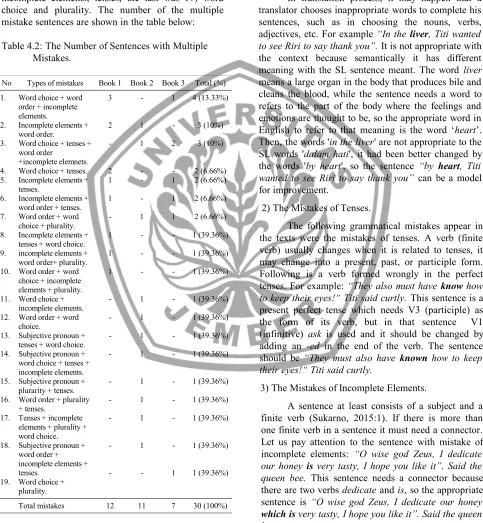
choice, and plurality, 8) incomplete elements, tenses, and word choice, 9) incomplete elements, word order, and plurality, 10) word order, word choice, incomplete elements, and plurality, 11) word choice and incomplete elements, 12) word order and word choice 13) subjective pronoun, tenses, and word choice, 14) subjective pronoun, word choice, tenses, and mistake sentences are shown in the table below:
Table 4.2: The Number of Sentences with Multiple Mistakes.
No Types of mistakes Book 1 Book 2 Book 3 Total (%)
1.
Total mistakes 12 11 7 30 (100%)
Discussion
From the result of the research above, the ungrammatical sentences, as the data, were classified into two groups – the sentences with a single mistake and the sentences with multiple mistakes -. The following are the examples of discussion of both groups of sentences:
1. The Sentences with a Single Mistake. 1) The Mistake of Word Choice.
In translation process, it may happen that a translator chooses inappropriate words to complete his sentences, such as in choosing the nouns, verbs, adjectives, etc. For example “In the liver, Titi wanted to see Riri to say thank you”. It is not appropriate with the context because semantically it has different meaning with the SL sentence meant. The word liver
means a large organ in the body that produces bile and cleans the blood, while the sentence needs a word to refers to the part of the body where the feelings and emotions are thought to be, so the appropriate word in English to refer to that meaning is the word ‘heart’. Then, the words 'in the liver' are not appropriate to the SL words 'dalam hati', it had been better changed by the words 'by heart', so the sentence “by heart, Titi wanted to see Riri to say thank you” can be a model for improvement.
2) The Mistakes of Tenses.
The following grammatical mistakes appear in the texts were the mistakes of tenses. A verb (finite verb) usually changes when it is related to tenses, it may change into a present, past, or participle form. Following is a verb formed wrongly in the perfect tenses. For example: “They also must have know how to keep their eyes!“ Titi said curtly. This sentence is a present perfect tense which needs V3 (participle) as
3) The Mistakes of Incomplete Elements.
Three Selected Fable Books.
4) The Mistakes of Subjective Pronoun.
The sentence “He brought a souvenir with a nest full of delicious honey.” uses a wrong subjective pronoun to refers to the third person singular female, it should have been she, then the improved sentence is
“She brought a souvenir with a nest full of delicious honey.”
5) The Mistakes of Possessive Adjective.
The use of possessive adjective in sentence “That afternoon, Dara was reading a book, but in fact his eyes were tired” is incorrect, it must be referred to a thing that belongs to a female. The improved sentence should be “That afternoon, Dara was reading a book, but in fact her eyes were tired”.
2. The Sentences with Multiple Mistakes.
There were 30 sentences and 19 types of multiple mistakes in this research. Following are some sentences with multiple mistakes;
• “Today the Queen bee bersiap- ready been kekerajaan god Zeus”.
This sentence has mistakes of word choice, word order, tenses, and incomplete elements. Let us correct the mistakes of the sentence one by one.
The first mistake of the sentence above is the mistake of choosing the word bersiap-ready for
bersiap-siap in SL, it should be prepare, then the word kekerajaan is untranslated, it should be to go to kingdom, so the sentence becomes today the Queen Bee prepare to go to kingdom god Zeus. Another mistake of word choice is the choice of the word
today, it should be changed by in that day. The tenses in this sentence should be changed as past continuous tense because the context of the sentence shows that the event still happens in the past, so it has to be In that day the Queen Bee was preparing to go to kingdom god Zeus. This sentence is still strange because of having unordered form, the underline words in that sentence should be god Zeus kingdom. The last mistake of this sentence is the incomplete elements, adding an apostrophe after the word Zeus is a best choice for solving the mistake. The improved sentence is In that day the Queen bee was preparing to go to the god Zeus’ kingdom.
The sentence below also consists of multiple mistakes. See the following sentence:
• “Good doctor“. Answer Titi.
This sentence has mistakes of word choice and tenses, as the bold type words above, the word good
should be substituted by yes, as a symbol of an agreement. Then, the word answer had been better added by the suffix -ed as a simple past tense. The
Another multiple mistakes also appear in a sentence below:
• “and what I mean come?” Replied Zeus
The inappropriate word for lalu is chosen in sentence above, it should be then. The choice of a question word what had been better changed into why. Then, choosing a wrong word for kamu/mu in SL text is the next wrong word choice of this sentence, the word I should be substituted by you as a subjective pronoun which refers to the second person singular, then, the first improved sentence is then why you mean come?. This sentence also needs an addition of an auxiliary do after the question word why, while the second improvement is then why do you mean come?. It is still strange for reading the sentence, omitting the word mean can be a good modification. Then, the addition of the word here after the word come may be a model for improvement. The final improvement for the sentence is “then why do you come here?”.
From the discussion above, it can be said that the sentences in the data are incorrect because they were formed by inappropriate grammatical rules, then, they had been corrected in accordance with the grammatical rules until they formed more standard English sentences.
Conclusion
Three Selected Fable Books.
plurality, word choice, 18) subjective pronoun, word order, incomplete elements, tenses, the last is 19) word choice and plurality.
Next, the data were claimed as incorrect because they have inappropriate grammatical rules, such as the inappropriateness in ordering the structures of sentences, the inappropriateness in selecting words, and the inappropriateness in completing the forms of sentences. Those inapproriateness had been corrected to be more appropriate ones which were provided in tables as the model for improvement.
In conclusion, having inappropriate sentence structures can influence the quality of the fable books. Those incorrect sentences need to be corrected in term of English grammatical rules in order to form a more standard English sentence.
Acknowledgment
Our sincere gratitude goes to my first and second supervisors, Dr. Sukarno, M.Litt. and Indah Wahyuningsih, S.S., M.A who have encouraged and given me a valuable assistance to finish this thesis. Thank to Dr. Hairus Salikin, M.Ed, the Dean of Faculty of Letters; Dr. Ikwan Setiawan,M.A.; and also Dra. Supiastutik, M. Pd, the Head of English Department for giving a chance to write a thesis. Thank you so much for all lecturers and also the librarians of the English Department, Faculty of Letters; the librarians of Central Library of Jember University.
References
Denscombe, M. (2010). The Good Research Guide. New York : Open Univesity Press.
Djatmika. Wibowo, A.H., and Dewi, I.K. (2014). “The Quality of English Translation Version of Bilingual Books for Physics and Social Science.” Humaniora. Vol. 26 (3): 351-361. Mugiati, P. ( n.d ). Dongeng Dunia Binatang: Nasehat
Eyang Katak Yang Bijaksana: Cahaya Agency. Mugiati, P. ( n.d ) . Dongeng Dunia Binatang: Pesan
Burung Kenari: Cahaya Agency.
Mugiati, P. ( n.d ) . Dongeng Dunia Binatang: Ratu Lebah yang Jahat: Cahaya Agency.