n Original Research Paper
Chemometrics and Intelligent Laboratory Systems, 12 (1991) 49-55 Elsevier Science Publishers B.V.. Amsterdam
49
zyxwvutsrqponmlkjihgfedcbaZYXWVUTSRQPONMLKJIHGFEDCBA
Factorial design in oxidation reactions and analysis
of variance of initial rates of reaction
N.C. Sadiris, NC. Thanasoulias and N.P. Evmiridis *
Laboratory of Analytical Chemistry, Department of Chemistry, University of loannina, 451 10 Ioannina (Greece)
(Received 23 August 1990; accepted 25 January 1991)
Sadiris, N.C., Thanasoulias, N.C. and Evmiridis, N.P., 1991. Factorial design in oxidation reactions and analysis of variance of initial rates of reaction. Chemometrics and Intelligent Laboratory Systems, 12: 49-55.
An illustration is given of how the factorial experiment and analysis can provide the basis for the deduction of information about the chemistry of a reaction and/or reaction kinetics with three oxidation reaction examples.
INTRODUCTION
In the world of chemical reactions a molecule of a particular compound goes through a change from one form to another by colliding either with inert molecules to give reaction products com- posed of its constituent atoms, or with active molecules that act either (i) as reagents, giving reaction products that are composed of atoms that belong to both types of reacting molecules, or (ii) as catalysts that cause an effective collision to occur, changing the chemical nature of the mole- cule or allowing it to react with other molecules.
The dissociation species of the reagents, resid- ual reactivity and/ or instability of reaction prod- ucts and catalyst intermediates are some of the factors that complicate the reaction process in solution, leading to the expression
r (observed) = Cr, (I)
where
zyxwvutsrqponmlkjihgfedcbaZYXWVUTSRQPONMLKJIHGFEDCBA
r, are the rate contributions from all thereaction paths that are occurring in the system at any moment during the reaction period. However, the rate equation (1) can be considerably sim- plified by replacing the rate by the initial rate (IR) and the rate equations by the much simpler initial rate equations, thus obtaining the equation
IR(observed) = C(IR,) (2)
where
II+@
I0
50
zyxwvutsrqponmlkjihgfedcbaZYXWVUTSRQPONMLKJIHGFEDCBA
Chemometrics and Intelligent Laboratory Systems nzyxwvutsrqponmlkjihgfedcbaZYXWVUTSRQPONMLKJIHGFEDCBA
simultaneous changes that contribute to the over- all change in the initial part of the reaction and u represents the number of the factors involved in the product. The establishment of the specific equation that is followed by the reacting system under examination is a matter of discovering the effects and interactions of concentration factors, which is simple since, in most cases, there are no more than two dominant terms involved in eq. (2). A useful method used to investigate effects and interactions is the factorial experiment, which is conventionally used as a ‘precursor’ method for generating linear mathematical models which rep- resent the response surface [3] for a response optimization procedure in analytical chemistry. The establishment of the significance of effects and interactions proceeds with the factorial analy- sis procedure described by Yates [3].
The factorial procedure consists of the follow- ing stages:
1.
2.
3.
4.
Establishment of the factors involved in the determination of the response size.
Decision making about the levels ( - , + ) of each factor. The decision has to be taken in such a way that the levels convey the necessary information for the correct representation of the response surface.
The execution of the trials of the factorial experiment, which must be done in a random order.
The statistical analysis of the factorial experi- ment.
and is applicable to all types of responses. How- The factorial experiment is a general method
ever, if the response is the rate of the reaction and such factors involved are the concentrations of the reactants the factorial experiment provides a study of the kinetics of the reaction and such factorial experiments have been applied in the assessment of the validity of proposed kinetic models [4,5]. However, the factorial experiment can also be used to provide information about the actual chemistry and kinetics of complex reacting sys- tems, as explained above.
In this work we present the factorial experi- ments for the oxidation of (1) p-phenylenedia- mine (PDA), (2) N, N, N ‘, N ‘-tetramethyl-p-phen- ylenediamine (TMPDA), and (3) pyrogallol, and
we use these experiments to draw conclusions about the chemistry and the kinetics of the oxida- tion reactions. The conclusions drawn are further supported by other methods.
APPLICATIONS
Example 1. Oxidation of p-phenylenediamine
Introduction
The
oxidation reaction of PDA with hydrogen peroxide in aqueous solutions forms coloured products [6-81 which increase in quantity with time until a stage is reached where a coloured precipitate is formed. The overall reaction is given by the following equationPDA + H,O, --* oxidation products
and proceeds at a rate which is very slow but, upon the addition of formaldehyde, becomes much more rapid. The oxidation products formed during the whole oxidation cycle are products of a con- secutive oxidation path that, at some stage, branches to give condensation products which are oxidized much more slowly. Of all the oxidation products, two products are intensely coloured and absorb significantly at 485 nm. The coloured product that is formed earlier in the reaction path is the so called ‘Wurster salt’, which has the formula
Because of its ionic form this product is readily
Wurster ion
soluble in water. The other coulored product is formed later on along the reaction path and is a product of the condensation branch of the path. It has the following formula and is called the ‘Badrowski base’. This product is quite stable and slightly soluble in water.
w Original Research Paper 51
zyxwvutsrqponmlkjihgfedcbaZYXWVUTSRQPONMLKJIHGFEDCBA
The initial rate (IR) of oxidation followed by the absorbance at 485 nm is weakly dependent on the rate of formation of the Badrowski base; whereas it depends strongly on the rate of forma- tion of the Wurster salt. Upon the addition of formaldehyde the rate of reaction is significantly increased, thus suggesting that the formaldehyde molecule is a ‘catalyst’ of the oxidation reaction. The ‘catalytic’ properties of formaldehyde are as- sumed to stem from the formation of peroxy acids which readily form peroxy radicals [9] by the
reaction:
zyxwvutsrqponmlkjihgfedcbaZYXWVUTSRQPONMLKJIHGFEDCBA
H- C =0
I
+ HP2 -H
i i
H-C
zyxwvutsrqponmlkjihgfedcbaZYXWVUTSRQPONMLKJIHGFEDCBA
-0 OH -I
-
H- C - 00*
OH
The peroxy radicals provide a lower activation energy for the oxidation of PDA. The oxidation process can then proceed via a peroxy radical mechanism through the formation of the Wurster salt [lo] as follows:
The Wurster salt is further oxidized to quinonedi- imine, which is very unstable [ll] and partly con- densed to form the Badrowski base, which is in turn oxidized very slowly to quinone, and partly
hydrolysed and oxidised to quinone [7,8].
zyxwvutsrqponmlkjihgfedcbaZYXWVUTSRQPONMLKJIHGFEDCBA
Results
The reaction system described above was in- vestigated using the factorial experiment proce- dure after the performance of preliminary experi- ments to establish the range within which each factor affects the rate. The results are tabulated in Table 1.
From the factorial experiment analysis (F test) it is apparent that all effects and interactions between the factors are statistically significant, which is commonly found in such experiments.
TABLE 1
Factorial experiment of PDA oxidation
Factors Response
l
, Effects ***A** B ** C ** D** R**
-1 -1 -1 -1 0.0007 Total +1 -1 -1 -1 0.0025 1.88 A
-1 +1 -1 -1 0.0035 2.57 B
+1 +1 -1 -1 0.0128 1.87 AB
-1 -1 +1 -1 0.0062 2.59 C +1 -1 +1 -1 0.0192 1.87 AC
-1 +1 +1 -1 0.6750 2.56 BC
+1 +1 +1 -1 5.8000 1.86 ABC
-1 -1 -1 +1 0.0008 0.96 D +1 -1 -1 +1 0.0030 0.59 AD -1 +1 -1 +1 0.0030 0.97 BD +1 +1 -1 +1 0.0300 0.59 ABD
-1 -1 +1 +1 0.0180 0.96 CD
+1 -1 +1 +1 0.0440 0.59 ACD
-1 +1 +1 +1 2.1800 0.96 BCD
+1 +1 +1 +1 12.0000 0.58 ABCD
* M ean value from duplicate measurements.
l * A = [PDA], B = pH, C = [HCHO], D = [H,O,], R = IR (absorbance units/min).
l ** Residuals, $ = 0.0042; Ftb = 4.49.
TABLE 2
Ratio of IR between levels of each factor
Oxidant level
[H z4 1 = (+) [H z4 1 = C-1
A. Ratio behveen [reagent] levels
[HCHO] pH
2.4 6.0
0.00 ppm 4.0 10.0
500.0 ppm 2.5 5.5
B. Ratio between [HCHO] levels
V’DAI PH
2.4 6.0
4.0 4.0 3.0 9.0
2.4 6.0 2.4 6.0
0.1% 30.0 700.0 9.0 200.0
1.0% 15.0 400.0 8.0 450.0
C. Ratio between pH levels
[HCHO] lPD-41
0.1% 1.0% 0.1% 1.0%
[image:3.540.44.209.240.318.2] [image:3.540.281.502.433.656.2]52 Chemometrics and Intelligent Laboratory Systems n
The initial rates given above, however, can be
manipulated to provide information about the ini-
tial rate equation. Such a manipulation is based
on the ratios of IR between the two levels of each
factor at different combinations of the levels of
the other factors. A comparison of these ratios is
presented in Table 2.
The values of ratios obtained in Table 2A be-
tween [PDA] levels at all combinations of levels of
the other factors do not differ very much and they
fall within the numerical range of l-10. Since the
ratio of PDA concentration levels is 10, this sug-
gests that the rate equation may be approximated
by the expression.
IR = k,[PDA],
where k, = constant
(3)
On the other hand, the values obtained between
[HCHO] levels at all combinations of levels of the
other factors in Table 2B fall into two groups. One
group is characterized by small values and is ob-
tained at a low pH level, and the other group is
characterized by relatively large values being ob-
tained at a high pH level. This leads to the follow-
ing rate equation,
IR = ~,/L[HCHO]
(4)
where
k, = constant and p is a factor depending
on the pH value. Finally, the values obtained in
Table 2C between pH levels at all combinations of
other factor levels once again fall into two groups.
One group is characterized by low values and is
found when HCHO is absent and the other group
is characterized by relatively high values and is
found in experiments where HCHO is added at
the 500 ppm level. This leads to a rate equation of
the form
IR =
k,Nh
(5)
where
k, =
constant, N is a factor depending on
the HCHO concentration
and X is a factor that
depends on pH.
Discussion
The
expression for IR, deduced from Table 2
for each level of [H20z], is therefore
approxi-
mately given by the expression
IR =
k/A
[PDA] [HCHO]
(6)
where A =
zyxwvutsrqponmlkjihgfedcbaZYXWVUTSRQPONMLKJIHGFEDCBA
f(pH),p is a factor that depends on
the interaction
between pH and [HCHO], and
k = the kinetic constant.
The contribution
of [H202] to the overall rate
response can be deduced from Table 1, from which
it is clear that, in the absence of formaldehyde,
[H202] has no effect while, in the presence of
formaldehyde,
the contribution
of [H20J
to the
IR is much less than the change in [H20z] ( - 5).
The final picture that the factorial experiment
conveys by the method of ratios is that, in the
absence of HCHO, the initial rate equation is
IR =
kh
[PDA]
(7)
and, in the presence of HCHO,
IR= kXp[PDA][HCHO]{
f(H,O,)}
0)
which demonstrates that all factors and the inter-
actions of any number of factors are significant,
which is in agreement with the factorial analysis of
the data of the factorial experiment.
The evidence that the IR depends on the pH is
reasonable if the rate is different for the different
dissociation species of
PDA.2HCl
since the wn-
centration of the species depends on pH. Also, the
dependence of IR on the interaction of pH and
[HCHO] is reasonable and can be explained by
the reaction of peroxy-radical
formation if this is
assumed to be pH-dependent.
Finally, the depen-
dence of the IR on [H,O,] in the presence of
HCHO suggests once again the existence of the
peroxy-radical
formation
reaction, which occurs
when both HCHO and H,Oz are present.
Example 2. Oxidation of N,N,N’,N ‘-tetramethyl-
p-phenylene diamine
Introduction
The
oxidation of TMPDA is relatively slow and
follows the overall chemical equation [Et]
TMPDA + oxidant + oxidation products
l
zyxwvutsrqponmlkjihgfedcbaZYXWVUTSRQPONMLKJIHGFEDCBA
Original Research Paper 53TABLE 3
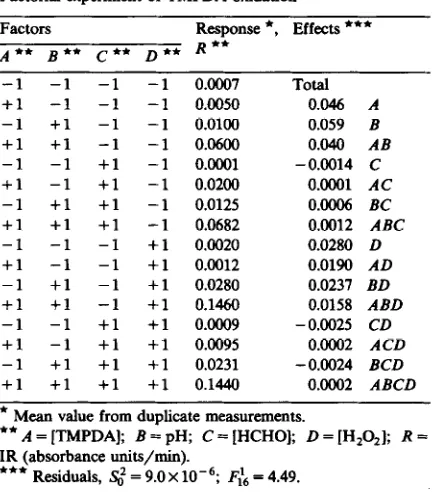
Factorial experiment of T’MPDA oxidation
Factors Response *, Effects l ** A** B** C l * D ** R **
-1 -1 -1 -1 0.0007 Total
+1 -1 -1 -1 0.0050 0.046 A
-1 +1 -1 -1 0.0100 0.059 B
+1 +1 -1 -1 0.0600 0.040 AB -1 -1 +1 -1 0.0001 -0.0014 c +1 -1 +1 -1 0.0200 0.0001 AC -1 +1 +1 -1 0.0125 0.0006 BC +1 +1 +1 -1 0.0682 0.0012 ABC
-1 -1 -1 +1 0.0020 0.0280 D +1 -1 -1 +1 0.0012 0.0190 AD -1 +1 -1 +1 0.0280 0.0237 BD +1 +1 -1 +1 0.1460 0.0158 ABD
-1 -1 +1 +1 0.0009 -0.0025 CD
+1 -1 +1 +1 0.0095 0.0002 ACD
-1 +1 +1 +1 0.0231 -0.0024 BCD
+1 +1 +1 +1 0.1440 0.0002 ABCD
* Mean value from duplicate measurements.
l * A = [TMPDA]; B = pH; C = [HCHO]; D = [H20z]; R =
IR (absorbance units/min).
l ** Residuals, $ = 9.0 x
zyxwvutsrqponmlkjihgfedcbaZYXWVUTSRQPONMLKJIHGFEDCBA
lo-$ F:6 = 4.49.quite
zyxwvutsrqponmlkjihgfedcbaZYXWVUTSRQPONMLKJIHGFEDCBA
stable in the reacting mixture, being readily soluble in aqueous solutions. This compound ab-sorbs at 560 nm. In this example there is no ‘catalytic’ effect due to HCHO, and H,O, is not an effective oxidant for the reaction.
Results
A similar factorial experiment was performed as in the previous example and the data obtained are shown in Table 3. The factorial analysis of the data in Table 3 shows that the effect of [HCHO] is not significant. Neither are most of the interac- tions involving [HCHO] and interactions that in- volve more than two factors.
Disctmion
Following the procedure of determining IR ratios between the levels of each factor at constant combinations of the other factor levels, as in the previous example, it is found that the equation for IR at each [H202] level is approximated by
IR = kX [TMPDA] (9)
where
k = kinetic
constant and X = f(pH).Eq. (9) is in agreement with the factorial analy- sis results and this relationship provides evidence that the HCHO molecule is not acting as a ‘cata- lyst’ in this oxidation reaction. If one considers the change of IR between the levels of [H202] one realizes that the ratio is close to unity, which suggests that the H,O, is not the oxidizing agent in this example. On the other hand the IR is proportional to the concentration of TMPDA and the pH. The dependence on pH suggests that the rate of oxidation is different among the various dissociation species of TMPDA * 2HCl that exist in aqueous solution.
Example 3. Oxidation of pyrogallol
Introduction
The
oxidation of pyrogallol (Pg) may be accomplished with a variety of oxidant molecules, a few of which can generate chemihnninescence (CL) emission [12]. Periodate ion is one of the oxidants that generates CL emission during the oxidation of pyrogallol according to the chemical reaction [13-151Pg + IO; + oxidation products + hv(light)
The CL emission generated is dependent on the inner filter effect, the sensitizing effect and the rate of the reaction. When the experiment is car- ried out under conditions that eliminate the inner filter effect and there are no sensitizers in the reaction mixture the CL emission provides a mea- sure of the rate of the reaction. However, in this particular CL reaction it has been shown that the CL emission is generated through energy transfer between primary CL oxygen excimer species and secondary CL species originating from Pg oxida- tion products [16] as shown below
(lo,): +F+230,+F* F*+F+hv
[image:5.540.42.259.106.352.2]54
zyxwvutsrqponmlkjihgfedcbaZYXWVUTSRQPONMLKJIHGFEDCBA
Chemometrics and Intelligent Laboratory Systems n545 385 225
Wavclcngth,nm
Fig. 1. UV -visible spectra of (a) pyrogallol; (b) hydroxylamine hydrochloride; and (c) molar mixture (1: 1) of pyrogallol and hydroxylamine solutions.
both the oxygen excimer and the F are products of
the same reaction. However, since the oxygen ex-
timer is a short-living sequence product origi-
nating from the oxidant reagent while the F is a
sequence product originating from pyrogallol, the
ratio also depends on the degree of overlap of the
reaction profiles of the two products within the
reaction period, or on the extent of other parallel
reactions that occur before the CL emission step,
thus decreasing the concentration
of F. The ad-
dition of a thud compound to the reaction system
may produce a change in the intensity of CL
emission because it may change the ratio of the
oxygen excimer to the F molecule concentration
by acting as a reagent or catalyst of the oxidation
reaction, or it may change the quantum yield
because of a change of the structure of the F
molecule.
The overall rate of reaction, up to the step of
CL emission, depends on the pH of the aqueous
solution; it is relatively rapid and it is monitored
with a photomultiplier
after mixing the Pg solu-
tion with the oxidant solution in a flow injection
analysis manifold system. From previous work it
was found that CL emission intensity is increased
270 470 w.vctength,nm
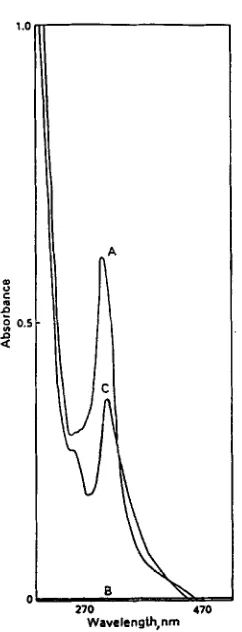
Fig. 2. Fingerprint fluorescence spectra with AX = 25 mn of (A ) pyrogallol; (B) hydroxylamine hydrochloride; and (C) molar mixture (1: 1) of pyrogallol and hydroxylamine solu- tions.
TABLE 4
Factorial experiment of Pg oxidation (pH = 7.8)
Factors * Response, Effects l * M ean Sign/NCE
A * g* C* R* square level 95%
-1 -1 -1 230 +1 -1 -1 4 -1 +1 -1 1 +1 +1 -1 38 -1 -1 +1 440 +1 -1 +1 45 -1 +1 +1 35 +1 +1 +1 1100
Total
121.0 A 29282 Yes 112.5 B 25312 Yes 432.9 AB 373248 Yes 335.5 c 225120 Yes 216.0 AC 93312 Yes 210.0 BC 88200 Yes 300.0 ABC 180600 Yes
*A = [Pg], B = [NH,OH], C = [IO,- ), R = hr (mv).
l * Residuals from 12 repeat measurements, $ = 379.5; FtrI =
[image:6.541.283.404.73.389.2] [image:6.541.282.499.505.627.2]n Original Research Paper 55
about five-fold by the addition of hydroxylamirte at optimum concentration
[13]. The hydroxyl-
amine is rapidly oxidized by periodate but this
oxidation process is not accompanied
by light
emission. In order to discover the origin of the CL
enhancement upon the addition of hydroxylamine
we proceeded with the design of a factorial experi-
ment.
Results
The
data obtained from the factorial experi-
ment, together with the results of the factorial
analysis, are presented in Table 4.
Discussion
From Table 4 it can be seen that the order of
effects and interactions from the factorial experi-
ment has the following sequence:
AB>C>ABC>AC>BC>A>B
The interaction
ACbetween the factors of [Pg]
and [IO;], as well as the interaction
BCbetween
the factors of [NH,OH] and [IO;] are expected,
since periodate reacts with both of them sirnulta-
neously in parallel oxidation reactions. However,
the strong interaction between [Pg] and [NH,OH]
was not expected. One possibility for such a strong
interaction
between [Pg] and [NH,OH]
was to
consider the association of Pg with NH,OH in the
formation of species that are oxidized by per-
iodate with higher quantum yield. This suggestion
was investigated by obtaining the absorption spec-
tra and fingerprint fluorescence spectra of Pg and
NH,OH solutions alone and in admixture. These
spectra are shown in Figs. 1 and 2, and they
provide evidence of the formation of such a Pg-
NH,OH association compound.
CONCLUSION
The three examples presented in this work show clearly how the factorial experiment is able to provide useful information about the chemistry involved during a reaction process and how the initial rate data can provide the kinetics of reac- tions in a simplified model, apart from providing linear mathematical models of the response surface.
REFERENCES
1 O.A. Hougen, K.M. Watson, Chemical Process Principles, Part 3, Kinetics and Catalysis, Wiley, New York, 1947, pp. 815-863.
2 H.A. Mottola, Kinetic Aspects of Ana&tical Chemistry, Wi- ley, New York, 1988,
pp.
25-30.3 F. Yates, Design and Analysis of Factorial Experiments, Imperial Bureau of Soil Sciences, London, 1937.
4 W.G. Hunter and R. Mezaki, Catalyst selection by group screening, Industrial and Engineering Chemistry, 56 (1964) 38-40.
5 G.E.P. Box and W.G. Hunter, The experimental study of physical mechanics, Technometrics, 7 (1965) 23-42.
6 B.W. Bailey and J.M. Rankin, New spectrophotometric method for determination of formaldehyde, Analytical Chemistry, 43 (1971) 782-784.
8
7 N.P. Evmiridis and M.I. Karayannis, Determination of
formaldehyde using a spectrophotometric method. Part I. Oxidation of p-phenylenediamine with hydrogen peroxide, The Analyst (London), 112 (1987) 831-835.
N.P. Evmiridis, N.C. Sadiris and M.I. Karayannis, De- termination of formaldehyde using a kinetic-speotrophoto metric method. Part II. Oxidation of N-methyl-substituted 1,4-phenylenediamines with hydrogen peroxide, The Analyst (London), 115 (1990) 1103-1107.
G. Woker, Ein Be&rag zur Theorie der Oxidations-fermente ilber “Peroxidase” und “Katalase’‘-Reaktionen des Form- aldehydes und Acetaldehydes, Chemische Berichte, 47 (1914) 1024-1029.
9
10
11
12
13
14
15
16
C.E. Boozer and G.S. Hammond, Molecular-complex for- mation in free radical reactions, Journal of the American Chemical Society, 76 (1954) 3861-3862; Air oxidation of hydrocarbons. II. The stoichiometry and fate of inhibitors in benzene and chlorobenzene, Journal of the American Chemical Society, 77 (1955) 3233-3237.
R. Adams and A.S. Nagarkatti, Quinone imides. I. p-
Quinone disulfonimides, Journal of the American Chemical Society, 72 (1950) 4601-4606.
NC. Thanasoulias and N.P. Evmiridis, presented at the European Conference of Analytical Chemistry “Euroanaly- sis VII”, Vienna, 26-31 August, 1990.
N.P. Evmiridis, Effect of hydroxylamine on chemilumines- cence intensity generated during the oxidation of pyrogallol with periodate, The Analyst (London), 112 (1987) 825-829.
N.P. Evmiridis, Prospects of using chemihuninescence emission generated during oxidation of pyrogallol with periodate for the determination of pyrogallol with flow injection, The Analyst (London), 113 (1988) 1051-1056. N.P. Evmiridis, Periodate determination by FIA with CL emission detection and its application to ethylene glycol, Tafanta, 36(3) (1989) 357-362.
![Table 1. C. Ratio between pH levels [HCHO]](https://thumb-ap.123doks.com/thumbv2/123dok/618460.164578/3.540.281.502.433.656/table-c-ratio-ph-levels-hcho.webp)