CONTROL OF INVERTED PENDULUM SYSTEM
NURULNAIM MOHD ALUWI
This is submitted in partial fulfilment of the requirements for the award of Bachelor of Electronics Engineering (Computer Engineering) with Honours.
Faculty of Electronics and Computer Engineering Universiti Teknikal Malaysia Melaka
UNIVERSTI TEKNIKAL MALAYSIA MELAKA
FAKULTI KEJURUTERAAN ELEKTRONIK DAN KEJURUTERAAN KOMPUTER
BORANG PENGESAHAN STATUS LAPORAN
PROJEK SARJANA MUDA II
Tajuk Projek : ………
Sesi
Pengajian : ………
Saya ……….. (HURUF BESAR)
mengaku membenarkan Laporan Projek Sarjana Muda ini disimpan di Perpustakaan dengan syarat-syarat kegunaan seperti berikut:
1. Laporan adalah hakmilik Universiti Teknikal Malaysia Melaka.
2. Perpustakaan dibenarkan membuat salinan untuk tujuan pengajian sahaja.
3. Perpustakaan dibenarkan membuat salinan laporan ini sebagai bahan pertukaran antara institusi pengajian tinggi.
4. Sila tandakan ( √ ) :
SULIT* (Mengandungi maklumat yang berdarjah keselamatan atau kepentingan Malaysia seperti yang termaktub di dalam AKTA RAHSIA RASMI 1972)
TERHAD* (Mengandungi maklumat terhad yang telah ditentukan oleh organisasi/badan di mana penyelidikan dijalankan)
TIDAK TERHAD
Disahkan oleh:
__________________________ ___________________________________
(TANDATANGAN PENULIS) (COP DAN TANDATANGAN PENYELIA)
Alamat Tetap: ………...
………...
iii
“I hereby declare that this report is the result of my own work except for quotes as cited in the references.”
Signature : ……… Author : Nurulnaim Mohd Aluwi
iv
“I hereby declare that I have read this report and in my opinion this report is sufficient in terms of and quality for the award of Bachelor of Electronics Engineering (Computer
Engineering) with Honours.”
Signature : ……… Supervisor : En. Amat Amir Basari
v
vi
ACKNOWLEDGEMENT
Finishing this report is a true blessing in disguise. There would be an endless list from where I need to convey my gratitude. Without these people, I would not be able to finish my research. This past year had been a journey embarked in the most appropriate time. Had it been earlier or later, it would not be the same.
A special thanks to my supervisor, En. Amat Amir Basari whose constant support, patience and unbounded enthusiasm were of invaluable help. His helping hands in assisting me throughout this whole experience are something that could not be replaced.
A significant gratitude is also offered to the colleagues who travelled a long way to make sure I succeeded in carrying out my tasks. Thank you, Syazana Sapie, Nor Hanim Md Razali, Faten Nadia Mansor and Zatul Iffah Ahmad for granting me a chance in time of need. Without all of your support and ideas, I would have not come this far.
I would also like to appreciate all the people that have stood by me in the past four years. Thank you for baring all my incompetence and lack of knowledge. Also to family who have supported me along the way with all the encouragement and love they could give.
vii
ABSTRACT
viii
ABSTRAK
ix
TABLE OF CONTENTS
CHAPTER CONTENTS PAGE
TITLE i
REPORT STATUS AUTHENTICARION FORM i
CONFESSION iii
AUTHENTICATION FROM SUPERVISOR iv
DEDICATION v
ACKNOWLEDGEMENT vi
ABSTRACT vii
LIST OF TABLES xii
LIST OF FIGURES xiii
LIST OF APENDICES xv
I INTRODUCTION 1
1.1 Overview 1
1.2 Objectives 3
1.3 Problem Statement 3
1.4 Work Scope 4
x
II LITERATURE REVIEW 7
2.1 Introduction 7
2.2 Background 7
2.3 Present Applications 8
2.4 Inverted Pendulum Configurations 8
2.5 Control Methodology 9
2.6 Fuzzy Logic Controller 10
2.7 Sliding Mode Controller 11
III Project Methodology 13
3.1 Literature Review 15
3.2 Mathematical Modelling 17
3.2.1 Inverted pendulum mathematical modelling 17 3.2.2Linear Model in state space form 21
3.2.3Controllability 22
3.3 Simulation and Analysis 23
3.4 Thesis Writing 23
3.5 Conclusion 23
IV SLIDING MODE CONTROLLER 24
4.1 Introduction 24
4.2 Switching Surface and Controller Design 25
4.3 Implementation in Simulink 28
V FUZZY LOGIC CONTROLLER 29
xi
5.2 Designing Fuzzy Control 30
5.2.1 Set of fuzzy controller 31
5.3 Rule Base 33
5.4 Implementation in Simulink 34
VI RESULTS AND DISCUSSIONS 35
6.1 Simulations 35
6.2 Closed Loop System 36
6.2.1 Sliding Mode Controller 36
6.2.2 Fuzzy Logic Controller 38
6.2.3 Comparison of Fuzzy Logic and Sliding Mode Controller outputs 40
VII CONCLUSION AND RECOMMENDATION 45
7.1 Conclusion 45
7.2 Recommendation 46
REFFERENCES 47
xii
LIST OF TABLES
NO TITLE PAGE
3.1 Time management Gantt Chart 16
3.2 Plant Parameters 21
xiii
LIST OF FIGURES
NO TITLE PAGE
1.1 An Inverted Pendulum model in non-functional state 1
1.2 The movement of an inverted pendulum 2
1.3 An inverted pendulum on its centre 4
2.1 An Inverted Pendulum model offered in the market. 8
3.1 Methodology Flowchart 14
3.2 K. Ogata model of Inverted Pendulum on cart 17
4. 1 Implementation of Sliding Mode Controller in Simulink 28
5. 1 Rearranged block diagram of the system with Fuzzy Logic Controller 29 5. 2 Membership functions for each of the fuzzy subsets of the controller 32 5. 3 Fuzzy rule matrix for Fuzzy Logic Controller of the system 33 5. 4 Schematic diagram of the Nonlinear Inverted Pendulum system 34
6. 1 Controllability simulated in Simulink 22
6. 2 Graph of Pendulum Oscillation versus Time 36
6. 3 Graph of Cart Displacement versus Time 37
xiv
xv
LIST OF APENDICES
NO TITLE PAGE
A.1 Sliding Mode System 48
A.2 Sliding Mode System 48
B Controllability of System 48
CHAPTER I
INTRODUCTION
1.1 Overview
The inverted pendulum is a classic problem in dynamics and control theory and widely used as benchmark for testing newly developed control strategies. Variations on this problem include multiple links, allowing the motion of the cart to be commanded while maintaining the pendulum, and balancing the cart-pendulum system.
2
The inverted pendulum is an intriguing subject from the control point of view due to their intrinsic non-linearity. The main concern is to balance a pole on a mobile platform that can move in only two directions; left or right. The inverted pendulum is related to rocket or missile guidance, where thrust is actuated at the bottom of a tall vehicle. The largest implemented use is on huge lifting cranes on shipyards. When moving the shipping containers back and forth, the cranes move the box accordingly so that it never swings or sways. It always stays perfectly positioned under the operator even when moving or stopping quickly.
[image:17.612.200.496.379.533.2]Another way that an inverted pendulum may be stabilized, without any feedback or control mechanism, is by oscillating the support rapidly up and down. If the oscillation is sufficiently strong (in terms of its acceleration and amplitude) then the inverted pendulum can recover from perturbations in a strikingly counterintuitive manner.
Figure 1.2: The movement of an inverted pendulum
3
1.2 Objectives
The objectives of this project are:
i) To synthesis the mathematical model of an Inverted Pendulum based on the K. Ogata, 1978 modelling.
ii) To develop the fuzzy logic control strategy to restrain the system‟s cart displacement and rod angle.
iii) To develop the mathematical model of sliding mode controller to restrain the system‟s cart displacement and rod angle.
iv) To run a simulation for both developed control strategies in Matlab Software.
v) To compare the both control strategies in terms of the cart displacement and rod angle pattern as well as other differences.
1.3 Problem Statement
It is virtually impossible to balance out an inverted pendulum without applying external force into the system. The balancing of an inverted pendulum by moving a cart along a horizontal track is a classic problem in the area of control. They are often useful to demonstrate concepts in linear control such as the stabilization of unstable systems.
4
Figure 1.3: An inverted pendulum on its centre
This problem comprises a simple coupled system. If the pendulum starts off-centre, it is prone to fall immediately. Even if it starts off-centre, once the cart moves, it would triggered to be off-centre and cause the pendulum to fall. In stabilizing this circumstance, such to keep the pendulum in upright position, a control strategy must be applied.
1.4 Work Scope
During the project, a mathematical representation of inverted pendulum will be synthesized based on the K. Ogata, 1978 modelling. An analysis on the difference of linear and nonlinear equations will also be done in order to have a deeper understanding on the characteristics of the system.
Then, control strategies for both fuzzy logic and sliding mode will be developed to restrain the system‟s cart displacement and rod angle.
5
1.5 Project Methodology
To ensure a successful outcome in the project, the project objectives shall be achieved first. The flow chart below shows the method that will be done step by step until the goal of the project is achieved. There are four phases involved during this project‟s execution:
i) First Phase : Literature Review
ii) Second Phase : Mathematical Modelling and control strategy development
iii) Third Phase : Simulation and Analysis iv) Fourth Phase : Thesis Writing
i) First Phase : Literature Review
Gather the information about the project via internet, journals, magazines, published work and reference books.
Study of the software implementation (Matlab).
Do research to know more details about fuzzy logic controller and sliding mode controller.
ii) Second Phase: Mathematical Modelling and control strategy development Synthesize the mathematical model of an Inverted Pendulum
based on the K. Ogata, 1978 modelling.
Simulate the passive system for linear and non-linear validity Develop the fuzzy logic control strategy.
Develop the mathematical model of sliding mode controller.
iii) Third Phase : Simulation and Analysis
Simulate the inverted pendulum system with controllers separately. Analyze the control of cart displacement and rod angle on the
6
iv) Fourth Phase: Thesis writing
State all the ideas concentrated regarding to this project. Show flow of ideas during the implementation of this project. State the project conditions (from the beginning until the end of
CHAPTER II
LITERATURE REVIEW
2.1 Introduction
The literature review undertaken focus on understanding the background and application of inverted pendulum system, mathematical modelling, control and other projects of similar nature.
2.2 Background
8
2.3 Present Applications
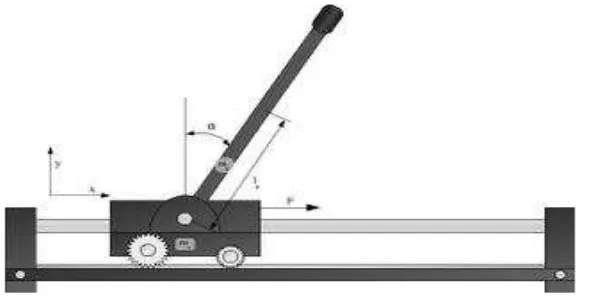
Inverted pendulum is currently used as teaching aids and research experiments. Quanser (2004), a supplier of educational and research based equipment produce modular systems which can be configured as single or double inverted pendulum. The range offers both rotary and linear version. Many other researchers have also built their own inverted pendulum systems such as Åström and Furuta in 1996 to suit their investigations.
Figure 2.1: An Inverted Pendulum model offered in the market.
2.4 Inverted Pendulum Configurations
9
the pendulum base is restricted to only one dimensional movement. The angle has to also vary in only one dimension. For higher degrees of freedom, either more single degree of freedom links are added, or the existing links are allowed to move in multiple dimensions.
In the linear case, a motor is used to move a cart along a straight track. The pendulum is attached to the cart by a pin joint. The axis of rotation of the pendulum link about the pin joint is horizontal and perpendicular to the cart‟s direction of travel. The input to the system is the force applied to the cart, via the motor. Full derivation of the systems‟ dynamics for a linear inverted pendulum can be found in Dorf and Bishop (1998) and Franklin (2002).
2.5 Control Methodology
In general, a Control System is a collection of electronic devices and equipment which are in place to ensure the stability, accuracy and smooth transition of a process or a manufacturing activity. It takes any form and varies in scale of implementation, from a power plant to a semi-conductor machine. As a result of rapid advancement of technology, complicated control tasks accomplished with a highly automated control system.