Conservation of Asian-Native Medicinal Plants on the University Campus
Irma Nurhayati
International Forestry Students’ Association Local Committee Bogor Agricultural University
P.O. Box 168, Jl. Dramaga Raya
Faculty of Forestry, Bogor Agricultural University West Java, Indonesia
Tel: + 62 251 621677; Fax: + 62 251 621256 Email: [email protected] and [email protected]
URL: http://www.ifsa.net
Introduction
Forests, especially tropical forests, are well known for the high biodiversity and potentials; among these are the medicinal plants which exhibit excellent prospects for development. The recent ‘back to nature’ trend has meant that medicinal plants have once again become viable as an alternative medicine; unfortunately, the full potential and value of these plants has not yet been fully explored.
In Indonesia, plants have been used traditionally for generations of indigenous peoples, although this precious heritage was threatened by the introduction of synthetic medicines. However, after communities became aware of the dangers of the introduced chemicals, the traditional use of plants saw a renewed interest. Today, through employing the latest technologies and large-scale production capabilities, the pharmaceutical industry has been able to make extensive use of medicinal plants.
Natural resources have the potential to provide new opportunities for finding medicines for combating diseases. For example, the active calanolides compound found in bintangur
(Callophyllum lanigerum), which grows in the Sarawak forest, is capable of inhibiting HIV (Zuhud 2002), and Phaleria macrocarpa can be used to cure tumors and skin problems (Winarto 2003).
The occurrence of medicinal plants is in danger for several reasons. Some issues threatening the sustainability of medicinal plants in Indonesia are (Zuhud 2002):
Most plants are directly harvested from the natural forest; Habitat destruction;
Forest conversion (tree exploitation, which includes medicinal plant species); Lack of adequate management and cultivation; and
The gradual loss of indigenous knowledge and culture.
Furthermore, the demand for medicinal plants as a raw material is escalating along with the increase of (Zuhud 2002):
Human population (increase/decrease) using plants as medicine; The price of modern medicine using imported material;
Industry and traditional companies1: medicinal plants are used extensively; and The behaviour and trends in natural material use.
1
Conservation constraints
The following issues are having an impact on the ability to adequately conserve medicinal plants:
Habitat destruction;
The loss of indigenous knowledge; Over-harvesting of medicinal plants;
Imbalance in the supply and demand of medicinal plants;
The slow development of medicinal plant cultivation, especially in Indonesia;
The generally low market value of the plants (fresh/dried matter; seeds; and seedlings) has resulted in people not being interested in medicinal plant cultivation; and
Very little research has been done on medicinal plants.
What needs to be done?
Increase awareness on the importance of medicinal plants and their conservation to communities, especially those who live in the surrounding forest;
Establish in-situ and ex-situ conservation of medicinal plants; and
Build stakeholder participation and cooperation between the community, industry, academia, and government, in order to increase community wealth and assure sustainable use.
Conservation on the University Campus
These are several examples of conservation efforts been done by the students; however, there is so much more that can be done. Some activities that been performed by the students of Bogor Agricultural University are:
Establishment of a “live pharmacy” (plot of medicinal plants that are commonly used to cure certain diseases);
Planting of medicinal plants in greenhouses and identification of their medicinal benefits (102 species have currently been studied);
Conduct research on medicinal plants in order to discover new methods of cultivation; Discovery of new ways of using medicinal plants for small and medium industries, for
example, the production of mahkota dewa tea (see Appendix 1 for a description of
mahkota dewa); and
Discovery and identification of the flora in national parks, especially medicinal plants and their traditional usage (performed in Bukit Barisan Selatan National Park in 2004).
Discussion
The discussion was conducted by the author of this paper and Ivonne Melissa (also of Bogor Agricultural University) with the aim of sharing experiences about medicinal conservation effort in other countries’ universities. In order to achieve this, the discussion was started with a presentation the conservation of medicinal plants at Bogor Agricultural University (see Appendix 2). Unfortunately, because are only participants from two countries were present at this discussion (namely, Indonesia and Thailand), the author feels that the discussion was not as fruitful as it could have been. However, mahkota dewa (Phaleria macrocarpa) generated much interest and, as such, there are ongoing discussions taking place on this matter.
Conclusion
It is felt that the purpose of exchanging experiences on conservation efforts in each country’s university was not attained. Rather, information was exchanged on mahkota dewa and other medicinal plants in general. Language barriers were also felt to have been another major constraint in the discussion.
References
Winarto, W. P. 2003. Mahkota Dewa: Budidaya Dan Peman – Faatan Untuk Obat. Penebar Swadaya, Indonesia.
Appendix 1:
Mahkota dewa
(
Phaleria macrocarpa
(Scheff.) Boerl.)
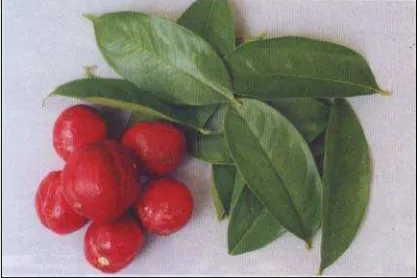
Mahkota dewa is a multi-purpose medicinal plant, becoming productive after an age of about 4 months and can be utilised for 10–20 years. The plant originally comes from Papua and is found in forests from 10–1,200m.a.s.l.
Classification
Division: Spermatophyta Subdivision: Angiospermae Class: Dicotyledoneae Family: Thymelaeaceae Genus: Phaleria
Species: macrocarpa(Scheff.) Boerl.
Mahkota dewa is a dense evergreen tree, growing well in tropical climates and reaching 1–2.5m in height in cultivation and up to 6m in the wild. The active compounds are alkaloid, terpenoid, saponin and resin; there is also polifenol in the leaves and flavaloid in the fruit shell (Winarto 2003).
The fruit is the most commonly used part for medicine and contains saponin and alkaloid active compounds; it cannot be consumed without any previous treatments because it is toxic. The fruit has similar shape to an apple and so attracted the royal family of Keraton Jogja and Solo that they planted it in the palace grounds.
The seed of mahkota dewa is the most toxic part of the tree. It has oval shape with a diameter of 1cm. The seed causes a numbing sensation on the tongue when bitten and is, therefore, only used to treat skin problems and for ornamental cultivation purposes.
When mixed with other medicinal plants, other uses include treatment for cancers and tumors, diabetes mellitus, hypertension, hepatitis, and heart problems.
Figure 2. The Mahkota dewa tree. Figure 1. Picture of the fruit and leaves of
mahkota dewa.
Appendix 2: Presentation “The role of youth in medicinal plants
conservation”
As stakeholders, the youth have the right to take part in conservation efforts and, as such, the students of Forest Resources Conservation in Bogor Agricultural University realised that their involvement in conservation efforts is important for the future.
The Students Association developed the idea of interest groups that related to their studies, for example: bird watchers group, cave explorers group, flora interest group, herpetofauna group, butterfly group and photography group. The idea was to put theoretical knowledge into practical action, and to encourage the students to become involved in conservation efforts, hoping to eventually lead to employment in the conservation sector.
The groups conduct an annual expedition called “Surili” (Studi Konservasi Lingkungan) to study environmental conservation in action. This event takes place an Indonesian national park — in 2004 it took place in Bukit Barisan Selatan National Park.
During the expedition, the flora group discovered a new location of Raflesia spp. (other groups found new records on fauna in the same national park).
The flora group also conducts the following activities at the university:
The creation and maintenance of a “live pharmacy” garden consisting of medicinal plants from the area (not exotic species);
Host and attend seminars and discussions on plant conservation, usually in cooperation with Bogor Botanical Garden; and
Establishment of a project on orchid cultivation using tissue media: the idea is to create a new product, which can be implemented by local communities in small-scale enterprise to supplement their incomes.