THE SPECIES OF
POLYALTHIA
IN BERAU REGENCY,
EAST KALIMANTAN
BY :
DlAN
AKBARlNI
NRP:
98285
POST GRADUATE PROGRAM
BOGOR AGRICULTURAL UNIVERSITY
ABSTRAK
Dian Akbarini. Jenis Polyalfhia di Kabupaten Berau, Kalimantan Timur. Dibimbing oleh: Prof. Dr. Ir. Edi Guhardja, M.Sc., Prof. Dr. Mien A. Rifai dan Dr. Paul J. A.
Kessler.
Penelitian marga Polyalthia Blurne ( Annonaceae) telah dilakukan di Kabupaten Berau. Marga ini terdiri dari lima belas jenis (Polyalthia berauensis, Polyalthia cauliflora, Polyalthia dicfyoneura, Polyalthia glauca, Polyalthia igniflora, Polyalthia jenkensii, Polyalthia laferiflora, Polyalfhia microtus, Polyalthia oblonga, Polyalthia obliqua, Polyalthia rumphii, Polyalthia sclerophylla, Polyalthia sumafrana, Polyalthia tipuliflora, dan Polyalthia sp. A ). Polyalthia berauensis
ABSTRACT
Dian Akbarini. The Species of Polyalthia in Berau Regency, East Kalirnantan. Supervised by : Prof. Dr. Ir. Edi Guhardja, M. Sc., Prof. Dr. Mien A. Rifai, and Dr. Paul J . A. Kessler.
Surat Pernyataan
Dengan ini saya menyatakan bahwa tesis yang berjudul:
THE SPECIES OF POLYALTHIA IN BERAU REGENCY,
EAST KALIMANTAN
Adalah benar merupakan hasil karya saya sendiri dan belum pernah dipublikasikan. Semua sumber data dan informasi yang digunakan telah dinyatakan secara jelas dan dapat diperiksa kebenarannya.
Bogor, Mei 2002
THE SPECIES OF POLYALTHIA IN BERAU REGENCY,
EAST KALIMANTAN
BY
:
DlAN AKBARlNl
NRP: 98285
A Thesis Submitted for the Degree of Master
at
Post Graduate Program Bogor Agricultural University
Department of Biology
POST GRADUATE PROGRAM
BOGOR AGRICULTURAL UNIVERSITY
Tittle of Thesis
: The Species of
Polyalthiain Berau Regency, East
Kalimantan
Name
: Dian Akbarini
NRP
: 98285
Study Program
: Biology
Approved
1 .Supervisor Committee
Prof. Dr. Ir. Edi Guhardia, M.Sc.
Chairman
Prof. Dr. Mien A. Rifai
Supervisor
Dr. Paul J.A. Kessler
Supervisor
f Biology Program
Graduate Program
CURRICULUM VITAE
Dian Akbarini was born on June, 12, 1975 in Pangkalpinang, as the first daughter from four children, from father H. M. Azro'i Kosim and mother Hj.
Nur'aini.
In 1987, she graduated from SD Negeri No. 9 Tanjungpandan, in 1990
she graduated from SMP Negeri 1 Pangkalpinang, and in 1993 she graduated
from SMA Negeri 2 Pangkalpinang. She graduated from Biology Department of
the Faculty of Mathematics and Natural sciences, Padjadjaran University in
Jatinangor, 1998.
In 1998, she registered as a post graduated student at Bogor Agricultural
ACKNOWLEDGEMENT
Alharndulillah.
I would like to thanks to my supervisors : Prof. Dr. Ir. Edi Guhardja, M.Sc,
(chairman of the supervisor committee), Prof. Dr. Mien A. Rifai and Dr. Paul J.A.
Kessler (members of the supervisor committee) for their supervising this study.
My thanks are due to Dr. Rugayah, M.Sc and Dra. Tutie Djarwaningsih,
M.Si for her support and comment of this manuscript and to Dr. lrawati head of
Herbarium Bogoriense who permitted this study to be executed in the Herbarium
Bogoriense. Miss Rina and Herbarium staff to provided some references which
are related to this study. Ir. Teguh Triono, M.Sc. and Yelita, S.Si. helped to
make photographs, Mr. Sobari assisted in making the illustrations and Mr. Arif
Hidayat helped in compiling specimens from East Kalimantan.
I would like also to thanks all post graduate students of Plant Taxonomy.
IPB '98 for their support.
Finally to my parents, for their moral support and financial support of my
study; my brothers for their moral support and last but not least, to my husband
Ade Kelana Risfiardy, ST., for his moral support, his understanding and deep
TABLE OF CONTENTS
ABSTRAK
...
ii ...ABSTRACT
...
111CURRICULUM VITAE
...
viACKNOWLEDGEMENTS
...
vii TABLE OF CONTENTS...
viii LIST OF TABLE AND FIGURES...
xINTRODUCTION
...
...
...
1MATERIAL AND METHOD
...
2RESULT AND DISCUSSION
...
3. . .
Geographical Distr~but~on
...
3...
Floristic Analysis of Polyalthia in Berau Regency 6
Morphological Characters
...
7...
Habit 8
Twig
...
7Leave
...
....
...
7Flower
...
8Stamen
...
9Carpel
...
9.
.Carp~d~a
...
9. .
Key and Descript~ons
...
.
.
...
11...
Key to Species 12
...
Polyalthia berauesis 14
Polyalthia cauliflora
...
15Polyalthia dictyoneura
...
17. . .
Polyalthra rgnrflora
...
21Polyalthia jenkensii
...
23Polyalthia lateriflora
...
25. .
Polyalthra mrcrotus
...
26...
Polyalthia obliqua...
... 28Polyalthia oblonga
...
29Polyalthia rumphii
...
...
...
30Polyalthia sclerophylla
...
32Polyalthia sumatrana
...
33Polyalthia tipuliflora 35
...
Polyalthia sp.A 37
...
CONCLUSION 40
...
LIST OF TABLES AND FIGURES TABLES
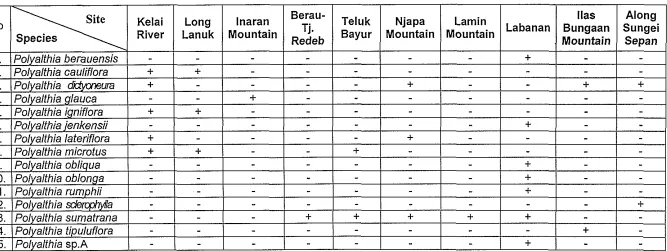
1 . The Distribution of ThePolyalthia in Berau Regency
...
42 . The Polyalthia in Berau Regency based on Sist & Saridan (1998)
. .
and Akbar~n~ (2002)
...
6FIGURES
1 . Distribution of Polyalfhia in Berau Regency
...
2.
The various size and shape of flowers Polylathia...
3.
Stamen Polyalfhia ... 4 . The carpidia shapes of Polyalthia...
5.
Polyalthia berauensis...
6 . Polyalthia cauliflora
...
. .7
.
Polyalthra drctyoneura ... 8.
Polyalthia glauca...
. . .
9 . Polyalthra rgn~flora
...
..
10 . Polyalthra jenkensii
...
11
.
Polyalthia lateriflora...
.
.12
.
Polyalthra rnrcrofus...
...
13 . Polyalthia obliqua
14
.
Polyalthia rurnphii...
...
15
.
Polyalthia sclerophylla16 . Polyalthia surnatrana
...
.
.
.
...
17 . Polyalthia t~pulrflora
The genus was first published by Blume (1829) based on Polyalthia
subcordata Blume. Polyalthia Blume is one of the largest genera in Annonaceae,
containing over 100 species and has wide distribution. The generic name
Polyalthia is derived from the Greek words polus- much and althein
-
to heal, probably because it was much used as native medicine (Corner, 1940).Hildebrandt (1952) enummerated one species (Polyalthia g1auca)in
Berau (Borneo). Kessler and Heusden (1993) recorded 7 species (Polyalthia glauca, Polyalthia sumatrana, Polyalthia lateriflora, Polyalthia rumphii, Polyalthia
flagellaris, Polyalthia cauliflora and Polyalthia microtus) in Balikpapan
-
Samarinda area, East Kalimantan. Argent et.al. (1998) described 4 species
(Polyalthia sumatrana, polyalthia glauca, Polyalthia rumphii, Polyalthia lateriflora
and Polyalthia xanthopetala) in Central Kalimantan. Sist and Saridan (1998)
described 11 species Polyalthia in this Labanan area, 5 of them identified
(Polyalthia beccarii, Polyalthia glauca, Polyalthia lateriflora, Polyalthia rumphii,
and Polyalthia sumatrana ), and others were unidentified. Recently, Johnson and Murray (1999) recorded 4 new species of Polyalthia from Borneo (Polyalthia
endertii, Polyalthia igniflora, Polyalthia montis-silam and Polyalthia tipuliflora ).
A study of Polyalthia from Berau Regency is undertaken as part of a
general floristic study conducted there. The aim of this study is to inventorize, and
to make identification key by using morphological characters. This information
MATERIAL AND METHOD
This research was conducted in the Herbarium Bogoriense (BO), from
January2000-June2000.
Research materials were herbarium specimens from Herbarium
Bogoriense (BO, Herbarium Wanariset (WAN) and living collection in Bogor
Botanical Garden.
This research used the descriptive method, as described by Leenhouts
(1968), Rifai (1976), de Vogel (1987) and Maxted (1992), : select all herbarium specimens of Polyalthia from Berau regency, sort the specimens into groups
according to their overall resemblances, gather the literature, identify and
describe the herbarium specimens, analyse the data, deliniate the taxa, construct
RESULT AND DISCUSSION
Based on herbarium specimen, there are 15 species which can be
recognized, namely; Polyalthia berauensis, P. cauliflora, P. dictyoneura, P.
glauca, P. igniflora, P. jenkensii, P. lateriflora, P. microtus, P. obliqua, P. oblonga, P. rumphii, P. sclerophylla, P. sumatrana, P. tipuliflora and Polyalthia sp. A.
Polyalthia berauensis is proposed as a new species.
Geographical Distribution
The genus is distributed throughout the Old World Tropics and particularly
numerous in South East Asia (Sinclair, 1955).
In this study, the species are found in logged over forest, primary forest,
low hills, logged over dipterocarp forest, limestone rocks, secondary forest and
Floristic Analysis of Polyalthia i n Berau Regency
In this floristic study, there are 15 species which can be recognized based on the specimen deposited in herbarium Bogoriense (table 2).
Table. 2
.
The Polyalthia i n Berau regency based o n Sist & Saridan (1998)Morphological Characters
Habit
This character is important to recognized in species level. Species of
Polyalthia in Berau regency are either treelets or trees. The treelets are P.
berauensis, P. cauliflora, P. igniflora, P. microtus, P. rumphii, P. tipuliflora and
Polyalfhia sp.A. The trees species are P. dicfyoneura, P. glauca, P. jenkensii, P.
laferiflora, P. oblonga, P. obliqua, P. sclerophylla and P. sumatrana.
Twig
The twigs are circular, sometimes lenticelled (P. cauliflora, P. dictyoneura,
P. jenkensii, P. lateriflora, P.sclerophylla and Polyalthia sp.A). The twigs are
glabrous and hairy. lnduments type in this genus is simple hair. The twigs are
hairy in P. berauensis, P. cauliflora, P. jenkensii, P. microtus, P. oblonga, P.
rumphii and P. tipuliflora.
Leave
Some species of Polyalthia can be recognized by their leaves. Their
shapes are narrow ovate, oblong, broadly lanceolate, elliptic, spathulate or
oblanceolate. Generally acute or rounded base. Polyalthia obliqua is specific at
base, cuneate. Their apexes are various, apex, acuminate or caudate. The size
of leaves varies from 4.6 crn to 50 cm. The biggest size is at P. lateriflora ( 7.7
crn- 50 crn). Polyalthia glauca and P. sumatrana differ from others, because they
have glaucous of their below surface, and their secondary veins unclear and
difficult to be counted. Polyalthia microtus has leaves with rise in furrow midrib in
upper surface and this is a specific character of this species. Polyalthia jenkensii
Flower
The flower is important character to recognize in species level.
Calyx
Calyx in this genus has 3 sepals, imbricate, usually triangular, sometime
broadly triangular (Polyalthia jenkensii), and fleshy. It has simple hairy in the
outside and the margin. The size is from 0.5 mrn to 3 cm. The apex of sepal is acute.
Corolla
The corolla consists of two whorls, inner petal (3) and outer petal (3). The inner petal and outer petal are various in size or shape (fig. 2), equal or unequal.
The petal usually hairy in outside and margin. The shape of inner petal and outer
petal are elliptic, narrow ovate and ovate, with acute apex. The position of the
inner petal to outer petal is valvate.
-
Stamen
Type of the stamen in Polyalthia is uvarioid (Fig. 3). Uvariod stamen is
broad with conspicuos connective stamen ( kessler, 1993).The shape of stamen is cylindrical. Generally, the size of stamen is 1 mm in length, except
P.
berauensis, P. igniflora, P. microtus, P. rumphii P. tipuliflora and Polyalthia sp.A
which are 2 mm in length. lndument in the stamen can be used to recognize the
species;Polyalthia microtus differ from other species, because this species has
Carpel
Generally, cylindrical shaped. The carpels are covered by simple hairs,
and the size is mostly less than 2 mm in length, cylindrical shaped . The carpels in this genus are numerous ( more than 20).
Carpidia
The carpidia shapes of the Polyalthia are globose
(P.
glauca) or ellipsoid(P.cauliflora, P. dictyoneura, P. jenkensii, P. lateriflora, P. microtus, P. rumphii, P.
apex on carpidia can be used to identify the species (fig.4). Polyalthia rumphii, has glandular in its carpidia, whereas the other species have no glandular. Polyalfhia obliqua is yellow colour when dry, whereas the are others black or dark brown colour when dry.
Fig.
4.
The carpidia shapeso f
Polynlthia.
a.Polyalthia sclerophylla.
b.
P.
slmiatma.
c.
P. nrmphii.
d.
P. cauliflora.
e.P. glauca.
f.
P. obliqua.
g.
P.
Interrjlorn.
[image:83.595.88.475.146.498.2]KEYS AND DlSCRlPTlONS
POLYALTHIA
Polyalthia Blume, FI. Jav. Anonac. (1829) 68; Hook.f., FI. Br. Ind. 1 (1875)
62; King, Ann. Roy. Bot. Gard. Cal. (1893) 62; Boerl., Icon. Bog. 1 (1901) 103;
Koord & Valet., Meded Land Platent.
ixi.
(1903) 2983; Ridley, FI. Malay Pen. 1 (1922) 48; J. Sincl., Gard. Bull. Sing. 14 (1955) 279; Whitmore, Tree FI. Mal. 1(1972) 85, Bakhuizen & Backer. Jr., FI. Jav. 1 (1963) 106; Kessler, P.J.A. &
Heusden, Rheedea 3.1 (1993) 75; Heusden, Blumea suppl. 7 (1992) 125.
Shrubs, treelets or trees up to 40 m. Bark smooth, lenticelled or
unlenticelled, fibrous, bole circular, straight. Twigs glabrous or hairy, lenticelled or
unlenticelled. Leaves: petioles glabrous or hairy (simple hairy), 1-9 mm in length,
1-9 mm in diameter; lamina oblong, narrow ovate, oblanceolate, broadly
lanceolate; texture carthaceous to coriaceous, sometime shiny above; base
acute, rounded, or sub cordate; apex acute, acuminate or caudate; margin
entire; glabrous or hairy above and below surface, glaucous or not glaucous in
below surface; midrib above sunken, flat or raised in furrow, midrib in below
surface prominent. Flowers solitary or cluster, axillary, supra axillary, cauliflorous
or ramiflorous. Flowers bisexual; sepals 3, triangular, 0.5 mm- 3 cm, usually hairy
in margin, and outside, valvate, fleshy; petals in two whorls ( inner petals and outer petals), equal or unequal in size and shaped, elliptic, narrow ovate or ovate,
apex acute, inner petal 3, glabrous outside, fleshy, outer petals 3, glabrous
outside, fleshy. Stamens numerous (more than 20), fleshy, have connective
prolongation (uvarioid stamen), 0.7 mm
-
2mm in length. Carpels numerous (more than 20), cylindrical. Carpidia: stalked, globose or ellipsoid shape, apexDistribution: Assam, lndo China, Thailand, Malay Peninsula, Philippines,
Sumatra, Java, Celebes, Borneo, New Guinea, Africa, Australia.
Key
To Speciesof
PolyalthiaI. a. Tree. diameter more than 12 cm .
...
2 b. Treelet, diameter less than 12 cm...
9
2. a. Leaves glabrous above and below surface
...
3b. Leaves hairy above and below surface
...
.PP obl.onga 3. a. Leaves below surface glaucous, secondary veins not distinct...
4b. Leaves below surface not glaucous, secondary veins clear
...
5
4. a. Carpidia globose, intrasecondary veins 10-15 mm
...
P. glauca b. Carpidia ellipsoid, intrasecondary veins 2-5 mm...
P.
sumatrana 5. a. Carpidia globose, seed globose...
..6b. Carpidia ellipsoid, seed ellipsoid
...
.76. a. Leaves coriaceous, midrib in above sunken
...
P. sclerophylla b. Leaves charthaceous, midrib in above flat...
P. dictyoneura7. a. Midrib in above sunken, base acute, truncatus or rounded
...
8...
b. Midrib in above surface flat, base cunete
.P.
obliqua8. a. Secondary veins 5-7 in pairs, leaves chartaceous, petals ovate
P. jenkensii
b. Secondary veins 7-8 in pairs, leaves coriaceous, petals elliptic ..P. laterifora
9. a. Midrib hairy above
...
I 0 b. Midrib glabrous above...
11...
10. a. lndument pale yellow
.
2-3 mm longP .
berauensis...
b.lndument dark brown or light brown, less than 1 mm long P. rumphii
...
11. a. Leaves hairy above, densely hairy below 12
...
12. a. lnner petals 2.5
-
3.9 cm in length, secondary veins 14-21 pairs...
P. igniflorab. lnner petals 4.2
-
5-9 cm in length, secondary veins 21-24 pairs...
P. tipuliflora13. a. Flowers cauliflorous, stamen less than 2 mm in length P. cauliflora
b. Flowers axillary or supraaxillary, stamen 2 mm in length
...
14 14. a. Midrib raised and furrowed above, twigs unlenticelled....
P. microtus1. Polyalthia berauensis Akbarini sp.nov.
Polyalthia berauensis. --Type
:
Ambriansyah et al. Berau 839. Borneo(BO).
Folia chartacea, oblonga-lanceolata. 31-34 cm longa, 8.5-9.5 cm lata,
basi cordata, apice acuti-acuminati, newis lateris 20-26 paribus. Petioli 2.4 mm
diametro, 3 mm longi. Pedicello ca. 6 mm longa. Sepalum ca. 5 mm longa.
Interior petalum 2.7 cm longa, exterior petalum 2.5 cm longa. Stamen 2 mm
longa. Typus : Ambransyah etal. Bemu 839. Borneo (Holo: 80).
Treelet 7 m tall, 6 cm in diameter. Bark black, fibrous, rachis and lower
surface of leaves with long pale yellow hairs. Twigs 4-5 mm in diameter, densely
hairy (long hairy, 2-3 mm in length). Leaves: petioles hairy, 2.4 mm in diameter,
3 mm in length; lamina charthaceous, oblong
-
lanceolate 31-34 cm by 8.5-9.5 cm; base subcordate, apex acute-acuminate; hairy above and below; midrib flatabove and hairy below, secondary veins flat above, prominent below; secondary
veins 20-26 in pairs. Flowers on the main bole; pedicel 6 mm in length, densely
hairy, like silky hairs; sepals triangular, 5 mm in length, hairy; petals elliptic,
creamy white, densely hairy, inner petals 2.7 cm in length, outer petals 2.5 cm in
length. Stamens 2 mm in length. Carpidia not seen.
DISTRIBUTION : Borneo (Berau )
HABITAT AND ECOLOGY : Logged over forest. Altitude : 50 m. SPECIMEN EXAMINED: Ambriansyah et al. Berau 839.
NOTE: This species differs from other species in its indument. It has long
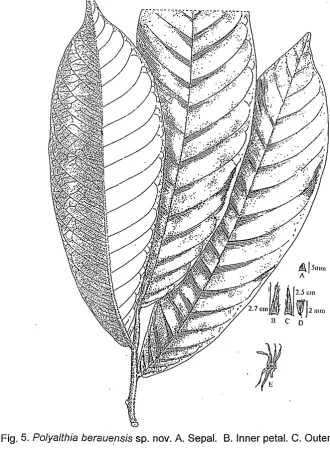
Fig. 5. Polyalthia berauensis sp. nov. A. Sepal. B. Inner petal. C. Outer petal. D. Stamen. E. Flower,
2. Polyalthia cauliflora Hook. f . & Thorns.
Polyalthia cauliflora Hook. f. & Thorns., FI. Ind. 1 (1855) 138; Hook.f.,
FI.
Br. Ind. 1 (1875) 66; Airy Shaw, Kew Bull. (1939) 280. Ridl., FI. Mal. Pen. 1 (1922)51; Kessler & Heusden, Rhedeea 3, 1 (1993) 78 Fig. 9. 79.
Polyalthia macrorhyncha Miq.. Bot Ann. Mus. Lugd.-Bat. 2 (1865) 14.
Treelet or tree up to 11 m tall. Bark smooth, black, inner bark thick, hard,
bole straight. Twigs hairy, 0.15 in diameter, lenticelled. Leaves: petioles hairy 1
mm in diameter, 2-5 cm in length; lamina charthaceous, young leaves purple,
ovate to oblong, 4.6
-
14.8 by 0.9-
3.8 cm; base acute, apex caudate; glabrous above and hairy below; midrib sunken and glabrous above, hairy and prominentbelow; secondary veins sunken and glabrous above, prominent and hairy below,
9 in pairs. Flowers on the main bole, cauliflorous, on twigs, short-tubercled shoot;
pedicel glabrous, 1 mm in diameter, 1-2 cm in length; sepals triangular, 3 mm,
hairy in outside and margin; petals greenish yellow, equal (inner and outer petals)
narrow ovate, 1.6-1.8 cm hairy; stamens 1 mm, creamy yellow. Carpidia: green
when young, stalked 1.1-2.5 cm, ellipsoid, apex acute, 3-7 mm in diameter.
Carpels cream yellow. Seed 2.
DISTRIBUTION
:
Malay Peninsula, Sumatra, Thailand, Borneo ( KelaiRiver near Long Lanuk, Berau)
HABITAT AND ECOLOGY : Logged over forest along road, on slope, primary forest, undulating area, low hills. Altitude 30 m.
SPECIMENS EXAMINED: Kostermans 21167, Ambriansyah et al. Berau
878, F. Slik, Pono & Rasyadi Berau 547, Kade Sidiyasa et al. Berau 1204, Z.
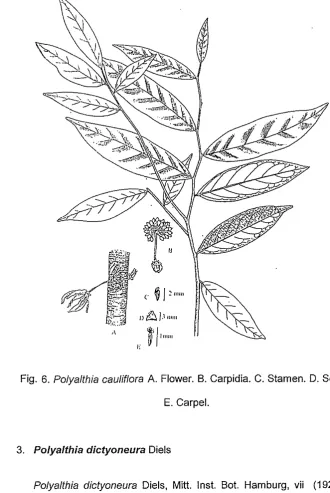
Fig. 6. Polyalthia cauliflora A. Flower. B. Carpidia. C. Stamen. D. Sepal E. Carpel.
3. Polyalthia dictyoneura Diels
Polyalthia dictyoneura Diels, Mitt. Inst. Bot. Hamburg, vii (1927) 78.-
Type: H. Winkler 1148, West Borneo, Bukit Mehipit, 29.12.1924 (Iso: BO)
Tree 7-20 m tall, 15-20 cm in diameter. Bark smooth, blackish, hooped,
bole tapered. Twigs 3.5 mm in diameter, lenticelled. Leaves: lamina
chartaceous, oblong, 9.2 -24.8 cm by 3.2 -15.3 cm; base subcordate; apex
[image:90.595.110.441.88.582.2]prominent and glabrous below; secondary veins prominent above and below, 10-
12 in pairs. Flowers ramiflorous; pedicels 1 mm in length; hairy; sepals
triangular, 2.5 mm in length, hairy; petals when young green, inner petals ovate;
ca. 7 mm in length; outer petals ovate, 6.7-7 mm in length. Stamen and carpel
not seen. Carpidia: stalked 11 mm in length, ellipsoid, apex acute, diameter 5-6
mm.
DISTRIBUTION : Borneo ( along Sungai Sepan at base Mt. Njapa, Kelai
River)
HABITAT AND ECOLOGY: logged over mixed dipterocarp forest, along
river bank, primary forest, on limestone rocks, covered by thick humus. Altitude:
40 m. Flowering : October. Fruiting : October. FIELD NOTES: Flowers strong sweet smell.
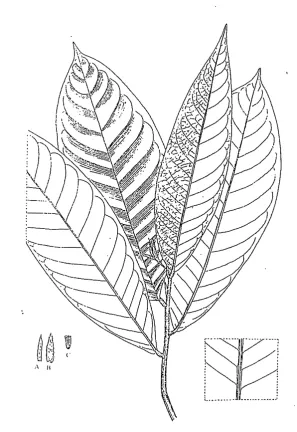
Fig. 7. Polyalthia dictyoneura. A. Sepal. B. Inner petal. C. Outer petal. D. Stamen. E. Carpel. E. Lenticelled on twig.
4. Polyalthia glauca Boerl.
Polyalthia glauca Boerl., Icon. Bogor. 1 (1901) 104; Koord. & Valeton,
Bijdr. IX (Meded. PI. Tuin No. LXI) (1908) 285; Whitmore. Tree FI. Mal. 1 (1983)
90. Fig. 10; Kessler & Heusden, Rhedeea 3, 1 (1993) 80. Fig. 10. 81.
Unona merritiiMerr.. Philip. J. Sci: 1, Supp. 1 (1906) 190. Polyalthia merritii (Merr.) Merr., Philip. J. Sci. 10 (1915) 250.
[image:92.595.87.442.33.467.2]Tree up to 41 m tall, up to 47 cm in diameter. Bark smooth, light orange-
greyish, bolestraight, circular. Twigs glabrous 6 mm in diameter. Leaves: lamina
chartaceous; oblong to broadly lanceolate, 8-15 cm by 3-4 cm; base acute, apex
acuminate -caudate; glabrous above, glaucous below; midrib sunken and
glabrous above, prominent below; secondary veins flat above and below, unclear;
intra secondary veins 1- 1.5 cm. Flowers not seen. Stamen not seen.
Carpidia:when young linght green, ripe dark, stalked 0.7 cm
-
4.2 cm in length,globose, 1.7-1.9 cm in diameter. Seed 1, 16 mm in diameter.
VERNACULAR NAME : Landur
DISTRIBUTION: Malay Peninsula, Sumatra, Java, Celebes, Philippines,
Borneo (Kampoeng lnaran, Berau).
HABITAT AND ECOLOGY : Logged over dipterocarp forest. Altitude
75-100 m, Fruiting : October.
SPECIMENS EXAMINED: Arifin, Z; Arbainsyah B1341; Van der Zwaan
600 (00).
NOTE: The species is similar to P. sumatrana in leaf character, which is
glaucous below. However they differ in carpidia shape. Polyalthia glauca has
Polyalthia. igniflora D.M. Johnson, Contr. University of Michigan
Herbarium. 22.1999.96.--Type: Clemens & Clemens 32841. Borneo. Sabah (East Malaysia). Mt. Nunkok, 2500-3500 ft. 13 April 1993 (fl) (Holotype : A.
Isotype: U. Ny, not seen).
Treelet, 3m, 6-23 cm in diameter. Twigs 1.4-5 mm in diameter, thick,
hairy with golden-brown to brown acicular hairs 0.5-0.7 mm in length, eventually
glabrous, occasionally sparsely lenticellate. Leaves: lamina chartaceous,
oblanceolate or oblong-oblanceolate, 18.3-38 cm by 5.1-14 cm, olive-grey
,
usually paler and tan-colored; base obliquely rounded to subcordate, apex
acute-acurninate; glabrous and sparsely hairy above and below, midrib flat to
sunken but with a longitudinal groove running along either side above and
prominent below; secondary veins sunken above and prominent below.
secondary veins 14-21 in pairs. Flowers internodal, occasionally subopposit to
the leaves, frequently on leafless segments of twigs, pedicels 1-2, arising from a
tubercle, 7-27 mm in length, 1.3-1.8 mrn thick at midpoint; sepals brown, orange
suffused with green or dull orange-yellow, 11-23 mm in length; petals of both
whorls orange, yellow, or dull red, glabrous above, sparsely appressed-
pubescent in below surface, outer petals 2.1-3.6 cm in length, 6.5-11.5 rnm in
width, inner petals 2.5-3.9 cm in length, 3.5-8 mm in width. Carpidia not seen.
DISTRIBUTION : Borneo (Kelai River near Long Lanuk).
HABITAT : along ridge.
Fig. '9. Polyalthia igniflora. A. Inner petal. 8. Outer petal. C. Stamen.
6. Polyalthia jenkensii Benth. & Hook.
Polyalthia jenkensii Benth & Hook; FI. Br. Ind. 1 (1876) 64; Ridley, Sar. Mus. Jour. (1911-1913) 81; Whitmore, Tree FI. Mal. (1983) 90. Fig. 10. ---Type-
South Andarnan, Kurz s.n., (BO).
Tree, up to 20 rn tali, 8-20 crn in diameter. Bark greyish, smooth, hooped.
Twigs hairy, lenticelled. Leaves: petioles 1-2 rnrn in diarnater. 3 rnrn in length,
acuminate-caudate; glabrous above and below; midrib sunken and glabrous
above, prominent and glabrous below; secondary veins prominent and glabrous
above and below, secondary veins 5-7 in pairs. Flowers extraaxillary, sepals broadly triangular 1 cm in length, hairy; petals broadly ovate, outer petals 3.9- 4
cm in length, inner petals 3.5-3-8 cm hairy. Carpidia ellipsoid. Seed 1.
DISTRIBUTION : Borneo (Berau).
HABITAT AND ECOLOGY: limestone rocks covered by thick, on river
bank of small stream. Altitude: 40 m. Flowering: October.
FIELD NOTES : Petals strong sweet smell, carpidia green.
SPECIMEN EXAMINED: Kessler, P.J.A.; Arbainsyah B 1346.; Arbainsyah
B 1365.
NOTE: This species can be distinguished from the other species by its
leaves, because in its lower surface the cluster of base of secondary veinsare
7. Polyalthia laferiflora King
Polyalfhia laterflora King, Journ. As. Soc. Beng.
1x1.
(1892) ii. 58.,
Ann. Roy. Bot. Gard. Calcutta V, IV (1893) 73.Tree 12-30 m tall, 10-55 cm in diameter. Bark smooth, sparsely
lenticelled, hooped, greyish black-brownish, inner bark thick, buttresses
spreading, bole straight. Twigs glabrous. Leaves: petioles glabrous, 1.5-2.5 mm
in diameter, 5-9 rnm in length; lamina coriaceous, shiny above, oblong, 7.7-50
cm by 4-12 cm; base rounded, apex acuminate; glabrous above and below
surface; midrib sunken above and prominent below; secondary veins sunken and
glabrous above, prominent and glabrous below, secondary veins 7-18 in pairs.
Flowers solitary or in few- flowered fascicles on short shoots; pedicels hairy, 2.1-
3.4 cm length, sepals triangular, 4mm, hairy; petals greenish yellow, inner petals
and outer petals elliptic, 1-3 cm in length, hairy. Stamens 2 mm in length, stamen
greenish, carpels 2.8 mm, hairy, stigma cream. Carpidia: stalked ca. 4.5 cm in
length, ellipsoid, acute rounded, ca.3 cm length, ca.2 cm in diameter. Seed I .
DISTRIBUTION
:
Malay Peninsula, Sumatra, Java, Borneo ( Mt. Njapaand Kelai River).
HABITAT AND ECOLOGY : logged over forest, logged over dipterocarp.
Altitude: 85-100 m. Flowering : October.
SPECIMENS EXAMINED: Kostermans 21465, Kessler, P.J.A.;
Fig. 11. Polyalthia lateriflora A. Stamen. B. Petal. C.
8. Polyalthia microtus Miq.
Polyalthia microtus Miq., Ann. Mus. Bot. Lugd. Bat. 2 (1865) 13; Kessler &
Heusden. Rhedeea 3, 1 (1993) 80-82.
Treelet 2.5-5 m tall, 4 cm in diameter. Twigs hairy, 3-4 mm in diamater.
Leaves: petiole hairy, 2 mm in diameter, 4-7 mm in length; lamina charthaceous, elliptic, 20.5-28.7 cm by 6-9.6 cm.; base subcordate, apex acuminate; glabrous
and prominent below; secondary veins glabrous and sunken above, prominent
and glabrous below, secondary veins 14-20 in pairs. Flowers supraaxillary,
ramiflorous, solitary; pedicels 3-9 mm in length, hairy; sepals yellowish,
triangular, c.2 cm. in length, hairy; petals orange, inner petals elliptic, c.3 cm,
hairy, outer petals c.2.8 cm hairy. Stamen 2mm in length. Carpidia 2-13, stalked
3-13 mm in length, shortly cylindrical to ellipsoid, 7
-
9 mm in length, 4-
5 mm in diameter. Seed not seen.DISTRIBUTION : Borneo (Tanjung Redeb, Kelai River near Long Lanuk.
HABITAT AND ECOLOGY: primary forest, logged over forest, flat pain,
ridge. Altitude : 30-85 m.
SPECIMENS EXAMINED: Kade Sidiyasa et al. Berau 1220, 1230 (BO).
NOTE: This species is easily recognized by midrib character which is
raised and furrowed on the umer surface.
[image:100.605.158.411.383.681.2]9. Polyalthia obliqua H0ok.f. & Thoms.
Polyalthia. obliqua H0ok.f. & Thoms. FI. Ind. 1 (1855) 138; Miq. FI. Ned.
Ind. (1859) 44; Hook., FI. Br.. Ind. 1. (1875) 67; Ridley, Sar. Mus. Jour. (1911-
1913) 81.
Polyalthia
sirnilis
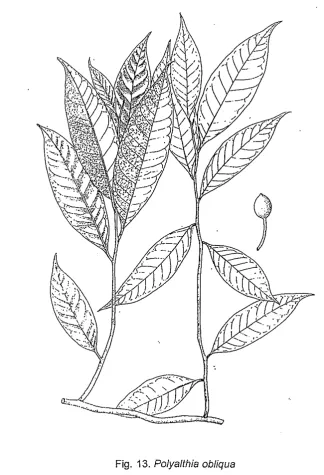
Merr. Philip. Jour. Sci. 8 (1913) 371.Tree up to 10 m tall, 12 cm in diameter. Bark greyish-white, black,
smooth, hooped, deppled, lenticelled. Twigs glabrous 5-6 mm in diameter,
fissured. Leaves: petioles glabrous, 1.2 mm in diameter, 4-9 mm length; lamina
coriaceous,shiny above, oblong, 9.2
-
17.5 cm by 3.2-
4.7 cm; base cuneate, apex acuminate to caudate; glabrous above and below surface; midrib flat andglabrous above, prominent and glabrous below; secondary veins prominent and
glabrous above and belows, secondary veins 11-15 in pairs. Flowers not seen.
Carpidia: stalked 3 cm, ellipsoid, apex acute, glabrous, 16 mm in diameter. Seed
1.
DISTRIBUTION : Borneo (Berau)
HABITAT: Primary forest.
SPECIMENS EXAMINED: Adriansyah; Boestani, A.N. AA 2197.
NOTE: The species has leaves the edges of which are very slightly
Fig. 13. Polyalthia obliqua
10. Polyalthia oblonga King
Polyalthia oblonga King, Journ. As. Soc. Beng 11, 2 (1892) 65.---Type:
King s.n. Malaysia : Perak (Holo: CAL, not seen ).
Tree, 15 m tall, 12 cm in diameter, bark cracked, hooped. Twigs circular,
fissured, hairy. Leaves: petioles hairy, 3 mm in diameter, 3 mm in length; lamina
[image:102.595.118.443.69.545.2]apex acute; glabrous above and hairy below; midrib sunken and hairy above,
prominent and hairy below; secondary veins sunken and glabrous above,
prominent and hairy below, secondary veins 10-16 in pairs. Flowers and carpidia
not seen.
DISTRIBUTION : Malay Peninsula, Borneo (Berau)
HABITAT AND ECOLOGY: logged over dipterocarp forest. Altitude: 1000
m.
SPECIMEN EXAMINED : Arifin.2.; Arbainsyah B 1332
11. Polyalthia rumphii (Blume) Merr.
Polyalthia rumphii (Blume) Merr. Enum. Philipp. FI. PI. ii (1923) 162;
Whitmore, Tree FI. Mal. 1 (1983) 90. Kessler & Heusden, Rheedea 3
.
1 (1993) 82.Polyalthia. kunstleri King, Journ. As. Soc. Beng. Pt. Nat. Hist. 61 (1893)
55.
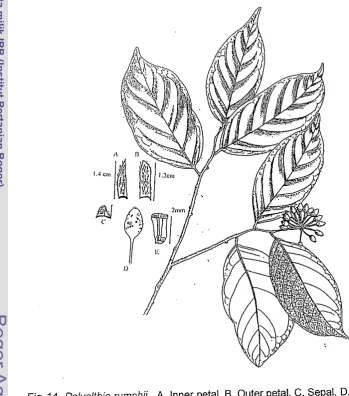
Treelet, up to 8 m tall, up to 12 cm in diameter: Bark fibrous, smooth,
white to black-brownish, bole straight, circular, columnar. Twigs circular, hairy, 4
mm in diameter, fissured. Leaves: petioles hairy, 1-2 mm in diameter, 0.4
-
1 cm in length; lamina charthaceous, oblong-ovate. 5.4-12.5 cm by 2.4-5.2 cm; baseacute, apex acuminate-caudate; glabrous above and below; midrib sunken and
hairy above, prominent and hairy below; secondary veins flat and glabrous
above, prominent and hairy below, secondary veins 6-12 in pairs. Flowers extra
axillary, cluster; pedicels 0.5-1 mm in diameter; sepals triangular, hairy; petals
green becoming yellowish; inner petals and outer petals unequal, inner petals
elliptic (1.4 cm) , hairy, outer petals (1.2 cm), hairy. Stamen 2 mm in length.
DISTRIBUTION : Sumatra, Java, Amboina, Philippines,Borneo (Berau)
HABITAT AND ECOLOGY: Logged over forest, primary forest and
secondary forest Altitude: 45 m.
SPECIMENS EXAMINED: Ambriansyah; Arifin, Z. Berau 984, Kessler et
al. 282, Kessler et al. 319 (BO).
NOTE: The glands on carpidia surface can be used to recognize this
[image:104.595.87.437.266.663.2]species.
12. Polyalthia sclerophylla Hook
.f.
& Th.Polyalthia sclerophylla Hook. f. & Th., FI. Br. Ind. 1 (1872) 65
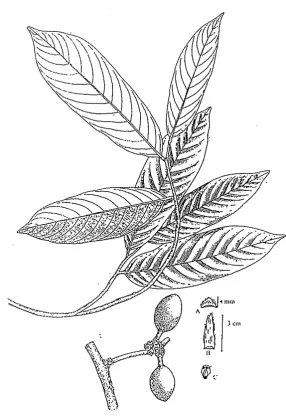
Tree.c.10 m up to 15 m tall, 7-12 cm in diameter, bark whitish. Twigs
fissured, glabrous with lenticelled. Leaves: petioles hairy, 2 mm in diameter, 5-9
mm in length; lamina coriaceous, oblong, 13 cm-25 cm by 5.8 cm- 8.5 cm.; base
rounded; apex acute
-
acuminate; glabrous above and below surface; midrib sunken above and prominent below; secondary veins flat and glabrous above,prorninent and glabrous below, 10-13 in pairs. Flowers not seen.. Carpidia:
stalked 4.1 cm in length, hairy, shortly ellipsoid, diameter 18-20 mm, stalks
monocarpidia 2.8 cm in length, 4 cm in diameter, hairy.
DISTRIBUTION : Berau, PT. lnhutani I logging area, KM 35. along Sungei Sepan
HABITAT : Over mixed Dipterocarp forest, along river bank
SPECIMEN EXAMINED : Kessler, Arbainsyah 81417
Fig. 15. Polyalthia sclerophylla
13. Polyalthia sumatrana (Miq.)Kurz
Polyalthia sumatrana (Miq.) Kurz, Sar. Mus. Jour. (1911-1913) 80.; Ridl.,
FI. Mal. Pen. 1 (1922) .52. ; Merrill, Univ. Cal. Publ. Bot. XV. (1924) 67; Airy Shaw, Kew Bull. (1939) 280; Whitmore. Tree FI. Mal. 1 (1983) 90; Kessler &
Heusden, Rhedeea 3 , l (1993) 82.
Monoon sumatranurn Miq. Ann. Mus. Bot. Lugd. Bat. 2 (1865) 19. --Type
: Teijsman s.n., Sumatra occid., Lubu Alang (not seen).
Tree 8-20 m tall, up to 25 cm in diameter. Bole straight, circular, bark
smooth, fibrous, hooped, white, greyish, inner bark thick. Twigs glabrous. Leaves:
petioles glabrous, mm in diameter, 5-12 mm in length, lamina chatthaceous,
oblong to broadly lanceolate, 23.4-28 cm by 4.7-16.6 cm; base acute, apex
acuminate-caudate; glabrous above and below surface; midrib sunken and
glabrous above, prominent below; secondary veins flat and glabrous above and
below; glaucous below, secondary veins not clear. Flowers axillary, subaxillary;
pedicels 1.5-2 cm in length; sepals triangular, hairy; inner and outer petals nearly
same length, 3.7 cm in length, elliptic, hairy. Stamen not seen. Carpidia: red
when young becoming black, stalked c.3.2 cm in length, 2 mm in diameter;
ellipsoid, 13-21 mm in diameter. Seed 1.
DISTRIBUTION : Malay Peninsula, Sumatra, Java, Borneo (Berau PT. lnhutani I, Berau road to Tj. Redeb, Near Teluk Bayur, Mt. Njapa, G. Lamin, Labanan).
HABITAT AND ECOLOGY : primary forest, logged over forest, secondary
forest, burned over forest along road, Hill forest, altitude : 20-200 m. Flowering :
February, June, October, November. Fruiting : October.
SPECIMENS EXAMINED: Kessler et al. Berau 135, 191, 325, 331, 892,
Fig. 16. Polyalthia sumatrana A. Sepal. B. Petal
14. Polyalthia tipuliflora D.M. Johnson
[image:108.595.139.477.108.548.2]Treelet 3-5 m tall, trunk 5 cm in diameter. Bark smooth. Twigs 4.5-6 mm
in diameter, light brown to grey-brown, densely covered with a pale yellow to pale
brown tomentum formed of matted and twisted hairs 1.5-3 mm long. Leaves:
lamina charthaceous, oblanceolate, 36-6 cm by 11-12 cm, olive grey; base
subcordate; apex acminate; above with long hairy (2 mm)along midrib toward the
base, below surface hairy; midrib sunken above, prominent below, secondary
veins sunkenabove, prominent below, secondary veins 21-24 in pairs. Flowers
arising from woody tubercles on thrunk or leafless twigs, pedicel 5-6 mm by 2.5
mm thick at midpoint, tirsute; sepals 6.5-11,3 mm by 4.5-5.5 m at base,
triangular, caudate, densely hirsute; petals dirty-orange to orange, slightly fleshy,
filiform, sparsely pilose to glabrous in upper surface, sparsely pubescent to
glabrous below surface; outer petals 4.5-6.1 cm by 5-6 mm, acute, subauriculate
at base because of short inflexed claw; inner petals 4.2-5.9 cm by 3-3.5 mm,
acute. Stamens numerous, 2 mm in length, glabrous. Carpidia not seen.
DISTRIBUTION Borneo ( Mt. llas Bungaan) HABITAT: sand and limestone.
Fig. 17. Polyalthia tipuliflora A. Flower. B. Stamen. 15.
Polyalthia
sp. Apedicel 10
-
12 rnrn in length, hairy; sepals triangular, 5 rnm, hairy; petals elliptic, hairy, inner petals 15 mrn, outer petals 10 mrn. Stamen 2 mm in diameter.Carpidia not seen.
DISTRIBUTION : Borneo (Berau).
HABITAT AND ECOLOGY: Secondary forest along road ca.2 km from
Labanan Altitude : 10 rn.
FIELD NOTES : Young fruits green, young leaves purple. Flowers whitish cream.
SPECIMEN EXAMINED : Kessler et al. Berau 309
NOTE: The species resembles to
P.
rumphii in flower character andP.
dictyoneura
in twigs character.The identify of this species is still uncertainCONCLUSION
There are 15 species of Polyalthia from Berau Regency. Polyalfhia berauensis, P. cauliflora, P. dictyoneura, P. glauca, P. igniflora, P. jenkensii, P. lateriflora, P. microtus, P. oblonga, P. obliqua, P. rumphii, P. sclerophylla, P.sumatrana, P. tipuliflora, and Polyalthia sp. A. Polyalthia berauensis is proposed as a new species.
REFERENCES
Argent, G.. A. Saridan, E.J.F. Campbell, P. Wilkie, G. Fairweather, J.T. Hadiah, D.J. Middletton, C. Pendly, M. Pinard, M. Warwick & K.S. Yulita. 1998. Polyalthia. In Manual of The Larger and More Important Non Dipterocarp Trees of Central Kalimantan Indonesia. Vol.1. Forest Research Institute, Samarinda. p. 68-71.
Blume, C. L. von. 1829. FI. Jav. Anonac. 68. Bruxellis: Suntibus Librariae J. Frank.
Corner, E. C. H. 1940. Wayside Trees of Malaya. Singapore: Government Printing Office. P. 135.
Hildebrandt, F. H. 1952. Daftar Nama Pohon-Pohonan " Bulungan dan Berau" Kalimantan Timur. Dalam Laporan Balai Penyelidikan Kehutanan No. 55. Balai Penyelidikan Kehutanan Bogor.
Johnson, D. M. & Nancy A. Murray. 1999. Four New Species of Polyalthia (Annonaceae) from Borneo and Their Relationship to Polyalthia insignis. Contr. Univ. Michigan Herb. 22 : 95
-
104.Kessler, P.J.A. 1993. Annonaceae. In Kubitzki, K. et al.(Eds.) Fam. Gen. Vas. Plants Vol.
2.
Springer, Berlin. P. 97 -1 29.Kessler, P. J. A. & E. C. H. van Heusden. 1993. The Annonaceae of the Balikpapan
-
Samarinda Area, East Kalimantan Indonesia. Rhedeea 3:50
-
89.Kochummen, K. H. 1972. Annonaceae. In Whitmore, T.C. (Eds.)Tree Flora of Malaya. Vol. 1. Kuala Lumpur: Longman. p. 85.
Leenhouts, P.W. 1968. A Guide to the Practice of Herbarium Taxonomy. The International Bureau for Plant, Taxonomy and Nomenclature of The International Association of Plant Taxonomy, Utrecht. The Netheerland. Maxted, N. 1992. Towards defining a taxonomic revision methodology. Taxon
41(4): 653
-
660.Rifai. M.A. 1976. Sendi-Sendi Botani Sistematika. Lembaga Biologi Nasional
-
LIPI, Bogor.Sinclair, J. 1955. A Revision of Malayan Annonaceae. Gard. Bull. Sing. 14 (2): 149
-
516.Sist, P. & A. Saridan. 1998. Description of the Primaty Lowland Forest of Berau. In Bertault, J. G. & K. Kadir (Eds.). Silvicultural Research in A Lowland Mixed Dipterocarp Forest of East Kalimantan. Jakarta: Cirad. p. 51
-
94. Vogel, E.F. de. 1987. Guideline for the Preparation of Revisions. In Vogel (ed.)