www.elsevier.com/locate/ibmb
A new member of the AKH/RPCH family that stimulates
locomotory activity in the firebug, Pyrrhocoris apterus
(Heteroptera)
Dalibor Kodrı´k
a,*, Radomı´r Socha
a, Petr Sˇimek
a, Rostislav Zemek
a, Graham J.
Goldsworthy
baInstitute of Entomology, Academy of Sciences, Branisˇovska´ 31, CZ-370 05 Cˇ eske´ Budeˇjovice, Czech Republic bDepartment of Biology, Birkbeck College, University of London, Malet Street, London, WC1E 7HX, UK
Received 25 March 1999; received in revised form 2 November 1999; accepted 1 February 2000
Abstract
A new member of the AKH/RPCH family was isolated and identified from the corpora cardiaca of the firebug Pyrrhocoris
apterus. The peptide was isolated in a single step by reversed phase HPLC and the structure deduced from the multiple MS (MSN) electrospray mass spectra and amino acid analysis as that of an octapeptide with the sequence pGlu–Leu–Asn–Phe–Thr–Pro–Asn– Trp–NH2: this sequence was confirmed by synthesis. The synthetic peptide induced lipid mobilisation and stimulated locomotory activity in macropterous females. This peptide, designated as Pyrrhocoris apterus adipokinetic hormone (Pya-AKH), is the first identified adipokinetic hormone described in a representative species of the suborder Heteroptera. 2000 Elsevier Science Ltd. All rights reserved.
Keywords: Adipokinetic hormone; AKH/RPCH; Neuropeptide; HPLC; Electrospray mass spectrometry; Lipid mobilisation; Locomotory activity;
Bug
1. Introduction
The adipokinetic hormone/red pigment concentrating hormone family (AKH/RPCH family) is one of the best known groups of arthropod neuropeptides. This name comes from the first members of this family to be fully characterised, a chromatophorotropin (RPCH) from prawns (Fernlund and Josefsson, 1972), and an adipoki-netic hormone (Lom-AKH) from Locusta migratoria (Stone et al., 1976). The AKHs are synthesised and released from the corpora cardiaca, but small quantities of AKH-I are also found in the brain of L. migratoria (Moshitzky et al., 1978; Bray et al., 1993). Flight is a primary stimulus for the release of the hormones into the haemolymph (Mayer and Candy, 1969) although little is known about the integration of flight activity with the
* Corresponding author: Tel.: +420-38-7775271; fax: +420-38-43625.
E-mail address: [email protected] (D. Kodrı´k).
0965-1748/00/$ - see front matter2000 Elsevier Science Ltd. All rights reserved. PII: S 0 9 6 5 - 1 7 4 8 ( 0 0 ) 0 0 0 2 5 - 4
neurosecretory system (Orchard, 1987; Goldsworthy, 1990). In locusts, where the hormones have been investi-gated intensively, the AKHs are known to be essential for long-term flight (Goldsworthy, 1983). The known actions of AKHs are, however, broader than their name implies. The peptides have been reported to act on the fat body to mobilise stores of lipid and carbohydrate, activate glycogen phosphorylase, accumulate cAMP (see Goldsworthy, 1983) and inhibit the synthesis of lipids (see Lee and Goldsworthy, 1996), proteins (Carlisle and Loughton, 1979), and RNA (Kodrı´k and Goldsworthy, 1995). Recently, it was reported that AKH also stimu-lates locomotory activity (Socha et al., 1999). AKHs are thus typical stress hormones: they stimulate catabolic reactions, making energy more available while inhibiting synthetic reactions.
mem-490 D. Kodrı´k et al. / Insect Biochemistry and Molecular Biology 30 (2000) 489–498
bers of the AKH/RPCH family have been identified but, in spite of this growing list of AKHs (Ga¨de, 1997; Ga¨de et al., 1997), no representatives of the suborder Heterop-tera of the order HemipHeterop-tera have been characterised. Several years ago, three independent groups described a neuropeptide of the AKH/RPCH family isolated from cicadas (Ga¨de and Janssens, 1994; Raina et al., 1995; Veenstra and Hagedorn, 1995), from the suborder Homoptera, closely related to the Heteroptera. The lack of information on AKH peptides from Hemiptera is sur-prising, because this order is by far the most successful non-holometabolan order (Kristensen, 1981). The fire-bug, Pyrrhocoris apterus (L.), appeared to be an excel-lent insect for such study, because it has been used for many years as a convenient experimental model in the Institute of Entomology and there is a wealth of infor-mation about the biology of this species (for review see Socha, 1993).
P. apterus is a flightless heteropteran producing
long-winged (macropterous) and short-winged (brachypterous) morphs. In central Europe, the bug lives at the foot of lime trees, whose seeds are the basic component of its food. Development from the egg to adult takes about 1 month under laboratory conditions (25–26°C and long-day, LD 18:6 h photoperiod). The larvae pass through five instars. Under constant labora-tory conditions, development through four initial larval stadia takes approximately 10–14 days, while the final stadium lasts from 7 to 10 days. The adults live from 2 months to 1 year, depending on whether the individuals are maintained under conditions favouring reproductive activity or diapause (see Socha, 1993). Thus, this study was initiated to investigate AKH/RPCH peptides in the firebug P. apterus, a representative species of the suborder Heteroptera.
2. Materials and methods
2.1. Experimental animals
A laboratory stock culture of the firebug, P. apterus, was used in the present study. The origin and details on breeding of this culture are described elsewhere (Socha and Sˇula, 1996). Larvae and adults were kept in 0.5-l jars in mass culture (approximately 40 specimens per jar), and food and water were replenished twice a week. Freshly ecdysed adult females were transferred in groups of 10–20 specimens to small glass jars (250 ml) and kept under the same photoperiodic and temperature regimes in which they had developed. The bugs were supplied with linden seeds and water in small glass tubes plugged with cellulose wool.
2.2. Isolation/purification procedure
Corpora cardiaca (CC) often with corpora allata (CA) and a corresponding part of the brain were dissected from 3- to 5-day-old adults and placed in an ice-cold Eppendorf 1.5 ml centrifuge tube. For the purification of the peptide, tissues from several hundred insects were extracted in 80% methanol. Evaporated methanolic extract was re-dissolved and purified by single-step reverse phase high pressure liquid chromatography (RP HPLC; Merck-Hitachi D-6000 chromatography system) on a LiChrospher WP 300 RP-18 column (250 mm×4 mm, particles 5µm, Merck), with a gradient from 25 to 100% B in 40 min (A=0.1% TFA in water; B=0.05% TFA in 40% acetonitrile) at a flow rate of 0.8 ml/min and UV detection at 215 nm. Biological activity in the fractions was tested in a bioassay (see below) and the active material (retention time 28.33 min) was used for the structure elucidation.
2.3. Amino acid analysis
The active fraction (about 500 pmol of the active substance) was hydrolysed in 6 M HCl at 110°C in sealed tubes for 18 h. The hydrolysate was evaporated to dryness and the amino acids determined as tertiary-butyldimethylsilyl derivatives by GC/MS (Sˇimek et al., 1994; Jegorov et al., 1997).
2.4. Molecular weight and structure elucidation
The molecular weight and amino acid sequence of the peptide were estimated by electrospray mass spec-trometry performed on an LCQ mass spectrometer (Thermoquest, USA). The sample was introduced in CH3CN–0.05% TFA (50:50) either via a syringe pump at 3µl/min or via an RP-C18 150 mm×1 mm Symmetry C8column at 50µl/min employing an LCQ electrospray ion source operated at 4.2 kV.
The amino acid sequence was deduced from the elec-trospray MSN
mass spectra obtained by the collision induced decomposition (CID) of the MH+ ion and its product ions in a series of MSN experiments that were performed with the ion trap mass spectrometer. The pep-tide was synthesised commercially by Genosys Biotech-nologies Ltd. (Europe).
2.5. Bioassay
2.5.1. Sample treatment
Fig. 1. The RP HPLC elution profile of an extract of 410 CC–CA complexes from P. apterus (for details see Section 2). Activity of the marked fractions was tested in the lipid mobilisation assay and is shown in Table 1. The Pya-AKH fraction is marked by an asterisk.
solution. The tested samples were injected into 10-day-old macropterous females—the reasons for this choice of age are explained elsewhere (Socha and Kodrı´k, 1998). Peptidic dilutions were prepared to give the desired con-tent per 2 µl solution. This volume was injected using a syringe (5 or 10µl; Hamilton Co., Reno, NV) through the metathoracic–abdominal intersegmental membrane into the thorax of the experimental bug. Control bugs were injected with 2µl of 20% methanol in Ringer saline in the same way.
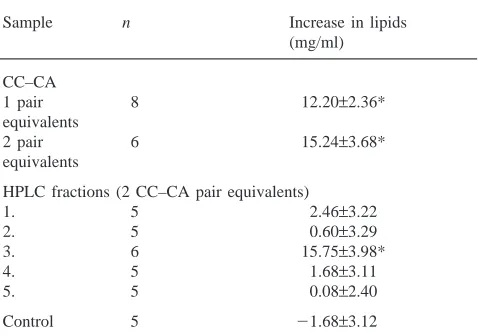
Table 1
Effect of crude extract of corpora cardiaca and corpora allata complex (CC–CA) and RP HPLC purified fractions (see Fig. 1) of the same material on the change (mean±SD) in concentration of lipids in the haemolymph. Statistically significant differences at the 5% level are indicated by asterisks (experimental vs. control)
Sample n Increase in lipids
(mg/ml)
CC–CA
1 pair 8 12.20±2.36*
equivalents
2 pair 6 15.24±3.68*
equivalents
HPLC fractions (2 CC–CA pair equivalents)
1. 5 2.46±3.22
2. 5 0.60±3.29
3. 6 15.75±3.98*
4. 5 1.68±3.11
5. 5 0.08±2.40
Control 5 21.68±3.12
2.5.2. Lipid mobilisation assay
The lipid content of the haemolymph samples was determined by a method based on the sulpho-phosphov-anillin test (Zo¨llner and Kirsch, 1962; modified by Holwerda et al., 1977 and by Van Marrewijk et al., 1984). The haemolymph samples were taken from the cut end of an antenna: a drop of haemolymph was leaked onto a piece of parafilm M and 0.5 µl taken up by micropipette (Eppendorf Varipipette 4810) and used for the determination of lipids. The samples were collected just before and 90 min after injection. Using the Microsoft Excel program, the optical densities at 546 nm in a spectrophotometer (UV 1601 Shimadzu) were con-verted to mg lipids per ml haemolymph with the aid of a calibration graph based on known amounts of oleic acid. Results were expressed as a mean of haemolymph lipid elevation for between 6 and 12 observations (difference of lipid levels before and after injection)
±SD. Standard deviations were shown only in one direc-tion in the figure.
2.5.3. Locomotory activity
492 D. Kodrı´k et al. / Insect Biochemistry and Molecular Biology 30 (2000) 489–498
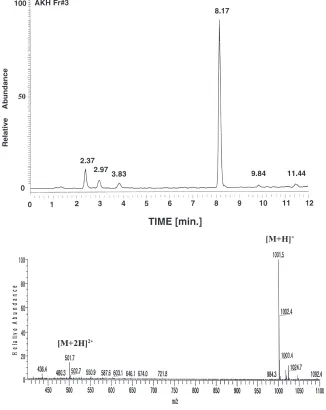
Fig. 2. The HPLC/ESI-MS analysis of the active material in fraction 3. Top panel: total ion chromatogram of m/z=400–1400. Gradient elution with CH3CN–0.05% TFA from 20:80 to 80:20 in 10 min, flow rate 50µl/min, column Symmetry C8(Waters, USA). For details, see Section 2. Bottom panel: ESI full scan mass spectrum of the base peak at RT=8.17 min with MH+1001.5. The double-charged ion (M+2H)2+at m/z=501.7 and the (M+Na)+adduct at m/z=1023.6 further confirm the molecular weight of the target peptide.
periods of 1 h. Locomotory activity was measured in 46 bugs in both the experimental and control groups.
2.6. Data presentation and statistical analyses
The results of adipokinetic responses were plotted using the graphic program Prism (GraphPad Software, version 2.1, San Diego, CA, USA). The statistical analy-ses were performed with use of the program Instat (GraphPad Software, version 1.15, San Diego, CA, USA). For a similarity search of the Pya-AKH with other members of the AKH/RPCH family the DNASTAR (PROTEAN-Clustal method) software (DNASTAR, Inc., Lasergene, Madison, WI) was used.
An unstructured multivariate approach (Diggle, 1992) was applied as the method of statistical analysis for the
locomotory activity data, because they consisted of two relatively short non-stationary time series. The data were first normalised by log transformation and the test stat-istic was calculated as
D5np{log(uS0u)2log(uSu)}
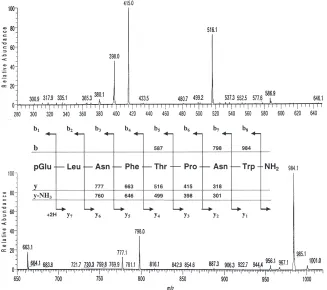
Fig. 3. CID ESI-MS2spectrum of the ion MH+(m/z=1001.5) from P. apterus. The Pya-AKH sequence insert shows theoretical calculated masses for b and y-type ions, which were observed in the MS2mass spectrum.
3. Results and discussion
RP HPLC analysis of the methanolic CC–CA extract from P. apterus generated a number of UV-absorbing peaks (Fig. 1) which were tested in the lipid mobilisation assay. The results obtained from fractions in the region where AKHs are expected to elute are shown in Table 1. None of the other fractions were active (data not shown). The highest adipokinetic activity was in fraction 3, where the response of the assay bugs was comparable with that obtained to crude extracts of CC–CA. Further RP HPLC separations (data not shown) indicated high purity of the material, and HPLC/ESI-MS analysis revealed a base peak with (M+H)+ 1001.5 Da (Fig. 2) indicating a molecular weight of 1000.5 Da for the pep-tide. Quantitative amino acid analysis showed stoichio-metric ratios of leucine (1), threonine (1), proline (1), phenylalanine (1), aspartic acid (2) and glutamic acid (1) in the acid hydrolysate. Treatment of the peptide with pyroglutamate aminopeptidase (Boehringer Mannheim) and subsequent HPLC/ESI-MS analysis revealed that its N-terminus is blocked by a pyroglutamic acid residue. The amino acid sequence was deduced from the multiple tandem (MSN) mass spectra obtained by a consecutive isolation, storage and collisionally induced dissociation (CID) of the (M+H)+ ion in the ion trap (and resulting in the MS2
spectra), followed by an analogous process with selected product ions (resulting in a set of the MS3
,
MS4, etc. spectra). The MS2 (or MS/MS) spectrum of the peptide from Pyrrhocoris and the sequence product ions are shown in Fig. 3.
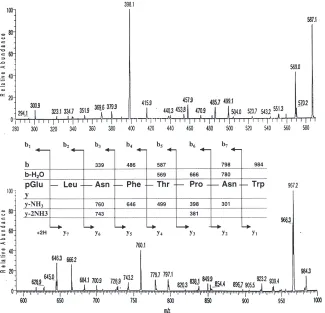
The intensive (MH–NH3)+product ion, m/z 984.3, and for the adipokinetic peptides characteristic y-type and b-type product ions (Raina et al., 1995) show diagnostic fragmentations at nearly every peptide bond except those between pGlu–Leu. They clearly indicate a C-terminus amido block and a partial peptide sequence (amino acid positions 3–8 in the peptide). The structure was further deduced from a set of the collected MSNspectra. Thus, the correct assignment was confirmed by a CID experi-ment with an ion, m/z 984.3, giving MS3
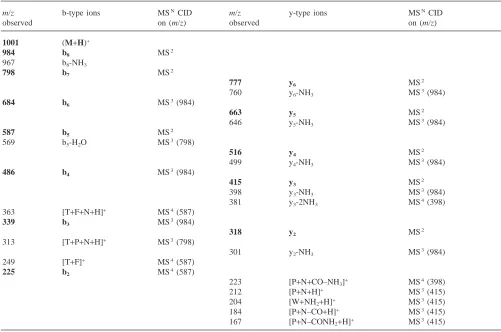
mass spectra with a series of diagnostic (y-NH3) and b-type ions and, as expected, with an absence of the y-type ions (Fig. 4). Structurally important ions from the set of MSN spec-tra are summarised in Table 2. The power of MSNscans is exemplified in Fig. 5 on the selective MS4 and MS3 decomposition of the b5(m/z 587) and y3(m/z 415) pro-duct ions arising from the N- and C-terminus peptide sequence fission, respectively.
Finally, a complete primary sequence was established from information about the N-terminus pyroglutamic amino residue, the amino acid composition and the mass spectral data, and was assigned as an octapeptide pGlu– Leu–Asn–Phe–Thr–Pro–Asn–Trp–NH2 belonging to the AKH/RPCH family. The structure was confirmed by synthesis and MSN
494 D. Kodrı´k et al. / Insect Biochemistry and Molecular Biology 30 (2000) 489–498
Fig. 4. CID ESI-MS3spectrum of the product ion m/z=984.3 obtained from consecutive CID of the MH+(m/z=1001.5). The Pya-AKH sequence insert shows theoretical calculated masses for b and y-type ions, which were observed in the MS3mass spectrum.
synthesized peptides. Both compounds showed identical chromatographic (the synthetic peptide co-eluted with the natural one) and mass spectral properties.
From its structure and the activity in the lipid mobilis-ation assay, the peptide is a new member of the AKH/RPCH family—P. apterus AKH. To our knowl-edge this is the first member of the family identified within the suborder Heteroptera. The peptide has been designated Pya-AKH.
A similarity search using DNASTAR software revealed maximal identity with Lom-AKH-I and Phm-AKH (Table 3). This is not surprising because the Pya-AKH sequence is identical to the first eight amino acids of these two decapeptides. Further, the analysis showed 87.5% similarity with five octapeptides (which means an exchange of one amino acid) (Emp-AKH, Lom-AKH-III, Miv-CC, Pea-CAH-II and Tem-HrTH), and with four (or five) decapeptides (which means an exchange of one amino acid within the first eight amino acids of the mol-ecule and the addition of two more amino acids at the C-terminus) (Cam-HrTH-I, II, Phl-CC, Del-CC and Rom-CC; see review by Ga¨de et al., 1997). Surprisingly, there is relatively low similarity (62.5%) with the cicada peptides Plc-HrTH-I and II (Ga¨de and Janssens, 1994; Veenstra and Hagedorn, 1995; Raina et al., 1995),
despite the close phylogenetic relationship between Homoptera and Heteroptera.
Table 2
Summary of the diagnostic product ions arising from the CID ESI-MSNN- and C-terminal cleavage of the amide (peptide) bond which were employed for structure elucidation. The data were obtained from a set of the MSNmass spectra of the Pya-AKH by electrospray ion trap mass spectrometry. The rationalised sequence ions are labelled using nomenclature discussed elsewhere (Biemann, 1988)
m/z b-type ions MSNCID m/z y-type ions MSNCID
observed on (m/z) observed on (m/z)
1001 (M+H)+
adipokinetic peptides in P. apterus CC seems to be unlikely, because each fraction obtained after the HPLC analysis was tested in the lipid mobilisation assay and only one was active. This particular fraction was ana-lysed again in another HPLC run under different separat-ing conditions and no heterogeneity of the material was revealed. Moreover, chemical analysis of the peak showed one clearly readable signal. For these reasons we exclude the possibility of the presence of other pep-tides with adipokinetic activity.
Intriguingly, the octapeptide sequence that we have now identified as Pya-AKH has been synthesised pre-viously and assayed for lipid mobilisation in locusts: it was also found to be less active than the [Gly8a–Thr8b]-C-terminally extended (deca)peptide analogue of Pya-AKH (=Lom-AKH-I) in locust assays performed both in vivo and in vitro (Lee and Goldsworthy, 1996). It will be of interest to explore further the structure–activity relationships of the receptors for AKHs in the firebug.
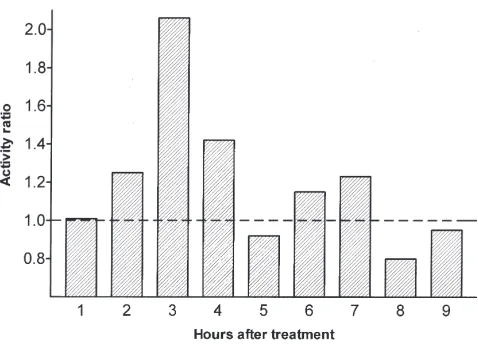
The synthetic Pya-AKH also stimulated locomotory activity. Time serial analysis revealed highly significant (D=149.41, df=9, P,0.0001) differences between loco-motory activities of Pya-AKH-treated and control
fire-bugs when expressed as an activity ratio (Fig. 7). The most apparent stimulation was observed 3 h after the treatment when the activity of hormonally treated fire-bugs was twice that of the controls. We reported earlier that Lom-AKH-I stimulates locomotory activity in P.
apterus females (Socha et al., 1999). In the present study
496 D. Kodrı´k et al. / Insect Biochemistry and Molecular Biology 30 (2000) 489–498
Fig. 5. ESI-MSNspectra of the N-terminus b
5(m/z=587) and C-terminus y3(m/z=415) product ions. Top panel: MS4spectrum obtained by the isolation/CID of m/z=1001.5 (MH+)
→984.3 (MH+–NH3)→587.2 (b5)→. Bottom panel: CID MS3spectrum of m/z=1001.5 (MH+)→415.2 (y3)→. For diagnostic y- and b-type ions, see Table 2.
Table 3
Primary structures of peptides of the adipokinetic hormone/red pigment-concentrating hormone family showing high similarity (100% and 87.5%) with Pya-AKH. For details see the text
Peptide Species Sequence
Lom-AKH-Ia Locusta migratoria pQ L N F T P N W G Tamide
Phm-AKHa Phymateus morbillosus pQ L N F T P N W G Samide
Emp-AKHa Empusa pennata pQ V N F T P N Wamide
Lom-AKH-IIIa Locusta migratoria pQ L N F T P W Wamide
Miv-CCa Microhodotermes viator pQ I N F T P N Wamide
Pea-CAH-IIa Periplaneta americana pQ L T F T P N Wamide
Tem-HrTHa Tenebrio molitor pQ L N F S P N Wamide
Cam-HrTH-I, IIa Carausius morosus pQ L T F T P N W G Tamide
Phl-CCa Phymateus leprosus pQ L T F T P N W G Samide
Del-CCa Decapotoma lunata pQ L N F S P N W G Namide
Rom-CCa Romalea microptera pQ V N F T P N W G Tamide
Pya-AKH Pyrrhocoris apterus pQ L N F T P N Wamide
Fig. 6. The effect of increasing doses of Pya-AKH (j) and high doses of Lom-AKH-I (h) on the elevation of haemolymph lipid level in
Pyrrhocoris females. Control bugs were injected with saline. Statistically significant differences at the 5% level (experimental vs. control) are
indicated by asterisks.
Fig. 7. The ratio of locomotory activity (mean number of infrared beam crosses per female per hour) between P. apterus females injected with 10 pmol Pya-AKH and controls that received only the solvent.
haemolymph (unpublished data). All these observations indicate that the AKH effect on locomotory activity rep-resents a physiologically significant phenomenon. The mechanism of its action is not known yet, but we have hypothesised that either metabolic and/or neuromodula-tory pathways could be involved (Socha et al., 1999).
Acknowledgements
This study was supported by grant No. A6007804 from the Grant Agency of the Czech Academy of Sciences (DK) and by a grant from The Royal Society (GJG and DK). The authors thank Mrs J. Irova´, D. Rienesslova´ and J. Jabu˚rkova´ for technical assistance.
References
Biemann, K., 1988. Contributions of mass spectrometry to peptide and protein structure. Biomed. Environ. Mass Spectrom. 16, 99–111. Bray, M.M., Shafi, S., Wheeler, C.H., Goldsworthy, G.J., 1993.
Quantification by radioimmunoassay of adipokinetic hormone-I in neural tissues in the head of Locusta migratoria. Comp. Biochem. Physiol. 106A, 257–262.
Carlisle, J., Loughton, B.G., 1979. Adipokinetic hormone inhibits pro-tein synthesis in Locusta. J. Insect Physiol. 282, 420–421. Diggle, P.J., 1992. Time Series: A Biostatistical Introduction.
Claren-don Press, Oxford, 257 pp.
Fernlund, P., Josefsson, L., 1972. Crustacean color-change hormone: amino acid sequence and chemical synthesis. Science 177, 173– 175.
Ga¨de, G., 1997. The explosion of structural information of insect neur-opeptides. In: Herz, W., Kirby, G.W., Moore, R.E., Steglich, W., Tamm, C. (Eds.), Progress in the Chemistry of Organic Natural Products 71. Springer Verlag, New York, pp. 1–128.
Ga¨de, G., Hoffmann, K.H., Spring, J.H., 1997. Hormonal regulation in insects: facts, gaps, and future directions. Physiol. Rev. 77, 963–1032.
Ga¨de, G., Janssens, M.P.-E., 1994. Cicadas contain novel members of the AKH/RPCH family peptides with hypertrehalosaemic activity. Biol. Chem. Hoppe-Seyler 375, 803–809.
Goldsworthy, G.J., 1983. The endocrine control of flight metabolism in locusts. Adv. Insect Physiol. 17, 149–204.
Goldsworthy, G.J., 1990. Hormonal control of flight metabolism in locusts. In: Chapman, R.F., Joern, A. (Eds.), Biology of Grass-hoppers. John Wiley and Sons, pp. 205–225.
Holwerda, D.A., Van Doorn, J., Beenakkers, A.M.T., 1977. Charac-terization of the adipokinetic and hypertrehalosaemic substances from the locust corpus cardiacum. Insect Biochem. 7, 151–157. Jegorov, A., Sˇimek, P., Heydova´, A., Cvak, L., Mina´rˇ, J., 1997. Free
and bonded homo-isoleucine in sclerotia of the parasitic fungus
Claviceps purpurea. Amino Acids 12, 9–19.
Kodrı´k, D., Goldsworthy, G.J., 1995. Inhibition of RNA synthesis by adipokinetic hormones and brain factor(s) in adult fat body of
Locusta migratoria. J. Insect Physiol. 41, 127–133.
Kristensen, N.P., 1981. Phylogeny of insect orders. Ann. Rev. Ento-mol. 26, 135–157.
498 D. Kodrı´k et al. / Insect Biochemistry and Molecular Biology 30 (2000) 489–498
containing two tryptophan residues and their activities in vitro and in vivo in Locusta. J. Comp. Physiol. B 166, 61–67.
Mayer, R.J., Candy, D.J., 1969. Control of haemolymph lipid concen-tration during locust flight: an adipokinetic hormone from the corpora cardiaca. J. Insect Physiol. 15, 611–620.
Moshitzky, P., Henzel, W.J., Rafaeli, A., Ramachandran, J., Apple-baum, S.W., 1978. Synthesis of adipokinetic hormone (AKH-I) in the locust brain. Insect Biochem. 17, 1133–1137.
Neale, M.C., 1997. Mx: Statistical Modelling, 4th ed. Department of Psychiatry, Richmond, VA, 154 pp.
Orchard, I., 1987. Adipokinetic hormones—an update. J. Insect Phy-siol. 33, 451–463.
Raina, A., Pannel, L., Kochansky, J., Jaffe, H., 1995. Primary structure of a novel neuropeptide isolated from the corpora cardiaca of per-iodical cicadas having adipokinetic and hypertrehalosaemic activi-ties. Insect Biochem. Mol. Biol. 25, 929–932.
Socha, R., 1993. Pyrrhocoris apterus (Heteroptera)—an experimental model species: a review. Eur. J. Entomol. 1, 241–286.
Socha, R., Kodrı´k, D., 1998. Adipokinetic response of Pyrrhocoris
apterus (L.) (Heteroptera). In: Brunnhoffer, V., Solda´n, T. (Eds.),
Book of Abstracts, VIth European Congress of Entomology, Cˇ eske´ Budeˇjovice, August 23–29, pp. 87–88.
Socha, R., Sˇula, J., 1996. Differences in haemolymph proteins in
relation to diapause and wing dimorphism in Pyrrhocoris apterus (L.) (Heteroptera: Pyrrhocoridae). J. Comp. Physiol. B166, 382– 387.
Socha, R., Kodrı´k, D., Zemek, R., 1999. Adipokinetic hormone stimu-lates insect locomotor activity. Naturwissenschaften 88, 85–86. Stone, J.V., Mordue, W., Blatney, K.E., Morris, H.R., 1976. Structure
of locust adipokinetic hormone, a neurohormone that regulates lipid utilization during flight. Nature 263, 207–211.
Sˇimek, P., Heydova´, A., Jegorov, A., 1994. High resolution capillary gas chromatography and gas chromatography–mass spectrometry of protein and nonprotein amino acids, amino alcohols and hyd-roxycarboxylic acids as their tert-butyldimethylsilyl derivatives. HRC-J. High Res. Chrom. 17, 145–152.
Van Marrewijk, W.J.A., Van den Broek, A.T.M., Van der Horst, D.J., Beenakkers, A.M.T., 1984. Hypertrehalosaemic and hyperlipaemic responses to adipokinetic hormone in fifth larval instar locusts
Locusta migratoria. Insect Biochem. 14, 151–157.