INTRODUCTION
Melon (Cucumis melo L.) was probably cultivated more than 2,000 years BCE (Andrews, 1956; Keng, 1973; Walters, 1989). Wild melons can be found in Africa since it is believed to be originated from Africa (Kirkbride, 1993). This species is morphologically diverse due to the natural cross-pollinated character. Therefore, related to wild spicies of C. melo as well as enormous quantities of domesticated types (Decker-Walters, Chung, Staub, Quemada, & López-Sesé, 2002) thrived geographically throughout the tropical and subtropical areas across the Indian - Pacific ocean (Kirkbride, 1993).
Taeng-thai is the Thai names for oriental pickling melon or muskmelon (Cucumis melo L.) (Paje & van der Vossen, 1994). Muskmelon’s a Cucumis species, related to the same group with melon and cantaloupe (Kirkbride, 1993). Thai traditional dessert made from the ripe Taeng-thai are mostly consumed due to it’s fragrance character and also the unripe fruits can be consumed as a fresh
and pickled vegetable like cucumber (C. sativus L.). Based on the consumption, muskmelons and cucumbers have the most significant economic value in the Cucurbitaceae family (Call, Criswell, Wehner, Klosinska, & Kozik, 2012; Lebeda, Widrlechner, & Urban, 2006). According to the major consumption of muskmelon at ripening stage, fruit characters are very important for improve the muskmelon cultivar. Therefore, understanding the genetic control of fruit traits is the key to a successful crop improvement.
During domestication process many traits related to yield and fruit qualities are determined. The genetic control of fruit shape, sex expression, gelatinous sheath around the seeds, sutures, number of placentas and white flesh color are determined as recessive genetic control (Pitrat, 2013). About fruit traits, several reports (Eduardo et al., 2007; Pitrat, 2013; Pornsuriya & Pornsuriya, 2009) suggested that the genetic control of fruit traits at unripe and ripe stage are mono and oligogenic characters. Previously, most researchers used the less diverse traits of parental lines (with a difference less than 3 times of traits value).
AGRIVITA
Journal of Agricultural Science
AGRIVITA Journal of Agricultural Science. 2018. 40(1): 1-7Genetics Analysis and Heritability of Fruit Characters
in Muskmelon (
Cucumis melo
L.) Using Extreme Parental Differences
Sunisa Sakulphrom, Sompong Chankaew*) and Jirawat SanitchonDepartment of Plant Science and Agricultural Resources, Faculty of Agriculture, Khon Kaen University, Thailand
ARTICLE INFO
Keywords: Cucumis
Generation mean analysis Muskmelon
Ripping stage Wild melon
Article History:
Received: November 4, 2016 Accepted: November 22, 2017
*) Corresponding author:
E-mail: [email protected]
ABSTRACT
Taeng-Thai is the Thai name for oriental pickling melon or muskmelon (Cucumis melo L.) which is a Cucumis species. Based on consumption as Thai traditional dessert, fruit characters at ripening stage are very important to improve the muskmelon cultivar. Understanding the genetic control of fruit traits is the key to a successful for crop improvement. Research aimed to determine the genetic effects, number of genes and heritability of fruit characters in muskmelon. The results have shown that both additive and dominant effects governed for fruit weight, fruit length, fruit width and fruit thickness with the number of gene as 40.26, 1.55, 10.70 and 11.10 genes, respectively. Simple phenotypic correlation coefficients shown, had a significant positive correlation among the four fruit traits. Due to the quantitative inheritance of fruit characters, quantitative traits loci (QTL) mapping of those traits were necessary to identify all controlling genes of fruit traits in further muskmelon improvement.
ISSN: 0126-0537 Accredited by DIKTI Decree No: 60/E/KPT/2016
Cite this as: Sakulphrom, S., Chankaew, S., & Sanitchon, J. (2018). Genetics analysis and heritability of fruit characters in muskmelon (Cucumis melo L.) using extreme parental differences.AGRIVITA Journal of Agricultural Science, 40(1), 1–7. http://doi.org/10.17503/agrivita.v40i1.1133
However, some traits such as fruit weight and fruit shape have polygenic characters when they have a high genetics diverse in parental materials (Pitrat, 2013). The human selection can decrease the genetic diversity of some traits especially; fruit character due to the fixation of the same genes that corresponding to trait during domestication.
In the wide genetic variability of this species especially for fruit characters, the genetics (gene action) of those traits are interesting and need to be determined. However, the use of low diverse lines as parental will be limited to determine the total of gene particularly to traits due to the same domestication processes. In this study, it is used the extreme fruit characters of muskmelon parental lines to determine the genetics and heritability of fruit characters in muskmelon. The results of this study can be used in muskmelon breeding program for further works.
MATERIALS AND METHODS
Plant Material and Population Creation
The small-fruited wild accession (hereafter designated as P1), native to Nakhon Si Thammarat, Southern Thailand was crossed as the pistillate parent to the big-fruited inbred ML074, accession of ACR-AVRDC, Kasetsart University, Kamphaeng Saen, Nakhon Pathom, Thailand (hereafter referred to as P2) to obtain F1 generation. The F1 hybrids were self-pollinated and used as female parent to both parents in order to develop F2, BC1P1 and BC1P2 generations, respectively.
Traits Evaluate
The parents, F1, F2, BC1P1 and BC1P2 comprised 5, 5, 20, 96, 36 and 36 plants, were respectively laid out in a completely randomized design (CRD) with non-replication during March to May 2016 at Agronomy field crop station, Khon Kaen University, Khon Kaen Thailand. Each plot contained fifty plants in a single row, the rows were 50 meter long and spacing adopted was 100 cm in between the rows and 100 cm in between the plants. The recommendation was practiced to achieve a good crop growth and yield.
Data Collection
Traits related to fruit characters consisting of fruit weight (g), fruit width (cm), fruit length (cm) and fruit thickness (mm) were collected from a 3-5 fruits of each plant at ripening stage.
Data Analysis
Mean and Generation Mean Analysis
The means value of fruit characters were computed for each generation of P1, P2, F1, F2, BC1P1 and BC1P2. The means with corresponding standard errors (SE) of means were computed from the deviations of the individual values from the pooled mean for each of the generations. To determine the presence or absence of non-allelic interactions 3 scaling tests, A, B, and C were used as described by Mather & Jinks (1982). The effects of A, B and C were calculated by t-values and decleared at 5 % and 1 % of significance level. Epistasis interactions were determined by significance of at least one of the tests. The mean values over fruits within plant were used for the estimation of the gene effects. After confirmation of presence of epistasis, joint scaling test of 6 parameters model significance estimates of m, [d], [h], [i], [j] and [l] was applied (Hayman, 1958). The variances, standard errors, and t-Student values were calculated and test for separately significance of each gene effects as discussed by Mather & Jinks (1982).
Number of Gene
The number of gene contribute to each traits were calculated by using equation 1 (Poehlman, 1987).
where Ṇ = number of gene, �1 mean value of P1, �2 = mean value of P2, VF1 = F1 variance, VF2 = F2 variance Heritability of Traits
The heritability of each traits were calculated by using equation 2 (Warner, 1952).
where = broad-sense heritability, V = variance of each generations.
RESULTS AND DISCUSSION
Several researches determined the genetic controls for fruit characters in Cucumis species. The use of low genetic divergent between parental lines were limited to the estimated number of gene controlling traits. In this study, we used the large difference traits value of parental lines to investigate the genetic effects, number of gene and heritability of fruit characters including fruit weight, fruit length, fruit width and fruit thickness. The results showed that fruit characters of muskmelon were controlled by quantitative inheritance.
...(1)
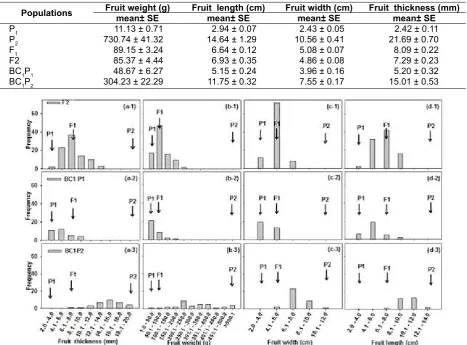
The mean value of fruit characters was extreme in the parental lines for fruit weight (11.13 vs 730.74), fruit length (2.94 vs 14.64), fruit width (2.43 vs 10.56) and fruit thickness (2.42 vs 21.69) (Table 1). The F1 shows all traits as nearly half of the P2 parent except in fruit weight, which F1 was eight times smaller than P2 parent. The results indicated that the incomplete dominant character is affected to all traits excepted for fruit weight. The backcross populations have the mean value toward backcross parent, indicated that additive gene effect also impacts to all traits (Table 1). The results were confirmed by the frequency distribution of all traits (Fig. 1 and Fig. 2). Interestingly, the fruit weight in P2 and BC1P2 were high in both mean and SE, It indicated that high variation among individual plant or fruits of observation whereas, P1,
F1, F2 and BC1P1 were low.
The generation mean analyses was used for estimation the genetic components for fruit weight, fruit length, fruit width and fruit thickness using six-parametric model as presented in Table 2. All fruit traits, additive effects were significant (P < 0.01), which indicated the additive mode of gene actions contributed fruit characters. The dominant effects were significant (P < 0.05) for fruit length, fruit width and fruit thickness while not significant for fruit weight. All three epistasis components were significant for all traits. The results indicated the dominant mode of gene actions also has an impact on fruit length, fruit width and fruit thickness while it did not apply for fruit weight, It suggested fruit weight are mostly affected by additive and epistasis components of gene actions (Table 2).
Table 1. Mean and standard error (SE) of fruit weight, fruit length, fruit width and fruit thickness of six populations of the melon crosses (small fruit (P1) x big fruit (P2))
Populations Fruit weight (g) Fruit length (cm) Fruit width (cm) Fruit thickness (mm)
mean± SE mean± SE mean± SE mean± SE
P1 11.13 ± 0.71 2.94 ± 0.07 2.43 ± 0.05 2.42 ± 0.11
P2 730.74 ± 41.32 14.64 ± 1.29 10.56 ± 0.41 21.69 ± 0.70
F1 89.15 ± 3.24 6.64 ± 0.12 5.08 ± 0.07 8.09 ± 0.22
F2 85.37 ± 4.44 6.93 ± 0.35 4.86 ± 0.08 7.29 ± 0.23
BC1P1 48.67 ± 6.27 5.15 ± 0.24 3.96 ± 0.16 5.20 ± 0.32
BC1P2 304.23 ± 22.29 11.75 ± 0.32 7.55 ± 0.17 15.01 ± 0.53
Fig. 1. Frequency distribution of fruit thickness (a), fruit weight (b), fruit width (c) and fruit length (d) of F2, BC1P1 and BC1P2 populations together with P1, P2 and F1 shows in arrow point.
3
Copyright © 2017 Universitas Brawijaya
Fig. 2. Fruit size and fruit thickness of some of F2, BC1P1 and BC1P2 populations compared to their parents of the melon crosses (small fruit (P1) x big fruit (P2))
Table 2. Genetic components obtained from generation mean analyses for fruit weight, fruit length, fruit width and fruit thickness using six-parametric model
Components 1 Characters
2
Fruit weight Fruit length Fruit width Fruit thickness
A -722.56(43.30)** -10.99(1.38)** -7.72(0.52) ** -19.38(0.98) **
B 508.17(44.69)** 13.92(0.67)** 7.60(0.36) ** 19.50(1.08) **
C -578.71(45.45)** -3.12(1.93)* -3.72(0.55) ** -11.15(1.26) **
m 44.10(28.68)ns 4.98(1.18)** 3.77(0.36) ** 3.64(0.96) **
d -255.56(23.15)** -6.61(0.41)** -3.60(0.23) ** -9.81(0.62) **
h 82.53(53.82)ns 3.92(1.76)* 2.17(0.62) ** 7.31(1.60) **
i 364.31(49.59)** 6.06(1.63)** 3.59(0.58) ** 11.27(1.55) **
j -615.37(31.03)** -12.45(0.76)** -7.66(0.31) ** -19.44(0.71) **
l -149.92(103.15)** -8.99(2.52)** -3.46(1.09) ** -11.39(2.77) **
Remarks: 1: m = mean, [d] = additive component, [h] = dominance component, [i] = additive x additive epistasis component, [j] = additive x dominance epistasis component, [l] = dominance x dominance epistasis component; 2: the values in parentheses represent the standard errors of the components; ns = non-significant; * and ** significant at P < 0.05 and 0.01, respectively.
Copyright © 2017 Universitas Brawijaya
et al.: Extreme Fruit T
raits in Muskmelon
Previously, the genetic controls of fruit traits of C. melo at unripe and ripe stage are mono and oligogenic characters (Eduardo et al., 2007; Pornsuriya & Pornsuriya, 2009; Pitrat, 2013) and polygenic characters (Pitrat, 2013). In this research, the estimated minimum numbers of genes controlling fruit weight, fruit length, fruit width and fruit thickness and broad-sense heritability estimates are presented in Table 3. The results have shown that the estimation as 40.26, 1.55, 10.70 and 11.10 genes for controlling fruit weight, fruit length, fruit width and fruit thickness, respectively. Indicated that polygenic character had been determined in all traits, that was confirmed by the continuous distribution of traits (Fig. 1 and Fig. 2).
According to the cross-pollination character of melon germplasm enhancing the genetic recombination has impressive fruit phenotype variability (José, Iban, Silvia, & Pere, 2005). The allelic variability detected in some are only a small portion of the melon genetic variability especially if the population made from a less genetics divergent among parents with same domestication. However, the analysis of melon populations derived from diverse crossings would identify the genes or quantitative trait loci (QTLs) responsible of the overall fruit variability observed within this species.
This study used wild melon of the exotic accession from Nakhon Si Thammarat province, Southern Thailand as parental line. This variety is a small (< 12 g) round or oval fruits, strong typical aroma and yellow color as P1 parent. To involve the genetic divergent, the large fruit size muskmelon accession ML074 (> 700 g) from ARC-AVRDC, Kasetsart University Thailand was used
as P2 parent. Broad-sense heritability estimated by variance of different generations for controlling fruit weight, fruit length, fruit width and fruit thickness were -0.63, 0.75, 0.63 and 0.78, respectively. The results suggested that fruit length, fruit width and fruit thickness were high inherited that also confirmed by the number of gene controlling of those traits. Interestingly, fruit weight showed negative or set to zero heritability that belonging to this trait that was highly influenced by the environmental factors and therefore, low heritable, once again that confirmed by the number of gene governed the fruit weight is more numerous (40.26) than the other traits (Table 3).The results of this study, similary reported by Eduardo et al. (2007) that fruit shape was a highly heritable trait in melon, whereas fruit weight usually showed a lower heritability.
Simple phenotypic correlation coefficients shown were significant positive correlation among the four fruit traits (Table 4). Fruit width gave the highest correlation with fruit thickness (r = 0.94, P < 0.001) followed by fruit width vs fruit weight and fruit weight vs fruit thickness respectively (Table 4). It indicated that fruit characters were correlated to traits especially fruit width that could be used as phenotypic criteria for fruit thickness in selection process.
Moreover, the classification of wild C. melo used as P1 parent in this study was unclear. Based on the natural cross-pollinated character, this species is morphologically diverse. Decker-Walters, Chung, Staub, Quemada, & López-Sesé (2002) demonstrated that the Genus C. melo including seven botanical varieties, among them were two varieties of a small fruit size, strong typical fragrance Table 3. Estimated minimum number of genes and broad-sense heritability (hb2) for fruit weight, fruit length, fruit width and fruit thickness of the melon crosses (small fruit (P1) x big fruit (P2))
Characters Minimum number of genes Broad-sense heritability (hb2)
Fruit weight 40.26 -0.63
Fruit length 1.55 0.75
Fruit width 10.70 0.63
Fruit thickness 11.10 0.78
Table 4. Phenotypic correlations among fruit weight, fruit length, fruit width and fruit thickness from melon crosses (small fruit (P1) x big fruit (P2))
Fruit weight Fruit length Fruit width Fruit thickness
Fruit weight 1
Fruit length 0.7446** 1
Fruit width 0.8981** 0.7803** 1
Fruit thickness 0.8843** 0.7561** 0.9402** 1
5
Copyright © 2017 Universitas Brawijaya
and secondary colour distribution characterize, C. melo var. chito and dudiam. Both groups are separated as described by Naudin (1859) but grouped together by Munger & Robinson (1991). In this study, it used the small fruit size, strong typical aroma and yellow color that thrived as weedy at Nakhon Si Thammarat province, Southen Thailand as parental line. The correct species of this variety are not determined due to the lack of morphological and genetic informations. However, based on the character of this variety, the authors expected this variety to be C. melo var dudiam. In addition, identifying the true variety of wild accession are needed in future work.
CONCLUSION
In this study, we used large difference trait values of parental lines to investigate the genetic effects, number of gene and heritability of fruit characters including fruit weight, fruit length, fruit width and fruit thickness. The results have shown that fruit characters of muskmelon were controlled by quantitative inheritance with both additive and dominant effects. Quantitative traits loci (QTL) mapping of those traits are necessary for the identification of all genes controlling fruit traits in further muskmelon improvement.
ACKNOWLEDGEMENT
This research was supported by the Plant Breeding Research Centre for Sustainable Agriculture, Khon Kaen University, Khon Kaen, Thailand. The authors thank ACR-AVRDC, Kasetsart University, Kamphaeng Saen, Nakhon Pathom, Thailand for providing seed of ML074. The authors thank Mr. Roquet Cyril for proofreading the manuscript. Thanks is also extended to the Thailand Research Fund (TRF) (Project code: IRG5780003) and the Faculty of Agriculture, Khon Kaen University, for providing financial support for manuscript preparation.
REFERENCES
Andrews, A. C. (1956). Melons and watermelons in the classical era. Osiris, 12, 368-375. Retrieved from https://www.jstor.org/stable/301715?seq=1# page_scan_tab_contents
Call, A. D., Criswell, A. D., Wehner, T. C., Klosinska, U., & Kozik, E. U. (2012). Screening cucumber for resistance to downy mildew caused by Pseudoperonospora cubensis (Berk. and Curt.)
Rostov. Crop Science, 52(2), 577–592. http://doi .org/10.2135/cropsci2011.06.0296
Decker-Walters, D. S., Chung, S. M., Staub, J. E., Quemada, H. D., & López-Sesé, A. I. (2002). The origin and genetic affinities of wild populations of melon (Cucumis melo, Cucurbitaceae) in North America.
Plant Systematics and Evolution, 233(3–4), 183– 197. http://doi.org/10.1007/s006 06-002-0191-3
Eduardo, I., Arus, P., Monforte, A. J., Obando, J., Fernandez-Trujillo, J. P., Martinez, J. A., … van der Knaap, E. (2007). Estimating the genetic architecture of fruit quality traits in melon using a genomic library of near isogenic lines. Journal of the American Society for Horticultural Science,
132(1), 80–89. Retrieved from http://journal.ash spublications.org/content/132/1/80.short
Hayman, B. I. (1958). The separation of epistatic from additive and dominance variation in generation means. Heredity, 12, 371-390. http://doi.org/10.1 038/hdy.1958.36
José, M. A., Iban, E., Silvia, A., & Pere, A. (2005). Inheritance mode of fruit traits in melon: Heterosis for fruit shape and its correlation with genetic distance. Euphytica, 144(1–2), 31–38. http://doi.org/10.1007/s10681-005-0201-y
Keng, H. (1973). Economic plants of ancient North China as mentioned in Shih Ching (Book of Poetry).
Economic Botany, 28(4), 391–410. http://doi.org /10.1007/BF02862856
Kirkbride, J. H. (1993). Biosystematic monograph of the genus Cucumis (Cucurbitaceae): Botanical
identification of cucumbers and melons. North Carolina, USA: Parkway Publishers.
Lebeda, A., Widrlechner, M. P., & Urban, J. (2006). In-dividual and population aspects of interactions between cucurbits and Pseudoperonospora cubensis: Pathotypes and races. Paper pre-sented at Cucurbitaceae 2006, Asheville, North Carolina, USA, 17-21 September (pp. 453-467). North Carolina, USA: Organizing Committee, Cucurbitaceae.
Mather, K., & Jinks, J. L. (1982). Biometrical genetics: The study of continuous variation (3rd ed.). London, UK: Chapman and Hall.
Naudin, C. (1859). Essais d’une monographie des espèces et des variétés du genre Cucumis.
Annales des Sciences Naturelles Botanique IV, 11, 5-87.
Paje, M. M., & van der Vossen, H. A. M. (1994). Cucumis melo L. In J. S. Siemonsma & K. Piluek (Eds.),
Plant resources of South-East Asia No. 8: Vegetables (pp. 153–157). Bogor, ID: Prosea.
Pitrat, M. (2013). Phenotypic diversity in wild and cultivated melons (Cucumis melo). Plant Biotechnology, 30(3), 273-278. http://doi.org/10.5511/plantbiote chnology.13.0813a
Poehlman, J. M. (1987). Breeding field crops (3rd ed.). Fifth Avenue, NY: Springer Science+Business
Media. http://doi.org/10.1007/978-94-015-7271-2
Pornsuriya, P., & Pornsuriya, P. (2009). Study on genetic effects in fruit shape of oriental pickling melon.
Journal of Agricultural Technology, 5(2), 385-390. Retrieved from http://www.ijat-aatsea.com/ pdf/Nov_v5_n2_09/16-IJAT2009_16F.pdf
Walters, T. W. (1989). Historical overview on domesticated plants in China with special emphasis on the Cucurbitaceae. Economic Botany, 43(3), 297– 313. http://doi.org/10.1007/BF02858729
Warner, J. N. (1952). A method for estimating heritability.
Agronomy Journal, 44, 427-430. http://doi.org/10 .2134/agronj1952.00021962004400080007x
Copyright © 2017 Universitas Brawijaya
7