
Achim J. Kopf
Scripps Institution of Oceanography University of California at San Diego
La Jolla, California, USA
Received 10 November 2000; revised 11 December 2001; accepted 12 December 2001; published 6 September 2002.
[1] Mud volcanism and diapirism have puzzled geoscien-tists for⬃2 centuries. They have been described onshore and offshore in many places on Earth, and although they occur in various tectonic settings, the majority of the features known to date are located in compressional tectonic scenarios. This paper summarizes the main thrusts in mud volcano research as well as the various regions in which mud volcanism has been described. Mud volcanoes show variable geometry (up to tens of kilometers in diameter and several hundred meters in height) and a great diversity regarding the origin of the fluid and solid phases. Gas (predominantly meth-ane), water, and mud may be mobilized at subbottom depth of only a few meters but, in places, can originate from several kilometers depth (with minor crustal or mantle input). The possible contribution of mud extru-sion to global budgets, both from quiescent fluid
emis-sion and from the extrusive processes themselves, is important. In regions where mud volcanoes are abun-dant, such as the collision zones between Africa and Eurasia, fluid flux through mud extrusion exceeds the compaction-driven pore fluid expulsion of the accretion-ary wedge. Also, quiescent degassing of mud volcanoes may contribute significantly to volatile budgets and, hence, to greenhouse climate.INDEX-TERMS:4835 Oceanogra-phy: Biological and Chemical: Inorganic marine chemistry; 8122 Tec-tonophysics: Dynamics, gravity and tectonics; 8045 Structural Geology: Role of fluids; 8102 Tectonophysics: Continental contractional oro-genic belts;KEYWORDS:mud volcanism; extrusion; fluid venting; con-vergent margin; diapirism
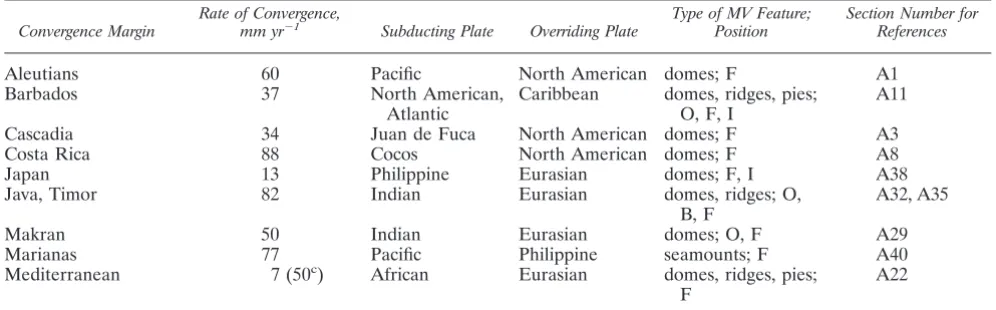
Citation:A. J. Kopf, Significance of mud volcanism,Rev. Geophys.,
40(2), 1005, doi:10.1029/2000RG000093, 2002.
1. INTRODUCTION AND STRUCTURAL OUTLINE
[2] Mud intrusion and extrusion are well-known phe-nomena whereby fluid-rich, fine-grained sediments as-cend within a lithologic succession because of their buoyancy. These processes have long been recognized as related to the occurrence of petroleum, regional volca-nic and earthquake activity, and orogevolca-nic belts (see the enlightening presentation by Ansted[1866]). The abun-dance ofmud volcanoes(terms in italic are defined in the glossary, after the main text) was first examined system-atically on a broad scale byHiggins and Saunders[1974]. These authors mostly focused on mud volcanoes on land, and they used industry drill-hole data to establish relationships between mud volcanism, hydrocarbons, and regional tectonics. The onshore mud volcanoes and their important role in predicting petroleum reservoirs have been summarized by Rakhmanov [1987]. Recent improvements in seafloor imagery and seismic explora-tion led to the discovery of countless mud extrusive provinces all over the world (Figure 1). In fact, com-pared to the compilation byHiggins and Saunders[1974], more than twice as many occurrences are presently known, the number gradually increasing through time. Most importantly, mud volcanoes occur along conver-gent plate margins where fluid-rich sediment is
accumu-lated in deep-sea trenches at high rates. Such deposits then enter the subduction factory, where liquids and volatiles are released due to increasing compactional stress and temperature. Studies of geophysical data and samples of mud volcanoes have considerably improved the understanding of the mechanics, driving forces, and evolution of the features through the most recent Earth history [e.g., Barber et al., 1986; Brown, 1990]. In addi-tion, deep ocean drilling and submersible studies shed crucial light on eruptivity, emission of volatiles, and poten-tial hazard originating from violent mud extrusion [e.g.,
Robertson et al., 1996;Bagirov et al., 1996a;Kopf, 1999]. The wealth of results attests that mud extrusion predominantly occurs in collisional settings, with mostly pore fluids during early (often marine) stages and with hydrocarbons at later stages (often on land [e.g.,Jakubov et al., 1971;Tamrazyan, 1972;Speed and Larue, 1982]). Although quantification of fluid and mud discharge in mud volcanoes is not easy because of their short-lived nature and inaccessibility on the seafloor, first-order estimates regarding flux rates have recently been attempted for various features and regions [e.g.,Henry et al., 1996;Kopf and Behrmann, 2000;Etiope et al., 2002]. When put into a broader context, such estimates indicate that mud extrusion contributes significantly to fluid back flux from the lithosphere to the hydrosphere.
Copyright 2002 by the American Geophysical Union. Reviews of Geophysics, 40, 2 / May 2002
Along wide parts of large accretionary prisms (like the Barbados or Mediterranean Ridges), hundreds of features can cause fluid expulsion at rates exceeding those at the frontal part of the prism (see discussion by Kopf et al. [2001]). Provided that the process of mud volcanism has been equally common in the past, these features have been
major players in fluid and gas budgets and in geochemical cycling in collision zones.
[3] In this paper, the general terminology, as well as the distribution of mud volcanism on Earth in its tec-tonic context, is introduced (section 2). Key issues con-cerning the nature of mud extrusion dynamics will be
Figure 1. Occurrence of mud volcanoes (MVs) on Earth. Numbers refer to section heading nomenclature of Appendix A as well as to Table 1.
discussed. These include the influence of the physical properties of the gaseous, aqueous, and solid phases, as well as processes like rapid sediment accumulation, en-hanced fluid pressures, gas hydrate stability, and chemical processes (see section 3). Combined with geo-physical investigations and results from modeling, quantitative studies estimate (1) mobilization depth of the different phases (section 4), (2) material flux with time, and (3) the impact of mud volcanism on global budgets (section 5). Finally, a compilation of the litera-ture on mud volcanoes appears in Appendix A. This summary closely resembles the review by Higgins and Saunders[1974], with the more recent discoveries added. Appendix A covers the early description of enigmatic mud features [e.g., Goad, 1816; Abich, 1857] up to the most recent studies [e.g.,Bouriak et al., 2000;Delisle et al., 2002;Etiope et al., 2002] and is divided into regional sections.
2. GENERAL RELATIONSHIPS AND TERMINOLOGY
[4] The wealth of data and extensive investigations both onshore and offshore make a compilation of mud volcanic occurrences on Earth a lengthy endeavor. Hence the majority of the material is found in Appendix A. There, known mud extrusive expressions are listed by area of occurrence.
[5] As can be seen from the map in Figure 1, mud volcanoes (MVs) are found almost everywhere on Earth. However, they predominantly occur at convergent plate margins, toward which about half of the ocean sediment travels due to plate kinematics. Although there are ap-proximately as many regions onshore as there are off-shore, the actual number of features as well as the amount of material involved is much larger (about twice as high) in the marine realm. Partly, this may be a result of the relatively poor consolidation of the features, so
that many of them were eroded before they were com-pacted or lithified. As a consequence, fossil mud volca-noes have rarely been preserved.
[6] Mud volcanoes in collisional settings show a broad range of similarities regarding geometry, age, materials extruded, and volatile emission (see Appendix A and Table 1 for a short summary of the most important margins). The region with by far the most mud extru-sions known to date is the Mediterranean Sea and Te-thyan Belt, spanning from south of Greece over the Black and Caspian Seas into Azerbaijan, the Crimea and Taman Peninsulas, Iran, and Turkmenistan into the Makran coast (Figure 1, locations 17, 20 –23, and 25–29). Here collisional manifestations of incipient convergence are accentuated compared to other accretionary mar-gins. Because of the closure of the Tethys (see detailed reconstruction byDercourt et al. [1986]), only remnants of the initial basin (eastern Mediterranean Sea) and back arc basins (Black Sea and Caspian Sea) remain. These undergo enhanced lateral tectonic shortening, with mud volcanoes known in the frontal and central
accretionary wedge[Mascle et al., 1999], itsbackstop[Kopf et al., 2001], the back arc [Limonov et al., 1997], and the Caucasus orogenic belt [Jakubov et al., 1971;Lavrushin et al., 1996;Jevanshir, 2002]. The area is ideal for reviewing mud extrusive processes for two reasons: First, it pro-vides examples of early dewatering to intense deforma-tion in an amphibic setting of deep marine to on land exposures. Second, it has been studied for a long time [e.g., Kulschin, 1845;Abich, 1863], with a large number of recent expeditions, including hydrocarbon exploration and deep ocean drilling [e.g.,Jakubov et al., 1971; Rob-ertson et al., 1996] (see also references in sections A22 and A25–A27). Many of the aspects tackled in this manuscript are hence exemplified by results from studies of these areas, with frequent cross-references to similar regions elsewhere. The reader is referred to the respec-tive sections in Appendix A and the references to the related literature therein.
Table 1. Selected MV Phenomena at Modern Convergent Marginsa
Convergence Margin
Rate of Convergence, mm yr⫺1
Subducting Plate Overriding Plate
Type of MV Feature; Position
Section Number for References
Aleutians 60 Pacific North American domes; F A1
Barbados 37 North American,
Atlantic
Caribbean domes, ridges, pies; O, F, I
A11
Cascadia 34 Juan de Fuca North American domes; F A3
Costa Rica 88 Cocos North American domes; F A8
Japan 13 Philippine Eurasian domes; F, I A38
Java, Timor 82 Indian Eurasian domes, ridges; O,
B, F
A32, A35
Makran 50 Indian Eurasian domes; O, F A29
Marianas 77 Pacific Philippine seamounts; F A40
Mediterranean 7 (50c
) African Eurasian domes, ridges, pies; F
A22
aPlate kinematic rates were taken fromJarrard[1986]. See detailed descriptions in the given sections of Appendix A for details. bF denotes forearc, B denotes back arc, O denotes onshore, and I denotes incoming plate.
[7] Given the large, diverse body of publications over 2 centuries, a wealth of terms specific to mud extrusive processes has been introduced. This manuscript at-tempts to provide a guide through the maze regarding terminology of features and processes.
[8] By definition, the Greek “diapeirein” means “to pierce” and was first excessively used byMrazec[1915]. However, the first mention of diapiric structures dates back to Leymerie [1881], who suggested the word “ti-phon.” This nomenclature was adapted byChoffat[1882] when describing sedimentary diapiric manifestations in Portugal, calling these small domes “tiphonique.”
Mrazec’s [1915] definition ofdiapirismas the process of forceful movement of a more or less plastic body from areas of greater pressure to areas of less pressure has since then been widely accepted. It has often been re-stricted to salt structures instead of having been applied on mechanical grounds, although some workers used it for effusive or intrusive magmatic processes [e.g., Weg-mann, 1930]. The term “sedimentary volcanism” suppos-edly (J. B. Saunders, personal communication, 2000) goes back to Kugler[1933].
[9] From a global compilation of mud processes and their products reported in the literature, one may get the impression that mud volcanoes are more abundant than
mud diapirs. There seems to be a commonly accepted agreement that diapirs are noneruptive. If related back to mud mobilization, researchers imply an intrusive rather than an extrusive mechanism of a moving mass of clay-bearing sediment when they favor mud diapirism over mud volcanism. However, such a finding is some-what dubious given that in the majority of the cases, intrusion does almost necessarily precede extrusion. As a consequence, mud (or, more generally speaking, sed-imentary) volcanism has to be viewed as the surface manifestation of intrusive processes like mud or shale diapirism. The term mud diapir is hence used in this manuscript for a slowly upward migrating mass of buoy-ant, clay-rich sediment, which does not pierce all of its overburden. By contrast, the (part of a) diapiric mass and the forceful injected mud from depth that reach the surface are both referred to as mud volcanoes. Mud diapirs and diatremes (see Figure 2) have been neatly distinguished on the grounds of the mechanical stress state of the mud intrusion they originate [Brown, 1990]. In mud diapirs the mud behaves as a single-phase vis-cous fluid, while for diatremes, flow of water and/or gas through sediment causes fluidization. When such lique-factionof the mud occurs, particle interaction may even equal zero (all stress is taken temporarily by the fluid, so that the effective stress is zero [e.g., Terzaghi, 1947;
Bachrach et al., 2001]). However, the surface expression of the extruded mud may be very similar, whether ex-trusion is preceded by an unconfined, confined, or re-leased (i.e., vertically constrained, forceful) intrusion (see Bishop [1978] and section 3.3). Also, there is no necessity for diatremes to originate from a diapir in the first place (Figure 2).
[10] In this summary, the term mud volcanism will be used throughout, except when evidence suggests other-wise. Apart from the concerns outlined above, there is one main reason for such a simplified terminology: the scale problem. If a mud feature onshore or offshore is identified, in a compressional setting it is dominantly sourced along narrow zones of weakness (e.g., faults). Following Bishop’s [1978] models, such a scenario may meet the requirements for either the unconfined, the confined, or the released case, at least temporarily (see
Clennell [1992, p. 324] and section 3.3). To overcome such imprecision, other categories have been based on geometry of the surface expression of mud extrusiva
[Brown, 1990]. Topographically speaking, mud volca-noes, domes, and ridges are positive features, whilemud pools, basins, and pockmarks are negative phenomena (i.e., depressions). As they are all surface expressions, the term mud volcanism applies, despite the possibility that an initially intrusive component facilitated mud extrusion (see Figure 2). With a few exceptions, strict dewatering features without fluid influx from elsewhere (e.g., in Alpine fluvial deposits [Fenninger and Scholger, 1994]), soft sediment deformation (slumping, slides, etc.), and mud mounds (in the sense of Wilson[1975]) are not granted particular attention; they are reported, however, when found associated with mud volcanism (see, e.g., sections A13 and A22).
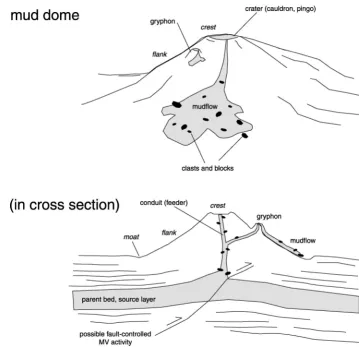
[11] The following abbreviations will be used through-out: MV for mud volcano, MVs for mud volcanoes, and MVism for the process of mud volcanism in the broader sense. Given the variety of MVs, no strict classification seems useful or possible. However, two typical features are schematically shown in Figure 3 and are referred to below. The distinction between cones (domes) and pies is made on the grounds of angle of the flanks. Pies generally have⬍5⬚slopes (similar to class C mud volca-noes inShih’s [1967] classification scheme). The feeder, or conduit, is the central feature through which mud extrusion is facilitated. It may be either cylindrical, ir-regularly shaped, or a slit (i.e., a fracture, fault, etc.). The area where the central conduit crops out at the surface is called the crest, being generally the most elevated point. If the crest region shows a depression, this is referred to as thecrater. If this crater is filled with soupy mud, this feature is called a mud pool. It has also been termed atassik in pioneer MV studies (e.g., amid otherwise dense vegetation in the southeast Moluccas [Heim, 1940]). If the main conduit of the MV terminates as a crater, it may also have been termed a pingo or
source layers or mud reservoirs), and one of the prereq-uisites is the presence of a thick, undercompacted series of clays or shales (see also the beginning of section 3 and
Yassir[1987]).
[12] The deposits forming MVs are astonishingly sim-ilar all over the world, although no systematic nomen-clature exists in the literature. They generally comprise a variety of clasts and rock fragments in a clay mineral-rich matrix. The ratio of clasts to matrix covers the entire spectrum from supported deposits to virtually
clast-free homogeneous muds (the latter are often related to the final phase of an eruptive cycle, when loose wall rock along the conduit has already been removed by the ascend-ing mud [e.g.,Kopf et al., 1998]). The most common terms used for the ejectaof MVs as well as of diapirs are mud breccia or conglomerate (depending on the shape of the fragments),olistostromes/olistoliths, mud debris flow depos-its, scaly clay (here the fragments are sheared, strongly dewatered matrix material), diapiricme´lange[e.g.,Orange, 1990], or argille scaliose [e.g.,Agar et al., 1988]. A
lation of such rocks related to diapirism is given byClennell
[1992, Table 7.5a]. A useful distinction between mud vol-canism, shale diapirism, and me´langes is given byBarber et al. [1986] for Timor as well as byBarber and Brown[1988].
3. NATURE OF MUD VOLCANISM
[13] The term “sedimentary volcanism” refers to the similar geometry of many mud extrusions and igneous
volcanoes, and only very rarely are MVs connected with igneous activity [e.g., von Gumbel, 1879; White, 1955;
Chiodini et al., 1996]. More often (and this is especially true for deep-seated features), MV occurrences have the following aspects in common: (1) an origin from thick, rapidly deposited sequences of marine clays; (2) a Ter-tiary age; (3) a structural association due to tectonic shortening and/or earthquake activity; (4) sediment overpressuring and accompanying fluid emission (gas,
Figure 3. Schematic diagrams of (a) cone-shaped and (b) pie-shaped mud feature with main applicable termini; see also the glossary.
brines, gas hydrate water, or, rarely, oil); and (5) polymictic assemblages of the surrounding rock present in the ejected argillaceous matrix [e.g., Ansted, 1866;
Higgins and Saunders, 1974;Fertl, 1976;Yassir, 1987].
3.1. Sediment Mineralogy, Burial, and Overpressure [14] In order to allow a buried body of sediment to ascend, the prerequisite is density inversion. This inver-sion may either be primary, i.e., as a result of grain density contrasts in the deposits, or secondary in origin. Secondary buoyancy can be caused by lateral influx of low-density fluids, variation in sedimentary dynamics, hydrocarbon formation, diagenetic and metamorphic processes, or tectonic processes that remove material or otherwise modify the overburden stress field. In other words, if a primary density inversion exists within a stratigraphic succession, no additional driving force for diapirism is needed. Conversely, no density contrast is necessary if other processes generating buoyancy are operating (e.g., gas flux). However, the majority of the MV areas known to date have more than this gravita-tional instability operating to facilitate extrusion.
[15] As for the primary density inversion, mineralog-ical differences as a function of sediment provenance may cause density differences within a sedimentary col-umn. Minerals with low densities, like some evaporitic and clay minerals, are predestined to eventually ascend. They include gypsum, halite, and some clay minerals of the kaolinite, smectite, and vermiculite groups that all have densities lower than quartz or feldspar. In addition, these clay minerals are very common in marine environ-ments and have the capability to incorporate large vol-umes of water into their mineral structure (for quanti-tative estimates, see X-ray diffraction results byFitts and Brown [1999]). Consequently, clays are often found to have both low grain densities and low bulk densities. Hence their buoyancy relative to most other (sedimen-tary) rocks suggests that strictly, no additional driving force other than this density inversion is needed to allow ascent. On the other hand, such diapirism would be rather slow, because the density of a clay having under-gone compaction dewatering may be close to that of quartz, feldspar, or other major rock-forming minerals overlying the clay [e.g.,Deer et al., 1992]. Hence most of the mud volcanoes and all diatremes require additional driving forces to explain their origin.
[16] Sedimentation, especially in the marine environ-ment, represents the link between primary and second-ary density inversion. When sediments are deposited, a considerable amount of seawater is trapped in the inter-granular space. For clays the initial porosity may be as high as 80%. This pore volume, or porosity, is mainly a function of grain size and sedimentation rate. When settling and pore water expulsion occur simultaneously, hydrostatic pore fluid pressures are maintained through-out. If, however, rapid burial or overlying low-perme-ability layers cause slow pore fluid dissipation, pore pressures soon exceed hydrostatic, and the sediment is
overpressured or undercompacted [e.g.,Maltman, 1994]. In other words, a clay-rich sediment may preserve ab-normally high porosities for its depth. Early geophysical surveys detected numerous areas where early postdepo-sitional rise of undercompacted sediment occurred [Lancelot and Embley, 1977]. These authors related the piercement of overlying strata to the rapid burial of fluid-rich hemipelagic sequences by terrigenous sedi-mentation (i.e., turbidites). Later, numerous workers attested to elevated porosities in trench fill deposits, which then undergo rapid dewatering due to tectonic stresses when accretion takes place [e.g.,von Huene and Lee, 1982]. The effect of pore pressure transients in-creases within the accretionary wedge, where it facili-tates imbrication and shortening [von Huene and Lee,
1982]. Fluid overpressures are known to play a crucial role in faulting and have been demonstrated to reach values near lithostatic pressure in places [e.g., Hubbert and Rubey, 1959; Moore and Shipboard Party ODP Leg 156, 1995].
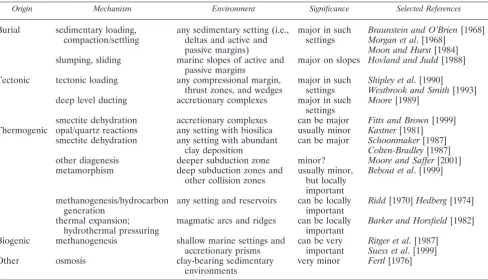
[17] The possible causes of undercompaction are nu-merous, and sediment loading is one mechanism that may apply in any setting. It can be enhanced by rapid plate motion in a subduction zone setting, because de-watering may not keep pace with the rate at which the undercompacted material is underthrust beneath the overriding plate. However, among the numerous other possibilities causing undercompaction, the most promi-nent are gas hydrate dissociation, tectonic loading, di-agenesis and mineral dehydration reactions, hydrocar-bon generation, aquathermal pressuring, and osmosis [e.g., Yassir, 1989]. Several of these processes may act simultaneously in MV areas at depth, so that distinction between them is difficult. A summary of various origins for elevated pore pressures is given in Table 2.
meters of burial. Extrapolated to the third dimension, tectonic shortening (normal as well as lateral stresses) has similar effects. In an accretionary prism in the upper subduction zone, the amount of water expelled from tectonic loading decreases exponentially with distance from the deformation front [Moore and Vrolijk, 1992, Figure 9]. For fluid overpressures, such trends have an interesting drawback. The more efficient dewatering has been in the frontal and upper part of such a deforming wedge, the more profound a change in pore pressure (of the then well-consolidated, less permeable sediment) will be if additional fluid is generated. Such fluids can be derived from early diagenetic dehydration reactions (clay mineral dehydration [e.g., Colten-Bradley, 1987], opal A/CT-quartz reactions [e.g., Kastner, 1981], and decay of organic matter), late diagenesis and low-tem-perature metamorphism (clay mineral and zeolite trans-formation [Moore and Saffer, 2001]), and dissolution of quartz [e.g., Guangzhi, 1996]. The chemical interaction of fluids and muds during burial will be further discussed in the context of fluid origin in MVism (see section 4.2). [20] As has recently been shown on accreted mud-stones elsewhere [Fitts and Brown, 1999], stresses equal to an overburden of only several hundred meters (i.e., 1.3 MPa) are sufficient to shorten the lattice distance of smectite, either due to vertical compaction or lateral tectonic shortening. In the deeper part of the subduction zone, or generally at greater burial depth, metamorphic reactions [e.g., Bebout, 1995; Moore and Saffer, 2001], hydrothermal pressuring [e.g., Barker and Horsfield,
1982], or maturation of organic matter to generate hy-drocarbons [e.g., Hedberg, 1974] may cause fluid over-pressure. However, one rarely finds a single process in operation. Most of the time, a combination of two or several processes is met. The most common cause of fluid supply, enhanced pore pressures, and lowered ef-fective viscosities are of sedimentary and tectonic origin, with smectite dehydration naturally being the dominant mineral reaction in argillaceous rocks. Deep-seated MVs are frequently triggered by hydrocarbon gases (see section 4.3), but are very rarely triggered by oil or hydrothermal liquefaction.
3.2. Geometric Constraints on the Mechanism of Eruption
[21] The study of the geometry of mud extrusions, which in pioneer studies was almost purely descriptive, has recently focused on the relationship between evolu-tion of MVs through time and the related geometry. The shape of the feature reflects to some extent the physical properties of the extruded material and points indirectly to the width of the conduit having facilitated theeruption
(see also section 3.4).
[22] Surface expressions of MVism are highly variable and depend primarily on the fluid content of extruded mud [Brown, 1990]. The “classic” mud volcano has a centralventwith mudflows building the edifice predom-inantly by the addition of material to the edifice’s outer slopes [Higgins and Saunders, 1967]. The morphology of the edifice is largely controlled by the viscosity and
Table 2. Causes for Overpressuring, Distinguished by Origin, Mechanism, and Corresponding Geological Settinga
Origin Mechanism Environment Significance Selected References
Burial sedimentary loading, slumping, sliding marine slopes of active and
passive margins
major on slopes Hovland and Judd[1988]
Tectonic tectonic loading any compressional margin, thrust zones, and wedges
major in such settings
Shipley et al. [1990]
Westbrook and Smith[1993] deep level ducting accretionary complexes major in such
settings
Moore[1989]
smectite dehydration accretionary complexes can be major Fitts and Brown[1999] Thermogenic opal/quartz reactions any setting with biosilica usually minor Kastner[1981]
smectite dehydration any setting with abundant clay deposition
can be major Schoonmaker[1987]
Colten-Bradley[1987] other diagenesis deeper subduction zone minor? Moore and Saffer[2001] metamorphism deep subduction zones and
other collision zones
any setting and reservoirs can be locally important
Ridd[1970]Hedberg[1974]
thermal expansion; hydrothermal pressuring
magmatic arcs and ridges can be locally important
Barker and Horsfield[1982]
Biogenic methanogenesis shallow marine settings and accretionary prisms
aTable is modified fromClennell[1992].
consolidation of the extruded material. Muds with low porosities (⬍50%) form mud domes or ridges, more cohesive muds with intermediate fluid content can give rise to mud volcanoes with large diameters (1–2 km) and elevation above the seafloor (⬎50 m), and high-porosity muds createmud pies[Lance et al., 1998] on the seafloor. The primary mechanism of the upward flow of plastic mud is a reaction to buoyancy forces caused by the bulk density contrast between overpressured mud at depth and the sedimentary burden of greater density. The continuous supply of pressurized pore fluids in conver-gent margin settings provides a powerful driving force for the mobilization of fluidized mud, causing the mud to rise through diatremes over several hundred meters to the seafloor.
[23] As can be seen from the regional summaries in Appendix A, as well as from Figure 4 showing two onshore MV examples, the geometry of mud extrusions is highly variable. Domes and cones range from only meters in both diameter and height [Sturz et al., 1992] to several kilometers in diameter and hundred meters in height (e.g., in Azerbaijan [Jakubov et al., 1971]). The biggest marine cones observed are the serpentinite
sea-mounts in the Mariana forearc, exceeding 30 km diam-eter and 2 km relative height [Fryer et al., 1985]. On the Barbados Ridge, diameters exceed 6 km in places, with several hundred meters relative height [Brown and West-brook, 1988].Mud ridgescan often occur along anticlinal crests in limited size, but they are reported to reach 18 km in length onshore (Timor [seeClennell, 1992]). Sea-floor features may be even larger, although sometimes evidence is lacking regarding a mud intrusive origin. Mud pools reach several hundred meters in Trinidad [Higgins and Saunders, 1974], while submarine mud pies are ⬎30 km in diameter on the Mediterranean Ridge [Kopf et al., 2001]. There is evidence from preserved fossil MVs that their geometry is not dissimilar to active features at present. Indeed, the 1200-m diameter of the Moruga Bouffe in Trinidad [Higgins and Saunders, 1974] and the 5-km diameter in British Columbia [Slack et al., 1998] are equivalent to modern counterparts. Only scant information exists concerning the geometry of the con-duit (or feeder channel) for ancient and modern exam-ples. Surface observations indicate small diameters of 15 cm (Taiwan MVs [Yassir, 1989] and Apennines MVs, Italy (A. Kopf, unpublished data, 2002)) and 30 cm (Greece [Stamatakis et al., 1987]) to 1.5 m (Burma [Pascoe, 1912]) and 2 m (Sakhalin [Gorkun and Siryk, 1968]). The first values agree well with cemented chim-neys in the ancient Verrua MV in Italy [Cavagna et al., 1998]. Also, theoretical considerations and calculations based on Stokes’ law indicate similar diameters of 2–3 m for the Mediterranean Ridge MVs [Kopf and Behrmann, 2000]. However, some controversial data are reported for the feeder geometry at depth. From seismic data, conduits of 1.5–3.5 km width have been proposed for the Black Sea area [Ivanov et al., 1996;Limonov et al., 1997]. Similarly, a width of 2 km for the bigger of the Barbados Ridge features (6 km across [Griboulard et al., 1998]), the Alboran Sea [Perez-Belzuz et al., 1997], and other areas seem common (see, e.g., sections A11 and A17). The interpretations are based on the diffuse borders of the seismically opaque mud intrusions when in contact with the structured country rock of the region. Assuming a slowly ascending diapiric intrusion without consider-able overpressure, this may well be a reasonconsider-able conclu-sion. At shallow depth and close to the surface, however, these conduits must narrow considerably; otherwise, as-tronomic flow rates would result even when small den-sity contrasts (not to mention an excess hydrostatic head) exist as a driving force (see section 3.4). In con-trast with the deep seismic example, Gorkun and Siryk
[1968] propose only 30-cm-wide conduits at depth, which then widen to 2 m surface diameter at the various gryphons of Sakhalin MVs. Despite the mechanical grounds on which the narrow width at depth is appar-ently based, no explanation is given for their inference. [24] From the compiled evidence on MV geometry, two main conclusions can be drawn. First, the size (and volume) of the individual features are mainly a function of the size of the conduit and the driving force behind
MVism in the area. Large features generally relate to wide conduits and to an efficient trigger at depth. The latter may be considerable fluid influx (in the case of diatremes) or generation (mud volcanism in a broader sense). Second, the consistency of the mud, although of minor importance for the sheer size, is suggested to be the controlling parameter for the height of the MV [Huguen, 1998]. Judging from backscatter reflectivity of abundant features on the Mediterranean Ridge, steep cones correspond with strong reflectivity (i.e., indurated material), while flat mud pies are hardly recognizable against the unconsolidated sediment apron of the wedge [Kopf et al., 2001]. As demonstrated by drilling and submersible studies, the highly reflective domes contain mud breccia with up to⬎65% lithified clasts [Flecker and Kopf, 1996] and are often covered with carbonate crust on their crest [Aloisi et al., 2000a, 2000b]. MVs com-posed of these me´lange-type deposits are generally more long lived [Robertson et al., 1996] and resist erosion even when undergoing intense deformation [Cavagna et al., 1998]. However, if no clasts are present in the extruding mud, the dimension of the conduit has some control on the geometry of the feature. Analog modeling of MVism in the laboratory has yielded flat mud pies for wide feeders and cones for narrowing feeders when using the same material [Lance et al., 1998]. The cross-sectional area of the conduit also has some important control on the extrusion dynamics (see sections 3.3 and 3.4).
3.3. Diapiric and Other Models
[25] As has been established in section 3.1, clay-bear-ing strata are often found to have low bulk densities.
Hence their buoyancy relative to most other (sedimen-tary) rocks suggests that strictly, no additional driving force other than the density inversion is needed. How-ever, in the majority of the MV areas known several secondary processes are operating simultaneously to fa-cilitate extrusion.
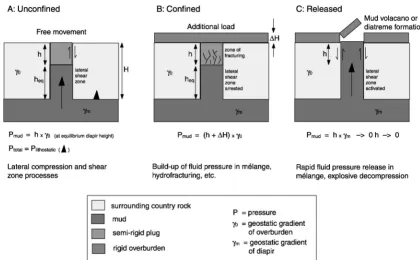
[26] Diapiric models for the origin of me´langes arose partly because of the shortcomings of tectonic models to explain their geometric and spatial occurrence. This also reflects the increasing recognition of the role played by overpressuring in their evolution (see section 3.2 and Table 2). Among the factors controlling mud extrusion, there are tectonic compression, density inversion, gas generation or fluid influx, and temperature. Their inter-relationship is immediately obvious and so is their over-lap with factors common to areas of MVism. Grain density inversion due to mineralogy (see section 3.1) as well as extensional forces are neglected in this para-graph, although they are certainly applicable in places (e.g., giant mud pies on the Mediterranean Ridge accre-tionary wedge (seeKopf et al. [2001] and section A22). [27] Regardless of whether buoyancy models or hy-draulic models are considered, density inversion is not required to drive diapiric emplacement if an excess hydrostatic pressure is present [Bishop, 1978]. Of the possibilities discussed by Bishop [1978], unconfined ex-trusion (i.e., thin or missing overburden; see Figure 5a) seems the most suitable mechanism to explain diapiric, slow emplacement, while me`langes are more likely to result from vertically constrained intrusions (i.e., thick overburden; see Figure 5b). Here pressure buildup
Figure 5. Schematic diagrams explaining the basic mechanical models of mud intrusion/extrusion under (a) confined, (b) unconfined, and (c) released pressures. Figure is modified from Bishop [1978] and Clennell
[1992].
causes hydrofracturation and fragmentation of me´lange blocks and may occur in temporarily arrested fault and shear zones as well as in diapiric dykes. The mechanism closest to diatremes and mud volcano formation is con-fined emplacement and sudden release of excess pore pressures (explosive decompression; see Figure 5c and
Clennell [1992]). Although not explicitly stated in the first case, this basic mechanical approach is in agreement with Yassir’s [1989] and Brown’s [1990] work. Fluidiza-tion added to the third model inarguably involves dia-tremes [Brown, 1990]. Depending on the amount and velocity of a fluid entraining a mud, different surface expressions follow the vigorous eruption. When flow is high, pockmarks will form, while thick sedimentary se-quences and/or lower fluid flux will cause mud mound formation [Brown, 1990]. For detailed outlines of such mechanical concepts, the reader is referred to Lorenz
[1975] orBrown[1990].
[28] Coming back to diapiric me´langes under verti-cally confined conditions, several refinements to existing models have been proposed in the various settings where mud breccias were encountered. Reed et al. [1990] hy-pothesized that massive gas hydrates may temporarily be able to act as a seal in the upper part of the MV conduit (Figure 6a). Although plausible in an environment of hydrate stability entrained by a (warmer) fluid from depth (thus destroying the hydrate cap), the physical properties of gas hydrates are only incompletely under-stood [e.g.,Stoll and Bryan, 1979;Zhang et al., 1999]. On the Mediterranean Ridge (Figure 7), where the fluids triggering MVism may be either ancient pore waters or mineral water from near the backstop, the me´lange-type breccias are believed to be the product of efficient re-moval of the fault breccia by the ascending mud [Kopf et al., 1998]. The release mechanism for excess mud pres-sures is tectonic forces, which episodically unlock the shear zone juxtaposed by the MV (Figures 5b, 6b, and 8). At a later stage, periods of extrusive activity alternate with quiescence, during which hemipelagic background sedimentation causes interbeds in the mud debris-flow deposits [Kopf et al., 1998]. Similar interfingering pat-terns may result from the combined diapiric and fault-induced mobilization of mud, as has been proposed for offshore Brunei by Van Rensbergen et al. [1999]. These authors initiate shale diapirism by faults that weaken the overburden (Figure 6c). Mud then intrudes into the overlying sedimentary rock and may or may not reach the surface. MVs that pierce the entire succession may be buried again at a later stage during their evolution, so that the overall result is an interbedding of extrusiva and surrounding rock [Van Rensbergen et al., 1999]. In the Black Sea region a hydrothermal model has been sug-gested bySlack et al. [1998] to relate tourmalinites and ore deposits to MVism. The authors argue that deep-seated faulting and continuous hydrothermal activity will create black smoker-type Fe-Mn-exhalites and sulfate precipitates, depending on oxic or anoxic bottom water conditions (Figure 6d). While conditions for
deep-seated faulting (⬎100⬚C hot brines and anoxic bottom water) are rarely met, the latter may play a minor role and has been observed rarely (see sections A20, Greece [Stamatakis et al., 1987], and A25, Taman Peninsula [Shnyukov et al., 1986]). However, the model bySlack et al. [1998, Figure 3] fails to propose a mechanism to maintain supply of such peculiar fluids through a fault zone over time (Figure 6d). Finally, numerous detailed models have been put forward by various workers to explain certain types of me´langes, be it the “colored me´lange” of the Makran [Sto¨cklin, 1990] or various me´langes in Indonesia [e.g.,Barber et al., 1986;Clennell, 1992]. The basic principles of their formation, however, closely resemble what is shown in Figure 5.
3.4. Mechanical Aspects, Mud Flux, and Episodicity/ Duration
content and of local differences in the parent bed com-position. Yassir [1989] found plasticities of Trinidad muds of ⬃30%, but of ⬍20% for the Taiwan features (with ⬍35 wt % clay; see above). The sample with the highest clay content (71.6 wt % at Digity MV in Trin-idad) had the highest plasticity (47.8 %), in agreement with maximum values of 41 wt % clay and 42 % plasticity at Napoli MV on the Mediterranean Ridge [Kopf et al., 1998].
[30] Drained and undrained shear strength has been
subject to laboratory studies of onshore and offshore MV deposits as well as of serpentinite mud mound samples. Undrained strength determined with a torsion-vane shear apparatus showed values well below 100 kPa for both marine clays and serpentinite diapiric clays [Phipps and Ballotti, 1992]. Drained shear strength tests (1.2 MPa) on muds from Mediterranean Ridge MVs using a standard geotechnical shear box had peak values of 200 –380 kPa at friction angles typical for smectite-rich material [Kopf et al., 1998]. The mud was found to
Figure 6a. Model for MV evolution proposed by Reed et al. [1990] for a seal of massive gas hydrate destroyed by deep, warm fluid, reprinted with permission from Elsevier Science.
be considerably weaker than the surrounding sediment. High-stress triaxial tests (110 MPa) on heated serpen-tinite also showed a weak response, with friction coeffi-cients as low as 0.17 [Moore et al., 1997]. Moore et al. [1997] demonstrated that increasing temperature at depths strengthens the material, especially when exceed-ing 150⬚C. Serpentinite, which extrudes locally like mud volcanoes (e.g., in the Marianas or California; see sec-tions A4 and A40), also shows velocity strengthening during shear at high rates. By performing high-stress triaxial (5–50 MPa) consolidation tests on Trinidad and
Taiwan MV muds,Yassir[1989] demonstrated the positive relationship between plasticity, tendency for dilation dur-ing shear, and pore pressure response. Also, samples hav-ing suffered anisotropic stresses (which can be reasonably inferred in many tectonic environments) showed a stronger pore pressure response (up to⬎30 MPa excess pore pres-sures [Yassir, 1989]). During undrained normal consolida-tion, excess pore fluid pressures are caused by shear stress, which is a function of volume loss during shear and is important in a mud volcanic system.
[31] Viscosity tests are more delicate to conduct, as
Figure 6c. Model for MV evolution proposed byVan Rensbergen et al. [1999] (modified from their Figure 15) for a combined diapiric and fault-induced mobilization of mud offshore of Brunei, reprinted with permission from the Geological Society (London).
Figure 6d. Model for MV evolution proposed bySlack et al. [1998] for a hydrothermal seafloor extrusion in the Black Sea. See section 3.3 for further explanation.
the majority of the rheometers are designed for small samples. Consequently, a mud slurry often cannot be measured reliably before alteration effects (e.g., dryness due to high clay contents during shear) become opera-tive. A recent series of experiments using a parallel disk rheometer yielded values of 106Pa s for MV muds at water contents of 65% (which, for those Mediterranean Ridge features, appears to be the syndepositional poros-ity [Kopf and Behrmann, 2000]) at low stress. On that accretionary prism, low viscosities are also inferred from pie-like mudflows over tens of kilometers, disregarding slope angles of⬍2⬚(comparePrior and Coleman[1978] and section A22). For comparison, salt diapirs have viscosities ranging from 1010to 1017Pa s (depending on mineralogy [seeOde´, 1968, Table 4]).
[32] If the mud viscosity results of 106Pa s are trusted, basic viscous flow can be estimated through a cylinder (i.e., a pipe- or dyke-like conduit) or a slit (e.g., a fault or shear zone) on the basis of Poiseuille’s and Stokes’ laws (see Kopf and Behrmann [2000] for theoretical back-ground). Using no other driving force than the density contrast between mud and clasts (surrounding accreted rock) from the Mediterranean Ridge, the ascent velocity ranges between 6 m yr⫺1
(10 cm conduit diameter) and
38,000 km yr⫺1
(10 m conduit diameter). The dramatic effect the diameter has on the mud discharge is obvious from these numbers, and one can imagine that an un-confined system with conduits in the kilometer range (as suggested previously; see above) are out of the question for the subsurface geometries of these conduits. Using the Mediterranean MVs for precise estimates, a rate of 60 –300 km yr⫺1
(or up to almost 1 km per day) is obtained for their actual conduit width of 2–3 m [Kopf and Behrmann, 2000]. Such values may appear very high, but are nonetheless the same order of magnitude as, for example, hydrous felsic magmas (their viscosities are pretty similar as well [see Petford et al., 1994]). Thus a certain amount of fluid added to the system would undoubtedly result in a vigorous, diatreme-type erup-tion. A high discharge is definitely helpful (if not essen-tial) to explain the presence of voluminuous blocks of exotic lithology from deep levels, as has been described for the Mediterranean, Sakhalin [Gorkun and Syrik, 1968], and many other areas (see Appendix A).
[33] The logical step to follow these first-order mud discharge rates is an estimate of how long lived MVism has been. With the mud volume and conduit geometry of an individual feature known, the duration of MV activity
is determined by modifying Poiseuille’s law and, in the case of the studied Mediterranean MVs, yields 12–58 kyr [Kopf and Behrmann, 2000]. Such periods are very short compared to the age of MV initiation (⬎1 Myr before present [Robertson and Kopf, 1998a]). On the one hand, episodicity of extrusive activity had been inferred from the intercalation of mudflow deposits with hemipelagic background sediments from drilling [Robertson and Kopf, 1998a]. On the other hand, the brevity of mud expulsion relative to the long periods of quiescence (⬃95% of the total MV life) are surprising, given that the bulk of the dome (including its base) is composed of mostly mud breccia.
[34] A minority of the Earth’s MVs are studied in sufficient detail to date their eruptive cycles. Onlapping sequences and seismic stratigraphy estimated some MVs from the Barbados Ridge to have lasted over the previ-ous 20 kyr to not more than 300 kyr, with a considerable error on that estimate and with no constraints on erup-tive and quiescent periods [Langseth et al., 1988]. Al-though dating is not always possible when interfingering of background sediments occurs, evidence is provided
for episodic changes in fluid supply. Features that were previously interpreted as diapiric bodies are now reevalu-ated as buried MVs [Van Rensbergen et al., 1999, Figure 15]. The key to such a model has been “fingers” of country rock separating individual mudflow events (Figures 6b and 6c). Examples are known from seismic profiles off Brunei [Van Rensbergen et al., 1999], transects of oil wells in Trin-idad [Higgins and Saunders, 1974, Figures 13 and 14], the Japan Margin [Ujiie, 2000], or commercial drill holes in British Columbia [Slack et al., 1998, Figure 1]. The fact that pebbly, me´lange-type rocks from the MVs are con-nected with the interfingering patterns on each occasion implies that interfingering is somehow an indication of violent, nondiapiric emplacement.
[35] One physical property so far neglected is the temperature regime in which mud extrusion takes place. In general, mud and fluid temperatures are most often found to be slightly elevated relative to the surrounding strata. On the other hand, even the presently active features rarely show an increase of ⬎1–5⬚C [e.g., Rob-ertson et al., 1996]. An exception to this rule is the Håkon Mosby MV at the Norwegian Margin [e.g., Eldholm et Figure 8. (a) Interpretation of a north-south-oriented seismic profile across the Mediterranean Ridge
accretionary wedge between Libya and Crete and (b) detail showing the mud volcano, Lich, juxtaposing an active back thrust fault some 150 km hinterlandward of the deformation front. Modified afterKopf et al. [2001] with permission from Elsevier Science.
al., 1999], where high local heat flow causes the MV fluid to rise to 13⬚C while the seafloor water column ranges from⬃1⬚to⬃3⬚C [Eldholm et al., 1999] (see section A16 for details). More spectacularly, waters from Sicilian MVs near Etna volcano show temperatures up to 46⬚C [Chiodini et al., 1996]. Other work encountered mud of 16⬚–18⬚C, which could reach 46⬚– 49⬚C when freshly ex-truded during paroxysmal phases [Cumin, 1954]. The composition of the gas and liquid phases suggests a hydrothermal reservoir at 100⬚–150⬚C, possibly related to the magmatic feeder channel of Mount Etna (see section A19). There are more examples in the regional sections (see Appendix A) (e.g., some Barbados MVs have muds of elevated temperature, while others do not), and reference is made to the sources in the litera-ture. However, despite some general similarities, most MVs are geological peculiarities in the area where they occur. As density contrasts from processes other than pure heat transfer are envisaged as the main driving forces (see above), it is not surprising that the observed temperatures of MV products are highly variable al-though features of different areas are strikingly similar.
3.5. Fluid Discharge and Related Phenomena (Biosphere and Gas Emission)
[36] Many MVs have previously been shown to emit gases or fluids during both eruptions and intervals of quiescence. In onshore environments the discharge of fluids is usually limited to gas flux of predominantly methane [e.g., Jakubov et al., 1971]. Depending on the area regarded and on local variations, methane ranges between 70 and ⬎99 vol %. The remainder is usually CO2(especially when MVism is connected with igneous volcanism) and, less often, is higher hydrocarbons, H2S [e.g.,Stamatakis et al., 1987], or noble gases [e.g., Chio-dini et al., 1996;Lavrushin et al., 1996]. However, MVs that are closely interrelated to magmatism may consist of CO2as the dominant gas phase [e.g.,Sheppard et al., 1992;Chiodini et al., 1996]. In terrestrial MVs, seeping of liquids is an uncommon phenomenon, except in some petroleum fields where higher hydrocarbons coexist in the ascending muds [e.g.,White, 1955;Humphrey, 1963]. In marine environments, both liquid fluids and gases vent in considerable amounts from MVs into the over-lying water column. Liquids may originate from deep-seated faults and allow upward migration of hydrother-mal waters [e.g., Slack et al., 1998], but may also be brines [e.g., Robertson et al., 1996], freshened waters from mineral dehydration reactions or gas hydrate dis-sociation [e.g., DeLange and Brumsack, 1998], and lat-eral meteoric water influx. The signature of the fluid often hints toward the origin of the water [e.g., Mottl, 1992; Martin et al., 1996] but also to the mobilization depth of the mud feeding the MV (see section 4).
[37] The primary control over fluid flow is the perme-ability of the material, while the absolute amount of fluid supplied is of secondary importance [Kopf et al., 1998]. In general, MV settings are characterized by a sufficient
presence of fluid, although these fluids may be trapped and do not always (and sometimes episodically) migrate to the surface. Low permeability of the crestal MV deposits, either due to high smectite contents (with permeability of those mud breccias 2 orders of magni-tude lower than other deep sea clays [Kopf et al., 1998]) or presence of massive gas hydrates [Reed et al., 1990;
Bouriak et al., 2000], at times blocks the conduit com-pletely. Such temporary inactivity allows excess pore fluid pressures to build up, which, at lithostatic pressure, results in a usually violent eruption and sudden release, as evidenced by hydrofractured clasts [Robertson and Kopf, 1998b]. This mechanism applies to diatreme-like features more than to diapiric ones, asscaly fabricsoften evolve along mud diapirs, causing an increase in perme-ability due to widened shear zones, increased effective stresses, and failure to create fluid overpressures [Moore and Byrne, 1987]. High fluid flow velocities cause long mudflows, slumping, and pockmarks [e.g., Hovland and Judd, 1988; Limonov et al., 1998]. Tectonic activity and earthquakes are other efficient mechanisms to facilitate rapid pressure release and vigorous MV activity [e.g.,
Siryk, 1962]. In 1922, MV emissions in the Caucasus caught fire, resulting in a 14-km-high flame visible over hundreds of kilometers [Kugler, 1939]. Similarly, self-igniting methane gas has been reported from the Cas-pian Sea region [Bagirov et al., 1996a, 1996b]. For quan-titative fluid discharge estimates, see section 5.
4. ORIGIN OF GASEOUS, AQUEOUS, AND SOLID PHASES
[39] In this section, the gas, liquid, and solid compo-nents of MV deposits and emissions are treated sepa-rately for two main reasons. First, their origin as well as their role in driving or triggering MVism may differ considerably (with the fluid phases often originating from much deeper levels than the position of the parent bed). Second, characterizing the various phases and their depth of mobilization (or generation) varies as a function of the gas, liquid, or solid material itself.
4.1. Origin of Mud
[40] In general, mud volcanoes are an important “tec-tonic window” into the underlying strata, because both a low-competence parent bed and some overlying rock fragments are transported to the surface. Often, the mud breccia matrix (i.e., the parent bed) in a study area can be easily related to the regional geology and to clay or shale-bearing lithologies at depth. Even in old reports, where the scientists relied on standard field geological techniques, the depth of potential parent beds to MVs could successfully be estimated or extrapolated. This is particularly true for onshore geological fieldwork. This difficulty is particularly experienced along many accre-tionary margins, where it may not be known what type of sediment enters the subduction zone (either due to inaccessible depths for sampling or to a lack of data altogether). Moreover, large parts of the accretionary wedge may comprise similar argillaceous deposits, which have been accumulated through time and whose tec-tono-stratigraphic position may be obscured by complex imbrication and deformation patterns. In such cases, marker particles indicating thermal maturation, diage-netic alteration, or dating may have to be sought to gain information about the parent bed.
[41] Mud origin is exemplified by the Mediterranean Ridge MVs, where a wealth of methods have been applied to identify the source materials and depths. With 19 Myr [Thomson et al., 1998] over which accretion takes place together with incipient deformation of the prism through time, detailed investigation of the mud breccias is required to shed light on the origin of the mud parent bed. Also, the regional diversity of mud features suggests that different processes are interacting, in turn involving different clay-rich lithologies to host mud mobilization (Figure 7). In the frontal part of the accretionary prism, small clast-free domes are found in an irregularly formed belt (the so-called “outer belt”; see Figures 7 and 8). These features are believed to be largely driven by the high strain and dewatering rates usually encoun-tered at the toe of an accretionary wedge [e.g., von Huene et al., 1998]. As availability of water from com-paction decreases exponentially with distance from the deformation front, some other mechanism has to drive MVism of the “inner belt” features (Figures 7 and 8). These domes are larger in number and are generally
bigger than near the toe, so that other processes have to account for the enormous fluid volumes involved [Kopf et al., 2001]. Their size and age (see section A22 for details) as well as their high acoustic reflectivity suggest considerable amounts of lithified clasts in the mud brec-cia, which also hinders rapid erosion. Such clasts are interpreted to represent fault breccia having been col-lected by the extruding mud mass during ascent, because many of the inner belt features juxtapose out-of-se-quence thrusts [Kopf et al., 2001] (Figure 8b). While both the outer belt and inner belt MVs occur in an area of pure compression, even larger mud features have been observed where collision is oblique (see Figure 7). These giant mud pies reach diameters of tens of kilometers and supposedly originate when small pull-apart structures in the prism give way to ascent of undercompacted mud [Kopf et al., 2001]. Like the frontal small cones, the mud pies are apparently free of lithified clasts. For details on the eastern Mediterranean MVs, see section A22.
prism [Robertson et al., 1996]. Clast petrography and provenance of components of redeposited sandstones from nine drill holes provided the basis for a reevalua-tion of the origin of the mud breccia [Robertson and Kopf, 1998b]. Despite the presence of Cretaceous micro-fossils in the matrix and in some sandstone clasts (both of which are products of reworking), the oldest clast has been related to Miocene (Burdigalian). Its position within the accretionary prism may well have been above underthrust Messinian muds, which apparently form the matrix of the mud breccias. The latter conclusion was drawn from striking similarities in the physical proper-ties, color, and composition of the mud breccia matrix and Messinian deposits in the Tyrrhenian Sea nearby [Kastens et al., 1987;Kopf et al., 1998]. A Messinian age was also inferred by the Lopatin method [e.g., Waples, 1980] for maturation of organic matter to muds from Napoli MV [Schulz et al., 1997]. In their model, organic-rich mud has hypothetically traveled along the de´colle-mentto depths of up to⬎7 km below the seafloor before ascending and being extruded as MV (without having undergone compaction). Reevaluation of such a model using the same approach based on clasts and matrix from the adjacent Milano MV is in favor of a shallower origin of both clasts and matrix [Kopf et al., 2000b]. The low vitrinite reflectance measured makes it unlikely that the solid component has experienced elevated tempera-tures or deep burial. These results are supported by another, more theoretical approach based on quasistatic modeling of the ascent of mud [Cherskiy, 1961;Kopf and Behrmann, 2000]. The latter estimate of a mud mobili-zation depth of 1.7 km is bracketed by the less well constrained 1–2 km depth of burial from the maturity data [Kopf et al., 2000b]. In conclusion, the
multidisci-plinary investigation has successfully limited the possible parent bed (or reservoir) location within the highly de-formed accreted strata of the central Mediterranean Ridge to a certain depth interval. Although not identi-fied in seismic profiles, the source of the mud may well be located at a moderate depth, possibly within slices of Messinian evaporites and older argillaceous material.
4.2. Origin of Aqueous Fluid
[43] Aqueous fluids may contribute to MV systems from various sources and by different mechanisms and reactions (Figure 2). Brown [1990] pointed out that especially in diatremes, the liquid may have been trans-ported from elsewhere at high rates prior to facilitating liquefaction of a potential MV parent bed. Such lateral or vertical fluid advection is known in many compres-sional settings, where stresses usually increase both to-ward the hinterland and with increasing burial depth [e.g.,Moore and Vrolijk, 1992]. It is beyond the scope of this summary to introduce the complex chemical inter-actions through which a fluid receives a signature diag-nostic of certain conditions. However, such characteris-tic signatures inherited at subbottom depth are powerful tracers for the environment of the fluid origin [Kastner et al., 1991]. They help to understand processes inaccessi-ble to in situ sampling, with the MVs acting as a “win-dow.”
[44] After deposition, pore fluid immediately starts to interact with the sediment particles, and numerous ele-ments are exchanged during diagenetic and early meta-morphic reactions [Guangzhi, 1996]. The two most pro-found diagenetic processes in MVs are (1) the successive dewatering of smectite (both thermally and compaction-ally [seeFitts and Brown, 1999]), which looses its
inter-Table 3. Chemistry of Muds and Mud Breccia Pore Fluids From Selected Areasa
Seawater
Hydrothermal Experiments Costa Rica Barbados Taiwan
Low T Fluid High T Fluid Fluid Fluid Fluid
Alkalinityb
2.3 3–56 - 4–35 3–24 1–245
Clb
560 450–590 - 555 200–550 13–347
Mgb
53 17–53 - 46–54 1–54 0.3–2.2
Kb
10.2 0.9–12 - - 2–11.8
-Bb
0.42 0.12 2.04 - 0.41–5.17 0.2–10
Lib
2.6⫻10⫺5
0.001–0.008 3.08 - 0.05–0.6 0.007–0.82
Brb
0.84 0.93–1.52 - - 0.5–0.84
-␦13 Cc
0 - - - ⫺60 to⫺113 (G) ⫺38 (G)
␦18 Oc
0 - - - ⫺0.3 to⫹1.5 (IW)
-␦11 Bc
39.5 25.5 2 - - 22–65
Depth of
mobilization, km
- - - ⬍⬍1 ⬍1 1–3
References Sadiq[1992] You et al. [1996] You et al. [1996] Zuleger et al. [1996]
Martin et al. [1996] Gieskes et al. [1992]
Deyhle[2000] Taira et al. [1991] Dia et al. [1995]
aFor comparison, the believed mobilization depth of the MV products is given. References concerning the data shown can be found in section 4 and in the given regional sections in Appendix A. Dash denotes data not analyzed or not reported, G denotes gas, IW denotes interstitial water, and question marks denote data not known.
layer water together with soluble volatile elements ad-sorbed to the mineral (see below and Table 3), and (2) the possible enrichment of the fluid as well as part of the solid phase in MV deposits, the first of which often causes formation of authigenic minerals (e.g., carbonate cementation, as has been found on numerous active MVs; see sections A22, A29, etc.).
[45] On a clay-rich sediment from the Nankai accre-tionary prism, off Japan (see section A38), a systematic study has been conducted to identify geochemical water-rock interaction at temperatures of 25⬚–350⬚C at con-stant pressure in an autoclave system [You et al., 1996]. With increasing temperature during the test, volatile elements such as B, N, Cs, Ba, Sb, and U were enriched in the pore fluid. Complementary depletion patterns in the sediment were observed. The first devolatilization at relatively low temperatures (still below 100⬚C) was asso-ciated with release of elements formerly adsorbed to the clay minerals. Evidence for this interpretation has been provided by, for example, isotope ratios of boron of both fluid and sediment, which show characteristic excursions toward values typical for exchangeable B [You et al., 1996]. At higher temperatures, less mobile elements (e.g., As, Li, and Be; see Table 3) are enriched in the fluid and, conversely, are removed from the sediment. Unfortunately, the laboratory equipment was limited to
T ⫽ 350⬚C, and there had still been lively exchange between the solid and fluid phase at this upper range. However, one can extrapolate trends when looking at subduction zone processes and especially at the part that escapes both metamorphism and arc or mantle recycling. High-temperature hydrothermal alteration and low-grade metamorphism/metasomatism create characteris-tic fluid isotope signatures (high ␦11B, high ␦13C, and
high ␦15N [cf. Bebout, 1995]), which may be acquired through venting conduits and deep-seated faults or when intrusion and MVism affect the forearc [Fryer and Mottl, 1992]. As a consequence, the ␦11B isotopes become more negative in the mud (see trend in Figure 9b).
[46] If the in vitro results by You et al. [1996] are compared to MV samples taken from several prominent convergent margins (such as Barbados, Costa Rica, Tai-wan, Trinidad, the Mediterranean Ridge, and the Mari-ana forearc), a major discrepancy becomes obvious (Fig-ure 9). While the fluid enrichment patterns with increasing temperature measured by You et al. [1996] match those from MVs triggered by deep-seated fluids [e.g., Deyhle and Kopf, 2001], MV muds are also en-riched in volatiles when compared to marine sediments. For example, muds from Caucasian MVs have been dem-onstrated to have up to 80 mM B [Deyhle, 2000], which is about 8⫻higher than regular marine clays [Ishikawa and Nakamura, 1993]. Given that these muds experienced sub-duction and incorporation into the Caucasian orogenic wedge, this is unexpected, because the clay stones should have undergone desorption. Elevated B, Ba, Sr, and Li contents have been interpreted as secondary enrichment, probably because clay dehydration was partly reversed dur-ing liquefaction and mud mobilization. Other examples of enriched muds include the Mediterranean Ridge MVs [Deyhle and Kopf, 2001], Trinidad [Dia et al., 1999], and the serpentine domes in the Marianas [Mottl, 1992]. In addi-tion, the muds of these MVs are enriched in the same elements. Guangzhi [1996] also showed that many muds are enriched in light rare Earth elements (REEs) and are depleted in heavy REEs after diagenesis, with the major fraction bound by the clay-size particles. This observation leads to the conclusion that the hydrothermal experiments
Trinidad Mediterranean Ridge Caucasus Håkon Mosby Marianas
Fluid Fluid Mud Fluid Mud Fluid Fluid
5–68 1–90 - 1–189 - 2.9–20.6 0.3–63
20–385 61–5300 - 3–145 - 82–561 310–560
0.5–6.2 0.6–500 - 1.2–12.3 - 2.5–54.3 0.1–50
0.2–2.2 0.3–94 - 0.12–3.3 - 2.8–14.1 5.9–15.2
0.3–12 1.7–9.7 7.9–18.5 1.85–84.7 13–50 1.85–3.9
0.01–0.71 0.01–0.23 - 0.06–0.67 - - 0.01–0.14
⬍0.01–1.74 - - - - -
-- - ⫺8 to 0 ⫺10 to⫹11 (G) ⫺20 to⫹13 (G) -
-1.6–7.5 - ⫺1 to⫹2.5 - - ⫺0.15 to⫹4.6
-- 25–40 ⫺3 to⫹7 22–40 ⫺8 to⫹13 -
-1–4 (plus meteoric)
⬎5??? 1–2 3–10 (plus mantle gas) 2–4 ??? ???(⬎⬎150⬚C)
Dia et al. [1999] Deyhle[2000] Deyhle[2000] Deyhle[2000] Deyhle[2000] Ginsburg et al. [1999]
Mottl[1992]
Emeis et al. [1996] Lagunova[1976]
in a “closed system” only partly (i.e., for the fluid com-ponent) resemble natural processes. However, despite these shortcomings, the fluid enrichment can be used to tie in the source depths of MV fluids.
[47] Among the major subduction margins a system-atic increase in deformation is seen from the frontal part of accretionary prisms (Nankai, Barbados, and Costa Rica), over the central and backstop domains of such
Figure 9. (a) Boron content versus proposed depth of mud and fluid mobilization based on regional geology and B data from the literature; (b) ␦11B versus proposed depth of mud and fluid mobilization based on regional geology and B data from the literature. Note that the numbers behind the sampling localities correspond to those in Figure 1 and Appendix A. Symbols in the plots represent mean average, while bars show the range of results. The underlying shading trends are fluid data approximated from the hydrothermal experiments byYou et al. [1996]; the starting point is 25⬚C and the graph terminates at 300⬚C, which would also
wedges (Taiwan, Barbados, and Mediterranean Ridge) and the deep forearc (Marianas), to the orogenic wedges (Great Caucasus; see Figure 10b). In general, a weak but systematic pattern in the altered fluid chemistry in the different MV areas along such margins with respect to the estimated source depth is inferred (Table 3). First, a basic trend of enrichment of the fluid phase in various elements with increasing burial and temperature exists. This includes some of the abovementioned elements, like Ba, Na, K, B, Sr, Cs, I, As, Rb, or Sb, which are usually enriched in mature MV waters [Dia et al., 1995, 1999; Deyhle, 2000]. These basic trends may be blurred by dilution effects owing to mineral dehydration reac-tions, influx of gas hydrate cage water, or meteoric water from elsewhere. Regardless of the latter disturbances of the MV system, volatile elements seem to be more concentrated in fluids mobilized from considerable depth. For instance, maximum boron contents in accre-tionary prisms are low seaward or near the deformation front, increase in the central and landward prism [Deyhle and Kopf, 2001], and may be up to 20⫻ higher than seawater when expelled from a highly deformed oro-genic wedge, like the Great Caucasus [Lagunova, 1976]. This quasisystematic behavior is illustrated in Figure 9 and is shown for various elements in Table 3.
[48] The B enrichment is accompanied by preferential release of adsorbed (i.e., exchangeable)11B, resulting in isotope ratios as low as ⫺3‰(Mediterranean Ridge mud breccia) and even lower in Caucasian muds (⫺8‰ [seeDeyhle, 2000]). Similar trends are reported for other collisional margins (e.g., Barbados or Nankai accretion-ary complexes [You et al., 1993]) and for a variety of elements and isotope systems (e.g., C, O, and He in Caucasian MVs [Lavrushin et al., 1996]). In addition, it has been demonstrated that enrichment of fluids in volatile elements is regularly accompanied by strongly enriched muds [Deyhle, 2000]. For B, Li, Cs, As, and Rb, MVs represent important sinks in collisional environ-ments and hence play an important role in geochemical cycling. Despite regional effects (like mobilization of gas hydrate waters, mineral waters, or brines), MV fluids as well as their authigenic phases are heavily mineralized. This applies to MVs on accretionary complexes com-pared with the surrounding accumulated strata [e.g.,
Deyhle, 2000] and to serpentinite MVs relative to upper mantle composition [e.g., Mottl, 1992], as well as to onshore MVs in fault zones when compared to their adjacent country rock [e.g., Deyhle, 2000]. As a conse-quence, mud volcanism has to be envisaged as an im-portant back flux mechanism of waters and solubles from the lithosphere to the hydrosphere (and atmo-sphere).
4.3. Origin of Gas
[49] In the majority of MVism areas, liquid and gas-eous fluids do not originate from the same source or depth. Also, despite thermocatalytic methane being the most abundant gas phase involved in MVism, there are
other areas where shallow methane from dominantly biogenic processes is involved in mud extrusion. There are many such regions known on Earth [e.g.,Heggland, 1997; Wallmann et al., 1997; Croker and O’Loughlin, 1998], where shallow gas is a trigger, but is not the driving force of mud extrusion. The Mediterranean Ridge MVs may serve once again as an example to illustrate this point. De Lange and Brumsack [1998] as well as Aloisi et al. [2000a, 2000b] proposed from pro-nounced pore fluid “freshening” (i.e., decrease in dis-solved ions and, specifically, low chlorinity) in the up-permost pore fluid profiles that biogenic methane had been released from gas hydrate processes, and they conclusively made gas hydrate dissociation a driving force for MVism. If the authors are correct about the hydrate having caused low chlorinity, such hydrates would be stable only at depths not exceeding a few tens of meters. Consequently, the overwhelming evidence for a deep mud source in many MV provinces (see section 4.1) is in conflict with shallow gas being a major driving force for extrusion. Such shallow gas more likely assists the final stages of mud ascent and extrusion [Kopf et al., 1998].


![Figure 4.Examples of onshore mud volcanoes: (a) smallonshore mud volcano, Jeroco, at Sabah, Malaysia [from Clen-nell, 1992]; (b) burning methane seeping out of a small MV inTaiwan (photograph is courtesy of Kevin Brown).](https://thumb-ap.123doks.com/thumbv2/123dok/1745077.1580624/9.596.50.290.65.399/examples-volcanoes-smallonshore-malaysia-seeping-intaiwan-photograph-courtesy.webp)
![Figure 6a.Model for MV evolution proposed by Reed et al. [1990] for a seal of massive gas hydratedestroyed by deep, warm fluid, reprinted with permission from Elsevier Science.](https://thumb-ap.123doks.com/thumbv2/123dok/1745077.1580624/12.596.143.431.318.525/figure-evolution-proposed-hydratedestroyed-reprinted-permission-elsevier-science.webp)
![Figure 6b.Model for MV evolution proposed by Kopf et al. [1998] for a violent eruption with numerousdebris-flow events in the Mediterranean, reprinted with permission from Springer-Verlag.](https://thumb-ap.123doks.com/thumbv2/123dok/1745077.1580624/13.596.114.495.66.557/evolution-proposed-eruption-numerousdebris-mediterranean-reprinted-permission-springer.webp)
![Figure 6c.Model for MV evolution proposed by Van Rensbergen et al. [1999] (modified from their Figure15) for a combined diapiric and fault-induced mobilization of mud offshore of Brunei, reprinted withpermission from the Geological Society (London).](https://thumb-ap.123doks.com/thumbv2/123dok/1745077.1580624/14.596.123.475.472.719/evolution-rensbergen-modied-diapiric-mobilization-reprinted-withpermission-geological.webp)
