JOURNAL
A STUDY OF OVEREXTENSION AND UNDEREXTENSION OF TWO
YEAR-OLD CHILDREN IN AL-QODIRI SONGO
ISLAMIC BOARDING SCHOOL OF GRESIK
By
A. FAIZIN
UNIVERSITAS GRESIK
FAKULTAS SASTRA
ABSTRACT
Faizin, A. 2012 : A Study Of Overextension And Underextension Of Two Year-Old Children In Al Qodiri Songo Islamic Boarding School of Gresik. Faculty of Letters, English Department, University of Gresik.
Key Words : Underextension, Overextension
A child language always develops rapidly, especially his or her acquisition of words and word meaning. Language acquisition is very similar to the process children use in acquiring first and second languages. It requires meaningful interaction in the target language--natural communication--in which speakers are concerned not with the form of their utterances but with the messages they are conveying and understanding. Error correction and explicit teaching of rules are not relevant to language acquisition
These three phenomenons are experienced by the subject and they all occured in the subject‟s utterances. In addition, Anglin‟s theory of conceptual categories stated that the extensional error phenomenon happened because the referent shared the visual, functional, and the auditory features. In this study, the writer found the words that undergo the overextension phenomenon based on the visual features.
This study is done within the scope of language acquisition especially on the first language acquisition. The writer only uses one Indonesian children as the subject of this case study. This study also focused only on the child‟s utterances. The classification of the child‟s utterances was based only on the extensional error phenomenon including overextension, underextension.
INTRODUCTION
Background of Study
Language acquisition is very similar to the process children use in acquiring first and second languages. It requires meaningful
interaction in the target language--natural communication--in which speakers are
concerned not with the form of their utterances but with the messages they are conveying and understanding. Error correction
and explicit teaching of rules are not relevant to language acquisition (Brown and Hanlon,
1970; Brown, Cazden, and Bellugi, 1973), but caretakers and native speakers can modify their utterances addressed to acquirers to help
them understand, and these modifications are thought to help the acquisition process (Snow
and Ferguson, 1977). Conscious language
learning, on the other hand, is thought to be helped a great deal by error correction and the
presentation of explicit rules (Krashen and Seliger, 1975). Error correction it is
maintained, helps the learner come to the
correct mental representation of the linguistic generalization. Whether such feedback has
this effect to a significant degree remains an open question (Fanselow, 1977; Long, 1977). No invariant order of learning is claimed,
although syllabi implicitly claim that learners proceed from simple to complex, a sequence
that may not be identical to the acquisition sequence. A Child usually deals with many fields of study in acquiring language, for
instance, phonology, morphology, syntax, pragmatics, semantics, and lexicology.
Lexicology it self comes from the word “lexicon” which means word which have
meaning (Carrol, 1994). A child language always develops rapidly, especially his or her acquisition of words and word meaning.
According to Dardjowidjojo.(2000), llexicon is a language component with its very
controversial acquisition becausse almost in all lexion aspects. There is no universality for lexicon acquisition. As a result, the word
different from a child to another ( Dardjowidjojo,2000). In other words, there is
considerable individual variation in patterns of early vocabulary growth. In addition, young children typically acquire their first words
about nine to twelve month of age. By the time that they are two or two and a half years
old, they may have acquired up to 500 word or more ( Fletcher & Mac Whinney, 1995). Furthermore, Nelson (1973) found that the
average age at which the children had acquired ten words was 15 months (with a
range of 13-19 month),the average age at which the children had acquired fifty words
was 20 months (with a range of 14-24 month), and the average vocabulary size at 24 months of age was hundred and eighty six words
(range 28-436 words).
However, during the period of early
lexical acquition, children usually experience the extensional error phenomenon. Such as underextension, overextension, overlap, and
mismatch. Underextension happens if children
use a referential word in a range of different situation to refer to only a subset of the full
range of objects. In addition overextension is a phenomenon when children use a refential word to refer not only to all of the subjects,
but also to refer to some further inappropriate subject. Also, a word is overextended to refer
in appropriate referents but is only used to refer to some and not all of the appropriate adult referents.
Through the result of the study, the writer wants to show about the
overextension and underextension phenomenon in a two years old children
in acquiring their first language. The writer also hopes that the result of the study can add more knowledge about the
extensional error phenomenon of children in Indonesian language. Beside
, the writer also wants to give more attention in the process of early lexical development of a two years children in
the finding of this research will contribute something to other students
especially for those who are doing linguistics research and take language
acquisition as their topic of research.
Scope and Limitation
This study is done within the scope
of language acquisition especially on the first language acquisition. The writer only uses one children as the subject of
this case study. This study also focused only on the child‟s utterances. The
classification of the child‟s utterances
was based only on the extensional error phenomenon including overextension
and underextension. These three extensional error phenomenon are used in analyzing the child‟s utterance in
order to see the process of early lexical development of a two year old children
in Al Qodiri Songo Islamic boarding School in acquiring a two year old
children in acquiring their first language.
REVIEW OF RELATED
LITERATURE
This chapter is devided into two. The first is the theories and the second is related
studies. The theory of this chapter will be mostly about language acquisition. They are
stages of language development of a child, extensional error phenomenon, and also the
conceptual categories of children‟s
overextension. In addition,
Review to Related Theory
The writer uses the theory of language development of a child, the extensional error phenomenon, and the perceptual categories
as the main theories.
Stages of language Development of a
Child.
In addition to language development,
are pre language stages, the one-word or holophrasctic stages, the word-stages,
telegraphic speech, and the acquisition process (morphology, syntax, and semantic).
The first stages, pre language stages,
are simply called „ cooing‟ and babbling.
The period from about three months until
ten months old is usually characteized by three stages of sound production in the infant‟s developing repetoire. The first
recognizable sounds are describe as coonging, with velar consonant such as (k)
and (g) usually present, as well as high vowels such as (i) and (u). By six months, the child is usually able to sit up and can
produce a number of different vowel and consonants such as fricatives and nasals.
The sound production at this stage is described as babbling and may contain
syllable type sound such as mu and da. In the last stage of sound production as children begin to pull themselves into
standing position about the tenth and
eleventh month, they are capable of using their vocallization to express emotion and
emphasis. Which is characterized by lot of “sound play” and attempted imitation.
According to Fletcher & Mac Whinney
(1995), there are four types of extensional error phenomenon which are often
experienced by young children. They are underextension, overextension, overlap and
mismatch.
Underextension
it happens because the children use a
referential word in a range of different situation to refer to only a subset of the full
range or object, actio, states, and properties which are properly labeled with that word in the adult language. Children also use
underextensions, in which they use a word in a more restrictive way than adult usage.
his parent‟s badroom, he would crawl to his
mother‟s closet and play with her shoes. If
other shoes were between Quentin and the closet, he would crawl around them to get his mother‟s shoes. Similarly, his father‟s
shoes did not count. Reich found that Quentin‟s notion of shoes gradually
expanded to coincide wiyh adult usage. Example :
The word „bottle‟ is only limited on the
plastic baby bottle only
The word „cut‟ is used only for the action of
cutting, but only when performed with a knife.
The word „mouse‟ is used for only one
particular mickey mouse only.
Overextension
Sometimes, the children include too
many items in their word classes, it is a phenomenon referred to as overextension, Examples are when children refer to all
four-legged animals as dogs or all round
objects as moon. Typically, these error occur when the chid identities one attribute of a
complex stimulus with the name and then applies the name to another object with the same attribute. Rescorla (1980) has studied children‟s overextensions and found that
some, like the example above, are based on
perceptual similarities between the objects. Others are based on other kinds of similiarity, such as functional (a child reerring to a shirt stuck on a person‟s head
as hat), constextual (calling a crib blanket a
nap), and effective (referring to a forbiden object as hot). It happens because the
chidren use referential word to refer not to all of the subjects, action, states, or properties which are properly labeled with
that word in the adult language, but also to refer to some further inappropriate subjects,
states, actions, or properties as well.
The word „dog‟ is used for „dog‟
The word „kick‟ is used wheen the children
are pushing own stomach againts a mirror,
pushing own chest against a sink, making aball roll by bumping it with the front wheel of a kiddicar, etc.
The word „tick-tock‟ is used for clocks both
analog and digital watches.
METHODOLOGY
This research took the data from two year old children. The boy one name is
Muhammad David and the girl one is Nur Aliyah. The writer usually call them David
and Lia. David was boy born in village of Gresik city on October 2009. Lia was girl born in Gresik city on Juli 2009, David used
to spend his day with his mother as housewife. They lived in islamic boarding
school of Al Qodiri of Gresik. His father always go to working everyday in the morning. Beside his mother, David also is
accompanied by Sofie. Sofie is his brother
he is fourteen year old. The language that used his mother and Sofie in islamic
boarding school. They sometimes used java language as a original language in the village. but they are using indonesian
language if they are speaking with David. The mother wants to learn him indonesia
words. considering that David is childhood the mother would not speak more in having
conversation with David.
The second subject is Lia, she is a first daughter of Mr. Arif an Mrs. Nasiati. Lia
spend her day with her mother at home. the language that is used by both Lia and her Mother at home is Indonesia. Actually, her
mother comes from village, but she did not use java language if she convers with Lia.
Morever, the data was taken in six weeks, an hour per each meeting. However, the
meeting would not be held everyday ; but three times in a week so that the writer knew about the development from week to week.
extensional phenomenon (i.e. overextension and underextension) experienced by two-
year old children.
Data Collection
The writer used to collected data generally for children including the boy and girl. The writer tries to collected the data by
taking simple notes everytime the extensional error phenomenon occured by David and Lia‟s utterences. The writer also
took note about the situation and condition of both David and Lia so that the writer can
connect the extensional error phenomenon with the context. While was taking notes of David and Lia‟s utterences the writer was
helped by their mothers. Sometimes brother of David, Sofie. Sofie shows the usual of David‟s spoken pleasure. Sofie knows
David‟s vocabularies because he and David
always together when David playing. Lia as
the subject also shows her emotion to spoke some words, her mother permitted the writer
to ask some questions and open a
conversation. Actually at the first time the writer came, played with him, and took
notes. Then, the writer realized that recording David and Lia‟s utterences was a
better way than taking notes. Hence, the
writer left the Video recorder in handphones to their mothers chance to help the writer record David and Lia‟s utterences.
Unfortunately, the result was not good enough because it is not clearly about their
voices to be listened. So the writer got nothing from the recordings. The writer
decided to come to boarding school to met David three times a week and come to Lia‟s
house two times a week. The writer always took notes whenever the extensional error phenomenon occured in David and Lia‟s
ANALYSIS AND
FINDINGS
Analyze data done after collect all of
data. Data taken generally from children that consist the boy and girl. the This chapter concerns with the data analysis of the data in
order to answer the research problem mentioned in chapter I.an Furthermore, the
description in this chapter consists of two parts. The first part is about overextension phenomenon, their referents, and further
explanation about the phenomenon related to context of situation, and the pattern. In
addition, this part is devided again into three small part which are overextension based on visual, functional, and both visual and
functional features. Then, the second part is about underextension phenomenon, their
referents, and further explanation about the phenomenon related to context of situation,
and the pattern. Again, this part is devide into two small parts which are visual and functional. Moreover, all of the
overextension and underextension, their referents, and the conceptual categories are
put in the form of tables.
Overextension
As the writer mentioned in the analysis of data, the writer analyze the data based on the phenomenon,
references, and the perceptual features that the subject of this research produced. The data which is taken in six weeks
observation by writer are presented in the formof table.
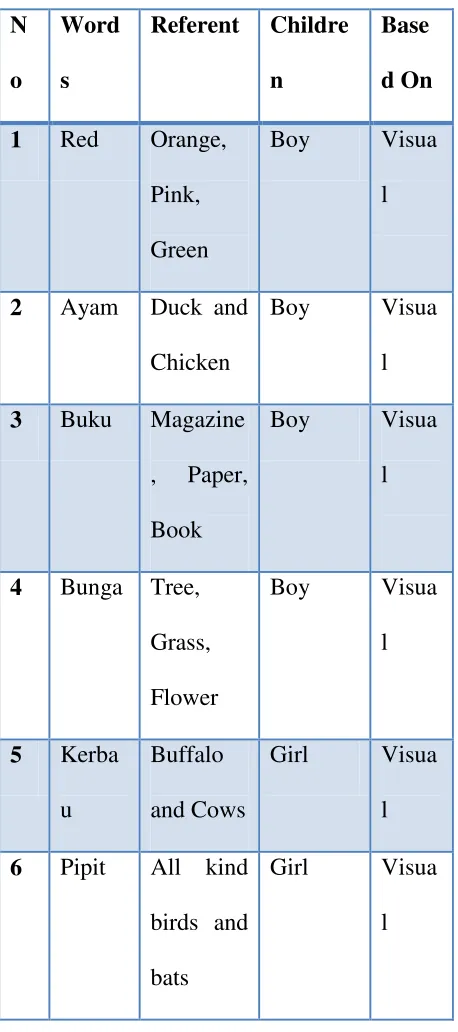
Overextension Based on Visual Features
All of the words which undergo the overextension phenomenon based on the
Table. Overextension Based on Visual
In the following, the writer described all of the further explanation about the words that
undergo the overextension phenomenon based on the visual features. The data based on the phenomenon, referent, and
the perceptual feature that the subject of this research produced. The data which is taken
in six observation by the writer are presented in the form of table.
4.2.1. Underextension Based on the Visual Features.
All of the word which undergo the
underextension phenomenon based on the visual features are put in the following table.
Table. Underextension Based on the Visual
N
In the following, the writer described all of the further explanation about the
words that undergo the underextension phenomenon based on the visual
features. The explanation is done in the same order with the table above
CONCLUSION
The conclude from the analysis of
this research, the writer believes that rhe theory of conceptual categories by Anglin and the theory of extensional error
phenomenon by Fletcher and Whinney are in accordance with the repondent‟s
utterance description.
According to Fletcher and Whinney, there four extensional errror phenomenons that
will be experienced by a child during their lexical acquisition, which are overextension,
underextension, mismatch, and overlap. However, the writer only analyses the first three phenomenons. These three
phenomenons are experienced by the subject and they all occured in the subject‟s
utterances. In addition, Anglin‟s theory of
conceptual categories stated that the extensional error phenomenon happened
because the referent shared the visual, functional, and the auditory features. In this
undergo the overextension phenomenon based on the visual features. They are
Merah’, Ayam’, Buku’, Bunga’, Kerbau’,
Pipit’, Hp’, Pisau, Bantal, Kaset, Sendok,
Pesawat, Sepatu, Truk, Lap, Radio. While t about the Underextension phenomenon based on the visual feature. They are bantal and Mobil.
Furthermore, the writerdid not find any word that became the extensional error
phenomenon only because of auditory feature. Thus, the writer conlude that the
children have already experienced the extensional error phenomenon.
BIBLIOGRAPHY
Ferguson.C.1977 “baby talks as simplified ‘
in snow and ferguson (eds) 1977.
Krashen, S and H. Seliger.1975. The essential characteristics of formal instruction „TESOL Quarterly 9 : 173 – 83 Fanselow,J.F.1977. The treatment of error in oral work. Foreign Language Annals 10 (5) 583-595.
Darjowidjojo, S. 2000. Kisah pemerolehan bahasa anak Indonesia. Jakarta : PT Grasindo.
Fletcher, P., & Mac Winney, B.1995. The handbook of child language. London: Edward Alnold,Ltd
Carrol, D.1994. Psycchology of language. California :Brooks/cole Publishing company.
Clark, H., & Clark E. 1977. Psychology langunge an introduction to psycholinguistics. USA : Harcourt Brace lovanovich, Inc.