Solitary Wave Solutions for Heat Equations
Tetyana A. BARANNYK † and Anatoly G. NIKITIN ‡
‡ Poltava State Pedagogical University, 2 Ostrogradsky Str., 36003 Poltava, Ukraine E-mail: [email protected]
‡ Institute of Mathematics of NAS of Ukraine, 3 Tereshchenkivs’ka Str., 01601 Kyiv-4, Ukraine E-mail: [email protected]
We present exact solitary wave solutions for a class of nonlinear heat equations and for coupled system of heat equations.
1
Introduction
A great number of mathematical models in thermomechanics, chemistry, biology, ecology, etc., are formulated using nonlinear heat equations. Some of these models admit exact solutions which play fundamental role for theory of the related equations and have large application values, refer, e.g., to monograph [1].
There are well-known regular approaches for searching exact solutions of partial differential equations (see, e.g., monographs [2–4]) which make it possible to find specific changes of depen-dent and independepen-dent variables (Ans¨atze) reducing equations of interest to simpler ones. Usually the possibility of such reduction is caused by the symmetry (classical Lie [2], conditional [3], Lie–B¨acklund [4], etc.) of the related equations.
In the present paper we find exact solutions for the nonlinear heat equations
ut−uxx =f(u) (1)
and for coupled systems of heat equations
ut−uxx =f(u, v),
vt−vxx =g(u, v), (2)
where f(u), f(u, v) and g(u, v) are functions of dependent variables specified in the following. To find these solutions we use the “universal” Ansatz of the following general form
u= (zx)kϕ(z) (3)
and
v= (zx)kξ(z), (4)
where the new variable zis a function of t andx.
The Ans¨atze (3), (4) appear to be very effective tools for reduction of equations (1), (2) and many others, refer e.g. to [5, 6]. In particular, they enable making a wide class of reductions caused by classical Lie symmetries and conditional symmetries as well [5].
2
Reduction of equations (1) with cubic nonlinearity
We start with equations (1) with the cubic nonlinearities, i.e.,
ut−uxx =−2u3. (5)
Exact solutions for (5) as well as for equation (1) with cubic polynomial nonlinearity were found in [7, 8] using the conditional symmetry approach. Here we find these solutions directly using Ansatz (3). The results presented in this section will be used to construct solutions for the system of heat equations (2).
Using Ansatz (3) with k= 1 we find
ut=ztxϕ+zxztϕz, ux=zxxϕ+z2xϕz,
uxx =zxxxϕ+ 3zxzxxϕz+zx3ϕzz, u3 =z3xϕ
3
. (6)
Substituting (6) into (5) and equating coefficients forϕandϕ′ we come to the following reduced equations
ztx−zxxx= 0, zt−3zxx= 0, (7)
ϕzz = 2ϕ3. (8)
Up to constant multiplier and shifts of tand x solution of (7) have the form
z= 6t+x2. (9)
Solutions of equations (8) can be expressed via Jacobi elliptic functions. In paper [5] we present an infinite set of such solutions (and solutions for equation (1) with cubic polynomial nonlinearities as well) in explicit form.
Thus the Ansatz (3) makes it possible to find exact solutions for equation (5) in the form
u= 2xϕ
6t+x2 ,
whereϕ(z) is an elliptic function satisfying (8).
In the following Section we generalize the reduction scheme (5)–(9) to find exact solutions for systems of heat equations (2).
3
Reduction and exact solutions for equations (2)
Consider a subclass of equations (2) wheref and g are homogeneous functions of order 3, i.e.,
f(λu, λv) =λ3
f(u, v), g(λu, λv) =λ3
g(u, v). (10)
To find exact solutions of these equations we need nothing but a direct generalization of the procedure described in the previous Section. Indeed, all such equations can be reduced to systems of ordinary differential equations using the Ans¨atze (3), (4) fork= 1. In analogy with (5)–(9) we obtain
u= 2xϕ
6t+x2, v= 2xξ
6t+x2,
ϕ′′=f(ϕ, ξ), ξ′′ =g(ϕ, ξ). (11)
1. Let f = 2 u3
−3u2
v+ 2uv2
, g= 0. Then equations (11) admit the following particular solutions: ϕ= 1−tanh(z),ξ= 1. Using them we come to the following solutions for the related equations (2)
u= 2x
1−tanh
x2+ 6t
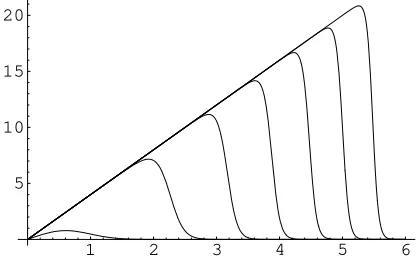
, v= 2x. (12)
For any finite interval x0 < x < x1 solutions (12) are bounded. Moreover, the patternu has
a solitary wave sharp. The plot of functionu (12) is given in Fig. 1.
1 2 3 4 5 6
2. Consider now the system (2) with nonlinearities of the following general form
f = ε The Ansatz (4) reduces (2), (13) to the following system of ordinary equations
ϕ′′=ε
whose solutions forε=−1 andε= 1, are expressed via trigonometric and hyperbolic functions respectively. Thus for ε=−1 we come to the following exact solutions for (2), (13)
u= 2µx
If ε= 1 then the related solutions can be found in the form
u= 2µx
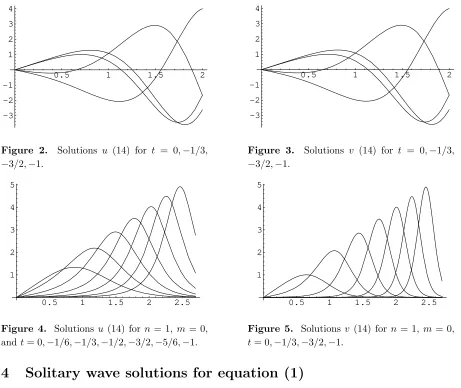
n+m >0 formulae (15) present solitary waves. We notice that solutions (15) are not of plane wave type and their amplitudes decrease if tgoes from −t0 to 0 (t0 >0). The
plots of these solutions forn= 1, m= 0 are given in Figs. 4 and 5.
Like in the case of solutions (12), whentruns from t=−1 tot= 0, our solitary waves move from the point x = 2.3 to x ≈ 0.7 and their amplitudes decrease. When variable t becomes positive and grows the amplitudes tend to zero.
0.5 1 1.5 2
-3 -2 -1 1 2 3 4
Figure 2. Solutions u (14) for t = 0,−1/3,
−3/2,−1.
0.5 1 1.5 2
-3 -2 -1 1 2 3 4
Figure 3. Solutions v (14) for t = 0,−1/3,
−3/2,−1.
0.5 1 1.5 2 2.5
1 2 3 4 5
Figure 4. Solutionsu(14) for n= 1, m= 0, andt= 0,−1/6,−1/3,−1/2,−3/2,−5/6,−1.
0.5 1 1.5 2 2.5
1 2 3 4 5
Figure 5. Solutionsv (14) for n= 1,m = 0,
t= 0,−1/3,−3/2,−1.
4
Solitary wave solutions for equation (1)
Let us return to equation (1) and choose the nonlinearityf(u) in the form
f(u) =−n+ 1 n−1u
n+λ
1u+λ2u n+ 1
2 +λ3u 3−n
2 +λ4u2−n, (16)
wheren is an arbitrary parameter.
Reaction-diffusion equations of the general form (1), (16) can be effectively reduced using Ansatz (3) [5]. Choosingϕ=z−k,k= 2
n−1 we transform (1), (16) to the form
z
zxzxx−zxzxxx−(k−1)zxx2 −λ4z2−λ3zxz
=z2x(zx−(2k+ 1)zxx+λ1z+λ2zx). (17)
Equation (17) is homogeneous in dependent variable and is more convenient for searching for exact solutions than the initial equation (1), (16).
Let us search for solutions of (17) in the form z(t, x) = U(ξ) where ξ = µt+x and µ is an arbitrary (nonzero) constant. Then we come to the following ordinary differential equation forU
U[U′(µU′′−U′′′−λ3U)−λ4U2−(k−1)(U′′)2]
= (U′)2[(µ+λ2)U′+λ1U −(2k+ 1)U′′], (18)
whereU′ = dU dξ.
Using the idea of Fan [9] we express U in the form
whereν0, ν1, . . . are constants andϕ satisfies the equation of the following general form
ϕ′=εc0+c1ϕ+c2ϕ2+· · ·. (20)
In order (19) to be compatible with (18) we have to equate separately the terms which include odd and even powers of the square root given by (20). As a result we obtain
U′(µU U′′−λ3U2
U′ we come to the Riccati equation
Y′−λ2
U, whose general solutions are
Y =
whereC is the integration constant.
Solutions (23), (24) and (25) are compatible with (22) provided
µ=−λ2, λ1 =−k
we can rewrite the related equation (1), (16) as follows:
uτ −uyy =
The corresponding solutions for equation (26) have the following form
whereν <0 and b= (n−1)−ν
2 ,
u= (ν)n−11 tan b y−√σ
2t
+C
2
n−1
, (29)
whereν >0 and b= (n−1)ν 2, and
u= 2n−1
(n−1) y− √σ
2τ +C
12
−n
(30)
ifν = 0. For 2
n−2 >1 formula (27) presents solitary wave solutions propagating with the velocity
σ √ 2.
In the casen= 2 we come to the bell-shaped solitary wave. If 2
n−2 < −1 then equation (26) again admits solitary wave solutions which are given by
relation (28). In contrast with (14) they are bell-shaped plane waves.
5
Discussion
We present a collection of solitary wave solutions for nonlinear heat equations. All these solutions are obtained using the Ansatz (3), (4).
It is possible to show that all reductions used in the present paper are caused by the con-ditional symmetry of the related equations (1), (2). Instead of investigation of concon-ditional symmetries we prefer the direct use of the universal Anz¨atse which seams to be the easiest way to find equations admitting exact solutions of the desired solitary wave type.
Nevertheless the very existence of extended classes of exact solutions for systems of heat equations shows that the problem of classification of conditional symmetries for these systems is quite interesting. We plane to consider this problem elsewhere.
[1] Samarski˘ı A.A., Galaktionov V.A., Kurdyumov S.P. and Mikhailov A.P., Peaking modes in problems for quasilinear parabolic equations, Moscow, Nauka, 1987 (in Russian).
[2] Olver P.J., Application of Lie groups to differential equations, New York, Springer, 1986.
[3] Fushchych W.I., Shtelen W.I. and Serov M.I., Symmetry analysis and exact solutions of nonlinear equations of mathematical physics, Kyiv, Naukova Dumka, 1989 (in Russian); Kluwer Publishers, 1993 (in English). [4] Anderson R.L. and Ibragimov N.H., Lie–B¨acklund transformations in application, Philadelphia, SIAM, 1979.
[5] Nikitin A.G. and Barannyk T.A., Solitary wave and other solutions for nonlinear heat equations, math-ph/0303004.
[6] Barannyk A.F. and Yuryk I.I., Construction of exact solutions of diffusion equation, Contribution in these Proceedings.
[7] Fushchych W.I. and Serov M.I., Conditional invariance and reduction of the nonlinear heat equation,Dokl. Akad. Nauk Ukr. SSR, Ser. A, 1990, N 7, 24–27 (in Russian).
[8] Clarkson P.A. and Mansfeld E.L., Symmetry reduction and exact solutions of a class of nonlinear heat equations,Physica D, 1994, V.70, 250–288.
[9] Fan E., Multiple travelling wave solutions of nonlinear evolution equations using a unified algebraic method,