• Tidak ada hasil yang ditemukan

Arctic Oil Spill Brief Final02

N/A
N/A
Protected

Academic year: 2017

Membagikan "Arctic Oil Spill Brief Final02"

Copied!
8
0
0

Teks penuh

(1)

REPORT IN BRIEF

REPORT IN BRIEF

NATIONAL ACADEMY OF ENGINEERINGNATIONAL ACADEMY OF SCIENCES

INSTITUTE OF MEDICINE NATIONAL RESEARCH COUNCIL

Responding to Oil Spills in the U.S. Arctic Marine Environment

THE RISK OF A SERIOUS OIL SPILL IN THE ARCTIC is escalating due to potential increases in shipping trafic and oil and gas activities. To provide an effective response effort in challenging Arctic condi-tions—and minimize impacts on people and sensitive ecosystems—a full range of proven oil spill response technologies is needed. This report assesses the current state of science and engineering regarding oil spill response in Arctic waters and identiies key oil spill research priorities, critical data and monitoring needs, mitigation strategies, and important operational and logistical issues.

OCEAN STUDIES BOARD, POLAR RESEARCH BOARD, MARINE BOARD

APRIL 2014

Mounting an effec-tive oil spill response is dificult in any environ-ment, but oil spills in Arctic waters present an even greater challenge. In addition to extreme cold, rough seas, and darkness in winter months, Arctic oil spill responders must also contend with the region’s remote location (Figure 1) and a lack of infrastructure, equipment, and trained personnel. Many aspects of the Arctic environment— including the presence of

sea ice—can inluence the behavior of spilled oil, yet most spill response technologies were designed for and tested in temperate regions.

The potential for an oil spill in the U.S. Arctic is growing. The warming climate is causing sea ice to retreat, opening up Arctic waters to increased activity from tankers using newly accessible shipping routes, ishing leets following the northward migra-tion of ish stocks, and cruise ships ferrying tourists interested in exploring the Arctic wilderness. At the same time, interest has grown in developing the Arctic’s rich natural resources—there are an esti-mated 30 billion barrels of technically recoverable, undiscovered oil in the U.S. Arctic alone (see Figure 2 for exploration wells in federal waters and production wells in state waters).

This report evaluates the current state of science and engineering regarding oil spill response and

environmental assessment of Arctic marine waters, with emphasis on U.S. waters in the Bering Strait and Chukchi and Beaufort Seas. The report identiies envi-ronmental conditions and monitoring priorities in the Arctic, recommends opportunities to advance oil spill research, identiies strategies to enhance infrastructure and logistics, and discusses mitigation, recovery, and restoration options.

UNDERSTANDING THE ARCTIC MARINE ENVIRONMENT

(2)

Shoreline mapping and high-quality bathymetry provide context for the marine environment as well as impor-tant logistical information during response. From a biological perspec-tive, understanding the Arctic food web helps identify key species for monitoring in the instance of an oil spill. Key areas for study include:

Ocean Processes and Characteristics

Ocean circulation, currents, and storm surges are important factors in supporting safe marine operations in the Arctic and for understanding the pathways and fate of spilled oil.

Marine Weather and Sea Ice Processes

Key weather parameters in the Beaufort and Chukchi region, including air and water temperature, winds, visibility, and hours of daylight, can impact oil spill response and marine and air operations. Factors such as ice thickness, concentration, and extent are critical to understanding how oil might behave in, on, and under the ice and to understanding operating limits for marine and air activities (see Figure 1).

Coastal Processes and Characteristics

High-quality bathymetry, nautical charting, and shoreline mapping data are needed for managing marine trafic and coordinating oil spill response. Regular updating will be necessary due to the rapid pace of coastal erosion.

Ecology and Community Structure Knowledge of the current ecosystem structure is crucial to understanding how it may change over time or be impacted in the event of an oil spill. This data informs the identiication of key species and areas of biological signiicance—for example, important foraging areas; places for spawning, nesting, or calving; or migration routes—that can then be used to prioritize research and monitoring.

Box 1. Benchmark Data Needs

Baseline data are critical to assess changes over time. The Arctic environment is changing, due to seasonal and year-to-year vari-ability, but also due to the impacts of climate change. That means historical data do not provide reliable baselines to assess current environmental or ecosystem states. Instead, benchmark data (refer-ence points measured over time) would provide a more reliable monitoring approach to assess ecosystem status. Critical types of benchmark data for oil spill response in the Arctic include:

Populations of ish, birds, and marine mammals and their distribu-tion over space and time;

The use of marine organisms, including ish, birds, and mammals for subsistence and for cultural reasons;

Identiication and monitoring of areas of biological signiicance (e.g., important foraging areas; places for spawning, nesting, or calving; or migration routes);

Rates of change for key species (e.g., to the number of births and deaths or to life span);

Sensitivity of key Arctic species to hydrocarbons;

High-resolution coastal topography and shelf bathymetry to monitor rapidly eroding coastlines;

Measurements of sea ice cover, thickness, and distribution. Additional research and development needs include meteorological models to more accurately forecast the extent and thickness of sea ice and assimilation of traditional knowledge of sea state and ice behavior into forecasting models.

(3)

An Observing Network is Needed to Support Oil Spill Response Early warning is the key to rapid inter-vention in the event of an oil spill. Efforts are underway to monitor physical processes and ecosystem components in the Arctic—including, for example, community-based programs that collect information on ocean conditions or environmental parameters such as walrus populations, and data gathering projects organized by the Alaska Ocean Observing System and the Arctic Observing

Network. However, each of these projects has different datasets, contributors, and potential or current users.

A community-based, multiuse observing network in the Arctic that provides a wide range of long-term, accessible benchmark information could bring these disparate data together in an integrated fashion to support oil spill response and other activities. Such a system could be a collaboration of federal, state, and tribal governments, non-govern-mental organizations, and maritime and oil and gas industries and could be organized by the Interagency Arctic Research Policy Committee (IARPC).

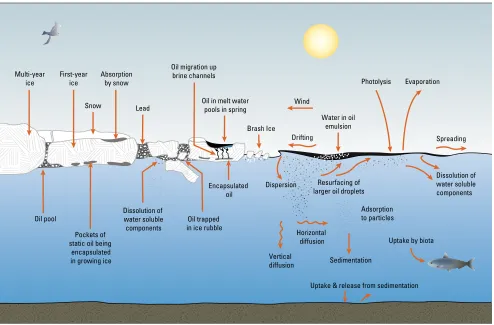
OIL SPILL RESPONSE RESEARCH Laboratory experiments, ield research, and practical experience gained from responding to past oil spills have built a strong body of knowledge on the proper-ties of spilled oil and response techniques. However, much of this work has been done for temperate regions, and additional research is needed to make informed deci-sions about the most effective response strategies for Arctic spills. Processes that control oil behavior and weathering, in both open water and ice, are shown in Figure 5.

There is also a need to validate current and emerging oil spill response technolo-gies in Arctic environmental conditions on operational scales. Carefully planned and controlled ield releases of oil in the U.S. Arctic would improve the understanding of oil behavior in the Bering Strait and Beaufort and Chukchi Seas and allow for the evaluation of new response strate-gies speciic to the region. Scientiic ield Figure 3.  Gathering benchmark data on populations of Arctic ish, birds, 

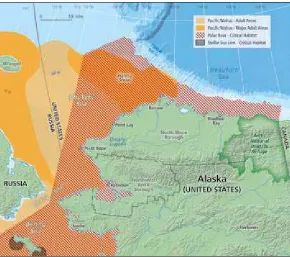
and marine mammals is crucial to understanding how these populations  might change in the event of an oil spill. This map shows the distribution of  walrus, sea lions, and polar bears in U.S. Arctic waters. Data from the Arctic  Environmental Response Management Application (ERMA), attributed to  Audubon Alaska (Paciic walrus), NOAA (Stellar sea lion), and U.S. Fish and  Wildlife Service (Polar bear).

Understanding the Arctic Marine Environment

RECOMMENDATIONS

¾ High-resolution satellite and airborne imagery needs to be coupled with up-to-date high-resolution digital elevation models and updated regularly to capture the dynamic, rapidly changing U.S. Arctic coastline. Nearshore bathymetry and topography should be collected at a scale appropriate for accurate modeling of coastline vulnerability and storm surge sensitivity. Short- and long-term Arctic nautical charting and shoreline mapping that have been identiied in NOAA and USGS plans should be adequately resourced, so that mapping eforts can be initiated, continued, and completed in timescales relevant to anticipated changes. To be efective, Arctic mapping priorities should continue to be developed in consultation with stakeholders and industry and should be implemented systematically rather than through surveys of opportunity.

(4)

releases that have been conducted elsewhere in the Arctic demonstrate that such studies can be carried out without measurable harm to the environment.

The Oil Spill Toolbox

Spill response options will vary depending on the oil type and volume, the location of the spill, and environ-mental conditions. Other considerations include the proximity of the spilled oil to sensitive marine ecosys-tems, populations of marine organisms, and culturally sensitive sites. The report reviews key oil spill counter measures, which, together with the option of “no response,” make up the oil spill toolbox. Though much is known about oil behavior and response tech-nologies in ice-covered environments, there are areas where additional research is needed to make informed decisions about the most effective response strategies for different Arctic situations.

Biodegradation and Dispersants

The degradation of oil by naturally occurring microbial communities (biodegradation) is an important process controlling the weathering and removal of oil in the sea. Chemical dispersants promote biodegradation by

breaking up oil droplets in the water column. There has been considerable debate over the effectiveness of chemical dispersants at low seawater temperatures, but recent studies show dispersants can be effective on non-emulsiied oil at freezing temperatures if viscosity (resistance to low) does not increase signiicantly.

Using subsea injection to apply dispersants directly to the blowout site could disperse oil at higher rates and with higher eficiency than aerial dispersant application. This technique can be employed even in darkness, extreme temperatures, strong winds, rough seas, or the presence of ice. However, more work needs to be done on the effectiveness, systems design, and short- and long-term impacts of subsea dispersant delivery.

Research and Development Needs

Determining and verifying biodegradation rates for hydrocarbons in offshore environments

Evaluating the toxicity of dispersants and dispersed oil on key Arctic marine species

Improving methods for dispersant application for oil spills in ice

Figure 5.  Environmental processes that affect oil behavior and weathering in open water and in ice. Modiied from Daling  et al., 1990, A. Allen.

Absorption by snow Multi-year

ice

First-year ice

Oil pool Oil trapped in ice rubble

Oil in melt water pools in spring

Wind Drifting

Dispersion

Sedimentation

Uptake & release from sedimentation Uptake by biota

Dissolution of water soluble components Resurfacing of

larger oil droplets Adsorption to particles

Vertical diffusion

Horizontal diffusion

Water in oil emulsion

Evaporation Photolysis

Spreading Oil migration up

brine channels

Brash Ice

Encapsulated oil

Pockets of static oil being

encapsulated in growing ice

Dissolution of water soluble components

(5)

In Situ Burning

In situ burning—the controlled burning of oil at the site of the spill—can signiicantly reduce the amount of oil on the water and minimize the adverse effect of the oil on the environment. With relatively fresh oil that is wind-herded against an ice edge or collects in melt pools in the spring, in-situ burning can remove a majority of spilled oil. However, in open ocean condi-tions, oil can rapidly spread as thin slicks or ilms, becoming too thin to ignite.

Research and Development Needs

Mapping the usefulness of chemical herders at different spatial scales, oil types, and weathered states and in conjunction with other methods such as in situ burning

Improving ignition methods for in situ burning

Mechanical Containment and Recovery

Mechanical containment and recovery removes oil without adding chemicals to the water or creating burn residue. Small oil spills can be contained within some types of ice; however, large offshore spills can quickly spread to a thin sheen, which severely limits recovery. Oil slicks would need to be concentrated using equipment such as containment booms, vessels, and skimmers. The lack of approved disposal sites on land for contaminated water and oily waste, a lack of port facilities, and limited airlift capability make large-scale mechanical containment and recovery operations dificult in the Arctic.

Research and Development Needs

Better knowledge of the limitations of mechanical recovery in both open water and ice

Detection, Monitoring, and Modeling

Knowing the location of spilled oil is critical to

mounting an effective response. Over the past decade, several government and industry programs have evaluated rapidly developing remote sensing tech-nologies for detection and tracking—for example, sonar, synthetic aperture radar, infrared, and ground-penetrating radar. In addition, the use of unmanned aerial vehicles and autonomous underwater vehicles to detect, track, and monitor oil has grown. However, aerial observers to map oiled areas and transmit critical information to response crews will continue to be needed.

Improvements in oil spill trajectory modeling will be needed to more accurately predict the movement of spilled oil. Promising advances in modeling better account for the incorporation of oil into brine

channels and freezing into ice, although under-ice roughness still requires further attention. Investment in detection and response strategies for oil on, within, and trapped under ice is needed for contingency planning. In addition, robust operational meteoro-logical-ocean-ice and oil spill trajectory forecasting models for the U.S. Arctic would further improve oil spill response efforts.

Research and Development Needs

Improving under-ice oil detection and response strategies

Integrating remote sensing and observational tech-niques for detecting and tracking ice and oil

The Oil Spill Toolbox

RECOMMENDATIONS

¾ Pre-approval for the use of dispersants in Alaska should be based on sound science, including research on fates and efects of chemically dispersed oil in the Arctic environment, experiments using oils that are representative of those in the Arctic, toxicity tests of chemically dispersed oil at realistic concentrations and exposures, and the use of repre-sentative microbial and lower-trophic level benthic and pelagic Arctic species at appropriate tempera-tures and salinities.

¾ A comprehensive, collaborative, long-term Arctic oil spill research and development program needs to be established. he program should focus on understanding oil spill behavior in the Arctic marine environment, including the relationship between oil and sea ice formation, transport, and fate. It should include assessment of oil spill response technologies and logistics, improvements to forecasting models and associated data needs, and controlled ield releases under realistic conditions for research purposes. Industry, academic, government, non-governmental, grassroots, and international eforts should be integrated into the program, with a focus on peer review and transparency. An interagency permit approval process that will enable researchers to plan and execute deliberate releases in U.S. waters is also needed.

(6)

OPERATIONS, LOGISTICS, AND

COORDINATION FOR AN ARCTIC OIL SPILL The Oil Pollution Act of 1990 places the primary responsibility for mounting an effective oil spill response on the party who was responsible for the accident. However, federal, state, local, and tribal entities each have legal authorities to oversee, approve, and, if needed, supplement measures taken by the responsible party. A wide range of federal and state laws, as well as international treaties and agreements, weave a complicated web of duties, responsibilities, and authorities for all parties involved in a spill response.

The U.S. Coast Guard has a low level presence in the Arctic, especially during the winter. As a result, Coast Guard personnel, equipment, transportation, communication, navigation, and safety resources are not adequate for overseeing oil spill response in the Arctic. Furthermore, there is no comprehen-sive system for real-time vessel trafic monitoring or management in the Bering Strait or in the U.S. Arctic. This creates signiicant vulnerability for all Coast Guard missions, including oil spill response, and creates undue reliance on private industry and foreign national systems for monitoring. Signiicant gaps in coverage create numerous regional “blind spots,” where an early indication of elevated risks may not be apparent to oficials ashore.

International Coordination

The U.S. has long engaged its regional neighbors in Arctic spill preparedness and has bilateral agree-ments with both Canada and Russia regarding oil spill response. Formal contingency planning and exercises with Canada have enabled both the U.S. and Canada to reine procedures and legal requirements for cross-border movement of technical experts and equipment in the event of an emergency. The resolution of anticipated response problems with Russia, including

communications between command centers, coordi-nated planning, trans-boundary movement of people and equipment, and identiication of translators, needs to be accomplished in advance of an actual event.

Infrastructure

The lack of infrastructure and oil spill response equipment in the U.S. Arctic (Figure 6) is a signiicant liability in the event of a large oil spill. Building U.S. capabilities to support oil spill response will require signiicant investment in physical infrastructure and human capabilities, from communications and personnel to transportation systems and trafic moni-toring. Prepositioning response equipment throughout the Arctic would provide more immediate access to oil spill countermeasures.

Training and Organization

Local communities possess knowledge of ice condi-tions, ocean currents, and marine life in areas that could be affected by oil spills, yet there have been only modest efforts to integrate local knowledge into formal incident command-based responses.

Flexible and scalable organization is important to develop an effective Arctic oil spill response. This can be achieved through drills, case studies, simulation, and organizational learning. To build system-wide capacity, sustained long-term training and continued resource investments are required. Inclusive and trustful communications, relationship-building, and decision-making; clear accountability; and on-going assessment and improvement are also needed.

STRATEGIES FOR RESPONSE AND MITIGATION

All pre-spill strategies emphasize oil spill preven-tion above everything else. In the event of an oil spill, however, strategies for decision-making and response are critical to keep oil away from the shore and to

Coast Guard Needs

RECOMMENDATIONS

¾ As oil and gas, shipping, and tourism activities increase, the U.S. Coast Guard will need an enhanced presence and performance capacity in the Arctic, including area-speciic training, icebreaking capability, improved availability of vessels for responding to oil spills or other emergency situations, and aircrat and helicopter support facilities for the open water season and eventually year-round. Furthermore, Arctic assignments for trained and experienced personnel and tribal liaisons should be of longer duration, to take full advantage of their skills. Sustained funding will be required to increase the presence of the Coast Guard in the Arctic and to strengthen and expand their ongoing Arctic oil spill research programs.

(7)

minimize impacts on sensitive habitats, organisms, and people. No response method is completely effective or risk-free. Decision processes that evaluate options and strategies are critical to an effective response.

The Net Environmental Beneit Analysis (NEBA) process provides a framework to determine which oil spill countermeasures will be the most effective and will cause the least ecological damage, based on an analysis of environmental tradeoffs. NEBA incorporates prioritization criteria for the protection of sensitive and impor-tant ecosystem components that could be impacted by oiling, cleanup opera-tions, or residual oil—for example, marine mammals, coastal habitats, ishes, or areas of cultural signiicance. An Arctic NEBA would also include information on the transport, fate, and potential effects of the spilled oil; knowledge of operational limits, advantages, and disadvantages of each oil spill response countermeasure for the natural resources at risk; and consideration of logistical constraints Figure 6.  Lack of infrastructure and oil spill response equipment in the U.S. 

Arctic could present a signiicant liability in the event of a large oil spill. Arctic  shipping routes, the Alaska Department of Environmental Conservation’s spill  response equipment depots, and villages and towns with the capacity to land  passenger jets in Alaska are shown.

Training and Organization

RECOMMENDATIONS

¾ he U.S. Coast Guard should expand its bilateral agreement with Russia to include Arctic spill scenarios, conduct periodic exercises to establish joint responses under Arctic conditions, and build on existing bilateral agreements with Russia and Canada to develop and exercise a joint contingency plan.

¾ Infrastructure to support oil spill response should be enhanced in the North Slope and Northwest Arctic Boroughs, with marine facilities for addressing response operations. he scope, scale, and location of infrastructure needs should be determined through structured decision processes, studies, and risk assessments.

¾ he U.S. Coast Guard and Alaska Department of Environmental Conservation should undertake the development of an oil spill training program for local entities to develop trained response teams in local villages. Industry should continue to participate in local training initiatives. Local oicials and trained village response teams should be included in the coordinated decision-making and command process during a response event. Input from commu-nity experts should be actively solicited for inclusion in response planning and considered in conjunction with data derived from other sources. he Coast Guard should set this as an exercise objective in all government-led oil spill response exercises in the Arctic and should set the expectation that industry-led exercises will do the same.

(8)

and cleanup intensity. Due to the range of conditions typically encountered within an area affected by an oil spill, a combination of countermeasures, rather than a single response option, would be most likely to provide optimal protection for all environ-mental resources.

Controlling oil release and spread at the source of a spill, deterring animals from entering oiled areas, and capturing and rehabilitating oiled wildlife can help minimize the potential impact of oil spill response on wildlife, the broader ecosystem, and the food web. However, rehabilitation and release in the Arctic is complicated by remote locations, lack of response equipment, concerns over subsis-tence use of potentially oiled animals, and safety considerations when dealing with large animals like polar bears and walruses. Wildlife response plans will need to include key indicators of environmental health and prioritize response strategies. This includes a “no response” strategy, which may be preferable for some species.

Strategies for Response and Mitigation

RECOMMENDATIONS

¾ A decision process such as the Net Environmental Beneit Analysis should be used to select the response options that ofer the greatest overall reduction of adverse environmental impacts. In the Arctic, areas of cultural and subsistence importance should be among the priority ecosystem components. In light of concerns regarding detrimental efects on ecosystems, further study should focus on the impact of oil spills on Arctic food webs and dynamics at diferent trophic levels. he process should involve regulators, resource managers, health authorities, technical specialists, scientiic experts, and local experts.

¾ U.S. Fish and Wildlife Service, NOAA’s National Marine Fisheries Service, Alaska Fish and Game, co-management organizations, and local government and communities are the trustees for wildlife deterrence and rehabilitation. As appro-priate, these agencies and groups should work together to explore and improve deterrent and rehabilitation methods for wildlife. Additional research and development for improved methods could beneit from the involvement of universities, non-govern-mental organizations, and others. Priorities should be set and regularly updated by the trustees for oil spill response based on the type of wildlife threatened, the season, other factors related to a spill, and updated research and methodology.

Committee on Responding to Oil Spills in Arctic Marine Environments: Martha R. Grabowski (Chair), Le Moyne College/ Rensselaer Polytechnic Institute; homas Coolbaugh, ExxonMobil Research and Engineering; David F. Dickins, DF Dickins and Associates, LLC; Richard Glenn, Arctic Slope Regional Corporation; Kenneth Lee, Commonwealth Scientiic and Industrial Research Organisation; William (Lee) Majors, Alaska Clean Seas; Mark D. Myers, University of Alaska, Fairbanks;

Brenda L. Norcross, University of Alaska, Fairbanks; Mark Reed, SINTEF; Brian Salerno*, BIMCO; Robert Suydam, North Slope Borough; James M. Tiedje (NAS), Michigan State University; Mary-Louise Timmermans, Yale University; Peter Wadhams, Cambridge University; Deborah Glickson (Senior Program Oicer), Lauren Brown (Associate Program Oicer,

Polar Research Board), Stacee Karras (Research Associate), Heather Chiarello (Senior Program Assistant, until April 2013),

Payton Kulina (Program Assistant, from June 2013), National Research Council. *Resigned from the committee. he National Academies appointed the above committee of experts to address the speciic task requested by the U.S. Arctic Research Commission; American Petroleum Institute; U.S. Coast Guard; U.S. Department of the Interior, Bureau of Ocean Energy Management and Bureau of Safety and Environmental Enforcement; Marine Mammal Commission; National Oceanic and Atmospheric Administration; Oil Spill Recovery Institute; National Academy of Sciences. he members volunteered their time for this activity; their report is peer-reviewed and the inal product signed of by both the committee members and the National Academies. his report brief was prepared by the National Research Council based on the committee’s report.

For more information, contact the Ocean Science Board at (202) 334-2714 or visit http://dels.nas.edu/osb. Copies of Responding to Oil Spills in the U.S. Arctic Marine Environment are available from the National Academies Press, 500 Fith Street, NW, Washington, D.C. 20001; (800) 624-6242; www.nap.edu.

Permission granted to reproduce this document in its entirety with no additions or alterations. Permission for images/igures must be obtained from their original source.

Gambar

Figure 1.  Left: Alaska and the continental United States, and surrounding countries and water bodies. Right: Alaska and U.S. Arctic waters, focused on the Bering Strait, Chukchi Sea, and Beaufort Sea. Map area corresponds to the red box in the map on the left.
Figure 2.  Oil and gas planning areas in the Chukchi and Beaufort Seas. Oil and gas lease areas are shown in orange, with seismic survey areas shown in grey. Selected oil and gas wells, some in Alaskan state waters and some in federal waters, are shown as purple dots.
Figure 3.  Gathering benchmark data on populations of Arctic ish, birds, and marine mammals is crucial to understanding how these populations might change in the event of an oil spill. This map shows the distribution of walrus, sea lions, and polar bears in U.S. Arctic waters. Data from the Arctic Environmental Response Management Application (ERMA), attributed to Audubon Alaska (Paciic walrus), NOAA (Stellar sea lion), and U.S. Fish and Wildlife Service (Polar bear).
Figure 5.  Environmental processes that affect oil behavior and weathering in open water and in ice. Modiied from Daling et al., 1990, A. Allen.
+2

Referensi

Dokumen terkait

Jika dikemudian hari ditemui bahwa Data/Dokumen yang anda sampaikan tidak benar dan ada Pemalsuan, maka anda dan Badan Usaha yang anda wakili bersedia dikenakan

Dengan memperhatikan tahapan seleksi untuk Paket Pekerjaan Pengadaan Jasa Konsultansi Perencanaan Revitalisasi Gedung Kantor Badan Pusat Statistik Kabupaten Tapanuli Tengah Tahun

The results of data analysis show that the types of interpersonal meaning in the lyrics of Muse’s album Black Holes and Revelations realized in the wordings of the clause if

Berdasarkan hasil analisis, diperoleh: (1) uji spearman perangkingan metode electree dengan perangkingan metode vikor adalah signifikan sama, terbukti dengan nilai

Proposal untuk memperoleh Dana Bantuan PAUD Percontohan Kabupaten/Kota disusun oleh lembaga untuk diajukan ke Direktorat Pembinaan Anak Usia Dini melalui Dinas

bahwa dalam rangka penyelenggaraan program Pendidikan Anak Usia Dini melalui dana bantuan Penguatan Lembaga PAUD tahun 2014 menyatakan kesediaan untuk melaksanakan

Menurut Omear Hamalik (2005:172), belajar tidak cukup hanya mendengar dan melihat tetapi harus dengan melakukan aktivitas yang lain, diantaranya membaca, bertanya,

Panitia Pengadaan Pekerjaan Jasa Konstruksi Pembangunan Rumah Dinas Badan Pusat Statistik Kabupaten Asahan Tahun