Full Terms & Conditions of access and use can be found at
http://www.tandfonline.com/action/journalInformation?journalCode=vjeb20
Download by: [Universitas Maritim Raja Ali Haji] Date: 11 January 2016, At: 19:17
Journal of Education for Business
ISSN: 0883-2323 (Print) 1940-3356 (Online) Journal homepage: http://www.tandfonline.com/loi/vjeb20
The Influence of Counterfactual Thinking and
Regret on Ethical Decision Making
Kevin Celuch, Carl Saxby & Jill Oeding
To cite this article: Kevin Celuch, Carl Saxby & Jill Oeding (2015) The Influence of
Counterfactual Thinking and Regret on Ethical Decision Making, Journal of Education for Business, 90:4, 175-181, DOI: 10.1080/08832323.2015.1014455
To link to this article: http://dx.doi.org/10.1080/08832323.2015.1014455
Published online: 16 Mar 2015.
Submit your article to this journal
Article views: 194
View related articles
The Influence of Counterfactual Thinking and Regret
on Ethical Decision Making
Kevin Celuch, Carl Saxby, and Jill Oeding
University of Southern Indiana, Evansville, Indiana, USAThe authors explore the influence of counterfactual thoughts in triggering the emotions of regret and disappointment in ethical decision making. Counterfactual thinking involves examining possible outcomes to events and is often explored in what-if scenarios. Findings support that subjects were able to transfer regret (but not disappointment) associated with an actor’s unethical behavior in one scenario to another actor’s decision to make an unethical choice in a second, different scenario, with the manipulation impacting subjects’ ethical judgment and their behavioral intention (expressed tendency to act ethically). In addition, ethical judgment was found to mediate the influence of the anticipated negative emotion of regret on subjects’ intention to perform the unethical behavior of the actor portrayed in the scenario. These findings are used to offer suggestions to educators to influence student ethical decisions as well as to offer potential avenues for future research.
Keywords: counterfactual thinking, ethical decision making, regret
How can business schools positively impact students’ ethi-cal decision making? Does what we do as instructors in the classroom make any difference? These questions have been asked by more than one business school dean, professor, or instructor. Damage from ethically questionable decisions can be wide ranging and span from individuals to compa-nies as well as from industries to economies. We often see individuals who have been involved in these transactions express obviously painful regret after the fact. One cannot help wondering: if only the ethical transgressors could experience this feeling before the act, perhaps they would act differently.
Ethical decision making has been and continues to be an imperative for industries, organizations, and business edu-cation. Any number of initiatives by industries and organi-zations including various regulations and policies have been implemented with less than promising results. Given the importance of ethical decision making, educators con-tinue to develop approaches to positively impact the ethical decision making of students. The Association to Advance Collegiate Schools of Business (AACSB, 2013) noted that degree programs would typically include learning experien-ces that address ethical reasoning.
While there is virtually no disagreement with the senti-ment expressed by AACSB with respect to ethics, there is much less alignment as to how ethics can be effectively implemented in the classroom (Beggs, 2011; Roy, 2012). While experiential learning appears to be a favored approach (Beggs, 2011), demonstrable outcomes remain mixed (Lau, 2010; Waples, Antes, Murphy, Connelly, & Mumford, 2009).
A significant amount of ethical decision theory has accounted for how peoplethink. Recent research supports, the power of feeling in decisions (Connelly & Zeelenberg, 2002). The present study extended research in the area in the following ways. First, we examined the efficacy of a counterfactual experiential intervention. Counterfactual interventions involve examining possible outcomes to events explored in what-if scenarios. Counterfactual think-ing has only recently been applied to ethical decision mak-ing in the business education literature with some promising results (Celuch & Saxby, 2013). Second, we addressed the influence of counterfactual thought on emo-tions (i.e., regret and disappointment) and thereby shed light on the influence of these emotions in ethical decisions. The role of emotions in ethical behavior is not well under-stood (Baumgartner, Pieters, & Bagozzi, 2008). This type of research is consistent with approaches aimed at theory deepening (Perugini & Bagozzi, 2001). As a result, this research may offer guidance to business educators and
Correspondence should be addressed to Kevin Celuch, University of Southern Indiana, Department of Economics and Marketing, Evansville, IN 47712, USA. E-mail: [email protected]
ISSN: 0883-2323 print / 1940-3356 online DOI: 10.1080/08832323.2015.1014455
corporate trainers in developing curriculum to improve eth-ical decision making for future as well as novice business professionals.
COUNTERFACTUAL THINKING: ITS RELEVANCE TO ETHICAL DECISION MAKING
If a person questions him or herself with “If only I had (not) done (a behavior), what might have happened?” he or she is using counterfactual thinking (Kray, Galinsky, & Wong, 2006). A counterfactual mindset is activated by a context that is then carried forward and applied to another context (Gollwitzer, Heckhausen, & Steller, 1990). Kray et al. (2006) explained the process underlying counterfactual thinking as relational in nature. In this type of thinking, a situational element can be an important factor influencing counterfactual thinking, especially when potential alterna-tives tied to the element are associated with negative out-comes (Kahneman & Miller, 1986). Evidence suggests that counterfactual thinking can play an important role in influ-encing decision making and behavior (Kray et al., 2006).
The notion that counterfactual thinking can impact aspects of decision making is well supported. However, questions remain as to exactly when and how counterfac-tual thinking can impact decision making (Petrocelli, Percy, Sherman, & Tormala, 2011). In a recent study in which a counterfactual manipulation wash applied to a classroom ethical intervention, Celuch and Saxby (2013) employed scenarios in which the significant situational element was whether an employee’s immediate supervisor was hands on or hands off. In the scenarios, an employee was portrayed as choosing to behave unethically. The implications being that the hands-on supervisor condition will be logically tied to a greater likelihood of the employee getting caught and experiencing negative consequences in comparison to the employee in the hands-off condition.
An important goal of education and training curricula is to transfer learning from one context to another. In order to examine the carry-over effect of counterfactual thinking, Celuch and Saxby (2013) manipulated the situational ele-ment for one scenario, had subjects complete relevant measures for this scenario, and then exposed subjects to a second scenario. No situational elements are manipulated in the second scenario. Subjects then completed dependent variable measures for the second scenario. The counterfac-tual manipulation was found to significantly affect emo-tions for the first scenario. More importantly, the counterfactual effect transferred to the second scenario by impacting participants’ behavioral intention measured as the intention to perform the unethical behavior of the actor portrayed in the scenario. Since the second scenario did not include a manipulation, differences in subject responses to the second scenario must be attributed to the manipulated first scenario. In addition, attributions and negative
consequences helped explain both emotions and intention associated with unethical behavior. The significance of these findings relate to the participants transfer of counter-factual thinking from one ethical context to another and the explanation of the transfer effect.
While Celuch and Saxby (2013) examined the influence of a counterfactual manipulation on behavioral intention (the expressed tendency to act ethically) and certain emo-tions, they did not examine the impact on ethical judgment. We extend research in this area by examining the influence of a counterfactual manipulation (supervisor hands on or hands off) on ethical judgment in addition to behavioral intention. Justification for the addition of ethical judgment is based on its central role in a number of ethical frame-works. Hunt and Vitell (1986) and Cherry (2006) placed ethical judgment as an immediate antecedent to intention.
Counterfactual thinking should impact an individual’s self-regulatory mindset. For the scenario with the hands-on supervisor, subjects should perceive a stronger likelihood of negative consequences that the actor could have chosen to avoid. This type of thinking should prime a mindset that is then transferred to consideration of a second ethical sce-nario (Higgins, 1997). The mindset should influence subse-quent thinking about the unethical conduct in the second scenario such that the ethical judgment should be more neg-ative for subjects exposed to the hands-on condition. This mindset should also negatively influence a subject’s inten-tion to perform the unethical act (Celuch & Saxby, 2013). Consideration of consequences to behavior has been found to be an important determinant of ethical judgment and intention (cf. Celuch & Dill, 2011). Based on the foregoing discussion we formulated the following hypothesizes:
Hypothesis 1 (H1): A counterfactual manipulation (boss hands on vs. hands off) would have a negative impact on a subsequent ethical judgment.
H2: A counterfactual manipulation (boss hands on vs. hands off) would have a negative impact on a subse-quent behavioral intention.
ETHICAL JUDGMENT AS A MEDIATOR OF THE INFLUENCE OF REGRET VERSUS
DISAPPOINTMENT ON BEHAVIORAL INTENTIONS
In addition to examining the influence of a counterfactual manipulation on ethical judgment and intention, an objec-tive of this study was to explore the role of the emotions of regret and disappointment. Prior work has begun to exam-ine anticipatory emotions in ethical decision making (Celuch & Saxby, 2013). While regret and disappointment have received conceptual examination in ethical decision contexts (Rajeev & Bhattacharyya, 2007), calls for empiri-cal examination of these constructs in ethiempiri-cal decision mak-ing have only recently been made (Celuch & Saxby, 2013; Rajeev, 2012).
176 K. CELUCH ET AL.
A core idea in regret theory (Zeelengerg & Pieters, 2007) is that humans are programmed to regulate the emotion of regret. Exactly how this regulatory process works is not fully understood (Zeelenberg & Pieters, 2007). Regret has been characterized as an aversive, complex emotion that can originate from and produce higher order cognition. Accordingly, regret has been referred to as a counterfactual emotion (Zeelenberg et al., 1998). Regret focuses an actor’s attention on his or her role in the occurrence of a negative outcome and how one could change or prevent the outcome. Personal agency or a sense of responsibility for negative out-comes associated with a decision differentiates regret from disappointment (Zeelenberg & Pieters, 2007).
When an individual is responsible for the negative out-come he or she is likely to experience regret. In contrast, a negative outcome associated with a decision in which an individual does not have a sense of responsibility is likely to spawn disappointment. Thus, the negative affect of dis-appointment does not have the sense of personal agency attached to it. Note that while both emotions consist of neg-ative affect they have the potential to impact individuals differently in that underlying the negative affect associated with regret is the sense that I’m responsible for the negative feeling. This difference helps explain why regret and disap-pointment have different effects on some consumer behav-iors (Zeelenberg & Pieters, 2007) and may explain why these emotions may work differently in ethical decision making. It is not that an individual feels bad that is the point of influence for ethical decision making, but that the indi-vidual feels bad and believes that he or she is the cause of the bad feeling.
While powerful emotions such as regret and disap-pointment have long been a focus of decision research, ethical research has only recently started to systemati-cally consider the role of emotions (Connelly, Helton-Fauth, & Mumford, 2004). Exactly how might these two related negative emotions work differently to impact ethical decision making?
The Hunt and Vitell (1986) model conceives of potential consequences and their evaluation as important antecedents to ethical judgments. Cherry (2006) and Celuch and Dill (2010) found support for the influence of consequences on ethical judgment and, in turn, also found a strong relationship between ethical judgment and intention. We now extend thinking to explain the proposed differential effects for the hands-off versus hands-on manipulation to the role of regret and disap-pointment in ethical decision making.
Personal agency, a sense of responsibility for nega-tive outcomes tied to a decision, is a key distinction between regret and disappointment. For subjects in the hands-on supervisor manipulation, the perception of actor responsibility should be strongly related to poten-tial negative consequences given that the actor is
choosing to behave unethically even with a greater like-lihood of getting caught as compared to subjects in the hands-off scenario. Thus, under this scenario the percep-tion of the regret that the actor would feel with the unethical decision should be more likely to be carried forward from the manipulated first scenario to consider-ation of the nonmanipulated second scenario.
Based on the conceptual work of Rajeev and Bhatta-charyya (2007), given regret’s increased saliency under the hands-on manipulation, regret will be more likely to affect reasoning associated with the ethical judgment of the actor’s behavior in the second scenario. Further, based on regret’s connection to personal agency, an individual under the influence of this emotion should be more motivated to reduce its occurrence in the future (Rajeev & Bhattacharyya, 2007). Regret associated with the hands-on manipulation from the first scenario should work through the ethical judgment of the actor’s behav-ior to influence the intention to perform the unethical behavior in the second scenario. In contrast, under the hands-off boss manipulation, the ethical judgment should not mediate the relationship between actor regret and intention to perform the unethical behavior. This would be so given the weakened saliency of regret as negative consequences are not as likely since the actor is not likely to get caught.
Based on conceptual and behavioral distinctions between regret and disappointment (Zeelenberg et al., 1998), we do not expect disappointment to be implicated in ethical decision making to the extent of regret. While nega-tive affect associated with potential undesired consequen-ces is a powerful human experience, we believe it is the connection to personal agency that should underlie an emotion’s influence in ethical reasoning. Thus we formu-lated the following hypothesizes:
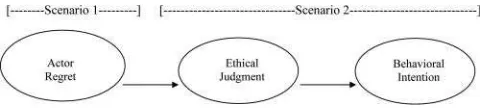
H3: A counterfactual manipulation (boss hands on vs. hands off) would impact whether the negative influ-ence of perceived actor regret on subsequent behav-ioral intention is mediated by ethical judgment (please refer to Figure 1).
H4: A counterfactual manipulation (boss hands on vs. hands off) would not impact whether the negative influence of perceived actor disappointment on subse-quent behavioral intention is mediated by ethical judgment.
FIGURE 1. Hypothesized mediated relationships for the hands-on condition.
METHOD
Procedure and Subjects
Following the counterfactual methodology employed by Celuch and Saxby (2013), the study manipulated a salient situational element (hands-off or hands-on immediate supervisor) for two ethical scenarios in business contexts. Participants were randomly provided a study packet that consisted of, in order, one of two scenarios which included the manipulation, followed by related measures, followed by one of two scenarios that did not include a manipulation, and a second set of measures that were different from those assessed after the first scenario. Participants were provided instructions for completing measures and were then instructed to proceed in order through the packet reading each scenario and then completing associated measures.
Two phases of data collection were utilized. Seventy-four undergraduate students enrolled in a variety of classes (sections and instructors) ranging from introductory level (e.g., introduction to economics) to advanced level (e.g., marketing strategy) at a medium-size Midwestern univer-sity participated in the first phase of this study in order to testH1andH2.Within two weeks, an additional 188 under-graduate students enrolled in various classes at the same university were added to the first sample in order to testH3 and H4. This approach was used so as not to over inflate the sample size for mean difference tests forH1andH2as small differences will be significant for larger sample sizes. Therefore, differences that are statistically significant may not be practically relevant. At the same time, it is important to have a larger sample to insure the stability of regression equations for testingH3andH4. The average age of partici-pants in the overall sample was 21 years old with a range of 18–47 years. About half of the participants were male. Upperclassmen comprised approximately 60% of participants.
Scenarios
Ethical scenarios have been used extensively in business ethics research (cf. Buchan, 2005). Scenarios combine the benefits of standardization and mundane realism (Cherry, 2006). Scenarios used in this study were from scenarios employed in prior research (Celuch & Saxby, 2013).
In the first scenario, a male actor is considering copying a copyrighted software package. In the second scenario, a female actor is considering charging some personal items to her company credit card. In each scenario the actors opt for the unethical action. As previously noted, the manipula-tion of the situamanipula-tional element involves whether the actor’s immediate supervisor is very hands off or very hands on, as this could impact the chance of getting caught. Approxi-mately one half of the participants received the copying software scenario first as the manipulation followed by the
charging personal items (nonmanipulated) scenario. The other participants received the charging personal items sce-nario first as the manipulation followed by the copying soft-ware (nonmanipulated) scenario.
Measures
Measures following the first, manipulated scenario included manipulation checks and the perception of actor regret and disappointment. Themanipulation check measureconsisted of one, seven-point item that assessed a subject’s perception of the likelihood that the actor will experience negative consequences for their behavior (adapted from Petrocelli et al., 2011). Perception of actor regret and disappointment consisted of two, seven-point items that assessed the per-ception that the actor in response to likely outcomes of their decision will feel a good deal of the relevant emotion (adapted from Zeelenberg et al., 1998).
Measures following the second scenario included the ethical judgment and intention to perform the actor’s behavior. Ethical judgment consisted of three 7-point items that assessed the perception of the actor’s behavior as just, fair, and morally acceptable (Cronbach’saD.93; adapted from Celuch & Dill, 2011). Behavioral intention consisted of one, seven-point item that assessed the likelihood that a participant would perform the same unethical behavior as the actor in the second scenario (adapted from Celuch & Dill, 2011). To help ease concerns associated with demand characteristics and common method variance multiple filler items were included with the measures of interest.
RESULTS
The purpose of this study is to test for the effects of the counterfactual manipulation on (a) ethical judgment, (b) behavioral intention, (c) the mediational effect of ethical judgment on the perception of actor regret-behavioral inten-tion relainten-tionship, and (d) the mediainten-tional effect of ethical judgment on the perception of actor disappointment-behav-ioral intention relationship.
Manipulation Check and Mean Differences
As previously noted, each participant received two scenar-ios with approximately half receiving the copying software scenario manipulation followed by the charging personal items and the remaining participants receiving the charging personal items scenario manipulation followed by the copy-ing software scenario. Tests for scenario effects found no differences between the orderings of scenarios for manipu-lation check and dependent measures. Therefore, the hands-on and hands-off groups were combined across sce-nario orderings for purposes of subsequent analyses.
178 K. CELUCH ET AL.
In order to perform the manipulation check and testH1
andH2, an independent samplest-test was performed with the hands-on and hands-off conditions as the grouping vari-able and the manipulation check, ethical judgment, and behavioral intention for the unethical act variables. As expected, the hands-on manipulation (M D 5.9) was per-ceived to be significantly more likely to result in negative consequences than the hands-off manipulation (MD3.9,t
(74)D6.02,p<.01.
H1 predicted a condition effect for ethical judgment associated with the actor’s unethical behavior (for scenario 2) such that it should be more negative for the hands-on condition as compared to the hands-off condition. As antici-pated, ethical judgment was significantly more negative for participants in the hands-on condition (M D1.9) than for participants in the hands-off condition (M D 2.5, t(74) D 2.13,p<.05.
H2predicted a condition effect for behavioral intention associated with the actor’s unethical behavior (for scenario 2) such that it should be weaker for the hands-on condition as compared to the hands-off condition. As expected, inten-tion was significantly weaker for participants in the hands-on chands-onditihands-on (M D1.6) than for participants in the hands-off condition (MD3.0,t(74)D3.67,p<.01.
Regression Analyses Testing for Mediation
In order to check the manipulation an independent sample t-test was performed on the combined sample with the manipulation as the grouping variable. As expected, the hands-on manipulation (MD6.0) was perceived to be sig-nificantly more likely to result in negative consequences than the hands-off manipulation (M D4.2,t(260)D9.97,
p<.01.
In order to test whether the ethical judgment mediates the effect of perceived actor regret (or disappointment) on behavioral intention, three conditions must be met: (a) per-ceived actor emotion should have a significant effect on the ethical judgment; (b) perceived actor emotion should also have a significant effect on behavioral intention; and (c) as compared to condition 2, the impact of perceived actor emotion on behavioral intention should significantly dimin-ish when ethical judgment is included in a regression model with perceived actor emotion as a predictor of behavioral intention (Baron & Kenny, 1986).
The previous procedure was utilized for participants in the hands-on and hands-off conditions and results are reported in Table 1. With respect to regret for the hands-on condition, perceived actor regret had a significant negative effect on ethical judgment, thus, condition 1 is met. Further, actor regret had a significant negative effect on behavioral intention, thus, condition 2 was met. Finally, the influence of actor regret was diminished (i.e., decreasing from signifi-cant to nonsignifisignifi-cant) when ethical judgment is included in the regression model predicting behavioral intention),
meeting condition 3. Note that with respect to the hands-off condition, mediation is not indicated, as regret was not found to be significantly related to the ethical judgment.
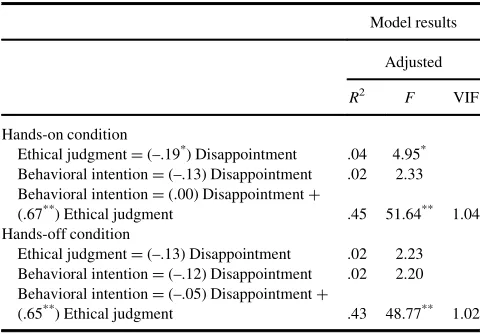
Again, with respect to disappointment, the same proce-dure was utilized and results are reported in Table 2. Note that mediation is not indicated as disappointment was not found to be significantly related to behavioral intention (in the hands-on condition) and was not found to be signifi-cantly related to the ethical judgment or behavioral inten-tion (in the hands-off condiinten-tion).
As a precaution, variance inflation factors (VIFs) were examined to assess the effects of collinearity among the independent variables for step 3 models. The VIFs are well below the recommended 10.0 cutoff (Hair, Black, Babin,
TABLE 1
Hierarchical Regression Analyses Testing the Mediating Effect of Ethical Judgment on Regret and Behavioral Intention
Model results
Adjusted
R2 F VIF
Hands-on condition
Ethical judgmentD(–.27**) Regret .07 9.91** Behavioral intentionD(–.18*) Regret .03 4.42* Behavioral intentionD(.00) RegretC
(.67**) Ethical judgment .45 51.64** 1.08 Hands-off condition
Ethical judgmentD(–.11) Regret .01 1.74 Behavioral intentionD(–.19*) Regret .04 5.10*
Behavioral intentionD(–.12) RegretC
(.64**) Ethical judgment .44 51.29** 1.01
Note: Standardized coefficients appear in parentheses.
*
p<.05.**p<.01.
TABLE 2
Hierarchical Regression Analyses Testing the Mediating Effect of Ethical Judgment on Disappointment and Behavioral Intention
Model results
Adjusted
R2 F VIF
Hands-on condition
Ethical judgmentD(–.19*) Disappointment .04 4.95* Behavioral intentionD(–.13) Disappointment .02 2.33 Behavioral intentionD(.00) DisappointmentC
(.67**) Ethical judgment .45 51.64** 1.04 Hands-off condition
Ethical judgmentD(–.13) Disappointment .02 2.23 Behavioral intentionD(–.12) Disappointment .02 2.20 Behavioral intentionD(–.05) DisappointmentC
(.65**) Ethical judgment .43 48.77** 1.02
Note: Standardized coefficients appear in parentheses.
*
p<.05.**p<.01.
Anderson, & Tatham, 2006), thus, collinearity between construct measures was not indicated.
DISCUSSION
This study extends ethical decision-making research by examining the efficacy of a counterfactual educational intervention. In the present research some of the subjects considered whether the actor in the first scenario with a hands-on boss would be likely to regret an unethical deci-sion. These subjects were then able to transfer the regret to another actor’s decision to behave unethically in a completely different scenario. As such, a counterfactual mindset from the first scenario was likely carried forward to influence the decision in the second scenario with regret having a significant effect on ethical judgment and inten-tion. The counterfactual manipulation impacting behavioral intention supports prior research (Celuch & Saxby, 2013) while the counterfactual influence on ethical judgment is a unique contribution.
Second, we explored the influence of counterfactual thought on emotions, thereby deepening the understanding of the role these emotions play in ethical decision making. We extended theory by examining mediation for new ethi-cal constructs (the emotions of regret and disappointment) as well as existing ethical constructs (ethical judgment and intention). The anticipated negative emotion of regret had a significant effect on subjects’ judgment and behavioral intention associated with an unethical decision when the boss was hands on. This finding implies that regret can play a role in influencing an individual to do the right thing in ethical decisions. The influence of regret on intention appears to work through the ethical judgment.
In contrast to regret, disappointment was not found to be significantly related to the behavioral intention under either hands-on or hands-off conditions. Nor was ethical judgment found to mediate the effect of the perception of actor disap-pointment on behavioral intention. This difference may be explained through the personal agency or sense of personal responsibility that is associated with regret (Zeelenberg & Pieters, 2007). Prior conceptual work had conjectured that regret and disappointment would work differently in ethical decision contexts (Rajeev & Bhattacharyya, 2007) but this conceptual thinking had not been tested empirically. The present study showed that anticipated negative regret can affect ethical decision making.
It appears that emotions are not a threat to rational deci-sions. In fact, forming appropriate (ethical) decisions may depend on the influence of anticipated regret. The present finding counters the common notion that emotions disrupt rational thinking (Pfister & B€ohm, 2008). Given the finding of regret working through ethical judgment to influence intention, emotion may be an important aid in some cases to ethical appraisal, which supports the conceptual
framework of Pfister and B€ohm (2008) as well as the think-ing of Zeelenberg and Pieters (2007).
The manipulation of a counterfactual mindset may be able to be leveraged in a classroom setting. An instructor could use the same (or appropriately adapted) scenarios as used in this research to drive counterfactual thinking to pro-duce a mindset relating to satisfying duties and avoiding negative outcomes (Higgins, 1997).
After working students through an extended consider-ation of the negative consequences that could result from an actor’s unethical decision, an instructor could then ask, “Do you think the actor would regret his/her decision if these consequences transpire?” An instructor could also emphasize the personal agency that is inherent in regret. For example, “Who is to blame in this situation? Who made the choice to behave unethically, particularly if they were aware of the boss being ‘hands on’?”
With reinforcement, the use of anticipated regret can help educators enhance ethical decision making on the part of students. Educators will provide students with the cogni-tive architecture to more carefully consider ethical dilem-mas by employing: (a) the counterfactual approach by asking what-if questions and (b) the personal agency aspects of regret.
Business educators could also emphasize the emotion of regret in discussing ethics. Regret has been found to be experienced as the most intense of all negative emotions (Saffrey & Roese, 2006). Because regret is such an intense emotion, getting students to think about past decisions that they have regretted making could pay dividends in terms of future ethical decision making. This helps explain the pres-ent finding related to the significance of anticipated regret in that people tend to want to avoid future occurrences of the emotion.
Several avenues are available to expand ethical research related to anticipatory regret. For example, future research-ers should explore how other emotions involving presearch-ersonal agency or a sense of responsibility such as guilt and shame compare to regret’s effect on ethical decision making. In addition, research may be expanded to determine whether an individual assigns different weights to future potential outcomes when making ethical decisions. Further, the role of peers as influencers (i.e., normative influence) would be interesting to integrate with regret research. Would norma-tive influence mitigate the influence of regret in ethical decision contexts?
As with any study employing cross-sectional, single-time period data collection, results should be interpreted with these limitations in mind. The student sample, although appropriate for inferences regarding students and perhaps entry-level employees, raises issues with respect to generalizing these results to other populations. Future research could also explore additional contexts for scenarios beyond those employed in this study. We employed a three-item measure of ethical judgment and
180 K. CELUCH ET AL.
three single-item measures of regret, disappointment, and behavioral intention. Although the key outcome var-iables ethical judgment and intention are theoretically relevant, it is acknowledged that we do not assess actual decisions or behavior. Of course, assessing actual uneth-ical behavior raises alternative issues in the conduct of research in the area.
In conclusion, a counterfactual manipulation impacted not only ethical judgment and intention but also influenced the emotion of regret working through the ethical judgment to impact intention. These findings hold implications for business educators’ efforts to advance understanding as well as develop practical interventions to positively impact students’ ethical decision making.
REFERENCES
Association to Advance Collegiate Schools of Business (AACSB). (2013).
Business accreditation standards. Retrieved from http://www.aacsb. edu/accreditation/business/standards/
Baron, R. M., & Kenny, D. A. (1986). The moderator-mediator variable distinction in social psychological research: Conceptual, strategic, and statistical considerations.Journal of Personality and Social Psychology,
51, 1173–1182.
Baumgartner, H., Pieters, R., & Bagozzi, R. P. (2008). Future-oriented emotions: Conceptualization and behavioral effects.European Journal of Social Psychology,38, 685–696.
Beggs, J. M. (2011). Seamless integration of ethics.Marketing Education Review,21, 49–55.
Celuch, K., & Dill, A. (2011). An extension of the Theory of Reasoned Action in ethical decision contexts: The role of normative influence and ethical judgment.Journal of Education for Business,86, 201–207. Celuch, K., & Saxby, C. (2013). Counterfactual thinking and ethical
deci-sion making: A new approach to an old problem for marketing educa-tion.Journal of Marketing Education,35, 155–167.
Cherry, J. (2006). The impact of normative influence and locus of control on ethical judgments and intentions: A cross cultural comparison. Jour-nal of Business Ethics,69, 113–132.
Connelly, S., Helton-Fauth, W., & Mumford, M. D. (2004). A managerial in-basket study of the impact of trait emotions on ethical choice.Journal of Business Ethics,51, 245–267.
Connelly, T., & Zeelenberg, M. (2002). Regret in decision making. Cur-rent Directions in Psychological Science,11, 212–216.
Gollwitzer, P. M., Heckhausen, H., & Steller, B. (1990). Deliberative vs. implemental mind-sets: Cognitive tuning toward congruous thoughts and information. Journal of Personality and Social Psychology, 59, 1119–1127.
Hair, J. F. Jr., Black, W. C., Babin, B. J., Anderson, R. E., & Tatham, R. L. (2006).Multivariate data analysis(6th ed.). Upper Saddle River, NJ: Pearson/Prentice Hall.
Higgins, E. T. (1997). Beyond pleasure and pain.American Psychologist,
52, 1280–1285.
Hunt, S. D, & Vitell, S. (1986). General theory of marketing ethics. Jour-nal of Macromarketing,6, 5–16.
Kahneman, D., & Miller, D. T. (1986). Norm theory: Comparing reality to its alternatives.Psychological Review,93, 136–153.
Kray, L., Galinsky, A. D., & Wong, E. M. (2006). Thinking within the box: The relational processing style elicited by counterfactual mind-sets.
Journal of Personality and Social Psychology,91, 33–48.
Lau, C. L. L. (2010). A step forward: Ethics education matters!Journal of Business Ethics,92, 565–584.
Perugini, M., & Bagozzi, R. P. (2001). The role of desires and anticipated emotions in goal-directed behaviours: Broadening and deepening the theory of planned behavior.British Journal of Social Psychology,40, 79–98.
Petrocelli, J. V., Percy, E. J., Sherman, S. J., & Tormala, Z. L. (2011). Counterfactual potency.Journal of Personality and Social Psychology,
100, 30–46.
Pfister, H., & B€ohm, G. (2008). The multiplicity of emotions: A framework of emotional functions of decision making. Judgment and Decision Making,3, 5–7.
Rajeev, P. N. (2012). Correlates of ethical intentions: A critical review of empirical literature and suggestions for future research.Journal of Inter-national Business Ethics,5, 3–17.
Rajeev, P. N., & Bhattacharya, B. (2007). Regret and disappointment: A conceptualization of their role in ethical decision-making.Vikalpa,32
(4), 75–85.
Roy, D. P. (2012). Promoting active learning of ethical issues in marketing communications using debates.Marketing Education Review,22, 73–76. Saffery, C., & Roese, N. J. (2006). Praise for regret: Positive evaluative
metaperceptions of negative affective experience.Unpublished manuscript. Waples, E. P., Antes, A. L., Murphy, S. T., Connelly, S., & Mumford, M. D. (2009). A meta-analytic investigation of business ethics instruction.
Journal of Business Ethics,87, 133–151.
Zeelenberg, M., & Pieters, R. (2007). A theory of regret regulation 1.0.
Journal of Consumer Psychology,17, 3–18.
Zeelenberg, M., van Dijk, W. W., van der Pligt, J., Manstead, A. S. R., van Empelen, P., & Reinderman, D. (1998). Emotional reactions to the out-comes of decisions: The role of counterfactual thought in the experience of regret and disappointment. Organizational Behavior and Human Decision Processes,75, 117–141.