AIII.3 - 1
ARTICLES BALI INTERNATIONAL SEMINAR ON SCIENCE AND TECHNOLOGY 2011
“ Strengthening Basic Sciences and Technology for IndustrialSustainability“
July 22-23 , 2011, BALI-INDONESIA
ISBN 978 – 979-98623-1-0
MECHANISM AND REACTION KINETICS OF PEAT DECOMPOSITION
Edi Mulyadi1) , Nurul Wiji Triana
Departement of chemical engineering, Faculty of Industry Technology
UPN “Veteran” East Java Indonesia (60295)
email : [email protected];
ABSTRACT
Peat is one of natural resources with high potential which have not been used well, either as land or peat itself as a material. This researc aims to determine steps of rate limiting reaction, with data of kinetic parameter based on unreacted core model, and empirical model for correlation of conversion, reaction time at various variables. Research on peat pyrolisis was done batch wise in fixed bed reactor. Variation of time, temperature and bea d diameter was done in the first year to formulate reaction mechanism and kinetic parameters. Second year was planned to study variation of gas flow, process pressure, and effect of catalyst which then used to optimize decomposition process. Data taken was the changes in peat masses in reactor at all time which was done by direct weighing. Also it was found the time needed for complete
was found that all data could be well correlated using unreacted core model. Therefore, in the process of peat
decomposition it can be assured that the limiting reaction was chemical reaction, following 1st order reaction. Similar to the
effect of time, the rising of pyrolisis temperature also cause volatilized material rise in amount, thus collision frequency (ko)
and activation energy (E) rising. From correlation of temperature (T) to k, it was found that collision frequency, ko= 1.407.10
-4
minutes, activation energy, E = 4326.2 cal/gmol, and k = 0.14(10-3) exp (-4326.2/RT)
Keywords: pyrolisis, fixed bed, peat, reaction kinetic
Acknowledgements
Authors are grateful for financial support from DP2M DIKTI (Hibah fundamental)
Introduction
Indonesia has many kind of tropical peat (ombrogeneus) which were the largest in the world, more than 60% of its kind could be found in Indonesia. This kind of turf has relatively low sulfur and ash content. Processing of tropical peat mainly by means of pyrolysis produces solid residue (charcoal), tar and gasses. The boundaries for developing peat decomposition by pyrolysis were limited kinetic data and decision for thorough reaction rate equation. It was mainly caused by complex interconnection bwtween parameters affecting the reaction. Nevertheless, the assumptions used to formulate model were high in variation (Trianna dan Rochimullah, 2002). The different approach used resulted in different decompotition reaction rate model formulated by individual research (Trianna dan Mulyadi, 2006). Up to date, kinetic model and empirical equation formulated by previous research mostly used model mechanism of progressive-conversion model. For example, Varhegyi dan Antal (1989); Alves dan Figueiredo (1989); Caballero, et al. (1995); and Bilbao, et al. (1995). Therefore, formulation of reaction rate equation could be approached by pseudo homogenous reaction model.
1. Kinetic Formulation of Decomposition rate
By assuming that the diffusion to release vapor resulted from pyrolysis reaction happened spontaneously and mass transfer barrier could be ignored, then the overall reaction rate equation was limited by chemical reaction. Therefore decomposition was happened by progressive-conversion model. Reaction rate stated in mass fraction per time could be written as:
dC/dt = - kh (C - C)n (1),
with
= time needed for solid, tar and gas residue a
become constant (i.e. at m = m),
n = reaction order,
kh = constant for pseudo homogenous rate reaction,
minutes-1
Application of equation (1), which was generally done by first order approach (Bilbao, et al., 1995), defines that infinite time () was needed to make solid,
tar and gas residues become constant. The value of
AIII.3 - 2
ARTICLES BALI INTERNATIONAL SEMINAR ON SCIENCE AND TECHNOLOGY 2011
“ Strengthening Basic Sciences and Technology for IndustrialSustainability“
July 22-23 , 2011, BALI-INDONESIA
ISBN 978 – 979-98623-1-0
isothermal temperature. Based on theory by Arrhenius oleh Cabalero, et al., (1995), equation (1), could be written as:
dC/dt = -ko e -E/RT (C - C)n (2),
Caballero, et al., (1995), and Liliedahl and Sjostrom (1994), assumed that equation (2) follows first order reaction equation, therefore:
dC/dt = -ko e -E/RT (C - C) (3),
In isothermal process, integration of equation (3) with boundary condition between t = 0 to t = t , obtaioned:
ln (1 - C) - ln(C- C) = ko e -E/RT (t) (4). or;
ln (mt- m) = ln(mto- m) - k t (5).
2. Empirical formulation of decomposition rate
This formulation was generally done by exponential or polynomial model approach. Empirical formulation of decomposition rate was initially done by Badzioch and Hawksley (1970) by simulation using Gauss distributioin model and defined that:
C = matter volatile mass normalization, which C =
Next step was developed by Liliedahl and Sjostrom (1994), by formulating: matter convertion as devolatilization degree which the value was:
xs = [mto - mt]/ [mto- m] (8).
Trianna and Rochimullah (2002) done unreacted core model research (heterogen reaction) but was limited at first order reaction rate equation. The mathematic
formulation model of decomposition reaction developed by Trianna and Mulyadi (2006) resulted in functional relation between convertion and reaction time stated by:
xs = -0,0152 + 0,1179 t0,5. (9).
By substituting equation (8) to (5) then obtained:
-ln [(1- xs)] = kt (10).
If the reaction has been control, and reaction mechanism follow the constant size particles, and taking place in unreacted-core model, then
-(1/a)[(dC)/dt] = k C = -[1/(a.mto)][dmt/dt] (11).
By assuming solid particle was a sphere with equal size equation (11) become; Peat was dried under the sun until water content reached 15%. The Peat was analyzed for water content, ash content, volatile matter, and fixed carbon, consecutively using method of ASTM D 3302-97 a, ASTM D 3174-97, and ASTM D3175-89a. Other method used to determine water content was by heating the peat inside oven at
110oC. It was then cooled down in exicator and weighed
until reached constant weight. Changes in weight is the water content inside turf. Analysis result shows that water content was 11,3 % , as content 13,9%, 48,2 % volatile matter, and fixed carbon was 28,2%. Size of peat beads was determined by standard sieving teyler. Turf was crushed and sieved. The smallest sieving size was 149 micron or 100 mesh, while the largest was 1410 micron or 12 mesh. Variations of bead size studied were 100, 80, 60, and 12 mesh.
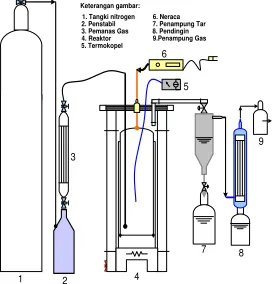
Unit for pyrolisis was showed in figure 1. The reactor where pyrolisis took place was made from rust resistance steel. Tar cooler made from stainless steel and gas vessel was made from polyethylene/glass.
Research procedure, peat of certain size and weight was put into reactor (4). Heater (5) then turned on. Time (t) was counted after the desired temperature reached and reading of weighing/balance (6) was done to
measure solid residue mass (mto). Measurement of solid
AIII.3 - 3
ARTICLES BALI INTERNATIONAL SEMINAR ON SCIENCE AND TECHNOLOGY 2011
“ Strengthening Basic Sciences and Technology for IndustrialSustainability“
July 22-23 , 2011, BALI-INDONESIA
ISBN 978 – 979-98623-1-0
of time. Same treatment also valid for the measurement of tar ( bio-oil).
9.Penampung Gas Keterangan gambar:
1. Tangki nitrogen 6. Neraca
2. Penstabil 7. Penampung Tar
3. Pemanas Gas 8. Pendingin
Preliminary experiment was done to obtain the
characteristic of heating and cooling of pyrolisis reactor. Heating was done from room temperature up to the
highest temperature studied, i.e. 420 oC (figure 2). To
reach the mentioned temperature, 45 minutes was needed.
Next, refrigeration of reactor was conducted.
Temperature degradation in each moment was shown in figure 3. Hence, collection of result from reactor was done after refrigeration take place for three hours.
Turf used was originated from Pontianak, West Kalimantan. After dried under the sun, it was then separated and sieved according to diameter to be used in research. The raw material was analyzed for water
Relation of Conversion with Time and Temperature,
pyrolysis of turf or conversion of volatile matter was calculated by mto, mt, dan m∞. To calculate conversion, turf mass inside reactor (measured as solid residue) was measured at various time and temperature. Conversion of volatile matter or devolatilization degree was calculated by xs = [mto - mt]/ [mto- m]. The value of (mto– mt) was the volatilized mass at turf at every moment and the total mass of turf that could be volatilized was (mto – m∞). However, the rise was no longer seen after 45 minutes of
pyrolisis time. Infinite time (data) was the time needed to
reach constant condition of solid residue, tar and gas. The
value of data measured after the process reached
isothermal to the time at the turf mass inside reactor
reahed constant. The value of turf mass measured as m.
Next, the data was used to calculate r using equation:
AIII.3 - 4
ARTICLES BALI INTERNATIONAL SEMINAR ON SCIENCE AND TECHNOLOGY 2011
“ Strengthening Basic Sciences and Technology for IndustrialSustainability“
July 22-23 , 2011, BALI-INDONESIA
Numurical calculation could be applied to calculate count. After count determined, the the value of process of turf decomposition could be certainly determined that chemical reaction was the control, and following first order reaction. As the effect of time, the rise in pyrolisis temperature caused increase in volatilized matter, thus increase in decomposed fraction (xs). The rise was caused by increase of volatile matter
movement so that collision frequency (ko) and activation
energy (E) rises, therefore decomposition rate constant (k) increase. From the influence of temperature (T) to k,
then values of ko and E could be determined by
Arrhenius equation. Since points in figure 7 could generally approached by straight line, it was obtained: average error 1,04%, and value of collision frequency,
k0=1.407.10-4 minutes, gas constant, R = 1,987
cal/g.mol.0K, and activation energy, E = 4326.2 cal/gmol.
k = 0.14(10-3) exp(-4326.2/RT). The effect of time to xs,
at various temperatures could illustrate the controlling reaction step.
Experiment of bead size variation was done at 405oC and
studied ro was about 0,00745 to 0,0705 cm. Figure 8
showed that the rise in bead diameter resulted in reduced conversion. The rise in bead size caused decrease in area for heat transfer per bead per mass unit of turf, hence decrease in pyrolisis rate. For bead at the same size, time gace significant affect to conversion. According to figure 8, the effect of increasing time to increasing conversion for each bead size has similar influence. In each studied bead size, rise up to 45 minutes could rise conversion significantly.
Conclusion
1. Rate of reaction controlled by chemical reaction, in the order of one, following
unreacted-core model
2. Value of collision frequency, k0=1.407.10-4 minute,
and activation energy, E = 4326.2 cal/gmol, so that k =
0.14(10-3) exp(-4326.2 / RT
3. Verifying value calculated from empiric formulation: [xs] = 0,6572 (1/t)
0,7808
, with various model shows relatively same result. Especially at
252oC with the time between 25 - 40 minutes.
Reference:
Mulyadi, E. dan Trianna, N.W, 2006, “Mekanisme
Reaksi Pirolisis Gambut”, Jurnal Hasil Penelitian
Kimia dan Teknologi, ISSN 0216-163X, Vol-1, 138, Gadjah Mada University Press.