D32 - 1
REACTION KINETICS OF OXALIC ACID PRODUCTION
FROM PALM FIBER WITH H
2O
2Retno Dewati, Erwan Adi Saputro, Nurul Novita
Chemical Engineering Department UPN”Veteran” Jawa Timur Jl. Raya Rungkut Madya – Gunung Anyar – Surabaya
Email: [email protected]
ABSTRACT
The Purpose of this research to study reaction kinetics of oxalic acid production from palm fiber. Using peroxide oxidator at a pressure one atmosphere in a batch. The study was conducted two phases, the first is the hydrolysis of palm fiber into glucose. At this stage of palm fiber that has been dried in an oven (at 80ºC for 10 minutes), plus a 10% NaOH and then for 60 minutes (with stirring 1000 rpm) so we get a solution. In the second stage, a solution of glucose from the hydrolysis incorporated into a three neck flask and added 25 cc of peroxide solution with the temperature and time as variables. During the process of oxidation of oxalic acid will be formed which is then analyzed in levels. Variable used is the oxidation time ( 20, 30, 40, 50 and 60 minutes) and temperature of oxidation ( 40, 50, 60, 70 and 80 ºC). The resuls of this study obtained the largest conversion of oxalic acid is 12.520 % at temperatures 80ºC and 60 minutes. Price reaction rate constant (k) obtained by k = 0.0011107 e-4620/RT reaction and the reaction followed the order of three.
Keywords : reaction kinetics, oxalic acid , palm fiber
Introdution
Palm crop in areas that get a lot of sunlight, for example in coastal areas. In East Java, Tuban and Gresik in particular is an area near the beach which many plants grow palm. To date palm plant utilization is limited to fruit and trunk. Water trunk is tapped into a drink called legen. Many sellers legen roadside, and even many that have been processed into a beverage bottle to be marketed both domestically and to be sent abroad, while the fruit can be eaten or preserved in cans. Peeling the fruit must be done carefully so that husk is not broken, because if it would be easy pecan frit not and it becomes acidic. Necessary for the canning of fruit really well and in large numbers, so many palm fiber that would be a waste of disturbing the environment. Yet until now has not been processed palm fiber into results that can be sold.given the many canned palm fruit to be sent abroad, it is necessary to think about ways to add values as one of the coir palm plantation results exploited waste into other substances that
higher economic value. One way, is to cultivate palm fiber, into oxalic acid.
Factors affecting rate reaction
These are several factors which affect, among other :
a. Time
The longer reaction time, then the reaction will be more nearly perfect because the contact time between the substances will be longer. But it should be noted that the reaction time the excess can cause reactions that lead to unwanted reactions, so it is necessary to find optimum reaction time. In this experiment the treaction time when the excess is likely to happen further reaction of oxalic acid into CO, CO2 and H2O.
b. Temperature
The relationship between temperature and rate reaction is expressed by the Arrhenius equation as follows :
k = k
o. e
-E/RTD32 - 2
where :
k = reaction rate constant
k
o= frequency factor
E = activation energy
R = gas constant = 8,314 Joule/mol.°K
= 1,987 kal/mol.°K
For each increase in temperature will give rise in the price k. The larger the k, then the reaction rate will be greater, But it should be noted in this study that when the temperature is too high it will cause undesirable changes in oxalic acid.
c. Composition and Concentration
The composition of a material greatly affect the speed of reaction, addition of inert substances also affect the rate reaction (Smith, 1969). A reaction can usally be turned into products quickly when reacted with a high concentration, but it does not apply to all reactions, so it is necessary to find a good comparation that will get a very high conversion products.
d. Stirring
Stirring would help accelerate the reaction due to the agitation will increase the frequency of collisions and the reaction rate constant prices will be greater.This was expressed by Arrhenius equation :
k = k
o. e
-E/RT,
with : k
o= frequency factor
Reaction mechanism
a. Hydrolysis reaction mechanism palm fiber into glucose.
Hydrolysis is a process of interaction between the most saline water. When a solution of salt dissolved in water then the solutionis not always react to neutral as a result of H+ or OH- are left in solution will be acidic or alkaline. There are several types of hydrolysis, the hydrolysis of pure, hydrolysis in alkaline solution and hydrolysis enzyme as a catalyst. It uses pure experiment hydrolysis, ie the compound to be hydrolyszed (from coco palm cellulose solution) is reacted with H2O. The mechanism of the reaction is
written as follows :
C6H10O5 + H2O C6H12O6 Cellulose glucose
b. Mechanism of oxidation reactions with peroxide.
The result of solution of cellulose hydrolysis (from palm fiber) into glucose to be further oxidized to oxalic acid.
The reaction is as follows :
C6H12O6 + 9H2O2 3 C2H2O4 + 12 H2O glucose oxalic acid
or briefly written as follows :
A + B
C + D
When the glucose oxidation reaction the result of palm fibert hydrolysis into oxalic acid followed first order, the equation used is as follows :
-rA = - dt
A dC
= k1 . CA CB ... (2)
For the concentration of reagent H2O2 is nuch greater than A, then reagent H2O2 did not change during the process ( CH2O2 any time constant ), then k’ = k CB so that equation (2) becomes : - dt A dC = k’ . CA... (3)
-A
C
A dC = k ‘ dt ... (4)-dt A dC A C A C
∫
0 = k’ . ∫ t dt 0 ... (5)- (ln CA + In CA0) = k’.t ... (6)
CA = CA0 (1 - XA ) ... (7)
- ln (1n - XA ) = k’t ... (8)
D32 - 3 If the reaction of oxalic acid production
following the second order, then the reaction rate eqation becomes :
-rA = dt
A dC −
= dt
B dC −
= k . CACB ... (9)
The number of A and B are reaction at any time t is the same that is the same as equation (9) CAoXA thus becomes :
-rA = CA0 dt
A dX
= k .(CAo- CAo XA).( CBo-
CAo XA.) ... (10)
With M = CBo / CAo is a first molar ratio of reactant, then obtained :
-rA = CA0 dt
A dX
= k C2 Ao- (1-XA).(M-XA.)
... (11)
Integrated the above equation becomes :
ln
A B
X
X
−
−
1
1
=ln
)
1
(
AA
X
M
X
M
−
−
=lnA Bo
Ao B
C
C
C
C
= CA0 (M-1) k .t
= (CB0 - CA0 ) k .t ... (12)
If the reaction of oxalic acid production did not follow first order and second order then use the n-th order equation, namely as follows :
dt A dC −
= k CAn
Log ( dt
A dC −
) = log k + n log CA (13)
Subsequently made agraph of log CA Vs
Log ( dt
A dC −
)
slope = n and intercept = log k
Research method.
The purpose of this research is to study the kinetics of oxidation reactions palm fiber,
the oxalic acid using peroxide at a pressure of one atmosphere in a batch.
Variables consist of research :
1. Variables with fixed conditions : the cellulose solution of 0,62 M palm fiber as much as 100 cc, stirring 1000 rpm, volume peroxide 50% as much as q5 cc, 55 minutes hydrolysis time, hydrolysis temperature of 80ºC, glcose 88 %.
2. Variables with the condition of the run,: oxidation temperature (ºC), 40,50,60,70,80 and oxidation time (minutes); 20,30,40,50 ,60.
1. Three nack flash 2. stirrer
3. Water Batch 4. Thermometer 5. Condensor
The study was conducted two phases, the first is the hydrolysis of palm fiber into glucose. At this stage of the palm fiber that has been dried in an oven (at 80ºC for 10 minutes), plus a 10% NaOH and then heated for 60 minutes (with stirring 1000 rpm) so we get a solution of cellulose is then hydrolyzed for 55 minutes. The result of hydrolysis is glucose solution. In the second stage, a solution of glucose from the hydrolysis incorporated into a three neck flask and added 25 cc of peroxide solution with the temperature and time as variables. During the process of oxidation of oxalic acid will be formed which is then analyzed the levels. The materials used are dried palm fiber 10 grams , 10% NaOH, CaCl2
D32 - 4
Results and Discussion
Research results
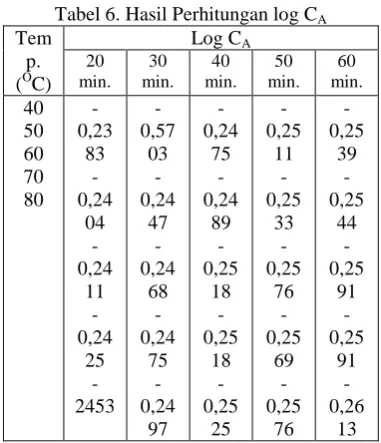
The results of oxalic acid production from glucose (hydrolysis of palm fiber) and the influence of all variables (temperatre and time) are presented in tables .
Table 1 Data research
Temp. (OC)
Volume titration (cc) 20
Concentration (CA)
20
Tabel 6. Hasil Perhitungan log CA Tem
Effect of conversion (XA) to temperature oxidation. Effect oxidation temprerature on the conversion of glucose to a solution of oxalic acid can be seen in table 3. The higher the oxidation temperature of the conversion of glucose to oxalix acid will increase.
Effect of conversion (XA) against oxidation time.
Effect of oxidation time can be seen in table 3 . The longer time of oxidation, the conversion of glucose to the formation of oxalic acid will also increase.
Conclusion
The conclusion can be drawn from this study are as follows :
D32 - 5
DAFTAR PUSTAKA
Fieser, L.F, and Fieser M., 1956, Organic
Chemistry, 3 ed, p.385 – 388,
Health and Co., New York
Groggins, P.H. 1958, Unit Processes In
Organic Synthesis, 5 ed., p.486 –
554. Mc. Graw Hill Kogakusha Co. Ltd Tokyo.
Hawley, G.G., 1977, The Condensad
Chemical Dictionary, 9 ed., p. 452,
p. 642, p.663, Van Nostrand Reinhold Co., Ltd., New York.
Kirk, R.E., Othmer, D.F., 1952,
Encyclopedia Of Chemical Tecnology, Vol.4, p.593-616, The
International Science Encyclopedia Inc. New York.
Levenspil, O., 1972, Chemical Reaction
Engineering, 2 ed., John Willey and
Sons, New York.
Sudjana, 1986, Metode Statistika, Edisi 4, penerbit Tarsito, Bandung.
Schaible, P.J., 1976, Poultry Feed and
Nutrion, 2 ed., p.330 – 335, The
Evil Publishing Co. Inc. Wetport Winarno, F.G., Srikandi F., dan Dedi F.,
1984, Pengantar Teknologi Pangan, Edisi 4, Hal.9 – 10,