REVISITING THE JAVANESE LOANWORDS IN THE
OXFORD ENGLISH DICTIONARY
A THESIS
By:
RIKA NOVRIANI Student Number: 120912044
ENGLISH DEPARTMENT
FACULTY OF HUMANITIES
AIRLANGGA UNIVERSITY
SURABAYA
REVISITING THE JAVANESE LOANWORDS IN THE
OXFORD ENGLISH DICTIONARY
A THESIS
Submitted as Partial Fulfillment of Requirements for the Sarjana Degree of English Department, Faculty of Humanities,
Airlangga University, Surabaya
By:
RIKA NOVRIANI Student Number: 120912044
ENGLISH DEPARTMENT
FACULTY OF HUMANITIES
AIRLANGGA UNIVERSITY
SURABAYA
DECLARATION
This thesis contains no material which has been accepted for the award of any other degree or diploma in any university. And to the best of this candidate’s knowledge and belief, it contains no material previously published or written by other persons except where due reference is made in the text of the thesis.
Surabaya, June 25, 2013 The writer,
For those people whom I love,
Approved to be examined
Surabaya, 25 June 2013
Thesis Advisor,
Deny Arnos Kwary, Ph.D. NIP. 197501011999031001
Head of English Department
Dra. Lilla Musyahda, M.Pd NIP. 1966121020007012001
ENGLISH DEPARTMENT
FACULTY OF HUMANITIES
AIRLANGGA UNIVERSITY
SURABAYA
This thesis has been approved and accepted by the board of Examiners English Department, Faculty of Humanities, Airlangga University
On July 9th 2013
The Boards of Examiners are:
Drs. Jurianto, M. Ed. NIP. 196505191991031003
Deny Arnos Kwary, Ph.D. NIP. 197501011999031001
ACKNOWLEDGEMENTS
All praises and gratitude be to Allah S.W.T. who has blessed me to accomplish this thesis on time.
I would like to thank my thesis advisor, Deny A. Kwary, Ph.D., for his outstanding nurture. I also thank to Sudijah S., M.A. for supporting me during thesis work. Without their encouragements and advices, this thesis could not have been finished.
It has been my pleasure to be part of English Department or EDSA 2009, Faculty of Humanities, Airlangga University. This thesis also would never be completed without support from all of my best friends, Burhanudin F. A, Diannita R., Rozzy C., Mikek K., Farahdiba, and Karina Putri, S.Hum..
Finally, I also would like to thank Hendra G. Saputra, S.H. M. Kn. for being such a lovely friend, and to others whose names I could not mention one by one, but your support is such a wonderful thing that I always need.
“Study the past if you would define the future.”
TABLE OF CONTENTS
1.4.Significance of the Study ... 5
1.5.Definition of Key Terms ... 6
CHAPTER II: LITERATURE REVIEW ... 8
2.1.The History of the English Language ... 8
2.2.The History of the Oxford English Dictionary ... 12
2.3.The Internal Structure of the OED ... 14
2.3.1. Headword Section ... 15
2.4.The Studies of Borrowings ... 16
2.5.Related Studies ... 19
CHAPTER III: METHOD OF THE STUDY ... 22
3.1.Research Approach ... 22
3.2.Source of the Data... 22
3.3.Technique of Data Collection ... 23
CHAPTER IV: DISCUSSION ... 27
4.1.Outdated Javanese Loanwords ... 27
4.2.The Existing Javanese Loanwords ... 28
4.2.1. Abangan ... 28
4.2.2. Batik ... 30
4.2.3. Dedes ... 32
4.2.4. Gado-gado ... 34
4.2.5. Gamelan ... 36
4.2.6. Lahar ... 38
4.2.7. Pelog ... 40
4.2.8. Rasse ... 41
4.2.9. Saron ... 43
4.2.10.Subud ... 45
4.2.11.Tjanting ... 47
4.2.12.Wayang ... 49
4.3.Interpretation ... 52
CHAPTER V: CONCLUSION ... 57
Novriani, R. 2013. REVISITING THE JAVANESE LOANWORDS IN THE OXFORD ENGLISH DICTIONARY
ABSTRACT
Language is a living organism that changes over time, notably the words of language. The historical changes of words can be observed from a dictionary, and in the English language, the dictionary that provides a full account of the historical changes of words is the Oxford English Dictionary (OED). The changes can be related to the language sources of the words in the OED that come from more than 350 languages (Denison & Hogg, 2006, p. 1), including the languages far from the UK. One of such languages is Javanese, which is a local language in Indonesia. An advanced search in the OED for the entries with Javanese etymology results in 33 entries. An analysis of these Javanese loanwords in the OED reveals the need to revise the entries in order to give a better account of these Javanese loanwords. The revision or update of the entries at the OED has been conducted quarterly since the OED went online in 2000. An entry in the OED has the following components: etymology section, sense section, and lemma section (Weiner, 2009, p. 403). In this thesis, the writer focuses on the variants section, lemma section and the sense section. The writer believes that there are several out-dated variants in the Javanese entries. As well as for the lemma section, there are additional lemmas that have yet included in the OED. The writer also thinks that there is a need to revise and update the sense section due to the imprecise definition or semantic change. The analysis shows that 21 are outdate, 3 need revisions in the variants section, 3 need addition in the lemma section, and 6 need revisions in the sense section. An example of an update for the variant section is the entry of batik that has a variant spelling batik in the OED. A concordance search in the BNC and ukWaC shows that the variant is not used any longer in the UK. In this case, the writer suggests that this variant should be marked by an obsolete symbol (†). The concordance lines in the corpora show the need to add a lemma batik-painting in the lemma section for the entry of batik. An example of an update for the sense section is the entry for abangan which is not really define in the OED but only related it with two other terms: wong Islam
‘Muslim’ and wong Jawa ‘a follower of Javanese religion’. By referring to the citations from the OED, the concordance lines in the corpora, and Kamus Basa Jawa (Javanese language dictionary), we can infer that abangan is a nominal Muslim or a Javanese person who is Muslim but does not fulfill his religious obligations. Consequently, the revision of the entries is indeed necessary, and this thesis is expected to serve as an input for revising the entries in the OED.
CHAPTER I
INTRODUCTION
1.1. Background of the Study
Language is an intermediary in conveying ideas and thoughts. Language becomes a device of verbal communication from one individual to another as well as from one country to another. As communication moves across a country’s border, one language may borrow some words from another language. Hatch & Brown (2001, p. 170) noted that all languages borrow words from other languages.
English as a worldwide spoken language is quite open to borrow foreign languages. It is surprising that English has absorbed a great number of useful words of almost every language in the world. The sources of words in the Oxford English Dictionary come from more than 350 languages (Denison & Hogg, 2006, p. 1). The English borrowings are not only from French, Latin, Greek, and Scandinavian, but also from Indonesian, Chinese, Japanese and other languages. From advanced search at the Oxford English Dictionary, the writer found that English has also taken words from local language in Indonesia, that is Javanese language.
158.262.640 inhabitants (total population), while the use of English as a second language numbered 107.066.316 or 67.80%. Among the users of Indonesian language as a first language, there are eight large groups distinguished on the basis of their local language. Those are Javanese (38.08%), Sundanese (15.26%), Madurese (4.29%), Batak (1.97%), Minang (2.23%), Bali (1.64%), Bugis (2.04%), and Banjar (1.74%). Here, the data show that Javanese language is the most frequently used local language by Indonesian people.
As mentioned earlier, Javanese, which is the most popular local language in Indonesia, can also be found in the Oxford English Dictionary. There are a number of Javanese words borrowed by the English language. A search in the Oxford English Dictionary for entries with Javanese etymology results in 33 entries. These are called loanwords.
From a dictionary, we can find that one language can borrow words to produce loanwords from another language. Borrowing can be defined as the process whereby a language takes words from another language, while “loanword” is the name given to those words that have been taken from borrowing. Loanword is vocabulary whose basic form and meaning are taken directly from another language (Haugen & Mithun, 2003). The problem of this process is when the speakers try to adopt loanwords, there is a possibility that the meaning and form are changing.
language, current trends and needs nowadays (Juřicová, 2012). Therefore, language changes over time notably the words of language because when a suitable word exists in another language, the easiest thing in the world to do is to adopt that word.
The Oxford English Dictionary is one of the dictionaries that provide a full account of the historical changes of words. It helps us to discover how English words and meanings have changed over time. The revision or update of the Oxford English Dictionary has been conducted quarterly since the Oxford English Dictionary went online in 2000 (Weiner, 2009, p. 401).
According to Weiner (2009, p. 403), an entry in the Oxford English Dictionary now potentially has the following components: headword section, pronunciation section, inflection section, variants section, etymology section, sense section, and lemma section. From these components, the headword cannot be changed because it is based on the spelling found in the earlier document of the Oxford English Dictionary. Then, the pronunciation cannot also be changed because it needs field study in the UK, the inflection also follows regular inflection to be changed, and it is hard to change etymology section despite the etymology still needs search old document to show etymology of an original word. Therefore, the writer focuses on variation section, sense section and lemma section.
ukWaC (Available in the www.sketchengine.co.uk) show the battik variants is outdated and should be marked by an obsolete symbol (†) before the word in the variant section. However, the writer finds a new lemma that is batik-painting
resulted in 6 hits and 45 hits from the corpora. In this case, the writer suggests that the additional lemma should be added in the lemma section of the entry for batik. In the sense section case, the entry of abangan is one of the examples. The Oxford English Dictionary does not define it, but only relates it with two other terms:
wong Islam ‘Muslim’ and wong Jawa ‘a follower of Javanese religion’. The terms are not quite precise. If we see abangan in citations from the Oxford English Dictionary and the concordance in corpora, and refer to Kamus Basa Jawa (2011), we can infer that abangan is a nominal Muslim or a Javanese who is Muslim but does not fulfill his religious obligations. It is necessary to revise the sense section for this entry.
There are two researchers that have conducted studies of loanwords in English. Those researchers are Doi (2010) with his research entitled Japanese Loanwords in the Oxford English Dictionary and in the English version of
Kæmpfer’s the history of Japan, and Juřicová (2012) with her research entitled
Chinese Loans in English. They both investigated loanwords that have been taken by English from Asian language especially Japanese and Chinese. Other journal papers or articles about loanwords usually analyze the borrowings from European language such as Dutch, French, Italian and Spanish. Therefore, the writer is interested in studying the Javanese loanwords in the Oxford English Dictionary,
Dictionary has yet analyzed. The findings of the variants, lemmas, and senses on 33 entries are expected to serve as inputs for revising the entries in the Oxford English Dictionary.
1.2. Statement of the Problems
Based on the background of the study above, the writer formulates the research problems as follows:
1. Which headwords of the Javanese loanwords are no longer used in the current English?
2. Which entries of the Javanese loanwords need revisions on the variant, lemma, and sense?
3. Why are the revisions of the Javanese loanwords needed?
1.3. Objective of the Study
1. To determine the headwords of the Javanese loanwords which are no longer used in the current English.
2. To determine the entries of the Javanese loanwords that needs revisions in the variant, lemma, and sense.
3. To show why the revisions of the Javanese loanwords are needed
1.4. Significance of the Study
Lexicography and Etymology particularly in identifying the variants, lemmas and senses of loanwords in dictionary.
Practically, after knowing the changes in the variants, lemmas, and senses of loanwords in the Oxford English Dictionary, the Editor of the Oxford English Dictionary would consider revising the Javanese loanwords in the Oxford English Dictionary. Meanwhile, the readers especially English lexicographers, will be able to know the old and new variants, lemmas and senses of the Javanese loanwords in the Oxford English Dictionary. The writer also hopes that this study will encourage further research for researchers or linguists who are interested in studying similar topic as a comparative study.
1.5. Definition of Key Terms
Dictionary: the most common type of reference work (Hartmann & James, 2002).
Javanese: A native of Java (formerly with pl. Javaneses); also, the language of central Java (Hartmann & James, 2002).
Lemma: The position at which an entry can be located in the structure of reference work, e.g. baby-oil, olive-oil, and etc. (Hartmann & James, 2002)
Loan-word: A word or phrase which is the result of borrowing (Hartmann & James, 2002).
CHAPTER II
LITERATURE REVIEW
2.1. History of the English Language
English is one of the world's most prominent languages. Its history shows flexibility that has enriched its vocabulary over the centuries. According to Algeo (2010), the history of the English language can be divided into Old English, Middle English, and early Modern English, Late Modern English up to English Worldwide.
The invansion of French continued in the Middle English period (1100-1500). Denison and Hogg (2006, p. 359) stated that Middle English is, par excellence, the dialectal phases of English, in the sense that while dialects have been spoken at all periods, it was in Middle English that divergent local usage was normally indicated in writing. They also noted that the variety of types of English are increased, both because of the increase in texts which had varied in type and not overwhelmingly religious and because of the variable influence of French and Scandinavian (Old Danish, Old Norse) on English.
Unlike Scandinavian, French language are found significantly more in religious, the vocabulary of religious: religion, savior, trinity, angel, saint, and many others words and other high styles of speech, thus, their language in this period became language of Government and of upper classes in the society. The vocabulary of Government in this period included govern(ment), reign, country,
and state (Algeo, 2010).
Despite vast changes in vocabulary and pronunciation, English speakers of the sixteenth century were unaware that they are leaving Early Modern English (1500-1800) and entering the period. The signs of developing in the Early Modern English are the invention of technology (e.g. printing) and the expansion of the British Empire. McIntyre (2009) said that the period from printing produced the first monolingual dictionary of English in 1604 and was written by Robert Cawdrey. He described that the first monolingual dictionary was called A Table Alphabetical and contained the definitions of around 2500 words which focused on ‘hard words’. In addition, the first daily newspaper was published in London in 1702, resulting in the expanding power of the press to disseminate information and to form public opinion (Algeo, 2010, p. 140).
McIntyre (2009) noted that the spread of English was to continue with the expansion of the British Empire into such places as Canada, the Indian subcontinent, Africa and Australasia. He continued that as the British Empire expanded, English also became the official language of administration and government in such places as Malaysia, Singapore, and Hong Kong, British colonies were also established in South Africa, East Africa, and West Africa. As a result of colonization, there are a number of words were borrowed into English.
In Late Modern English (1800-present), the written Standard English develop rapidly in this period. Algeo (2010) mentioned that the dictionaries that appeared in this period are Noah Webster’s American Dictionary of the English Language (1828), the New English Dictionary on Historical Principles (1928),
Webster’s Third New International Dictionary (1961). But the emergence of a spoken standard did not occur in Britain until the prestige of Received Pronunciation (‘received’ in the sense of accepted’) or RP was adopted by the
BBC (the British Broadcasting Corporation), which founded in 1921 (McIntyre, 2009).
In the nineteenth and twentieth centuries, the booming of technological innovation occurred. In the area of communication technologies, this was to have a major impact of development of English. Algeo (2010) mentioned that in this era, the first motion picture with spoken dialog (e.g. the Jazz Singer) was released in 1927, the first high-definition television service was established by the BBC, to be followed by cable service in the early 1950s and satellite service in the early 1960s. The internet, developed in the 1960s, was popularized via the World Wide Web in the early 1990s, and has been the development of English into a global language.
2.2. The History of the Oxford English Dictionary
The Oxford English Dictionary has been widely acclaimed in lexicography. The Oxford English Dictionary is the most complete historical dictionary of any language (Denison & Hogg, 2006, p. 1). The Oxford English Dictionary provides detailed, fully documented, treatments of the various scholarly projects which have been central to the development of lexicography over the past 150 years, and takes full account of the impact on English dictionary of the recent development in corpus and computational linguistics (Cowie, 2009, p. 1).
Although much was done to produce scholarly editions of early texts, the general activity of collection slackened by the early 1870s. In 1879, Henry Sweet (a President of society) pointed out in a letter to Oxford University Press the twin value of their taking on the dictionary project and appointed James Murray as the editor of New English Dictionary (Cowie, 2009, p. 8), later become the Oxford English Dictionary. In this project, he stressed that the significance of lexicography in national and international context, and argued that major dictionaries were now inconceivable without a basis in data and historical method (Mugglestone, 2006, p. 241).
contributed a million additional quotations derived from the careful scrutiny of over five thousand writers (Mugglestone, 2006, p. 244). A successful of the whole dictionary (600,000 entries), the Oxford English Dictionary, was first completed in 1927 despite the death of Murray in 1915.
Several years after the first edition of the Oxford English Dictionary
appeared, the first the Oxford English Dictionary Supplement was published in 1933 (Brewer, 2009, p. 214). The first Supplement is so fascinating. It was the reflection in its pages of a turbulent period of social and cultural history, and the increasing acceptability of informal language and slang in printed sources (Brewer, 2009, p. 260).
In the 1930s and beyond, the problem of this Supplement appeared. Many scholars and others continued to send in information about new words and senses and about omissions or errors in the printed dictionary. It makes the publishers from time to time asked whether they should publish another supplement or instead undertake a full reworking of the parent dictionary (Brewer, 2009, p. 263). Finally, the Oxford University Press appointed Robert Burchfield in 1957 to work on the supplement. In between 1972 and 1986, the four supplements were published.
Oxford English Dictionary began to express concern about the future of this dictionary, the Oxford English Dictionary published online.
In 1993, the first CD-ROM was developed by the Dutch software company AND, as Oxford University Press command. Then, continued by the online version of the Oxford English Dictionary which was appeared in 2000 (Weiner, 2009, p. 391). The apparent of CD-ROM and online version were simplified the processes of production, maintenance, and user support. However, according to Weiner (2009, p. 379), the Oxford English Dictionary had to kept in print, and an integrated edition would protect the copyright on the first edition while giving the reader the convenience of having the entries from the supplement inserted in their proper places.
Then, the expansion of text corpora gives an important thing for the further development of the Oxford English Dictionary. It has been the changes made possible by online editing and publication. Weiner (2009) noted that one significant aspect has been the editorial revision of the dictionary, now ongoing, which has resulted in the online publication of large amounts of new and revised dictionary text.
2.3. The Internal Structure of the OED
of types: affix, phrase, phrasal verb, compound, adjectival special use, or derivative section (Weiner, 2009, p. 403).
2.3.1. Headword Section
According to Hartmann and James (2002, p. 67), Headword is the form of word or phrase which is chosen for the lemma, the position in the dictionary structure where the entry starts.
2.3.2. Pronunciation Section
The form, production and representation of speech is called pronunciation (Hartmann & James, 2002, p. 112). They also explained that the phenomenon is studied in Phonetics and Phonology, and the results are codified in general dictionaries or specialized pronouncing dictionaries by means of one of two basic systems of graphic notation.
2.3.3. Inflection Section
Hartmann and James (2002, p. 13) noted that Inflection is one of the information categories presented by the compiler and consulted by the user of a reference work.
2.3.4. Variant Section
According to Hartmann and James (2002, p. 153), variant is a form of a word which differs from other forms in spelling, pronunciation, or grammar, e.g. colour/color, ‘controversy/con ‘troversy, got/gotten.
2.3.5. Etymology Section
2.3.6. Sense Section
Sense is one of several meanings that can be established for a word or a phrase and covered by a definition in a reference work (Hartmann & James, 2002, p. 125). Because of the multiple meanings of word, particularly core items in the basic vocabulary, compilers of dictionaries have for centuries tried to rationalize, discriminate, and display these senses for the benefit of users.
2.3.7. Lemma Section
The position at which an entry can be located and found in the structure of a reference work is called lemma (Hartmann & James, 2002, p. 83). The relationships of the lemma in the reference work are two-way; within the overall (e.g. alphabetical).
2.4. The Studies of Borrowings
Other linguistic terms for the loanwords are “adaptation” and “lexical borrowing”. In the process of borrowing, a recipient language may borrow a word or an expression from a donor language. Juřicová (2012, p. 4) noted that this ‘borrowing’ is consequently adapted and naturalized in its host language. Obviously, Jackson (2003, p.15) said that some loanwords continue to betray their origin, either in their spelling or pronunciation, or both (e.g. spaghetti from German); while others have become naturalized (e.g. tycoon from Japanese and
coach from Hungarian).
Kemmer (2011) describes the process of borrowing in detail. The actual process of borrowing is complex and involves many usage events (i.e. instances of use of the new word).
Generally, some speakers of the borrowing language know the source language too, or at least enough of it to utilize the relevant words. They adopt them when speaking the borrowing language. If they are bilingual in the source language, which is often the case, they might pronounce the words the same or similar to the way they are pronounced in the source language. For example, English speakers adopted the word garage from French, at first with a pronunciation nearer to the French pronunciation than is now usually found. Presumably the very first speakers who used the word in English knew at least some French and heard the word used by French speakers (Kemmer, 2011).
Haugen’s influential article on linguistic borrowing can still be considered as central for current studies of loanwords. According to his study, the taxonomies of borrowing can be divided into these categories (Haugen in Juřicová, 2012, p. 10):
Both the morphemes and the meaning of the source word are copied completely, (e.g “café” in English borrowed from French). It will be specified here as “fully imported loanwords.”
2. Loan-blend
Part of the word is copied and part comes from the source language (e.g.
Saturday from Latin Saturni dies). 3. Loan-shift
Only meaning is transferred, morphemes are either substituted or not transferred. Substitutes have two subtypes:
a) “Loan translations” or “calque” translates each morpheme item (e.g. “world view” from German Welt-anschauung).
b) “Semantic borrowing” (also called “semantic loan” or “semantic extension”) transport a borrowed meaning onto already existing word in the recipient language, (e.g. Easter denoted pagan goddess festival and under Christian influence took over present meaning) (Cited in Juřicová, 2012, p. 10)
came to Austronesia and took several variants language, which one of the languages comes from Java.
Such changes, which are the outcomes of language contact, can have a wide variety of final forms from only a few words borrowed to whole new languages developing (Juřicová, 2012, p. 4). When the new words come up, the speakers would change the meaning from the original. This process is called semantic change. Some loan phrases have a different meaning from their original, possibly because the component words were taken in separately, and recombined by chance. Examples are moningu sibisu (morning service) which in Japanese means a set breakfast served by a restaurant, shc5ro kart0 (short cut) which is a short haircut, and roreningupunrsu (training pants) which in Japanese refers to sweat pants (Kay, 1995, p. 5).
Common and easily observable changes often happen on the level of vocabulary through borrowing. The simplest kind of influence that one language may exert on another is the borrowing words (Juřicová, 2012, p. 4). Therefore, the profound study of the loanwords may serve as an information source of history and culture of a society and even provide insight into the history of the whole world.
2.5. Related Studies
from the theses made by the students at this department. There are two previous studies which are closely related to this thesis. The first is Japanese Loanwords in the Oxford English Dictionary and in the English version of Kæmpfer’s the
history of Japan by Schun Doi (2010). The second is Chinese Loans in English by Selena Juřicová (2012).
The first study attempts to investigate what kind of Japanese loanwords can be identified in the Oxford English Dictionary and the History of Japan. Since the source of the data are in the form of words, Schun Doi uses qualitative approach. The data of Japanese words found in the Oxford English Dictionary
through advance search and in the History of Japan which could be retrieved easily byelectronic searches. As the techniques of data analysis, he compares the Japanese words in the two sources. He concludes that signs of some influence of the History of Japan on the Oxford English Dictionary could be seen: (a) Capitalisation of the first letter of a noun; (b) the History of Japan spelling adopted in the Oxford English Dictionary; and (c) the History of Japan spelling given as alternative spelling.
The second study attempts to examine words in English which originated from Chinese. Selena Juřicová uses qualitative approach for the data which are in the form of words. The data are collected by identifying Chinese words in the Oxford English Dictionary online and the Econonomist. Then, she writes the Chinese words which come up. In analyzing data, she checks Chinese words in
the Economist Corpus and gains which Chinese words are still used by English speaker. Finally she concludes that the results of the analysis through the Economist Corpus is evaluated from the perspective of linguistic as well as social and cultural phenomena.
CHAPTER III
METHOD OF THE STUDY
3.1 Research Approach
This study applies qualitative approach especially regarding to the aim of the study, which is to analyze the Javanese loanwords which reveals the need to revise the entries in order to give a better account of these Javanese loanwords in
the Oxford English Dictionary. According to Dörnyei (2007, p. 38), qualitative research is fundamentally intrepretive, which means that the researchers make an interpretation of the data. The interpretation includes developing a description of an individual or setting, analyzing the data for themes and catagories, and finally making an intrepetation or drawing conclusion about its meaning personally and theoretically. In this case, the writer develops a description of the Javanese entries, analyzes the senses, lemmas, and variants. Finally, the writer draws conclusion on which entries should be revised.
3.2 Source of Data
that contains the most number of languages. It does not only include the national languages, but also local language. One of the local languages included is Javanese language, which is a local language in Indonesia.
3.3 Techniques of Data Collection
In collecting the data, the writer took several steps. These steps are important to collect the data in order to lead the writer to obtain adequate and appropriate data for this research. In general, there are two steps to acquire the data i.e. searching Javanese language in the Oxford English Dictionary and compiling the whole entries for each headword.
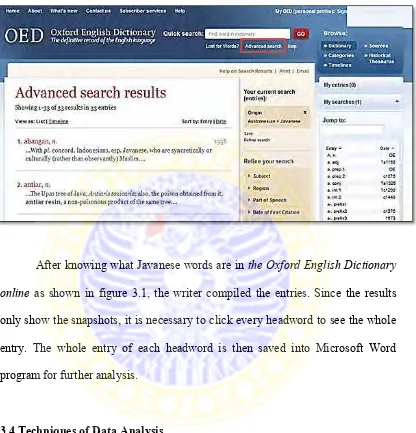
The search for the Javanese words in the Oxford English Dictionary online
Figure 3.1 Screenshot of the result from the Oxford English Dictionary
After knowing what Javanese words are in the Oxford English Dictionary online as shown in figure 3.1, the writer compiled the entries. Since the results only show the snapshots, it is necessary to click every headword to see the whole entry. The whole entry of each headword is then saved into Microsoft Word program for further analysis.
3.4 Techniques of Data Analysis
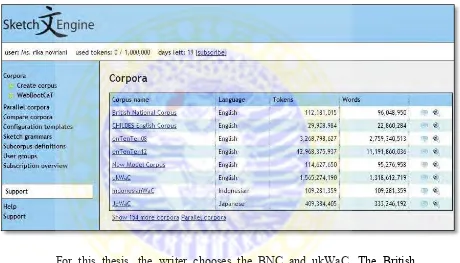
incorporating word sketches, one-page, automatic, corpus-derived summary of a word’s grammatical and collocational behaviour (www.sketchengine.co.uk). It is web-based program which takes as its input a corpus of any language with an appropriate level of linguistic mark-up. The Sketch Engine contains 162 corpora from 42 languages as shown in Figure 3.2.
Figure 3.2 Screenshot of the Sketch Engine
number of token words. The writer did not choose the enTenTen08 and enTenTen12 because it has a raw data which contains duplicate concordance lines.
There were three steps in analyzing the data. First, the writer used the concordance menu in the Sketch Engine to show the number of hits and concordance lines of every headword in the data. The purpose of the result in number of hits and concordance lines is to determine whether or not the words still exist in current English.
Second, after checking the data from concordance lines, the writer used the Kamus Basa Jawa in order to compare the meaning of the Javanese words that still exist in current English with the meanings of Javanese words in Java. In
Kamus Basa Jawa, the writer also checked the spelling of the lemmas and possible variants.
CHAPTER IV
DISCUSSION
This chapter is divided into three parts. The first sub chapter shows the outdated loanwords. In the second sub chapter, the writer discusses the loanwords that are still used. Finally, as in the last sub chapter, the writer interprets the loanword which has variants, lemmas, and senses.
4.1. Outdated Javanese Loanwords
In this sub chapter, the writer determined whether or not the loanwords in
the Oxford English Dictionary online (OED) are outdated by checking the hits from British National Corpus (BNC) which contains 96,048,950 words and UK Web as a corpus (ukWaC) which contains 1,318,612,719 words. If there is no hit for a particular loanword, it means that the loanword is not used any longer by the British English.
Based on BNC and ukWac, the writer found the outdated loanwords in the Oxford English Dictionary results in 21 of 33 entries. They are antiar(n), banxring(n), delundung(n), dukun(n), kaparrang/kaparring (n), kidang(n),
kromo(n), kumbang(n), linsang(n), ngoko(n), pangeran(n), pendopo(n),
rasamala(n), slendang(n), sonerila(n), susuhunan(n), tchincou(n), teledu(n),
English. This suggests that the outdated loanword can be marked by using the obsolete symbol (†) before the word or sense to give information that those loanwords are not used any longer.
4.2. Existing Javanese Loanwords
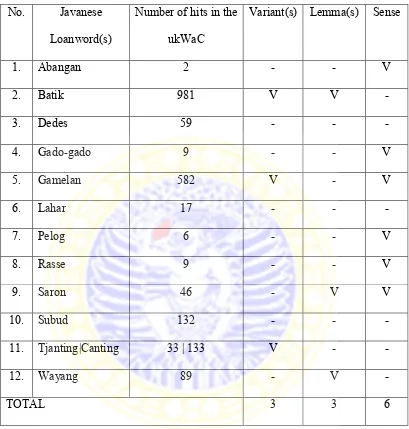
In this sub chapter, the Javanese loanwords that are still found in the BNC and ukWaC are analyzed individually from each entry. The existing Javanese loanwords are abangan(n), batik(n), dedes(n), gado-gado(n), gamelan(n), lahar(n), pelog(n), rasse(n), saron(n), subud(n), tjanting(n), and wayang(n). The analysis is mainly based on the concordance lines in BNC and ukWaC. The concordance lines are helpful to see the patterns and meanings associated with a word in a restricted set of the context (Stubbs, 2009). They also encourage us to make unexpected connections between items. The analysis of the variants, lemmas, and senses are also conducted by referring to Kamus Basa Jawa (KBJ). The details of the analysis are presented in the following sections.
4.2.1. Abangan
The first entry alphabetically is abangan. The entry in the OED is as follows:
The term abangan is at present not widely used by the Javanese themselves, but was popularized by the American anthropologist C. Geertz in his book The Religion of Java (1960), when describing the various cultural variants found in Javanese society. The usual terms used by the Javanese are wong Islam ‘Muslim’ and wong Jawa ‘a follower of Javanese religion’.
With pl. concord. Indonesians, esp. Javanese, who are syncretically or culturally
(rather than observantly) Muslim.
and those who observe them faithfully..are given special names (wong putihan, lebe, santri) and distinguished from the great mass of the people (wong abangan, bangsat).] 1956 C. Geertz in Econ. Devel. & Cultural Change4 138 The abangan, whose main adherence is to what is often miscalled ‘the Javanese religion’ (agama djawa).
1959 W. F. Wertheim Indonesian Soc. in Transition (ed. 2) viii. 224 There was a clear distinction between..those considered pious Moslems, who followed meticulously the precepts of Islam..and (probably because of the white garments they preferred to wear while praying) were called the putihan, the ‘white ones’, and..the mass of the Javanese who were less strict in the observance of the duties prescribed by religion and were called abangan, the ‘red ones’.
1976 C. A. Coppel in J. A. C. Mackie Chinese in Indonesia ii. 71 President Suharto and his ruling group of abangan generals.
1994 S. Owen Indonesian Regional Food & Cookery 173 The people who are most observant in giving and attending selamatan are not..the educated middle-class pious Muslims, but abangan.
As we can see in this entry, there is no definition of abangan. The OED does not really define it, but only relates it with two other usual terms: wong Islam
‘Muslim’ and wong Jawa ‘a follower of Javanese religion’.
From the corpus query system, there is no hit from the BNC, but there are two hits from the ukWaC. The writer found the concordance lines are as follows:
# Corpus: ukWaC # Hits: 2
# Query word,[lc="abangan"|lemma_lc="abangan"] 2
Javanese religion," which Geertz calls < Abangan >. The second type is a puritanical Islam The rest are only nominal Muslims called < abangan >, whose religion is based more on animism
From corpora, the writer did not find any variants. If we check from concordance lines in ukWaC, there is also no lemma for the entry abangan. However, for the sense section, we need to check the meaning in the concordance lines.
After seeing the concordance lines, the writer checked the entry abangan
in KBJ and found the following entry:
From those results, we can see that there is no suggestion regarding the variants and lemmas. There are no variant in both the ukWaC and KBJ. There are also not enough evidence to create lemmas because there are no frequent collocates. However, it is necessary to suggest the sense to make the meaning clearer. If we see the sense in the concordance lines and citations from the OED, and refer to KBJ, the entry abangan should be added with the following sense:
A nominal Muslim or a Javanese who is Muslim but he does not fulfill his religious obligations.
4.2.2. Batik
The word batik is still quite popular in the UK, as can be seen later in the concordance lines in the BNC and the ukWaC. Before seeing the concordance, we need to see the entry in the OED is as follows:
The Javanese art and method (introduced into England by way of Holland) of executing designs on textiles by covering the material with wax in a pattern, dyeing the parts left exposed, and then removing the wax, the process being repeated when more than one dye is used. Also, (a garment made of) a fabric dyed in this way; the kind of pattern, consisting of a medley of colours, characteristic of this art.
1880 Encycl. Brit. XIII. 604/2 Another mode is to cover with melted wax or damar the part of the cloth not intended to receive the dye... The ‘battiks’, as the cloths thus treated are called, are in request by the wealthier classes.
1906 Daily Chron. 26 Jan. 4/6 Java is the home of Batik, which is a kind of colour-printing on fabrics.
1922 Daily Mail 8 Aug. 3/3 Exact in detail, faultless in design, brilliant in colour, good batik is a joy.
1924 Times Lit. Suppl. 20 Nov. 777/1 ‘Batik’ is a Javanese word, and the art was originally practised in Java, whence the Dutch brought it to Europe over three hundred years ago.
1936 J. Dos Passos Big Money 428 Ladies in flowing batiks.
As we can see, there is a variant of this entry that is battik. In this case, it is necessary to check whether this variant is still used or not. Based on the search the BNC and the ukWaC, there is no hit for the entry Battik. Therefore, the writer gave an obsolete symbol (†) to battik to give information that this variant is not used any longer and not used in New Edition Entries.
Next, to check the lemmas, the writer used the BNC and the ukWaC. Batik
has 27 concordance lines from the BNC and 981 concordance lines from the ukWaC. The writer checked the variant and sense through seeing the concordance lines. The writer also sorted the concordance lines to right both of two corpora by clicking ‘sort to right’ in the left panel in order to see the lemmas for the entry
batik. The writer checked the samples of concordance lines as follows:
# Corpus: British National Corpus at the exhibition and find out all about < Batik > painting. (ABOVE) MIXED MEDIA MIXED MEDIA with diverse activities. Try your hand at < Batik > painting with the Batik Guild or discover with diverse activities. Try your hand at < Batik > painting with the Batik Guild or discover rattan chair, admiring Pauline's < Batik > printed dress. It was made of a fine gossamer
in the same way that wax is used in the < batik > process. Choose from an assortment of shapes
Channel 4 on Thursdays in May and June. THE < BATIK > TECHNIQUE The ancient art of batik, a whole range of topics, from calligraphy and < batik > to reflexology and environmental health
# Corpus: ukWaC # Hits: 981
# Query lc,[lc="batik"|lemma_lc="batik"] 981 # Sort word/i 1>0~3>0 981
including willow sculpting, carving, < batik > painting , and creating flag panels from drawing techniques, ink painting , silk and < batik > painting, textile arts, feltmaking, mosaics including paper weaving, pastry making and < batik > painting . The themes discussed will be traditional shoulder massage, jewellery making, < Batik > painting and a special demonstration of Devoted to < batik > painting and batik and all related topics
classroom." Pupil: "I enjoyed the < batik > painting because of the way you used different
From concordance lines in the BNC and the ukWaC, there is no variant for the entry batik. However, the writer found an additional lemma: Batik-painting.
For batik-painting, it shows 6 hits from the BNC and 45 hits from the ukWaC. For the sense section, the writer compared the sense both in following entry in the OED and in concordance lines through the BNC and the ukWaC. The result of the comparison is that they have a similar meaning.
However, we need to check the sense in KBJ is as follows:
Batik N corak gegambaran nganggo malam (bakal didadekake jarit, iket, lsp) ‘the art of pattern that is made by wax (base material for jarit, iket, and etc.)’
From those results, we can see that there is no suggestion regarding the variant because there is no hit in corpora, and the sense because it is already clear. However, we need to add the additional lemma: batik-painting. It may also be necessary to add the sense for this new lemma. Therefore, the lemma of batik-painting should be added with the following sense:
The method and art of pattern by covering the material (esp. cotton and silk) through directly painting process with ‘wax’ for the line and ‘dye’ for the color.
4.2.3. Dedes
The third entry alphabetically is dedes. The entry in the OED is as follows: Musk obtained from the rasse.
1817 T. S. Raffles Hist. Java I. 50 Musk, called dedes, is procured from the rasé.
1843 Penny Cycl. XXVI. 406/2 This is the Rasse of the Javanese, who term the
As we can see, there is no variant and lemma for the entry dedes. The definition for this entry is also clear. However, we need to check in the corpora and KBJ. Based on the BNC and the ukWaC, the entry dedes has no hit from the BNC and 59 hits from the ukWaC. The samples of the result is as follows:
# Corpus: ukWaC # Hits: 59
# Query lc,[lc="batik"|lemma_lc="batik"] 59 # Sort word/i 1>0~3>0 59
gentil, be he duc or erl ; For vileyns sinful < dedes > make a cherl. Thy gentillesse nis but ywis, Me felawes gonne say Þat y nas of < dedes > nou?t, For þat y me fader [ne] sou?t In euery stounde. Euery man. Welcome my good < dedes > now I here thy voyce I wepe for very swetenes frende at nede. Euery man. Gramercy good < dedes > now may I true frendes se They haue forsaken trewe Regist(re) copyed out of ffynes And < dedes > selyd in wax. How that olde John off Wodford suffred that we all shall endure The good < dedes > shall make all sure Now hath he made endynge loue best do forsake me Excepte my good < dedes > that bydeth truely. Good dedes. All erthly and moost entendeth ay To do the gentil < dedes > that he kan ; Taak him for the grettest haue lyued and my dayes spent Also of yll < dedes > that I haue vsed In my tyme syth lyfe was actes of chyualrye, the jentyl and vertuous < dedes > that somme knyghtes vsed in thos dayes,
From the concordance lines in the ukWaC, there is no variant and lemma for the entry dedes. For the sense section, the writer compared the sense both in following entry in the OED and in the concordance lines in the ukWaC. The result is the definition in the OED and concordance lines are the same.
Then, the writer also checked the definition in KBJ:
Dhedhes: N wewangen sing asale saka klenjar sing ana pawadonane rase. ‘Scented of the glands derived from Rase’
From those results, we can see that the variant in the OED and the concordance lines are still dedes. Even though, KBJ has the spelling variant:
because it is already clear. Consequently, there is no change and suggestion for the variant, lemma, and sense in dedes.
4.2.4. Gado-gado
The fourth entry is Gado-gado. The following entry from the OED is as follows:
In Indonesian cookery: a salad of raw and cooked vegetables in a spicy peanut sauce, often with fried tofu or tempeh and hard-boiled eggs.
1924 Mededeelingen van den Dienst der Volksgezondheid in Nederlandsch-Indië
344 Tao-geh is such an important and popular food in the Dutch East Indies, never failing at the principal meal (rijsttafel) and forming one of the chief ingredients of ‘gado-gado’ and ‘bami’.
1950 Washington Post 18 Aug. c3/1 An elaborate buffet served at the reception included several Indonesian dishes—the gado-gado, krupuk and nasi goreng.
1987 E. Ronay Bird's Eye Guide Healthy Eating 223 There's an attractive display of salads, and daily savouries like gado gado and kidney bean and cheese bake.
2003 J. Stevenson Empress of Last Days ii. 37 Her girlfriend Pieternelle taught me how to make fantastic gado-gado, but it really needs fresh sereh and laos, and proper palm-sugar.
After seeing the following entry of gado-gado, we also can see and check the variants, lemmas, and senses in the concordance lines. A search gado-gado in the corpora, there are one hit from the BNC and nine hits from the ukWaC. The writer found the concordance lines:
# Corpus: BNC # Hits: 1
# Query lc,[lc="gado-gado"|lemma_lc="gado-gado"] 1
immaculately in a white safari-suit, eating < gado-gado > - a delicious local vegetable dish with
# Corpus: ukWaC # Hits: 9
# Query word,[lc="gado-gado"|lemma_lc="gado-gado"] 9 # Sort word in right context 9
Few Indonesian meals are served without < gado-gado >, an interesting melange of cooked and raw to be the Indonesian style < Gado-Gado >. It is a combination of seasonal and exotic
to be the Indonesian style < Gado-Gado >. It is a combination of seasonal and exotic "sate" (skewered grilled meat), " <gado-gado >" (vegetables salad with a peanut sauce) "sate" (skewered grilled meat), " <gado-gado >" (vegetables salad with a peanut sauce) inexpensive. "Satay" and " <gado-gado >" are two local dishes which are known internationally warped, but I nearly spat my < gado-gado > all over the screen with laughter just
As we can see from corpora, the writer checked the possible spelling variant of gado-gado by searching word by word which have near spelling variant with gado-gado. The result is that there is no variant for this entry. It so happens in the lemma section, we can see in the concordance lines, there is no lemma for the entry gado-gado. Then, the writer checked the sense by seeing the meaning in KBJ. KBJ shows the following entry:
Gadho-gadho KN araning panganan saemper pecel nanging nganggo kupat, endhog godhog, lsp ‘the name of vegetable dish in peanut sauce with ketupat, boiled eggs, and etc.’
As we can see, the variant in KBJ and in the OED are unlike. However, the spelling variant such gadho-gadho in KBJcannot be added in the entry gado-gado because the writer did not find any concordance lines for that spelling. Based on the meaning in the OED and KBJ, there has difference between the meaning of each other. The word ketupat does not added by the OED. As we can see in the corpora, it mentions about one of the ingredients of gado-gado such as
ketupat. Therefore, it is necessary to add one of the ingredients for the entry gado-gado.
From those results, we can see that there is no variant and lemmas for this entry. Nevertheless, the sense needs the little revision in order to make the meaning of gado-gado clearer. The suggested revision is as follows:
4.2.5. Gamelan
The fifth entry is gamelan. As we can see the entry gamelan in the OED is as follows:
a. A type of orchestra common in the East Indies, esp. in Java, consisting mainly of percussion instruments with some woodwind and string ones. Also transf. and attrib.
1817 T. S. Raffles Hist. Java I. viii. 469 The musical instruments of the Javans are peculiar. Several of them are necessary to compose a gámelan, set, or band.
1869 A. R. Wallace Malay Archipel. I. vii. 161 A native band or Gamelang, was playing almost all the evening.
1949 C. McPhee in Musical Q. XXXV. 250 Just at what point the gamelan emerged from a small ensemble of gongs into the elaborately organized orchestra it is today is not known.
1965 New Statesman 10 Sept. 370/2 The wild music that Boulez scores for his gamelan orchestra of xylophones, harps, celesta, vibraphone, piano and multitudinous bells. 1967 J. Cleary Long Pursuit viii. 180 Behind him half a dozen musicians had begun to play, two of them on percussion instruments like a xylophone, the others with gongs, cymbals and a drum. ‘The gamelan, that is the orchestra, plays what the Darlan tells it.’
b. A percussion instrument resembling a xylophone, used in the East Indies. 1934 in Webster's New Internat. Dict. Eng. Lang.
1967 Listener 10 Aug. 170/1 A woman singer and a gamelan-player moved through the Pullman coaches.
As we can see in the entry gamelan, the spelling variant in the citations shows gamelang. However, in this case, we need to see and check this variant in the corpus query system or corpora whether this variant is still used or not. Based on the corpora, there is no hit for word gamelang. It means that gamelang is not used any longer and should give an obsolete symbol (†) before the word.
Next, the writer checked the lemma by using the corpora. There are 14 hits from the BNC and 582 hits from the ukWaC for gamelan. The writer found the concordance lines:
# Corpus: British National Corpus # Hits: 14
# Query lc,[lc="gamelan"|lemma_lc="gamelan"] 14
everyone does their own thing, the SCO with < gamelan > instruments assembled from recycled bits Like an all-night performance of Balinese < gamelan > or a Central African cult ceremony, the Japanese woodcut, Debussy and the Javanese < gamelan >, Frank Lloyd Wright and Japanese
Indonesian, he will simultaneously conduct a full < gamelan > orchestra with his feet. Through his West African drum orchestra music, Balinese < gamelan > music). Recording technology can be used
# Corpus: ukWaC # Hits: 582
# Query word,[lc="gamelan"|lemma_lc="gamelan"] 582
# Sort word/i -1<0~-3<0 582 classroom projects to aid preparation. Balinese < gamelan > workshops Struggling to attract those
Sharda Sahai (tabla), Andy Channing (Balinese < gamelan >) and musicians from the Thai Music Circle Institute (Hear music on-line) Balinese < Gamelan > Covers rhythms and has online and seems
multi-purpose project rooms and a Balinese < gamelan > Crypt Cafe (can only be hired in conjunction
instruments, including African drums, Indonesian < gamelan > percussion, Kenyan guitars and steel section. This gives the piece an Indonesian < Gamelan > effect. Listeners will have the opportunity , New Music Ensemble, Big Band, Javanese < Gamelan > and Brass Ensemble. Membership of these , folk, classical Indian music, Javanese < gamelan >, samba, West African percussion, and even video; KRT Wasitodiningrat, Javanese < gamelan >), the University of Sussex, and the Guildhall Australian; Andean; Bluegrass; Javanese < Gamelan >; Caribbean - Steel Band; Macedonian - Roma
After knowing the concordance lines of the entry gamelan, we can see that there is no hit shows the lemma or more precisely a sub-lemma for word gamelan. Then, the writer checkedin KBJ for sense section and found the following entry:
Gamelan N araning tetabuhan reicikane akeh cacahe (kayata saron, bonang, gender, lsp) ‘the name of instruments which has many kind such as saron, bonang, and gender.
using of Indonesia word than the East-Indies in the corpora. In the corpora, we also see that gamelan is played not only in Java but also it is played in Bali. So, it is necessary to change the East-Indies and add Balinese in the definition.
From those results, we can see that there is no suggestion regarding the lemmas. It is necessary to give an obsolete symbol (†) for the variant gamelang. For sense section, there is a need to change both definitions for this entry to make the meaning clearer. Consequently, the suggested revision is as follows:
a. A type of orchestra common in Indonesia, esp. in Java and Bali, consisting mainly of percussion instruments with some woodwind and string ones. Also transf. and attrib.
b. A percussion instrument resembling a xylophone, bonang, and the gong that only used in Indonesia.
4.2.6 Lahar
The sixth entry alphabetically is Lahar. The entry in the OED is as follows:
A mud-flow of volcanic ash mixed with water.
1929 Geol. Mag. LXVI. 433 (heading) The mudstreams (‘lahars’) of Gunong Keloet
in Java.
1944 C. A. Cotton Volcanoes xiii. 247 Lahars follow mainly channels already existing,
filling them temporarily to the brim with rushing torrents but leaving them empty again and eventually depositing their loads of debris on low ground many miles beyond. 1954 W. D. Thornbury Princ. Geomorphol. xix. 497 A lahar that accompanied an
erruption of the volcano Galunggung, in Java, in 1822, spread over 114 villages.
1972 Science 9 June 1119/1 The site of the eastern spillway is now covered by lahar
deposits.
From the corpus query system there are 4 hits from the BNC and 17 hits from the ukWaC. The writer found the concordance lines:
# Corpus: British National Corpus # Hits: 4
# Query lc,[lc="lahar"|lemma_lc="lahar"] 4
with water a rapidly moving mud flow, or < lahar >, can be produced. Lahars can be a direct moving mud flow, or lahar, can be produced. < Lahars > can be a direct result of an eruption, as a result of heavy rain. In some cases < lahars > travel large distances and form thick deposits Mount St Helens, Washington, U S A, led to a < lahar > which flowed some 27 km down the valley
# Corpus: ukWaC # Hits: 17
# Query word,[lc="lahar"|lemma_lc="lahar"] 17 # Random sample 50 17
that mixes with the debris to start the < lahar > can come from glacial ice on the volcano needs of children and women displaced by the < lahar > (mudflows) in the Philippines. "Awareness GNS) instituted a review of the existing < Lahar > Warning System (LWS). This review was brought Detection System (EDS). Unlike the existing < Lahar > Warning System, the Eruption Detection System does not attempt to detect a < lahar >; rather, it uses the occurrence of an eruption
volcanic earthquake, as a guide to whether < lahar > generation is likely. The algorithm consists used as an indication of the likelihood of < lahar > generation. The EDS was installed on Mt humic soils underlying volcanic related < lahar > flow deposits at a depth of 56.42 m of suggesting that the accumulation of the < lahar > flow deposits was caused by the Kureishibaru erutions through crater lakes and resultant < Lahar > formation: a simple model using GIS for
After seeing the concordance lines, the writer did not find any variants and lemmas. The writer also checked the definition of lahar in KBJ and found the following entry:
Lahar: KN endhut panas saka ing gunung geni ‘mud-flow from a volcano’
4.2.7. Pelog
The seventh entry alphabetically is pelog. The entry in the OED is as follows:
The heptatonic scale used in Javanese (esp. gamelan) music, and also in Sundanese music.
1817 T. S. Raffles Hist. Java I. viii. 471 The gámelan pélog..usually accompanies the
recitation of the popular poems of the country.
1884 Proc. Royal Soc. 37 378 Pelog and Dantsoe..are only given from our own
observations.
1957 New Oxf. Hist. Mus. I. iii. 166 A recent study has shown that both slendro and pelog
are essentially non-equidistant scale-systems.
2000 S. Broughton et al. World Music: Rough Guide II. i. 119/2 For outdoor ceremonies
loud ensembles in the pelog scale were played in specially-built pavilions.
As we can see in the entry, there is no variant and lemma in the following OED. The definition of pelog is also already clear. However, to ensure the definition, the writer checked the meaning of pelog in the corpus query system. From the corpus query system, there is no hit from the BNC, but there are six hits from the ukWaC. The writer found the concordance lines:
# Corpus: ukWaC # Hits: 6
# Query word,[lc="pelog"|lemma_lc="pelog"] 6 # Random sample 50 6
Venerable Sweet Harmony), a complete slendro and < pelog > gamelan, which was presented by the was founded in 1991 and plays on a gamelan < pelog > (heptatonic gong-chime ensemble) made by instruments in two different pentatonic tunings: < pelog > degung and gamelan salendro . RHUL pentatonic slendro and the younger seventone < pelog >, each producing its own mood and having pentatonic slendro and the younger seventone < pelog >, each producing its own mood and having typical for their traditional music, such as < pelog > for Indonesian forms. On the Triton you
After knowing the concordance lines in the ukWaC, a search shows that there are no additional variants and lemma. For sense section, the definition in the concordance lines shows that the meaning of pelog is always followed by
gamelan is played not only in Java but also in Bali. The writer also checked pelog
in KBJ and found the following entry:
Pelog: KN larasing gamelan ‘gamelan’s scales’
From those results, we can see that there is no suggestion regarding the variants and lemmas. However, it is necessary to suggest the sense to make the meaning clearer. The entry pelog should be added with the following sense:
The heptatonic scale used in Javanese and Balinese (esp. gamelan) music, and also in Sundanese music.
4.2.8. Rasse
The eighth entry alphabetically is rasse. The entry in the OED is as follows:
The small Indian civet, Viverricula indica, which is widespread in southern and
south-eastern Asia and frequently kept in captivity for its musk, used to flavour tobacco. 1817 T. S. Raffles Hist. Java I. 50 Musk, called dedes, is procured from the rasé.
1824 T. Horsfield Zool. Res. Java, Viverra Rasse... The Rasse belongs to the division of
strictly digitigrade Carnassiers.
1861 J. G. Wood Illustr. Nat. Hist. I. 232 The Rasse is spread over a large extent of country.
1896 R. Lydekker Hand-bk. Carnivora 216 While all the other civets are non-arboreal
animals, the Rasse is said to be an expert climber.
1971 L. H. Matthews Life of Mammals II. ix. 273 The rasse, Viverricula indica, widespread
in India and southeast Asia, is smaller [than the African civet] but similar in diet and habits. 1991 R. M. Nowak Walker's Mammals of World (ed. 5) II. 1146/2 The rasse is kept in
captivity by natives for the purpose of extracting the civet that is secreted and retained in sacs close to the genitals in both sexes.
# Corpus: British National Corpus # Hits: 4
# Query lc,[lc="rasse"|lemma_lc="rasse"] 4
the spotted and banded linsang and the < rasse >. The male of the latter is a solitary night the forest floor that only meets another < rasse > to mate and leaves rearing the young to month's Collectair as a letter from Lorenz < Rasse > of Livermore, California, brings news of all-metal model of a Me 262, treasured by Lorenz < Rasse > of California. Detail from a corner
# Corpus: ukWaC # Hits: 9
# Query word,[lc="rasse"|lemma_lc="rasse"] 9
January 2004 Notes 1 . Isabel Heinemann, ' <Rasse >, Siedlung, deutsches Blut'. Das Rasse- States v. Ulrich Greifelt et al) The RuSHA ( <Rasse > und Siedlungshauptamt) was the Main Race race." [62] (Zugehörigkeit zur jüdischen < Rasse >) In short, Jews were to be killed for being racial differences among men { Kultur und < Rasse > (Leipzig, 1914); Anthropology and Modern 27 - 68 Kletzin, Birgit, 2000: Europa aus < Rasse > und Raum. Die nationalsozialistische Idee Associate School for Social Entrepreneurs ( <RASSE >) Project Description The School for Judentums , or Ausrottung der jüdischen < Rasse > in Europa ? But you will not seriously Archaeological Site Survey and Evaluation ( <RASSE >) is a current two year project based at Castle is one of the wrecks on which the < RASSE > project above is experimenting with sonar
After knowing the concordance lines, the writer concluded that there is no result of revision for the variants, lemmas, and senses because the concordance lines especially in ukWaC, in this case, is false friends. False friend is when the concordance lines are no longer connected with the meaning of a word.
Then, the writer checked rasse in KBJ and found the following entry:
Rasse: KN araning kewan nusoni sing ngetokake dhedhes, paradoxurus hermaphrodites ‘the name of mammal’s animal, paradoxurus hermaphrodites’
As we can see from the Latin name of rasse:paradoxurus hermaphrodites
From those results, we can see that there is no suggestion regarding the variants and lemmas. However, to make the meaning of rasse clearer, we need to change the definition as follows:
The Asian palm civet, paradoxurus hermaphrodites, which is in south-eastern Asia and use to flavor coffee by eating the outer fruit and the coffee beans pass through their digestive tract.
4.2.9. Saron
The ninth entry alphabetically is saron. The entry in the OED is as follows:
An Indonesian musical instrument, normally having seven bronze bars which are struck with a stick.
1817 T. S. Raffles Hist. Java I. viii. 470 The sáron.., the démong.., and selántam.., are staccátos of metallic bars, and a sort of bells placed on a frame. They contain a regular diatonic scale, and nearly two octaves.
1940 C. Sachs Hist. Mus. Instruments (1942) xii. 239 The Javanese saron cannot have
been constructed much earlier than 900 a.d. The modern saron has a wooden resonance box which frequently is carved in the shape of a crouching dragon... Sarons are constructed in four main sizes an octave apart.
1961 K. P. Wachsmann in A. Baines Mus. Instruments i. 31 Whereas the
metallophones can be dated—the saron to not much before a.d. 900 and the gender to not later than a.d. 1157—the ancestry of the xylophone is quite obscure.
1964 S. Marcuse Musical Instruments 457/1 Saron, metallophone of Bali and Java,
first depicted at Borobudur (ca. 800). In modern sarons the bars are set above a wooden trough resonator.
As we can see in the entry saron, there are no variants and lemmas. For the sense section, the meaning in this entry is quiet clear, but the word of Indonesian in this sense is too wide because Indonesian has so many islands. For the detail in the definition, the writer checked the citation and found that the saron