REINWARDTIA
A JOURNAL ON TAXONOMIC BOTANY,
PLANT SOCIOLOGY AND ECOLOGY
Vol. 14(1): 1-248, December 23, 2014
Chief Editor
Kartini Kramadibrata (Mycologist, Herbarium Bogoriense, Indonesia)
Editors
Dedy Darnaedi (Taxonomist, Herbarium Bogoriense, Indonesia) Tukirin Partomihardjo (Ecologist, Herbarium Bogoriense, Indonesia) Joeni Setijo Rahajoe (Ecologist, Herbarium Bogoriense, Indonesia) Marlina Ardiyani (Taxonomist, Herbarium Bogoriense, Indonesia) Topik Hidayat (Taxonomist, Indonesia University of Education, Indonesia) Eizi Suzuki (Ecologist, Kagoshima University, Japan)
Jun Wen (Taxonomist, Smithsonian Natural History Museum, USA)
Managing Editor
Himmah Rustiami (Taxonomist, Herbarium Bogoriense, Indonesia) Lulut Dwi Sulistyaningsih (Taxonomist, Herbarium Bogoriense, Indonesia) Secretary
Endang Tri Utami
Layout Editor
Deden Sumirat Hidayat Medi Sutiyatno
Illustrators
Subari
Wahyudi Santoso Anne Kusumawaty
Correspondence on editorial matters and subscriptions for Reinwardtia should be addressed to: HERBARIUM BOGORIENSE, BOTANY DIVISION,
RESEARCH CENTER FOR BIOLOGY- INDONESIAN INSTITUTE OF SCIENCES CIBINONG SCIENCE CENTER, JLN. RAYA JAKARTA - BOGOR KM 46, CIBINONG 16911, P.O. Box 25 Cibinong
INDONESIA
PHONE (+62) 21 8765066; Fax (+62) 21 8765062 E-MAIL: [email protected]
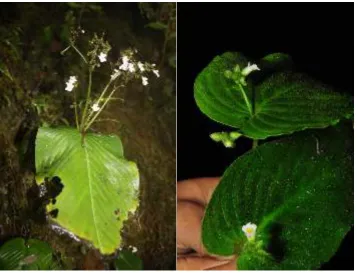
1
2 3
4
1
3 4
4
Abdulrokhman Kartonegoro - Herbarium Bogoriense, Bogor, Indonesia Altafhusain B. Nadaf - University of Pune, Pune, India
Amy Y. Rossman - Systematic Mycology & Microbiology Laboratory USDA-ARS, Beltsville, USA Andre Schuiteman - Royal Botanic Gardens, Kew, UK
Ary P. Keim - Herbarium Bogoriense, Bogor, Indonesia
Barry Conn - Royal Botanic Gardens National Herbarium of New South Wales, Sydney, Australia Dato' Abdul Latiff Mohamad - Universiti Kebangsaan Malaysia, Bangi, Selangor, Malaysia Daniel Potter - Department of Plant Sciences, University of California, Davis, California, USA
Deby Arifiani - Herbarium Bogoriense, Bogor, Indonesia Ferry J. W. Slik - University of Brunei Darussalam, Brunei
Henti H. Rachmat - Conservation and Rehabilitation Research and Development Center, Bogor, Indonesia Ian M. Turner - Royal Botanic Gardens, Kew, UK
Iskandar Z. Siregar - Bogor Agricultural University, Bogor, Indonesia Jay H. Bernstein - Kingsborough Community College, Brooklyn, New York, USA
Jens G. Rohwer - University of Hamburg, Hamburg, Germany Joan Pereira - SAN Herbarium, Sabah Forestry Department, Sabah, Malaysia
Kuswata Kartawinata - Herbarium Bogoriense, Bogor, Indonesia Lars H. Schmidt - University of Copenhagen, Copenhagen, Denmark
Mark Hughes - Royal Botanic Gardens, Edinburgh, UK Masahiro Kato - Kyoto University, Kyoto, Japan Nuril Hidayati - Herbarium Bogoriense, Bogor, Indonesia Ong Poh Teck - Forest Research Institute Malaysia, Kepong, Malaysia
Peter C. van Welzen - National Herbarium Netherlands, Leiden University Branch, Leiden, Netherlands Reuben Nilus - Sabah Forestry Department, Sabah, Malaysia
Rugayah - Herbarium Bogoriense, Bogor, Indonesia
Ruth Kiew - Forest Research Institute of Malaysia, Kepong, Malaysia
REINWARDTIA south. The area is characterized by tropical lowland evergreen forest and tropical montane forest (Mortelliti et al., 2012). The highest peak, Mosero-Sero, reaches an elevation of about 2620 m above sea level. The Mekongga Mountains include karst areas similar to those in the Verbeek Mountains in South Sulawesi. The Mekongga Mountains area has been designated as protected forest by the Ministry of Forestry, but, to date, it has not been included in any conservation area such as a National Park or Nature Reserve.
INTRODUCTION
The plant species richness of Sulawesi, Indonesia is much lower than Borneo, Sumatra or New Guinea in the Malesian region, but the level of endemism in Sulawesi flora is very high. This pat-tern is apparent in the family Gesneriaceae, in which eleven genera are currently recorded from Sulawesi, including Aeschynanthus, Agalmyla, Boea, Codonoboea, Cyrtandra, Epithema, Monophyllaea, Paraboea, Rhynchoglossum, Rhynchotechum and Stauranthera. About 50 species are found on with the island, mostly from Cyrtandra and followed by several other genera. Boea, Codonoboea, Rhynchotechum and Stauranthera are each represented by only one
THE GESNERIACEAE OF SULAWESI VI: THE SPECIES FROM
MEKONGGA MTS. WITH A NEW SPECIES OF CYRTANDRA DESCRIBED
ReceivedJanuary 13, 2014; accepted April 6, 2014
ABDULROKHMAN KARTONEGORO
Herbarium Bogoriense, Botany Division, Research Center for Biology-LIPI, Cibinong Science Center, Jln. Raya Jakarta-Bogor Km. 46, Cibinong 16911, Bogor, Indonesia. E-mail: [email protected]
DANIEL POTTER
Department of Plant Sciences, MS 2, University of California, 1 Shields Avenue, Davis, CA 95616, USA. E-mail: [email protected]
ABSTRACT
KARTONEGORO, A. & POTTER, D. 2014. The Gesneriaceae of Sulawesi VI: The species from Mekongga Mts. with a new species of Cyrtandra described. Reinwardtia 14 (1): 1 – 11. ― Field exploration of the flora of the Mekongga Mountainous area of Southeast Sulawesi was conducted from 2009 to 2011. Herbarium specimens collected during this exploration and additional collections from Herbarium Bogoriense (BO) included 21 species in nine genera of the family Gesneriaceae. These comprise one species of Aeschynanthus, four species of Agalmyla, one species of
Codonoboea, seven species of Cyrtandra, one species of Epithema, three species of Monophyllaea, two species of
Rhynchoglossum, one species of Rhynchotechum and one species of Stauranthera. Twelve of these species are consider-ed endemic to Sulawesi while the rest are known to occur on neighbouring islands or are more widely distributconsider-ed.
Monophyllaea merrilliana, previously known only from the Philippine Islands and Borneo, is newly recorded for Sulawesi. A new species of Cyrtandra collected in the Mekongga area, C.widjajae, which resembles C. gorontaloensis
from North Sulawesi but differs in having shorter pedicels and curved rather than straight fruits, is described.
Key words: Endemic, Gesneriaceae, Mekongga Mountainous area, Sulawesi.
ABSTRAK
KARTONEGORO, A. & POTTER, D. 2014. Gesneriaceae Sulawesi VI: Jenis-jenis dari Pegunungan Mekongga dengan deskripsi satu jenis baru Cyrtandra. Reinwardtia 14 (1): 1 – 11. ― Eksplorasi tumbuhan di wilayah Pegunungan Mekongga Sulawesi Tenggara telah dilakukan sejak 2009 sampai 2011. Spesimen herbarium yang dikoleksi dalam eksplorasi ini dan koleksi tambahan dari Herbarium Bogoriense (BO) terdiri dari 21 jenis dalam sembilan marga dari suku Gesneriaceae. Jenis-jenis tersebut terdiri dari satu jenis Aeschynanthus, empat jenis Agalmyla, satu jenis Codonoboea, tujuh jenis Cyrtandra, satu jenis Epithema, tiga jenis Monophyllaea, dua jenis Rhynchoglossum, satu jenis Rhynchotechum dan satu jenis Stauranthera. Dua belas jenis dari keseluruhan merupakan endemik untuk Sulawesi sedangkan sisanya diketahui terdapat di pulau lainnya atau tersebar lebih luas. Monophyllaea merrilliana, sebelumnya diketahui hanya terdapat di Filipina dan Borneo, terekam baru untuk Sulawesi. Satu jenis baru Cyrtandra
dipertelakan berasal dari wilayah Mekongga, C. widjajae, yang mirip dengan C. gorontaloensis dari Sulawesi Utara tetapi berbeda karena memiliki tangkai bunga yang lebih pendek dan buah yang melengkung dan tidak lurus.
MATERIAL AND METHODS
Herbarium specimens of Gesneriaceae from Her-barium Bogoriense (BO) collected from Mekongga Mts. were examined. Most of these collections were made during field exploration for an International Cooperative Biodiversity Groups (ICBG) Project from 2009-2011. Additional specimens examined were collections made by Gunar Kjellberg in 1929. The data were supplemented by additional field notes from the specimens.
RESULTS
Nine genera and about 21 species of Gesneria-ceae were recognized from the Mekongga Moun-tains. Cyrtandra is the best represented genus, with seven species, one of which is described as new in
this account and one of which remains undetermined. Agalmyla, Monophyllaea and
Rhynchoglossum are represented, respectively, by four, three and two species, while each of the genera Aeschynanthus, Codonoboea, Epithema, Rhynchotechum and Stauranthera is represented by only one species. Twelve species are endemic to Sulawesi (four from Agalmyla, five from Cyrtandra, two from Monophyllaea and one from Rhynchoglossum) and two species, Agalmyla scabriflora Hilliard & B. L. Burtt and Cyrtandra widjajae Karton., are endemic to Mekongga Mts. A new species of Cyrtandra, C.widjajae, ishere described from the Mekongga Mountains in South-east Sulawesi. The species belongs to the section Dissimiles C. B. Clarke, a group distinguished by clear diagnostic characters including anisophyllous opposite leaf arrangement, a zygomorphic calyx with the three upper lobes fused and the two lower lobes free, and the corolla small (less than 2 cm long) and fleshy (Bramley, 2005).
Key to genera (adapted from Weber, 2004).
1a. Fleshy herb, unifoliar or leaves asymmetric, ovary and fruit globose, not twisted .…….…. 2 1b. Shrubs or not fleshy herb, leaves equal in size,
ovary and fruit elongate, twisted or not.…..… 5 2a. Plant unifoliar, sepals ovate to suborbicular,
ovary bilocular ………... Monophyllaea
2b. Plant not unifoliar, leaves asymmetric, some-times anisophyllous or pseudoalternate …..… 3 3a. Leaves of upper nodes equal in size and shape,
inflorescence scorpioid ………..…… Epithema unilateral raceme in two rows.. Rhynchoglossum 5a. Fruit fleshy, indehiscent ………...… 6 5b. Fruit a capsule, dehiscent ………. 7 6a. Corolla tube shorter than 6 mm, fertile stamens
4 ………..…. Rhynchotechum
6b. Corolla tube longer than 6 mm, fertile stamens 2
………... Cyrtandra
7a. Plants epiphytic, fruits straight……….. 8
7b. Plants terrestrial, fruits bent ……... Codonoboea
8a. Leaves not coriaceous, lateral veins visible,
fer-tile stamens 4 ……….…….… Agalmyla
8b. Leaves coriaceous, lateral veins invisible, fertile
stamens 2 ……….….. Aeschynanthus
Aeschynanthus Jack, Trans. Linn. Soc. London 14
(1823) 42, nom. cons. ― Type: A. volubilis Jack.
Aeschynanthus comprises about 160 species distributed from India through South China and Southeast Asia to the Solomon Islands (Middleton, 2007). The genus is easily recognized by its epi-phytic pendulous habit with opposite or verticillate coriaceous leaves. The fruits are long narrow cap-sules that dehisce loculicidally.
AESCHYNANTHUS RADICANS Jack
Aeschynanthus radicans Jack, Trans. Linn. Soc. London 14 (1823) 43. ― Type: Sumatra, Bencoolen, Jack s.n. (lost). Neotype (Middleton 2007): Sumatra, Lampung, Gunung Rate Telanggaran, Iboet 57 (L; isotype BO).
This is the first confirmed report from Sulawesi of this species, which is widespread in western Malesia including Southern Thailand. It is usually found in evergreen forest, often along streams. In Kalimantan (Indonesian part of Borneo), the species has been recorded grown in peat swamp forest. Aeschynanthus radicans is often confused with A. pulcher (Blume) G. Don, which is distributed in western Malesia as well. The difference between these two closely related species is that leaves are generally pubescent in A. radicans, but rarely so in A. pulcher. They also differ in pubescence of the ovary, which is densely pubescent in A. radicans and with sessile glands in A. pulcher (Middleton, 2007).
Additional distribution. South Thailand, Peninsu-lar Malaysia, Sumatra, Borneo, Java.
Specimen examined. Julianto 17, Tinukari 704 m.
Agalmyla Blume, Bijdr. Fl. Ned.-Ind. 14 (1826)
2014] KARTONEGORO & POTTER: Gesneriaceae of Mekongga 3
Agalmyla is a genus comprising about 99 species found in the rain forest areas from Malay Peninsula eastwards to New Guinea. Hilliard & Burtt (2002) divided this genus into 3 sections, Agalmyla, Dichrotrichum (de Vriese) Hilliard & B. L. Burtt and Exannularia Hilliard & B. L. Burtt. The section Agalmyla is found only in west of the Wallace line while the other two are found only in east of the line. Twelve species known from Sulawesi belong to the section Exannularia, characterized by the lack of an annulus inside corolla tube, which is present in other sections of the genus either as a ring or as a broad band of hairs. Moreover, all the Sulawesi species are endemic to the island. Four species have been collected in the Mekongga Mts.
Key to species
1a. Corolla glabrous or sparsely hairy on the edge of the lobes ………...……….... 2 1b. Corolla densely covered with coarse hairs on the
tube and lobes ……….. A. scabriflora
2a. Calyx lobes as long as tube ………... A. brownii
2b. Calyx lobes longer than tube ……….... 3 3a. Leaf blade oblong, 30-70 cm long; corolla lobes
yellow ……….. A. remotidentata
3b. Leaf blade ovate, less than 25 cm long; corolla
lobes red ………... A. exannulata
1. AGALMYLA BROWNII (Koord.) B. L. Burtt
Agalmyla brownii (Koord.) B. L. Burtt, Edinburgh J. Bot. 59 (2002) 76. ― Didymocarpus brownii Koord., Meded. Lands Plantentuin 19 (1898) 551, 628; Suppl. Fl. N. O. Sulawesi (1922) tab. 121. ― Dichrotrichum brownii
(Koord.) B. L. Burtt, Notes Roy. Bot. Gard. Edinburgh 24 (1962) 41. ― Lectotype: Sulawesi, Province Minahassa, Gunung Lokon, Koorders 17177β (L; isotype BO).
Agalmyla brownii is distributed widely in separated localities in Sulawesi, especially in montane forest from 1700 and 2500 m asl. (Hilliard & Burtt, 2002). The species has been collected from the north peninsula area (Lokon) through the Central (Nokilalaki-Roreka Timbu) and into the Southern (Latimojong) and Southeastern (Mekongga-Watuwila) regions of the island. This species shows variation in leaf shape based on age. Young leaves are usually ovate with lobes accounting for roughly half the blade. The second leaves are elliptic and coarsely toothed and the third leaves are obovate. All leaves are hairy, with denser pubescence along the midrib and lateral veins. The peduncle is usually long up to 23 cm, with 3–7 red flowers in each cyme.
Additional distribution. North Sulawesi (Mt. Lokon, Mt. Ambang), Central Sulawesi (Mt. Noki-lalaki, Mt. Roreka Timbu, Mt. Beabis), South Sulawesi (Latimojong Mts.), Southeast Sulawesi (Mt. Watuwila).
Specimen examined. Widjaja et al. 9816, Tinukari 1900 m.
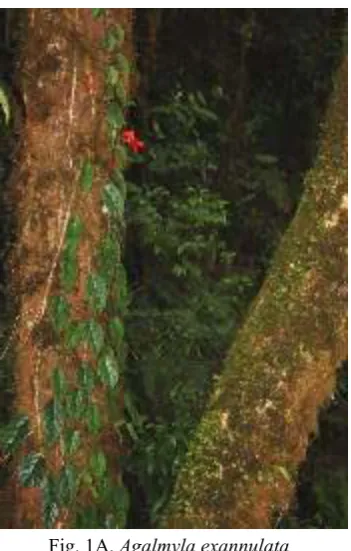
2. AGALMYLA EXANNULATA Hilliard & B. L. Burtt ― Fig. 1A
Agalmyla exannulata Hilliard & B. L. Burtt, Blumea 44 (1999) 383; Hilliard & B. L. Burtt, Edinburgh J. Bot. 59 (2002) 95. ― Type: Sulawesi, Gunung Nokilalaki, Johansson, Nyboom & Riebe 257 (E; isotype L).
The name of the species refers to the lack of annulus inside the corolla tube, a character shared by all species of Agalmyla in Sulawesi for which the Section Exannularia (Hilliard & Burtt, 2002) to which they belong is also named. The inflorescence in this species is almost sessile in few-flowered axillary cyme. Some individuals have the posticous stamens reduced into staminodes; to date, this condition has been observed only in specimens from west of the Wallace line. Hairs on the leaves are relatively few and scattered.
Additional distribution. Central Sulawesi (Mt. Nokilalaki, Mt. Tambusisi, Tojambu), Southeast Sulawesi (Mt. Watuwila).
Specimens examined. Kjellberg 2676, Bulu Porema, 1200 m; Widjaja et al. 9765, Tinukari, camp 4-5, 1500 m.
3. AGALMYLA REMOTIDENTATA Hilliard & B. L. Burtt ― Fig. 1B
Agalmyla remotidentata Hilliard & B. L. Burtt, Edinburgh J. Bot. 59 (2002) 98. ― Type: Sulawesi, Mts. Roroka Timbu South of Palu, Hennipman 5480 (E; iso-types BO, L).
Additional distribution. Central Sulawesi (Mt. Roreka Timbu).
Specimen examined. Hafid 132, Tinukari.
4. AGALMYLA SCABRIFLORA Hilliard & B. L. Burtt
Agalmyla scabriflora Hilliard & B. L. Burtt, Edinburgh J. Bot. 59 (2002) 87. ― Type: Sulawesi, Mekongga Mts., B. Porema, Kjellberg 2636(S; isotype BO).
Agalmyla scabriflora is known endemic to Me-kongga Mts.; the type collection was collected by Kjellberg from Bulu Porema in northern part of the mountain. It has corolla with a coarse hairs on both side and the lobes. This feature makes this species distinct among all the Sulawesi Agalmyla (Hilliard & Burtt, 2002). The flowers are small and solitary in the leaf axils, which is very rare for the genus.
Habitat and ecology. In wet mountainous forest, rich with bryophytes, 1400-2576 m.
Specimens examined. Widjaja et al. 9289, Sero-Sero 2576 m; Kjellberg 2636, Porema 1400 m.
Codonoboea Ridl., Fl. Malay Pen. 2 (1923) 533. ― Lectotype: C. leucocodon (Ridl.) Ridl.
Codonoboea is the third largest genus of Gesneri-aceae in Malesia after Cyrtandra and Aeschynan-thus. More than 100 species are known which
previ-ously described under Didymocarpus and Hencke-lia. The genus is distributed in western Malesia from southern Thailand eastward to New Guinea and the Philippines but absent from Java and the Lesser Sunda Islands. The center of distribution is in Peninsular Malaysia.
CODONOBOEA KJELLBERGII (B. L. Burtt) Kar-ton. ― Fig. 2
Codonoboea kjellbergii (B. L. Burtt) Karton., Edinburgh J. Bot. 69 (2012) 360. ― Henckelia kjellbergii B. L. Burtt, Beitr. Biol. Pflanzen 70 (1998) 378. ― Type: Su-lawesi, B. Watoewila, Kjellberg 1092(S; isotype BO).
Codonoboea kjellbergii is found in Sulawesi, Moluccas and New Guinea. These areas comprise the eastern most distribution of the genus (Kartonegoro, 2012). This is also the only species of the genus in Sulawesi. Codonoboea kjellbergii is easily distinguished by its oblong lanceolate pubes-cent leaves and corolla with a white tube and purple lobes.
Additional distribution. Central Sulawesi (Kolonedale, Poso), South Sulawesi (Mt. Latupa, Mt. Taponga, Tojambu, Soroako), Southeast Su-lawesi (Mt. Watuwila, Kolaka, Pohara), Moluccas (Ambon, Seram), New Guinea (Paniai Lake).
Specimens examined. Widjaja et al. 9945, Tinu-kari, Sero-Sero 2560 m; Widjaja & Sujadi 8973, Tinukari, on the way to Point 1250 m.
2014] KARTONEGORO & POTTER: Gesneriaceae of Mekongga 5
Cyrtandra J. R. Forst & G. Forst, Char. Gen. Pl.
(1775) 3. ― Type: C. biflora J.R. Forst & G. Forst.
Cyrtandra is a large genus in Gesneriaceae, comprising ca. 600 species of herbs, shrubs, climbers and small trees. The genus has wide distri-bution from Nicobar Islands in the west to Polyne-sia and Hawaii to east, and the southern Japan islands in the north to northern Australia in the south (Atkins, 2004). The center of diversity of Cyrtandra is in Malesia with more than 400 species. In Sulawesi there are so far 17 described species and at least 11 awaiting description known (Mendum & Atkins, 2004).
stem below ground; corolla white.. C. hypogaea
5a. Stem tessellated; corolla yellow …... C. fasciata
5b. Stem smooth; corolla white ……... C. polyneura
1. CYRTANDRA COCCINEA Blume var. CELEBICA (Blume) C. B. Clarke ― Fig. 3A
Cyrtandra coccinea Blume var. celebica (Blume) C.B. Clarke in A.DC & C.DC, Monog. Phan. 5 (1883) 256. ― Cyrtandra celebica Blume, Bijdr. 14 (1826) 772. ―
Type: Sulawesi, Forsten s.n. (L).
Specimens examined. Hidayat et al. 4095, Tinu-kari, Patikal Forest 130 m; Widjaja et al. 9694,
Key to species
1a. Leaves anisophyllous, reduced leaf smaller or
scale-like ………..……… 2
1b. Leaves isophyllous, equal ………... 3 2a. Reduced leaf scale-like; inflorescences
1-flowered; pedicels 15-30 mm long; fruits
straight ………... C. gorontaloensis
2b. Reduced leaf ovate to peltate; inflorescences 3-7 flowered; pedicels 3-4 mm long; fruits curved
………... C. widjajae
3a. Stem strongly woody; inflorescence cauliflorous ……….. 4 3b. Stem strongly fleshy; inflorescence in the leaf
axils ………..……….... 5 4a. Plants 2-3 m high; inflorescence arising from
stem above ground; corolla bright red ……….
………...C. cocinea var. celebica
4b. Plants 0.5-1 m high; inflorescence arising at
Tinukari, on the way to camp 3, 952 m; Potter 16, Tinukari.
2. CYRTANDRA FASCIATA H. J. Atkins
Cyrtandra fasciata H.J. Atkins, Edinburgh J. Bot. 60 (2004) 309. ― Type: Sulawesi, Gorontalo, Gunung Gambuta, Atkins et al. 54(BO; isotype E).
Cyrtandra fasciata is easily distinguished from other species by its tessellated and erect stems and flowers with red and yellow lobes constricted below the tips.
Additional distribution. North Sulawesi (Mt. Gambuta), Central Sulawesi (Tambing Lake), West Sulawesi (Polewali).
Specimen examined. Widjaja et al. 9711, Tinukari, on the way to camp 3, 931-942 m.
3. CYRTANDRA GORONTALOENSIS H. J. Atkins
Cyrtandra gorontaloensis H. J. Atkins, Edinburgh J. Bot. 60 (2004) 307. ― Type: Sulawesi, Gorontalo, Gunung Gambuta, Atkins et al. 91(BO; isotype E).
Cyrtandra gorontaloensis is allied with two other species of the genus found in Sulawesi, C. engleri Koord. and C. widjajae; all three of these species have anisophyllous leaf pairs, calyces with united 3-upper lobes and the densely hairy corolla exteriors. Cyrtandra gorontaloensis differs from the other two by having longer pedicels (1.5 to 3 cm long) and yellow corollas. This species was previously known only from the northern peninsula of Sulawesi and is here reported from the southeastern peninsula.
Specimen examined. Rinal et al. 8, Tinukari, on the way to the top, 1300 m.
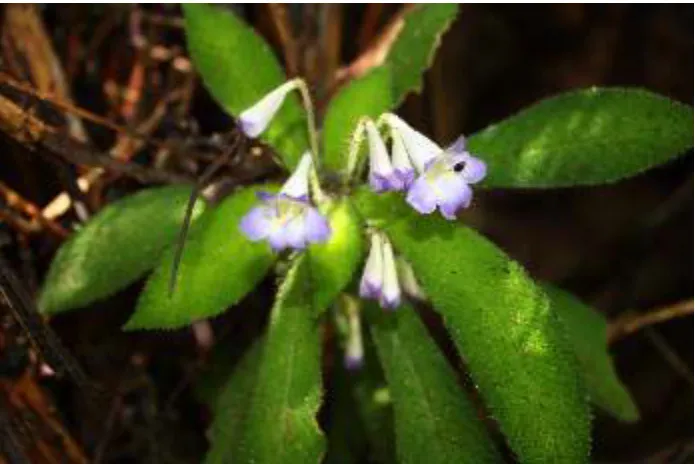
4. CYRTANDRA HYPOGAEA Koord. ― Fig. 3B
Cyrtandra hypogaea Koord., Meded. Lands Plantentuin 19 (1898) 550, 628. ― Type: Sulawesi, Minahassa, Lolomboelan, Koorders 17190β(BO).
There are three species Cyrtandra from Sulawesi that have flowers borne on trailing stems that originated from the base plant. One of them is C. hypogaea which has geocarpic inflorescences with a reddish brown calyx and white corollas with yellow dots on the lobes. The other two species are C. geocarpa Koord. with bright red corollas and C. luteiflora H. J. Atkins with yellow corollas.
Specimens examined. Widjaja et al. 9713, Tinukari; Widjaja et al. 9712, Tinukari, on the way to camp 3, 931-942 m.
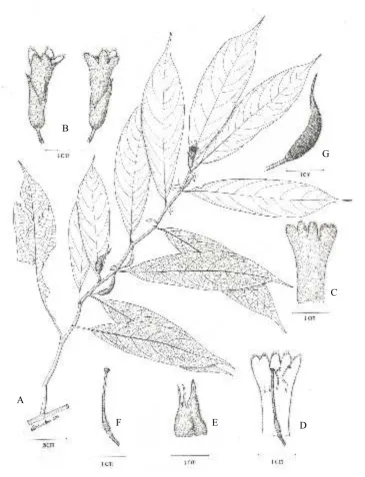
6. Cyrtandra widjajae Karton.spec.nov. ― Fig. 4
Cyrtandra widjajae belongs to Section Dissimiles, in whose members are characterized by anisophyllous leaf arrangement, zygomorphic calyces and small corollas 1.5
–2 cm long. The flowers of C. widjajae are densely hairy
outside and glabrous inside and the fruits are curved, hairy, and tessellated. Cyrtandra widjajae is most simi-lar to C. gorontaloensis H.J. Atkins but differs from the latter by its ovate or peltate reduced leaf, 3–7-flowered inflorescences with shorter pedicels (3-4 mm long) and curved fruits rather than scale-like reduced leaf, 1– flowered solitary inflorescences with longer pedicels (15 –30 mm long) and straight fruits. ―Type: Sulawesi, South East Sulawesi Province, Mekongga Mts., North Kolaka, Rante Angin District, Tinukari village, Hura Hura. 1426 m. 28.xi.2010. Widjaja et al. 9412 (BO; iso-types DAV; E).
Shrub; stem woody, terete, subangular, glabrous to puberulous, ca. 3.5 mm in diameter; nodes swollen, interpetiolar line conspicuous. Leaves opposite, ani-sophyllous; larger leaf oblong-elliptic, entire, 7.8– 16 by 2–4 cm, tip acuminate, 0.5–1 cm long, base cuneate; reduced leaf ovate to peltate, entire, 0.4–2 by 0.3–1 cm, tip acute, base cordate, subsessile or with ca. 0.2 mm long petiole; lamina glabrous
2014] KARTONEGORO & POTTER: Gesneriaceae of Mekongga 7
above, dark green, glabrescent below, brownish when dry, densely hairy when young; venation re-ticulate below, lateral nerves in 10–14 pairs. Petiole terete, glabrous, 0.5–0.7 cm long. Inflorescence axillary, 3–7 flowered, sessile; flowers 2–2.5 cm long. Bracteoles ovate to linear, glabrous ca. 0.5 mm long. Pedicels terete, sparsely to densely hairy, 3–4 mm long. Calyx campanulate to tubular, white to pale green, connate at base, glabrous to sparsely hairy, 6–7 by 2–2.5 mm; calyx 5-lobed, bilabiate, 3 upper lobes united into shallowly triangular lip, 2
lower lobes mostly free with subconnate base, 3–7 mm long, base hairy. Corolla white, densely hairy outside ca. 0.5–1 mm long, glabrous inside, 1.5–2 cm long; limb bilabiate, not recurved, 2 upper lobes equal, 2–4 mm by 1–2 mm, 3 lower lobes 3–5 mm by 1–2 mm. Stamens 2, exserted from corolla tube in the lower lobes; filaments terete 3–5 mm long; anthers ovoid, glabrous, ca. 1.5 mm long, cohering at tips. Ovary densely hairy, 5–7 mm long; style terete, hairy, up to 2 cm long; stigma bilobed ca. 1.5 mm long. Disk cupular, ca. 1 mm, glabrous. Fruits Fig. 4. Cyrtandra widjajae. A. Habit; B. Flowers; C. Corolla (outside); D. Corolla (inside); E.
Calyx; F. Style; G. Fruit. (from Widjaja et al. 9412 [holotype BO]). A
B
C
D E
F
elongate, acute with 1–2 mm long tip, curved, densely hairy, tessellate, 1.3–2.5 by 0.3–0.5 cm; stalk glabrous, ca. 0.5 cm long.
Distribution. Sulawesi (only known from Me-kongga Mts.)
Habitat. Mountain forest under canopy at 1426 m.
Etymology. The epithet name after Elizabeth A. Widjaja (BO), a bamboo taxonomist and collector of plants.
Notes. Similar to C. gorontaloensis H. J. Atkins, but differs by its inflorescences with 3–7 flowers with short pedicels (3–4 mm long) and its elongate curved fruits. Cyrtandra gorontaloensis has solitary flowers with longer pedicels (15–30 mm long) and ovoid fruits that are not recurved. The two species are similar in having unequal leaf pairs, corollas less than 2 cm long, calyces with the three upper lobes united and the two lower lobes mostly free. Based on those characters, the species is included in Section Dissimiles, which is also known from Sumatra and Borneo. Sterile specimens of this species are similar to C. rubropicta Kraenzl., which is known from Borneo but the two species differ in habit: C. rubropicta is an epiphyte or scrambler 9727, Tinukari, on the way camp 3, 931-942 m.
7. Cyrtandra sp.
An unidentified species of Cyrtandra was collected from Mekongga in August 2009. The plant was fruiting at the time of collection; no flowers were collected. Based on the habit and leaves, this spe-cies is similar to C. gorontaloensis, but it differs from the latter in having large glabrous (ca. 22 mm long) and smooths fruits rather than small (12-18 mm long) densely hairy fruits with tessellated sur-faces.
Specimen examined. Hidayat et al. 4217, Tinukari 1063 m.
Epithema Blume, Bijdr. Fl. Ned.-Ind. 14 (1826)
737. ― Type: E. saxatile Blume
EPITHEMA SAXATILE Blume
Epithema saxatile Blume, Bijdr. Fl. Ned.-Ind. 14 (1826) 737. ― Type: Java, Blume sn. (L).
Epithema saxatile also found in some areas in Malesia. The species also found in Sumatra, Peninsular Malaysia, Borneo and Java. Resembles with E. horsfieldii but different with having oppo-site leaves near apex while the later having solitary leaves at apex.
Specimen examined. Kjellberg 2616, Kosali-Porema 500 m; Kjellberg 2618, Kosali-Porema 600 m.
Monophyllaea R. Br., in Bennett, Pl. Jav. Rar.
(1838) 121. ― Type: M. horsfieldii R.Br.
Monophyllaea is a genus that has distribution along Malesian region from Sumatra to New Guinea. This genus has a unique character, an unifoliar leaf with inflorescence arising from the base of petiole or base of lamina. Members of this genus are usually found growing on limestone or other rocky habitats in rainforest and on the edges of streams. Another genus whose members occupy similar habitats is Whytockia from China.
Key to species
1a. Inflorescence branched ………...……….. 2
1b. Inflorescence not branched …………. M. eymae
2a. Leaf blade ovate, indumentum hairs branched, dendroid; inflorescence forked ... M. merrilliana 2b. Leaf blade oblong, indumentum hairs simple; inflorescence with lateral branches ………. Bantimoeroeng, between Makassar and Maros, Van Steenis 10445 (L; isotypes A, BO, K, NY, SING).
Compared to other species, M. anthocrena has more crowded branches in the inflorescences with a bright white corolla and pinkish portion close to the upper lobes. The leaf shape of this species is also oblong rather than ovate-lanceolate.
2014] KARTONEGORO & POTTER: Gesneriaceae of Mekongga 9
2. MONOPHYLLAEA EYMAE B. L. Burtt
Monophyllaea eymae B.L. Burtt, Notes Roy. Bot. Gard. Edinburgh 37 (1978) 30. ― Type: Sulawesi, Res. Menado, Loewoek, between Pinapoeang-G.Loloa-G.Beabis, Eyma 3875 (L; isotypes A, BO, K).
Specimens examined. Kjellberg 2603, Kosali-Porema, 650 m; Widjaja et al. 9320, Tinukari, Sero-Sero, 2576 m; Widjaja 9815, Tinukari.
3. MONOPHYLLAEA MERRILLIANA Kraenzl. ― Fig. 5B
Monophyllaea merrilliana Kraenzl., Philipp. J. Sci., C 8 (1913) 168. ― Lectotype: Philippines, Mindanao, District of Zamboanga, Sax River (BM; isotype K).
Monophyllaea merrilliana is one of the species in the genus that has a widespread distribution. Prior to 1978 the species was only known from Philip-pines Islands, but it has more recently been found in several locations in Borneo and also Sulawesi. The other Monophyllaea species that has a widespread distribution is M. horsfieldii, which is found in Sumatra, Peninsular Malaysia and Java. Monophyl-laea merrilliana is also unusual in the genus in that the species is not only found on limestone substrates but is also sometimes found on other rock types close to streams. Several collections from Mekongga show a leaf shape that is more ovate compared to the type, whose leaves have an oblong leaf shape.
Specimens examined. Kjellberg 2617, Kosali-Porema, 650 m; Widjaja et al. 9697, Tinukari, on the way to camp 3, 952 m.
Rhynchoglossum Blume, Bijdr. Fl. Ned.-Ind. 14
(1826) 741. ― Type: R. obliquum Blume.
Rhynchoglossum is a genus of fleshy herbs with anisophyllous, decussate or alternate leaves with asymmetrical leaf blades and unilateral inflorescen-ces. Its preferred habitat is on wet and shady (especially limestone) rocks, in forest or in open vegetation or shady places, usually in the lowlands. Rhynchoglossum is distributed in tropical Asia from India, Sri Lanka, China, Taiwan and Indochina to New Guinea and in the New World in Central and South America extending from Mexico to Peru (Kartonegoro, 2013).
Key to species
1a. Leaf blade oblong; fruits elongate, half enclosed
by persistent calyx ……….... R. capsulare
1b. Leaf blade ovate to elliptic; fruits ovoid, fully
enclosed by persistent calyx …….. R. obliquum
1. RHYNCHOGLOSSUM CAPSULARE Ohwi ex Karton.
Rhynchoglossum capsulare is endemic to Sulawesi and known only from two collections. The species is not easily confused with other species in the ge-nus due to its oblong-lanceolate (vs. ovate to elliptic in other species) leaves and the capsule-like fruits with a persistent calyx not bearing a wing and not fully enclosing the fruit. This species is mostly similar to a common R. obliquum which is wide-spread through Southeast Asia.
Specimen examined. Kjellberg 2663, Bulu Porema, 1400 m.
2. RHYNCHOGLOSSUM OBLIQUUM Blume
Rhynchoglossum obliquum Blume, Bijdr. 14 (1826)
741. ― Lectotype: Java, Blume 52 (L).
Rhynchoglossum obliquum is the most common and widespread species in the genus. This species has a long and crowded inflorescence with a small white to blue-purple flowers. Another closely related spe-cies found in Sulawesi is R. capsulare, but the latter differs from the former by having oblong-lanceolate leaves and a half-enclosed persistent calyx.
Habitat and ecology. Open places along streams, in secondary forest, creeping on rocks up to 1400 m.
Additional distribution. India, Srilanka, South China, Taiwan, Indochina, Thailand throughout Malesia to New Guinea.
understory subshrubs distributed from India, South China, Formosa, and Ryukyu, southwards through Indochina, Thailand, Malesia to Papua New Guinea. The genus is allied with Cyrtandra but differs by its four fertile stamens with unilocular anthers and its globose fruits (Anderson & Middleton, 2013).
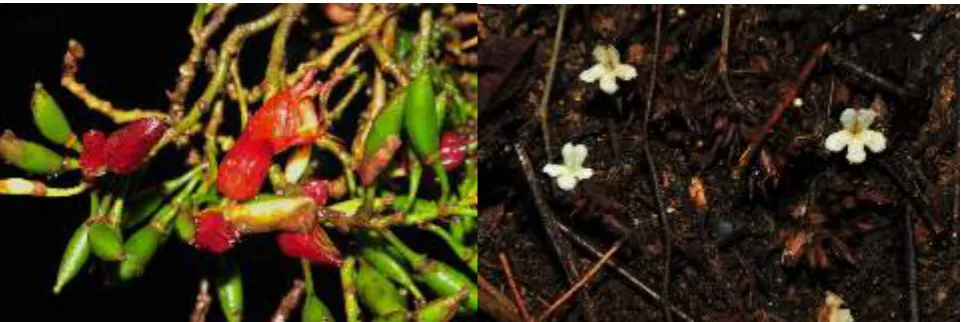
RHYNCHOTECHUM PARVIFLORUM Blume ― Fig 6A & 6B.
Rhynchotechum parviflorum Blume, Bijdr. 14 (1826) 775; Anderson & Middleton, Edinburgh J. Bot. 70 (2013) 160. ― Lectotype: Java, Mt. Seribu, Blume sn. (L). and secondary forests and thickets, near stream or in limestone and sandstone bedrocks.
Specimens examined. Widjaja & Sujadi 9038, Tinukari, Hutan Masembo 515 m; Widjaja & Sujadi 8931, Tinukari, Point 1, 250 m; Widjaja & Sujadi 9056, Tinukari, Surrounding Plot 4.1, 478 m; Widjaja et al. 9700, Tinukari, on the way to camp 3, 931-942 m.
Stauranthera Benth., Scroph. Ind. (1835) 57. ― Type: S. grandiflora Benth.
STAURANTHERA COERULEA (Blume) Merr.
Stauranthera coerulea (Blume) Merr., Enum. Philipp. Fl. Pl. 3 (1923) 455. ― Miquelia coerulea Blume, Bull. Sci. Phys. Nat. Néerl. 1 (1838) 94. ― Type: Blume sn., Java (L).
2014] KARTONEGORO & POTTER: Gesneriaceae of Mekongga 11
mens from there have recently been assigned to a different species, S. philippinensis Elmer (Burtt, 1984).
Specimen examined. Kjellberg 2619, Kosali-Porema, 650 m.
ACKNOWLEDGEMENTS
The project described was supported by Grant Number U01TW008160 from the Fogarty International Center, the Office of Dietary Supplements, the National Science Foundation and the Department of Energy. This project was supported by the USDA Agricultural Food Research Initiative of the National Institute of Food and Agriculture, USDA, Grant #35621-04750. The content is solely the responsibility of the authors and does not necessarily represent the official views of the Fogarty International Center or the National Institutes of Health, the Office of Dietary Supplements, the National Science Foundation, the Department of Energy, or the Depart-ment of Agriculture. We would like to thank Prof. Dr. Elizabeth A. Widjaja (BO) for providing all the speci-mens Gesneriaceae from Mekongga. Thanks are also for Dr. David Middleton (E) and Dr. Ruth Kiew (KEP) for support and invaluable guidance when working in the family of Gesneriacae in Malesia. We are also grateful to the curator of BO for permission to examine the collec-tions.
REFERENCES
ANDERSON, B. M. & MIDDLETON, D. J. 2013. A revision of Rhynchotechum Blume (Gesneriaceae).
EdinburghJournal of Botany 70: 121–176.
ATKINS, H. J. 2004. The Gesneriaceae of Sulawesi II: seven new species of Cyrtandra. Edinburgh Journal of Botany 60: 305–321.
BRAMLEY, G. L. C. 2005. Revision of Cyrtandra sec-tion Dissimiles (Gesneriaceae). Blumea 50: 163– 189.
BURTT, B. L. 1978. Studies in the Gesneriaceae of the old world XLV: a preliminary revision of Monophyl-laea. NotesRoy. Bot. Gard. Edinburgh 37: 1–59. BURTT, B. L. 1984. The first species of Stauranthera
from New Guinea, with general notes on the genus.
JournalArnold Arboretum 65: 129–133.
HILLIARD, O. M. & BURTT, B. L. 2002. The genus
Agalmyla (Gesneriaceae-Cyrtandroideae). Edinburgh Journal of Botany 59: 1–210.
KARTONEGORO, A. 2012. The Gesneriaceae of Su-lawesi V: A new species of Rhynchoglossum and a new combination in Codonoboea. Edinburgh Journal of Botany 59: 357–361.
KARTONEGORO, A. 2013. A revision of Rhynchoglos-sum (Gesneriaceae) in Malesia. Reinwardtia 13(5): 421–432.
MENDUM, M. & ATKINS, H. J. 2004. The Gesneri-aceae of Sulawesi I: an introduction. Edinburgh Journal of Botany 60: 299–304.
MIDDLETON, D. J. 2007. A revision of Aeschynanthus
(Gesneriaceae) in Thailand. Edinburgh Journal of Botany 64: 363–429.
MORTELLITI, A., CASTIGLIA, R., AMORI, G., MARYANTO, I. & MUSSER, G. G. 2012. A new species of Margaretamys (Rodentia: Muridae: Muri-nae:Rattini) from Pegunungan Mekongga, southeast-ern Sulawesi, Indonesia. Tropical Zoology 25(2): 74 –107.
INSTRUCTION TO AUTHORS
Scope. Reinwardtia is a scientific irregular journal on plant taxonomy, plant ecology and ethnobotany published in December. Manuscript intended for a publication should be written in English.
Titles. Titles should be brief, informative and followed by author's name and mailing address in one-paragraphed.
Abstract. English abstract followed by Indonesian abstract of not more than 250 words. Keywords should be given below each abstract.
Manuscript. Manuscript is original paper and represent an article which has not been published in any other journal or proceedings. The manuscript of no more than 200 pages by using Times New Roman 11, MS Word for Windows of A4 with double spacing, submitted to the editor through <[email protected]>. New paragraph should be indented in by 5 characters. For the style of presentation, authors should follow the latest issue of Reinwardtia very closely. Author(s) should send the preferred running title of the article submitted. Every manuscript will be sent to two blind reviewers.
Identification key. Taxonomic identification key should be prepared using the aligned couplet type.
Nomenclature. Strict adherence to the International Code of Botanical Nomenclature is observed, so that taxonomic and nomenclatural novelties should be clearly shown. English description for new taxon proposed should be provided and the herbaria where the type specimens area deposited should be presented. Name of taxon in taxonomic treatment should be presented in the long form that is name of taxon, author's name, year of publication, abbreviated journal or book title, volume, number and page.
Map/line drawing illustration/photograph. Map, line drawing illustration, or photograph preferably should be prepared in landscape presentation to occupy two columns. Illustration must be submitted as original art accompanying, but separated from the manuscript. The illustration should be saved in JPG or GIF format at least 350 pixels. Legends or illustration must be submitted separately at the end of the manuscript.
References. Bibliography, list of literature cited or references follow the Harvard system as the following examples.
Journal : KRAENZLIN, F. 1913. Cyrtandraceae novae Philippinenses I. Philipp. J. Sci. 8: 163-179.
MAYER, V., MOLLER, ML, PERRET, M. & WEBER, A. 2003. Phylogenetic position and generic differentiation of Epithemateae (Gesneriaceae) inferred from plastid DNA sequence data. American J. Bot. 90: 321-329.
Proceedings :TEMU, S. T. 1995. Peranan tumbuhan dan ternak dalam upacara adat "Djoka Dju" pada suku Lio, Ende, Flores, Nusa Tenggara Timur. In: NASUTION, E. (Ed.). Presiding Seminar dan Lokakarya Nasional Etnobotani II. LIP1 & Perpustakaan Nasional: 263-268. (In Indonesian).
SIMBOLON, H. & MIRMANTO, E. 2000. Checklist of plant species in the peat swamp forests of Central Kalimantan, Indonesia. In: IWAKUMA et al. (Eds.) Proceedings of the International Symposium on: Tropical Peatlands. Pp. 179-190.
Book : RIDLEY, H. N. 1923. Flora of the Malay Peninsula 2. L. Reeve & Co. Ltd, London.
Part of Book : BENTHAM, G. 1876. Gesneriaceae. In: BENTHAM, G. & HOOKER, J. D. Genera plantarum 2. Lovell Reeve & Co., London. Pp. 990-1025.
Thesis : BAIRD, L. 2002. A Grammar of Keo: An Austronesian language of East Nusantara. Australian National University, Canberra. [PhD. Thesis].
Published by Herbarium Bogoriense, Botany Division, Research Center for Biology, Indonesian Institute of Sciences
Address: Jin. Raya Jakarta-Bogor Km. 46 Cibinong 16911, P.O. Box 25 Cibinong Telp. (+ 62) 21 8765066; Fax (+62) 21 8765062
E-mail: [email protected]
REINWARDTIA
Author Agreement Form
Title of article
Name of Author(s) :
I/We hereby declare that:
• My/Our manuscript was based on my/our original work.
• It was not published or submitted to other journal for publication.
• I/we agree to publish my/our manuscript and the copyright of this article is owned by Reinwardtia. • We have obtained written permission from copyright owners for any excerpts from copyrighted
works that are included and have credited the sources in our article.
Author signature (s) Date
MUHAMMAD EFFENDI, TATIK CHIKMAWATI & DEDY DARNAEDI. New cytotypes of Pteris ensiformis var. victoria from Indonesia 133
SUZANA SABRAN, REUBEN NILUS, JOAN T. PEREIRA & JOHN BAPTIST SUGAU. Contribution of the heart of Borneo (HoB) initiative towards botanical exploration in Sabah, Malaysia 137
WENNI SETYO LESTARI, BAYU ADJIE, TASSANAI JARUWATANAPHAN, YASUYUKI WATANO & MADE PHAR-MAWATI. Molecular phylogeny of maidenhair fern genus Adiantum (Pteridaceae) from Lesser Sunda Islands, Indonesia based on
Rbcl and Trnl-f 143
ELIZABETH A. WIDJAJA & DANIEL POTTER. Floristic study of Mekongga Protected Forest: towards establishment of the Mekongga National Park 157
YESSI SANTIKA, EKA FATMAWATI TIHURUA & TEGUH TRIONO. Comparative leaves anatomy of Pandanus, Freycinetia
and Sararanga (Pandanaceae) and their diagnostic value 163
SUHARDJONO PRAWIROATMODJO & KUSWATA KARTAWINATA. Floristic diversity and structural characteristics of mangrove forest of Raj a Ampat, West Papua, Indonesia 171
IAN M. TURNER. A new combination in Orophea (Annonaceae) for Uvaria nitida Roxb. ex G. Don 181
IVAN S AVINOV. Taxonomic revision of Asian genus Glyptopetalum Thwaites (Celastraceae R. Br.) 183
YUSI ROSALINA, NISYAWATL ERWIN NURDIN, JATNA SUPRIATNA & KUSWATA KARTAWINATA. Floristic compo-sition and structure of a peat swamp forest in the conservation area of the PT National Sago Prima, Selat Panjang, Riau, Indone-sia 193
IMAN HID AY AT & JAMJAN MEEBOON. Cercospora brunfelsiicola (Fungi, Mycosphaerellaceae), a new tropical Cercosporoid
fungus on Brunfelsia uniflora 211
MAX VAN BALGOOY & ELIZABETH A. WIDJAJA. Flora of Bali: a provisional checklist 219
EKA FATMAWATI TIHURUA & INA ERLINAWATI. Leaf anatomy of Pandanus spp. (Pandanceae) from Sebangau and Bukit
Baka-Bukit Raya National Park, Kalimantan, Indonesia 223
JULIA SANG & RUTH KIEW. Diversity of Begonia (Begoniaceae) in Borneo - How many species are there? 23 3
DIAN LATIFAH, ROBERT A. CONGDON & JOSEPH A. HOLTUM. A Physiological approach to conservation of four palm
Vol. 14. No. 1.2014
CONTENTS
PageABDULROKHMAN KARTONEGORO & DANIEL POTTER. The Gesneriaceae of Sulawesi VI: the species from Mekongga Mts.
with a new species of Cyrtandra described 1
LIM CHUNG LU & RUTH KIEW. Codonoboea (Gesneriaceae) sections in Peninsular Malaysia 13
WISNU H. ARDI, YAYAN W. C. KUSUMA, CARL E. LEWIS, ROSNIATI A. RISNA, HARRY WIRIADINATA, MELISSA E. ABDO & DANIEL C. THOMAS. Studies on Begonia (Begoniaceae) of the Molucca Islands I: Two new species from Halmahera,
Indonesia, and an updated description of Begonia holosericea 19
YUZAMMI, JOKO R. WITONO & WILBERT L. A. HETTERSCHEID. Conservation status of Amorphophallus discophorus
Backer & Alderw. (Araceae) in Java, Indonesia 27
MOHAMMAD F. ROYYANI & JOENI S. RAHAJOE. Behind the sacred tree: local people and their natural resources sustainabil-ity 35
FIFI GUS DWIYANTI, KOICHI KAMIYA & KO HARADA. Phylogeographic structure of the commercially important tropical
tree species, Dryobalanops aromatica Gaertn. F. (Dipterocarpaceae) revealed by microsatellite markers 43
SACHIKO NISHIDA & HENK VAN DER WERFF. Do cuticle characters support the recognition of Alseodaphne, Nothaphoebe
and Dehaasia as distinct genera? 53
NURUL AMAL LATIFF, RAHAYU SUKMARIA SUKRI & FAIZAH METALI. Nepenthes diversity and abundance in five
habi-tats in Brunei Damssalam 67
NURUL HAZLINA ZATNI & RAHAYU SUKMARIA SUKRI. The diversity and abundance of ground herbs in lowland mixed Dipterocarp forest and heath forest in Brunei Darussalam 73
MUHAMMAD AMIRUL AIMAN AHMAD JUHARI, NORATNI TALIP, CHE NURUL ATNI CHE AMRI & MOHAMAD RUZI
ABDUL RAHMAN. Trichomes morphology of petals in some species of Acanthaceae 79
DIAN ROSLEINE, EIZI SUZUKI, ATIH SUNDAWIATI, WARDI SEPTIANA & DESY EKAWATI. The effect of land use history on natural forest rehabilitation at corridor area of Gunung Halimun Salak National Park, West Java, Indonesia 85
JULIUS KULIP. The Ethnobotany of the Dusun people in Tikolod village, Tambunan district, Sabah, Malaysia 101
PETER O'BYRNE. On the evolution of Dipodium R. Br 123
Reinwardtia is a LIPI accredited Journal (517/AU2/P2MI-LIPI/04/2013)
Herbarium Bogoriense Botany Division
Research Center for Biology - Indonesian Institute of Sciences Cibinong Science Center