• Tidak ada hasil yang ditemukan

A JOURNAL ON TAXONOMIC BOTANY, PLANT SOCIOLOGY AND ECOLOGY

N/A
N/A
Protected

Academic year: 2019

Membagikan "A JOURNAL ON TAXONOMIC BOTANY, PLANT SOCIOLOGY AND ECOLOGY"

Copied!
25
0
0

Teks penuh

(1)

2016 15 (1)

A JOURNAL ON TAXONOMIC BOTANY, PLANT SOCIOLOGY AND ECOLOGY

ISSN 0034 – 365 X | E-ISSN 2337 − 8824 | Accredited 792/AU3/P2MI-LIPI/04/2016

REINWARDTIA

REINW

ARD

TIA

Vol. 15. No. 1. 2016

Page

ASEP SADILI & KUSWATA KARTAWINATA. A study of the undergrowth vegetation of Sempu Island, East Java, Indonesia 1

RAHMAH, KUSWATA KARTAWINATA, NISYAWATI, WISNU WARDHANA & ERWIN NURDIN. Tree species diversity in the lowland forest of the core zone of the Bukit Duabelas National Park, Jambi, Indonesia 11

NASRIANTI SYAM, TATIK CHIKMAWATI & HIMMAH RUSTIAMI. A phenetic study of the Calamus flabellatus complex

(Palmae) in West Malesia

DIAN LATIFAH, ROBERT A. CONGDON & JOSEPH A. HOLTUM. Regeneration strategies of Palms (Arecaceae) in response to cyclonic disturbances

I MADE ARDHAKA, WISNU HANDOYO ARDI, NI KADEK EROSI UNDAHARTA & I. G. TIRTA. A new species of Begonia

(Begoniaceae) from Manusela National Park, Seram 61

ERRATUM REINWARDTIA Vol. 14(2), 2015

Reinwardtia is a LIPI accredited Journal (792/AU3/P2MI-LIPI/04/2016) http://e-journal.biologi.lipi.go.id/index.php/reinwardtia

Herbarium Bogoriense Botany Division

Research Center for Biology – Indonesian Institute of Sciences Cibinong Science Center

(2)

A JOURNAL ON TAXONOMIC BOTANY, PLANT SOCIOLOGY AND ECOLOGY

Vol. 15 (1): 1 – 65, June 27, 2016

Chief Editor

Kartini Kramadibrata (Mycologist, Herbarium Bogoriense, Indonesia)

Editors

Dedy Darnaedi (Taxonomist, Herbarium Bogoriense, Indonesia) Tukirin Partomihardjo (Ecologist, Herbarium Bogoriense, Indonesia) Joeni Setijo Rahajoe (Ecologist, Herbarium Bogoriense, Indonesia) Marlina Ardiyani (Taxonomist, Herbarium Bogoriense, Indonesia) Himmah Rustiami (Taxonomist, Herbarium Bogoriense, Indonesia) Lulut Dwi Sulistyaningsih (Taxonomist, Herbarium Bogoriense, Indonesia) Topik Hidayat (Taxonomist, Indonesia University of Education, Indonesia) Eizi Suzuki (Ecologist, Kagoshima University, Japan)

Jun Wen (Taxonomist, Smithsonian Natural History Museum, USA)

Barry J Conn (Taxonomist, School of Life and Environmental Sciences, The University of Sydney, Australia) David G. Frodin (Taxonomist, Royal Botanic Gardens, Kew, United Kingdom)

Secretary Endang Tri Utami Rina Munazar

Layout Dede Aryanto

Illustrators Subari

Wahyudi Santoso Anne Kusumawaty

Correspondence on editorial matters and subscriptions for Reinwardtia should be addressed to:

HERBARIUM BOGORIENSE, BOTANY DIVISION,

RESEARCH CENTER FOR BIOLOGY– INDONESIAN INSTITUTE OF SCIENCES CIBINONG SCIENCE CENTER, JLN. RAYA JAKARTA – BOGOR KM 46, CIBINONG 16911, P.O. Box 25 CIBINONG

INDONESIA

PHONE (+62) 21 8765066; Fax (+62) 21 8765062 E-MAIL: [email protected]

http://e-journal.biologi.lipi.go.id/index.php/reinwardtia

Cover images: Begonia manuselaensis Ardaka & Ardi. A. Plant habit in situ; B. Plant habit ex situ; C. Lamina abaxial surface with the small red scales on the veins; D. Stipules. E. Male inflorescence; F. Solitary female inflorescence; G. Male flower; H. Female flowers; I. Ovary cross section; J. Fruit. Source of materials: Wisnu Ardi, WI 104 (BO, KRB, SING). Photo credits: (B-J) by Wisnu Ardi; A: I.G. Tirta

G H I D C

A B

F

E

(3)

Andrew Henderson - New York Botanical Garden, Bronx, New York, USA

Andrew Powling - School of Biological Sciences, University of Portsmouth, Portsmouth, UK Axel D. Poulsen - Royal Botanic Garden Edinburgh, Edinburgh, Scotland, UK

Jeffrey Lee Walck - Tennessee State University, Tennessee, USA Mark Hughes - Royal Botanic Garden Edinburgh, Edinburgh, Scotland, UK

(4)
(5)

11

TREE SPECIES DIVERSITY IN THE LOWLAND FOREST OF THE CORE

ZONE OF THE BUKIT DUABELAS NATIONAL PARK, JAMBI,

INDONESIA

Received 8 November 2015; accepted 26 May 2016

RAHMAH

Program Studi Biologi, Program Pascasarjana, Fakultas Matematika dan Ilmu Pengetahuan Alam, Universitas Indonesia, Depok 1424, Indonesia & Dinas Pendidikan Kabupaten Tanjung Jabung Timur, Jambi. Email: [email protected]

KUSWATA KARTAWINATA

Integrative Research Center, Field Museum, 1400 S. Lake Shore Drive Chicago, Illinois 60605-2496, USA. Email: [email protected]

NISYAWATI, WISNU WARDHANA & ERWIN NURDIN

Program Studi Biologi, Program Pascasarjana, Fakultas Matematika dan Ilmu Pengetahuan Alam, Universitas Indonesia, Depok 1424, Indonesia.

ABSTRACT

RAHMAH, KARTAWINATA, K., NISYAWATI, WARDHANA, W. & NURDIN, E. 2016. Tree species diversity in the lowland forest of the core zone of the Bukit Duabelas National Park, Jambi, Indonesia. Reinwardtia 15(1): 11 - 26. — An analysis of the composition and structure of a one-hectare plot of forest on a lowland hill slope in the eastern core zone of the Bukit Duabelas National Park, Jambi, was conducted in October and November 2012. The objective of the study was to obtain a descriptive account of the structure and tree species composition of a lowland forest in the eastern core zone of the park. The plot was divided into 100 subplots of (10 m × 10 m) each and the seedling subplots (5 m × 5 m) were nested in the sapling subplots. A total of 414 trees were recorded with DBH (Diameter at Breast Height) ≥10 cm, representing 113 species and 38 families, with the total BA (Basal Area) of 25.71 m2 and Shannon

-Wiener diversity index of 4.29. Prunusarborea with IV (Importance Value) of 19.19 is the dominant species and the other prevalent species were, Dracontomelondao (IV = 11.46) and Hydnocarpus sp. (IV = 11.38). A total of 44 species (38.9%) had each density of 1 tree/ha, which may be considered locally rare. Ficus fistulosa had thehighest density (24 trees/ha) and Prunus arborea had the highest BA (3.28 m2 = 12.8% of the total). Only 10 species had F (frequency) of 8-18%, of which Hydnocarpus sp. had the highest (18%); the remaining species had F<8%, which may be considered locally rare. Moraceae (IV= 34.05) was the dominant family. The two richest families were Moraceae (11) and Clusiaceae (9). A total of 61 species were registered in the Sumatra checklist and one of them was endemic (Baccaurea dulcis). A total of 13 species are listed in the IUCN Red List. The forest is a developing community after disturbance in the past with poor regeneration. Species with complete representation of trees, saplings and seedlings will probablyremain in the forest in the future.

Key words: J ambi, lowland for est, r egener ation, species r ichness, str uctur e.

ABSTRAK

RAHMAH, KARTAWINATA, K., NISYAWATI, WARDHANA, W. & NURDIN, E. 2016. Keanekaragaman jenis pohon di hutan dataran rendah area inti Taman Nasional Bukit Duabelas, Jambi, Indonesia. Reinwardtia 15(1): 11 -26. — Penelitian dilakukan di zona inti bagian timur Taman Nasional Bukit Duabelas, Jambi, pada bulan Oktober dan November 2012. Tujuan penelitian ini adalah untuk memperoleh data deskriptif mengenai struktur dan komposisi jenis pohon hutan pamah di zona inti bagian timur taman nasional. Penelitian dilakukan pada plot satu ha di lereng sebuah bukit. Plot dibagi menjadi 100 subplot berukuran (10 m × 10 m) dan pada setiap subplot semai yang berukuran (5 m × 5 m) dalam setiap subplot belta. Tercatat 414 pohon berdiameter setinggi dada (DSD)≥10 cm, yang mewakili 113 jenis dari 38 suku, dengan AD (area dasar) total 25,71 m2 dan indeks keanekaragaman Shannon-Wiener(H’) 4,29.

Prunus arborea adalah jenis terpenting (Nilai Kepentingan, NK= 19,19) yang diikuti oleh Dracontomelon dao

(11,46), dan Hydnocarpus sp. (11,38). Berdasarkan NK dan frekuensi, jenis yang paling menonjol adalah Prunus ar-borea dan Dracontomelon dao. Sebanyak 44 jenis (38,9%) mempunyai kerapatan 1 pohon/ha, yang secara lokal dapat dianggap langka. Kerapatan tertinggi (24 individu/ha) dicapai oleh Ficus fistulosa dan frekuensi tertinggi (F=8%) oleh Hydnocarpus sp., sedangkan AD tertinggi (2,38 m2 atau 9,04%) oleh Prunus arborea. Moraceae (NK=34,05%) merupakan suku yang dominan. Moraceaedan Clusiaceae mempunyai kekayaan jenis tertinggi. Hanya 10 jenis mempunyai frekuensi 8-18%, dan yang lain F<8%, yang secara lokal dianggap langka. Baccaurea dulcis

tercatat sebagai jenis endemik Sumatra. Sebanyak 13 jenis termasuk kategori IUCN Red List. Hutan ini adalah sebuah komunitas yang sedang berkembang setelah terjadi gangguan pada masa lalu dengan regenerasi yang kurang baik. Jenis yang mempunyai representasi pohon, belta dan semai lengkap diperkirakan akan tetap tumbuh dalam hutan ini di masa depan.

(6)

INTRODUCTION

The remaining lowland tropical forest of Sumatra is an important center of plant species diversity as well as the center of distribution for many families and genera within the Malesian archipelago (Kartawinata, 2013; Whitmore, 1986), yet large areas of the forests have not been investi-gated. The most widespread forest ecosystem in Sumatra is the dipterocarp forest, characterized by tall canopy dominated by an association of dipterocarp species. During the last four decades the dipterocarp forests have experienced extensive logging and conversion into oil palm plantations and industrial timber estates (Kartawinata, 2005; Kartawinata et al., 2008). To date the lowland hill and montane forests of the interior constitute the remaining relatively intact undisturbed primary forests and much of them are located in national parks and other conservation areas and protected forests.

A better knowledge of basic ecological information, including floristic composition and structure of the forest is necessary for development of sustainable forest management and conserva-tion. To date, there are relatively few detailed descriptions and quantitative assessments of forest floristic and structure to represent and illustrate the huge area of the Malesian rain forests (Kartawinata, 2005; Whitmore & Sidiyasa, 1986). Information on vegetation and physiography of Sumatra has been summarized by Laumonier (1997). Current knowledge of the ecology, floristic, structure and species richness of the low-land dipterocarp forests is mainly based on scattered studies carried out in different parts of Sumatra, mainly in national parks and other pro-tected areas, such as the Batang Gadis National Park (Kartawinata et al., 2004), Rimbo Panti Na-ture Reserve (Yusuf et al., 2005), Gunung Leuser National Park (Abdulhadi, 1991; Samsoedin & Heriyanto, 2010), Berbak National Park (Silvius

et al., 1984), Bukit Tigapuluh National Park (Polosakan, 2001), Hutan Danau Bangko (Polosakan, 2011), Kerinci Seblat National Park (Gillison et al., 1996), Tesso Nilo National Park (Gillison, 2001), Harapan Tropical Rainforest (Mansur et al., 2010) and Imbo Mengkadai cus-tomary forest (Elviqar, 2013; Hermawan, 2013). Such detailed studies in the Bukit Duabelas Na-tional Park (BDNP) in Jambi are still meager. To date such studies have been undertaken by Anas (2013) and Sehati (2013), who investigated spe-cies composition and structure of the forest in one-hectare plots in the middle and west sections of the core zone, respectively. The dominants species in the middle zone were Dacryodes rostrata, Shorea leprosula and Hydnocarpus sp. While in the west section were A rchidendron bubalinum, Dacryodes

sp. and A ntidesma neurocarpum. The two sites

have low species richness of 89 and 91, respectively.

The objective of the present study is to obtain a basic descriptive account of the structure and floristic composition of a lowland forest in the eastern core zone of the BDNP that may be useful for park management, including long-term investigation of forest dynamics and floristic changes. In this paper, analysis of the species inventory data collected in the plots will be limited to the description of the forest in terms of the main structural parameters, species richness, pattern of relative abundance and family composition.

MATERIALS AND METHODS

Study site

BDNP with a total area of 60,500 ha was estab-lished through the Ministry of Forestry and Plan-tation Decree No. 258/Kpts-II/2000 dated 23 August 2000, comprising primary and secondary forests, which were originally permanent production forests, limited production forest and forests designated for other uses (Sriyanto et al., 2003; Wiriadinata & Setyowati, 2000), which is within the lowland dipterocarp forest of Sumatra (Whitmore, 1986). It was designed to conserve lowland forest biological diversity and to function as one of the water catchment areas for the Province of Jambi (Wiriadinata & Setyowati, 2000). BDNP was also designed to provide a natural living environment for the indigenous Suku Anak Dalam (SAD) community that has been inhabiting the natural forests in Jambi for centuries (Setyowati, 2003).

BDNP contains rare plant species, such as

Eusideroxylon zwageri, Fagraea fragrans, Cala-mus manan, Daemonorops draco and Dyera cos-tulata (Kementerian Kehutanan dan Balai TNBD, 2011). Species diversity within BDNP and its sur-roundings has declined due to commercial timber logging (Wiriadinata & Setyowati, 2000) and harvesting of trees with high economic values by local communities (Kementerian Kehutanan dan Balai TNBD, 2011).

(7)

(Kementerian Kehutanan dan Balai TNBD, 2011).

Methods

Field sampling was carried out from October to November 2012 in the lowland forest located in the eastern section of the core zone of BDNP, using the quadrat method (Cox, 1967; Mueller-Dombois & Ellenberg, 1974). A plot of one hectare (100 m × 100 m) was established subjec-tively in the most accessible area of the core zone on a slope in the forest near the Singkarak Kecil River. The plot was further divided into 100 tree-subplots of 10 m × 10 m each (Kartawinata et al.,

2004). Within each subplot all trees with DBH (Diameter at Breast Height) ≥ 10 cm were identi-fied, their diameters and heights were measured and their positions were recorded. Woody lianas with DBH ≥ 10 cm were treated as trees. The plot was made into a permanent sample plot by numbering each tree and big woody liana within the plot with a numbered aluminum tag nailed on-to the tree trunk 10 cm above the place where the diameter was measured. Saplings (small trees with DBH 5-10 cm) were recorded in a 5 m × 5 m sapling-subplot nested in each tree-subplot and seedlings (woody plants with height < 50 cm) were recorded in a seedling-subplot of 1 m × 1 m nested in each sapling-subplot.

Definition and calculation of density, frequency and dominance followed Cox (1967) and Mueller-Dombois & Ellenberg (1974). Density refers to the number of individuals per unit area, and counting was done within subplots. The number of individuals per species was later calculated for the total area of the plot, which is one hectare. The density for each species was expressed in terms of the number of individuals per hectare. The density in the plot is the sum of the individuals of all

species. The Relative Density (RD) for each species was calculated using the following formula:

Frequency relates to the number of times a species occurs in a given number of subplots in the plot and is expressed as percentage of the total number of subplots. No counting of individuals was carried out just recording the species presence. The Relative Frequency (RF) for each species was calculated using the following formula:

Dominance for trees is usually defined as stem cover, which is the same as basal area. The basal area (BA) is obtained with the formula:

ba=(½d)2x

π

where d stands for diameter. The Relative Domi-nance (RDo) was obtained with the following formula:

The sum of density, frequency and dominance can be used to indicate the importance of a species in the plot and this can be done only if they are ex-pressed in terms of relative values. The Im-portance Value is then calculated with the formula:

IV = RD+RF+RDo

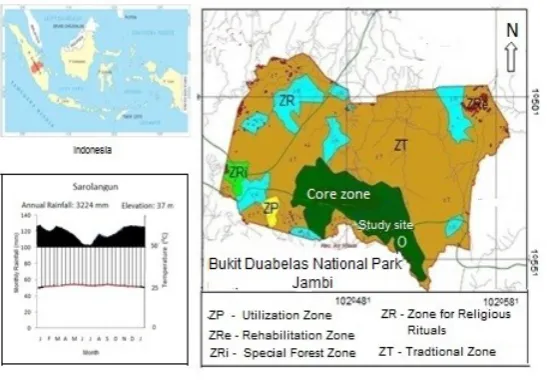
Fig. 1. The map showing the geographic location and the climate of the BDNP

RF= frequency of a species sum frequency of all species

× 100%

dominance of all species

RDo= dominance of a species × 100% RD= number of individulas of a species

total number of individuals

(8)

and the IV of a species reaches a maximum of 300 in the plot consisting of only one tree species. In each tree-subplot percentage of canopy gaps and the projected tree crown coverage were estimated, topograpy and air humidity were measured and soil type was noted. In the field, species of Dipterocarpaceae were identified using the Tree Identification Guide for Diptero-carpaceae of Sumatra (Newman et al., 1999). Herbarium specimens for each species within the plot were collected and identified at the Herbarium Bogoriense, Research Center for Biology‒LIPI at Cibinong. The identity and nomenclature of each tree species followed the

Tree flora of Indonesia: checklist for Sumatra

(Whitmore & Tantra, 1986) and Flora Malesiana

(Steenis et al., 1948-2013).

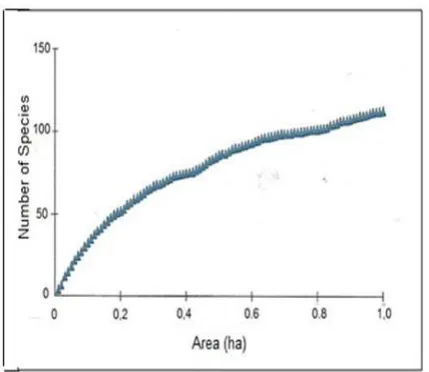
The species-area curve was constructed based on species data from 100 subplots nested within the plot. It is not intended to establish the minimal -area of sampling the forest in the study area. The minimal sample area is usually applied to show that the species are as fully represented as possible when the objective is to obtain data using a single

“minimal area” plot of the community (Mueller-Dombois & Ellenberg, 1974). This approach is normally difficult to apply in species-rich and complex tropical forests (Ashton, 1965; Mueller-Dombois & Ellenberg, 1974), such as those of Sumatra and Kalimantan (Kartawinata, 2005), where there is no indication of leveling-off of the curve at the area of 5 hectare.

A dendrogram of Jaccard similarity of species among plots in the study area was constructed by using computer software Multivariate Statistical Package (MVSP) Version 3.12 (Kovach, 2001).

RESULTS

Species composition

In the one hectare plot we recorded 414 trees, representing 113 species and 38 families (see Ap-pendix). Fig. 2 shows that each of 44 species (38.94%) had only a density of one tree/ha, 17 species (15.04%), had a density of two trees/ha, 16 species (14.16%) had a density of three trees/ ha, 32 species (28.32%) had a density of 4-12 trees/ha, and four species (3.54%) had a density of 13-24 trees/ha.

Table 1 shows 10 species having high IV, where Prunus arborea, Dracontomelondao, Hyd-nocarpus sp. and Ficus fistulosa were the four most important species, with IV > 10. Prunus ar-borea with IV = 19.20 is definitely the dominant species.

Species density, dominance and distribution within plot vary. Ten species with highest density were also species with highest frequency, but they were in different orders (Table 2). Ficus fistulosa

had the highest density (24 trees/ha). Species with

the highest frequency was Hydnocarpus sp. (F=18%). In the plot there were only a few species having F>8% and most of the species had F = <8%, of which 44 species each had F = 1% . In the present study the species-area curve tends to increase steadily and at one-hectare area there is no sign of levelling-off (Fig. 3). It indicates that the forest in the study plot has a relatively high species diversity, as shown also by the species richness index of 113 species/ha. It is further confirmed by the Shannon-Wiener Index (McCune & Grace, 2002) of 4.29.

Non-dipterocarp species were prevalent in terms of the number of species, basal area and density (Table 3). In terms of the number of species the dominant families were Moraceae (11), Clusiaceae (9) and Lauraceae (7) (Table 4). Based on the im-portance value Moraceae was the most important family (IV=34.05), followed by Sapindaceae (20.25) and Rosaceae(19.19) (Table 4).

Structure

The total basal area for all species was 25.71 m2, with the mean BA of 0.23 m2. A total of 88 species (77.9%) had BA of < 0.3 m2 (Fig. 4a). BA of the species of Moraceae was the highest (3.03 m2 or 11.79% of the total). The BAs of other fami-lies were < 2 m2.

Fig. 4b shows that trees with DBH < 30 cm had the highest number, i.e. 327 individuals (78.99%). Species of Moraceae dominated the diameter class

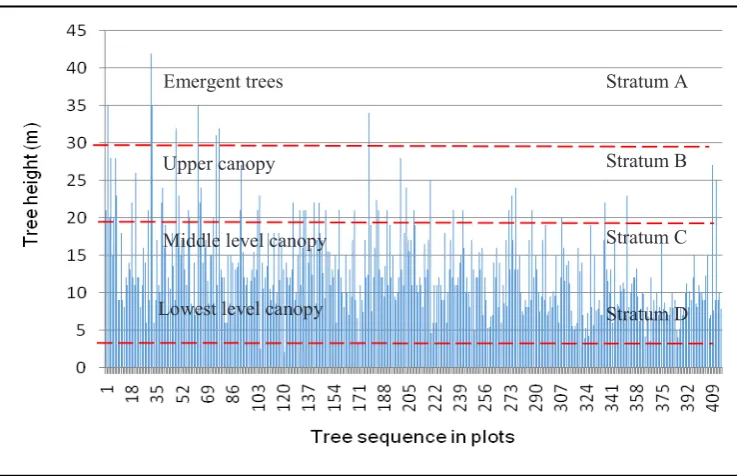
≥ 30 cm, i.e., 14 individuals (16.1%). Five individ-uals with DBH ≥ 100 cm were A rtocarpus odo-ratissimus. Cratoxylum arborescens, Litsea spathacea, Polyalthia kingii and Prunus arborea. Fig. 5 is the simulated profile diagram of the forest in the plot, prepared using the method of Kartawinata et al. (2004). It shows that the height of most trees (395 individuals or 95.4%) was < 20 m. It shows that the forest consisted of four strata: A (> 30 m), B (20-30 m), C (4-20 m), and D (1-4 m). Emergent trees with height > 30 m (Stratum A) consisted of Cratoxylum arborescens, Hydno-carpus sumatrana and Prunusarborea. In terms of number of trees Stratum B was dominated by

Dracontomelon dao and Dacryodes spp., Stratum C by Hydnocarpus sp. and Ficus fistulosa, and Stratum D by Madhuca sp.

Regeneration

Topography and habitat conditions in the study plots

(9)

Fig. 2. Number of species and number of individuals of trees in a one-hectare plot of forest in the east section of the core zone at BDNP

Table 1. The Relative Density (RD), Relative Frequency (RF), Relative Dominance (RDo) and Importance Value (IV = RD +RF+ RDo) of the ten most important species based on IV.

No. Species RD (%) RF (%) RDo (%) IV

1. Prunus arborea 5.31 4.64 9.24 19,20

2. Dracontomelon dao 2.17 2.46 6.83 11.46

3. Hydnocarpus sp. 4.35 4.92 2.11 11.38

4. Ficus fistulosa 5.80 2.73 2.29 10.83

5. Litsea spathacea 1.69 1.64 5.17 8.50

6. Knema laurina 3.14 3.01 1.11 7.25

7. Artocarpus odoratissimus 1.21 1.37 4.59 7.16

8. Palaquium walsuraefolium 2.90 2.19 2.05 7.13

9. Diospyros areolata 2.90 2.73 0.99 6.62

10. Dacryodes sp. 2.42 2.46 1.58 6.46

slopes of 8 - 16o the average was 4.5 trees/subplot, and on slopes of 4 - 8o the average was5.4 trees/ subplot. A total of 73 subplots (73%) occurred on slopes of 16 - 45o; 22 subplots on slopes of 8 - 16o and 2 subplots on slopes of 4 - 8o.

Humidity within the plot was high (77 – 90%), attributed to the dense stand and high mean per-centage (76%) of canopy cover with a range of 50 - 100%. In general the soils of the BDNP belong to the red yellow podsolic group (Kementerian Kehutanan dan Balai TNBD, 2011). Although in the plot 18 subplots have sandy soils with large rocks above.

DISCUSSION

Species diversity and structure

The species richness [i.e., number of species in a sampling unit (McCune & Grace, 2002)] and tree

density in the forest of the eastern zone of the BDNP are smaller than those in several lowland forests in Sumatra and Kalimantan, but higher than those in the upper lowland forest of Java (Table 6). The situation is related to the status of the forests whether they are undisturbed lower lowland for-ests (Kartawinata et al., 2004; Sheil et al., 2010) or disturbed lower primary lowland forests (Anas, 2013; Elviqar, 2013; Hermawan, 2013; Sehati, 2013), disturbed upper primary lowland forests (Helmi et al., 2009), or lowland secondary forests (Mansur et al., 2010)

(10)

Table 2. Ten species with highest frequency (F), density (D) and basal area (BA), species with lowest density and frequency and species that is included in the IUCN Red List.

Fig. 3. A species-area curve in a one-hectare plot of forest at BDNP, Jambi.

Table 3. The floristic and structural characteristics of the forest at the East BDNP.

Species group Species

a. Ten species with highest fre-quency (%)

Hydnocarpus sp. (18), Prunus arborea (17), Knema laurina (11), Diospyros areolata (10), Ficus fistulosa (10), Dracontomelon dao (9), Paranephelium nitidum (9), Dacryodes sp. (9), Arenga pinnata (9), Palaquium walsuraefoli-um (8)

b. Ten species with highest densi-ty (number of trees/ha)

Ficus fistulosa (24), Prunus arborea (22), Hydnocarpus sp. (18), Knema lau-rina (13), Palaquium walsuraefolium (12), Diospyros areolata (12), Paranephelium nitidum (10), Dacryodes sp. (10), Arenga pinnata (10), Dracontomelon dao (9).

c. Ten species with highest basal area (m2)

Prunus arborea (2.38), Dracontomelon dao (1.75), Litsea spathacea (1.33), Artocarpus odoratissimus (1.18), Polyalthia kingii (1.12), Cratoxylum arbo-rescens (0.93), Gonocaryum gracile (0.73), Pterospermum javanicum (0.66), Ficus fistulosa (0.59), Hydnocarpus sp. (0.54).

d. Forty four species with lowest density (1 tree/ha) and lowest frequency (1%)

Alangium javanicum, Aphanamixis polystachya, Artocarpus nitida, Artocar-pus glaucus, Baccaurea dulcis, Baccaurea sp., Bhesa paniculata, Bouea op-positifolia, Calophyllum molle, Calophyllum tetrapterum, Calophyllum sp., Claoxylon longifolium, Cratoxylum arborescens, C. cochinchinense, Diospy-ros lanceifolia, Dialium indum, Dimocarpus longan, Dracontomelon sp., Du-rio sp., Elaeocarpus glaber, Fagraea elliptica, Ficus elastica, Fissistigma latifolium, Garcinia celebica, Garcinia sp., Gluta renghas, Knema globularia, Knema mandaharan, Litsea elliptica, Mallotus floribundus, Madhuca sericea, Neo-uvaria acuminatissima, Neo-uvaria sp., Nephelium sp., Ochanostachys amentacea, Palaquium ridleyi, Pertusadina eurhyncha, Polyalthia kingii, Porterandia anisophylla, Scaphium macropodum, Shorea leprosula, Styrax benzoin, Tetranthera angulata, Uncaria gambir.

e. Species included in the IUCN Red List

(11)

Table 4. Summary of family characteristics at tree level.

Characteristics Family

Eight families with number of species ≥5

Moraceae (11), Clusiaceae (9), Lauraceae (7), Malvaceae (7), Euphorbi-aceae (6), SapindEuphorbi-aceae (6), PhyllanthEuphorbi-aceae (5), AnnonEuphorbi-aceae (5).

Ten families with highest density (trees/ ha)

Moraceae (52), Sapindaceae (30), Lauraceae (27), Clusiaceae (25), Euphorbiaceae (23), Flacourtiaceae (23), Rosaceae (22), Burseraceae (21), Malvaceae (18), Myristicaceae (18).

Ten families with the highest basal area (m2)

Moraceae (3.07), Rosaceae (2.38), Annonaceae (1.88), Lauraceae (1.87), Anacardiaceae (1.86), Malvaceae (1.59), Sapindaceae (1.38), Clusiaceae (1.09), Flacourtiaceae (0.97), Hyperacaceae (0.93).

Ten families with the highest Importance Value

Moraceae (34.0), Sapindaceae (20.25), Rosaceae (19.19), Lauraceae (16.92), Annonaceae (15.98), Flacourtiaceae (15.58), Malvaceae (15.2), Euphorbiaceae (14.73), Burseraceae (13.93), Anacardiaceae (13.46).

b

a

Fig. 4a. Number of species according to the BA classes and b. the number of trees according to the diameter classes.

Fig. 5. Tree stratification profile based on the tree height and sequential tree positions from tree no. 1 in 1st subplot up to the tree no. 414 in 100th subplot in BDNP eastern core zone.

Stratum D Stratum C Stratum B Stratum A

(12)

Regeneration Status Species 1. Species (33) with complete

representation of trees, sap-lings and seedsap-lings

1.1. Species (23) with poor seedling populations (1-3 seedlings/ha)

Artocarpus nitidus, Artocarpus odoratissimus, Baccaurea javanica, Cleistanthus macropyllus, Dacryodes rostrata, Dacryodes rugosa, Diospyros areolata, Diospyros curanii, Dysoxyllum excelsum, Ficus fistulosa, Hydnocar-pus sp., Laportea stimulans, Litsea noronhae, Mallotus floribundus, Mallotus rufidulus, Memecylon excelsum, Memecylon edule, Neonauclea calycina, Paranephelium nitidum, Polyalthia sumatrana, Pterospermum sp., Syzygium cymosa and Trigonostemon sp.

1.2.Species (8) with relatively good seedling popula-tions (5-16 seedlings/ha)

Parashorea sp., Palaquium walsurifolium, Litsea confusa, Prunus arborea, Antidesma erythrocarpum, Shorea leprosula, Polyalthia cauliflora, and Neo-uvaria acuminatissima.

1.3.Rare species (2) with 1 seedling/ha

Ficus elastica and Bouea oppositifolia

2. Species (45) represented by trees only

Aphanamixis polystachya, Arenga pinnata, Artocarpus glaucus, Baccaurea sp., Bhesa sp., Calophyllum molle, Calophyllum tetrapterum, Claoxylon longifoli-um, Cnestis palala, Cratoxylum arborescens, Cratoxylum cochinchinense, Dillenia cf. pentagyna, Dimocarpus longan, Diospyros lanceifolia, Durio sp., Elaeocarpus glaber, Ficus padana, Ficus sp. 1, Ficus sp. 2, Garcinia sp., Gi-ronniera hirta, Gluta renghas, Knema globularia, Knema latifolia, Leptonychia caudata, Litsea elliptica, Madhuca sericea, Melochia umbelata, Mussaenda frondosa, Nephelium sp., Ochanostachys amentacea, Oncosperma horridum, Palaquium ridleyi, Paratocarpus bracteatus, Pertusadina eurhyncha, Phoebe grandis, Polyalthia kingii, Porterandia anisophylla, Pterospermum javanicum, Rauvolfia sumatrana, Sterculia rubiginosa, Styrax benzoin, Tetranthera angula-ta, Tetrastigma lanceolarium and Uncaria gambir.

3. Species (26) represented by trees and saplings

Alangium javanicum, Artocarpus elasticus, Baccaurea dulcis, Blumeodendron

tokbrai, Callophylum sp., Dacryodes sp., Dialium indum, Dialium platysepalum, Dracontomelon dao, Dracontomelon sp., Durio oxleyanus, Fagraea elliptica, Fissistigma latifolium, Garcinia atroviridis, Hydnocarpus sumatrana, Knema laurina, Laportea sp., Litsea spathacea, Macaranga hypo-leuca, Madhuca sp., Nephelium uncinatum, Ochanostachys amentacea, Pometia sp., Scaphium macropodum and Strombosia javanica.

4. Species (7) represented by saplings and seedlings

Archidendron sp., Gomphandra capitulata, Macaranga hulletii, Polyalthia lat-eriflora, Rinorea anguifera, Tetracera akara and Tetramerista glabra.

5. Species (5) represented by trees and seedlings

Artocarpus anisophyllus, Diospyros cauliflora, Garcinia celebica, Knema man-daharan and Microcos opaca.

6. Species (20) represented by saplings only

Alstonia sp., Antidesma tetrandum, Aquilaria malaccensis, Atuna sp., Cananga odorata, Garcinia parvifolia, Gironniera hirta, Gynotroches axillaris, Man-gifera odorata, Nephelium lappaceum, Omalanthus populneus, Pentaspadon motley, Phoebe grandis, Porterandia sp., Pternandra azurea and Tristaniopsis whiteana.

7. Species (19) represented by seedlings only (1-22 seedlings/ ha)

(13)

forests were lower than those in the undisturbed primary forests in North Sumatra and in East Kali-mantan. It should be noted that the forest in Harapan Rainforest was a secondary forest (Mansur et al., 2010). Low tree density in BDNP was possibly attributed to the physiography of the site, which ranges from undulating, hilly to steep slopes.

Differences in topography appear to affect not only the number of species and density but also species combination forming the floristic compo-sition of the forest. in line with Whitmore (1986), who stated that lowland forest variations from one place to another are related to terrain, topography and degree of natural disturbance. Fig. 5 shows low similarities of tree species composition, as indicated by low Jaccard’s coefficients, between the forest in the present study (E. BDNP ) and those at C. BDNP (Anas, 2013), HAIM 2 (Hermawan, 2013), HAIM 1 (Elviqar, 2013) and B. GADIS (Kartawinata et al., 2004). The topo-graphy at E. BDNP is undulating, while that in C. BDNP is hilly with steep slopes (Anas, 2013) and the topography at HAIM 1 (Elviqar, 2013) and HAIM 2 (Hermawan, 2013) is relatively flat. Big differences of species composition in the eastern core zone of the BDNP and those at HAIM 1 & 2 and B. Gadis NP were likely due to the differences in the degree and intensity of disturbances. Human disturbances at BDNP were lower than those at HAIM, but higher than those at B. Gadis NP, which is a relatively undisturbed primary forest (Kartawinata et al., 2004). The significance of the species-area relation-ship is fundamental to ecology (Plotkin et al., 2000) and can also be used to estimate species

extinction due to habitat loss (May et al., 1995; Pimm & Raven, 2000) and to evaluate species diversity patterns in different forest types (Ashton, 1965). The curve is constructed to indicate species diversity in relation to increasing size of the area (Mueller-Dombois & Ellenberg, 1974) within the plot. In the present study the species-area curve tends to increase steadily and at one-hectare there was no sign of levelling-off (Fig. 3). It indicates that the forest had a relatively high species diversity, as shown also by the species richness index of 113 species/ha and the Shannon-Wiener Index of 4.29. Plot richness may be attributed to disturbance by allowing species dependent on disturbance to occur in very close association with late-successional species (Connell, 1978; Sheil & Burslem, 2003; Slik et al., 2008).

Trees with large diameters and the emergents in the A stratum were dominated by light demanding species, such as A rtocarpus odoratissimus and

Cratoxylum arborescens. We assume that they developed and grew well in the past during the time when canopy gaps were formed, due to natural disturbance and human activities. From the past history of BDNP, confirmed by the struc-ture and floristic composition, the forest of the eastern core zone of BDNP is a disturbed forest due to the death of trees and tree extraction by the indigenous Suku Anak Dalam (SAD) community as well by commercial logging, which took place prior to the establishment of the BDNP in 2000. The existence of fallen decaying big trees on the forest floor and the tree stumps and other wood remains resulting from cutting by axes and knives usually operated by the indigenous SAD is a

Table 6. Comparison of number of species and density (trees/ha) in several one-hectare plots in Sumatra: Bukit Dua-belas National Park (BDNP), Imbo Mengkadai customary forest (HAIM) in Jambi; Mount Leuser NP (National Park) and Batang Gadis NP in North Sumatra; Malinau in East Kalimantan; and Mount Gede-Pangrango National Park (MGPNP) in West Java. Kartawinata et al. (2004)

(14)

Fig. 6. Dendrogram of similarity of species among plots at Batang Gadis NP (B. GADIS), Hutan Adat Imbo Mengkadai (HAIM 1 and HAIM 2) and Bukit Duabelas NP (C. BDNP & E. BDNP).

strong proof.

In the BDNP forest 61 species (54%) are classi-fied as primary forest species and are registered in the Tree flora of Indonesia. Check list for Sumatra

and one of them, Baccaurea dulcis, is endemic to Sumatra (Whitmore & Tantra, 1986). The dominance of Prunus arborea does not reflect the typical forest of Sumatra, where dipterocarp species are generally dominant (Abdulhadi, 1991; Gillison, 2001; Gillison et al., 1996; Kartawinata

et al., 2004; Polosakan, 2011; Samsoedin & Heriyanto, 2010). In the present study dipterocarps were represented only by Parashorea sp. and

Shorea leprosula, which were both at very low density and frequency. The insignificant presence and the disappearance of dipterocarp species are likely attributed to the commercial logging and were later followed by indiscriminate cutting of remaining commercial tree species, including dipterocarps, by illegal loggers. No records are available on dipterocarp populations in the forest at the eastern core zone prior to commercial log-ging activities, which took place before the establishment of the park in 2000 (Ministry of Forestry and Plantation, 2000). It is assumed that dipterocarps were dominant in BDNP just like in lowland dryland forests elsewhere in Sumatra (Abdulhadi, 1991; Gillison, 2001; Gillison et al.,

1996; Kartawinata et al., 2004; Polosakan, 2011; Samsoedin & Heriyanto, 2010; Whitmore & Tan-tra, 1986).

Prunus arborea grows in primary and second-ary forest at 0-1800 m alt. (Kalkman, 1993), thus its presence with high importance value and density in the present study site could be in response to the previous disturbance and acted as pioneer and took advantage of the increased light and added to the original population in the primary forest prior to disturbance. In primary forest of

Sumatra the population of Prunus arborea is very low (Kartawinata et al., 2004).

Other important species are Ficus fistulosa

which is a forest species (Berg & Corner, 2005),

Dracontomelon dao, a tall tree with diameter up to 150 cm and height up to 55 m, grows in secondary forest in high rainfall areas at 500-1000 m alti-tudes (Ding Hou, 1978) and Knema laurina which occurs in primary and degraded dipterocarp forests on a variety of soils at 1000 m alt. (Wilde, 2000). Other species that could be identified as secondary forest species (Corlett, 1991; Kartawinata, 1994; Keβler et al. 2000; Whitmore, 1986) were Cratox-ylum arborescens, C. cochinchinense, Dillenia pentagyna, Macaranga hypoleuca, Mallotus flori-bundus, Mallotus rufidulus, Melochia umbelata, Mussaenda frondosa, Neonauclea calycina, and

Shorea leprosula.Shorea leprosula is actually one of the major components of primary dipterocarp forests, but it often behaves more like a secondary forest species or even a pioneer species, invading canopy openings or open areas at forest edges.

The presence and abundance of these species indicate past disturbances, including possibly minor landslides on unstable ridges. Disturbance may also explain the high density of smaller trees which also contribute to plot-level richness (Sheil

et al., 2010).

(15)

community with heterogeneous species composi-tion. The heterogeneity is reflected by the majority of the species having low frequency and density. The decline of the populations of some species is attributed to harvesting by the SAD community to satisfy their various needs (Setyowati, 2003).

Shorea leprosula, Bouea oppositifolia, and

Diospyros sp. are used as building material, A rto-carpus anisophyllus, Oncosperma horridum, Garcinia atroviridis, and Dialium indum as sources of food; Ochanostachys amentacea as a medicinal plant Styrax benzoin as materials for traditional rituals, and A rtocarpus elasticus as clothing material. Calamus manan, Daemonorops draco, Dyera costulata, Eusideroxylon zwageri

and Fagraea fragrans, which were reported as rare species (Kementerian Kehutanan dan Balai TNBD, 2011) were no longer present in the study plots. It is very likely that their absence is due to extraction or that they only growing elsewhere in the BDNP.

Regeneration

Hubbell & Foster (1986), defined a species as rare if, on the average, it has one or fewer stems per hectare. Following this definition, the 44 species (38.94% of the total) listed in the Table 2d can be definitely considered rare at least locally in the BDNP, which is not necessarily in line with IUCN criteria. They are extremely vulnerable to disappearance caused by even slight disturbances. This is aggravated by the fact that their regeneration was poor and only Shorea leprosula

had slightly better regeneration (Table 5.1.2). Poor regeneration of dipterocarps is due to the absence of mature trees within and in the surrounding area of the plot as well as high exposure to light after heavy logging prevented seed germination and development of shade tolerance seedlings of dipterocarps.

Species that are represented only by trees with no representation of saplings and seedlings will usually sooner or later disappear from the forest (Richards, 1996). Some species, e.g.,Aphanamixis polystachya, Artocarpus glaucus, Calophyllum molle, Claoxylon longifolium, Cratoxylum arborescens, Cratoxylum cochinchinense, Dimocarpus longan, Elaeocarpus glaber, Gluta renghas and Madhuca sericea were represented by trees with no saplings and seedlings, thus they will disappear sooner than the others. The 19 species of group 7 in Table 5, that were represented by seedlings only, particularly Carallia brachiata, could be considered as invaders that, in the long run, could probably slowly change if not take over the community, provided that the environmental conditions favor their growth.

The

seedlings are usually unevenly distributed and their abundance varies periodically. In a species-rich mixed rain forest the species

In the canopy seed production is usually seasonal

The number of individuals in each species at tree, sapling and seedling stages is indicators of the ability of a forest to reproduce itself and to maintain its survival, stability and sustainability. A total of 33 species with complete representation of trees, saplings and seedlings (Table 5). Group 1 especially group 1.2. (Parashorea sp., Palaquium walsurifolium, Litsea confusa, Prunus arborea, Antidesma eurocarpum, Shorea leprosula, Polyal-thia cauliflora, and Neo-uvaria acuminatissima) will probablyremain in the forest in the future.

CONCLUSION

(16)

succes-sion is, however, slow, but could be enhanced and assisted by ecological restoration through planting tree species characteristics of un-those listed in the IUCN Red List.

Science-based conservation in and management of BDNP should be supported by further research on structure and composition of forests over a wider area in the park and Jambi to understand variation in composition related to habitat factors.

ACKNOWLEDGEMENTS Marjohni for their assistance and collaboration extend-ed during the field data collection. We thank also the Head and the staff members of the Bukit Duabelas NP for the permit and for providing various facilities during the field work.

REFERENCES

ABDULHADI, R. 1991. A Meliaceae forest in Ketambe, G. Leuser National Park, Sumatra, Indo-nesia. In: SOERIANEGARA, I., TJITROSOMO, S. S., UMALY, R. C. & UMBOH, I. (Eds.). Proceed-ings of the 4th Round-Table Conference on Diptero-carps, Bogor, Indonesia, 12-15 December 1989. BIOTROP Special Publication 41: 307-315. SEAMEO-BIOTROP, Bogor.

ANAS, A. 2013. Studi fitososiologi hutan pamah di zona inti bagian tengah Taman Nasional Bukit Duabelas, Jambi. Universitas Indonesia, Depok, [Thesis]. (In Indonesian).

ASHTON, P. S. 1965. Some problems arising in the sampling of mixed rain forest communities for floristic studies. In: Symposium on Ecological Research in Humid Tropics Vegetation (1963). 235-240. Government of Sarawak and UNESCO Science Cooperation Office for SE Asia, Tokyo Press Co. Ltd., Itabashi, Tokyo. 376 p.

BERG, C. C. & CORNER, E. J. H. 2005. Moraceae (Ficus). Flora Malesiana I. 17(2): 1-727.

BOERLAGE, H. P. 1949. Regenval in Indonesië (Rainfalll in Indonesia), Meteorologische en Geoph-ysische Dienst, Koninklijk Magnetisch en Meteorol-ogisch Observatorium te Batavia, Verhandelingen No. 37: 134.

CONNELL, J. H. 1978. Diversity in tropical rain for-ests and coral reefs - high diversity of trees and cor-als is maintained only in a non-equilibrium state. Science 199: 1302–1310.

CORLETT, R. T. 1991. Plant succession on degraded land in Singapore. Journal of Tropical Forest Science 4(2): 151–161. Imbo Mengkadai, Desa Temenggung, Kabupaten Sarolangun, Provinsi Jambi. Universitas Indonesia, Depok. [Thesis]. (In Indonesian).

GILLISON, A. N. 2001. V egetation Survey and Habitat Assessment of the Tesso Nilo Forest Complex; Pekanbaru, Riau Province, Sumatra, Indonesia. Report prepared for WWF-US. (October-November, 2001). Center for Biodiversity Management, Yungaburra, Australia.

GILLISON, A. N., LISWANTI, N. & ARIEF-RACHMAN, I. 1996. Rapid Ecological A ssessment, Kerinci Seblat National Park Buffer Zone, Central Sumatra: Report for Plant Ecology. CIFOR Working Paper No. 14., Bogor, Indonesia.

HELMI, N, KARTAWINATA, K. & SAMSOEDIN, I. 2009. An undescribed lowland natural forest at Bodogol, the Gunung Gede Pangrango National Park, Cibodas Biosphere Reserve, West Java, Indonesia. Reinwardtia 13: 33-44.

HERMAWAN, A. 2013. Komposisi spesies pohon hutan pamah dan keanekaragaman A rtocarpus serta pola sebarannya di Hutan Adat Imbo Mengkadai, Kabupaten, Sarolangun, Provinsi Jambi. Universitas Indonesia, Depok. [Thesis]. (In Indonesian).

HUBBELL, S. & FOSTER, R. 1986. Commonness and rarity in a neotropical forest: implications for tropical tree conservation. In: SOULE, M. (Ed.). Conserva-tion Biology: The Science of Scarcity and Diversity. Sinauer Assoc. Inc., Sunderland, MA.

IUCN 2011. The IUCN Red List of Threatened Species. http://www.iucnredlist.org/apps/redlist. Accessed on 22 April 2013.

KALKMAN, C. 1993. Rosaceae. Flora Malesiana I, 11: 227 351.

KARTAWINATA, K. 1994. The use of secondary for-est species in rehabilitation of degraded forfor-est lands. Journal of Tropical Forest Science 7(1): 76–86. KARTAWINATA, K. 2005. Six decades of natural

vegetation studies in Indonesia. In: SOEMODI-HARDJO, S. & SASTRAPRADJA, S. D. (Ed.), Six Decades of Science and Scientists in Indonesia, Naturindo, Bogor: 95-140.

KARTAWINATA, K. 2013. Diversitas ekosistem alami Indonesia. Yayasan Pustaka Obor Indonbesia & LIPI Press, Jakarta. (In Indonesian).

KARTAWINATA, K., SAMSOEDIN, I., HERI-YANTO, M. & AFRIASTINI, J. J. 2004. A tree spe-cies inventory in a one-hectare plot at the Batang Gadis National Park, North Sumatra, Indonesia. Reinwardtia 12 (2): 145-157.

KARTAWINATA, K., PURWANINGSIH, PARTO-MIHARDJO, T., YUSUF, R., ABDULHADI, R. & RISWAN, S. 2008. Floristics and structure of a low-land dipterocarp forest at Wanariset Samboja, East Kalimantan, Indonesia. Reinwardtia 12 (4): 301-323.

KEMENTERIAN KEHUTANAN DAN BALAI

TNBD. 2011. Buku informasi Taman Nasional Bukit Duabelas. Kementerian Kehutanan dan Balai TNBD, Jambi.

(17)

KOVACH, W. 2001. Multivariate Statistical Package (MVSP) Version 3.12 Computer software, Kovach Computing Services, Anglesey, Wales, U.K.

LAUMONIER, Y. 1997. The V egetation and Physiography of Sumatra. Kluwer Academic Publishers, Dordrecht, Netherlands.

MANSUR, M., TRIONO, T. & ISMAIL. 2010. Analisis vegetasi pohon di hutan hujan tropik Harapan, Jambi. Berita Biologi 10: 173-178.

McCUNE, B. & GRACE, J. B. 2002. Analysis of Ecological Communities, MJM Software Design, Gleneden Beach, Oregon.

MAY, R. J. LAWTON, J. & STORK, N. 1995. Extinc-tion rates. In: LAWTON, J. & MAY, R. (Eds.), Ox-ford. University Press. OxOx-ford. Pp: 1-24.

MINISTRY OF FORESTRY & PLANTATION. 2000. Ministry of Forestry and Plantation Decree No. 258/ Kpts-II/2000 dated 23 August 2000. Jakarta.

MUELLER-DOMBOIS, D. & ELLENBERG, H. 1974. Aims and method of vegetation ecology. John Wiley & Sons, New York.

NEWMAN, M. F., BURGESS, P. F. & WHITMORE, T. C. 1999. Pedoman Identifikasi Pohon-pohon Dipterocarpaceae Sumatera. PROSEA Indonesia, Bogor (In Indonesian).

PIMM, S. & RAVEN, P. 2000. Extinction by numbers. Nature 403: 843-845.

PLOTKIN, J. B., POTTS, M. D., LESLIEA, N., MANOKARAN, N., LAFRANKIE, J. & ASHTON. P. S. 2000. Species-area curves, spatial aggregation, and habitat specialization in tropical forests. J. theor. Biol. 207: 81-99.

POLOSAKAN, R. 2001. Komposisi jenis pohon di hutan kawasan Taman Nasional Bukit Tigapuluh, Propinsi Riau. Proyek inventarisasi dan karakterisasi sumberdaya hayati. Laporan Teknik. Pusat Penelitian Biologi, LIPI, 63-71 (In Indonesian).

POLOSAKAN, R. 2011. Studi keanekaragaman jenis pohon di kawasan Hutan Danau Bangko, Jambi: ana-lisis aspek ekologi dan pemanfaatannya. In: PUR-WANTO, Y., WALUYO, E. B. & WAHYUDI, A. (Eds.). V aluasi hasil hutan bukan kayu (Kawasan Lindung PT. Wirakarya Sakti Jambi), LIPI Press, Jakarta. 215-224 (In Indonesian).

RICHARDS, P. W. 1996. The tropical rain forest: A n ecological study, 2nd edition. Cambridge University Press, Cambridge.

RISWAN, S. 1982. Ecological studies on primary, second-ary and experimentally cleared mixed dipterocarp forest and kerangas forest in East Kalimantan,

Indonesia. [Ph.D. Thesis], University of Aberdeen.

SAMSOEDIN, I. & HERIYANTO, N. M. 2010. Struktur dan komposisi hutan pamah bekas tebangan ilegal di kelompok hutan Sei Lepan, Sei Serdang, Taman Nasional Gunung Leuser, Sumatera Utara. Jurnal Penelitian Hutan dan Konservasi Alam 7: 299-314 (In Indonesian).

SCHMIDT, F. H. & FERGUSON, J. H. 1951. Rainfall types based on wet and dry period rations for Indonesia with Western New Guinea. Verhandelingen Djawatan Meteorologi dan

Geofisika, Djakarta 42.

SEHATI. 2013.Komposisi dan struktur hutan pamah di zona inti bagian barat Taman Nasional Bukit Duabelas, Jambi. Universitas Indonesia, Depok. [Thesis] (In Indonesian).

SETYOWATI, F. M. 2003. Hubungan keterikatan masyarakat Kubu dengan sumberdaya tumbuh-tumbuhan di Cagar Biosfer Bukit Duabelas, Jambi. Biodiversitas 4: 47-54 (In Indonesian).

SHEIL, D. & BURSLEM, D. F. R. P. 2003. Disturbing hypotheses in tropical forests. Trends in Ecology & Evolution 18: 18–26.

SHEIL, D., KARTAWINATA, K., SAMSOEDIN, I., PRIYADI, H. & AFRIASTINI, J. J. 2010. The low-land forest tree community in Malinau, Kalimantan (Indonesian Borneo): results from a one-hectare plot. Plant Ecology and Diversity 3: 59-66.

SILVIUS. M. J., SIMMONS, H. W. & VERHEUGT, W. J. M. 1984. Soils, vegetation, fauna and nature conservation in Berbak Game Reserve, Sumatra, Indonesia. Research Institute for Nature Management, Arnhem, The Netherlands.

SLIK, J. W. F., BERNARD, C. S., BREMAN, F. C., VAN BEEK, M., SALIM, A. & SHEIL, D. 2008. Wood density as a conservation tool: quantification of disturbance and identification of conservation-priority areas in tropical forests. Conservation UNESCO and CIFOR, Jakarta.

STEENIS, C. G. G. J, VAN, KALKMAN, C., KIR-KUP, D. W., NOTEBOOM, H. P., WILDE, W. J. J. O. DE, SAW, L. G., STEVENS, P. F., COODE, M. J. E. & WELZEN, P. C. VAN (Eds.). 1948-2013. Flora Malesiana Series I, Volumes 4-21. Foundation Flora Malesiana, Leiden.

WHITMORE, T. C. 1986. Tropical rain forests of the Far East, 2nd Edition. ELBS/Oxford University Press, Oxford.

WHITMORE, T. C. & SIDIYASA, K. 1986. Com-position and structure of a lowland rain forest at Toraut, northern Sulawesi. Kew Bulletin 41: 747 -756.

WHITMORE, T. C. & TANTRA, I. G. M. 1986. Tree flora of Indonesia. Check list for Sumatra. Forest Research and Development Centre, Bogor.

WILDE, W. J. J. O. DE. 2000. Myristicaceae. Flora Malesiana, I, 14: 1-632.

WIRIADINATA, H. & SETYOWATI, F. M. 2000. Kajian pemanfaatan tumbuhan oleh Suku Anak Dalam di Cagar Biosfer Bukit Duabelas Jambi. In: PURWANTO, Y. & WALUJO, E. B. (Eds.). Prosiding Seminar Nasional Ethnobotani III. Pusat Penelitian dan Pengembangan Biologi-LIPI, Bogor: 274-283 (In Indonesian).

(18)

Appendix. The density (D), relative density (RD), frequency (F), relative frequency (RF), dominance (Do), relative dominance (RDo), importance value (IV) and family importance value (FIV) in one-hectare forest block at the east section of the core zone of the Bukit Duabelas National Park (BDNP), Jambi

No. Family and Species D (Tree/ Ha)

RD (%)

F (%)

RF (%)

Do (m2)

RDo (%)

IV (%)

FIV (%)

Anacardiaceae 13,46

1 Bouea oppositifolia 1 0.24 1 0.27 0.08 0.31 0.82

2 Dracontomelon sp. 1 0.24 1 0.27 0.03 0.11 0.63

3 Dracontomelon dao 9 2.17 9 2.45 1.75 6.83 11.45

4 Gluta renghas 1 0.24 1 0.27 0.01 0.05 0.56

Annonaceae 12.43

5 Fissistigma latifolium 1 0.24 1 0.27 0.06 0.25 0.76

6 Neo-uvaria sp. 1 0.24 1 0.27 0.32 1.25 1.77

7 Neo-uvaria acuminatissima 1 0.24 1 0.27 0.04 0.14 0.65

8 Polyalthia cauliflora 7 1.69 5 1.36 0.34 1.33 4.38

9 Polyalthia sumatrana 5 1.21 5 1.36 0.25 0.98 3.55

10 Polyalthia kingii 1 0.24 1 0.27 1.12 4.35 4.87

Apocynaceae 1.69

11 Rauvolfia sumatrana 2 0.48 2 0.54 0.17 0.66 1.69

Arecaceae 8.54

12 Arenga pinnata 10 2.42 9 2.45 0.35 1.38 6.25

13 Oncosperma horridum 5 1.21 2 0.54 0.14 0.54 2.30

Bombacaceae 3.48

14 Durio oxleyanus 2 0.48 2 0.54 0.46 1.81 2.84

15 Durio sp. 1 0.24 1 0.27 0.03 0.13 0.64

Burseraceae 13.93

16 Dacryodes sp 10 2.42 9 2.45 0.41 1.58 6.45

17 Dacryodes rugosa 6 1.45 6 1.63 0.20 0.76 3.85

18 Dacryodes rostrata 5 1.21 5 1.36 0.27 1.07 3.64

Cannabaceae 1.20

19 Gironniera hirta 2 0.48 2 0.54 0.04 0.17 1.19

Cardiopteridaceae 4.89

20 Gonocaryum gracile 4 0.97 4 1.09 0.73 2.83 4.88

Celastraceae 0.70

21 Bhesa paniculata 1 0.24 1 0.27 0.05 0.18 0.70

Clusiaceae 15.98

22 Calophylum molle 1 0.24 1 0.27 0.04 0.15 0.66

23 Calophyllum sp. 1 0.24 1 0.27 0.14 0.54 1.06

24 Calophyllum tetrapterum 1 0.24 1 0.27 0.02 0.08 0.59

25 Garcinia atroviridis 2 0.48 2 0.54 0.04 0.14 1.17

26 Garcinia celebica 1 0.24 1 0.27 0.02 0.06 0.57

27 Garcinia sp. 1 0.24 1 0.27 0.02 0.08 0.59

Connaraceae 1.38

28 Cnestis palala 3 0.72 0.02 0.54 0.03 0.11 1.38

Cornaceae 0.56

29 Alangium javanicum 1 0.24 0.01 0.27 0.01 0.05 0.56

Dillenaceae 1.26

30 Dillenia pentagyna 2 0.48 0.02 0.54 0.06 0.23 1.26

Dipterocarpaceae 3.68

31 Parashorea sp. 2 0.48 0.02 0.54 0.53 2.05 3.08

32 Shorea leprosula 1 0.24 0.01 0.27 0.02 0.09 0.61

Ebenaceae 10.34

33 Diospyros areolata 12 2.90 0.11 3.00 0.26 0.99 6.89

34 Diospyros curranii 2 0.48 0.02 0.54 0.08 0.31 1.34

35 Diospyros cauliflora 2 0.48 0.02 0.54 0.07 0.26 1.29

36 Diospyros lanceifolia 1 0.24 0.01 0.27 0.08 0.31 0.82

Elaeocarpaceae 2.94

(19)

Appendix. The density (D), relative density (RD), frequency (F), relative frequency (RF), dominance (Do), relative dominance (RDo), importance value (IV) and family importance value (FIV) in one-hectare forest block at the east section of the core zone of the Bukit Duabelas National Park (BDNP), Jambi (continued)

No. Family and Species D (Tree/ Ha)

RD (%)

F (%)

RF (%)

Do (%)

RDo (%)

IV (%)

FIV (%)

Euphorbiaceae

38 Blumeodendron tokbrai 5 1.21 0.05 1.36 0.12 0.48 3.05

39 Claoxylon longifolium 1 0.24 0.01 0.27 0.04 0.15 0.67

40 Macaranga hypoleuca 4 0.97 0.04 1.09 0.14 0.54 2.59

41 Mallotus floribundus 1 0.24 0.01 0.27 0.05 0.20 0.71

42 Mallotus rufidulus 4 0.97 0.03 0.82 0.28 1.08 2.86

43 Trigonostemon sp. 8 1.93 0.07 1.91 0.26 1.00 4.84

Fabaceae 4.53

44 Dialium platysepalum 3 0.72 0.02 0.54 0.47 1.82 3.09

45 Dialium indum 1 0.24 0.01 0.27 0.24 0.93 1.44

Flacourtiaceae 15.58

46 Hydnocarpus sp. 18 4.35 0.18 4.90 0.54 2.11 11.37

47 Hydnocarpus sumatrana 5 1.21 0.05 1.36 0.42 1.64 4.21

Hyperacaceae 4.65

48 Cratoxylum arborescens 1 0.24 0.01 0.27 0.92 3.58 4.09

49 Cratoxylum cochinchinense 1 0.24 0.01 0.27 0.01 0.04 0.56

Lauraceae 20.34

50 Litsea confusa 2 0.48 0.02 0.54 0.04 0.16 1.19

51 Litsea elliptica 1 0.24 0.01 0.27 0.01 0.05 0.57

52 Litsea noronhae 9 2.17 0.07 1.91 0.20 0.79 4.87

53 Litsea spathacea 7 1.69 0.06 1.63 1.33 5.17 8.50

54 Phoebe grandis 2 0.48 0.02 0.54 0.05 0.20 1.23

55 Tetranthera angulata 1 0.24 0.01 0.27 0.01 0.06 0.57

Loganiaceae 1.00

56 Fagraea elliptica 1 0.24 0.01 0.27 0.12 0.48 1.00

Malvaceae 15.20

57 Melochia umbellata 3 0.72 0.02 0.54 0.38 1.46 2.73

58 Pterospermum sp. 2 0.48 0.02 0.54 0.15 0.58 1.61

59 Pterospermum javanicum 3 0.72 0.03 0.82 0.66 2.56 4.10

60 Leptonychia caudata 4 0.97 0.04 1.09 0.21 0.82 2.88

61 Scaphium macropodum 1 0.24 0.01 0.27 0.02 0.08 0.59

62 Sterculia rubiginosa 3 0.72 0.03 0.82 0.15 0.57 2.11

63 Microcos opaca 2 0.48 0.02 0.54 0.04 0.15 1.18

Melastomataceae 3.23

64 Memecylon excelsum 3 0.72 0.03 0.82 0.10 0.40 1.94

65 Memecylon edule 2 0.48 0.02 0.54 0.07 0.26 1.29

Meliaceae 7.45

66 Aglaia odoratissima 8 1.93 0.07 1.91 0.28 1.09 4.93

67 Aphanamixis polystachya 1 0.24 0.01 0.27 0.03 0.11 0.63

68 Dysoxylum excelsum 3 0.72 0.03 0.82 0.09 0.36 1.90

Moraceae 34.05

69 Artocarpus anisophyllus 3 0.72 0.03 0.82 0.19 0.75 2.29

70 Artocarpus nitidus 1 0.24 0.01 0.27 0.06 0.25 0.76

71 Artocarpus elasticus 4 0.97 0.04 1.09 0.43 1.68 3.74

72 Artocarpus odoratissimus 5 1.21 0.05 1.36 1.18 4.59 7.16

73 Artocarpus glaucus 1 0.24 0.01 0.27 0.20 0.79 1.31

74 Ficus elastica 1 0.24 0.01 0.27 0.01 0.03 0.55

75 Ficus fistulosa 24 5.80 0.1 2.72 0.59 2.30 10.82

76 Ficus sp. 1 3 0.72 0.02 0.54 0.05 0.19 1.46

77 Ficus padana 2 0.48 0.02 0.54 0.02 0.09 1.11

78 Ficus sp. 2 5 1.21 0.04 1.09 0.28 1.09 3.39

79 Paratocarpus bracteatus 3 0.72 0.02 0.54 0.05 0.19 1.46

Myristicaceae 11.36

80 Knema latifolia 3 0.72 0.03 0.82 0.28 1.08 2.63

(20)

Appendix. The density (D), relative density (RD), frequency (F), relative frequency (RF), dominance (Do), relative dominance (RDo), importance value (IV) and family importance value (FIV) in one-hectare forest block at the east section of the core zone of the Bukit Duabelas National Park (BDNP), Jambi (continued)

No. Family and Species D (Tree/ Ha)

RD (%)

F (%)

RF (%)

Do (%)

RDO (%)

IV (%)

FIV (%)

82 Knemaglobularia 1 0.24 0.01 0.27 0.10 0.39 0.90

83 Knema mandaharan 1 0.24 0.01 0.27 0.02 0.07 0.58

Myrtaceae 1.71

84 Syzygium cymosum 2 0.48 0.02 0.54 0.18 0.68 1.71

Olacaceae 6.53

85 Strombosia javanica 8 1.93 0.08 2.18 0.33 1.29 5.41

86 Ochanostachys amentacea 1 0.24 0.01 0.27 0.02 0.07 0.58

87 Ochanostachys sp. 1 0.24 0.01 0.27 0.01 0.03 0.55

Phyllanthaceae 8.35

88 Cleistanthus macropyllus 3 0.72 0.03 0.82 0.04 0.15 1.69

89 Baccaurea sp. 1 0.24 0.01 0.27 0.03 0.11 0.63

90 Baccaurea dulcis 1 0.24 0.01 0.27 0.01 0.05 0.57

91 Baccaurea javanica 2 0.48 0.02 0.54 0.04 0.16 1.19

92 Antidesma neurocarpum 7 1.69 0.07 1.91 0.17 0.68 4.27

Rosaceae 19.20

93 Prunus arborea 22 5.31 0.17 4.63 2.38 9.24 19.19

Rubiaceae 7.17

94 Porterandia anisophylla 1 0.24 0.01 0.27 0.02 0.08 0.59

95 Neonauclea calycina 5 1.21 0.05 1.36 0.22 0.85 3.42

96 Mussaenda frondosa 3 0.72 0.03 0.82 0.11 0.42 1.96

97 Pertusadina eurhyncha 1 0.24 0.01 0.27 0.03 0.13 0.64

98 Uncaria gambir 1 0.24 0.01 0.27 0.01 0.05 0.56

Sapindaceae 20.25

99 Dimocarpus longan 1 0.24 0.01 0.27 0.02 0.07 0.59

100 Nephelium sp. 1 0.24 0.01 0.27 0.01 0.05 0.57

101 Nephelium uncinatum 7 1.69 0.07 1.91 0.40 1.56 5.16

102 Paranephelium nitidum 10 2.42 0.09 2.45 0.27 1.04 5.90

103 Pometia sp. 7 1.69 0.06 1.63 0.52 2.02 5.35

104 Pometia pinnata 4 0.97 0.04 1.09 0.16 0.63 2.68

Sapotaceae 4.16

105 Madhuca sp. 6 1.45 0.06 1.63 0.11 0.42 3.50

106 Madhuca sericea 1 0.24 0.01 0.27 0.04 0.14 0.65

107 Palaquium ridleyi 1 0.24 0.01 0.27 0.04 0.15 0.66

108 Palaquium walsurifolium 12 2.90 0.08 2.18 0.53 2.05 7.12

Styracaceae 0.63

109 Styrax benzoin 1 0.24 0.01 0.27 0.03 0.11 0.63

Urticaceae 3.98

110 Laportea stimulans 4 0.97 0.04 1.09 0.05 0.20 2.25

111 Laportea sp. 3 0.72 0.03 0.82 0.05 0.19 1.73

Violaceae 1.16

112 Rinorea lanceolata 2 0.48 0.02 0.54 0.03 0.13 1.16

Vitaceae 1.69

113 Tetrastigma lanceolarium 3 0.72 0.03 0.82 0.04 0.15 1.69

(21)

65

ERRATUM

REINWARDTIA Vol. 14 (2), 2015

1. Please change the existing epithet name in p. 307, LINE 2 on ABSTRACT after Zingiber: engganoense

2. Please change the existing epithet name in p. 307, LINE 2 on ABSTRAK after Zingiber: engganoense

3. Please change the existing epithet name in p. 307, COLUMN 2, LINE 4 on SPECIES DESCRIPTION after Zingiber: engganoense

4. Please change the existing epithet name in p. 307, COLUMN 2, LINE 9 on SPECIES DESCRIPTION after Zingiber: engganoense

5. Please change the existing epithet name in p. 308, COLUMN 2, LINE 3 on Phenology after Zingiber: engganoense

6. Please change the existing epithet name in p. 308, on Table 1 after Zingiber: engganoense

7. Please change the existing epithet name in p. 309, on Table 2 after Zingiber: engganoense

8. Please change the existing epithet name in p. 309, on Fig. 1. after Zingiber: engganoense

9. Please change the existing epithet name in p. 310, on Plate 1. after Zingiber: engganoense

(22)

published in December. Manuscript intended for a publication should be written in English.

Titles. Titles should be br ief, infor mative and followed by author’s name and mailing address in

one-paragraphed.

Abstract. English abstr act followed by Indonesian abstr act of not mor e than 250 wor ds. Keywor ds

should be given below each abstract.

Manuscript. Manuscr ipt is or iginal paper and r epr esent an ar ticle which has not been published in any

other journal or proceedings. The manuscript of no more than 36 pages by using Times New Roman 11, MS Word for Windows of A4 with double spacing, submitted to the editor through <[email protected]>. New paragraph should be indented in by 5 characters. For the style of presentation, authors should follow the latest issue of Reinwardtia very closely. Author(s) should send the preferred running title of the article submitted. Every manuscript will be sent to two blind reviewers.

Identification key. Taxonomic identification key should be pr epar ed using the aligned couplet type.

Nomenclature. Str ict adher ence to the Inter national Code of Botanical Nomenclatur e is obser ved, so

that taxonomic and nomenclatural novelties should be clearly shown. English description for new taxon proposed should be provided and the herbaria where the type specimens area deposited should be presented. Name of taxon in taxonomic treatment should be presented in the long form that is name of taxon, author’s name, year of publication, abbreviated journal or book title, volume, number and page.

Map/line drawing illustration/photograph. Map, line dr awing illustr ation, or photogr aph pr efer ably

should be prepared in landscape presentation to occupy two columns. Illustration must be submitted as original art accompanying, but separated from the manuscript. The illustration should be saved in JPG or GIF format at least 350 pixels. Legends or illustration must be submitted separately at the end of the manuscript.

References. Bibliogr aphy, list of liter atur e cited or r efer ences follow the Har var d system as the

following examples.

Journal : KRAENZLIN, F. 1913. Cyrtandraceae novae Philippinenses I. Philipp. J. Sci. 8: 163–179.

MAYER, V., MOLLER, M., PERRET, M. & WEBER, A. 2003. Phylogenetic position and generic differentiation of Epithemateae (Gesneriaceae) inferred from plastid DNA sequence data. American J. Bot. 90: 321–329.

Proceedings :TEMU, S. T. 1995. Peranan tumbuhan dan ternak dalam upacara adat “Djoka Dju” pada suku Lio, Ende, Flores, Nusa Tenggara Timur. In: NASUTION, E. (Ed.). Prosiding Seminar dan Lokakarya Nasional Etnobotani II. LIPI & Perpustakaan Nasional: 263–268. (In Indonesian).

SIMBOLON, H. & MIRMANTO, E. 2000. Checklist of plant species in the peat swamp forests of Central Kalimantan, Indonesia. In: IWAKUMA, T. et al. (Eds.) Proceedings of the International Symposium on: Tropical Peatlands. Pp.179-190.

Book : RIDLEY, H. N. 1923. Flora of the Malay Peninsula 2. L. Reeve & Co. Ltd, London.

Part of Book : BENTHAM, G. 1876. Gesneriaceae. In: BENTHAM, G. & HOOKER, J. D. Genera plantarum 2. Lovell Reeve & Co., London. Pp. 990–1025.

Thesis : BAIRD, L. 2002. A Grammar of Kéo: An Austronesian language of East Nusantara. Australian National University, Canberra. [PhD. Thesis].

Website : http://www.nationaalherbarium.nl/fmcollectors/k/KostermansAJGH.htm. Accessed 15 February 2012.

(23)

REINWARDTIA

Author Agreement Form

Title of article :

Name of Author(s) :

I/We hereby declare that:

 My/Our manuscript was based on my/our original work.

 It was not published or submitted to other journal for publication.

 I/we agree to publish my/our manuscript and the copyright of this article is owned by Reinwardtia.

 We have obtained written permission from copyright owners for any excerpts from copyrighted works that are included and have credited the sources in our article.

Author signature (s) Date

___________________________________________________________________________________________

Name

Address: Jln. Raya Jakarta-Bogor Km. 46 Cibinong 16911, P.O. Box 25 Cibinong Telp. (+ 62) 21 8765066; Fax (+62) 21 8765062

(24)
(25)

Vol. 15. No. 1. 2016

CONTENTS

Page

ASEP SADILI & KUSWATA KARTAWINATA. A study of the undergrowth vegetation of Sempu Island, East Java, Indonesia ... 1 RAHMAH, KUSWATA KARTAWINATA, NISYAWATI, WISNU WARDHANA & ERWIN NURDIN. Tree species diversity in the lowland forest of the core zone of the Bukit Duabelas National Park, Jambi, Indonesia ..……….. 11 NASRIANTI SYAM, TATIK CHIKMAWATI & HIMMAH RUSTIAMI. A phenetic study of the Calamus flabellatus complex (Palmae) in West Malesia ………..…..………..… 27 DIAN LATIFAH, ROBERT A. CONGDON & JOSEPH A. HOLTUM. Regeneration strategies of Palms (Arecaceae) in response to cyclonic disturbances ………..……..………. 43

I MADE ARDHAKA, WISNU HANDOYO ARDI, NI KADEK EROSI UNDAHARTA & I. G. TIRTA. A new species of Begonia

(Begoniaceae) from Manusela Natioal Park, Seram ……….. 61

ERRATUM REINWARDTIA Vol. 14(2), 2015 ………...65

Reinwardtia is a LIPI accredited Journal (792/AU3/P2MI-LIPI/04/2016)

http://e-journal.biologi.lipi.go.id/index.php/reinwardtia Herbarium Bogoriense

Botany Division

Research Center for Biology – Indonesian Institute of Sciences Cibinong Science Center

Gambar

Fig. 1.  The map showing the geographic location and the climate of the BDNP
Fig. 2.  Number of species and number of individuals of trees in a one-hectare plot of forest in the east section of the core zone at BDNP
Table 3. The floristic and structural characteristics of the forest at the East BDNP.
Fig. 4a. Number of species according to the BA classes and b. the number of trees according to the diameter classes
+3

Referensi

Dokumen terkait

6 by 5-8 mm; top obtuse to truncate; keels 5, with undulating mar- gin, the central 3 a continuation of those on the hy- pochilium, the lateral ones continuing somewhat on

— BO followed sequences written in the first Flora Malesiana series II for Malesian fern specimen arrangement and flora listing, which then updated as revision for pteridophyte

–– 150 species of mosses in 74 genera and 25 families are reported for the first time from Gunung Halimun National Park (GHNP) in West Java.. Three mosses are new to the

In Asia the distribution is restricted to two separate areas: 2 species (of which K. foetidissima also in Africa) in S India and Sri Lanka and 3 (including one

Meekiong Kallu - University Malaysia Sarawak, Samarahan, Sarawak, Malaysia Harry Wiriadinata - Herbarium Bogoriense, Indonesian Institute of Sciences, Bogor, Indonesia.. Ulrich Meve

pectinatum sebagai varietas Gymnopetalum menjadi jenis tersendiri Gymnopetalum pectinatum (W. de Wilde &amp; Duyfjes) Rugayah, menambah jumlah jenis Gymnopetalum yang ada

Two climbing taxa from Sumatra, Morinda lanuginosa Suratman and Morinda wongiana Suratman (Suratman, 2011), belong to the same group as the other climbing Morinda

pp: 103‒108 DOI: 10.14203/reinwardtia.v19i2.3972 103 ETLINGERA TJIASMANTOI ZINGIBERACEAE, A NEW SPECIES FROM CENTRAL SULAWESI Received September 29, 2020; accepted November 19,