98.44%
Originality1.56%
Similarity105
SourcesDoc vs Internet + Library
Web omitted sources: 95 sources found
1. http://repository.unika.ac.id/1945/6/10.70.0137%20Vincent%20Kevin%20Tejo%20DAFTAR%20PU… 14.28%
2. http://repository.unika.ac.id/15911 12.3%
3. https://core.ac.uk/download/pdf/35394738.pdf 10.58%
4. http://repository.unika.ac.id/1945 7.12%
5. http://blog.unika.ac.id/publication/itasulistyawati 6.42%
6. https://core.ac.uk/display/35394738 4.03%
7. https://core.ac.uk/download/pdf/35399880.pdf 2.84%
8. http://repository.unika.ac.id/view/subjects/G63.html 1.48%
9. http://repository.unika.ac.id/view/year/2013.html 1.03%
10. http://repository.unika.ac.id/9131/7/12.70.0052%20William%20Wibowo%20DAFTAR%20PUSTAK… 0.95%
11. https://patents.google.com/patent/WO2012109585A1/en 0.74%
12. https://www.ncbi.nlm.nih.gov/pmc/articles/PMC2995313 0.62%
13. https://docplayer.net/12220232-Gras-notice-grn-no-555-http-www-fda-gov-food-ingredientspackagi… 0.58%
14. http://www.ejaet.com/PDF/3-5/EJAET-3-5-70-73.pdf 0.53%
15. https://efsa.onlinelibrary.wiley.com/doi/10.2903/j.efsa.2017.4785 0.49%
16. http://przemyslspozywczy.eu/category/eng2011 0.41%
17. https://www.emissions-euets.com/risk-mitigation-techniques-emir/collateral 0.41%
18. http://data.europa.eu/eli/reg_del/2017/565/oj 0.41%
19. https://eur-lex.europa.eu/eli/dir/2015/2366/oj 0.41%
20. https://eur-lex.europa.eu/legal-content/EN/ALL/?uri=CELEX:32017R0565 0.41%
21. https://link.springer.com/chapter/10.1007/978-3-319-50932-7_12 0.41%
22. https://eur-lex.europa.eu/eli/reg_del/2017/565/oj 0.41%
23. http://www.talkingaboutthescience.com/list.html 0.37%
24. https://rotary1.org/101-things-about-rotary 0.37%
25. https://nfb.org/images/nfb/publications/bm/bm17/bm1710/bm1710.htm 0.37%
26. https://wattsupwiththat.com/2012/03/31/the-epas-mercurial-madness 0.37%
27. http://eur-lex.europa.eu/legal-content/EN/TXT/?uri=CELEX%3A52017SC0148 0.37%
28. https://www.slideshare.net/bakeralan/fisheries-and-aquaculture-food-security-and-nutrition-hlpe7 0.37%
29. http://againstvaricoceleembolization.org 0.37%
30. http://www.feingold.org/Research/list.html 0.37%
35. https://archive.org/stream/blg-231228/blg-231228_djvu.txt 0.37%
36. https://patents.google.com/patent/US9510611B2/en 0.37%
37. https://vdocuments.site/food-safety-stevia.html 0.37%
38. https://docplayer.net/34076159-Preservice-teachers-use-of-lesson-study-in-teaching-nature-of-sci… 0.37%
39. https://onlinelibrary.wiley.com/doi/full/10.1111/nbu.12244 0.37%
40. https://www.federalregister.gov/documents/2016/01/25/2016-00039/energy-conservation-program-… 0.37%
41. https://www.ecb.europa.eu/pub/fsr/html/ecb.fsr201805.en.html 0.37%
42. https://eur-lex.europa.eu/legal-content/EN/TXT/?uri=CELEX%3A32013R0231 0.37%
43. http://www.feingold.org/Research/PDFstudies/list.html 0.37%
44. https://www.egnyte.com/jobs/jobs.html?title=sr-contracts-counsel 0.33%
45. https://eur-lex.europa.eu/eli/reg/2011/582/oj 0.33%
46. http://www.livingwellmag.com/dawn-memory-care-intimate-alzheimers-disease-living-magazine 0.33%
47. https://eur-lex.europa.eu/eli/dec/2015/1601/oj 0.33%
48. https://ec.europa.eu/eurostat/cache/metadata/EN/hrst_esms.htm 0.33%
49. http://cofemersimir.gob.mx/expediente/13896/mir/33123/archivo/925144 0.33%
50. http://www.eba.europa.eu/documents/10180/15718/EBA+DC+091+%28RoP+for+the+Settlement+… 0.33% 51. http://www.europarl.europa.eu/sides/getDoc.do?type=REPORT&reference=A8-2018-0001&langua… 0.33%
52. https://ec.europa.eu/clima/policies/ets_en 0.33%
53. https://sophia.stkate.edu/cgi/viewcontent.cgi?article=1526&context=msw_papers 0.33% 54. http://www.oxfordreference.com/view/10.1093/acref/9780199689828.001.0001/acref-97801996898… 0.33%
55. https://www.loc.gov/law/help/refugee-law/europeanunion.php 0.33%
56. http://jusintergentes.com.ua/archives/2012/1-2/12.pdf 0.33%
57. http://commdocs.house.gov/committees/intlrel/hfa94707.000/hfa94707_0.HTM 0.33%
58. http://corporateofficehq.com/dick-s-sporting-goods-corporate-office 0.33%
59. https://www.goodreads.com/book/show/11250317-the-song-of-achilles 0.33%
60. http://digitalcommons.wayne.edu/cgi/viewcontent.cgi?article=1869&context=oa_dissertations 0.33%
61. https://www.goodreads.com/book/show/6068551-shiver 0.33%
62. http://apiasf.org/recipient_profiles_2008.html 0.33%
63. http://publications.europa.eu/webpub/eca/special-reports/foodwaste-34-2016 0.33%
64. https://www.mariuslex.de/english/blog/blog-archive 0.33%
65. https://link.springer.com/chapter/10.1007/978-3-319-01502-6_1 0.33%
66. https://link.springer.com/chapter/10.1007%2F698_2014_305 0.33%
67. https://link.springer.com/chapter/10.1007/978-94-007-0437-4_5 0.33%
68. https://vdocuments.site/fundamentals-of-bio-medical-engineering.html 0.33%
69. https://eur-lex.europa.eu/legal-content/EN/TXT/?uri=CELEX%3A32014L0056 0.33%
70. https://publishing.sfu.ca/author/monique/page/2 0.33%
71. https://eur-lex.europa.eu/legal-content/EN/TXT/?uri=CELEX:52015PC0613 0.33%
72. https://www.gfsis.org/media/download/geplac/Free-Trend-Agreement-with-Georgia.pdf 0.33%
73. https://eur-lex.europa.eu/legal-content/EN/TXT/?uri=CELEX%3A32016R0679 0.33%
74. https://gupea.ub.gu.se/bitstream/2077/10307/1/gupea_2077_10307_1.pdf 0.33%
75. https://www.routledgehandbooks.com/doi/10.4324/9780203101995.ch3 0.33%
76. https://eur-lex.europa.eu/legal-content/EN/TXT/?uri=CELEX:32014R0537 0.33%
77. https://vdocuments.site/multiculturalism-muslims-and-citizenship-a-european-approach.html 0.33%
78. https://link.springer.com/article/10.1007/s12649-016-9720-0 0.33%
79. http://eur-lex.europa.eu/legal-content/EN/TXT/?uri=CELEX:52012PC0776 0.33%
81. https://www.goodreads.com/book/show/7203676-shiver 0.33%
82. https://lucyblogs.wordpress.com/2018/08/02/all-about-phd-applications 0.33%
83. https://www.asian-efl-journal.com/Thesis_Liang_Tsailing.pdf 0.33%
84. https://eur-lex.europa.eu/legal-content/EN/TXT/PDF/?uri=CELEX:32017D2285 0.33%
85. https://efsa.onlinelibrary.wiley.com/doi/10.2903/j.efsa.2017.4849 0.33%
86. https://journals.senate.texas.gov/sjrnl/76r/html/5-31.htm 0.33%
87. https://www.herbalhealer.com/testimonials 0.33%
88. https://vdocuments.mx/brief-introduction-to-neural-networks.html 0.33%
89. https://www.scribd.com/book/232956745/The-Irresistible-Fairy-Tale-The-Cultural-and-Social-Histo… 0.33%
90. http://jultika.oulu.fi/files/nbnfioulu-201502111069.pdf 0.33%
91. https://eur-lex.europa.eu/legal-content/EN/TXT/?uri=SWD:2018:461:FIN 0.33%
92. https://eur-lex.europa.eu/legal-content/EN/TXT/?uri=CELEX:52013PC0520 0.33%
93. https://www.optentia.co.za/pdf/optentianews_decem_2018_1547109269c11.pdf 0.33%
94. https://www.tradecommissioner.gc.ca/european-union-europeenne/market-facts-faits-sur-le-march… 0.33%
95. https://otherreferats.allbest.ru/international/00816370_0.html 0.33%
Library sources: 4 sources found
04. WFE I-2.pdf 0.66%
04. WFE I-2.pdf 0.66%
OLIVIA-18 MEI.docx 0.58%
14.I1.0159 - Edy Suprianto (Skripsi).docx 0.33%
Library omitted sources: 6 sources found
2nd ISC (FPE-03).pdf 100%
2nd ISC (FPE-03).pdf 100%
2nd ISC (PP-28).pdf 6.67%
2nd ISC (PP-15).pdf 6.01%
2nd ISC (PP-15).pdf 6.01%
FPE
FPE-03
-03
EFFECT OF SOLAR TUNNEL DRYING
EFFECT OF SOLAR TUNNEL DRYING AND CHEMICAL BLANCHING
AND CHEMICAL BLANCHING
SOLUTIONS ON THE PHYSICOCHEMICAL QUALITY OF STEVIA
SOLUTIONS ON THE PHYSICOCHEMICAL QUALITY OF STEVIA
(STEVIA REBAUDIANA) LEAVES AND ITS APPLICATION IN GREEN TEA
(STEVIA REBAUDIANA) LEAVES AND ITS APPLICATION IN GREEN TEA
–
STEVIA
STEVIA DRINKTITLE
DRINKTITLE
Vincent Kevi
Vincent Kevin Tejon Tejo , Dr. V1)1), Dr. Victoria Kriictoria Kristina Ananingsstina Ananingsih, S.T., M.ih, S.T., M.ScSc , and 2)2), and Ita Sulistya
Ita Sulistyawati, S.TP., wati, S.TP., M.ScM.Sc2) 2)
1)Students of Faculty of Agricultural Technology, Soegijapranata Catholic
University Lecturer of Faculty of Agricultural Technology, Soegijapranata 2) Catholic University [email protected]
ABSTRACT ABSTRACT
Nowadays, consumers are very concerned about the health benefits of food products besides its taste and appearance. Tea is one of the most favorite drinks in the world, including in Indonesia. Normally, all people tend to add sugar in tea which certainly causes many negative health effects, such as obesity and diabetes. Of all the existing types of tea, green tea is the best kind of tea due its high antioxidant activity. Instead of sugar, Stevia rebaudiana has many benefits. The dried stevia leaf is 10-15 times sweeter than sucrose, does not produce calories, and etc. The purpose of the research is to optimize the drying process of stevia fresh leaves using Solar Tunnel Dryer, select the best chemical blanching solution and analyze the quality of stevia dried leaves and its
acceptability in green tea - stevia infusion. Blanching process as a pre-treatment prior to the drying process turned out to have a significant effect. Sodium bicarbonate and calcium chloride were used as chemical blanching with three different concentrations: 0.1%, 0.5% and 1%. It was found out that calcium chloride 1% treatment as the best treatment hence it could preserve the quality of Stevia rebaudiana leaves in terms of its antioxidant activity, sweetness level as well as color. For sensory analysis, dried stevia leaves 0.4% added to the green tea was the most preferrable samples for the panelists. Although Stevia rebaudiana has some shortage in sensory, it still showed a great potential to replace sucrose in our daily life consumption.
Keywords:
Keywords:Health Benefits, Green Tea, Stevia rebaudiana, Pre-treatment, Drying
INTROD
INTRODUCTION UCTION were extracted from Stevia rebaudianaleaves
Today, health is becoming a main concern for to act as natural sweetener. It has many
people around the world. There were a benefits compared to sugar, which are 250
significant increasing number of people times sweeter than sucrose, contains zero
suffering from obesity and diabetes calories, can decrease blood sugar, etc. The
worldwide (WHO, 2012). Stevia rebaudiana idea of this project is to combine green tea is one natural plant-derived sweetener that with dried stevia leaves in a tea bag product
can answer this problem. Steviol glycosides so that it makes consumers easier to serve
2nd International Student Conference
“Global Insight For The Future of Food Production”
Department of Food Technology, Soegijapranata Catholic University, November 28 , 2013 th
and also healthy to consume. Moreover,
steviol glycosides is approved as GRAS or
Generally Recognized as Safe with Codex
Alimentarius number E-960 as food additive
(EC, 2011).
Communiti, Solo) and green tea commercial
(Djenggot brand) as the main materials. For
blanching process, Sodium bicarbonate and
Calcium chloride with three different
concentrations (0.1%, 0.5% and 1%) were
used prior to the drying process in order to
preserve the quality of stevia leaves. The
drying process use Solar Tunnel Dryer. As
for analysis, DPPH
(2,2-Diphenyl-1-Picrylhydrazyl), phenol, methanol were used
as solutions while spectrophotometer,
chromameter and electronic scale were used
as instruments. For serving, materials like
tea bag, hot mineral water (80 C), 0
thermometer, glass, disposable cups,
dropper, electronic scale were used to
complement all the process.
Methods
Optim
Optimization ization Blanching Blanching process process of of SteviaStevia
Leaves Leaves
Calcium Chloride and Sodium Bicarbonate
with three different concentrations: 0.1%,
0.5% and 1% were used for blanching at
98oC for 10 seconds. Then the leaves were
dried until its moisture content <10%. The
dried stevia leaves were analysed its
moisture content, color, antioxidant activity,
sweetness intensity and sensory analysis.
until become powder in size. For the dried
stevia concentration, it was divided into three
concentrations: 0.2%, 0.4% and 0.6%. For
sucrose, the concentration was 6%, as the
Indonesia National Standard, SNI 3143:2011
(Minuman Teh dalam Kemasan). In order to
know the best composition of stevia leaves and
the green tea, there were 4 treatments samples
presented to the 9 trained panelists. Each of the
treatments have been mixed with green tea
commercial and dissolved in 250 ml mineral
water 80 C. The trained panelists were asked 0
their hedonic ranking test about the overall
liking preference and also rating intensity test
of astringency, sweetness intensity, aroma and
color from each sample in a 7 points line scale
questionnaire which consisted of anchor points
that have been discussed and approved before
in the Focus Group Discussion.
RESULTS AND D
RESULTS AND DISCUSSIOISCUSSION N
Moisture Conte Moisture Content nt
2nd International Student Conference
“Global Insight For The Future of Food Production”
The final moisture content produced was in
the range of 4.16- 7.54%. This moisture
contents have qualified the moisture content
target which is 10% (Velic, 2 007). The
temperature ranges from 55 C to 65 C with o o
55-77% Relative Humidity. Eac h samples
showed the same trends which its moisture
content were reduced every 10 minutes of
analysis. Solar Tunnel Dryer is safe from
exposure of the foodstuff to rain and dust,
infestation by insects, attack by animals and
also beneficial in terms of economical
(Bolaji & Olalusi, 2008).
Color Color
In this research, it was foun d out that
blanching process as a pre-treatment prior to
the drying process had a great effect on
changes of the color during the drying process.
Calcium chloride treat ments were the better
treatment as it can preserve the color quality of
stevia leaves in terms of its lightness, a* and
b*. Calcium blocks the amino group, whereby
the latter is restrained from entering into the
browning reaction. It is also capable of
forming chelating compounds with organic
substances having an alpha amino carboxylic
acid structure ( Davoodia et al., 2007). Post
harvests dips in calcium chloride solutions are
also combined with heat treatment to produce a
great effect. Heat allows the formation of
COO- groups from vegetables with which
Ca2+ ions can form salt-bridge cross-links
(Stanley e t al, 1995).
This makes the cell wall less acc essible to
the enzymes that cause softening.
Antioxidant Antioxidant Activity Activity
Stevia leaves has high antioxidant activity
(Singh et al., 2012). It was foun d that drying
process decreased the stevia’ s antioxidant
activity. Control samples got the lowest
antioxidant activity, while treat ment
samples were found that it could preserve the
antioxidant activity of the stevia leaves. The
antioxidant activities were varying from 84%
until 88% with Calcium Chloride 1%
treatment got the highest antioxidant activity,
which it is not significantly diff erent with
the fresh samples. With all of this benefit of
calcium, it can stabilize or strengthening the
stevia leaf’s cell walls hence it can preserve
polyphenols contained in the stevia leaves.
Figure 1.
Figure 1. Antioxidant Activity o f Stevia Leaves on Each Treatments
2nd International Student Confe rence
“Global Insight For The Future of Food Production”
Figure 2.
Figure 2. Sweetness Intensity of Stevia Leaves on Each Treatments
Sweetness Intensi Sweetness Intensity ty
All the dried samples showed a greater level
of sweetness intensity because the drying
process will improve the to tal solids
contained in the leaves hence the water was
evaporated through the drying process. All
the calcium chloride treatments showed a
better sweetness intensity comparing to the
sodium bicarbonate treatments. It showed
that pH had an effect on the sweetness
intensity of the stevia leaves. This results
was agreed with Chang and Cook (1983) and
the 63rd JECFA (Joint Expert Co mmittee
for Food Additives) for the informa tion on
the hydrolytic stability of steviol gl ycosides
in foods. The committee received results of
thermal and hydrolytic stability studies for
the specified material at 100oC
decomposition. The decompositio n was 4%
at pH 6.0, but increased to about 16% at pH
8.0. Similar results were ob tained by
Buckenhuskers and Omran (1997) who
showed that stevia sweeteners in aqueous
solutions are stable in acidic and neutral
conditions but not in alkaline condition.
Sensory Anal Sensory Analysis ysis
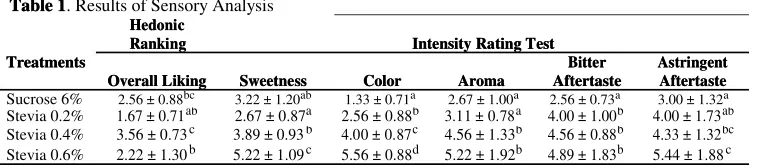
It was found out that higher co ncentration of
stevia would effected the sens ory intensity
attributes which give a higher intensity of
sensory. This trend is affecte d because of
stevioside component, which is the major
component from Stevia rebaudiana (Melis,
1992). These results agr eed with Arab et al.
(2010) and Yoshikawa et al. (1979) who
found that stevioside had slight bitterness,
some astringency aftertaste. S oejarto et al.
(1983) also reported that volatile aromatic or
essential oils, tannins and flavonoids,
contribute to the unpleasa nt flavours
associated with Stevia. The re sults can be
seen in Table 1 below.
2nd International Student Confe rence
“Global Insight For The Future of Food Production”
Table 1
Table 1. Results of Sensory Analysis
He Hedodoninicc Ra
Rankinkinng g InteIntensitynsity Ra Ratinting Tg Testest Treatments
Treatments BitteBitterr AsAstritringngentent
Overall L
Overall Likingiking SweetneSweetness ss Color Color Aroma Aroma Aftertaste Aftertaste Aftertaste Aftertaste
Sucrose 6% 2.56 ± 0.88bc 3.22 ± 1.20ab 1.33 ± 0.71a 2.67 ± 1.00a 2.56 ± 0.73a 3.00 ± 1.32a Stevia 0.2% 1.67 ± 0.71ab 2.67 ± 0.87a 2.56 ± 0.88b 3.11 ± 0.78a 4.00 ± 1.00b 4.00 ± 1.73ab Stevia 0.4% 3.56 ± 0.73c 3.89 ± 0.93b 4.00 ± 0.87c 4.56 ± 1.33b 4.56 ± 0.88b 4.33 ± 1.32bc Stevia 0.6% 2.22 ± 1.30b 5.22 ± 1.09c 5.56 ± 0.88d 5.22 ± 1.92b 4.89 ± 1.83b 5.44 ± 1.88c
Notes:
All values are estimate ± standard deviation
Value with different superscript show significant differences with Friedman test and LSD test in the confidence level of α = 0.05
This Sensory Analysis was done by 9 selected Trained Panelists
Figure 3.
Figure 3. Main Sensory Analysis Set of Sample
CONCLUSIO CONCLUSIONS NS
- The drying process using Solar Tunnel
Dryer was done in the temperature range of
55-65oC with 55-77% relative humidity and
achieve the target moisture content(<10%) in
120 minutes for the control sample and 140
minutes for all the treatment samples.
-Blanching process as pre-treatment prior to
the drying process can preserve the benefits
and quality from Stevia rebaudiana leaves.
-Calcium chloride treatment was found
better to maintain stevia leaves quality in
terms of its antioxidant activity, sweetness
intensity andcolor, with calcium chloride 1%
was the best chemical blanching solution.
-The increasing concentration level of
calcium chloride produced a brighter color
of stevia leaves, while the increasing
concentration level of sodium bicarbonate
resulted in a darker appearance of stevia
leaves.
-The increasing concentration of dried stevia
leaves added to green tea would give a higher
intensity of sensory in terms of sweetness,
color, aroma, bitter aftertaste and astringent
2nd International Student Conference
“Global Insight For The Future of Food Production”
aftertaste, with calcium chloride 0.4% was
the most preferable for the panelists.
ACKNOWL
ACKNOWLEDGEMEEDGEMENTS NTS
First of all, I want to dedicate my greatest
gratitude to Jesus Christ, who has blessed
me with His wisdom and guidance in the
long journey to finish this study.This modest
and imperfect study can nicely be done by
the help, supports, prayer and advice from
several individuals that the author very
honored and grateful for. In every phase and
every challenge in the way, there will always
persons who generously lend their heart,
mind and time: Dr. Victoria Kristina, ST,
MSc and Mrs. Ita Sulistyawati, S.TP, MSc.
as the supervisors, all the beloved lecturers
and laboratory assistants of Food
Technology Soegijapranata Catholic
University, my great friends and also my
dearest family who always be there for me
throughout the process of this study. Last but
not least I want to thank the committee of
2nd International Student Conference for
giving me the chance to share this research. I
hope it is useful and become a meaningful
contribution to food science education.
REFERE REFERENCES NCES
Abou-Arab, A., A. Abou-Arab and M. F. Abu-Salem. (2010). Physico-chemical assessment of natural sweeteners steviosides produced from Stevia rebaudiana Bertoni plant. African Journal of Food Science, 4, 269–281.
Bolaji, B.O and A.P. Olalusi. (2008).
Performance Evaluation of a Mixed-Mode Soplar Dryer. AU J.T. 11(4):225-231
Buckenhuskers, H.J. and H.T. Omran. (1997). Stevia rebaudiana Bertoni and stevioside. Sugar and S. Subst. in Food Proc. Nutr., Ismailia, Oct. pp. 157-178.
Chang, S.S., and J.M. Cook. (1983). Stability studies of stevioside and rebaudioside A in carbonated beverages. J. Agric. Food Chem. 31: 409-412.
Davoodia, M.G., P. Vijayanand, S.G. Kulkarnib and K.V.R. Ramana. (2007). Effect of different pre-treatments and dehydration methods on quality characteristics and storage stability of tomato powder. LWT-Food Technology, 40: 1832 –
1840
EC. (2011). Commission Regulation (EU) No 1131/2011 amending Annex II to Regulation (EC) No 1333/2008 of the European Parliament and of the Council with regard to steviol glycosides OJ L 295,
205-Soejarto, D. (2002). Botany of Stevia and Stevia rebaudiana. In A. Kinghorn (Ed.),Stevia: The genus Stevia (pp. 18–39). London, New York: Taylor and Francis. Stanley, D.W., M.C. Bourne, A.P. Stone and W.V. Wismer, (1995). Low temperature blanching effects on chemistry, firmness and structure of canned green beans and carrots”,
Food Sci., Vol . 60, pp. 327-333
Singh, S., V. Garg; D. Yadav; M.N Beg and N. Sharma. (2012). In-vitro Antioxidative and Antibacterial Activities of Various Parts of Stevia rebaudiana (Bertoni). International Journal of Pharmacy and Pharmaceutical Sciences. Vol 4, ISSN-0975-1491
2nd International Student Conference
“Global Insight For The Future of Food Production”
Velic, D. and M. Bilic. (2007). Study of the Drying Kinetics of Granny Smith Apple in Tray Drier. Agriculture Conspectus Scientificus vol 72.
Yoshikawa, S. T. Ishima and O. Katayama. (1979). Taste of components of stevioside. Am. Chem. Soc., 177(1): 74.
.
2nd International Student Conference
“Global Insight For The Future of Food Production”