Abstract - Since the concept of the industry cluster was popularized by Porter in 1990, many countries try to improve the competitiveness of through industry sector. Not only companies who take part in the cluster but also academic institutes, government agencies, associations, and supportive industries. The more actors involved in the cluster the more knowledge were distributed among the member of cluster. Although, many literatures about cluster explained how knowledge is important for the cluster development. But, there is no specific knowledge management methodology or system for the cluster. This study is concerned about knowledge exchange in the cluster by using knowledge engineering methodology to analyze, model and design Knowledge Management System (KMS). At the end of this study, we will implement KMS in handicraft cluster in Thailand as our case study. As we are in the beginning of the study, this paper proposed methodology and primary result from knowledge engineering. Then the KMS architecture was proposed as the result of study in this paper.
Keywords - knowledge management, architecture, industry cluster
I. INTRODUCTION
In developing country, Small and Medium Enterprises (SMEs) are very important to their economy due to more than 70% of firms in industry sector are small to medium size. Thus, governments try to support these companies in various ways such as financial support, government policy or import/export promotion. However, large number of SMEs still can not survive in the competition.
After the concept of industry cluster [1] was tangibly applied in Thailand in 1998. Thai SMEs trended to link to each other to maintain their competitiveness in the market. Successful companies gain benefits from being a member of the cluster. The major key success factors are knowledge sharing and collaboration within the cluster. This knowledge was collected in form of tacit and explicit knowledge in expert and institutions within cluster. Thus, applying knowledge management theory through cluster development should assist industry cluster to be able to achieve their goal efficiently.
Although, many papers claimed that knowledge is very important for cluster development but no demonstrate empirical method to initiate or improve knowledge sharing for cluster. Then, the objective of this paper is to
propose a knowledge management system architecture and methodology for the industry cluster.
A. Industry Cluster
The knowledge-based economy is affected by the increasing use of information technologies. Most of industries try to use available information to gain competitive advantages. Knowledge-based economy is based on the production, distribution and use of knowledge and information [2]. From the study of ECOTEC in 2005[3] about the critical success factors in cluster development, first two critical success factors are collaboration in networking partnership and knowledge creation for innovative technology in the cluster which are about 78% and 74% of articles mentioned as success criteria accordingly. This knowledge is created through various forms of local inter-organizational collaborative interaction [4]. There are many literatures regarding cluster developing in economic and management aspect. However, there are a few of literatures which study about cluster development in knowledge management context. Therefore, the fundamental of this study is about enhancing cluster by using knowledge management theory.
The concept of industry cluster was popularized by Prof. Michael E. Porter in his book named “Competitive Advantages of Nations” [1]. Then, industry cluster becomes currently trend in economic development planning. However, there is considerable debate regarding the definition of the industry cluster. Based-on Porter’s definition about industry cluster [5], in this study the cluster is “geographically proximate group of companies and associated institutions (for example universities, government agencies, and related association) in a particular field, linked by commonalities and complementarities”. Until now, literatures of the industry cluster and cluster building has been rapidly growing both in academic and policy-making circles [3].
The characteristic of the industry cluster is depending on definition, type of industry, and collaboration. However, the general cluster should have these characters to support the development, i.e. connectivity, collaboration, competition, and collective efficiency [6]. However, the concept of industry cluster development is quite different form organization development in many aspects. Cluster is composed of firms in specific industry, academic institutes, financial institutes, government
Knowledge Management System Architecture for the Industry Cluster
P. Sureephong
1, N. Chakpitak
1,Y. Ouzrout
2,G. Neubert
2,A. Bouras
2 1College of Arts, Media and Technology, Chiang Mai University, Chiang Mai, Thailand2LIESP Laboratory, University Lumiere Lyon 2, Lyon, France
hal-00196486, version 1 - 12 Dec 2007
agencies, and associations. Due to, there is no hierarchy, penalty, or incentive. Besides, the main goal of cluster is not the maximum profit but improving competitiveness of entire industry. Cluster Development Agent (CDA) is a person who plays a role as a facilitator in the cluster. From cluster green book [7], CDA is a critical success factor in cluster. From the statistic, 89% of successful cluster have full-time CDA.
B. Knowledge Management System
Knowledge management is the discipline that helps spread knowledge of individuals or groups across organizations in ways that directly affect performance. Knowledge management envisions getting the right information within the right context to the right person at the right time for the right business purpose [8].
Knowledge Management System (KMS) is a system for managing knowledge in organizations, supporting creation, capture, and storage and sharing of expertise in the form of information. Jennex and Olfman [9] classified the KMS in to two groups based on amount of common context of understanding.
1) The process/task based approach: focuses on the use of knowledge by participants in a process, task or project in order to improve the effectiveness of that process, task or project. This approach identifies the information and knowledge needs of the process, where they are located, and who needs them. The KMS is designed to capture tacit knowledge and to make knowledge available when needed to whom needs it.
2) The infrastructure/generic system based approach: focuses on building a base system to capture and distribute knowledge for use throughout the organization. It concern of the technical details needed to provide good mnemonic functions associated with the identification, retrieval, and use of knowledge. The approach focuses on network capacity, database structure and organization, and knowledge information classification.
Even though several models related to KM technologies have been developed, but they could not be used directly to meet the objective of this study. For example, the seven layer KMS architecture [10] which mirrors the OSI Model used in data communication [11] is oriented to the infrastructure/generic system based approach. The KM spectrum [12] and the Ovum KM tools architectural model [13] are process/task based approach. They are comprehensive in scope but lack of actual deployment examples and obscure reference to fundamental KM process [11]. Most of literatures proposed KMS architecture to support KM activities within single organization or community. As we mentioned earlier that the cluster development is different from usual organization so we tried to propose specific KMS architecture for the cluster that integrated process/task based and infrastructure/generic system based approach together.
II. METHODOLOGY
Our methodology was separated into two main parts. Firstly, knowledge engineering process which is more in the process/task based approach. Secondly, knowledge system development process is oriented in the infrastructure/generic based system approach. This integration combined technical and non-technical aspects of knowledge management theory within this architecture. 1) Knowledge Engineering (KE) process: is strongly emphasized on the conceptual modeling of knowledge intensive activities. The often geographical techniques have proved to be very useful in clarifying the major tacit knowledge, in a way enabling and stimulating fruitful communications with variety of people (managers, experts, end users, customers) who often do not have background in information technology [8].
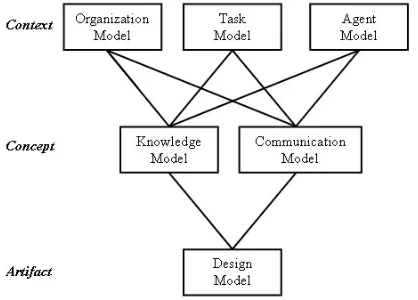
There are several knowledge engineering methods such as CommonKADS [8], SPEDE [14], and MOKA [15]. However, we selected CommonKADS as knowledge engineering methodology in this study become it provided a model suite (Fig.1) and template knowledge models for solving problems. Besides, it is now a European de facto standard for knowledge analysis and knowledge-intensive system development.
Together, the organization, task, and agent models analyze the organizational environment and the corresponding critical success factors for a knowledge system. The knowledge and communication models yield the conceptual description of problem-solving functions and data that were handled and delivered by a knowledge system. The design model converts it into a technical specification that is the basics for software system implementation.
2) Knowledge system development processes: are relative to knowledge engineering process. The outputs from CommonKADS model suite are specific requirements for designing knowledge system. Integrating these components to create knowledge management system model requires thinking in term of info-structure, rather than infrastructure [10].
Fig. 1. CommonKADS model suite.
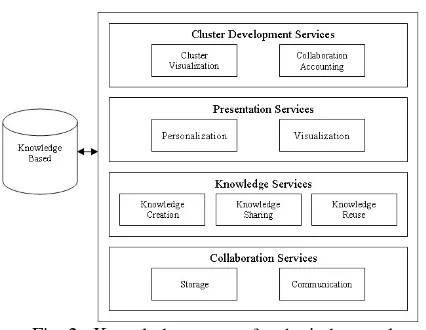
The KMS architecture for the industry cluster was adapted from three-tier KMS architecture [11] identifies three distinct services supported by knowledge management technologies. They are collaboration services, knowledge services and presentation services as shown in Fig. 2.
1) Collaboration services: refer to the basic technology platform and features needed to implement KM. The two main infrastructure services provided by technology are storage and communication.
1.1 Storage: known as knowledge repository such as drawings, audio, video or multimedia documents. The knowledge server which allow user to build content, create references and establish links among documents is technology that support KM processes, particularly knowledge creation and knowledge reuse. 1.2 Communication: related to collaboration and sharing activities in the cluster. This communication services are designed by specification output from communication model of CommonKADS. They could support communication between users (ex. e-mail) among user (ex. synchronous meeting and asynchronous discussion forum) and workflow management.
2) Knowledge services: intended to help achieve the goals of KM directly. Three primary goals are to promote the process of generating new knowledge, encourage the flow of knowledge among organization members and ensure the ease of access to knowledge repository [16]
2.1 Knowledge creation: is capability to capture and codify knowledge held by experts. This process was done by domain experts or knowledge engineer with the knowledge elicitation techniques provided by CommonKADS.
2.2 Knowledge sharing: is an important goal of KM technologies that support the knowledge sharing process which is collaborative tools, such as shared spaces, calendaring, workflow management service, etc.
2.3 Knowledge reuse: is a synonym with “information retrieval” in the information management literature. The emerging technology aim to provide enhanced search capabilities as user’s needs and automatic generation of meta-data [17]. Technologies that support knowledge reuse process are content management system (CMS) or concept mapping.
3) Presentation services: concerned with enhancing the interface between the user and the information /knowledge source.
3.1 Personalization: involves gathering user-information and delivering the appropriate content and service to meet the specific need of a user [18]. This service refer to the rule that determine how users and content are matched, base on their attributes and values.
Fig. 2. Knowledge system for the industry cluster.
3.2 Visualization: help users better understand the information and knowledge available by making subject-based browsing and navigation easier [17]. 4) Cluster Development Service: concerned with facilities for CDA to analyze and assess collaboration and sharing in the system. Technologies that support these services are social network analysis (SNA), accounting system, user’s activities tracking, etc.
4.1 Cluster visualization: helps CDAs to visualize their cluster character such as social network map, cluster map, etc.
4.2 Collaboration accounting: show the quality of communication and sharing by taking account from users’ activities via KMS.
III. INVESTIGATIONS AND RESULTS
The initial investigations have been done with 10 firms within the two biggest handicraft associations in Thailand and Northern Thailand. NOrthern Handicraft Manufacturer and EXporter (NOHMEX) association is the biggest handicraft association in Thailand which includes 161 manufacturers and exporters. Another association which is the biggest handicraft association in Chiang Mai is named Chiang Mai Brand. It is a group of qualified manufacturers who have capability to export their products and passed requirements of Thailand’s ministry of commerce. Until 2007, there are 99 authorized enterprises to use Chiang Mai brand on their products.
Regarding the study on cluster mapping by KIASIA [19], this project was funded by National Economic and Social Development Board (NESDB) to survey and analyze the current condition of clusters through the country. One of the recommendations that issued to Thai government is to establish knowledge database on cluster development to bring together cluster development information from various organizations. This will create more complete data on cluster development that can be used for monitoring operations and the progress of the development or related parties. Another recommendation is strengthening Cluster Development Agents (CDAs) within 5 years.
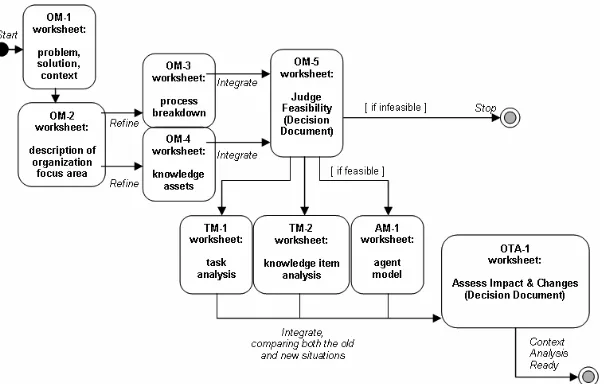
As we are in the beginning of this study, CommonKADS was used as a knowledge engineering methodology in the context level (organization model, task model, and agent model) in order to understand organization environment and corresponding critical success factors for knowledge system.
As shown in Fig. 3, Organization Model (OM-1 to OM-5), we found that handicraft cluster has its own vision as “Knowledge sharing hub for handicraft exporter”. And companies defined their problems, such as intellectual property problem, lack of collaboration, CDA development, product innovation, and product exporting. However, this cluster has many opportunities and solutions as well. We used “product exporting” and “product innovation” as our mock-up problems due to these problems are a knowledge intensive and feasible in business and technical aspect.
From the Task Model (TM-1 to TM-2), we analyzed the feasibility of each tasks that related to product exporting and product innovation processes. This model makes it possible to rank and prioritize the different knowledge-improvement scenarios.
Agent Model (AM-1) proposed organizational recommendations, improvements, and actions. From the experts’ point of view, they proposed actions for solving product exporting and product innovation problems as follow,
1) Develop information system that provides knowledge from experts about product selection, marketing information, or economic data from government organization.
2) Archive past lesson learn or experiences with in electronic forum
3) Create best practice of each task and store in knowledge-based system
4) Increasing the collaboration and information sharing within the cluster.
a. Between core business and supporting
organization (cluster level)
b. Between firms in the core business (core business level)
5) Create tools to support the capability of cluster development agency (CDA) to facilitate the cluster.
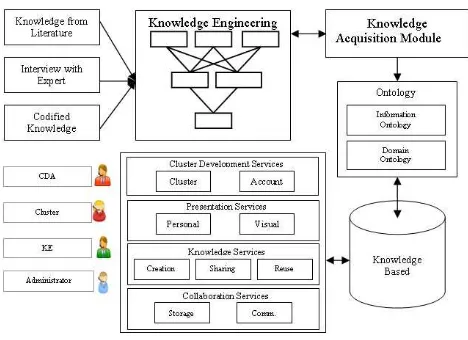
From knowledge engineering process in context level, we proposed our knowledge management system architecture for support cluster as shown in Fig. 4
The proposed architecture consisted of three parts, knowledge system part, ontology part, and knowledge engineering part. The Knowledge system part interacts with users (CDA, cluster members, knowledge engineers, and administrator) and also includes collaboration tools, repository, user’s database, content management, etc. In the presentation service, CDA’s tools are included for helping CDA to facilitate the cluster, such as social network analysis, cluster mapping. Knowledge acquisition part focused on supporting knowledge engineering process. During the manipulation stage, when user accesses the knowledge based, the ontology can support task of KM as well as searching. The knowledge based and the ontology is linked one to another via the ontology module. In the maintenance stage, knowledge engineers or domain experts can add, update, revise, and delete the knowledge or domain ontology via knowledge acquisition module.
IV. CONCLUSION
In our preliminary study on handicraft cluster and knowledge engineering in context level, we acquired basic requirements for design knowledge management system for cluster.
Fig. 3. A road map for carrying out knowledge oriented organization and task analysis.
Fig. 4. Proposed knowledge management system architecture for the industry cluster.
However, we are in the beginning of the research. In our perspectives of this study, we will finalize the specification of the sharable knowledge/information and the conditions of sharing among the cluster members. Then, we will capture and maintain the knowledge (for reusing when required) and work on the specific infrastructure to enhance the collaboration. At the end of the study, we will develop the knowledge management system for the handicraft cluster regarding to acquire requirements specification from the cluster.
ACKNOWLEDGMENT
The authors would like to thank Euro-Asia Collaboration and NetWorking in Information Engineering System Technology (EAST-WEST) project which aim to increase the collaboration between European countries and Asian countries in term of economics, knowledge, innovation or human resource development.
REFERENCES
[1] M. E. Porter, “Competitive Advantage of Nations”, New York: Free Press, 1990.
[2] A. Malmberg, D. Power, “(How) do (firms in) cluster create knowledge?”, in DRUID Summer Conference 2003 on creating, sharing and transferring knowledge, Copenhagen, June 12-14, 2004.
[3] dti, “A practical guide to cluster development”, Report to Department of Trade and Industry and the English RDAs by Ecotec Research & Consulting, 2005.
[4] A. Malmberg, D. Power, On the goal of global demand in local innovation processes. Rethinking Regional Innovation and Change. P. Shapiro and G. Fushs. Dordrecht, Kluwer Academic Publishers.
[5] M. E. Porter, “On Competition”, Boston: Harvard Business School Press, 1998.
[6] J. Dawson, P. Paris, UNIDO Report, consultants and UNIDO Project Teams in India, Nicaragua, Senegal and Zimbabwe, 2003.
[7] Ö. Sölvell, G. Lindqvist, C. Ketels, “The Cluster Initiative Green Book”, Garamond, Arial Narrow, Book Antiqa, August, 2003.
[8] A. Th. Schreiber, H. Akkermans, A. Anjewerden, R. de Hoog, N. Shadbolt, W. van de Velde, and B. Wielinga, “ Knowledge Engineering and Management: The CommonKADS Methodology”. The MIT Press, 1999.
[9] M. E. Jennex, L. Olfman, "Organizational
memory/knowledge effects on productivity, a longitudinal study", proceedings of the 35th Hawaii International Conference on System Sciences, HICSS35, IEEE Computer Society, 2002.
[10] A. Tiwana, “The knowledge management toolkit. Upper Saddle River, NJ: Prentice-Hall, 2000.
[11] A. Chua, “Knowledge management system architecture: a bridge between KM consultants and technologist”, International Journal of Information Management, Vol. 24, pp. 87-98, 2004.
[12] D. Binney, “The knowledge management
spectrum-understanding the KM landscape,” Journal of Knowledge Management, vol. 5, no.1, pp. 33-42, 2001.
[13] M. S. Woods, Knowledge management: applications,
markets and technologies. London: Ovum, 1998.
[14] N. Shadbolt, N. Milton, “From knowledge engineering to knowledge management”, British Journal of Management, vol. 10, pp. 309-322, 1999.
[15] S. Preston, C. Chapman “Knowledge acquisition for
knowledge-based engineering system”, Int. J. Information Technology and Management, vol. 4, no. 1, 2005.
[16] B. Martin, “Knowledge management within the context of management: An evolving relationship”. Singapore Management Review, vol. 22, no. 2, pp. 17-36, 2000. [17] A. D. Marwick, “Knowledge management technology”,
IBM Systems Journal, vol. 40, no. 4, pp. 814-830, 2001. [18] M. Bonett, “Personalization of web services: Opportunities
and challenges”. Ariadne Issue 28, 2001.
[19] KIASIA, “Cluster mapping project”, Final Report to
National Economic and Social Development Board (NESDB), 2006.