ANTIFOULING ACTIVITY OF BACTERIA ASSOCIATED WITH
SOFT CORAL Sarcophyton sp. AGAINST MARINE
BIOFILM-FORMING BACTERIA
Agus Sabdono1,2 and Ocky Karna Radjasa1,2,
1
Department of Marine Science, Diponegoro University, Semarang – 50275, Central Java, Indonesia
2
Center for Tropical Coastal and Marine Studies, Diponegoro University, Widya Puraya, Semarang – 50275, Central Java, Indonesia
Received : August, 10, 2006 : Accepted : September, 20, 2006
ABSTRACT
Marine bacteria associated with soft coral Sarcophyton sp collected from vicinity of Peucang island, Ujung Kulon, West Java, were successfully screened for antifouling activity against marine biofilm-forming bacteria isolated from the surrounding colonies of Sarcophyton sp. Six bacterial isolates were found to inhibit the growth of at least one of 7 biofilm-forming isolates. The most active strain USP3.37 was identified as Pelagiobacter variabilis by using 16S rDNA gene sequence analysis. Similarly, the active strains USP3.3, USP8.43, USP3.12, USP3.16 and USP8.6 were identified as Arthrobacter nicotianae, Shewanella alga, Pseudomonas synxantha, Pseudomonas falgida, Pseudovibrio denitrificans and Bacillus aquamaris, respectively. USP3.37 strain was found to amplify gene fragments of non-ribosomal peptide synthetase (NRPS). This raises the possibility the use of softcoral bacteria as the source of antibacterial compounds for controlling the antifouling in the sea. Therefore, this bacterium would be better to select eco-friendly antifouling compounds than the other antibacterial activities.
Keywords: Pelagiobacter variabilis, biofilm, antifouling, 16S rDNA,
* Correspondence :Phone: +62-24-7474698; Fax:+62-24-7474698; e-mail: [email protected]
I
NTRODUCTION
Soft corals are an important and diverse group of colonial invertebrates belonging to the Phylum Coelenterata (Cnidaria), Class Anthozoa, Subclass Octocorallia. One of the major group, order Alcyonaria consists of hundreds of different species including the genus of Sarcophyton. This leather coral,
Sarcophyton sp., is easily recognized by its mushroom shape. The thick, fleshy stalk attaches the colony to the bottom, and feathery, 8-branched polyps extend from the broad, disc-like cap (Benayahu et al., 2002). Furthermore, one of the reasons for the
evolutionary success of the alcyonacean soft corals in the Indo-Pacific is considered to be the high level of secondary metabolites commonly found in their tissues (Sammarco and Coll, 1992).
Marine biofouling, despite a natural process as a result of organism growth on underwater surfaces (Pereira et al, 2002), causes huge economic losses to marine industries. In seawater the microbial population on surfaces produce primary biofilm, which is generally thought to be a
prerequsite for the attachment and
Bacteria growing on the surfaces of marine algae and other organismslive in a highly competitive environment in which space and access to nutrients are limited (Burgess et al., 1999; Slattery et al, 2001). Previous studies have shown that a high percentage of marine epibiotic bacteria produceantimicrobial metabolites compared with the number of planktonicisolates that produce such metabolites (Boyd et al. 1999a; Boyd et al., 1999b; Jensen and Fenical, 1994; Lemos et al., 1986). One of the most interesting aspects of the soft corals is that fouling organisms usually do not colonize their surfaces and it is believed that antifouling represents another ecological role of secondary metabolite in the alcyonacean (Sammarco and Coll, 1990).
It has been widely reported that many bioactive natural products from marine invertebrates have stricking similarities to metabolites of their associated microorganisms including bacteria (Proksch et al, 2002; Imhoff and Stöhr, 2003). Thus, it is important to highlight the possible role of marine bacteria associated with soft coral in providing an alternative to the commercial metal-based antifouling coatings that are believed to be an environmental hazards due to their toxicity. Bacteria-soft coral association that occurs on the soft coral surface then could be of great interest to search for potential use as commercial antifoulants.
Advanced techniques of molecular biology such as Polymerase Chain Reaction (PCR), in particular the application of degenerated primers of Non-ribosomal peptide synthetases (NRPS) to amplify gene fragments from peptide producers has allowed screening on the presense of non
ribosomal peptides among secondary
metabolite-producing microorganisms
(Marahiel et al., 1997).
In this work, we reported the potential of marine bacteria associated with soft coral Sarcophyton sp for the production of secondary metabolites against marine
biofilm-forming bacteria coupled with PCR based-screening for the presence of non-ribosomal polypeptide synthetases.
M
ATERIALS AND
M
ETHODS
Sampling and isolation of soft
coral-associated bacteria
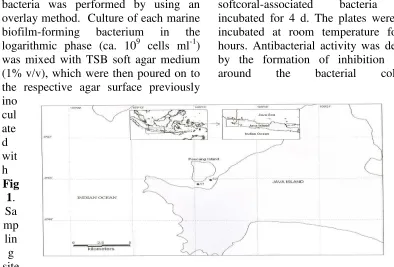
Colonies of soft coral Sarcophyton sp. were collected from the vicinity of Peucang island, Ujung Kulon, West Java, Indonesia (Figure 1) by scuba diving. Upon collection soft coral colonies were put into sterile plastic bags colonies were randomly picked and purified by making streak plates (Madigan et al, 2000).
Isolation of marine biofilm-forming
bacteria
Isolation was carried a method modified from Harder et al (2003). Four pre-sterilized glass diluted. One hundred µl of each dilution was spreaded onto ½ strength ZoBell 2216E and incubated at room temperature for 48 hours. Colonies with distinguished feature were selected and purified.
Antifouling test
bacteria was performed by using an
overlay method. Culture of each marine
biofilm-forming
bacterium
in
the
logarithmic phase (ca. 10
9cells ml
-1)
was mixed with TSB soft agar medium
(1% v/v), which were then poured on to
the respective agar surface previously
ino
cul
ate
d
wit
h
softcoral-associated
bacteria
and
incubated for 4 d. The plates were then
incubated at room temperature for 48
hours. Antibacterial activity was defined
by the formation of inhibition zones
around
the
bacterial
colonies
Fig
1
.
Sa
mp
lin
g
site
at Peucang islandUjung Kulon, West Java, Indonesia
PCR-based screening of NRPS producing bacterial strains
Genomic DNA of secondary metabolite producing-strains for PCR analysis were obtained from cell materials taken from an agar plate, suspended in sterile water (Sigma, Germany) and subjected to five cycles of freeze (-80°C) and thaw (95°C). Amplification of peptide synthetase gene fragments was carried out with the NRPS degenerated primers A2gamF (5´-AAG GCN GGC GSB GCS TAY STG CC-3´) and A3gamR (5´-TTG GGB IKB CCG GTS GIN CCS GAG GTG-3´)(Marahiel et al., 1997).
NRPS-PCR was performed with a thermal cycler (Eppendorf Inc, Germany) as follows: 1 µl template DNA, and 1 µl of each of the appropriate primers, which were then put into puReTaq Ready-To-Go PCR beads (Amersham Biosciences Europe GmbH, Germany). A PCR run comprised 40
cycles with denaturing conditions for one minute at 95°C, annealing for one minute at 70 °C and extension for two minutes at 72 °C, respectively.
PCR amplification and sequencing of 16S
rRNA gene fragments.
PCR amplification of partial 16S rRNA gene of active strains, purification of PCR products and subsequent sequencing analysis were performed according to the method of Thiel and Imhoff (2003). The determined DNA sequences of strains were then compared for homology to the BLAST database.
Phylogenetic analysis.
which less than 50 % of sequences of the
entire set of data had the same residues
were excluded from the calculations to
prevent uncertain alignments within
highly variable positions of the 16S
rDNA.
Phylogenetic
analysis
was
performed with the PAUP software
package (Swofford, 1988).
R
ESULTS AND
D
ISCUSSION
Antifouling activity of bacteria
associated with soft coral
Screening among 98 marine bacteria
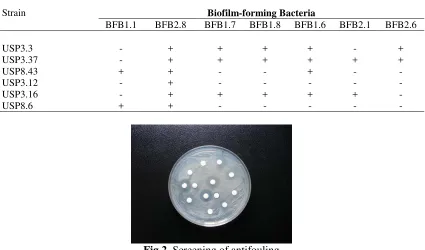
associated with softcoral Sarcophyton sp.by using test organisms revealed that only six isolates are capable of inhibiting the growth of biofilm-forming bacteria, while the rest of isolates showed no activity (Table 1 and Figure 2). USP3.37 isolate was the most active strain that inhibited 6 of 7 bacterial tested.
Table 1. Screening result of antifouling activity of soft coral associated bacteria
Strain Biofilm-forming Bacteria
BFB1.1 BFB2.8 BFB1.7 BFB1.8 BFB1.6 BFB2.1 BFB2.6
USP3.3 - + + + + - +
USP3.37 - + + + + + +
USP8.43 + + - - + - -
USP3.12 - + - - - - -
USP3.16 - + + + + + -
USP8.6 + + - - - - -
Fig 2. Screening of antifouling
Molecular
identification
and
Phylogenetic analysis
A comparison of the 16S rRNA gene sequence of active strains with sequences from GenBank demonstrated that the most active strain USP3.37 was identified as
Pelagiobacter variabilis with a homology of 96%. Similarly, the other
active strains USP3.3, USP8.43, USP3.12, USP3.16 and USP8.6 were identified as
Table 2. Molecular identification of active srains
No Strain Closest relative Homology (%)
1 USP3.16 Pseudovibrio denitrificans 97
2 USP3.3 Arthrobacter nicotianae 97
3 USP8.43 Shewanella alga 97
4 USP3.12 Pseudomonas synxantha 98
5 USP3.37 Pelagiobacter variabilis 96
6 USP8.6 Bacillus aquamaris 99
Kocuria rosea
USP3.3
Arthrobacter nicotianae Arthrobacter_russicus Bacillus_aquimaris
Bacillus_marisflavi
USP8.6
Bacillus_firmus
Pelagiobacter variabilis
USP3.37
Pelagiobacter epialgae Mucus bacterium
USP8.43
Shewanella algae Shewanella saira Shewanella frigidimarina Vibrio parahaemolyticus Vibrio cholerae
USP3.12
Pseudovibrio_denitrificans
USP3.16
Pseudomonas synxantha
Pseudomonas nitroreducens
Pseudomonas indica
Fig 3. Phylogenetic tree based on comparative 16S rRNA gene sequence analysis of
Phelagiobacter species showing the phylogenetic affiliation of strain USP3.37. Kocuria rosea was usedas outgroup.The bar indicates 2% sequence divergence.
PCR-based screening
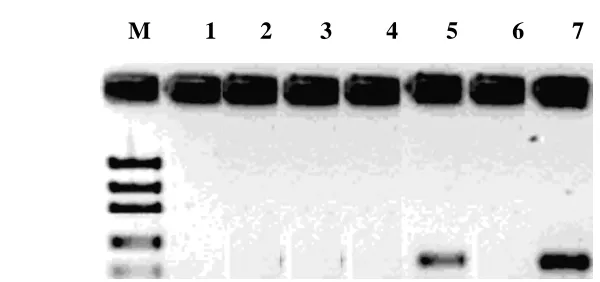
As shown in the figure 4, isolate USP3.37 was capable of amplifying the gene
fragments of Non-ribosomal peptide
synthetases (NRPS) indicated by the presence of single band having similar height to the positive control of Pseudomonas fluorescens
DSM 50117.
DISCUSSION
An attempt was carried out to estimate the potential of marine bacteria associated with soft coral Sarcophyton sp as the source of antibacterial compounds in particular against biofilm-forming bacteria.
Inhibitory interactions among coral-associated bacteria that occur on the coral surface are of great interest to search for secondary metabolite-producing bacteria. Isolation and screening for secondary metabolite-producing bacteria in coral reef ecosystems have been strongly neglected until now. Our results highlight one softcoral-associated bacterium (USP3.37) carrying the NRPS gene. This bacterium is 96% identical to Pelagiobacter variabilis
based on its 16S rRNA gene sequence. Growth inhibition of biofilm-forming bacteria by NRPS strain USP3.37 (Table 1) demonstrates the so far uncharacterized
secondary metabolites of strain USP3.37 lead to antagonistic activity and, may hence
lead to advantages in the competition for space and nutrients with other coral-associated bacteria. The efficient inhibition of biofilm-forming bacteria strain BFB1.1, BFB2.8, BFB1.7, BFB1.8, BFB1.6, BFB2.1 and BFB2.6 by strain USP3.37 may further reflect the potential role of coral bacteria in controlling biofouling on coral surface. Not all proteins are synthesized on ribosomes, and small polypeptides can be assembled by peptide synthetases just as
other compounds. Most non-ribosomal
peptides from microorganisms are classified as secondary metabolites. They rarely play a role in primary metabolism, such as growth or reproduction but have evolved to somehow benefit the producing organisms (Neilan et al, 1999). Interestingly, the organism closest related to USP3.37, Pelagiobacter variabilis,
owns a non-ribosomal peptide synthetase,
M 1
2 3 4 5 6 7
Fig 4. PCR amplification of NRPS gene fragments; M: DNA marker; 1: USP3.16;
which produces the anticancer antibiotics pelagiomicins (Mearns-Spragg et al, 1988; Yan et al., 2002; Imamura et al., 1997). Although the biological function of the gene product remains unknown, the feasibility that the respective gene detected in strain USP3.37 codes for a non ribosomal peptide synthetase is high.
The present work highlights the production of secondary metabolites by a symbiotic coral bacterium (UPS3.37) carrying the NRPS gene. The expression of the NRPS gene accounts for the biosynthesis of various natural products with different biological activity (Silakowski et al, 2000). Hence, the application of molecular approach through PCR using specific NRPS primers provides rapid detection and is suitable to greatly improve the screening efficiency for secondary metabolite-producer among coral-associated bacteria against biofilm-forming bacteria.
In conclusion, softcoral bacterium
Pelagiobacter variabilis USP3.37capable of
producing antifouling compound as
demonstrated by antibacterial test against biofilm-forming bacteria. It contained the NRPS gene fragment as shown by PCR screening. Further works are needed to clarify the responsible compounds in controlling the microfouling strain tested. This raises the possibility the use of softcoral bacteria as the source of antibacterial compounds for controlling the antifouling in the sea.
A
CKNOWLEDGEMENTS
The work was part of a research grant provided by Directorate General of Higher Education within the HIBAH BERSAING
Programme (Contract. No.
031/SPPP/PP/DP3M/IV/2005) and
Executive Programme of Scientific and Technological Cooperation between Italy and Indonesia .
R
EFERENCES
Benayahu,Y., T. Yosief and M.H. Schleyer
2002. Soft Corals
(Octocorallia,Alcyonacea) of the Southern Red Sea. Israel J. Zoology, 48, : 273–283
Boyd, K. G., D. R. Adams, and J. G. Burgess. 1999a. Antimicrobial and repellent activities of marine bacteria associated with algal surfaces.
Biofouling 14:227-236.
Boyd, K. G., A. Mearns-Spragg, and J. G. Burgess. 1999b. Screening of marine bacteria for the production of
microbial repellents using a
spectrophotometric chemotaxis
assay. Mar. Biotechnol. 1:359-363. Burgess, J. G., A. Mearns-Spragg, E. M.
Jordan, M. Bregu, and K. G. Boyd.
1999. Microbial antagonism: a
neglected avenue of natural products research. J. Biotechnol. 70:27-32.
antibiotics pelagiomicins, produced
by a new marine bacterium
Pelagiobacter sp. J. Antibiot : 50(1):8-12
Jensen, P. R., and W. Fenical. 1994. Strategies for the discovery of secondary metabolites from marine bacteria: ecological perspectives.
Ann. Rev. Microbiol. 48:559-584. Lemos, M. L., A. E. Toranzo, and L. J. Barja.
Madigan M.T, J.M. Martinko, J. Parker, and T.D. Brock, 2000. Biology of microorganisms. Prentice-Hall, Inc., New Jersey, USA
Marahiel M.A, T. Stachelhaus, and H.D. Mootz, 1997. Modular peptide
synthetases involved in
nonribosomal peptide synthesis.
Chem. Rev. 97:2651-2673
Mearns-Spragg, A., K. G. Boyd, M. Bregu, and J. G. Burgess. 1998. Cross-species induction and enhancement of antimicrobial activity produced by epibiotic bacteria from marine algae and invertebrates after exposure to terrestrial bacteria. Lett. Appl. Microbiol. 27:142-146. Neilan BA, Dittmann, L. Rouhiainen, R.A.
Bass, V. Schaub, K. Sivonen, and T. Borner ,1999. Nonribosomal peptide synthesis and toxigenicity of
cyanobacteria. J Bacteriol
181:4089-4097
Pereira, M. O., Kuehn, M., Wuertz, S., Neu, T. e Melo, L. 2002. Effect of flow regime on the architecture of a
Pseudomonas fluorescens biofilm.
Biotechnol.Bioeng : 78(2): 164-171. Proksch P, R.A. Edrada, R. Ebel, 2002.
Drugs from the seas-current status and microbiological implications.
Appl .Microbiol. Biot. 59:125-134 Sammarco, P. W., and J. C. Coll 1990. Lack
of predictability in terpenoid function: multiple roles and integration with related adaptations in soft corals. J Chem Ecol 16: 273-89
Sammarco P.W., J.C. Coll, 1992. Chemical adaptation in the Octocorallia: Evolutionary considerations. Mar. Ecol. Prog. Ser. 88:93-104
Silakowski B, Nordsiek G, Kunze B, Blöker H, Müller R, 2000 Novel features in a combined polyketide synthase/non-ribosomal peptide
Synthetase: the myxalamid biosynthetic gene
cluster of the myxobacterium
Stigmatella aurantiaca Sg a151.
Chem Biol 53:1-11
Slattery, M., I. Rajbhandari, and K. Wesson.
2001. Competition-mediated
antibiotic induction in the marine
bacterium Streptomyces
tenjimariensis. Microb. Ecol. 41: 90-96.
Swofford, D. L. 1998. PAUP*. Phylogenetic Analysis Using Parsimony (*and Other Methods). Version 4. Sinauer
Associates, Sunderland,
Massachusetts. Copyright ©
Smithsonian Institution, 1998.
Thiel,V and J.F. Imhoff. 2003. Phylogenetic identification of bacteria with antimicrobial activities isolated from Mediterranean sponges. Biomol. Eng. 20: 421-423.
Yan, L., K. G. Boyd, and J. G. Burgess. 2002.
Surface attachment induced
production of antimicrobial