Postharvest Biology and Technology 19 (2000) 33 – 45
Cultivar and growing region influence efficacy of warming
treatments for amelioration of superficial scald development
on apples after storage
Christopher B. Watkins
a,b,*, William J. Bramlage
c, Paul L. Brookfield
d,
Suzanne J. Reid
b, Sarah A. Weis
c, Thair F. Alwan
a,1aDepartment of Fruit and Vegetable Science,Cornell Uni6ersity,Ithaca,NY14853,USA
bThe Horticulture and Food Research Institute of New Zealand Limited,Pri6ate Bag92 169,Auckland,New Zealand cDepartment of Plant and Soil Sciences,Uni6ersity of Massachusetts,Amherst,MA01003,USA
dThe Horticulture and Food Research Institute of New Zealand Limited,Hawkes Bay Research Centre,Pri6ate Bag1401,
Ha6elock North,New Zealand
Received 8 June 1999; accepted 23 December 1999
Abstract
Single warmings of ‘Cortland’, ‘Delicious’, ‘Granny Smith’ and ‘Pacific Rose’ apples to 20°C for 0 – 9 days after cold storage of 0 – 27 days were tested as a potential non-chemical method to control superficial scald development. Only in ‘Granny Smith’ was scald development reduced to commercially acceptable levels by warming, and even for this cultivar the response varied among growing regions. Warming treatments greatly advanced ripening, as indicated by softening of ‘Cortland’, and to a lesser extent ‘Delicious’, but had only small ripening effects on ‘Granny Smith’ and ‘Pacific Rose’. The extent of any warming effects on fruit ripening was greater with longer storage time before warming and with longer warming periods. Warming ‘Cortland’ apples twice reduced scald to the level of DPA treatment but increased the amount of ripening induced. There was no evidence that warming could delay rather than prevent scald development. © 2000 Elsevier Science B.V. All rights reserved.
Keywords: Malus domestica; Physiological disorder; Superficial scald; Ethylene; ‘Cortland’; ‘Delicious’; ‘Granny Smith’; ‘Pacific Rose’
www.elsevier.com/locate/postharvbio
1. Introduction
Superficial scald, a physiological disorder that develops on a number of important apple culti-vars during storage, usually can be controlled by postharvest treatment with the antioxidant diphenylamine (DPA) (Huelin and Coggiola, 1968; Lau, 1990). However, concern about market
* Corresponding author. Tel.: +1-607-2551784; fax: + 1-607-2550599.
E-mail address:[email protected] (C.B. Watkins)
1Present address: Biochemistry Department, North
Caro-lina State University, Raleigh, NC 27695, USA.
C.B.Watkins et al./Posthar6est Biology and Technology19 (2000) 33 – 45 34
acceptance of DPA-treated fruit has stimulated research on alternative methods of control includ-ing low oxygen storage, heat treatments, ethanol treatments and application of other food-compat-ible antioxidants (Watkins et al., 1988; Lau, 1990; Lurie et al., 1991; Bauchot et al., 1995; Scott et al., 1995; Lau et al., 1998).
Warming of ‘Granny Smith’ apples for 3 – 5 days after 1 – 4 weeks during cold storage inhib-ited scald development similarly to DPA applica-tion (Watkins et al., 1995). Smith (1959) found that maximum scald reduction occurred from a warming of 5 days at 16 and 20 weeks in ‘Bram-ley’s Seedling’ apples, indicating that the timing of maximal sensitivity may vary with cultivar. Also, in a preliminary experiment we found that ‘Granny Smith’ apples from the Auckland region in New Zealand did not respond to warming treatments in the same manner as Hawke’s Bay-grown fruit (unpublished data). Similarly, warm-ing after 4 weeks in storage resulted in scald control comparable to that of DPA application for ‘Granny Smith’ apples harvested in France, but not for Spanish fruit warmed after 6 weeks in storage (Bauchot et al., 1995).
Although warming of fruit during storage pre-sents a number of challenges for its commercial utilization, consumer refusal to purchase DPA-treated fruit could result in acceptance of methods of scald control that are currently cost-pro-hibitive. A key factor in commercial acceptability of such a treatment is potential loss of fruit quality that might result from warming treatments required to control scald, which was small for ‘Granny Smith’ apples (Watkins et al., 1995).
The primary objective of the current study was to determine whether or not warming treatments produced a consistent effect on scald development and on fruit quality. Therefore, we have examined effects of various warming treatments on (1) a range of cultivars grown in the United States and New Zealand; and (2) ‘Granny Smith’ grown in two regions of New Zealand. In addition, the effects of two warmings were compared with those of a single warming. Development of scald and other disorders was assessed, several indices of fruit quality were measured, and effects of warming on accumulation ofa-farnesene and
con-jugated trienes were determined.
2. Materials and methods
2.1. Comparison of culti6ar responses to warming
treatments
Cultivar comparisons were carried out using ‘Cortland’ and ‘Delicious’ apples grown at the University of Massachusetts Horticultural Re-search Center in the US (harvest dates, 18 and 21 Sept. 1992, respectively), and ‘Delicious’ (1993 and 1994), ‘Granny Smith’ and ‘Pacific Rose’ (1994 only) apples grown at the Havelock North Research Orchard (Hawke’s Bay) in NZ (harvest dates were 9 March 1993, and 9, 28 and 29, March 1994, respectively).
A standard protocol was used for warming treatments in these locations. Fruit were harvested from randomly selected groups of trees to provide replicate groups of 70 apples. Four (US) or five (NZ) replicates were used for each treatment. Fruit were either not cooled and kept at 20°C for 0, 3, 6 or 9 days and transferred to storage at 0°C; or stored at 0°C for 9, 18 or 27 days and then transferred to 20°C for 0, 3, 6 or 9 days before being returned to cold storage. Therefore, there were 16 treatments for each cultivar. In the 1994 experiments, an add-itional treatment of 1000 mg l−1 DPA applied as a 1 min postharvest dip after harvest was in-cluded.
C.B.Watkins et al./Posthar6est Biology and Technology19 (2000) 33 – 45 35
Fruit were stored at 0°C for 20 weeks, except in 1994 when the experiments were expanded to include a 10 week period. Firmness and greasiness of fruit were measured on 10-fruit samples from each replicate after 1 day at 20°C, and the remain-ing fruit were kept at 20°C for a further 6 days. Fruit were then assessed for scald incidence and severity on affected fruit, where 0, none, 1, 1 – 10%, 2, 11% to 33%, 3, 34 – 66%, and 4, 67 – 100% of the surface area affected. Presence of any other disorder was also recorded.
2.2. Warming of Auckland-grown ‘Granny Smith’
‘Granny Smith’ apples were harvested from a commercial orchard in the Auckland region of NZ on 11 April, 2 and 20 May, 1994. At each harvest date, IEC and starch pattern index (Reid et al., 1982) were measured on 20 fruit. Fruit were divided into 12 replicates (100 fruit) for each of the following treatments: unwarmed (three repli-cates) or warmed for 5 days at 20°C before being returned to cold storage at 0°C (nine replicates). After 9, 16 or 24 weeks of cold storage, three of those nine replicates were transferred to 20°C for evaluation of firmness, background color and greasiness. Firmness was measured using an EPT-1 pressure tester (Lake City Technical Products, Canada), background color using a color reflec-tance meter (Chroma Meter II, Minolta, Japan) according to Watkins et al. (1995) and greasiness as described above, on 20 fruit after one day. Scald and other disorders were assessed after an additional 6 days.
2.3. Single and repeated warmings
The effect of two versus one 5-day warming treatment during storage was tested using ‘Cort-land’ apples grown at the Cornell University Or-chard at Ithaca, NY, US. Fruit were harvested on 23 September, 1996 from an orchard block and divided randomly into 45 groups of 80 fruit. Fifteen treatments were applied, each with three replicates of 80 fruit. Fruit were then placed into storage at 0°C. The treatments involved an at-har-vest 1000 mg l−1 DPA drench, a no warming treatment (control), a single warming treatment of
five days after 0, 2, 4, 6, 8, 10, 12 or 14 weeks, or two warming periods of five days each after 0 and 4, 2 and 6, 4 and 8, 6 and 10, 8 and 12, or 10 and 14 weeks.
Fruit were stored for a total of 23 weeks, and then kept at 20°C for 7 days to assess occurrence of scald and any other disorder. However, at removal from storage, one 10-fruit sample for each treatment replicate of fruit was assessed (while still cold) for IEC and flesh firmness. IECs were measured as above except that a Varian gas chromatograph (Model 3700, Varian, Walnut Creek, CA) was used. Firmness was measured using an EPT-1 pressure tester. A further set of 10 cold fruit was dipped sequentially in hexane to extract a-farnesene and its oxidation products as
described by Watkins et al. (1995). Absorbances of appropriate dilutions of the hexane extracts were measured at 258, 269, 281 and 290 nm, and in aliquots of the extract at 232 nm using a Beckman diode array spectrophotometer (Model DU 7400, Beckman Instruments, Columbia, MD) after being passed through Florisil columns (Watkins et al., 1988). Concentrations of CTs were calculated from OD258 – 290, OD269 – 290 and OD281 – 290, with an extinction coefficient of 25 000 (Anet, 1972). Concentrations of a-farnesene were
calculated using an extinction coefficient of E232=27 700 (Huelin and Coggiola, 1968). Data are expressed as nanomoles per square centimeter of peel.
2.4. Statistical analysis
All data were analyzed using the SAS program (SAS Institute, 1988). Except where it is stated that Dunnett’s test was used, the General Linear Models (GLM) procedure was used. The Analysis of Variance (ANOVA) program was used to give Dunnett’s Minimum Significant Differences.
C.B.Watkins et al./Posthar6est Biology and Technology19 (2000) 33 – 45 36
and (3) the interaction between these two factors. In most cases there was an interaction between storage and warming; i.e. the effect of the length of the warming period varied according to when the fruit were warmed. Whenever this interaction occurred, the warming and storage×warming factors were combined as warming within storage, and the data are presented separately for each of the prewarming storage periods. The SAS pro-gram cannot perform this separation, so it was done by hand according to Steel and Torrie (1960).
When scald was measured, in addition to being compared with one another, the warming treat-ments were compared with the DPA treatment. Dunnett’s test was used for these comparisons, with the unwarmed control or the DPA treatment as the basis for comparison.
The 1994 Auckland-grown ‘Granny Smith’ ex-periment, in which a number of storage quality factors were compared based on (1) harvest date; (2) length of cold storage; and (3) presence or absence of a postharvest warming period, was analyzed using simple analysis of variance treating all three factors as main effects and also looking at the two-way interactions.
The experiment in which ‘Cortland’ apples were warmed twice, stored, and then assessed for qual-ity was analyzed first using Dunnett’s test to determine if any of the treatments differed signifi-cantly from the DPA treatment. Then, the data were analyzed again to look at differences relating to time of warming among the once-warmed fruit and whether or not the second warming had additional effects.
3. Results
3.1. Comparison of culti6ar responses to warming
treatments
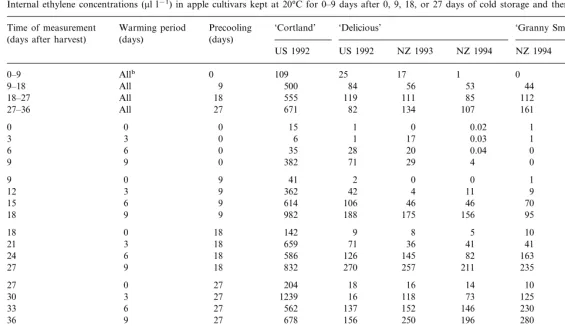
All cultivars were preclimacteric at harvest ex-cept for a few individual ‘Cortland’ fruit which produced a higher mean IEC (Table 1). IEC increased in all cultivars except ‘Pacific Rose’ with increasing storage and warming periods. ‘Pacific Rose’ produced only a small increase in IEC during storage and none during warming.
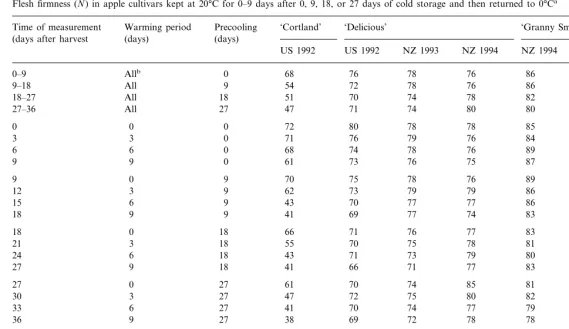
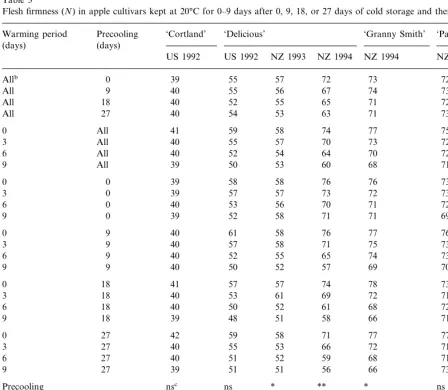
Warming caused ‘Cortland’ apples to soften, and this was increased with increasing prewarm-ing storage time (Table 2). Although warmprewarm-ing of other cultivars produced a statistically significant reduction in firmness, it was small enough to be of little or no practical importance. After storage for 20 weeks, ‘Cortland’ apples were unacceptably soft, regardless of treatment (Table 3). ‘Delicious’, ‘Granny Smith’ and ‘Pacific Rose’ apples were softer if they had been warmed, with softening increasing with increasing duration of the warm-ing period.
In general, background color changes were sim-ilar to those for firmness (data not shown), and therefore we present firmness alone to describe treatment effects on ripening. The only other ma-jor quality index that changed in warmed fruit was greasiness in ‘Granny Smith’ (data not shown). For example, in 1994, unwarmed fruit never had indices greater than 1.0 (slight), but in fruit stored 9 days or more and then warmed for 6 or 9 days, greasiness was rated as 2.4 – 3.0 (moderate to severe).
C
Internal ethylene concentrations (ml l−1) in apple cultivars kept at 20°C for 0–9 days after 0, 9, 18, or 27 days of cold storage and then returned to 0°Ca
Time of measurement Warming period Precooling ‘Cortland’ ‘Delicious’ ‘Granny Smith’ ‘Pacific Rose’ (days)
(days) (days after harvest)
NZ 1994 NZ 1994 NZ 1994 US 1992 US 1992 NZ 1993
1 0 0.6
18–27 All 18 555
107
aEthylene was measured at the end of each warming period.
bThe data shown in these top four rows are means of data shown in the following 16 rows. cns, *, **; nonsignificant atP=0.05, or significant atP=0.05 or 0.01, respectively.
dWarming and precooling×warming were significant atP=0.01 in all cases so effects of warming treatments were analyzed separately for each different precooling
C
Flesh firmness (N) in apple cultivars kept at 20°C for 0–9 days after 0, 9, 18, or 27 days of cold storage and then returned to 0°Ca
‘Cortland’
Time of measurement Warming period Precooling ‘Delicious’ ‘Granny Smith’ ‘Pacific Rose’ (days)
(days) (days after harvest
NZ 1994 NZ 1994 NZ 1994 US 1992 US 1992 NZ 1993
76 86 79
aFirmness was measured at the end of each warming period.
bThe data shown in these top four rows are means of data shown in the following 16 rows. cns, *, **; nonsignificant atP=0.05, or significant atP=0.05 or 0.01, respectively.
dWarming and precooling×warming were significant atP=0.01 in all cases (except ‘Pacific Rose’ for which neither was significant atP=0.05) so effects of
warming period were analyzed separately for each length of precooling. W:Pxrefers to effect of warming period within a given precooling treatment (wherex=0, 9,
C.B.Watkins et al./Posthar6est Biology and Technology19 (2000) 33 – 45 39
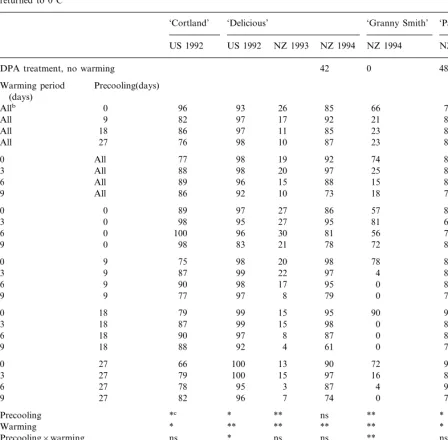
In 1994, the possibility that warming treatments delay, rather than control, the extent of scald development was tested by evaluating fruit 10 weeks as well as 20 weeks after harvest. If warming treatments delayed scald development, then treat-ment effects should be detectable at 10 weeks when
scald intensities were lower than at 20 weeks. ‘Delicious’ had 42% scald overall at 10 weeks (data not shown), but an absence of warming treatment effects indicated that scald development was not simply delayed by these treatments. No scald devel-oped on ‘Granny Smith’ at 10 weeks.
Table 3
Flesh firmness (N) in apple cultivars kept at 20°C for 0–9 days after 0, 9, 18, or 27 days of cold storage and then returned to 0°Ca
‘Pacific Rose’ Warming period Precooling ‘Cortland’ ‘Delicious’ ‘Granny Smith’
(days) (days)
NZ 1993 NZ 1994 NZ 1994 NZ 1994 US 1992 US 1992
73
Precooling×warming * ns * ** *
*
aFirmness was measured after storage at 0°C for 20 weeks, plus 1 day at 20°C.
bThe data shown in these top eight rows are means of data shown in the following 16 rows. cns, *, **; nonsignificant atP=0.05, or significant atP=0.05 or 0.01, respectively.
dIn cases of significant (P=0.05) precooling×warming interaction, effects of warming period were analyzed separately for each
C.B.Watkins et al./Posthar6est Biology and Technology19 (2000) 33 – 45 40
Table 4
Superficial scald incidence (%) in apple cultivars kept at 20°C for 0–9 days after 0, 9, 18, or 27 days of cold storage and then returned to 0°Ca
‘Cortland’ ‘Delicious’ ‘Granny Smith’ ‘Pacific Rose’
US 1992 US 1992 NZ 1993 NZ 1994 NZ 1994 NZ 1994
42
DPA treatment, no warming 0 48
Precooling(days) Warming period
(days)
Allb 0 96 93 26 85 66 76
All 9 82 97 17 92 21 84
86 97 11
18 85
All 23 84
76 98 10 87
All 27 23 86
77 98 19
0 All 92 74 88
3 All 88 98 20 97 25 81
All
6 89 96 15 88 15 84
86 92 10 73
All 18
9 77
89 97 27
0 0 86 57 83
98 95 27
0 95
3 81 69
0
6 100 96 30 81 56 71
0
9 98 83 21 78 72 81
75 98 20
0 9 98 78 86
87
3 9 99 22 97 4 85
90 98 17
9 95
6 0 86
9
9 77 97 8 79 0 78
0 18 79 99 15 95 90 90
87 99 15
18 98
3 0 84
90 97 8
6 18 87 0 87
88 92 4 61
18 0
9 73
0 27 66 100 13 90 72 91
3 27 79 100 15 97 16 84
78 95 3
27 87
6 4 91
82
9 27 96 7 74 0 77
* **
Precooling *c ns ** *
Warming * ** ** ** ** *
Precooling×warming ns * ns ns ** ns
** **
W:P0 d
ns **
W:P9
* **
W:P18
W:P27 ns **
17.1 21.1
DPA versus others, Dunnett’s mean significant difference 19.9
aScald was measured after storage at 0°C for 20 weeks, plus 7 days at 20°C.
bThe data shown in these top eight rows are means of data shown in the following 16 rows. cns, *, **; nonsignificant atP=0.05, or significant atP=0.05 or 0.01, respectively. dW:P
xrefers to effect of warming period within a given precooling treatment (wherex=0, 9, 18, or 27 days). This analysis was
not done when precooling×warming was ns.
Few other disorders were observed in these experiments. In US-grown ‘Delicious’, low inci-dence of breakdown and bitter pit was not
C.B.Watkins et al./Posthar6est Biology and Technology19 (2000) 33 – 45 41
severe coreflush by warming treatments of 9 days after 9 days of storage, and 6 and 9 days after 18 and 27 days of storage (data not shown).
3.2. Warming of Auckland-grown ‘Granny Smith’
Preliminary experiments had shown that warm-ing of ‘Granny Smith’ apples from the Auckland region did not reduce scald incidence. Because scald incidence is higher in fruit from this region than from southern regions such as Hawke’s Bay (Watkins et al., 1982), we examined the effect of warming fruit (for 5 days after 2 weeks of cold storage) at three harvest dates. IECs were 0.06, 0.15. and 0.1 ml l−1, and starch pattern indices
were 1.7, 3.1 and 3.7 units for harvests on 11 April, and 2 and 20 May, respectively. Fruit quality was assessed after 0°C storage for up to 24 weeks. Fruit firmness was not significantly influ-enced by harvest date or warming, but declined with increased storage time. Fruit were less green and had higher greasiness indices with later har-vest, with longer storage time, and also with warming (Table 5). Scald incidence increased with increasing storage length and was highest in the earliest harvested fruit. Length of storage and harvest date interacted with warming, however, with up to 50% reduction of scald in warmed fruit from the first harvest, while effects of warming on fruit from later harvests were absent. Scald was reduced 50% by warming after 9 weeks of storage, but scald reduction became less as storage time after warming increased. Scald reduction by warming was much less on fruit from the two later harvests than on those from the first harvest.
3.3. Single and repeated warmings
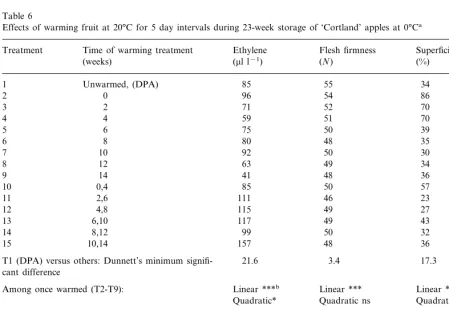
The effects of warming fruit twice during stor-age compared with single warming treatments were investigated using ‘Cortland’ apples (Table 6). Warming fruit once or twice during the first 4 weeks of storage doubled scald incidence, but later warmings resulted in levels similar to those found in the control. When fruit were warmed twice, the second warming reduced scald below that of those warmed once at 0, 2, or 4 weeks, but not in those fruit warmed later. The severity of
scald was slight, except in the 0 week treatment (severity, 2.3), averaging 1.2 overall across all other treatments (data not shown).
Breakdown and rots were detected in all treat-ments, but no consistent pattern associated with timing of warmings was found (data not shown). IECs of fruit were variable among treatments, but were higher in fruit that had been warmed twice (Table 6). The sole exception was the double warming at harvest and again 4 weeks later. Firm-ness of fruit was less than control in all warming treatments except for the at-harvest warming.
Analyses ofa-farnesene and its oxidation
prod-ucts also resulted in variations which did not show any consistent patterns across treatments, and neither CT258, CT269, CT281, values nor CT258/CT281 ratios were correlated significantly with scald incidence (data not shown).
4. Discussion
A single warming period applied to cold-stored fruit within four weeks of harvest advanced ripen-ing, as indicated by higher IECs and softening by the end of warming (Tables 1 and 2), and after storage (Table 3), and by less green fruit (data not shown). In general, the longer the storage period before warming, and/or the length of warming, the greater the effect of warming on ripening. The extent of these changes, however, was affected greatly by cultivar, with large effects on ‘Cort-land’ and moderate effects on ‘Delicious’, and small effects on ’Granny Smith’ and particularly ‘Pacific Rose’. These cultivar differences are con-sistent with IECs and ripening rates of relatively early (‘Cortland’), mid-season (‘Delicious’), and late harvested (‘Granny Smith’ and ‘Pacific Rose’) cultivars. Thus effects of warming on overall fruit quality were generally small for ‘Granny Smith’ and ‘Pacific Rose’, although greasiness, which can be a commercial problem (Leake et al., 1989), was increased by warming ‘Granny Smith’.
C
.
B
.
Watkins
et
al
.
/
Posthar
6
est
Biology
and
Technology
19
(2000)
33
–
45
42
Table 5
Fruit quality (firmness, background color, and greasiness) and superficial scald and coreflush occurrence in Auckland-grown ‘Granny Smith’ apples harvested 11 April and 2 and 20 May, 1994, and either stored at 0°C throughout (control) or warmed at 20°C for 5 days after 2 weeks of 0°C storagea
Background color
Firmness Greasiness
Storage (weeks) Scald
Harvest date Coreflush
(0–3) (%)
(ln -a*/b*) (N)
Control Warm Control Warm Control Warm Warm
Control Warm
Control
0.1 1.0 8 4 0 0
April 11 9 78 75 −0.77 −0.82
0.6 1.6 90 47 6
−0.93 2
72 74 −0.81
16
−0.97
24 70 69 −0.90 1.0 1.4 99 69 20 12
9 74 73 −0.86 0.7 1.7 13 8 2 2
May 2 −0.84
1.3 2.2 11 6 4
−0.99 3
−0.89 73
74 16
1.2 1.9 55 41 19 8
24 69 69 −0.91 −1.02
1.7 2.4 5 3 4
−0.88 4
May 20 9 74 72 −0.93
16 71 69 −0.90 −0.98 1.3 2.1 11 5 11 8
24 68 66 −1.01 −1.06 1.7 2.3 55 59 15 11
*** *** *** *
*** *** *
*** nsb
nsb
Harvest date
* *** *** ***
Storage ** ** *** *** * ***
** ** ** ** **
**
** **
Warming ns ns
***
ns ns ns ns *** ** ** *** ***
H×S
ns
H×W ns ns ns ns ns ** ** ns ns
ns *** *** ** **
ns
ns ns
S×W ns ns
C.B.Watkins et al./Posthar6est Biology and Technology19 (2000) 33 – 45 43
France or Spain reported in the study of Bauchot et al. (1995) was confounded by warming after inconsistent intervals of storage, but in the present study, fruit grown in Auckland or Hawke’s Bay and warmed at equivalent times produced very different effects of warming on scald (Tables 4 and 5). This regional effect was not modified by later harvest, which reduces scald susceptibility. Likewise, there was no indication that warming delayed scald development, rather than con-trolling it, as resulted from pre-storage heat treat-ment of fruit (Lurie et al., 1991).
A single warming treatment (Table 4) affected scald incidence of ‘Cortland’, ‘Delicious’ and ‘Pacific Rose’ apples only slightly; although there
was statistical significance, differences were not large enough to be of practical value. Single or double warming of ‘Cortland’ later than 4 weeks postharvest improved scald control to a level sim-ilar to that of DPA (Table 6). Flesh firmness, however, was reduced by warming, both once and twice. Scald development was inhibited in ‘Cort-land’ and ‘Delicious’ apples that were subjected to intermittent warming, involving warming for 24 hour cycles every one, two or three weeks (Alwan and Watkins, 1999). Each of these cultivars, as well as ‘Law Rome’, responded differently to fre-quency of warming, although a weekly cycle was always effective. Therefore, it appears that the intensity (frequency and length) of warming
treat-Table 6
Effects of warming fruit at 20°C for 5 day intervals during 23-week storage of ‘Cortland’ apples at 0°Ca
Time of warming treatment Ethylene Flesh firmness Superficial scald Treatment
(weeks) (ml l−1) (N) (%)
34 85
1 Unwarmed, (DPA) 55
54
2 0 96 86
52
3 2 71 70
70 51
59
4 4
5 6 75 50 39
6 8 80 48 35
50
92 30
10 7
8 12 63 49 34
14 41
9 48 36
10 0,4 85 50 57
23 46
111
11 2,6
4,8 115
12 49 27
13 6,10 117 49 43
14 8,12 99 50 32
10,14 157
15 48 36
T1 (DPA) versus others: Dunnett’s minimum signifi- 21.6 3.4 17.3 cant difference
Among once warmed (T2-T9): Linear ***b Linear *** Linear ***
Quadratic *** Quadratic ns
Quadratic*
Warmed once (T2–T7) versus twice (T10-T15): *** *** *** Warmed at 0 versus 0 and 4 weeks (T2 vs T10) ns ** ***
***
Warmed at 2 versus 2 and 6 wks (T3 vs T11) *** ***
Warmed at 4 versus 4 and 8 weeks (T4 vs T12) *** ns *** Warmed at 6 versus 6 and 10 weeks (T5 vs T13) *** ns ns Warmed at 8 versus 8 and 12 weeks (T6 vs T14) * ns ns
*** ns ns
Warmed at 10 versus 10 and 14 weeks (T7 vs T15)
aAnalyses were carried out on cold fruit immediately after removal from storage except for superficial scald assessment which was
carried out after 7 days at 20°C.
C.B.Watkins et al./Posthar6est Biology and Technology19 (2000) 33 – 45 44
ments that will alleviate scald development are specific to cultivar and growing region.
The mechanism whereby warming alleviates scald is not known. The a-farnesene hypothesis
generally is accepted as the basis of scald develop-ment (Anet, 1972; Du and Bramlage, 1994), and warming treatments might affecta-farnesene
pro-duction, its oxidation or associated chemical reac-tions that are presumed to cause injury, or by increased resistance of the fruit tissue to these damaging reactions (Watkins et al., 1995; Alwan and Watkins, 1999). Concentrations of a
-far-nesene and its oxidation products such as conju-gated trienes were affected inconsistently by warming treatments (data not shown; Watkins et al., 1995) possibly reflecting effects of warming on production, volatilization, and composition of the waxes in the fruit skin. Increases in a-farnesene
concentrations are closely associated with rises of ethylene in fruit (Watkins et al., 1993; Du and Bramlage, 1994). Watkins et al. (1995) suggested that effects of ethylene at low temperatures (chill-ing injury) might be different from those at higher temperatures. Warming of fruit might alleviate these low temperature effects. The present data on ethylene (Table 1), however, do not support a concept that differential stimulation of ethylene contributes to scald susceptibility (Table 4). Warming treatments, either as one several-day duration as examined here and elsewhere (Smith, 1959; Watkins et al., 1995), or as repeated brief warmings (Kidd and West, 1935; Alwan and Watkins, 1999), may allow removal of toxic sub-stances that accumulate during chilling, and/or condition the tissue against injury. Differences in responses to warming among cultivars and grow-ing regions may be related to factors such as skin permeability and wax composition that could infl-uence concentrations of volatiles or other materi-als in the cuticle
Acknowledgements
Part of the research at the University of Massa-chusetts was carried out with the support of a Trimble Agricultural Research Fund award to Chris Watkins. The research was also supported
by the New Zealand Apple and Pear Marketing Board, the NZ Foundation for Research Science and Technology, USDA specific cooperative agreement 58-1931-5-017, New York Apple Re-search and Development Program, and federal formula funds, regional project NE103.
References
Alwan, T.F., Watkins, C.B., 1999. Intermittent warming ef-fects on superficial scald development of ‘Cortland’, ‘Deli-cious’ and ‘Law Rome’ apple fruit. Postharvest Biol. Technol. 16, 203 – 212.
Anet, E.F.L.J., 1972. Superficial scald, a functional disorder of stored apples. IX. Effect of maturity and ventilation. J. Sci. Food Agr. 23, 763 – 769.
Bauchot, A.D., John, P., Soria, Y., Recasens, I., 1995. Sucrose ester-based coatings formulated with food-compatible an-tioxidants in the prevention of superficial scald in stored apples. J. Am. Soc. Hort. Sci. 120, 491 – 496.
Du, Z., Bramlage, W.J., 1994. Roles of ethylene in the devel-opment of superficial scald in ‘Cortland’ apples. J. Am. Soc. Hort. Sci. 119, 516 – 523.
Huelin, F.E., Coggiola, I.M., 1968. Superficial scald, a func-tional disorder. IV. Effect of variety, maturity, oiled wraps and diphenylamine on concentration ofa-farnesene in the
fruit. J. Sci. Food Agr. 19, 297 – 301.
Kidd, F., West, C., 1935. The cause and control of superficial scald of apples. GB Dept Sci Ind Res Food Investigation Board Rpt (1934), 111 – 117.
Lau, O.L., 1990. Efficacy of diphenylamine, ultra-low oxygen, and ethylene scrubbing on scald control in ‘Delicious’ apples. J. Am. Soc. Hort. Sci. 115, 959 – 961.
Lau, O.L., Barden, C.L., Blankenship, S.M., Chen, P.M., Curry, E.A., DeEll, J.R., Lehman-Sahada, L., Mitcham, E.J., Prange, R.K., Watkins, C.B., 1998. A North Ameri-can cooperative survey of ‘Starkrimson Delicious’ apple responses to 0.7% O2storage on superficial scald and other
disorders. Postharvest Biol. Technol. 13, 19 – 26.
Leake, A.L., Hoggett, S.M., Watkins, C.B., 1989. Solving the greasiness problem in Granny Smith apple fruit. Or-chardist of New Zealand 62(4), 24 – 26; 62(6), 23. Lurie, S., Klein, J.D., Ben Arie, R., 1991. Prestorage heat
treatment delays development of superficial scald on ‘Granny Smith’ apples. HortScience 26, 166 – 167. Reid, M.S., Padfield, C.A.S., Watkins, C.B., Harman, J.E.,
1982. Starch iodine pattern as a maturity index for ‘Granny Smith’ apples. 1. Comparison with flesh firmness and soluble solids content. NZ J. Agric. Res. 25, 239 – 243. SAS Institute. SAS/STAT7 User’s Guide, Release 6.03
Edi-tion. Cary, NC: SAS Institute. 1988. 1028 pp.
C.B.Watkins et al./Posthar6est Biology and Technology19 (2000) 33 – 45 45
Smith, W.H., 1959. Control of superficial scald in stored apples. Nature (London) 183, 760.
Steel, R.G.D. and Torrie, J.H. 1960. Principles and Procedures of Statistics. Analysis of variance IV: split-plot designs and analysis. pp. 232 – 251 (Chapter 12).
Watkins, C.B., Barden, C.L., Bramlage, W.J., 1993. Relation-ships among alpha-farnesene, ethylene production and su-perficial scald development of apples. Acta Hort. 343, 155 – 160.
Watkins, C.B., Bramlage, W.J., Cregoe, B.A., 1995. Super-ficial scald of ‘Granny Smith’ apples is expressed as a
typical chilling injury. J. Am. Soc. Hort. Sci. 120, 88 – 94.
Watkins, C.B., Harman, J.E., Hopkirk, G., 1988. Effects of lecithin, calcium, and antioxidant formulations on superfi-cial scald and internal breakdown of ‘Granny Smith’ ap-ples. NZ J. Exp. Agr. 16, 55 – 61.
Watkins, C.B., Reid, M.S., Harman, J.E., Padfield, C.A.S., 1982. Starch iodine pattern as a maturity index for Granny Smith apples. 2. Differences between districts and relation-ship to storage disorders and yield. NZ J. Agric. Res. 25, 587 – 592.