S T A N D A R D S
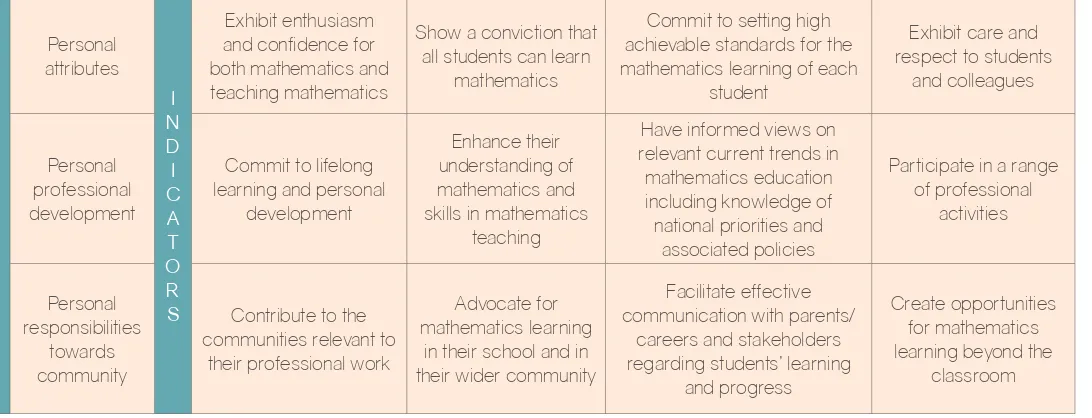
Personal attributes
I N D I C A T O R S
Exhibit enthusiasm and confidence for both mathematics and teaching mathematics
Show a conviction that all students can learn
mathematics
Commit to setting high achievable standards for the mathematics learning of each
student
Exhibit care and respect to students
and colleagues
Personal professional development
Commit to lifelong learning and personal
development
Enhance their understanding of mathematics and skills in mathematics
teaching
Have informed views on relevant current trends in mathematics education including knowledge of national priorities and
associated policies
Participate in a range of professional
activities
Personal responsibilities
towards community
Contribute to the communities relevant to
their professional work
Advocate for mathematics learning
in their school and in their wider community
Facilitate effective communication with parents/
careers and stakeholders regarding students’ learning
and progress
Create opportunities for mathematics learning beyond the
classroom
S T A N D A R D S
Professional
ethics I
N D I C A T O R S
Adhere to the codes of conduct
Demonstrate professionalism
Practise professional autonomy (e.g. willingness to perform duty above expectation)
Professional communities at
schools
Enrich the educational context for students (e.g. co-curricular activities, advisor for mathematics club, mathematics competition, mathematics
project)
Participate in the school-based professional learning community (e.g. mentoring, lesson study, action
research, journal contribution)
Professional communities outside schools
Affiliate with professional organisation (national and local government, international organisation,
private company, journal publication)
Take part in professional community networking among practitioners of schools, educational institutes, and/or
universities Table 3 Dimension 3: Personal and Professional Attributes and its Standards and Indicators
Table 4 Dimension 4: Professional Communities and its Standards and Indicators
CONCLUSION
As a regional initiative, the SEARS-MT would be especially beneficial for the developing nations in the region which may not have the capacity to develop their own teachers’ standards at the moment. Future research could be extended by developing local descriptors in the context of each SEAMEO member country.
For further details please contact:
Dr. Thien Lei Mee Email: [email protected]
Tel: +604 652 2773 / +6019 475 2541 Fax: +604 652 2737 Website: www.recsam.edu.my
SOUTHEAST ASIA REGIONAL
The Southeast Asian Ministers of Education Organisation (SEAMEO) has uniquely represented the collective aspirations of the Southeast Asian region in education and capacity building. The focus on education has accelerated the momentum to provide quality education for the next generation of leaders and human resource needs of the region. The emphasis on mathematics and science education underpins this agenda. Considering this, the SEAMEO Regional Centre for Education in Science and Mathematics (RECSAM) has outlined the Southeast Asia Regional Standards for Mathematics Teachers (SEARS-MT).
INTRODUCTION
To document a set of standards that describes the qualities that a mathematics teacher in the SEAMEO region should attain in the 21st century.
Collaborative inquiry approach
First workshop: 12 - 14 March 2013
at SEAMEO RECSAM, Penang
Second Workshop:
1
“Benchmarking Quality: AreTeachers a Precious Asset or a Big Problem?” by Assoc. Prof. Dr. Allan White
“Professional Competence and Professional Community in
Mathematics Education” by Prof. Dr. Takuya Baba
“Understanding and Teaching Mathematics in Southeast Asian Classrooms: Challenges and Opportunities for Practice and Professional Development” by Prof. Dr. Mohan Chinnappan.
70 educators from Malaysia, Indonesia, the Philippines and Thailand attended the seminar. Seminar:
2 – 5 July 2013 at SEAMEO RECSAM, Penang
International consultants and country experts included Brunei Darussalam, Cambodia, Indonesia, Laos, Malaysia, the Philippines, Thailand, Timor-Leste and Vietnam
METHODOLOGY
International consultant, country representatives and RECSAM staffs
PURPOSE
2
3
4
Workshop session Interaction between
consultant and participants
Presentation from country representative
REFERENCES
RESULTS
Standards for Excellence in Teaching Mathematics in Australian Schools (Australian Association of Mathematics Teachers, 2006),
Professional Teaching Standards (NSW Institute of Teachers, 2005), the Malaysian Teachers Standards (Ministry of Education, n.d.), and
Teaching Competency Standards in Southeast Asian Countries (SEAMEO INNOTECH, 2010).
Four dimensions and its standard and indicators of SEARS-MT were identified:
(1) Professional Knowledge
(2) Professional Teaching
(3) Personal and Professional Attributes
(4) Professional Communities
S
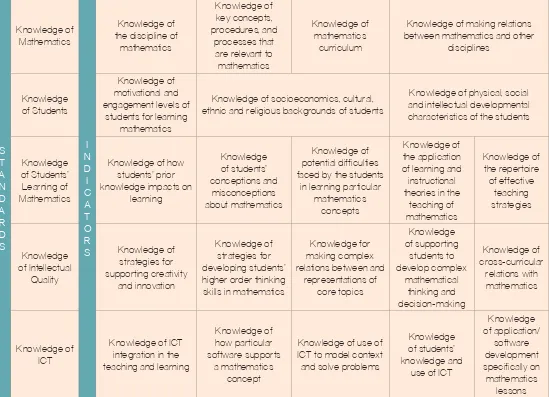
Knowledge of Mathematics
Knowledge of the discipline of
mathematics
Knowledge of key concepts, procedures, and
processes that are relevant to mathematics
Knowledge of mathematics
curriculum
Knowledge of making relations between mathematics and other
disciplines
Knowledge of Students
Knowledge of motivational and engagement levels of
students for learning mathematics
Knowledge of socioeconomics, cultural, ethnic and religious backgrounds of students
Knowledge of physical, social and intellectual developmental characteristics of the students
Knowledge of Students’ Learning of Mathematics
Knowledge of how students’ prior knowledge impacts on
learning
Knowledge of students’ conceptions and
misconceptions about mathematics
Knowledge of potential difficulties faced by the students
in learning particular mathematics
concepts
Knowledge of the application of learning and instructional theories in the
teaching of mathematics
Knowledge of the repertoire of effective
teaching strategies
Knowledge of Intellectual
Quality
Knowledge of strategies for supporting creativity
and innovation
Knowledge of strategies for developing students’ higher order thinking skills in mathematics
Knowledge for making complex relations between and
representations of core topics
Knowledge of supporting
students to develop complex
mathematical thinking and decision-making
Knowledge of cross-curricular
relations with mathematics
Knowledge of ICT
Knowledge of ICT integration in the teaching and learning
Knowledge of how particular software supports
a mathematics concept
Knowledge of use of ICT to model context and solve problems
Knowledge of students’ knowledge and
use of ICT
Knowledge of application/
software development specifically on mathematics
lessons
Mathematical Tasks and
Engage and enrich students in mathematical thinking
through discourse
Communicate thinking through various
means of representations and
reasoning
Facilitate student use of conjecturing, reasoning,
proving, modelling, and verifying to solve
mathematical tasks
Provide students with mathematical activities,
problem solving tasks and real-life investigations
to meet the needs of all students Planning for
Learning Process
Plan for an effective and safe learning environment to cater to the diversity of all
students
Incorporate a variety of commercial and self-developed learning resources and instructional materials with
appropriate teaching strategies Implementing
teaching strategies
Use of effective communication and promotion of classroom discussion
Use of strategies to challenge students’ thinking and engage
them actively
Manage the learning environment effectively
Negotiate mathematical meaning and modelling mathematical thinking and
reasoning
Monitoring, assessment and evaluation
Provide on-going, constructive and purposeful feedback
for learning
Develop and use a range of appropriate assessment tasks and
strategies
Regularly assess and report
student learning outcomes
Analyse students’
learning through assessment
Utilise the performance data to inform
teaching practice
Maintain on-going and informative
records of student
progress and learning
outcomes Reflection of
teaching and learning
Document the reflection of teaching practice
post-lesson analysis Utilise the record of reflection for self-improvement Table 1 Dimension 1: Professional Knowledge and its Standards and Indicators