PROSIDING
SEMINAR NASIONAL
INDUSTRI BAHASA
2016
Vol. 1
a
KATA PENGANTAR
Usia bahasa setua usia manusia. Nyaris tidak ada sesuatu pun dapat dilakukan manusia tanpa adanya bahasa. Bahasa diperlukan dalam pendidikan, perdagangan, bisnis, hubungan sosial, dll. Dengan adanya globalisasi di bidang sosial dan ekonomi, komunikasi antar budaya tak lagi bisa dihindari. Untuk memenuhi kebutuhan ini, lahirlah industri bahasa, sebuah sektor yang membantu komunikasi multibahasa. Menurut Globalization and Localization Association (GALA) hingga tahun 2018 diperkirakan industri ini tumbuh 6,5 – 7,5% per tahun. Sementara itu tahun 2016 ini industri bahasa memutar uang sekitar USD40 miliar di seluruh dunia.
Seminar Nasional Industri Bahasa 2016 ini berusaha menangkap kekuatan denyut nadi industri bahasa di Indonesia yang kemungkinan sebagian besar berkisar di bidang pengajaran bahasa, penerjemahan dan penjurubahasaan, dan bagaimana para profesional menerapkan keahliannya di bidang-bidang ini dan melihat bidang-bidang industri bahasa apa saja yang juga berkembang di Indonesia serta menerawang tren perkembangan industri bahasa.
Dari makalah-makalah yang terpilih untuk dipresentasikan, diterbitkan menjadi dua volume prosiding. Volume pertama adalah makalah-makalah tentang kajian dan industri terjemahan. Di dalam kajian terjemahan dapat dilihat beragamnya kajian mulai dari: tren kajian dan industri terjemahan dan praktik penjurubahasaan, penerjemahan sastra, kajian terjemahan berbasis linguistik, penerjemahan film, penerjemahan berita, penerjemahan artikel ilmiah, pengajaran terjemahan. Volume berikutnya adalah makalh-makalah terkait pengajaran bahasa. Tema-tema yang tercakup meliputi: pengajaran Bahasa Indonesia bagi Penutur Asing (BIPA), pengajaran TOEFL, pengajaran bahasa Inggris, pengajaran bahasa Inggris untuk tujuan khusus (ESP), pengajaran bahasa asing, teknologi pembelajaran bahasa & budaya, dan ELT. Makalah-makalah tersebut telah dipilih dan diurutkan dengan sebaik mungkin, meskipun memang tidak mudah mencari kaitan antara satu makalah dengan makalah lain.
Diharapkan makalah-makalah ini berkontribusi terhadap pemahaman pembaca akan industri bahasa di dunia dan di Indonesia. Dengan pemahaman tersebut pembaca bisa mengambil langkah-langkah untuk ikut berpatisipasi dalam pengembangan profesi dan industri bahasa di Indonesia. Bagi para peneliti, hasil penelitian dan ide-ide yang dilontarkan di sini bisa memperkaya khasanah dan ragam bahasan topik kebahasaan baik yang terkait dengan teroi dan praktik pengajaran bahasa, penerjemahan dan penjurubahasaan. Selamat membaca.
DAFTAR ISI
hal
1 Tren Kajian Terjemahan dan Industri Terjemahan, Sugeng Hariyanto, Polinema,
Malang 1-9
2 Tantangan Juru Bahasa dalam Menerjemahkan di Pengadilan, I Wayan Ana,
Fakultas Sastra, Universitas Warmadewa, Denpasar. 10-12
3
Techniques and Ideologies of Translation of Proper Names in Magical World in Harry Potter and The Prisoner of Azkaban, Nayla Sabrina, University of
Indonesia
16-24
4 Translation Methods and Strategies: An Evaluation of English Translation in
Literary Texts, Peter Sugiharto, FIB UI, Universitas Indonesia 25-28
5
Kesepadanan dan Pergeseran Gramatika dalam Penerjemahan Semimodal Bahasa Inggris Have To ke dalam Bahasa Indonesia pada Novel Eclipse, Nur Hasanah, STKIP Kusuma Negara Jakarta
28-37
6
Terjemahan Frasa Nominal Bahasa Bali ke dalam Bahasa Inggris, Ida Ayu Made Puspani, Sang Ayu Isnu Maharani, & I Made Sena Darmasetiyawan,
Universitas Udayana
38-41
7
Mengenal Budaya Bahasa Sumber melalui Ketakterjemahan Kata-kata Budaya: Tinjauan atas Terjemahan Karya Sastra Rusia dalam Bahasa Indonesia, Tri Yulianty Karyaningsih, Universitas Padjadjaran
42-53
8 Analisis Adjektiva dan Terjemahannya pada Visi dan Misi Perguruan Tinggi di
Jawa Timur, Dewantoro Ratri, Universitas Airlangga 54-57
9 Pergeseran Makna dalam Penerjemahan Kosakata Emosi Bahasa Jepang,
Sa’idatun Nishfullayli, Sekolah Vokasi UGM 58-67
10 Meaning Deviation in Translating Politeness of English Documents to
Indonesian, Sujito, IAIN Surakarta 68-74
11 The Strategies In Translating Humour: Case Study of Richie Rich Movie Subtitle,
Nur Kholishoh, Universitas Indonesia 75-79
12
Penyandang Disabilitas Visual dan Penerjemahan: Sebuah Studi Kasus Penerjemah dengan Disabilitas Visual dalam Menerjemahkan Teks Berita Televisi Kampus Udinus (TVKU), R. Arief Nugroho, Universitas Dian Nuswantoro Semarang
80-90
13
Analisis Strategi Penerjemahan Berita BBC Indonesia dan Pengaruhnya pada
Kualitas Terjemahan, Benedictus Bina Naratama, Universitas Indonesia 91-100
14 Penerjemahan Artikel dari Bahasa Indonesia ke Bahasa Inggris (Persoalan dan Solusinya), Drs. Adi Loka Sujono, M.Pd., Munikasia, Universitas Widya Gama 101-105 15
Penggunaan Prinsip Prinsip Gaya Penulisan Yang Tajam Dan Efektif Dalam Menerjemahkan Artikel Jurnal, Wawan Eko Yulianto MA, Munikasia, Universitas Machung Malang
106-110
16 Teknik Penerjemahan dalam Sebuah Teks Deskripsi: Sebuah studi kasus
Asmarani, Universitas Dian Nuswantoro
17 Transkreasi Puisi A Red Red Rose Karya Robert Burns Sebagai Model
Penerjemahan Kreatif Karya Sastra Puisi dalam Pengajaran Kelas
Penerjemahan, Sarif Syamsu Rizal, Universitas Dian Nuswantoro Semarang
116-126
18
Mengukur Kompetensi Penerjemahan Mahasiswa melalui Analisis Hasil Terjemahan Tindak Tutur dalam Buku Teks Practice and Progress, Alief Sutantohadi, S.S.,M.Hum., Politeknik Negeri Madiun
127-133
19 In Search for Characteristics of Text for Practice By Beginner Translators, FX.
Dono Sunardi, M.A., Universitas Ma Chung 134-140
20 Small Group Discussion in Translation Class: Problem and Solution, Siti
Mafulah, Universitas Kanjuruhan Malang 141-144
21
Kompetensi Penulisan dalam Bahasa Sasaran sebagai Salah Satu Penunjang Kemampuan Penerjemah Pemula (Mahasiswa) (Studi kasus mahasiswa sastra Inggris unipdu Jombang), Nurdin Bramono, Unipdu Jombang
145-149
22
Berbagai Kendala dan Cara Mengatasi dalam Pengajaran Pengalihbahasaan Lisan Konsekutif, Nuning Yudhi Prasetyani, Universitas Pesantren Tinggi Darul Ulum (Unipdu)
150-155
23 156-161
24
What Translation Works Say about the Translation Process the Inexperienced Translators Undergo, Sri Endah Tabiati, Brawijaya University
Students’ difficulties in translating expressive text: a consideration for designing material for translation course, Rizky Lutviana, Universitas
Kanjuruhan Malang 162-166
25 The Importance of Understanding the Procedures of Inferences in the
Translation, Dr. Nur Salam, M.Pd., State Polytechnic of Malang 167-173
26 Transkreasi: Suatu Diskursus Semiotik, Fitri Nura Murti , FKIP, Universitas
Jember 174-183
27 Alih Wahana Buku Cerita Bergambar ke dalam Komik Sebagai Sarana
Seminar Nasional Industri Bahasa 2016 Prosiding SNIB 2016 UPT Bahasa Politeknik Negeri Malang ISSN: 2541-5654
SMALL GROUP DISCUSSION IN TRANSLATION CLASS: PROBLEM AND SOLUTION
Siti Mafulah
Universitas Kanjuruhan Malang [email protected]
Abstract
Translation is one of the subject offered in University of Kanjuruhan Malang. Since translation become compulsory subject which divided into translation 1 and translation 2. Lecturers should consider the best teaching technique, so that translation class does not deal with any boring and monotonous class. Lecturers should raise their creativity. Translation class shouldn’t as bore as
reading and translating text. Classroom discussion considered as one of interesting technique in giving students understanding and variety. Furthermore, mostly research on translation field focus on process and product and there is little research done in a translation classroom (Davis, 2004). This research focuses on the teaching of translation using small group discussion. How small group
discussion run in translation class and how students’ perspective of using small group discussion in translation class will be describe in this paper. This activity offers students in learning translation and make enjoyable the class. Moreover, students can get more input to find the equivalence words, clause and sentence; and they can propose their better translation work.
Keywords: translation class, small group discussion, students’ perspective
I. INTRODUCTION
Translation is one of the compulsory subject offered in University of Kanjuruhan Malang. Since translation became 4 credits and separated into two, namely translation I and translation II. So that the team teaching of translation divided the material for Translation I is theory about translation and for translation II practice translating text. Translation seems new thing for the students to do and limited knowledge about it.
Translation team teaching found some difficulties in teaching translation because most of
the students’ translation work were really literally translation. They couldn’t improve their translation
work and only depend on the original text. Moreover, they have difficulties in finding the equivalence meaning of some words. They thing that they are afraid in making mistake and they do not want to deleting some words of the original text. They need long time to translate the text and they still have difficulties in arranging the Indonesian sentences. Furthermore, they rely on their friends keep asking and discussing although the task is for individual.
Considering that translating text is not only translate the form such as Newmark in Suryawinata (2003) said that translation is a craft consisting in the attempt to replace a written message and/or statement in one language by the same message and/or statement in another language. Moreover,
meaning can be seen from many aspects. There are five meaning according to Suryawinata (2003). they are lexical meaning, grammatical meaning, textual meaning, contextual meaning and social-cultural meaning.
In this paper the researcher wants to present what are the difficulties faced by students when they are translating text, how the application of small group discussion in translation class and how the students responses toward small group discussion in translation class.
II. REVIEW OF RELATED LITERATURE
In translation class, small group discussion is rarely used. Small group discussion is one of cooperative learning activity that need more than two students to work together in doing the task. Brown (2007) stated that group work is a generic term covering a multiplicity in which two or more students are assigned a task that involves collaboration and self-initiated language.
142 Siti Mafulah, Small Group Discussion
Second it offers embracing affective climate. Small group of students where each individual is not so starkly on public display, vurnerable the students may perceive as criticism and rejection and increase students motivation. Third, it promotes responsibility and autonomy. Group work places responsibility for action and progress upon each members of the group somewhat equally. And the last advantage is group work toward individualizing instruction. In applying group work teacher can recognize and capitalize upon other individual differences such as age, culture heritage, field of study, cognitive style and others by careful selection of small group and by administering different tasks to different group.
Cooperative learning in translation class had conducted by the research team of Stewart, Orban and Kornelius (2010). this research group examined the use of the cooperative method in a
translation class that they called ‘Cooperative Translation’. students are placed in groups of three
or four and they complete a translation task in realistic professional translation environment. One of the aims of their research is to examine translation unit in students work and they claimed that cooperative translation receives positive responses from students and is well suited for
translating ordinary texts into the translator’s native language.
III. METHOD
The aims of the study are what are the difficulties faced by students in translation class, how the application of small group discussion in translation class, and how the students responses toward small group discussion among translation class. So that the method of this research is descriptive qualitative. Observation, questionnaire and interview are the instruments to gather the data.
Questionnaire is given to 30 students in translation class to know how their responses toward the use of small group discussion in translation class. Interview is given to the students to dig information about what are the difficulties in translating the text. While observation is done to on the classification of text type proposed by Reiss and Newmark. They are informative, expressive and operative text. For the first four meetings students are given informative text and have to translate them. One text in one meeting. But they said that they face difficulties when translating the text. The problems are when they have to match the meaning between the original text and the translation. For example when they translate news, most of them have difficulties in finding the equivalent word. It can be because of their inadequate knowledge of that kind of news.
After finding the meaning of unfamiliar word, the second difficulty raises is how to arrange the words found into a good sentence in target language. Some of them said that translating text is not as easy as finding the word meaning. It is complicated. Some of them said ‘I know the message of this text ma’am but I cannot arrange the sentence well’ , ‘ I know the content of this news
but how to arrange to be a good sentence is really
difficult’ said one of the students when translating
the text.
Many ambiguous sentences they had produce. After the lecturer asked them to read the translation work again and again, finally they realize that their translation work is cannot be understood by other people as reader.
So the researcher found at least three difficulties in translation class. First, they have difficulties in finding equivalence word, second they have difficulties in arrange the sentences and the last is they have difficulties in transferring the message of the text although they know the content and the message of the text given.
2.The application of small group discussion in translation class.
Prosiding SNIB 2016 143
explain what they have done in translating the text. While one group presented their work, other groups as audience should gave suggestion and critics the presenter. Then at the end they revise their translation work based on the suggestion and other group review.
The activities done in translation room seemed that the students enjoy the process of translating the text
3.Students responses toward small group discussion in translation class.
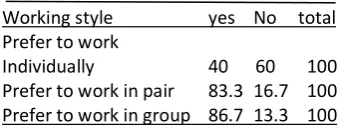
After doing several meetings with small group discussion, the researcher gave them questionnaire to know their responses toward small group discussion in translation class. Some students like to translate individually and some of them like to translate in group. The followings are the result students preferred group work, but significant number indicated that they also like working alone. From the table above can be seen that 40% students from the total amount of the students prefer to work individually. It means that 12 students like to work alone and 60% or 18 students does not like to work alone.
When they asked whether they like working in pairs, the responses of the students showed that most of them like to work in pairs. It is proved that 83.3% or 25 students from 30 students like to translate with her or his friend beside her or him. And only 16.7% students do not like work in pairs. When they asked whether they like to work in group of three, they really like it. 86.7% like to translate within a group of three. It means that more than half amount of the students like it. And only 13.7% or 4 students did not like to work in group. It indicated from their responses for this statement that almost all students like working in group.
When they asked ‘do you have any
difficulties in translating text if you do individually?’ their respond were ‘yes’ with 60% and ‘no’ 40%. it
means that half more students have difficulties in translating the text when they work alone. Who
said ‘no’ means that they do not have any difficulties when translating the text alone.
statement yes No total Tabel 2: percentage of difficulties in translating with their group
From table 2, it can be seen that they found translating text easily when they did it with their group member. Almost all students said it is easy to translate the text when we do it in group. It is 86.7% or 26 students said translation is easy. And the rest 13.3% or 4 students said that translate with their group is not easy.
For the following question, the researcher
gave open ended questions. First question is ‘what
do you think of using small group discussion in
translation class?’ their responses were varied from one another. Most of them said that small group discussion in translation class is really effective; they can share the difficulties each other, they can produce better work, they can comprehend the text well, more idea and they think that translating text with small group discussion was make it easier when they did alone. Second, they said that they enjoyed the discussion; the discussion run well and they like it. It is similar to Zainuddin and Awal’s
result of study done in 2012 that students in general like to work in group than work alone.
Different to two responses above, the negative response also raises. It was boring. Some students said that using small group discussion in translating text was boring because they have to consider friends opinion in translating the text and it wasted time.
Second question ‘what are the advantages of using small group discussion in translating class?’
the answer of this kind of question were they are able to understand the source text better, they are able to discuss the best translation, they got more idea in comprehending the source text, they are able to exchange their opinion and ideas, they are able to widen their knowledge, they translate the text easily, they get more new vocabulary, they have opportunity in correcting other members’
144 Siti Mafulah, Small Group Discussion
The advantages of group work as students have said, it is in line with Brown (2007) he said that group work helps to solve the problem of classes that are too large to offer many opportunities to speak, students initiation, for face to face give and take, for practice in negotiation of meaning, for extended conversational and for student adoption of roles that would otherwise be impossible. It offers embracing affective climate. It promotes responsibility and autonomy. Group work places responsibility for action and progress upon each members of the group somewhat equally.
V. CONCLUSION
From the findings, researcher can conclude that more students like to translate the text with their friend and in a group, rather than doing alone. They are many advantages that they get from small group discussion in translation class such as they can translate the text easily, they can discuss what they do not understand without feeling guilty, they get many new vocabularies and so on. Small group discussion is effective and can be applied in translation class.
Lecturer should be creative in giving the material and using strategy in translation class, so that translation class will run interesting and will not monotone anymore.
REFERENCES
Brown, H Douglas. 2007. Teaching by principles: an interactive approach to language pedagogy
third edition. USA: Pearson Education, inc
Davis, M.G. 2004. multiple voices in the classroom:
activities, task and projects. Amsterdam.
John Benjamin publishing company Gerding-salas, C. 2000.teaching translation:
problems and solutions. Translation journal
4(3)(online)
http://translationjournal.net/journal/13educ .html
Suryawinata, Z. & Hariyanto, S. 2003. translation, Bahasan teori &Penuntun Praktis
Menerjemahkan. Yogyakarta: penerbit
kanisius
Stewart et al. 2010. Cooperative Translationin the Paradigm of Problem-based Learning.
Zainuddin, I.S &Awal, N.M.2012 teaching