DEVELOPING PISA-LIKE PROBLEMS LEVEL 4 TO 6
Yudi Yunika Putra1, Zulkardi2, Yusuf Hartono3
Universitas Sriwijaya123
1) [email protected], 2) [email protected], 3) [email protected]
Abstract
This study aims at developing problems which valid and practical also to know the potential effect of those problems in regards of students mathematical reasoning ability. The subject of this research are students in AR-RAIHAN Junior High School Bandar Lampung. This study is a development research which consists of two stages, preliminary and prototyping stages. In the preliminary stage, analysis for the research subject, curriculum, and theory of the levels in PISA were conducted. In prototype stage formative evaluation of the problems were conducted by self evaluation, one-to-one, experts review, small group, and field test. The techniques of the data collection in this study are walk through (expert review stage) for knowing the validity of the contents, constructs, and languages. The interview (field test) an questionnaire (small group and field test) for knowing practicality of the problems, and questionnaire (field test) and interview (field test) for knowing potential effect mathematical reasoning ability of students. Based on the result of the questionnaire which measure the reasoning and argumentation abilities of the students, recognized by most of the student (90,91%) is used in resolving the problem furthermore on data analysis of this study the PISA-like problems level 4 to 6 has a potential effect on supporting/improving students reasoning ability
Keywords: development research, PISA-like problems junior high school, level 4, 5, 6 of PISA
INTRODUCTION
PISA (Program for International Student Assessment) is an international assessment organized by OECD on measuring skills and abilities of students in the age of 15 (OECD,2013). In this assessment reasoning ability one of the mathematical abilities used to solve the problems.
The reasoning ability is very crucial because it plays an important role in solving non-routine problems and supports students to develop abilities to face real life problems (Augustine, 2013; Annisah, 2011). However, Indonesian students seems to have low mathematical reasoning. This can be seen from the rank of Indonesian students in PISA. In a decade, the position of Indonesia is always in the bottom 10 (OECD, 2001; 2003; 2005; 2008; 2013).
In assessment of PISA there are 6 level abilities. This is research not develop problems 1, 2, 3 level because Indonesian student on assessment PISA in 2012 (98,5%) able to achieve third level (National Center for Education Statistics, 2013). In the National Council of Teacher of Mathematics or NCTM (2000) which stated that the school's math standards include standard contents (mathematical content) and standard processes (mathematical processes). The standard process includes troubleshooting (problem solving), reasoning and proof (reasoning and proof), connectedness (connections), communication (communication) and representation (representation).
Research question are:
1. How the characteristics of math problems type PISA level 4 to 6 are valid and practical?
2. How the potential effect of math problems type PISA levels 4 to 6, mathematical reasoning ability against use of students?
To reach the goals of the study are:
1. Develop math problems type PISA level 4 to 6 which valid and practical
2. To know the potential effect of those problems in regards of students mathematical reasoning ability
THEORETICAL FRAMEWORK
Based on PISA framework year 2015 there are third dimension which includes dimensions of content, process, and context. And there are 6 levels in PISA (OECD, 2013)
1. Content
In PISA framework year 2015 there are some mathematical content categories used in the assessment which include: change and relationship, space and shape, quantity, uncertainty and data (OECD;2013).
a. Change and Relationship
The natural and designed worlds display a multitude of temporary and permanent relationships among objects and circumstances, where changes occur within systems of interrelated objects or in circumstances where the elements influence one another.
b. Space and Shape
Space and shape encompasses a wide range of phenomena that are encountered everywhere in our visual and physical world: patterns, properties of objects, positions and orientations, representations of objects, decoding and encoding of visual information, navigation and dynamic interaction with real shapes as well as with representations.
c. Quantity
world, understanding various representations of those quantifications, and judging interpretations and arguments based on quantity.
d. Uncertainty and Data
In science, technology and everyday life, uncertainty is a given. Uncertainty is therefore a phenomenon at the heart of the mathematical analysis of many problem situations, and the theory of probability and statistics as well as techniques of data representation and description have been established to deal with it.
2. Context
In PISA framework year 2015 there are fourth Contexts which include: Personal, Occupational, Societal, Scientific, (OECD;2013).
a. Personal
Problems classified in the personal context category focus on activities of one’s self, one’s family or one’s peer group. The kinds of contexts that may be considered personal include (but are not limited to) those involving food preparation, shopping, games, personal health, personal transportation, sports, travel, personal scheduling and personal finance.
b. Occupational
Problems classified in the occupational context category are centered on the world of work. Items categorized as occupational may involve (but are not limited to) such things as measuring, costing and ordering materials for building, payroll/accounting, quality control, scheduling/inventory, design/architecture and job-related decision making
c. Societal
Problems classified in the societal context category focus on one’s community (whether local, national or global). They may involve (but are not limited to) such things as voting systems, public transport, government, public policies, demographics, advertising, national statistics and Economic.
d. Scientific
Problems classified in the scientific category relate to the application of mathematics to the natural World and issues and topics related to science and technology.
3. Process
Based on PISA framework year 5, student’ process in solving PISA problems relate
to three mathematical abilities. Those abilities include formulate, employ, interpret abilities, (OECD;2013).
a. Formulate
provide mathematical structure to a problem presented in some contextualized form. In the process of formulating situations mathematically, individuals determine where they can extract the essential mathematics to analyze, set up, and solve the problem.
b. Employ
The word employ in the mathematical literacy definition refers to individuals being
able to apply mathematical concepts, facts, procedures, and reasoning to solve mathematically-formulated problems to obtain mathematical conclusions.
c. Interpret
The word interpret used in the mathematical literacy definition focuses on the
abilities of individuals to reflect upon mathematical solutions, results, or conclusions and interpret them in the context of real-life problems. This involves translating mathematical solutions or reasoning back into the context of a problem and determining whether the results are reasonable and make sense in the context of the problem.
4. PISA of Level
Table 1 is proficiency scale descriptions for mathematics in PISA framework 2015 (OECD, 2013).
Table 1. Proficiency Scale Descriptions for Mathematics in PISA Level Mathematical Competence
6 Students can conceptualise, generalise and utilise information based on their investigations and modeling of complex problem situations. They can link different information sources and representations and flexibly translate among them. Students at this level are capable of advanced mathematical thinking and reasoning. These students can apply their insight and understandings along with a mastery of symbolic and formal mathematical operations and relationships to develop new approaches and strategies for attacking novel situations. Students at this level can formulate and precisely communicate their actions and reflections regarding their findings, interpretations, arguments and the appropriateness of these to the original situations.
Level Mathematical Competence
4 Students are able to work effectively with explicit models for complex concrete situations that may involve constraints or call for making assumptions. They can select and integrate different representations, including symbolic, linking them directly to aspects of real-world situations. Students at this level can utilize well-developed skills and reason flexibly, with some insight, in these contexts. They can construct and communicate explanations and arguments based on their interpretations, arguments and actions.
(OECD; 2013)
van den Akker (1999) During development processes, the emphasis in criteria for quality usually shifts from validity, to practicality, to effectiveness. Validity refers to the extent that the design of the intervention is based on state-of-the-art knowledge ('content validity') and that the various components of the intervention are consistently linked to each other ('construct validity'). Practicality refers to the extent that users (and other experts) consider the intervention as appealing and usable in 'normal' conditions. Effectiveness refers to the extent that the experiences and outcomes with the intervention are consistent with the intended aims.
This is research, third aspect above describe as follows :
a. Valid aspects associated with two things, namely :
1. devices in this problems would be developed should be based on a rational teoritik. Runway teoritik is meant here is the criteria of PISA framework year 2015
2. problems that are developed should be consistent internally or devices reserved designed logically. This is research validity can adequately be evaluated through expert appraisal.
b. Practical aspects associated with two things, namely :
1. The appraisal of experts or practitioners that the problem developed can be applied.
2. in the operational field, problems that was developed can be applied. Practicality means the problem can be solved by students and may be applied in accordance with the planning. in this study of this practicality based on the comments / suggestions the subject of the one-to-one and small group c. Effective aspects associated with two things, namely :
1. According to experts and practitioners, the problem developed qualify as effective, in this case the questions had the potential effect on students' mathematical reasoning abilities.
METHOD
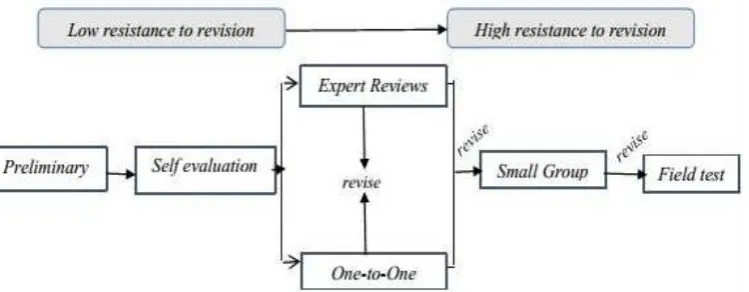
This study is a design research type of development study (Plomp, T., & Nieveen, N, 2007). This study is a part of my thesis. Level 4 to 6 of PISA-like problems were developed in the whole research. However, this study only point out at the 5th level of PISA-like problems. This research will be conducted in two stages: preliminary and prototyping (formative evaluation). Stages preliminary : design process. Prototyping : that includes one-to-one and expert reviews, small group, and field test. The figure.1 constitute groove design formative evaluation
Figure 1. Design formative evaluation (Tessmer, 1993; Zulkardi,2006)
Data Collection
The techniques of the data collection in this study are walk through (expert review stage) for knowing the validity of the contents, constructs, and languages. The interview (field test) and questionnaire (small group and field test) for knowing practicality of the problems, and questionnaire (field test) and interview (field test) for knowing potential effect mathematical reasoning ability of students.
Data Analysis
Walk through given to experts analyzed by descriptive taking into account the comments/suggestions, the results of the analysis were used to revise the problem so as to obtain a valid the problems.
Test results analyzed based on the rubric scoring that have been made the results of students ' answers can be known whether students in answering question involves the ability reasoning is based on the capabilities of the basic mathematics (KDM) reasoning as indicators.
Interview results at field test stage were analyzed by descriptive as a support in know the potential effect based students' comment directly, whether students in answering the question involves reasoning ability.
for knowing practicality of the problems, and result questionnaire on field test stage for knowing potential effect mathematical reasoning ability of students
RESULT AND DISCUSSION
This study resulted in 9 items is valid, practical and have a potential effect on mathematical reasoning students ability. In this paper, I would point out in merely one problem.
Figure 2. Monument of Lampung in Zainal Abidin Kedaton Bandar Lampung Based on the picture above, estimate how high the Monument is? Describe your argument!
Profile of Question Context : Societal
Content : Space and Shape Prediction of Level: 5
Process : Employ
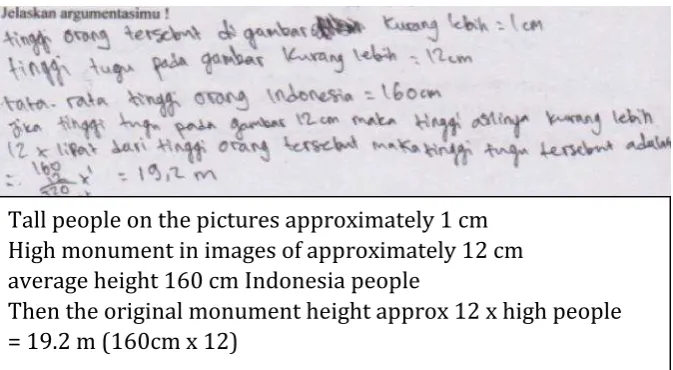
Figure 3. Answer sheet Muhammad Bilal Abidzar
In figure 3 Muhammad Bilal Abidzar using reasoning abilities with high hooking around a statue of objects that have the same unit.
Figure 4. Answer sheet Tasyania Miranda
In figure 4 Tasyania Miranda using reasoning abilities with hooking minibus to determine the height of the statue. But It is not right to use mathematical ability in determining the final results.
The difficulty in answering the question of students in addition to high level problem (level 5), that students feel unfamiliar resolves the question of PISA. The following comments on the problems form students show that: 1) It's hard, because first discovered the problem like this, 2) Because it is very different, unique, interesting 3) very hard, because it never get this kind of problem.
Although this problem belongs to difficult, but based result questionnaire (90,91%) the subject in question answering, with reasoning associate information-information on reserved (reasoning ability).
Tall people on the pictures approximately 1 cm High monument in images of approximately 12 cm average height 160 cm Indonesia people
Then the original monument height approx 12 x high people = 19.2 m (160cm x 12)
The question that researchers develop has an effect against the ability of reasoning It can be seen also on the basis of the results of the interview. General comments the student that is: so more can imagine, usually working on mathematical formulas use but this problem can imagine yourself how or in other ways besides using formulas, could reasoning.
CONCLUSION
Prototype developed to produce mathematical problems like PISA fulfill valid and practical, and potential effect mathematical problems like PISA Level 4 to 6 for mathematical reasoning ability of students. In this research is validity based on the comments of experts of the contents, constructs, and languages, and practical based on the results of the analysis of the students in the process of one-to-one and small group, the potential effects obtained by the comments of students in the field test. Based on the analysis of student answers that all students use reasoning skills in answering questions, and the results of questionnaires that as many as 90,91 % of students felt using reasoning ability in answering the question, supported by the results of interviews that students feel using reasoning abilities
REFERENCE
Badan Standar Nasional Pendidikan. (2006). Panduan Pengembangan Silabus Kurikulum Tingkat Satuan Pendidikan [Guide Development Of Curriculum Education Unit Level
Syllabus]. Jakarta : CV. Laksana Mandiri
Bairac, R. (2005). Some methods for composing mathematical problems. International
Journal for Mathematics Teaching and Learning. Retrieved from
http://www.cimt.plymouth.ac.uk/journal/bairac.pdf in January 4, 2014,
NCES. (2004). International Outcomes of Learning in Mathematics Literacy and Problem
Solving; PISA 2003 results from the U.S. perspective. Retrieved from
http://nces.ed.gov/pubs2005/2005003.pdf pada 3 Oktober 2014.
Nieveen, N. & Plomp, T. (2007). Formative Evaluation in Educational Design Research
(Eds). An Introduction to Educational Design Research. Enschede: SLO
OECD. (2013). PISA 2012 Assessment and Analytical Framework: Mathematics, Reading,
Science,Problem Solving and Financial Literacy. Paris: OECD
OECD. (2013). PISA 2015 Mathematics Framework. Paris : OECD
Tessmer, M. (1993). Planning and conducting formative evaluations: Improving the quality
of education and training. London: Kogan Page.
Turner, R (2009). Using Mathematical Competencies to Predict Item Difficulty in PISA.