lnternational Journal of Biological, Ecological and Environmental Sciences (IJBEES) Vol. 2, No. 2, 2013 ISSN 2277
-
4394oxicity
and
Degradation
of
the Wastewater of the
urea Fertili
zer
Plants,
Oxidation
of
Fenton
and
P
s
eudomonas
fluor
e
s
c
ens
B
acteria
M.
Hatta Dahlan,M.
Faizal,Arinafril,
Marsi,
andMarhaini
Treating the wastewater with high level of urea and
itrogen
is
oneof
the problems facedby
urea fertilizerhdonesia. The alternative treatrnent being studied is the one Fenton oxidation process rvhich is continued with the use
fluorescens bacteria. This study is conducted rvith
ion of ammonia-nitrogen of 2500 ppm, 2000 ppm, and
The response being obsen'ed is the level of
ammonia-NHr-N) and nitrate-and nitrite in the influent and the level ia-nitrogen (NHr-N) and nitrate-nitrite in the eflluent. This
&
aimsto
estimale the IC56 (lnhibition Concentration),t1{rr Observ'ed Effect Concentration) and LOEC (Lowest
Effect Concentration)
for
96
hours after being givenh
the form of the tvastervater of the urea fertilizer plantsof urea fertilizer plants against P.fluorescens is 723,219 the value of LOEC is 393, 992 ppn and that of NOEC is ppm. The result ofthe study shorvs that the biggest average
:
of
declineof
ammoniumis
that
of
the
level of
u-nitrogen of 2500 ppm in a ratio of l:10 which is 94.50%.
l!'
using P. fluorescens resultsin
a decrease ofnitrate-i
&e
ratioof
I
:
4
andI
: 6
rvhich satisfies the qualityspecified in the Environment Ministels Decision No.l22 of 2IIH and the Decree of the Governor of South Sumatra No.
1-ear 2005. The result of this study provides a fairly high
hence it is expected that it can be applied in the industrial
mmonia-nilrogen, Fenton oxidation, P.fluorescens,
I.
Iurnooucrtou
there are
sixurea fertilizer plants
with
high levels
of
ammonia-and urea.Dahlan, Chemical Engineering, Faculty of Engineering Sriwijaya
bnesia" e-mail [email protected]
Chemical Engineering Faculty
of
Engineering, Sriwijayahnesia, e-mail
Depar[nent
of
Pests and Diseases, Facultyof
Agriculture,ty, Indoncsia, e-mail arinafri I @lp. unsri.ac id
Department
of
Soi'l Science, Facultyof
Agriculture, Sriwijaya Honesia, e-mail mbasihin I 960@lahoo-comChemical Engineering,
Faculry
of
Engineering,Up
to
the time
of
this
study,
the
processof
sewagetreatment
of
those plantsis by
containing the wastewater inlarge pools
with
no special treatmentor
settingof
operatingconditions,
thereforethe
output process doesnot
alwayssatisS
the
quality
standards specifiedin
the
EnvironmentMinister's Decision No.122
of
the year 2004 and the Decreeofthe
Govemor of South SumatraNo. 18 ofthe year 2005.Ammonia
compound
has been widely known
as
animportant raw material for some important commodities in the
industrial
world.
On the other hand, ammoniais
also oneof
harmful
pollutants. Ammonia compoundin
the
water
at
acertain concentration can disrupt ecosystems because
it
causeseutrophication
of
aquatic ecosystems, inhibits the metabolismof aquatic animals, and
it
can even lead to poisoning resultingin
organ
damageand
death.
In
principle,
the
nitrogencompounds
in
the wastewater which can cause pollution are:ion
of
ammoniaffi3),
nitrite
ions(NOr)
and nitrate ions(NOr)
t22lBiological
waste treatment processes (microbes)will
not run optimally or
will
be
impaired when the wastecontains toxic chemicals that
will
affect the performanceof
awaste treatment facilib,ttsl
.
This advanced oxidation processcan
be
used asan
altemative methodof
treating industrialwastewater
of
the
urea fertilizer plants which
is
quiteeconomical.
The
use
of
this
processcan
save space andenergy, and
it
is safe and simple, and processing and reactionfime is relatively fast and
it
is easily applied andcontrolled-Some strong oxidizing agents such as peroxide is relatively
inexpensive and easy to obtain and can be used as an oxidizer
in
advanced oxidation processes. Hydrogen peroxide (HrOr)has long been known as a strong oxidizing agent and is able to
oxidize
organic and non-organic compoundsand
is
widelyused
in
various industries. Hydrogen peroxide is an oxidizingagent
which
is
safe enoughin
termsof
its
end product inwhich after the process
it will
besplit into
H2 and02
at thetemperatures
above
80"C.
Fenton reagent
is
a
peroxidecompound which is reacted with catalyst Fe 2 * lFeSOo) which
will
producehydroryl
radicalsloOH; wnicn
are
effectivecompounds
to
oxidize contaminantsor
waste water- Fentonreagents have been developed
in
many
placesto
processorganic materials
of
Biological
Oxygen Demand/
ChemicalOxygen Demand (BOD
i
COD), Total Suspended Solid (TSS),color,
nitrogen, phosphorusand
some metals contained indomestic ana
inaustriil
waste water and drinking water tr8] .Fenton reagent is capable
of
oxidizing organic and inorganicbonding
of
toxic
compoundsin
waste water.
A
settingcondition
of
a rapid mixing speedof
100 rpm-for 120 minutesis capable of eliminating hydrocarbon in the waste water in the
36
r&
development of the number of cells of P. fluorescens- Thed
IC;6 after 96 hoursof
being given the toxicantof
thecharacteristics
of
lntemational Journal of Biological, Ecological and Environmental Sciences (IJBEES) Vol. 2, No. 2, 2013 ISSN 2277
-
4394of 2000 mg
/
L
and COD of 4200 mg/
L
tr8lIt
is alsoIhat
the
Pseudomonasbacterium, particularly
P.which
is a
soil
bacteriumis
usedto
detect theof pollutants in the ecosystems [24]
t''1
These bacteriadv
cultured in the formof
culture. They can survive incnironment
contaminatedby
pollutants and pesticides,Lb *
expression ofbacteria that can degrade pesticidesrlrE
{rrl It
has
been
known
that
an
enuiron*entwith
heavy metals such as lead, mercury, andcan be remediated by P. putida6u.1..1u t2elt:ll
II. MATERIALS AND METHODS
furials
and Equipmentmols used
in
this
study include: measuring flask, pHmsuring
pipettes, spectrophotometer, scales, corkpcri
dish,
transparentmillimeter
paper.
A
set of
treatment equipment
using
Fenton
oxidation.te
materialsrequired
are
waste
water
containingie taken
from
the wetland areasof
the urea fertilizerPseudomonas Jluorescens bacteria
of
the
seedlingsre
in
a
state
of
pure
cultures
which are
notKings
B
media
(the
compositionof l0
gprotease,
K
z HPO4of
0.75 g, MgSOaTHzOof
0.75I
of
glycerol, aquadestof
500ml),
FeSO+.7H:O andperoxide (HrOz).
Test of Pseudomonas fluorescns
test,
the
wastewaterof
the
ureafertilizer
plants,fo diluted
at the
appropriate concentrations,is
mixedfigs B
media which
is
sterile.
The
mixture
isput into a petri dish
with
a medium doseof
Ih
is
shakenuntil
it
mixeswell
andis
allowed toThe existing
coloniesof
P. fluorescens are moveddrill
and placed in the middle of a petri dishwith
aof
14 cm, and then the developmentof
bacteria in;:si
dish
is
observed
and
the
diameter
of
theof
bacteriain
a petri dish is measured. They areby using a transparent millimeter paper.
of Fenlon and Pseudomonas fluorescens
Gervater
originating from an emergency pool is put-
control
tube. Beforeit
is put
into the
feed theis analyzed (NH3-N, nitrate, nitrite,). Out of the
tube some sample
of
the wastewaterof
5,000ml
isb
the reactor (reagent tube). The reagent fube serves'e
for
reactingthe
wastewaterof
urea fertilizerwith
Fenton reagentwith
various ratiosof
FeSO4 :rmelyl:.2,
1:4,
l:6, l:8,
l:10.
Themixtureis
by-using a magnetic stirrer at 100 rpm stirring speed
EtrD minutes, and then the sample
is
takenafter
it
isSr
20 minutes. Then the wastewater from the feedbrulyzrd
(NH3-N,nifate,
nihite).originating from the reagent tube is flowed
eqrarium
/
bottle
aeration (P. fluorescens),in
theprocess. Then the sample is allowed to stand for
7-because
the growth
of
microorganisms reachphase at 4
-
6days,
so that the microorganismso The water processed, namely the water from the aquarium
/
aeration bottle, is then analyzed
(NH:-N,
nitrate, nitrite,) toknow
the
quality
of
the
wastewaterafter
previousprocesses.
III.
THE RESULTS AND DESCzuPTIONA. The Effect of the
Grovth
of PseudomonasfluorescensThe data
of
daily growth observationof
the P. fluorescensfor
7 days are presentedin
Figure 1.It
has been known fromthe
previous studies
that
P.
fluorescens
can
remediatepollutants, such as heavy metals and pesticider tztl
trtl
151tstudy indicates that possibly P. Jluorescens is also capable
of
remediating
the
wasteof
the
urea fertilizer
plants.
It
isindicated by the daily growth
ofthe
bacteria (Figurel).
150
100
50
0
o7234567
Time
(day)
Fig. I The Graph Showing the Effect of Cell Grovrth of Bacteria
against the Wastewater of the Urea Fertilizer Plants
The result of this study supports the result of the study by tal
which states that
the
P. fluorescens bacteria are the bacteriathat can survive
in
extreme condition, namely the conditionwhere there are pollutants and through further processing the
pollutants
can be convertedinto
compoundswhich
are no longer dangerous for the environment.The data on Figure
I
show that at a concentration of 0 ppm,I
ppm,l0
ppm, and 100 ppm, the phase lag occurs on day 0 today
1. Onday-l
to-5, the eksponential growth phase occurs,indicated by a sharp expansion ofbacterial colonies. On day 5
to
7, the stationary phase occurs. The expansionof
bacterialcolonies
growth
startsto
be
static.The growth
rateof
thebacterial cells is the same as that of the death. On day 7, there
is a decrease in the expansion of bacterial colonies. Whereas at
a concentratidn
of
1000 ppm, exponential phase occurs on day2
to
day4.
The stationary phase occurs on days4 to
7. Asshown on Figure
l.
according [26]water is the biggest part of acell, so dissolved nutrients can be easily absorbed by the cells.
Beside that, according to Hong (2003), organic and inorganic
substances dissolved
in
the
water can
also
stimulate theactivities
of
the bacteria degrading the wastewater containingorganic and inorganic compounds.
It
is
allegedthat
in
theaquatic environment the nutrients required by the bacteria are
in
a
stateof
dissolved sothey can be
easily exploited bybacteria to grow. In relation to something similar, I31 states that
the
nutrients arenot
only
beneficialfor
the growth
of
thebacteria,
but
also
for their
survival. The
nutrients are thematerials
for
the processof
metabolism andfor
producingen-rymes for degrading the wastewater.
E
e
.9o
g
E
o
E
6
o
E o a EF
-e-
o
pptn*-L
ppm1O ppm
-1@
ppm
-1OOO
ppm
h)
ean decompose organie substances eontained rnlntemational Journal of Biological, Ecological and Environmental Sciences (IJBEES) Vol. 2, No. 2, 2013 ISSN 2272
-
4394The Results of Analysis of Probit IT50 and MIC50 of p.
test results on the activities
of
some treatmentsof
theof
the wastewaterof
the ureafertilizer
plants, showinhibition
of
bacterial growth occuring
at
variousions such as
0
ppm(control)
I
pp*,
10 ppm, 100and 1000 ppm. This can be seen in Figure. 2.
EM
" -
-*;."
*,"
2 The Graph of Probit IT50 P. fluorescens Bacteria against the
of
the Urea Fertilizer Plants at Various concentrationsts) 0 ppm (b) 1 ppm (c) !0 ppm (d) 100 ppm (e) 1000 ppm.
data on Figure 2. Show that P. fluorescens bacteria do
oryerience growth
inhibition,
however when they arein
sastewater
of
the
urea.fertilizer plants
containingia solution at a concefltration
of
1000 ppm the growthThe results
of
analysisof
probit
MIC56with
SPSSMIC1
value
of
bacteriaP.
fluorescens
on
theof
the ureafertilizer
plantsis
723.219 ppm, thusof the wastewater of the urea fertilizer plants
fu the process of bioremediation is 578.575 ppm, 650.897
723.219 ppm, 795.540 ppm and 867.862 ppm.
TIe Results of Analysis of Fenton Oxidation Processing
'-fluorescens
Amlysis of NH3-N Level
reagent is a solution ofhydrogen peroxide and iron
used
to
oxidize contaminantsor
wastewater.In
theof
the
wastewaterof
ureafertilizer plants
usingreagent,
the
concenbationsof
NH3-N
declines asby the data
of
Tablel.
The rateof
degradationof
theand inorganic pollutants through the Fenton reaction
in NH3-N levels that meet the quality standard of the Minister
of the Environment Decree
No.
122 of the Year 2004 and theDecree of the Govemor
of
South SumatraNo.
18 of the Year2005 is the result
of
the treatmentof
the wastewaterof
ureafertilizer plant using Fenton reagent at a concentration
of2000
ppm and 1500 ppm with a range of ratio from 1 :
4
to
I
:
10.ANALysrs oF NH3-N
r-u*.,
arl*tiJ*crlnRArroN
oF 2500 ppM, 2000In
the
treatmentof
the wastewaterof
the
urea fertilizerplants using
P.
Fluorescens bacteriain
absorbing NH3-Nduring the
maintenanceperiod NH3-N tends
to
decrease(Table
l).
This
is
because bacteria arethe most
importantgroup
of
microorganismsin
wastewater treatment and theycan oxidize inorganic compounds such as NH3
into
energy.According
to
t3o1 the bacteiiawill
use organic carbon as anenergy sourcg
in correlation
with the nitrogen to be usedfor
protein synthesis
in
order to produce new cell materials. Withthe addition
of
carbonaceous materials, the bacteriawill
usethe
nitrogen containedin the
culture
so
as
to
reduce theconcentation
of
inorganic nitrogen (ammonia) which is toxicto
the organism. The additionof
carbonaceous material hasbeen proven
to
reduce inorganicnihogen
[rl
Is).9""1..;"1
growth
is
limited
by
the balanceof
nutrientsin
the
water.Therefore,
the
population dynamicsof
bacteriais
closelyrelated to the availability ofnutrients tl6l
b.
Analysis of Nitrate LevelsAn
increasein
nitrate level
in
the
treatmentof
thewastewater
of
ureafertilizer
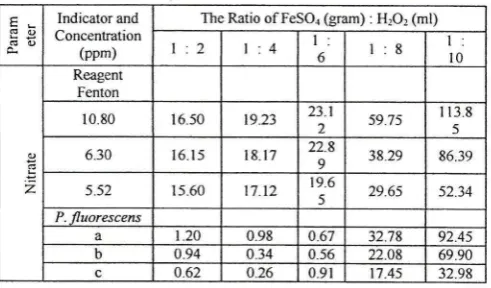
plants using Fenton reagent isshown by the data in Table 2. The data on the table shows that
the greater the ratio the greater the value
ofnitrate
formation.This is due to the greater amount of NH3-N compounds which
decompose to form ions and gases namely nitrates and nitrites
I2a Similarly 1331 reported that the removal of ammonia nitrogen
at high eoneentration of H2O2
will
produce Nzgs
and nitrate.So the higher the concentration of H2O2 or th€ greater the ratio
given" the greater the amount of gas N2, nifiate and
nifiite
or inother words, high concentration
of
H2O2 can reduce the valueof the ammonia and it
will
continuously occurs in the oxidizedwastewater.
The findings
of
the study shov',nin
Table2
state that theconcentrations which
still
meet the quality standards specifiedse through higher involvement
of
ironin
degradingof
the wastewatert2tl.
The declinein
the valueof
in the results of the study shown in Table
l-
is possiblyb
its
decompositionto
form
ions
and gases, such asnitrite, or nitrogen monoxide molecule. This is similar
in their
study
on the
methodof
Fenton OxidationPPMAND ISOOPPM Paramete
r
Indicator and Concentration
/nnm)
The Ratio of FeSO, (sram) : H,O, (ml)
t'.2
t:
46
l:8
l:
l0
NtIr-N
Reagent Fenton
2s00 512.23 387 52
298.
59 262.27 137.5
0 2000 n9.47 73.7
3
u.l
5 4.623 1.612 I 500 t7.50 4.25 1.75 0. l2 0.023
P- fluorescens
a 76.5 45 76.2
5 1o7.25 119.5
6 b o.72 o.08 0.00
7 o.0 0.0 c 0.07 0.00
3 0.0 0.0 0.0
lntemational Joumal of Biological, Ecological and Environmental Sciences (IJBEES) Vol. 2, No. 2, 2013 ISSN 2277
-
4Zg4Decree
of
the Ministerof
the EnvironmentNo.
122of
l-car
2004 andthe
Decreeof
the
Govemorof
SouthNo.
18of
the
Year 2005 are the concentrationof
pm,
2000 ppm and 1500 ppmin
a ratioof
1:2,
I
: 4,below 20 ppm in water quality class
l,
and a ratioof
I30 ppm of water quality in group 2.
the
maintenance,utilization
of
the
nitrateby
P.bacteria occurs
to
be
usedas
substrates. ThisIhe decrease
of
the nitrate level. The resulting nitratelhe nutritional
requirementsof
the
bacteriathat
will
the
growth
of
the
bacteriaand
the
increaseof
biomass.
Nitrate
is the
end
productof
ammoniaprocess.
the
maintenance,utilization
of
the
nitrate
by
P.bacteria occurs
to
be
usedas
substrates. Thisdrc decrease
of
the nihate level. The resulting nitrate6e
nutritional
requirementsof
the
bacteriathat
will
the
growth
of
the
bacteriaand
the
increaseof
biomass.
Nitrate
is
the
end
productof
ammonian process. Theoretically, the concentration of nitrate is
fu large amounts in the waters. Nitrate concentrations
bodies indicate faecal
pollution at the
initial
level.irae
levelin
drinking water is harmful to children andanemia (hemoglobin meta). According
to
t'olthe
do not
require organic
materialsto
perform
theand growth
but
they can simply use
inorganic(NO3 and NO2).
Similarly,
according to tel tr2l [20]bn
of nitrate in the wastewater can be done throughNitrate is
oneof
the important factorsin
theof
denitrification because nitrateis
used as electron[i
the bacteria. The presence of nitrates in the waterwater quality to decline, lower dissolved oxygen,
fsh
population,foul
odor,
bad tasteof
the
water.i
a tfueat to human health, especially to infants.It
canknown as methemoglobinemi4 which is also
:
baby syndrome". Polluted ground wateror
riverining nitrate which maybe used to prepare
milk for
the nitrates to enter the body of a baby. When the
hto
baby's gfrt, the nitrate is converted into nitrite,r binds
to
hemoglobinto
form methemoglobin andorygen carrying capaclty
of
the baby's 61oo6 ttJ tzJIL A,\ALysrs OF NTTRATE LEIELS AT CoNCENTRATIoN OF 2500 PPM, 2000 PpM AND I 50O PpM
of
Nitrile
Leveld
of
observationsof
nitrite
analysis
in
thed
the
wastewaterof
the
ureafertilizer
plants isi
Table3.
In the treatment of the wastewater usingFe-SOa
:
H2O2, the greater thenitrite
is formed. According tot26l
in their
studyofFenton
degradationofnitrogen
containedin
organic
compounds, ammoniawill
be
oxidizedto
formnitrite in small concentrations.
Similarly,
tlll t34l
statedthat
to
remove ammonianitrogen at high concentration
of
H2O2will
produce Nzgs,
nitrate and nitrite. So the higher the concentration of H2O2 or
the greater the ratio
of
a given gas the greater the amountof
N2, nitrate and nitrite is formed. The result of the study shown
in Table 3 indicates that at concentration of2500 ppm the ratio
is
I
: 2 and at concentration of2000 and 1500 the ratios are 1 :2,
I
: 4
and1 : 6
which
still
meet the specificationof
theDecree
of
theMinister
of
EnvironmentNo.
122of
the Year2004 and the Decree
of
the Govemorof
South Sumatera No.l8
ofthe
Year 2005.In a
study
of
wastewatertreatment
using
advancedoxidation,
it
is found that thereis
an increase in the levelof
nitrite,
then the study using bacteria Pfluorescensis
carriedout. The result
of
the study shows that there is a decrease innitrite
level as shown in Table 3. The decrease in the levelof
nitrite is thought to occur due to the use of it by the bacteria as
the nutrients. The
nirite
compounds is used by the bacteria asa final
electron acceptorin
the processof
metabolism. Themechanism
is
known as nitrite
respiration andthe
en-rymeinvolved is nitrite reductase [18]
TABEL Iu. ANALYSIS OF NTTRITE LEVEL AT TTG CoNcENTRAnoN OF 25OO
Although
in
alow
concentration, nitrite is toxic to fish andother aquatic organisms t'ul
Nit
ite
compoundsin
fishwill
bebound to the blood that
will
form methaemoglobin (Hb + NOz:
Met-Hb). Met-Hb
would
interferewith
the
transportof
oxygen to the tissues
offish
that can cause fish to experiencehypoxsia.
Met-Hb
in
the blood
causesthe blood
to
lookbroivn.
Thereforenitrite
poisoning
is
also
called "brortn
blood'disease [6]
[6]states that
high
contentof
nitrite in
drinking water cancause cancer
of
the stomach and respiratorytract
in
adults,because
nitrite
is
toxic
nitrogen compound, althoughit
isggually found in a very small
quantity. It
is also conveyed by[']
that excessive consumptionof nitrite
in human can lead todisruption
of
the binding
of
oxygenby
hemoglobinin
theblood,
which
in
turn,
canform the
met-hemoglobin whichcannot bind oxygen.
PPN4 2000 PPM AND I 500 PpM
E-60
Indicator and Concentration
(ppm)
The Ratio of FeSO. (gram) : H2O2 (ml)
l:2
t'.4
l:
6l:8
t.
l0z
Re€ent
Fenton
10.80 16.50 t9.23 23.1
2 59.75
I13.8
5 6.30 16.15 18.17 22.8
9 38.29 86.39 5.52 15.60 t7.12 19.6
5 29.65 52.34 P. fluorescenr
a 1.20 0.98 067 32.78 92.45
b 0.94 o.34 0.56 22.08 69.90
c 0.62 o26 0.91 17.45 32.98
hemational Journal of Biological, Ecological and Environmental Sciences (IJBEES) Vol. 2, No. 2, 2013 ISSN 2277
-
4394IV. Cor.rcr-usroNs
I
o
the results of the study it can be concluded that:-
h of MIC5e of bacteria P. Fluorescens is obtainedwastewater of
the
urea fertilizer plants at 723.219t
teatmentof
the wastewaterof
the
urea fertilizerusing Fenton reagent, the greaterthe ratio ofFeSOa
Itq,
the smaller the decrease of NH3-N,nitrate
andLiu F, Han W. 2004. Reuse Strategy of Wastewater in Prawn Nursery by Microbial Remediation Aquaculture 230 '.281-296
Madigan
tft,
MartinkoJM,
ParkerJ. 2000
Biology ofMicroorganism. 9 th edition.New Jersey: Prentice Hall
Metcalf dan Eddy. 1991. Wastev*ater engineering
:
Treatment,Disposal, and Reuse- McGraw-Hill, Nerv York
Moraes J.E.F., Quina F.H., Nascimento C-A.O., Silva D.N. and
Chiavone-Filho
O.
2OO5. Treatsnentof
Saline WastewaterContaminated With Hydrocarbons
by
the Photo-Fenton process,Environ. Sci. Technol.,38, I 183-l 187.
Munanto, G.
2006.
Pengolahan Limbah cair Painting Industri,Fumiare dengan metode oksidasi Fenton. Tesis Magister Jurusan
Teknik Lingkungan ITS, Surabaya
Nugroho, R. 2003. Development of Simple Denitrification Proses with Autotrophic Bacteria. IDisertasi]. Oita University Japan
Perez, M- a al. 2O02. Removal of Organic Contaminants in Paper Pulp
Treatment Eflluents Under Fenton and Photo-Fenton Conditions. lppl.
C atal - B : E rn i ronne ru al, Amsterdam, v. 36, p.63-7 4, 2C0.2b
Santacruz, G., E.R. Bandala, dan L.G. Torres. 2005. Chlorinated Pesticides (2,4-D and DDT) Biodegradation at High Concentrations
Using lmmobilized Pseudomonailuorescens.
l.
Environ. Sci. HealthPart B 40:571-583
Setiyawzn et al, 201
I,
Karakteristik Proses Klarifikasi Dalam SystemNitrifikasi-Denitrifikasi Untuk Pengolahan Limbash Cair Dengan
Kandungan N-NH3 Tinggi, Jurusan 'leknik Kimia, Fakultas 'teknik,
Universitas Diponegoro
Selvaraju, S.8., I.U.H. Khan, dan J.S. Yadav- 20ll.Susceptibility of
l4ycobacterium Immunogemtm and Pseudomonas Jluoresce$ lo Formaldehyde and Non-formaldehyde biocides
in
semi-synthetic metalworking fl uids. Int. J. Mol. Sci. 12 : 725-
7 41.Sechlan. 1982. Plantonologr.r, Fakultas Pertemalian dan Perikanan
UNDIP, Semarang
Timotus-K.H. 1982. Mikrobiologi Dasar, Universitas Kristen Satya
Wacan4 Salatiga.
Tirzhd Lins Porto Dantas, 2003. Fenton and Photo-Fenton Oxidation of
Tannery Wastewater, Maringii, v. 25, no. l, p. 91-95, 2003
Torres, L-G., M. Hem6ndez, Y- Pic4 V. Albiter dan E.R.Bandala. 2010. Degradation ofdi-, ai-, teEzi-, and Pentachlorophenolmixtures in
an Aerobic Biofilter. African J. Biotech. 9(23) 3396 -3403
Wasi, S , S. Takez dan M. Ahmad. 201
l.
Suitability of ImmobilizedPseudomonas fluorescens SMI SEain lor Remediation of phenols,
Heavy Metals, and Pesticides from Water. Water Air Soil Pollut. DOI
1 0. 1007/s I 12704 lG'O737 -x
Willet D, and Morrison C. 2006. Using Molasse to Control Inorganic
Nitrogen and
pH in
Aquaculture Ponds. wurv.dpi.qld.
gov.ar-r/cos/rdey'xchey' dpi/hs.xsV30 2790 ENA Print.hanl.
(3
September 20r 1).Wu H.C., T.K. Wood, M. Ashok, dan C. Wilfred- 2006. Engineering
Plant-Microbe Symbiosis for Rhizoremediation
of
Heavy Meals: Appl. Environ. Microbiol. 72 (2) : 1129.Van Wyk P, Scarpa
l.
1999. Water Quality Requirements andManagement. Di dalam: Van Wyk P, Davis-Hodgkins R" laramore
KL,
MainJ,
Mountain, ScarpaJ.
Farming Marine Shrimp inRecirculating freshwater system.
Zoh,K., and St€nstrom K.D.2002. Fenton Oxidation of Hexahydro
1,3,5-trinitro-l J,S-trianzine (RDX) and
octahy&o-l,3,5,7-tetranitro-1,3,5,7-tets-azocine (HIvOf)" Water Ras.36: 1331-1341
2@5, Keputusan Gubemur Sumatera Selatan Nomor 18
Ttahun 20O5 Tanggal 13 Mei 2005, tentang mutu limbah cair untuk industri
lt6l
llTl
lt6l
tl 8l
tlel
hst
ratioof
FeSO+:
HzOz
in
the treatmentof
theof
theurea
fertilizer plants and the one thatthe quality standards
of
thewastewater
qualityin the Decree of the Minister of the Environment
17? of
the
Year 2004 and the Decree of the GovemorSumatra
No.
18 of theYear
2005is
I
: 4 at the 1221of
1,500 and 2,000 ppm.*
firther
treatmentof
the
wastewaterof
the
ureaplants using advanced oxidation
by
bacteria P. [23]the decrease
of
NH3-N, nitrate,and
nitriteE
ryed Using Saquancing arobic/anaerobic Membran Bioreactor,l24l
[25]
[26]
[27]
[28]
L291
t30l
t3l
l
t33I
t321
[34] REFERENCES
,M.O.!. et a|,1991, Toxicolory the Basic Science of Poiser,3e Grow Hill, Inc. Toronto.
R.M..1984. Microbiolory, Fundarrentals and Application
tion and Identification of Microorganisme: Systematics of
(ch, t l,p 36!579) Macmilan Publ, Co. New York.
Y. 1999. Carbory'nitrogen Ratio as a Control Element in System. Aquacuhure 1 7 6, 227 -235
E.R., J. Andres{ctaviono, P. Pastrana dan L.G. Torres. 20O6.
of Aldrin, Dieldrin,Heptachlor, and HeptachlorEpoxide Using andlor Pseudomonasfuorescots Free Cell Cultures.
kiron.
Sci- Health Part 8zll:55L569-AW. 1990. Water Quality in Pond for Aquaculture. Aubum Birmingham Pubtishing Co. Atabama.
Lrno.
1995. Logam dalam Sistem Biologi Makhluk Hidup,Universitas Indonesia (-lI Press), Jakafia .l 0430; 55-56, 6549.
H. 2003. Telaah kualitas air : Bagi Pengelolaan Sumberdaya .
I i'Bkungan Perairan. Gramedia : Jakarta
Dirk.,PuuhSongsangiind4 TeeyapomKeawtau,ee,
um. 2005. Preliminary investigation into tlte eIIect of
ddition on $owttL water quality and nutrien dynamics in zero
:
skimp (Penaeusmonodon) culture system. Asian Fisheries18:195-2M
eraq
B. P., Sherrard J- H. dan Benoit, R. E. 1989. Biological of Water. ASCE Joumal of Environmental Engineeringt-
It5:93G943.(EA-Trapido.2002. Hydrogen peroxida Photolysis, Fenlon Reagenl
Photo-Fenton for the Degration of Niaophenol
;
Comperetivera{hemosphere, Vol z16, No.6, P. 913-922.
2003, Enhanced Biological Phosphorus and Nitrogen
ofEnviromental Engineering, Vol 157, Februari 2003, P.
345-K. M., Lioyd, J. W. dan Lemer, D. N, 1991. Review of
d
ard Artifrcial Denitriircation of Groundwater. Water Research29 1099-t
ll
l.2004. Pedoman Penetapan Baku Mutu Lingkungan. Kantor Negara Kependudukan Lingkungan Hidup 2004. Kepu0rsan
Negara Kependudukan dan Lingkungan Hidup. Kep
2004. Sekrelariat Negar4 Jakarta.
D,G,, T,C, Zhang, "Evaluation of Silfur-Based Autotophic
, Proceedings of &e HSRC/WERC Joint Conference on
Erironmental,
May
1996, Great Plains/Rocky MountainSubstance Research Center.
Li and Yan Liu,2A09 Ammonia Removal in Electrochemical
Mechanism and Pseudo-kineacs, Journal
of
Hazardous2009,vol 161 hal. l0l0-1016
t20l