THE EFFECTIVENESS OF STUDENT TEAMS ACHIEVEMENT DIVISION
(STAD) TO TEACH SPEAKING SKILL VIEWED FROM STUDENTS’
CREATIVITY
(An Experimental Study at the Eleventh Graders of Science Program at SMA
Negeri 7 Surakarta in the Academic Year of 2012/2013)
THESIS
DIRA PERMANA
NIM. S891108034
Submitted to Graduate School of Sebelas Maret University to Fulfill
One of the Requirements in the Attainment of Master Degree
in English Education
ENGLISH LANGUAGE EDUCATION DEPARTMENT
GRADUATE SCHOOL
SEBELAS MARET UNIVERSITY
SURAKARTA
APPROVAL
THE EFFECTIVENESS OF STUDENT TEAMS ACHIEVEMENT DIVISION
(STAD) TO TEACH SPEAKING SKILL VIEWED FROM STUDENTS’
CREATIVITY
(An Experimental Study at the Eleventh Graders of Science Program at SMA Negeri
7 Surakarta in the Academic Year of 2012/2013)
DIRA PERMANA
NIM. S 891108034
This thesis has been approved by the Consultants of English Language Education
Department of Graduate School of Sebelas Maret University, Surakarta, April
2013
First Consultant
Second Consultant
Prof. Dr. Joko Nurkamto, M.Pd
Dr. Sudjoko, M.A
NIP. 19610124 198702 1 001
NIP. 19510912 198003 1002
Established by:
The Head of English Language Education Department of
Graduate School of Sebelas Mare University
Dr. Abdul Asib, M.Pd.
LEGITIMATION OF THE BOARD OF EXAMINERS
THE EFFECTIVENESS OF STUDENT TEAMS ACHIEVEMENT DIVISION
(STAD) TO TEACH SPEAKING SKILL VIEWED FROM STUDENTS’
CREATIVITY
(An Experimental Study at the Eleventh Graders of Science Program at SMA Negeri
7 Surakarta in the Academic Year of 2012/2013)
DIRA PERMANA
NIM. S891108034
This thesis has been examined by the Board of Examiners of English Language
Education Department of Graduate School of Sebelas Maret University, April 2013
Board of Examiners
Signature
Chairman: Dr. Abdul Asib, M.Pd.
( ………..)
NIP. 195203071980031005
Secretary: Dra. Dewi Rochsantiningsih, M.Ed., Ph.D.
(………...)
NIP. 196009181987022001
Examiners: 1. Prof. Dr. Joko Nurkamto, M.Pd.
( ………..)
NIP. 19610124 198702 1 001
2. Dr. Sujoko, MA
(………...)
NIP. 19510912 198003 1002
The Director of Graduate School of
Sebelas Maret University
The Head of English Language Education
Department of Graduate School of Sebelas
Maret University
Prof. Dr. Ir. Ahmad Yunus, M.S
Dr. Abdul Asib, M.Pd.
PRONOUNCEMENT
This is to certify that I myself write this thesis entitled “
The Effectiveness of
Student Teams Achievement Division (STAD) to Teach Speaking Skill Viewed from
Students’ Creativity (An Experimental Study at the Eleventh Graders of Science
Program at SMA Negeri 7 Surakarta in the Academic Year of 2012/2013)”.
It is not a
plagiarism or composed by others. Anything related to other’s work is written in
quotation, and the source of which is listed on the reference.
If then this pronouncement proves incorrect, I am ready to accept any
punishment, including the withdrawal or cancellation of my academic degree.
Surakarta, April 2013
Dira Permana
ABSTRACT
Dira Permana, S891108034, 2013. The Effectiveness of Student Teams Achievement
Division to Teach Speaking Viewed from Students’ Creativity (An Experimental
Study at the Eleventh Graders of Science Program at SMA Negeri 7 Surakarta in the
Academic Year of 2012/2013) Thesis. Consultant I: Prof. Dr. Joko Nurkamto, M.Pd.,
Consultant II: Dr. Sujoko, M.Pd. English Education Department, Graduate School,
Sebelas Maret University, 2013.
The main objectives of this research are to investigate whether: (1) STAD is
more effective than PPP to teach speaking; (2) students having high creativity have
better ability in speaking than those having low creativity; and (3) there is interaction
between teaching methods and students’ creativity in teaching speaking to the
eleventh graders of Science Program at SMA Negeri 7 in academic year of
2012/2013.
This research applied an experimental study. The population of the study was
the eleventh graders of Science Program totally consisting 140 students. Samples of
the research were two classes; XI-IPA1 treated as the experimental class & XI-IPA2
treated as control class. The technique of sampling developed was cluster random
sampling. Each class was categorized into two groups; students having high and low
creativity. Techniques of collecting data were creativity test and speaking test. Data
of the research were analyzed using Multifactor Analysis of Variance (ANOVA) Test
of 2x2 and Tuckey Test.
From the result of data analysis, it was discovered that: (1) STAD
significantly differed from PPP with F
o> F
tand q
o(between A
1and A
2) > q
t; (2)
students having high creativity significantly differed in the speaking ability with F
o>
F
tand q
o(between B
1and B
2) > q
t; and (3) there was interaction between teaching
methods and students’ creativity in teaching speaking with F
o> F
t, and the result
Tuckey Test showed that: (1) the use of STAD significantly differed to students
having high creativity from PPP to teach speaking with q
o(between A
1B
1& A
2B
1) >
q
t; and (b) the use of PPP significantly differed to students having low creativity from
STAD to teach speaking with q
o(between A
1B
2& A
2B
2) > q
t.
Based on the result of the research, it can be concluded that STAD is more
effective than PPP to teach speaking. The result of the research also showed that the
students’ creativity affects the teaching methods in teaching speaking. Thus, English
teachers are expected to select appropriate teaching methods to teach speaking to
students having and low creativity. STAD can be used as an alternative teaching
method to teach speaking to students having high creativity.
MOTTO
Hard work and patience initiate the success of knowledge seekers.
DEDICATION
This thesis is proudly dedicated to:
His beloved mother and father
His brothers and sisters
His nephews
ACKNOWLEDGEMENT
Praise is endlessly glorified to Allah SWT, who has always given his mercies
and blesses, so that the researcher has been able to accomplish his thesis. In addition,
the researcher’s deepest gratitude is unforgettable presented to those helping him
prepare, propose, and settle his thesis. They are as follows:
1.
The Director of Graduate School of Sebelas Maret University for his consideration
and permission that he was allowed to compose his thesis.
2.
The Head of English Language Education Department of Graduate School of
Sebelas Maret University for having approved his thesis composition.
3.
Prof. Dr. Joko Nurkamto, M. Pd., the first consultant, who helped him, with his
kindness, ideas, advices, support, patience and time, guided and corrected his
thesis until it came into being.
4.
Dr. Sujoko, M.A, the second consultant, who provided for his ideas, advices,
patience and time to have smoothened the composition of his thesis until it came
into being.
5.
The head, the teacher, the students, and staffs of SMA Negeri 7 Surakarta, for their
kindness, permission, and participation in the implementation and settlement of his
research.
The researcher realizes that his thesis has not yet reached its truly ideal
composition. Therefore, suggestions and constructive critics are welcome for the
completion of his thesis.
Surakarta, April 2013
TABLE OF CONTENT
Pages
TITLE ...
i
APPROVAL ...
ii
LEGITIMATION ...
iii
PRONOUNCEMENT ...
iv
ABSTRACT ...
v
MOTTO ...
vi
DEDICATION ... vii
ACKNOWLEDGEMENT ... viii
TABLE OF CONTENT ...
ix
LIST OF TABLE ...
x
LIST OF FIGURE ...
xi
LIST OF APPENDICES ...
xii
CHAPTER I INTRODUCTION ...
1
A.
Background of the Study ...
1
B.
Identification of the Problems ...
13
C.
Limitation of the Study ...
13
D.
Formulation of the Problems ...
14
E.
Objectives of the Study ...
14
F.
Significance of the Study ...
15
CHAPTER II LITERATURE REVIEW ...
17
A.
Theoretical Description ...
17
1.
Speaking ...
17
a.
Definition of Speaking Skill ...
17
b.
Micro Skill and Macro Skill of Speaking ...
19
c.
The teaching of speaking ...
22
1)
Common Problems in Speaking ... 22
2)
Speaking Activities to Solve Problems of Speaking ...
23
d.
The Characteristics of Successful Speaking Activities ... 25
e.
Testing the Speaking Skill ...
26
1)
Testing the Speaking Skill ... 26
2)
Scoring the Speaking skill ... 28
2.
Teaching Methods ...
32
a.
Students Team Achievement Division ...
32
1)
The Concept of STAD ...
32
2)
Procedures of Teaching Speaking Applying STAD ...
33
3)
Advantages and Disadvantages of STAD ...
36
b.
Presentation, Practice, Production ...
38
2)
Procedures of Teaching Speaking Applying PPP ...
40
3)
Advantages and Disadvantages of PPP ...
42
c.
Teaching speaking Using STAD and PPP Methods ...
43
3.
Creativity ...
46
a.
The Concept of Creativity...
46
b.
The Traits of Creativity ...
48
c.
Factors Influencing the Students’ Creativity ...
51
d.
Assessing the Creativity ...
53
B.
Review of Relevant Researches ...
56
C.
Rationale ...
61
D.
Hypothesis ...
71
CHAPTER III RESEARCH METHOD ...
72
A.
Time and Place of the Study ...
72
B.
Research Design ...
73
C.
Population, Sample, and Sampling ...
76
1.
Population ... 76
2.
Sample ... 76
3.
Sampling ... 76
D.
Data Collection Technique ...
77
1.
Creativity Test ...
78
2.
Speaking Test ...
79
E.
Data Analysis Technique ...
80
1.
Pre-requisite Test ... 80
a.
Normality Test ...
80
b.
Homogeneity Test ...
81
2.
Hypothesis Testing ... 81
3.
Tuckey Test ... 83
4.
Statistical Hypothesis ...
84
CHAPTER IV THE RESULTS OF THE RESEARCH ... 86
A.
Implementation of the Research ...
86
B.
Data Description ... 89
C.
Pre-requisite Test ... 98
1.
Normality Test ... 98
2.
Homogeneity Test ...
99
D.
Hypothesis Testing ...
100
E.
Discussion of the Research ... 104
CHAPTER V CONCLUSION, IMPLICATION, SUGGESTION ... 114
A.
Conclusion ... 114
B.
Implication ... 115
BIBLIOGRAPHY ... 118
APPENDICES ... 124
LIST OF TABLES
Pages
Table 2.1
The Scoring Rubric of Speaking ...
30
Table 2.2
The Scoring Guide of Speaking ...
31
Table 2.3
Difference between STAD and PPP Teaching Methods ...
43
Table 2.4
Basic Components of Speaking Teaching Methods ...
45
Table 2.5
Stages of Teaching Speaking Using Methods ...
45
Table 3.1
Time and Schedule of the Research ...
72
Table 3.2
The Simulation Form of Factorial Design ... 75
Table 3.3
Research Instruments and Variables ...
79
Table 4.1
Teaching Schedule & Activities for Experimental Class ... 89
Table 4.2
Frequency Distribution of Data A
1... 90
Table 4.3
Frequency Distribution of Data A
2... 91
Table 4.4
Frequency Distribution of Data B
1... 92
Table 4.5
Frequency Distribution of Data B
2... 93
Table 4.6
Frequency Distribution of Data A
1B
1... 94
Table 4.7
Frequency Distribution of Data A
1B
2... 95
Table 4.8
Frequency Distribution of Data A
2B
1... 96
Table 4.9
Frequency Distribution of Data A
2B
2... 97
Table 4.10 The Result of Normality Test
... 98
Table 4.11 The Result of Homogeneity Test
... 99
Table 4.12 Summary of ANOVA ... 100
Table 4.13 Mean Scores ... 100
Table 4.14 The Result of Tuckey Test ... 102
LIST OF FIGURES
Pages
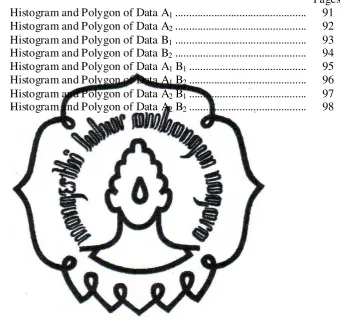
Figure 4.2 Histogram and Polygon of Data A
1... 91
Figure 4.3 Histogram and Polygon of Data A
2... 92
Figure 4.4 Histogram and Polygon of Data B
1... 93
Figure 4.5 Histogram and Polygon of Data B
2... 94
Figure 4.6 Histogram and Polygon of Data A
1B
1... 95
Figure 4.7 Histogram and Polygon of Data A
1B
2... 96
Figure 4.8 Histogram and Polygon of Data A
2B
1... 97
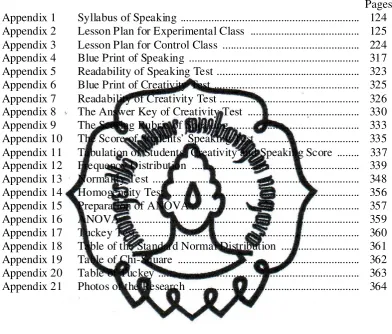
LIST OF APPENDICES
Pages
Appendix 1
Syllabus of Speaking ... 124
Appendix 2
Lesson Plan for Experimental Class ... 125
Appendix 3
Lesson Plan for Control Class ... 224
Appendix 4
Blue Print of Speaking ... 317
Appendix 5
Readability of Speaking Test ... 323
Appendix 6
Blue Print of Creativity Test ... 325
Appendix 7
Readability of Creativity Test ... 326
Appendix 8
The Answer Key of Creativity Test ... 330
Appendix 9
The Scoring Rubric of Speaking ... 333
Appendix 10 The Score of Students’ Speaking Test ... 335
Appendix 11 Tabulation of Students’ Creativity and Speaking Score ... 337
Appendix 12 Frequency Distribution ... 339
Appendix 13 Normality Test ... 348
Appendix 14 Homogeneity Test ... 356
Appendix 15 Preparation of ANOVA ... 357
Appendix 16 ANOVA ... 359
Appendix 17 Tuckey Test ... 360
Appendix 18 Table of the Standard Normal Distribution ... 361
Appendix 19 Table of Chi-Square ... 362
Appendix 20 Table of Tuckey ... 363