A STUDY OF ADVERTISING STRATEGIES IN HOTEL
BROCHURES
A RESEARCH PAPER
Submitted to the English Education Department in Partial Fulfillment of the Requirements for Sarjana Sastra Degree
By
Istia Hamdiati Nuri 0800583
ENGLISH EDUCATION DEPARTMENT
FACULTY OF LANGUAGE AND ARTS EDUCATION
INDONESIA UNIVERSITY OF EDUCATION
A STUDY OF ADVERTISING
STRATEGIES IN HOTEL BROCHURES
Oleh
Istia Hamdiati Nuri
Sebuah skripsi yang diajukan untuk memenuhi salah satu syarat memperoleh gelar Sarjana pada Fakultas Pendidikan Bahasa dan Seni
© Istia Hamdiati Nuri 2013 Universitas Pendidikan Indonesia
Agustus 2013
Hak Cipta dilindungi undang-undang.
PAGE OF APPROVAL
A Study of Advertising Strategies in Hotel Brochures
By
Istia Hamdiati Nuri 0800583
Approved by:
Main Supervisor
Dra. Sri Setyarini, M.A. NIP. 196312291990022001
The Head of English Education Department Faculty of Language and Art Education
Indonesia University of Education
Prof. Dr. Didi Suherdi, M.Ed NIP. 196211011987121000
Co Supervisor
ABSTRACT
The present study entitled A study of Advertising Strategies in Hotel Brochures aims to find out the advertising strategies: concepting approaches (Altstiel & Grow, 2007) made by several hotels in their hotel brochures (Aston Tropicana, Amaris, Sensa, Nalendra and Favehotel) located on Cihampelas street Bandung. In addition, this study also evaluates those concepting approaches using AIDCA (Attention, Interest, Desire, Conviction, and Action) formula (Clyde Bedell, 1952; Albert & Schick, 1996; Bird, 2005, and Trehan, 2009). To analyze the data, a descriptive qualitative approach was applied. The findings show that four out of five hotel brochures consist of two concepting approaches namely show the benefit and show the product. In addition, it is found that there are three brochures used comparison as their approach. Overall, the evaluation result of those advertising strategies indicates that the AIDCA formula fail to be utilized by all of the hotel brochures on Cihampelas street Bandung since none of the hotel brochures applied AIDCA formula completely.
TABLE OF CONTENTS
1.1 Background of the Study ………... 1.2 Research Questions ……….. 1.3 Aims of the Study ………... 1.4 Scope of the Study ……….... 1.5 Significance of the Study ………... 1.6 Research Methods ………... 1.7 Clarification of the Terms ………... 1.8 Organization of the Paper ………...
CHAPTER II THEORETICAL FOUNDATION ………....
CHAPTER III RESEARCH METHODHOLOGY………... 3.1 Research Design………....……….. 3.2 Data Collection ………... 3.3 Data Analysis ………... 3.4 Data Presentation …....………...
CHAPTER IV FINDINGS AND DISCUSSIONS ………...
4.1 The Main Concepting Approaches on the Brochures ………... 4.1.1 Show the benefit concepting approach ………...………..
Brochure... 4.1.2.3.2 Show the Product in the Non-Verbal Elements of the Brochure... 4.1.2.4 Nalendra Hotel Brochure………...
4.1.2.4.1 Show the Product in the Verbal Elements of the Brochure... 4.1.2.4.2 Show the Product in the Non-Verbal Elements of the Brochure...
4.1.2.5 Favehotel Brochure...
4.1.2.5.1 Show the Product in the Verbal Elements of the Brochure... 4.1.2.5.2 Show the Product in the Non-Verbal Elements of the
Brochure...
4.1.3 Comparison Concepting Approach... 4.1.3.1 Sensa Hotel Brochure...
4.1.3.1.1 Comparison in the Verbal Element of the Brochure 4.1.3.2 Nalendra Hotel Brochure………...
4.1.3.2.1 Comparison in the Verbal Element of the Brochure 4.1.3.2.2 Comparison in the Verbal Elemnt of the Brochure
4.1.3.3 Favehotel Brochure...
4.1.3.3.1 Comparison in the Verbal Element of the Brochure 4.2 AIDCA Formula Occured in the Brochures...
4.2.1.1 Aston Tropicana Hotel Brochure... 4.2.1.2 Sensa Hotel Brochure... 4.2.1 3 Nalendra Hotel Brochure………... 4.2.1.4 Favehotel Brochure...
4.2.4.3 Sensa Hotel Brochure... 4.2.4.4 Nalendra Hotel Brochure...
4.2.4.5 Favehotel Brochure... 4.2.5 Action Step...
4.2.5.1 Aston Tropicana Hotel Brochure... 4.2.5.2 Amaris Hotel Brochure...
Appendix D: The brochure of Nalendra Hotel... Appendix E: The brochure of Favehotel... Appendix F: List of verbal elements used by Aston Tropicana Hotel... Appendix G: List of verbal elements used by Amaris Hotel... Appendix H: List of verbal elements used by Sensa Hotel... Appendix I: List of verbal elements used by Nalendra Hotel... Appendix J: List of verbal elements used by Favehotel...
1
CHAPTER I
INTRODUCTION
This chapter presents the introduction to the study. It covers background of
the study, research questions, aims of the study, scope of the study, significance of
the study, research methodology, clarification of terms, and organization of the
research.
1.1 Background of the Study
Nowadays, hotel service is a worldwide business that grows pretty fast .It
is because the demands of the hotels from travelers are quite big (Bandung Tourism Department, 2013). A hotel is a place to find shelter for people who are traveling with the purpose of vacations, meetings, seminars and many other business
purposes (Vincent & Patrick, 2007). The World Travel Dictionary (1999) cited in
Vincent & Patrick (2007) defines a Hotel as “an establishment providing
accommodation and meals and would be expected to provide a greater and
superior range of facilities than establishments such as guest houses”. In addition,
Middleton & Clarke (2001) clarify that accommodation plays a functional role by
2
Related to the hotel occupancy in Indonesia, the researcher would like to
highlight Bandung which is known as one of the prominent icons in Indonesian
tourism (Tripadvisor, 2012) with more than two million tourists each year visited
the city as shown in table 1.1.
Table 1.1
Domestic and International Tourist Visit in Bandung Year Number of tourist
2008 2.638.555
2009 3.096.869
2010 3.205.269
2011 4.076.073
Source: Bandung Tourism Department, 2012
The table 1.1 shows that there is a significant rise in the number of tourists
visiting Bandung each year and the number reached the peak in 2011 with more
than four million tourists. Those numbers were in line with the growing number of
accommodation in the city. Bandung has provided numerous accommodations
with 273 hotel buildings (Bandung Tourism Department, 2012). Therefore, this
condition creates a very high competition among hotels in Bandung. They have to
perform some strategies to win the competition whether they have to attract the
customers through advertising strategy, increasing the quality of service or both. It
will be an advantage for hotels if they differentiate their products and services
from others through advertising, either through mass media such as television,
newspaper, and radio or direct mail such as color brochures (Venter, 2006).
Advertising as Altstiel & Grow (2007) state, is a tool of communication
that is designed to promote a product, a service, or an idea. Furthermore,
Vilanilam & Varghese (2004) explain that in everyday life, advertising has
3
buy the product. People can find advertisements wherever they are (Bashir, 2009).
Thus, people can find them in magazines, newspapers, televisions, internets,
radios, department stores, schools, and streets.
According to Venter (2006) one of the most effective advertising media
used by hotels to persuade the future costumers is brochures. He further explains
that brochures are usually the primary marketing pieces to attract customers. This
kind of printed advertisement is easy to find, precise to read, and it is not limited
by time and space (Phakdeeburut, 2009). A brochure design is a detailed version
of the product’s promotion. A brochure is a stronger tool for marketing as it
interacts directly with the customers; it makes the communication between an
advertisement and its target audience effective and efficient as compare to other
media (The Entrepreneur's Guidebook Series, 2001-2007).
An effective advertising strategy of a brochure will attract readers'
attention, build readers' interest, create readers' desire, carry readers' conviction,
and inspire the readers to take the action (Pennisi & Gunawan, 2011). Therefore,
this study is interested in analyzing the advertising strategies of hotel brochures on
Cihampelas Street Bandung from its concepting approaches (Altstiel & Grow,
2007). Concepting approaches is a central thought of how the product is described
and shown (Altstiel & Grow, 2007). It was explored by analyzing verbal and
nonverbal elements as discussed by Albert & Schick (1996). This study also
evaluated those advertising strategies according to AIDCA (Attention, Interest,
Desire, Conviction, and Action) formula proposed by Clyde Bedell (1952), Albert
4
advertising would be more satisfying, constructive and economical if all
advertisers used master selling strategies as fully as possible. The success or
failure of a hotel highly depends on how the advertising strategies were delivered
to customers. This model encourages the hotels to test the effectiveness of
advertising strategies.
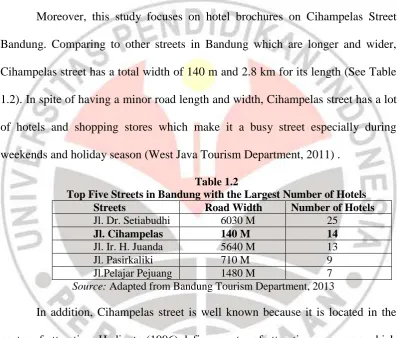
Moreover, this study focuses on hotel brochures on Cihampelas Street
Bandung. Comparing to other streets in Bandung which are longer and wider,
Cihampelas street has a total width of 140 m and 2.8 km for its length (See Table
1.2). In spite of having a minor road length and width, Cihampelas street has a lot
of hotels and shopping stores which make it a busy street especially during
weekends and holiday season (West Java Tourism Department, 2011) .
Table 1.2
Top Five Streets in Bandung with the Largest Number of Hotels Streets Road Width Number of Hotels
Jl. Dr. Setiabudhi 6030 M 25
Jl. Cihampelas 140 M 14
Jl. Ir. H. Juanda 5640 M 13 Jl. Pasirkaliki 710 M 9 Jl.Pelajar Pejuang 1480 M 7
Source: Adapted from Bandung Tourism Department, 2013
In addition, Cihampelas street is well known because it is located in the
centre of attraction. Hadianto (1996) defines center of attraction as an area which
provides tourism attractions and supported by tourism facilities and services such
as hotels, restaurants, and recreational facilities. The attraction of Cihampelas
Street lies in the huge statues of all-time favourite moviestars or superheroes
displayed in front of the shops, various restaurants and cafe, entertainment center,
5
Table 1.3
Number of Tourism Potential on Cihampelas Street Tourism Potential Number
Hotels 14
Restaurants & cafés 42 Entertainments/ Night Clubs 6
Cinemas 2
Stores and malls 35 Source: Bandung Tourism Department, 2013
The table above indicates that Cihampelas Street is potential for tourism with tens
of hotels, stores, and massive number of restaurants.
1.2 Research Questions
Based on the background of the study, this study is designed to answer the
following questions:
1. what are the main concepting approaches in the hotel brochures?
2. in what ways are the AIDCA (Attention, Interest, Desire, Conviction,
Action) formula applied by the hotels in their brochures?
1.3 Aims of the Study
Based on the research question above, the aims of the study are:
1. to examine the concepting approaches used by hotel brochures.
2. to evaluate the concepting approaches used by hotel brochures
6
1.4 Scope of the Study
This study focuses on the hotel brochures on Cihampelas street Bandung.
The study is carried out to analyze the concepting approaches proposed by
Altstiel & Grow (2007) and evaluate them according to AIDCA formula by Clyde
Bedell (1952), Albert, Schick (1996) Bird (2005), and Trehan (2009). The study
does not cover any other hotels that do not have brochures.
1.5 Significance of the Study
This study aims to investigate advertising strategies found in the brochures
of hotels. Thus, it would be useful for the hotels and others which purpose to
promote their products or services through their advertising brochure. The
findings of this study could be used as a guideline for them to select appropriate
advertising strategies and follow the AIDCA formula to reach the customers.
1.6 Research Methodology
In this study, a qualitative method will be used to describe the
phenomenon in natural condition without manipulation from the researcher. As a
tool of analysis, the Concepting Approaches (Altstiel & Grow, 2007) and AIDCA
formula (Clyde Bedell, 1952; Albert & Schick, 1996; Bird, 2005, and Trehan,
2009) were employed in order to analyze and evaluate the advertising concepts
7
the chosen hotel as the subject of the study. Furthermore, the detailed process of
collecting and elaborating the data are given in chapter 3.
1.7 Clarification of the Key Terms
In this study, there are several terms that are needed to be elaborated. Those terms are:
Hotel brochure
Hotel brochure is defined as a small printed paper with messages and
pictures that the hotels use to sell its products to the readers (Venter, 2006).
Advertising
Advertising is a tool of communication designed to promote a product, a
service, or an idea (Vilanilam & varghese, 2004).
Advertising strategies
Advertising strategies are elements that an advertiser uses on the hotel
brochures in order to gain reader's attention, arise their interest, stimulate their
desire, and evoke their action, respectively (Moriaty, 1991).
Concepting approach
Concepting approach is a central thought of how the product is described
and shown (Altstiel & Grow, 2007). Concepting approach is a part of advertising
strategies.
AIDCA formula
AIDCA is an acronym for Attention, Interest, Desire, Conviction and
Action. This model has been proposed by Clyde Bedell (1952), Albert, Schick
8
1.8 Organization of the Paper
The paper is organized into five chapters. Chapter I (Introduction) focuses
on presenting general introduction of presented study. It consists of the
background, research questions, aims of the study, significance of the study and
scope of the study. It also provides how the study is conducted, the list of key
terms and organization of the paper.
The second chapter elaborates the theoretical foundation that provides a
basis for conducting the research questions. This chapter covers the theories that
are applied in answering research questions. Moreover, some studies that are
related to the study are presented in this chapter.
Research Methodology is presented in chapter III explaining how the
study is conducted. It describes the focus of the study realized by the formulation
of problem. In addition, it presents the explanation of research design, data
collection and data analysis employed in this study.
Then, Findings and Discussions will be provided in chapter IV. It
provides the data obtained from the study, as well as the analysis of the data.
The last chapter presents the conclusions from the present study. It also
24
CHAPTER III
RESEARCH METHODOLOGY
This chapter describes the methodology of the study. It covers research design,
data collection, and data analysis employed in this study.
3.1 Research Design
In conducting the study, this study employed a descriptive qualitative method.
Sandelowski (2000) mentions that descriptive method includes present facts or
current condition to collect the data in order to interpret the result of analysis
without any manipulation of the variables themselves. It means that by using this
method, the five hotel brochures were analyzed by collecting the existing data,
such as verbal and non-verbal elements in the brochures. Furthermore, the data
were described in term of its need and in order to find out the facts in it.
Furthermore, Hancock (2002) explains that qualitative research concerns with the
answers to questions which begin with: why? how? in what way?. Therefore, this
method was considered to be relevant to this study since this study focused on
analyzing meanings not only in discovering what the advertising strategies
(concepting approaches) used by hotel brochures, but also in discovering how the
25
3.2 Data Collection
Data were collected through several steps. In the first step, the researcher
collected brochures from five hotels on Cihampelas street Bandung (ASTON
TROPICANA, AMARIS, SENSA, NALENDRA and FAVEHOTEL) that have
brochures from December 2012 to January 2013. Afterward, the researcher
searched the appropriate theories which were relevant to the subject. The third
step was the finding process of the advertising strategies used by each hotel
brochure The collected data were in the form of textual evidences such as words,
phrases, sentences, and images. They were selected and directed in answering the
research questions.
3.3 Data analysis
The present study investigated the advertising strategies, namely concepting
approaches (Altstiel & Grow, 2007). This study also evaluated those strategies
according to AIDCA (Attention, Interest, Desire, Conviction, Action) formula
(Clyde Bedell, 1952; Albert & Schick, 1996; Bird, 2005, and Trehan, 2009). It is
in line with what Moriaty (1991) states that advertising strategies are elements
that an advertiser uses on the hotel brochures in order to gain readers’ attention,
raise their interest, stimulate their desire, carry the conviction and evoke their
action.
The researcher investigated the verbal (brand name, headline, overline, underline
26
(logo, illustration, color, typography) of brochures in order to discover primary
concepting approaches used by hotel brochures, then the brochures were analyzed
separately to evaluate those advertising strategies according to AIDCA formula.
3.4 Data Presentation
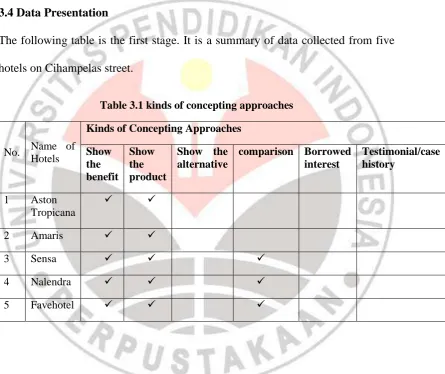
The following table is the first stage. It is a summary of data collected from five
hotels on Cihampelas street.
Table 3.1 kinds of concepting approaches
No. Name of
As seen in table 3.1, there are three concepting approaches used by hotels, namely
show the product, show the benefit, and comparison. Concepting approaches aims
to influence the way consumers' view. It is a central thought of how the product is
described and shown (Altstiel & Grow, 2007). The concepting approaches of
27
The second stage is in the form of words, group of words and clauses. It means
that the markers of verbal are in the form of words, group of words and clauses.
All of those forms are italicized.
The example of data presentation in the category of verbal element is presented
below.
-[41b ] [Body copy]" superbly located in the heart of the famed Cihampelas Bandung, guest literally just need to step out the hotel lobby to find themselves in the midst of hundreds of factory outlets, restaurant, trendy cafes, entertainment venues and boutiques while Bandung Airport and the Pasteur Toll Road gate are just a 15 minutes drive away"
The third stage is in the form of images. It means that the markers of non-verbal
are in the form of image or picture. The following image is the example of data
presentation in the category of non-verbal element.
Figure 3.2
61
CHAPTER V
CONCLUSIONS AND SUGGESTIONS
This chapter presents two parts. The first part discusses the conclusions of
the present study in line with the statement of problems presented in the first and
the third chapter of the paper. The second part provides some suggestions for
further studies.
5.1 Conclusions
The study was conducted to answer two research questions. The first
research question aims toexamine the concepting approaches in hotel brochures.
The second one evaluates the advertising strategies implemented by several hotels on Cihampelas street Bandung according to AIDCA (Attention, Interest, Desire, Conviction, Action) formula.
Based on the data analysis result, it shows that there are three concepting
approaches used by hotels in their brochures, namely show the benefit, show the
product, and comparison. All of those concepts are found in a form of verbal and
non-verbal elements. In terms of verbal elements, those concepts are mostly
gained in their headline, tagline, bodytext and caption. In addition, the non-verbal
elements are clearly seen in the brochures' pictures and logos.
With respect to the result on evaluating the concepting approaches used by
hotels, the findings indicate that the AIDCA formula proposed by Clyde Bedell
62
by most of the hotels on Cihampelas street. The hotel brochures seem not to fulfill
the following steps of AIDCA; Attention, Interest, Desire, Conviction and Action.
5.2 Suggestions
The present study is far from being perfect so that the researcher would
like to recommend several suggestions that might be useful for further studies.
First, regarding the importance of source, it is suggested to collect a deeper related
study about advertising strategies with wider source of studies.
Second, since this study only employs one formula of AIDCA, further
studies are recommended to combine several formulas such as AIDA, AIDAS,
ACCA to gain more comprehensive analysis.
Last, further study might focus on hotel brochures which are located in
other areas and compare them to find similarities and differences in using
BIBLIOGRAPHY
Albert, C. & Schick, D.C. (1996). Fundamentals of Copy & Layout. USA: NTC Publishing Group
Altsiel, T. & Grow, J. (2007). Advertising Strategies: Creative Tactics From the Outside/In. London: sage Publication Inc.
Anonymous. (2012). Bandung, West Java. Retrieved December 25, 2013, from http:// www.tripadvisor.com
Balkalf, E.E., Akbulut, T.N., & Kartapu, E. (2005). An Evaluative study of Billboard Advertisement's Attention-Perception and Design Criterias.
Retrieved December 27, 2013, from
http://newmedia.yeditepe.edu.tr/pdfs/isimd_05/03.pdf
Bandung Central Statistic Bureau, December 2012, http://disparbud.jabarprov.go.id.
Bandung Tourism Department. (2012). Domestic and International Tourist Visit in Bandung. Retrieved December 25, 2013, from http://disaparbud.com. Bandung Tourism Department. (2013). Numbers of Hotel in Bandung. Retrieved December 25, 2013, from http://disaparbud.com.
Bandung Vacations, January 2013, http://www.tripadvisor.com/Tourism-g297704-Bandung_West_Java_Java-Vacations.html [2013]
Bashir, I.N. (2009). Effects of Advertisement on Consumer Behaviour of University Students. Master Thesis, University of Sarghoda.
Bedell, C. (1952). How to Write Advertising That Sells (2nd ed.). London: McGraw-Hill Book Company, INC.
Bird, D. (2005). How to Write Sales Letters That Sell: Learn the Secrets of Successful Direct Mail (2nd ed.). London: British Library.
Glowa, T. (2002). White Paper: Advertising Process Models. Retrieved December 25, 2013, from http://www.ncResearch.com
Hanekom. (2006). A Theoretical Framework for The Online Consumer Response Process. Master Thesis, University of South Africa.
Hancock, B. (2002). Trent Focus for Research and Development inPrimary Health Care: An introduction to Qualitative Research. Trent Focus Group
Hotel, December 2012, http://disparbud.jabarprov.go.id.
Khunwuthikorn, K. (2011). A study of Advertising Techniques in English Tutorial Institutions' Brochures. Master Thesis, National Institute of Development Administration.
Littlefield, E.J. (1975). Readings in Advertising: Current Viewpoints on Selected Topics. United State of America: West Publishing Co.
Mendez, C.E. (2010). We Will Always be in The Shadows: A Qualitative Descriptive Study of Undocumented Latino Immigrants Surviving in the United States. Master Thesis, University of Lowa.
Middleton, V.T. & Clark, J. (2001). The Dynamic Business Environment: Factors influencing demand for tourism. Oxford: Butterworth Hanuman.
Moriaty, S.E. ( 1991). Creative Advertising. New Jersey: Prentice-Hall Inc.
Pennisi, A.L. & Gunawan, Y. (2011). How to Create an Effective Brochure.
Retrieved December 20, 2013, from
http://www.ianrpubs.unl.edu/live/g2028/build/g2028.pdf
Phakdeeburut, W. (2009). Language in Communication Arts. Bangkok: Triple Group.
Rieck, D. (2013). Headline Writing Basics: What Every Headline Should Do and
Proven. Retrieved January 5, 2013, from
http://www.directcreative.com/headline-writing-basics-what-every-headline-should-do-and-9-proven-ways-to-do-it.html
Sandelowski, M. (2000). Focus on Research Methods: Whatever Happened to Qualitative Description?. Journal of Research Method, 23, 334-340. Saxena, S. (2006). Headline Writing. New Delhi: Sage Publications India PVT
LTD.
Stokes, J. (2003). How to do Media and Culture Studies. London: SAGE Publications
Sullivan, A. (2005). Market Areas and Central Place Theory. Retrieved April, 2013, from http://www.vwl.tuwien.ac.at/hanappi/AgeSo/rp/UrbEco5eCh5.pdf Sugarman, J. (2007). The Adweek Copywriting Handbook. John Wiley & Sons,
Inc.
Sugino. (2005). Memehami Penelitian Kualitatif. Bandung: Alfabeta. The Entrepreneur's Guidebook Series. (2001-2007). Patsula Media.
Thwaites, T., Davis, L., & Mules, W. (1994). Tools for Cultural Studies: An Introduction. Macmillan Education Australia PTY LTD.
Trehan, M. & Trehan, R. (2009). Advertising and Sales Management. New Delhi: V.K. (India) Enterprises.
Van Dijk, T.A. (1995). Power and the News Media. Retrieved December 25, 2013, from http://www.discourses.org/download/articles/
Venter, I. (2006). Hotel Property Development: A Framework for successful Developments. Master Thesis, University of Pretoria.
Vilanilam, J.V. & Varghese ( 2004). Advertising Basic: A resource Guide for Beginners. New Delhi, Tajeshwar Singh.
Vincent, D. & Patrick, D.G. (2007). Globalisation in Hotel Chains. Case Study: Profile of the Belgian Business Traveller. Master Thesis, Universitas Hasselt, Belgium.
Wells, Moriarty, & Burnett. (2006). Advertising: Principles and Practice. New Jersey: Prentice Hal.
West Java Tourism Department. (2011). Pusat Perbelanjaan Cihampelas.
Witkowski, T. (2005). Know Your Folding: Clarifying Folding Terms and
Techniques. Retrieved December 27, 2012, from