HIGH PERFORMANCE THIN LAYER CHROMATOGRAPHIC DETERMINATION OF CAFFEIC
ACID AND ROSMARINIC ACID FROM THE LEAVES OF
Orthosiphon stamineus
M. Amzad Hossain
1*and Zhari Ismail
2 1Chemistry Division, Atomic Energy Centre, GPO Box 164, Ramna, Dhaka-1000, Bangladesh.
2
School of Pharmaceutical Sciences, Universiti Sains Malaysia,11800 Pulau Pinang, Malaysia
Received May 19, 2008; Accepted October 31, 2008
ABSTRACT
This paper presents the studies performed on extraction of Orthosiphon stamineus, Benth by using different
solvent for the identification and quantification of the caffeic acid derivatives such as caffeic acid and rosmarinic acid which confers to the leaves of this plant with remarkable pharmaceutical properties. High performance thin-layer chromatographic (HPTLC) allows the identification and the quantification of more than 20 samples in the same chromatographic run. The analysis of the samples requires 15-30 min compared with more than 2 h using a typical HPLC method. Using the techniques of the HPTLC and the UV-VIS spectra we have found that the extraction of this herb plant contain, the caffeic acid and rosmarinic acid ranging between 0.029% up to 0.506% and up to 0.24% to 2.24% respectively.
Keywords: Caffice acid derivatives, quantification, Malaysian Orthosiphon stamineus, HPTLC
INTRODUCTION
Orthosiphon stamineus, Benth belongs to the
Lamiaceae family and is commonly found in the rain forests of several tropical countries. The leaves of this plant are used as a diuretic and to treat rheumatism, diabetes, urinary lithiasis, edema, eruptive fever, influenza, hepatitis, jaundice, biliary lithiasis, and hypertension [1-3]. Owing to its beneficial pharmaceutical utility, it is under systematic cultivation in Malaysia and where is locally known as Misai kucing meaning ‘Cats whisker’ and consumed as a healthy Java tea to facilitate body detoxification. In particular, extracts
of Orthosiphon stamineus are now widely used in
Malaysia as drugs for the treatment of diabetes and kidney stone disease. Caffeic acid derivatives are a multi active substance used in cosmetics and to maintain healthy skin [4]. It also has antioxidant properties [5]. So far no report has appeared on the HPTLC of the caffeic acid derivatives present in Orthosiphon stamineus
leaves. In this paper, we describe a rapid and simple
method for the qualitative and quantitative determination of these two derivatives of caffeic acid from the leaves of Orthosiphon stamineus.
EXPERIMENTAL SECTION
Plant Material
The leaves of Orthosiphon stamineus Benth were collected from the Island of Penang. The plant was identified and voucher specimen was deposited in the herbarium of the School of Biology, University Sains Malaysia.
Chemicals and Reagents
Methanol, acetone, ethanol and chloroform (analytical-reagent grade) solvents were purchased from Merck (Germany). Standard caffeic acid and rosmarinic acid were isolated and purified by us in our laboratory. and chloroform (analytical-reagent grade) from Merck, Germany. Caffeic acid and rosmarinic acid standards and samples were applied to the plates by using CAMAG LINOMAT 5 auto sampler equipped with a 100
L syringe: the band length was 10 mm; the application volume was 20 L; the application rates 4 L/s. Thirteen bands per plates were applied 8 mm from the bottom edge, 15 mm apart. The plate was developed in an unsaturated glass chamber in solvent system hexane-ethyl acetate (4:1), the migration distance being 8 cm. After separation, the plate was dried in a steam of air for 5 min.
Scanning and data processing
processing were performed using the software winCATS.
Experimental condition
Ten grams of the powder samples was extracted with 100 mL methanol, 50% methanol, acetone, 70% acetone, ethanol, 50% ethanol, chloroform and water after maceration for 2, 4, 6 and 8 hours. The standards such as rosmarinic acid and caffeic of concentration 100, 150, 200, 250 and 300 ppm were prepared by standard procedure. The UV-VIS spectra were performed “in-situ” one plate between 200 and 700 nm. The densitograms were obtained at 365 nm in reflection.
RESULT AND DISCUSSION
A number of caffeic acid derivatives are present in
Orthosiphon stamineus leaves, caffeic acid and rosmarinic
acid being the most abundant. In addition to these two components, this plant contains some other caffeic acid derivatives. Thin layer chromatography (TLC)-densitometry is current method for the quantitation of some derivatives of caffeic acid in pharmaceutical
formulations. Quantitative TLC in situ scanning densitometry is rapidly gaining wide acceptance in pharmaceutical analysis [6-10]. This is because of its simplicity, accuracy, cost effectiveness and the possibility of simultaneous determination of a number of samples on a single TLC plate. The HPTLC allows the identification and the quantification of more than 20 samples in the same chromatographic run. The analysis of the samples requires 15-30 min compared with more than 2 h using a typical HPLC method. Moreover, there is no need for conditioning steps, as with HPLC, and each analysis by HPTLC is less expensive. However, we describe the qualitative and quantitative determination of caffeic acid and rosmarinic acid from the leaves of Orthosiphon
stamineus by using densitometer at different solvent
system.
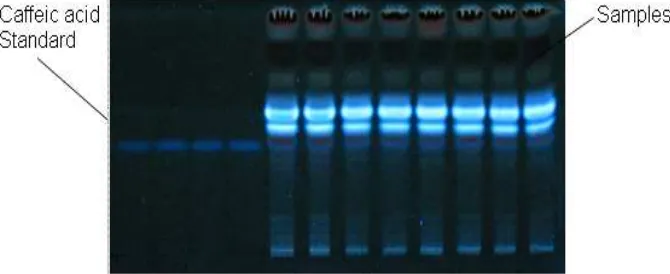
The chromatograms of the samples and standard were visualized in UV light at 365 nm. The chromatograms of the samples show the presence of the spots with same colour and at the same Rf values
as the standards. Fig 1 and 2 show the chromatograms of the samples and the standards at 365 nm without any sprayed reagent.
Fig 1. The chromatograms of the samples and standards (Rosmarinic acid) without any sprayed reagent, in UV light 365 nm
Fig 4. The densitogram of the methanol extract and the Caffeic acid standard at 365 nm
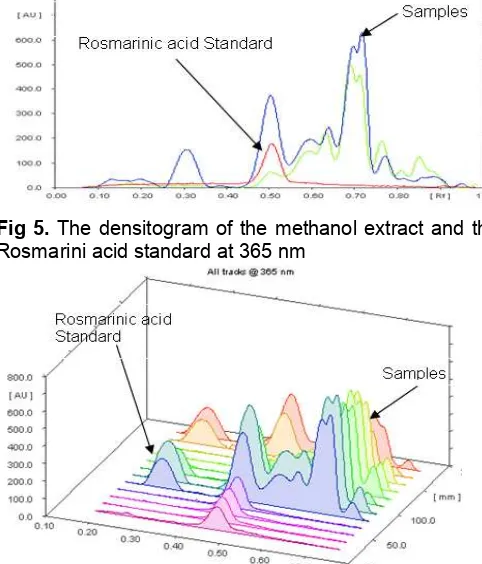
Fig 5. The densitogram of the methanol extract and the Rosmarini acid standard at 365 nm
Fig 6. The 3D chromatogram of all extract and the Rosmarinic acid standard at 365 nm
Fig 7. The 3D chromatogram of all extract and the caffeic acid standard at 365 nm
Fig 8. The UV-VIS spectra of the rosmarinic acid standard separated from all extract
Fig 9. The UV-VIS spectra of the caffeic acid standard separated from all extracts
Qualitative and quantitative determination of caffeic acid and rosmarinic acid from the leaves of
Orthosiphon stamineus using different solvent
system
The presence of the caffeic acid and rosmarinic acid in the samples was proven by comparison of the UV-VIS spectra of the standards with the UV-VIS spectra of the separated components from the samples. Fig 4-7. Shows the densitograms of the different
solvents extract samples with the standards. It can be observed the presence of the peaks in the samples densitograms, at the same Rf values, as the peak of
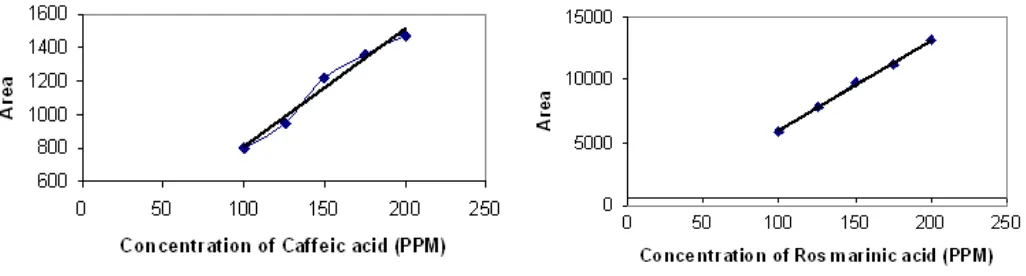
Fig 10. Calibration Curve for Caffeic acid Fig 11. Calibration Curve for Rosmarinic acid
Table 1. The concentration obtained from the caffeic acid and the rosmarinic acid in the various solvent systems from the leaves of Orthosiphon stamineus
Sample % yield of Caffeic acid % yield of Rosmarinic acid
Acetone-water (70:30) 0.068 2.24
for Caffeic acid: Y=7.035x +104.84; (R2=0.9773) and for Rosmarinic acid: Y=71.552x-1163 ; (R2=0.9985) Where Y is the peak area and x is the applied volume in a spot.
The concentration was obtained with the formula: C% g/g =VeCet/10m
Where C% (g/g) is the concentration; Ve is the
corresponding volume from the standard, Cet is the
concentration of the standard solution, 10 is the quantity of samples in L , and m is the weight of the plant used highest concentration of the caffeic acid derivatives and the lowest is 100% methanol solvent. So that 100% determined qualitatively and quantitatively by densitometric method and confirmed by chromatographic and spectral methods. This analytical procedure permits a fast and reliable determination of
1. Sumaryono, W., Proksch, P., Wray, V., Witte, L., and Hartmann, T., 1991,Planta Med., 57, 176-180. 2. Tezuka, Y., Stampoulis, P., Banskota, A.H., Awale,
S., Tran, K.Q., Saik, I., and Kadota, S., 2000, Chem.
Pharm. Bull.,48 (11), 1711-1719.
3. Shibuya, H., Bohgaki, T., Matsubara, T., Watari, M., Ohashi, K., and Kitagawa, I., 1999, Chem. Pharm.
Bull., 47, 695-699.
4. Eggensperger, H., Wilker, M., and Bauer, P., 1998,
SOFW J., 124, 634-640.
5. Leung, A.Y. and Foster, S., 1996, Encyclopedia of Common Natural Ingredients used in Food, Drug and
Cosmeties, 446-451.
6. Agbaba, D., Mijikovic, T., Marinkovic, V., Zivanovstakic, D., and Vladimirov, D., 1999, J. AOAC
7. Aboul-Enein, H.Y. and Serignse, V., 1994, Anal Lett., 27(4), 723-731.
8. Ling, B.L. Baeyens, W.R.G., Del Castillo, B., Imai, K., De Moerloose, P., and Stragier, K, 1989, J. Pharm.
Biomed. Anal.,7(12), 1663-1672.
9. Bhavar, B., Girija. B., Chatpalliwar, V.A., Patil, D.D., and Surana, S.J., 2008, Indian J. Pharm.
Scies., 70(4), 529-537.
10. Gandhimathi, M., Ravi, T.K., and Shukla, N., 2006,