Recommendations for Implementation of Community
Consultation and Public Disclosure Under the Food and
Drug Administration’s “Exception From Informed Consent
Requirements for Emergency Research”
A Special Report From the American Heart Association Emergency
Cardiovascular Care Committee and Council on Cardiopulmonary,
Perioperative and Critical Care
Endorsed by the American College of Emergency Physicians and the Society for Academic
Emergency Medicine
Henry Halperin, MD, MA, FAHA; Norman Paradis, MD; Vincent Mosesso, Jr, MD;
Graham Nichol, MD, MPH, FRCPC, FAHA; Michael Sayre, MD; Joseph P. Ornato, MD, FAHA;
Michael Gerardi, MD; Vinay M. Nadkarni, MD, FAHA; Robert Berg, MD, FAHA;
Lance Becker, MD, FAHA; Mark Siegler, MD; Megan Collins, MD; Charles B. Cairns, MD, FACEP;
Michelle H. Biros, MD, MS; Terry Vanden Hoek, MD; Mary Ann Peberdy, MD
I
n addition to the usual requirement of appropriate study design and institutional review board (IRB) approval, research studies performed under the Food and Drug Admin-istration (FDA) and Department of Health and Human Ser-vices regulations regarding “Informed Consent and Waiver of Informed Consent Requirements in Certain Emergency Re-search” (21 CFR §50.24)1 require community consultationand public disclosure. This special report discusses the general issues related to consent in emergency circumstances and provides a template to help IRBs implement community consultation and public disclosure appropriately. A portion of the material in this special report was presented as testimony by Dr Halperin on October 11, 2006, at the FDA’s public hearing on “Draft Guidance for Institutional Review Boards, Clinical Investigators, and Sponsors: Exception From In-formed Consent Requirements for Emergency Research.”
More than 300 000 Americans die each year due to catastrophic medical and surgical emergencies.2,3New
inter-ventions based on sound research could save lives. These research studies must be done within an ethical framework that traditionally includes obtaining prospective informed
consent from the research subject. The ethical framework for the conduct of human research began with the development of the Nuremberg Code4,5in 1949. This code states that (1)
informed consent of volunteers must be obtained without coercion of any form, (2) human experiments should be based on prior animal experiments, (3) the anticipated scientific results should justify the experiment, (4) only qualified scientists should conduct medical research, (5) physical and mental suffering should be avoided, and (6) no expectation of death or disabling injury should be expected from the research study.
The Declaration of Helsinki6 was issued in 1964 and
defines rules for clinical research. It repeats the ethical concerns stated in the Nuremberg Code but also gives a provision for enrolling certain patients in clinical research without their consent, by use of either proxy consent or waiver of consent in minimal-risk studies.
The subsequent Belmont Report,7which was published in
1979, is the cornerstone of ethical principles on which current federal US regulations for the protection of subjects are based. The report conveys the 3 major premises of ethical
The American Heart Association makes every effort to avoid any actual or potential conflicts of interest that may arise as a result of an outside relationship or a personal, professional, or business interest of a member of the writing panel. Specifically, all members of the writing group are required to complete and submit a Disclosure Questionnaire showing all such relationships that might be perceived as real or potential conflicts of interest.
This statement was approved by the American Heart Association Science Advisory and Coordinating Committee on August 10, 2007. A single reprint is available by calling 800-242-8721 (US only) or by writing the American Heart Association, Public Information, 7272 Greenville Ave, Dallas, TX 75231-4596. Ask for reprint No. 71-0425. To purchase additional reprints, call 843-216-2533 or e-mail [email protected].
Expert peer review of AHA Scientific Statements is conducted at the AHA National Center. For more on AHA statements and guidelines development, visit http://www.americanheart.org/presenter.jhtml?identifier⫽3023366.
Permissions: Multiple copies, modification, alteration, enhancement, and/or distribution of this document are not permitted without the express permission of the American Heart Association. Instructions for obtaining permission are located at http://www.americanheart.org/presenter.jhtml? identifier⫽4431. A link to the “Permission Request Form” appears on the right side of the page.
(Circulation.2007;116:1855-1863.) © 2007 American Heart Association, Inc.
Circulationis available at http://circ.ahajournals.org DOI: 10.1161/CIRCULATIONAHA.107.186661
1855
by guest on January 19, 2018
http://circ.ahajournals.org/
conduct of studies: respect for persons, beneficence, and justice. The report also provides elements used by IRBs to evaluate the ethical standards for individual research propos-als. The ethical principles presented in both the Belmont Report and the Declaration of Helsinki have been expanded and clarified in the most recent guidelines published by the Council for International Organizations of Medical Sciences,8
especially with regard to the provision of guidelines for the application of ethical standards in local circumstances.
A dilemma arises in research studies of interventions for life-threatening emergencies, such as cardiac arrest, neuro-logical emergencies including stroke, and some instances of major trauma. In these circumstances, a potential subject may be eligible for a research study but be unable to give prospective consent owing to impaired consciousness, severe alteration in cognition, or aphasia. Often with such research protocols, the subject must be enrolled immediately so that the potential physiological effects of the experimental inter-vention can be maximized before the onset of irreversible organ damage.9,10
The FDA defines the “therapeutic window” as “the time period, based on available scientific evidence, during which administration of the test article might reasonably produce a demonstrable clinical effect.”11,12 It is this therapeutic
win-dow that is limited or effectively nonexistent for research studies of life-threatening emergencies. There generally is not time to seek out a legally authorized patient representative for disclosure and consent. In addition, consent under such emergency circumstances may not meet the standards of informed consent, because there is little time for the investi-gator to explain the study, and little time for the patient representative to assess the various treatment options avail-able.13In addition, the emotional state of the patient
repre-sentative may eliminate the possibility of reflecting objec-tively on the situation. It is especially difficult to obtain informed consent in pediatric populations, in which it has been shown that “the emotional trauma of the diagnosis decreases a mother’s ability to absorb and understand vital information, and the emergent nature of the children’s con-dition and the urgency to begin treatment further compromise informed consent.”14
Clinical trials involving research on emergency patients who were unable to give prospective informed consent were traditionally performed in the United States either by the receipt of a waiver of informed consent from the local IRB or by deferred consent.15,16 In 1993, however, the Office for
Protection from Research Risks at the National Institutes of Health and the FDA questioned the legality of the deferred consent practice.17Because of problems with obtaining
con-sent in studies of life-threatening emergencies18,19 and the
impact on performing such studies, a coalition conference of acute resuscitation and critical care researchers was held in October 1994. Representatives from more than 20 organiza-tions participated in discussions that explored informed con-sent in emergency research and produced consensus recom-mendations.20 In 1996, the FDA and the Department of
Health and Human Services published regulations1 for the
ethically and legally acceptable conduct of emergency re-search. Emergency research must operate under exemption
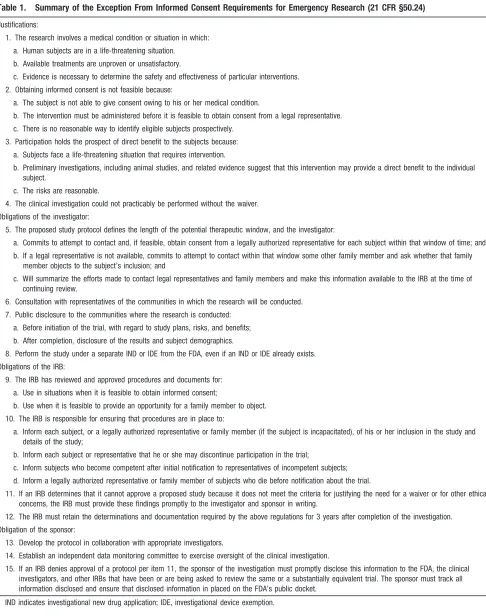
from consent, either because of no or minimal risk, or through community exception of consent regulations as outlined by the Office for Human Research Protections and the FDA. These guidelines aim to protect patients from participation in a study they would not consent to if they had decisional capacity. For research that is subject to FDA regulation, exception from consent can be applied to emergency research if explicit criteria are met (Table 1): (1) an investigational device exemption or investigational new drug application is in effect; (2) the research involves human subjects who cannot consent because of their emerging life-threatening medical condition for which available treatments are un-proven or unsatisfactory; (3) the intervention must be admin-istered before it is feasible to obtain informed consent from the patient’s legally authorized representative; (4) the sponsor has prior written permission from the FDA; (5) an indepen-dent data monitoring committee exists; and (6) the relevant IRB has documented that these conditions were met. In addition, the ethical framework for performing such studies mandates that there be an independent assessment of the risks and benefits of the protocol.
For all research that is supported by federal funding (eg, National Institutes of Health), even if the study does not use a drug or device regulated by the FDA, similar criteria are required to determine whether exception to informed consent is warranted for an emergency research study. In addition, for research that is not supported by federal funding or subject to FDA regulation (eg, a trial of a novel method of manual cardiopulmonary resuscitation), IRBs generally apply similar criteria to determine whether exception from consent is warranted for an emergency research study.
Before initiation of the study, community consultation and public disclosure must be provided for each emergency research protocol for which an exception from informed consent is requested.1 In March 2000, the FDA issued a
“Draft Guidance” report to help clarify the concepts of community consultation and public disclosure,11which was
updated in 2006.12These reports state, “[C]ommunity
con-sultation means providing the opportunity for discussions with, and soliciting opinions from the community(ies) in which the study will take place and from which study subjects will be drawn.” The 3 primary goals of the community consultation process are (1) to explain the nature of the research, with its attendant risks and benefits; (2) to state that informed consent will not be obtained from individual sub-jects before study participation; and (3) to explain the process by which potential subjects can refuse to participate in research studies.11,12The FDA guidance report defines public
disclosure as “. . . dissemination of information about the emergency research sufficient to allow a reasonable assump-tion that communities are aware that the study will be conducted, and later, that the communities and scientific researchers are aware of the study results.”11,12
The regulations indicate that each IRB is to exercise its own discretion in determining appropriate community sultation activities and public disclosure, which allows con-siderations specific to the local community(ies) to be taken into account. The regulations do not explicitly state the amount or types of community consultation and public
by guest on January 19, 2018
http://circ.ahajournals.org/
disclosure that need to be done to achieve compliance, although the FDA guidance document does give some gen-eral considerations.11,12 These requirements for community
consultation and public disclosure, although reasonable, sometimes lead to delays in obtaining approval for research studies using the emergency exception process. Each IRB
may lack experience in determining what types of consulta-tion and disclosure are necessary. In addiconsulta-tion, there is ambiguity in the regulations as to how individual IRBs should implement such community consultation and public disclo-sure. Shah and Sugarman21 examined emergency research
protocols at 36 centers and reported that to satisfy the public
Table 1. Summary of the Exception From Informed Consent Requirements for Emergency Research (21 CFR §50.24)
Justifications:
1. The research involves a medical condition or situation in which: a. Human subjects are in a life-threatening situation.
b. Available treatments are unproven or unsatisfactory.
c. Evidence is necessary to determine the safety and effectiveness of particular interventions. 2. Obtaining informed consent is not feasible because:
a. The subject is not able to give consent owing to his or her medical condition.
b. The intervention must be administered before it is feasible to obtain consent from a legal representative. c. There is no reasonable way to identify eligible subjects prospectively.
3. Participation holds the prospect of direct benefit to the subjects because: a. Subjects face a life-threatening situation that requires intervention.
b. Preliminary investigations, including animal studies, and related evidence suggest that this intervention may provide a direct benefit to the individual subject.
c. The risks are reasonable.
4. The clinical investigation could not practicably be performed without the waiver. Obligations of the investigator:
5. The proposed study protocol defines the length of the potential therapeutic window, and the investigator:
a. Commits to attempt to contact and, if feasible, obtain consent from a legally authorized representative for each subject within that window of time; and b. If a legal representative is not available, commits to attempt to contact within that window some other family member and ask whether that family
member objects to the subject’s inclusion; and
c. Will summarize the efforts made to contact legal representatives and family members and make this information available to the IRB at the time of continuing review.
6. Consultation with representatives of the communities in which the research will be conducted. 7. Public disclosure to the communities where the research is conducted:
a. Before initiation of the trial, with regard to study plans, risks, and benefits; b. After completion, disclosure of the results and subject demographics.
8. Perform the study under a separate IND or IDE from the FDA, even if an IND or IDE already exists. Obligations of the IRB:
9. The IRB has reviewed and approved procedures and documents for: a. Use in situations when it is feasible to obtain informed consent;
b. Use when it is feasible to provide an opportunity for a family member to object. 10. The IRB is responsible for ensuring that procedures are in place to:
a. Inform each subject, or a legally authorized representative or family member (if the subject is incapacitated), of his or her inclusion in the study and details of the study;
b. Inform each subject or representative that he or she may discontinue participation in the trial;
c. Inform subjects who become competent after initial notification to representatives of incompetent subjects; d. Inform a legally authorized representative or family member of subjects who die before notification about the trial.
11. If an IRB determines that it cannot approve a proposed study because it does not meet the criteria for justifying the need for a waiver or for other ethical concerns, the IRB must provide these findings promptly to the investigator and sponsor in writing.
12. The IRB must retain the determinations and documentation required by the above regulations for 3 years after completion of the investigation. Obligation of the sponsor:
13. Develop the protocol in collaboration with appropriate investigators.
14. Establish an independent data monitoring committee to exercise oversight of the clinical investigation.
15. If an IRB denies approval of a protocol per item 11, the sponsor of the investigation must promptly disclose this information to the FDA, the clinical investigators, and other IRBs that have been or are being asked to review the same or a substantially equivalent trial. The sponsor must track all information disclosed and ensure that disclosed information in placed on the FDA’s public docket.
IND indicates investigational new drug application; IDE, investigational device exemption.
by guest on January 19, 2018
http://circ.ahajournals.org/
disclosure requirement, the majority of these centers used a 1-way disclosure method (press releases, institutional and local newsletters, and radio and television announcements). A minority of the centers reported using 2-way disclosures with the community, including public forums, telephone polls, and written communications.21
Community Consultation and Public
Disclosure Template
The purpose of the present document is to provide guidance for implementation of community consultation and public disclosure. A template is presented that (1) provides for quantification of the minimum requirements that an IRB might adopt, (2) gives examples to help IRBs quickly become familiar with the process of implementing and reviewing studies proposed with exception to informed consent, and (3) proposes that trials of interventions approved by the FDA for the indication being studied should require different levels of community consultation and public disclosure than studies of unapproved interventions. The template gives a common interpretation of the requirements and provides a list of actions acceptable for the implementation of community consultation and public disclosure.
Ethics
The guiding ethical principle for the template is that there is a range of actions that are acceptable to protect subjects’ autonomy, dependent on the risk of the study. The risk referred to here is the incremental risk of participation in the proposed study over and above the risks of having sustained a life-threatening emergency and being treated with standard interventions. The higher the risk of the study, the more stringent are the actions that are required to protect subjects’ autonomy. Because there is a range of risk associated with different study interventions, different levels of community consultation and public disclosure can be used to appropri-ately balance subjects’ autonomy with the public good. A trial of an approved therapy should not require the same level of community notification and consultation as one in which nonapproved or not-generally-accepted interventions are be-ing introduced for the first time.
We therefore propose that it is ethically acceptable to stratify the intensity of community consultation and public disclosure on the basis of the anticipated incremental risks to subjects of participating in a research study. We acknowledge that any research study may have unanticipated risks, but we base our argument for stratifying community consultation and public disclosure on the reasonable and prudent prediction of subject risk.
Our proposal regarding stratifying community consultation is analogous to how IRBs currently review research protocols and informed consent documents. For example, IRB review of a protocol that studies unlinked serum samples will not require the same considerations as a project involving the use of a novel immunosuppressive agent in kidney transplanta-tion. The study of unlinked serum samples may be considered to have minimal risk and may therefore be eligible for expedited review, whereas the transplantation study requires standard IRB review. Similarly, the informed consent
docu-ment may be shorter and simpler for the serum sample study than for the transplantation study. Indeed, for the transplan-tation study, the IRB may suggest, in addition to an extensive consent protocol, the use of supplemental educational mate-rial or the involvement of a patient advocate to ensure that subjects fully understand the risks, benefits, and alternatives to participation. Our point is that although all emergency research that is not minimal risk requires some level of public disclosure and community consultation, emergency research studies that have less incremental risk and are not politically and culturally controversial may be performed ethically with lesser degrees of community consultation and public disclo-sure than would be needed for high-risk or controversial studies.
Stratification of Risk
This template breaks studies into categories of minimal, low, intermediate, and high incremental risk. Any sudden, cata-strophic, life-threatening condition places patients at high risk for substantial morbidity and mortality. Instead of paying heed only to the inherent risk of the underlying disease, which is present whether the patient is enrolled in the study or not, we recommend evaluating the incremental risk from partici-pating in the proposed study. That evaluation can then be used to determine the degree of community consultation and public disclosure appropriate for the proposed study.
Certain studies are justifiable without documented consent under minimal risk criteria. Consider the study of a therapy approved by the FDA for the indications being studied that is being compared with another therapy that was approved or did not need approval (eg, manual CPR). The study likely would carry a risk that was comparable to the risk of being treated with either approved therapy. In the absence of a research protocol, physicians could ethically and legally choose to treat patients with a life-threatening condition with either of these interventions. The only additional factors introduced by a research study of these interventions are (1) that the patients are being randomized to 1 of the approved interventions and (2) the loss of privacy and confidentiality during review of the clinical record after the intervention has been applied. Therefore, if the randomization procedure does not introduce any significant delay in applying the approved therapies, such a study is justifiable without documented consent under minimal-risk criteria. The rationale for not having an informed consent document is described in the preamble to the final rule for 21 CFR §50:
“The agency thinks that it may not always be possible to develop a meaningful informed consent document for con-tinued participation in the research, because the relevant information may vary significantly depending upon when it becomes feasible to provide the information to the subject or legally authorized representative. The agency is, therefore, not requiring that such a form be developed. The agency notes, however, that §50.24(a)(6) places the responsibility on the IRB to review and approve ‘informed consent procedures and an informed consent document’ for use with subjects or their legal representatives, and procedures and information to be used in consultations with family members, in situations where use of such procedures is feasible.”1
by guest on January 19, 2018
http://circ.ahajournals.org/
During the comment period for these regulations, the agency received feedback that the subject should be able to choose to continue to participate fully in a study, to continue the intervention but not have their data included in the research database or results, or to discontinue the intervention and use of the subject’s data. This was rejected on the following grounds:
“FDA regulations . . . require investigators to prepare and maintain adequate case histories recording all observations and other data pertinent to the investigation on each individ-ual treated with the drug or exposed to the device. The agency needs all such data in order to be able to determine the safety and effectiveness of the drug or device. The fact of having been in an investigation cannot be taken back. Also, if a subject were able to control the use (inclusion and exclusion) of his or her data, and particularly if the clinical investigation were not blinded, the bias potential would be immense.”1
The factors that can help decide the degree of incremental risk added by a particular study are shown in Table 2. We propose that IRBs use the following criteria to determine incremental risk: (1) FDA labeling status of the investiga-tional therapeutic drug or device, for studies of interventions; (2) an evaluation of whether the study introduces any addi-tional risk of harm over that of simply using the investiga-tional therapeutic drug or device (such as any delays in applying therapy that may be introduced by the randomiza-tion process); (3) the degree of invasiveness and need for real-time clinical decisions, for studies of diagnostics; and (4) the potentially sensitive nature of the study from the commu-nity’s or communities’ perspective, including political, cul-tural, and religious considerations. For a therapeutic
interven-tion, therefore, the study would have minimal, low, intermediate, or high incremental risk based on the FDA labeling status of the therapy and the assessment of whether there was minimal risk associated with being in the study (Table 2, “Intervention” row), unless it were placed in a higher-risk category on the basis of the community’s sensi-tivity (Table 2, bottom row). The same would be true for the study of a diagnostic, in which the type of diagnostic would place it in minimal-, intermediate-, or high-risk categories based on the degree of invasiveness, the need for real-time decision making, and whether the diagnostic is FDA ap-proved (Table 2, “Diagnostic” row), unless it were placed in a higher-risk category by the perceived sensitivity of the community (Table 2, bottom row).
Levels of Community Consultation and Public Disclosure
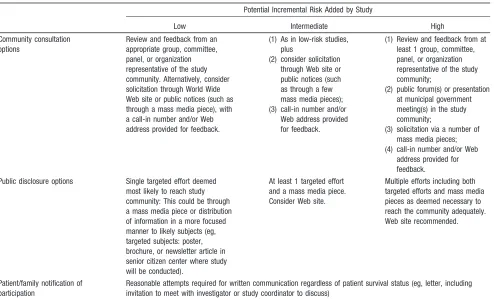
Once the degree of incremental risk has been determined, we propose that the amount and types of community consultation and public disclosure be guided by Table 3. For minimal-risk studies, no community consultation or public disclosure is required, although minimal community consultation should be strongly considered. For low-incremental-risk studies, minimal community consultation would be needed. For example, review and feedback from an appropriate group, committee, panel, or organization representative of the study community could allow appropriate community consultation without excessive time being needed to wait for public comment from a published advertisement. Alternatively, there could be solicitation through a World Wide Web site or public notices (eg, through the mass media), with a call-in
Table 2. Assessment of Incremental Risk of Research Studies
Study Type
Potential Incremental Risk Added by Study
Minimal Low Intermediate High
Intervention (device/drug) (1) FDA-approved for proposed study indication, and/or (2) generally accepted for
clinical use for study indication, and (3) confers minimal risk of
harm from being in the study
(eg, approved mechanical CPR device vs standard CPR; amiodarone vs lidocaine)
(1) FDA-approved for proposed study indication, and/or
(2) generally accepted for clinical use for study indication, and (3) confers higher than
minimal risk of harm from being in the study
(1) FDA-approved for clinical use, but
(2) not for the study indication
Not yet approved by the FDA for any indication
Diagnostic (test/device/feature) (1) Noninvasive and (2) not used for real-time
clinical decisions (eg, noninvasive monitor, low-volume blood drawing)
(1) Minimally invasive and (2) not used for real-time
clinical decisions (eg, transconjunctival oxygen saturation)
(1) More than minimally invasive, or (2) used for real-time
clinical decisions, or
Very unlikely to have community sensitivity
Very unlikely to have community sensitivity
Possible to have community sensitivity
Likely to have community sensitivity CPR indicates cardiopulmonary resuscitation.
For a therapy, the study would have minimal, low, intermediate, or high incremental risk based on the FDA labeling status of the therapy and the assessment of whether there was minimal risk from being in the study (“Intervention” row), unless it were placed in a higher-risk category based on the community’s sensitivity (bottom row). For a diagnostic study, the study would have minimal-, intermediate-, or high-risk categories based on the degree of invasiveness and the need for real-time decision making (“Diagnostic” row), unless it were placed in a higher-risk category by the perceived community’s sensitivity (bottom row).
by guest on January 19, 2018
http://circ.ahajournals.org/
number and/or Web address provided for feedback. For a high-incremental-risk study, however, more community con-sultation would be required, including an appropriate number of mass media solicitations, community meetings, and con-tact with prominent community organizations. Specific ex-amples of community consultations and public disclosures are available at http://www.americanheart.org/emergencyex-ception. We emphasize that the recommendations in Table 3 are simply guidelines, which would include their own ap-praisal of the risk of the intervention and the risk of being in the study. We also emphasize that involvement of the community should include attempts to consult with targeted, at-risk, or interested populations.
Definition of Community for Pediatric Studies
There is a unique problem in the definition of what consti-tutes a community for pediatric studies. For many pediatric populations, the community could be defined to include a group of patients with a specific disease, their families, and the appropriate healthcare providers (especially in the in-hospital environment). In these types of situations, rather than a particular geographically based community, consultation with the “community at risk” may be most appropriate. This process should be differentiated, however, from prospective informed consent of all patients at risk, because the latter process may not be feasible due to the potentially large numbers of patients involved.
Definition of Community for
Hospital-Based Studies
There is also a unique problem in the definition of what constitutes a community for hospital-based studies. For many hospital populations, the community could be defined to include a group of patients who present to the ambulatory clinic and emergency department of the hospital; their fami-lies; visitors; and the appropriate healthcare providers. In these types of situations, in which it is not feasible to obtain consent from every individual who enters the grounds of the hospital, consultation with the “community at risk” may be most appropriate. This process should be differentiated, however, from prospective informed consent of all patients at risk, because the latter process may not be feasible owing to the potentially large numbers of patients involved.
Discussion
We propose that it is ethically acceptable to stratify the intensity of community consultation and public disclosure on the basis of the anticipated incremental risks to subjects of participating in a research study. We propose, therefore, a template that breaks studies into categories of minimal, low, intermediate, and high incremental risk. Low-incremental-risk studies should require only minimal community consul-tation and public disclosure, whereas high-incremental-risk stud-ies would require more extensive community consultation and public disclosure. This template should aid IRBs in deciding what types and levels of community consultation and public
Table 3. Levels of Community Consultation and Public Disclosure Suggested at Different Degrees of Incremental Risk
Potential Incremental Risk Added by Study
Low Intermediate High
Community consultation options
Review and feedback from an appropriate group, committee, panel, or organization representative of the study community. Alternatively, consider solicitation through World Wide Web site or public notices (such as through a mass media piece), with a call-in number and/or Web address provided for feedback.
(1) As in low-risk studies, plus
(2) consider solicitation through Web site or public notices (such as through a few mass media pieces); (3) call-in number and/or
Web address provided for feedback.
(1) Review and feedback from at least 1 group, committee, panel, or organization representative of the study community;
(2) public forum(s) or presentation at municipal government meeting(s) in the study community;
(3) solicitation via a number of mass media pieces; (4) call-in number and/or Web
address provided for feedback. Public disclosure options Single targeted effort deemed
most likely to reach study community: This could be through a mass media piece or distribution of information in a more focused manner to likely subjects (eg, targeted subjects: poster, brochure, or newsletter article in senior citizen center where study will be conducted).
At least 1 targeted effort and a mass media piece. Consider Web site.
Multiple efforts including both targeted efforts and mass media pieces as deemed necessary to reach the community adequately. Web site recommended.
Patient/family notification of participation
Reasonable attempts required for written communication regardless of patient survival status (eg, letter, including invitation to meet with investigator or study coordinator to discuss)
For minimal-risk studies, it is suggested that a single announcement be done as in the low-risk category. A mass media piece refers to a newspaper article or advertisement, a radio announcement, or a television spot.
by guest on January 19, 2018
http://circ.ahajournals.org/
disclosure are needed for studies of emergency research done under the exception to informed consent process.
Standardization of community consultation and public disclosure is necessary because there has been uncertainty and hesitation by investigators and IRBs in the interpretation of current procedures for implementing research with the exception to informed consent process.22There are significant
variations in local IRBs’ interpretations of what is necessary to fulfill the FDA requirements for community consultation and what constitutes the proper venue for the community to provide feedback. These variations make it difficult for the investigator to judge what will be needed for IRB approval at any particular institution, and this often significantly prolongs the approval process, particularly for multicenter studies. IRB membership and experience change over time so that the investigator is faced with an evolving set of criteria that need to be met for initial, as well as continuing, approval.
In 1 large multicenter trial of 24 sites studying public access defibrillation using FDA-approved devices within the approved labeling, it took up to 404 days (median 108 days) and up to 7 submissions (median 2 submissions) to obtain IRB approval using the emergency exception process.22The
types and numbers of activities undertaken at each site to fulfill the community consultation and public disclosure requirements were quite diverse. There were public meetings; press releases; letters; brochures; newsletters; e-mail mes-sages; radio, television, or print advertisements; notices; feature stories; and radio and television appearances. Of more than 1000 comments received, 96% were reported as “posi-tive,” and only 1% were reported as “negative.”22 No IRB
rejected the project for approval on the basis of the negative
comments, and the study protocol was not changed in any location on the basis of the comments received.
IRB approval can be even more difficult if the drug or device to be studied has not been approved for sale by the FDA. The issue for the IRB is that they are asked to approve a research study in which a drug or device that has not been approved by the FDA is used on a test subject without their consent, there is likely to be a fatal outcome because of the inherent disease state, and the next of kin will be notified of these details. In many emergency situations, such as cardiac arrest, mortality may exceed 90%. This is precisely why the research is critical. Because of the large numbers of victims of these conditions, even small increases in survival could save many lives. Even if the experimental drug or device would reduce mortality only from 90% to 80%, that would translate into a potential saving of⬎20 000 lives per year for that single therapy (ie, 10% of the⬎200 000 cardiac arrest deaths per year). Some IRBs have expressed great reluctance to approve such studies because of fear of liability,23and at
least 1 IRB will not approve any studies using the exception to informed consent process.24
Conclusions
In conclusion, obtaining informed consent from patients or surrogates is difficult in the setting of serious emergency conditions. Current regulations do allow studies to be per-formed with exception to inper-formed consent, but ambiguities in implementing studies under current regulations can be onerous for IRBs and investigators and may discourage research to evaluate promising interventions for Americans. We propose a template to help guide IRBs in complying with the federal regulations with an appropriate balance between protecting eligible patients and preserving the public good.
by guest on January 19, 2018
http://circ.ahajournals.org/
Disclosures
Johns Hopkins University Zoll Inc None None Developer of CPR
devices; active CPR researcher
Guidant; Phillips; Abbott Labs Received royalties from Zoll Inc
Lance Becker University of Chicago; University of Pennsylvania
Philips Medical; Laerdal Medical
Alsius Corp None Cold Core
Therapeutics LLC: founders’ equity
Philips Medical; Abbott Pharma Zoll Medical: travel support
Robert Berg University of Arizona None None None None None None
Michelle H. Biros
Hennepin County Medical Center
None None None None None None
Charles B. Cairns
Duke University Northfield Laboratories; NIH None None None None None
Megan Collins University of Chicago None None None None None None
Michael Gerardi
Morristown Memorial Hospital
None None None None None None
Vincent Mosesso, Jr
University of Pittsburgh ASPIRE Trial: conducted under exception to consent
Equipment and supplies from Cardiac Science, HeartSine, Medtronic, Philips, Welch-Allyn, and Zoll
None None OxySure Systems, Inc; Sudden Cardiac Arrest Association
None
Vinay M. Nadkarni
The Children’s Hospital of Philadelphia, University of
Pennsylvania
None None None None None None
Graham Nichol
University of Washington Coinvestigator, Resuscitation Outcomes Consortium Data
Coordinating Center
Unrestricted grants from Medtronic ERS; Cardiac
Science; Philips Heart; Zoll Inc
Innercool, Inc; Radiant Medical, Inc
None Northfield Laboratories, Inc Medic One Foundation:
None None NRMI advisory board
member and speakers’ bureau. Lecture series speaker: sponsored by Bristol-Myers Squibb/Sanofi*
None Zoll Circulation Science Advisory Board; NRMI advisory board member. NRMI is
sponsored by Genentech but run independently. Chairman, Data/Safety
Monitor Board overseeing European TROICA study (study funded by Boehringer
Ingelheim)
None
Norman Paradis
Biosite Inc None None None Zoll Circulation;
Medivance Inc
Zoll Circulation; Rose Biomedical None
Mary Ann Peberdy
Virginia Commonwealth University Health System
None None None None None None
Michael Sayre Ohio State University None None None None None None
Mark Siegler University of Chicago None None None None None None
Terry Vanden Hoek
University of Chicago None None None None None None
NIH indicates National Institutes of Health; NRMI, National Registry of Myocardial Infarction; and TROICA, Thrombolysis in Cardiac Arrest.
This table represents the relationships of writing group members that may be perceived as actual or reasonably perceived conflicts of interest as reported on the Disclosure Questionnaire, which all members of the writing group are required to complete and submit.
1862
Circulation
October
16,
References
1. Protection of human subjects: informed consent: FDA: final rule.Fed Regist. 1996;61:51498 –51533.
2. Zheng ZJ, Croft JB, Giles WH, Mensah GA. Sudden cardiac death in the United States, 1989 to 1998.Circulation. 2001;104:2158 –2163. 3. State specific mortality from sudden cardiac death, United States 1999.
MMWR Morb Mortal Wkly Rep. 2002;51:126.
4. Trials of War Criminals Before the Nuremberg Military Tribunals Under Control Council Law.Washington, DC: US Government Printing Office; 1949;2:181–182.
5. Katz J. The Nuremberg Code and the Nuremberg Trial: a reappraisal. JAMA. 1996;276:1662–1666.
6. Rickham PP. Human experimentation: code of ethics of the World Medical Association: Declaration of Helsinki.Br Med J. 1964;2:177. 7. Protection of human subjects: Belmont report: notice of report for public
comment.Fed Regist. 1979;44:23191–23197.
8. International Ethical Guidelines for Biomedical Research Involving Human Subjects.Geneva, Switzerland: Council for International Organi-zations of Medical Sciences (CIOMS); 2002.
9. Weaver WD, Cobb LA, Hallstrom AP, Fahrenbruch C, Copass MK, Ray R. Factors influencing survival after out-of-hospital cardiac arrest.J Am Coll Cardiol. 1986;7:752–757.
10. Eisenberg MS, Bergner L, Hallstrom A. Out-of-hospital cardiac arrest: improved survival with paramedic services.Lancet. 1980;1:812– 815. 11. Guidance for Institutional Review Boards, Clinical Investigators, and
Sponsors: Exception from Informed Consent Requirements for Emergency Research: Draft Guidance. Available at: http://www.fda.gov/ OHRMS/DOCKETS/98fr/06d-0331-gdl0001.pdf. Accessed October 1, 2006.
12. Guidance for Institutional Review Boards, Clinical Investigators, and Sponsors: Exception from Informed Consent Requirements for Emergency Research. Available at: http://www.fda.gov/oc/ohrt/irbs/ except.html. Accessed September 15, 2006.
13. Williams BF, French JK, White HD; HERO-2 Consent Substudy Inves-tigators. Informed consent during the clinical emergency of acute
myo-cardial infarction (HERO-2 consent substudy): a prospective observa-tional study.Lancet. 2003;361:918 –922.
14. Stevens PE, Pletsch PK. Ethical issues of informed consent: mothers’ experiences enrolling their children in bone marrow transplantation research.Cancer Nurs. 2002;25:81– 87.
15. Frost N, Robertson J. Deferring consent with incompetent patients in an intensive care unit.IRB: A Review of Human Subjects Research. 1980; 2:5– 6.
16. Abramson NS, Meisel A, Safar P. Deferred consent: a new approach for resuscitation research on comatose patients. JAMA. 1986;255: 2466 –2471.
17. Protection of human subjects: subpart A: basic HHS policy for protection of human research subjects: definitions. 45 CFR §46.102(i). 1993. 18. Lurie KG, Shultz JJ, Callaham ML, Schwab TM, Gisch T, Rector T,
Frascone RJ, Long L. Evaluation of active compression-decompression CPR in victims of out-of-hospital cardiac arrest. JAMA. 1994;271: 1405–1411.
19. Biros MH. Research without consent: current status, 2003.Ann Emerg Med. 2003;42:550 –564.
20. Biros MH. Development of the multiorganizational document regarding emergency research consent.Acad Emerg Med. 1996;3:101–105. 21. Shah AN, Sugarman J. Protecting research subjects under the waiver of
informed consent for emergency research: experiences with efforts to inform the community.Ann Emerg Med. 2003;41:72–78.
22. Mosesso VN Jr, Brown LH, Greene HL, Schmidt TA, Aufderheide TP, Sayre MR, Stephens SW, Travers A, Craven RA, Weisfeldt ML; PAD Trial Investigators. Conducting research using the emergency exception from informed consent: the Public Access Defibrillation (PAD) Trial experience.Resuscitation. 2004;61:29 –36.
23. Kremers MS, Whisnant DR, Lowder LS, Gregg L. Initial experience using the Food and Drug Administration guidelines for emergency research without consent.Ann Emerg Med. 1999;33:224 –229. 24. Guidance: Waiver of Consent in Emergency Research. Available at:
http://www.med.umich.edu/irbmed/guidance/emergency.htm. Accessed September 15, 2006.
KEYWORDS: AHA Scientific Statement䡲 emergency medical services
Reviewer Disclosures
Reviewer Employment Research Grant
Other Research Support
Speakers’ Bureau/Honoraria
Expert Witness
Ownership Interest
Consultant/Advisory Board Other Elliott Antman Brigham and Women’s
Hospital
None None None None None None None
Tom Aufderheide Medical College of Wisconsin
Resuscitation Outcomes Consortium; Immediate
Trial; ResQTrial; NETT
None None None None None None
Larry Goldstein Duke University None None None None None None None Robert Nelson The Children’s Hospital
of Philadelphia
None None None None None None None
Max Harry Weil Weil Institute of Critical Care Medicine
None None None None None None None
This table represents the relationships of reviewers that may be perceived as actual or reasonably perceived conflicts of interest as reported on the Disclosure Questionnaire, which all reviewers are required to complete and submit.
by guest on January 19, 2018
http://circ.ahajournals.org/
Peberdy
Megan Collins, Charles B. Cairns, Michelle H. Biros, Terry Vanden Hoek and Mary Ann
P. Ornato, Michael Gerardi, Vinay M. Nadkarni, Robert Berg, Lance Becker, Mark Siegler,
Henry Halperin, Norman Paradis, Vincent Mosesso, Jr, Graham Nichol, Michael Sayre, Joseph
Emergency Physicians and the Society for Academic Emergency Medicine
Cardiopulmonary, Perioperative and Critical Care: Endorsed by the American College of
Association Emergency Cardiovascular Care Committee and Council on
Requirements for Emergency Research'': A Special Report From the American Heart
Print ISSN: 0009-7322. Online ISSN: 1524-4539
Copyright © 2007 American Heart Association, Inc. All rights reserved.
is published by the American Heart Association, 7272 Greenville Avenue, Dallas, TX 75231 Circulation
doi: 10.1161/CIRCULATIONAHA.107.186661
2007;116:1855-1863; originally published online September 24, 2007;
Circulation.
http://circ.ahajournals.org/content/116/16/1855
World Wide Web at:
The online version of this article, along with updated information and services, is located on the
http://circ.ahajournals.org//subscriptions/
is online at: Circulation
Information about subscribing to
Subscriptions:
http://www.lww.com/reprints
Information about reprints can be found online at:
Reprints:
document. Permissions and Rights Question and Answer
this process is available in the
click Request Permissions in the middle column of the Web page under Services. Further information about Office. Once the online version of the published article for which permission is being requested is located,
can be obtained via RightsLink, a service of the Copyright Clearance Center, not the Editorial Circulation
in
Requests for permissions to reproduce figures, tables, or portions of articles originally published
Permissions:
by guest on January 19, 2018
http://circ.ahajournals.org/