Journal of Physics: Conference Series
PAPER • OPEN ACCESS
Logistics Management: New trends in the Reverse
Logistics
To cite this article: A Antonyová et al 2016 J. Phys.: Conf. Ser.710 012018
View the article online for updates and enhancements.
Related content
Single-tier city logistics model for single product
N I Saragih, S Nur Bahagia, Suprayogi et al.
-Automatization of Transport Logistics Company
G B Barskaia and T I Chalkova
-Evaluation of a new trend in the geotechnology for steeply dipping vein deposits in Kyrgyzstan
-Logistics Management: New trends in the Reverse -Logistics
A Antonyová1, P Antony2 and B Soewito3 1
University of Prešov in Prešov, Faculty of Management, Konštantínova 16, 08001 Prešov, Slovak Republic
2
APmikro, Pavloviþovo námestie 19, 08001 Prešov, Slovak Republic
3
Bina Nusantara University, Jakarta 11530, Indonesia
E-mail: [email protected]
Abstract. Present level and quality of the environment are directly dependent on our access to natural resources, as well as their sustainability. In particular production activities and phenomena associated with it have a direct impact on the future of our planet. Recycling process, which in large enterprises often becomes an important and integral part of the production program, is usually in small and medium-sized enterprises problematic. We can specify a few factors, which have direct impact on the development and successful application of the effective reverse logistics system. Find the ways to economically acceptable model of reverse logistics, focusing on converting waste materials for renewable energy, is the task in progress.
1.Introduction
There are a few example definitions of the reverse logistics, which are more or less general or stressing some of its function. The European Working Group on Reverse Logistics (REVLOG) has analyzed the concept of reverse logistics and specified the definition as follows: “The process of planning, implementing and controlling backward flows of raw material, in process inventory, packaging and finished goods, from manufacturing, distribution or use point, to a point of recovery or point of proper disposal.” [23]
More general definition was formulated by the Reverse Logistics Executive Council (RLEC): “Reverse logistics is a movement of materials from a typical final consumption in an opposite direction in order to regain value or to dispose of wastes. This reverse activity includes take back of damaged products, renewal and enlargement of inventories through product take back remanufacturing of packaging materials, reuse of containers, and renovation of products, and handling of obsolete appliances.” [24]
The Council of Logistics Management (CLM) defined reverse logistics using the definition of logistics: “The process of planning, implementing, and controlling the efficient, cost effective flow of raw materials, in-process inventory, finished goods and related information from the point of origin to the point of consumption for the purpose of conforming to customer requirements. Reverse logistics
1
Anna Antonyová, Department of Mathematical Methods and Managerial Informatics
ScieTech 2016 IOP Publishing
Journal of Physics: Conference Series710(2016) 012018 doi:10.1088/1742-6596/710/1/012018
Content from this work may be used under the terms of theCreative Commons Attribution 3.0 licence. Any further distribution of this work must maintain attribution to the author(s) and the title of the work, journal citation and DOI.
includes all of the activities that are mentioned in the definition above. The difference is that reverse logistics encompasses all of these activities as they operate in reverse.” [25]
2.Overview of the literature
The individual aspects of the chain process that is characteristic for the reverse logistics, particularly how it is manifested in the various sectors of the economy, are focusing in the scientific works of certain researchers.
Alok Agrawal and Vijay Choudhary [1] examined reverse logistics in the light of product lifecycle. Reverse logistics activities are specified as follows:
• Gatekeeping as the activity of controlling, • Sorting and storing,
• Asset recovery,
• Transportation.
They also determined strategies as recommendations for companies to keep the reverse logistics as successful process:
Turkish researcher Aras constructed model with his colleagues Boyaci and Verter [3] for products intended to manufacturing, which are keeping in the serviceable inventory for categorization in the chain of the reverse logistics. Robert Bucki and Bronislav Chramcov pay attention to information support with simulation the manufacturing tasks to build the proper logistics channels [5]. It is important to recognize also the proportions as firms across economic sectors contribute to the overall reverse logistics of the country's economy [9], particularly the following sectors: industry, magazine publishing, book publishers, book distributors, greeting cards, catalog retailers, electronic distributors, computer manufacturers, CD-ROMs, printers, mail order computer manufacturers, mass merchandisers, auto industry, consumer electronics and household chemicals.
Nowadays the interest is devoted especially to e-waste and its place in the chain in the reverse logistics as e-waste increases equally to the development of computer industry. American researchers K. K. Dhanda,a and A. A. Peters [8] specify various methods to alleviate the e-waste amount from the resource reduction in the input process through reuse, computer refurbishing as a form of remanufacturing or recycling. Disposal results in toxic waste as well as the groundwater contamination. Extended producer responsibility can also help to cope with the increasing e-waste in its amount. The reason for avoiding to disposal of e-waste in China [20] is mainly prevention to restrain of considerable loss of valuable secondary raw materials. From this point of view the sustainable management of waste electrical and electronic equipment (WEEE) involves organizing small companies, groups, or even individuals for collecting, trading and processing of already used electronic material leading to increasing also the economic viability.
ScieTech 2016 IOP Publishing
Civil engineering is part of the industry which is typical with its problems how to cope with the continuous waste production. The Waste Management Plan (WMP) is a strategy how to minimize the construction waste. The causes of waste generation are set in the work of Malaysian researcher Sasitharan Nagapan with his colleagues [11], [16]. The practice proved the lack of waste management plan (WPM) as well as its implementation as the most significant factor for the increasing of the construction waste in its amount. This directly costs the following problems such as: mistakes in quantity surveys, ordering errors and wrong material storage. Poor supervision can costs poor materials handling as well as poor attitudes of workers. The managers sometimes can not influence the quality of construction materials. Natural materials to compose the building envelopes can not only increase the energy efficiency in buildings but also cope with the problem of artificial waste that is harmful for the environment. Scientists in Vienna [15] tried to composite new materials made of jute, flax, and hemp. However there is still problem with the moisture that influences the insulation properties.
Some countries are specific in the development of their system of the reverse logistics that is under the direct influence with the government legislation. Ismam [12] with his colleagues specifies new strategies for construction waste management in developed countries as a plan for government implementation in policy and regulations.
Customers’ involvement into the chain of the reverse logistics system is a necessity that can be realized not only through the government legislative but also through the supermarkets. Brazilians Renata Borini Marcondes e Santos and Sergio Silva Braga Junior [18] focus on processing the goods through the recycling of materials as important part of the reverse logistics. They also collected data through the questionnaire regarding implementing the reverse logistics in supermarkets. The researcher Patricia Oom do Valle with her coauthors [17] applies multivariate statistical methods such as discriminant analysis, exploratory factor analysis and confirmatory factor analysis to examine the level of customer service in the reverse logistics chain in Portugal. The obtained findings enable to improve the complex logistics service in the recycling program to stress the role of the customers at the collection stage.
Wright, Richey, Tokman and Palmer deal with building the recycling channel for products [21]. Reverse logistics activities for products they specify as: return to supplier, resell, sell via outlet, salvage, recondition, refurbish, remanufacture, reclaim materials, recycle, and landfill. Reverse logistics activities for packaging: reuse, refurbish, reclaim materials, recycle, and salvage.
3. Designing the waste logistics system
Assessment the optimal costs to manage the chain for the general logistics system with taking into account the specific qualities of the possible agents, which may appear in the production process, requires using the appropriate quantitative methods. Both empirical as well as modelling analyses play an important role in modelling the waste logistics system. Strategic and operational factors can be set for the specific chain of the waste logistics, when the mathematical model of the logistics system is already created. It is important to observe the principles of mathematical modelling as algorithm for creating the system model, which is applied to the specific conditions of the waste logistics system.
General methodology for designing the waste logistics system can be described as following:
• main agents of the waste in the system are identified,
• analyzing the economic behavior of the waste agents in the system,
• decision process that is based on the quantitative methods and empirical analysis,
• mathematical modelling with setting the main variables,
ScieTech 2016 IOP Publishing
Journal of Physics: Conference Series710(2016) 012018 doi:10.1088/1742-6596/710/1/012018
• identifying the dependency and interrelationships between the variables,
• assigning the coordination mechanisms where appropriate,
• economic behavior is applied using the mathematical apparatus,
• identifying special cases for the certain agents,
• completing the details of the system model,
• testing the system model.
We can specify a few factors, which have direct impact on the development and successful application of the effective reverse logistics system. We recognize especially strategic and operational factors. Strategic factors:
Both strategic and operational factors are identified for every enterprise according to the entrance materials to the production process, production specifics and packaging used for both purposes: immediate packaging to protect products and to keep products safety during the transportation.
4. Specification the key trends in the reverse logistics development
Dynamic progress of society in unity with the technology development brings also some specific trends in both a new material development as well as key trends for the waste logistics. Creating the sustainable production cycles becomes a necessity for the further society development.
The trends in the waste logistics development are motivated economically as well as according to the government regulations. We can specify them as follows:
• research in setting the suitable material with the recycling possibility before the production program starts,
• reusage of the components that are used already in the production process,
• new product development process with advanced technology that is based on usage the recycled materials,
ScieTech 2016 IOP Publishing
• creation the funds for development and building the reverse distribution channels,
• organizing the logistics programs for sustainable development,
• increasing responsibility of producers for the whole product life cycle,
• a „green“ image as important marketing element,
• remanufacturing of machine parts,
• renovation in technology of packaging materials,
• invention activities aiming to reusable materials,
• collaboration with the retail chains in the collection of materials for recycling,
• ensure the increased safety in transport of dangerous materials,
• decision-making processes based on advanced information technology applications,
• specific attention to the E-waste logistics.
5. Modelling of reverse logistic processes
Reverse logistics system is influenced with not only economic reasons or more less environmental feelings of the company owner but also with the legislation. Henrique Luiz Corrêa and Lucia Helena Xavier consider the establishment of legal environment-related limits such as maximum emissions for certain modes of transportation in the United States in the 90s [7] as a milestone in the logistics – environment interaction. The same way the public policy in many countries can influence through the rules included in the law the regulation of reverse logistics. However some modern companies build their corporate brand directly on their relationship to the environment.
There several approaches to building the model of the reverse logistics processes. The optimization model under the stochastic environment was applied for the chains of the reverse logistics, using genetic algorithm in the work of Mostafa Hosseinzadeh with Emad Roghanian [12] from Iran. They proposed also strategy with the minimum shipping cost as well as the fixed opening cost, taking into account the locations with possible transportation links and capacities of the recovery facilities. The selected items were used to measure the performance outcome attributed to the adoption of reverse logistics activities in the research of Kuan Siew Khor and Zulkifli Mohamed Udin [14] from Malaysia. The obtained results were used to apply Chi-Square Test and build the model. Yu Xie Y, George Bruce and John Mangan [22] present model that is typical for the Chinese industry with respect to the role of profession in the reverse logistics system.
Quantitative model of Fleischmann with his co-researchers was constructed [10] with respect to the type of items, which are recovered. Finally there were appointed the following categories:
• packages such as bottles or pallets,
• routable spare parts, for instance TV tubes and machine parts,
• consumer goods such as refrigerators or copiers.
Reverse channel was appointed according to the flow from the producer through distributor to the user. Another model expresses the causal relationships between energy consumption, economic growth and pollutant emissions for Malaysia [2] over the period of the years 1970-2010.
While in the large factories reverse logistics system is a direct part of the production process in small and medium sized enterprises logistics channels are self-built, often not directly dependent on the manufacturing process. The example model of the channels in the reverse logistics system for small
ScieTech 2016 IOP Publishing
Journal of Physics: Conference Series710(2016) 012018 doi:10.1088/1742-6596/710/1/012018
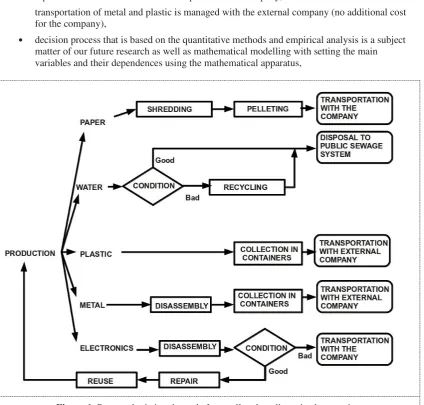
and medium sized enterprise devoted to paper box production in Slovakia is expressed in Figure 1. The production program of the company influences also the specific waste materials in the reverse logistic system. Our approach in constructing the model was to stress the activities, which are necessary for running directly in the enterprise and which are more suitable in collaboration with the external company:
• main agents of the waste in the system: paper, water, plastic, metal and electronics,
• economic behavior of the waste agents in the system:
transportation of pellets of paper is managed with the company using the railways (additional costs for the company),
transportation of electronics means additional costs for the company,
repair and reuse of electronics mean a profit for the company,
transportation of metal and plastic is managed with the external company (no additional cost for the company),
• decision process that is based on the quantitative methods and empirical analysis is a subject matter of our future research as well as mathematical modelling with setting the main variables and their dependences using the mathematical apparatus,
Figure 1. Reverse logistics channels for small and medium sized enterprise.
ScieTech 2016 IOP Publishing
• special cases for the certain agents: water is contaminated mostly with the dispersion colorants,
• the system model will be tested after completing the details of the system model.
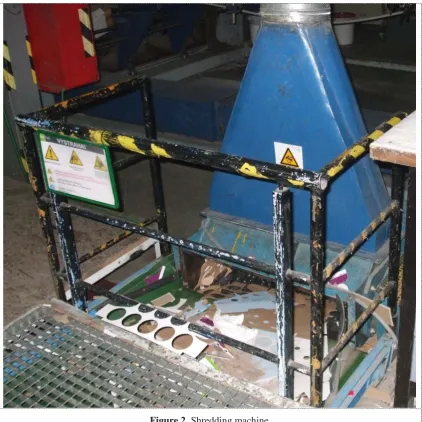
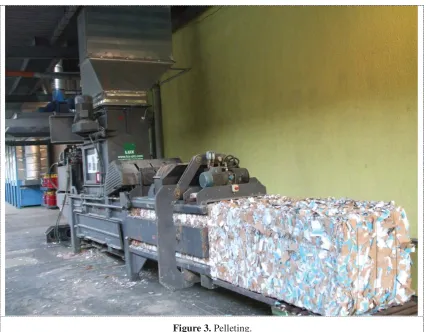
Some details of the specific channels including our research activities are subject matter also in our previous research [4], [6], such as for instance details of the shredding machine construction (Figure 2) for the waste paper material as well as the chamber with the pressing apparatus that is expressed in Figure 3 together with the pelleting process.
Suggested way for the water recycling is for instance the flotation technology. The example of the water cleaner working on the base of electro-flotation process is expressed in Figure 4. The water cleaner with the control system that is placed in the control box was designed in collaboration with a researcher and constructor Peter Antony from APmikro company. The concentrated dust is collected as foam from the surface of contaminated water during its recycling.
Figure 2. Shredding machine.
ScieTech 2016 IOP Publishing
Journal of Physics: Conference Series710(2016) 012018 doi:10.1088/1742-6596/710/1/012018
The container as a part of the water cleaner comprises 1000 liters of dirty water. The flotation tank is the place for the direct process of the water treatment. The water recycling is necessary part of every production where the water contamination is part of the manufacturing process as legislation in European Union does not allow discharging water directly into the public sewer network when there is occurrence of the specific contamination.
Figure 3. Pelleting.
6. Conclusion
The production process is the main source in contamination of our environment therefore consistency in building the channels of the reverse logistics is an important part of management in every company. The paper deals with the general trends in reverse logistics development. It specifies also some waste materials occurring in the production process as well as the ways how companies cope with the decision between the recycling or collection the waste materials for transportation to the external company. The channels of the reverse logistics system, which are typical for small and medium sized enterprises, are expressed using the schematic representation.
Model specification with its benefits as well as the cost of running the process the reverse logistics system for small and medium sized enterprise is the subject also for our future research. The costs optimization together with specification the proper paths in the decision making processes can make the reverse logistics more affordable for the companies.
ScieTech 2016 IOP Publishing
Figure 4. Cleaner for the contaminated water working on the flotation principle.
References
[1] Agrawal A and Choudhary V 2014 Reverse Logistics: Performance Measures and their effect in product lifecycle International Journal of Core Engineering & Management (IJCEM)1(2) 14-22
[2] Azlina A A and Mustapha N H N 2012 Energy, Economic Growth and Pollutant Emissions Nexus: The case of Malaysia Procedia - Social and Behavioral Sciences65 1-7
[3] Aras N, Boyaci T and Verter V 2004 The effect of categorizing returned products in remanufacturing IIE Transactions36(4) 319–331
[4] Antonyová A, Antony P and Soewito B 2015 Analytical Approach to Automation Control of Electro-flotation Process for Treatment the Water Contaminated with Dispersion Colorants
Advanced Science Letters21(1) 24-28
[5] Bucki R and Chramcov B 2013 Information Support for Logistics of Manufacturing Tasks
International Journal of Mathematical Models and Methods in Applied Sciences 7(3) 193-203
[6] Antonyová A, Antony P and Soewito B 2015 Analytical Approach to Automation Control of Electro-flotation Process for Treatment the Water Contaminated with Dispersion Colorants
Advanced Science Letters21(1) 24-28
[7] Corrêa H L and Xavier L H 2013 Concepts, design and implementation of Reverse Logistics Systems for sustainable supply chains in Brazil Journal of Operations and Supply Chain Management6(1) 1-25
[8] Dhanda K K and Peters A A 2005 Reverse Logistics in the Computer Industry International Journal of Computers, Systems and Signals6(2) 57-67
ScieTech 2016 IOP Publishing
Journal of Physics: Conference Series710(2016) 012018 doi:10.1088/1742-6596/710/1/012018
[9] Elmas G and Erdo÷muú F 2011 The Importance of Reverse Logistics International Journal of Business and Management Studies3(1) 161-171
[10] Fleischmann M, Bloemhof-Ruwaard J M, Dekker R, van der Laan E, van Nunen J A E E and Van Wassenhove L N 1997 Quantitative Models for Reverse Logistics: A review European Journal of Operational Research103 1-17
[11] Foo L Ch, Rahman I A, Asmi A, Nagapan S and Khalid K I 2013 Classification and Quantification of Construction Waste at Housing Project Site International Journal of Zero Waste Generation1(1) 1-4
[12] Hosseinzadeh M and Roghanian E 2012 An Optimization Model for Reverse Logistics Network under Stochastic Environment Using Genetic Algorithm International Journal of Business and Social Science 3(12) 249-264
[13] Ismam J N, Ismail Z and Hashim H 2014 Construction Waste Management Successful Implementation Framework in Developed Countries IEEE Colloquium on Humanities, Science and Engineering 97-102
[14] Khor K S and Udin Z M 2012 Impact of Reverse Logistics Product Disposition towards Business Performance in Malaysian E&E Companies Journal of Supply Chain and Customer Relationship Management 2012 1-19
[15] Korjenic A, Petránek V, Zach J and Hroudová J 2011 Development and performance evaluation of natural thermal-insulation materials composed of renewable resources Energy and Buildings43(9) 2518–2523
[16] Nagapan S, Rahman I A, Asmi A and Adnan N F 2013 Study of Site's Construction Waste in Batu Pahat, Johor Procedia Engineering53 99-103
[17] Oom do Valle P, Menezes J, Reis E and Rebelo E 2009 Reverse logistics for recycling: The customer service determinants International Journal of Business Science and Applied Management 4(1) 1-17
[18] Santos R B M, Braga Junior S S, da Silva D and Satolo E G 2014 Analysis of the economic and environmental benefits through the reverse logistics for retail American Journal of Environmental Protection3(3) 138-143
[19] Senthil S and Sridharan R 2014 Reverse Logistics: A Review of Literature International Journal of Research in Engineering and Technology (IJRET)3(11) 140-144
[20] Wolfer S, Sander H and Gogoll F 2011 Reverse Logistics for Waste Electrical and Electronic Equipment (WEEE) in China: Application of Linear Programming to Eco-Innovation in Industry Globus Working Paper2011-4 1-31
[21] Wright R E, Richey R G, Tokman M and Palmer J C 2011 Recycling and Reverse Logistics
Journal of Applied Business and Economics12(5) 9-20
[22] Xie Y, Bruce G and Mangan J 2010 Role of professional reverse logistics in china’s shipping sector and shipyards: a case study off shipyards in Zhejiang China Logistics & Sustainable Transport 2(1) 1-13
[23] Dolgui A, Morel G and Pereira C E (Ed) 2006 Information Control Problems in Manufacturing 2006, A Proceedings Volume from the 12th IFAC Conference, Saint-Etienne, France, 17-19 May 2006, Elsevier IFAC publications
[24] Ritha W and Antonitte Vinoline I 2014 Environmentally Responsible Repair and Waste Disposal Inventory Models. Aryabhatta Journal of Mathematics & Informatics6(1) 1-9 [25] Wu Y (Ed.) 2012 Software Engineering and Knowledge Engineering: Theory and Practice.
Advances in Intelligent and Soft Computing, Springer
ScieTech 2016 IOP Publishing