and Management
and Management
Telephone (+44) 1243 779777
Email (for orders and customer service enquiries): [email protected] Visit our Home Page on www.wileyeurope.com or www.wiley.com
All Rights Reserved. No part of this publication may be reproduced, stored in a retrieval system or transmitted in any form or by any means, electronic, mechanical, photocopying, recording, scanning or otherwise, except under the terms of the Copyright, Designs and Patents Act 1988 or under the terms of a licence issued by the Copyright Licensing Agency Ltd, 90 Tottenham Court Road, London W1T 4LP, UK, without the permission in writing of the Publisher. Requests to the Publisher should be addressed to the Permissions Department, John Wiley
& Sons Ltd, The Atrium, Southern Gate, Chichester, West Sussex PO19 8SQ, England, or emailed to [email protected], or faxed to (+44) 1243 770620.
This publication is designed to provide accurate and authoritative information in regard to the subject matter covered. It is sold on the understanding that the Publisher is not engaged in rendering professional services. If professional advice or other expert assistance is required, the services of a competent professional should be sought.
Other Wiley Editorial Offices
John Wiley & Sons Inc., 111 River Street, Hoboken, NJ 07030, USA
Jossey-Bass, 989 Market Street, San Francisco, CA 94103-1741, USA
Wiley-VCH Verlag GmbH, Boschstr. 12, D-69469 Weinheim, Germany
John Wiley & Sons Australia Ltd, 33 Park Road, Milton, Queensland 4064, Australia
John Wiley & Sons (Asia) Pte Ltd, 2 Clementi Loop #02-01, Jin Xing Distripark, Singapore 129809
John Wiley & Sons Canada Ltd, 22 Worcester Road, Etobicoke, Ontario, Canada M9W 1L1
Wiley also publishes its books in a variety of electronic formats. Some content that appears in print may not be available in electronic books.
Library of Congress Cataloging-in-Publication Data
Waters, C. D. J. (C. Donald J.), 1949–
Inventory control and management / by Donald Waters. – 2nd ed. p. cm.
Includes bibliographical references and index. ISBN 0-470-85876-1 (alk. paper)
1. Inventory control. I. Title.
TS160.W38 2003 658.7′87–dc21
2003057186
British Library Cataloguing in Publication Data
A catalogue record for this book is available from the British Library
ISBN 0-470-85876-1
Typeset in 10/12pt Palatino by Laserwords Private Limited, Chennai, India Printed and bound in Great Britain by TJ International, Padstow, Cornwall
Preface . . . xi
P
ARTI
Introduction
. . . 11 Stocks and Inventories. . . 3
Aims of the chapter . . . 3
Stocks of materials . . . 3
Reasons for holding stocks . . . 7
Stocks in the supply chain . . . 11
Trends affecting stock . . . 19
Changes to aggregate stocks . . . 24
Chapter review . . . 28
Project. . . 29
Discussion questions. . . 29
References and further reading . . . 29
2 Stocks within an Organization . . . 31
Aims of the chapter . . . 31
Inventory management and logistics . . . 31
Setting the aims of inventory management . . . 36
Strategic role of stock . . . 44
Costs of holding stock. . . 48
Approaches to inventory control . . . 55
Chapter review . . . 58
Project. . . 59
Discussion questions. . . 60
P
ARTII
Methods for Independent Demand
. . . 633 Economic Order Quantity . . . 65
Aims of the chapter . . . 65
Defining the economic order quantity. . . 65
Adjusting the economic order quantity. . . 77
Uncertainty in demand and costs . . . 86
Adding a finite lead time. . . 89
Chapter review . . . 96
Project. . . 97
Problems. . . 97
Discussion questions. . . 98
References and further reading . . . 98
4 Models for Known Demand. . . 99
Aims of the chapter . . . 99
Price discounts from suppliers. . . 100
Finite replenishment rate. . . 113
Planned shortages with back-orders. . . 120
Lost sales. . . 125
Constraints on stock . . . 128
Discrete, variable demand . . . 135
Chapter review . . . 141
Project. . . 142
Problems. . . 142
Discussion questions. . . 144
References and further reading . . . 144
5 Models for Uncertain Demand . . . 147
Aims of the chapter . . . 147
Uncertainty in stocks . . . 148
Models for discrete demand . . . 154
Order quantity with shortages. . . 166
Service level. . . 170
Uncertain lead time demand . . . 173
Periodic review methods. . . 181
Chapter review . . . 187
Project. . . 188
Problems. . . 188
Discussion questions. . . 189
P
ARTIII
Information for Inventory Management
. . . 1936 Sources of Information . . . 195
Aims of the chapter . . . 195
Inventory management information systems. . . 195
Information from accounting. . . 202
Information about supply and demand. . . 211
Warehousing . . . 218
Chapter review . . . 224
Project. . . 225
Problems. . . 225
Discussion questions. . . 226
References and further reading . . . 227
7 Forecasting Demand . . . 229
Aims of the chapter . . . 229
Methods of forecasting . . . 230
Judgemental forecasts. . . 234
Time series . . . 237
Causal forecasting . . . 241
Projective forecasting . . . 248
Planning forecasts . . . 260
Chapter review . . . 262
Project. . . 263
Problems. . . 264
Discussion questions. . . 265
References and further reading . . . 266
8 Planning and Stocks . . . 267
Aims of the chapter . . . 267
Levels of planning . . . 268
Aggregate planning . . . 274
Master schedules . . . 285
Operational schedules. . . 288
Simulation of stocks . . . 292
Chapter review . . . 299
Project. . . 299
Problems. . . 300
Discussion questions. . . 302
P
ARTIV
Methods for Dependent Demand
. . . 3059 Material Requirements Planning . . . 307
Aims of the chapter . . . 307
Limitations of independent demand methods . . . 307
Approach of material requirements planning . . . 310
Benefits and problems with MRP . . . 321
Adjusting the MRP schedules . . . 327
Extensions to MRP . . . 332
Chapter review . . . 336
Project. . . 337
Problems. . . 337
Discussion questions. . . 339
References and further reading . . . 339
10 Just-in-Time . . . 341
Aims of the chapter . . . 341
Principles of just-in-time . . . 341
Main features for stocks . . . 345
Achieving just-in-time operations. . . 348
Other effects of JIT . . . 354
Benefits and disadvantages of JIT. . . 363
Extending JIT along the supply chain . . . 365
Comparisons with other methods of inventory management. . . 367
Chapter review . . . 370
Project. . . 371
Problems. . . 371
Discussion questions. . . 372
References and further reading . . . 373
The subject
This is a book about inventory management. It describes recent thinking about stock and methods for its control.
You might imagine stock as warehouses full of goods but every organization holds stock, even those providing the most intangible service. A small company of knowledge workers, for example, stores information and experience, and it faces the same problems of inventory management as a giant manufacturer with its stores of finished goods and components.
As stocks are almost universal, we should start with the basic question, ‘Why do organizations hold stocks?’ The main answer is to allow for variations and uncertainty in supply and demand – they give a buffer between suppliers and cus-tomers, maintaining customer service even when there are problems in the supply chain. Unfortunately, this safeguard comes at a high price, and organizations are continually looking for ways of reducing their inventory costs without affecting service. In recent years this search has led to many changes. ‘Scientific inventory control’ is still at the core of inventory management, but it has been enhanced by requirements planning and just-in-time, with e-commerce giving a fast and efficient flow of material through an integrated supply chain.
Stock does not exist in isolation, so we have to consider its impact on other parts of the organization. There are no clear lines between inventory management and, say, procurement, supply chain management, warehousing, or broader operations. So we have to set inventory management in its overall context, noting its interactions with other activities, and explicitly recognizing its strategic importance.
Obviously we have to put some limit on the material covered, and we have concentrated on the core questions of inventory management: What exactly is inventory management? How do decisions about stock affect other operations? How can we control stocks? What information do we need? What is the effect of new methods and technology? The answers to these questions embrace the most important issues of inventory management.
About the book
developments. It does not assume any previous knowledge of the subject, and anyone reading the book will find it easy to build a detailed understanding of the topic.
The book is also careful not to assume any specific knowledge about manage-ment, operations, mathematics, accounting, or any other subject. This means that many different types of people can usefully read it, including students doing a general course in management, business, commerce, or related field. It can also be used for more specialized courses in, say, marketing, supply chain management, operations management, operational research, management science, or produc-tion. In addition, it is useful for practising managers who want to learn more about inventory management and how the ideas can be used in their work. Whatever your background, you can use this accessible and user-friendly book to learn about current thinking and practices in inventory management.
The book includes the following features:
ž
It is an introductory text and assumes no previous knowledge of inventory management, or experience in the area.ž
It is clearly written and takes a user-friendly approach, discussing ideas in an informative and easy style.ž
It develops material in a logical order, introducing ideas through examples and avoiding abstract discussion and unnecessary mathematics.ž
It includes many features, such as chapter aims, key concepts, worked examples, review questions and solutions, projects, discussion questions, additional prob-lems and sources of further reading.ž
It is suitable for many types of people, including students doing a wide range of courses and practising managers.ž
Ideas about inventory management are changing very quickly, and this book gives an up-to-date view of thinking and practices.ž
It takes a broad view of the subject, discussing the context and links with other functions, including the strategic role of stock.ž
It includes associated material in an instructors’ manual, with a glossary, solutions to problems, spreadsheets, comments on discussion questions, etc.Overview of the book
ž
independent demand methods, which assume that overall demand for an item is made up of a large number of independent, small demands from individual customers;ž
dependent demand methods, which assume that there are some links between the demands for different items.Part II of the book looks at independent demand inventory methods. This starts with the classic models of inventory control, which calculate an optimal order size under various conditions. Then Part III discusses the information needed to support these methods, including information from the inventory management information system, forecasts of demand and planned operations. Part IV describes dependent demand methods. The main approaches of this type are based on material requirements planning and just-in-time operations. Together, these four parts give a comprehensive review of current thinking and practices in inventory management.
There are ten chapters in the book, each of which follows a consistent pattern with:
ž
a list of aims, showing what you should be able to do after reading the chapter;ž
a statement of the key concepts covered in the chapter;ž
the main material in the chapter, divided into coherent sections;ž
summaries and review questions at the end of each section, with solutions to review questions at the end of the book;ž
worked examples to illustrate quantitative ideas;ž
a review at the end of each chapter summarizing the material covered;ž
a short project to encourage research into the subject;ž
problems to give practice in the quantitative analyses;ž
discussion questions to stimulate thinking and research.At the end of the book is a set of references and selected further readings.
As well as the main text there is associated material which includes spreadsheets used for calculations, solutions to problems, comments on projects and discussion questions, slide masters, a glossary, review of equations, etc. Details of this are given at the publisher’s website www.wiley.co.uk/waters or you can contact the author at[email protected]. If you have any comments, queries, requests or suggestions for the book or associated material, the author and publisher would be very pleased to hear them.
Changes to this edition
reflect changing importance, and generally update material. Some specific changes include:
ž
complete rewriting to improve the flow and make parts of the text even clearer;ž
adding new material that has become important, such as the strategic impact of stocks, integration along the supply chain, e-business, information flows, lean operations, etc.;ž
removal of material that has become dated and less relevant;ž
use of software – particularly spreadsheets – for all calculations and the Internet as a source of information for discussions and exercises;ž
general updating of material, examples and illustrations;ž
more features, including reviews, projects, key concepts, supplements, etc.;ž
improved design giving the book a better, clearer layout;Stocks and Inventories
Aims of the chapter
In this chapter we introduce the ideas that lie behind inventory management. We define the terms used, describe the general features of stocks, their purpose, importance and use. We describe some changes that have affected inventory management in recent years. Our aim is to set the scene for later chapters, taking a broad overview before moving on to more detailed discussions.
After reading this chapter you should be able to do the following:
ž
define the main terms used for inventory management;ž
describe the importance of stocks in an organization;ž
discuss the reasons for holding stock;ž
review the role of stocks in a supply chain;ž
explain the benefits of co-ordinated stocks in a supply chain;ž
describe some important business trends that affect stocks;ž
say how views of stock have changed over time;ž
describe the changing pattern of stocks at a national level.This chapter discusses the following concepts:
ž
Stocks, which are stores of materials that are kept until needed.ž
Inventory, which is a list of items held in stock.ž
Inventory management, which is responsible for all aspects of stock control.Stocks of materials
Definition of terms
stock until it sells them to customers; a factory keeps a stock of raw materials for its products; a television company has a stock of recorded programmes; a farmer stores hay to feed his animals over the winter; a research company has a stock of information; a bank holds cash for its day-to-day transactions. Whenever an organization has materials that it does not use immediately, it puts them into stock.
ž
Stockconsists of all the goods and materials that are stored by an organization. It is a store of items that is kept for future use.ž
Aninventoryis a list of the items held in stock.An immediate problem is that people use these terms in different ways. In recent years it has become more common to use ‘inventory’ for both the list of items and the stock itself, and the two terms then become interchangeable. At the same time, organizations refer to their stock as stores, provisions, stockpiles, holdings, reserves, accumulated materials, banks, or a host of other names. To add to the confusion some groups put slightly different interpretations on the terms. Accountants, for example, view ‘inventory’ as the amount of money tied up in stocks, rather than the stocks themselves, or it might be the total value of an organization’s assets. To finance people, ‘stocks’ are a way of raising cap-ital – in the sense of ‘stocks and shares’ – and have nothing to do with stores of materials. Usually, these differences are fairly obvious and cause few prob-lems, but sometimes you have to be a bit more careful. In this book we will stick to the standard definitions, where an inventory is a list of the items held in stock.
Each entry in the inventory is a distinctitemthat is held in stock. A supermarket, for example, has ‘one-litre bottles of Diet Coke’ as a distinct item. Other items in its inventory might be ‘two-litre bottles of Diet Coke’, ‘half-litre bottles of Diet Coke’, ‘one-litre bottles of Diet Pepsi’, and every other distinct product that it sells. A typical supermarket stocks about 30,000 items. Again, some people use different terms, with the most common alternative beingstock keeping unitorSKU.
Each item is sold in standard quantities, orunits. With our one-litre bottles of Diet Coke, the unit is clearly a bottle. Similarly, ‘500-gramme tins of Heinz baked beans’ is an item in a supermarket, and each tin of beans is a unit; £1 stamps are an item in a post office, and each stamp is a unit; unleaded petrol is an item in a filling station, and each litre is a unit.
ž
An item is a distinct product that is kept in stock: it is one entry in the inventory.ž
Aunitis the standard size or quantity of an item.reservoirs used by a water company, substitutes available for a football team, or seats available in a theatre. An even broader view includes services with intangible stocks, such as the information that is held by research companies, the stock of expertise with consultants, and the store of knowledge in universities. In principle, all of these stocks need the same kinds of management. It is easier to imagine stocks of tangible goods, but remember that in different circumstances organizations can hold stocks of raw materials, components, finished products, people, information, paperwork, messages, knowledge, consumables, energy, money and anything else they need. For simplicity, we will use the general term ‘material’ for anything that is kept in stock. In the same way, we will always refer to ‘organizations’ holding stock to cover all types of company, whether it is a not-for-profit organization, a government body, a charity, a quango, a club, or any other body.
Stock cycles
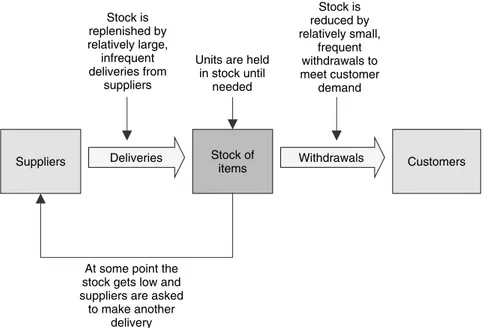
Stocks are formed whenever an organization acquires materials that it does not use immediately. A common practice has a delivery of material arriving from a supplier, and this is kept in stock until needed. Sometimes it is easier to picture a specific operation, so you might imagine the stocks in a supermarket. Goods are delivered by lorry at night, these are checked, sorted and put onto shelves. Then they stay on the shelves until customers buy them. At some point stocks get low, and the supermarket arranges another delivery (as shown in Figure 1.1).
This sequence of stock replenishment and reduction to meet demand is repeated continuously in astock cycle. Typically, each cycle has the following elements:
1. An organization buys a number of units of an item from a supplier.
2. At an arranged time, these units are delivered.
3. Unless they are needed immediately, the units are put into storage, replenishing the stock.
4. Customers, either internal or external, create demands for the item.
5. Units are removed from stock to meet these demands.
6. At some point, the stock gets low and it is time for the organization to place another order.
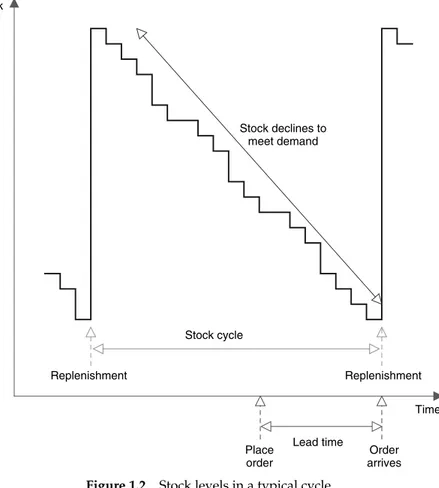
Usually deliveries from suppliers are relatively large and infrequent, while demands from customers are smaller and more numerous, giving the typical
Replenishment Replenishment
Stock level
Time Stock cycle
Stock declines to meet demand
Place order
Order arrives Lead time
pattern shown in Figure 1.2. Remember that in this broad sense, a customer is anyone or anything whose demand is met by removing units from stock. The customer can be internal, when they are someone else within the same organi-zation, or external, when they come from outside the organization. Asupplieris anyone or anything that replenishes or adds to stock, and again it can be either internal or external. The length of a stock cycle can vary between a few hours (like newspapers and milk which have frequent deliveries) and decades (like gold in Fort Knox that is rarely passed on to customers).
As materials move through the stock cycle, there are many different arrange-ments for purchasing, storage and delivery. One common feature, however, is that holding stock is surprisingly expensive. We will look at costs in the next chapter, but a rule of thumb says that the cost of holding stock is about 20 per cent of its value a year. If you keep £500 of food in a freezer, it costs about £100 a year. To appreciate the scale of these costs to industry, you only have to look at a big logistics centre, watch convoys of delivery lorries moving along motorways, or realize that Tesco keeps a billion pounds of stock in its shops. Not surpris-ingly, organizations put a lot of effort into controlling these costs through careful inventory management. This function is also calledstock controlorinventory control.
ž
Inventory managementis the function responsible for all decisions about stock in an organization.ž
It makes decisions for policies, activities and procedures to make sure the right amount of each item is held in stock at any time.Summary
Every organization holds stocks of materials. These are the stores of items – listed in an inventory – that are kept until needed. Stocks are replenished by deliveries from suppliers and reduced to meet demands from customers. Inventory management is responsible for all aspects of stock control.
Review questions
1.1 What is the difference between stock and inventory?
1.2 If a stock item is ‘Everyperson’s Encyclopaedia’, what is a unit? 1.3 How would you define ‘suppliers’ and ‘customers’?
Reasons for holding stocks
Giving a buffer
answers to this, all based on the need for a buffer, or cushion, between supply and demand.
We can illustrate the need for a buffer by considering the stock of bread at Angela’s Bakery Shop. It takes some time to make bread, but customers will not wait this time and want a loaf available as soon as they enter the shop. Angela clearly has to plan her baking in advance. If she knows exactly when customers want bread, she can schedule the baking so that loaves are ready at exactly the right time. This would have the advantages of eliminating stock, giving customers the freshest possible bread, and having no leftovers to go stale. In practice, of course, she does not know exactly when customers will buy bread, or how much they want. There is always some variation and uncertainty in the timing and size of customer purchases, and to allow for this Angela bakes loaves in advance and keep a stock on her shelves. Another important concern is that each customer only buys a small amount, but the most efficient way of making bread is in batches of an oven-full at a time. The stock allows for this mismatch between the best rate of supply and actual demand.
Now consider another example with two consecutive operations on an assembly line. Ideally, the first operation finishes a unit, and passes it to the second operation, which starts work immediately. But if the first operation develops a fault, or there is something wrong with the unit, or there is some other reason for a delay in passing the unit forward, the second operation has nothing to work on and it sits idly waiting. The way to avoid this loss of production is to have a small stock of work in progress between the operations. When there are problems with moving a unit forward, the second operation continues working on this stock, and the buffer ‘decouples’ their operations.
These two examples show how stock gives a buffer between supply and demand. It allows for variation and uncertainty in both supply and demand, and lets operations continue smoothly when there are problems (see Figure 1.3). We can add some details to this idea of a buffer and say that organizations hold stocks to do the following:
ž
allow for demands that are larger than expected, or at unexpected times;ž
allow for deliveries that are delayed or too small;ž
allow for mismatches between the best rate of supply and actual rate of demand;ž
decouple adjacent operations;ž
avoid delays in passing products to customers;ž
take advantage of price discounts on large orders;ž
allow the purchase of items when the price is low and expected to rise;ž
allow the purchase of items that are going out of production or are difficult to find;Supplies -with variation
and uncertainty in
quantities and timing
Demand -with variation
and uncertainty in quantities and
timing Stock
-giving a buffer between supply and
demand
Figure 1.3 Stock gives a buffer between supply and demand
Types of stocks
To achieve these purposes, organizations hold different types of stock. A useful classification has:
ž
raw materials, which have arrived from suppliers and are kept until needed for operations;ž
work in progress, which are units currently being worked on;ž
finished goods, which are waiting to be shipped to customers.This is a fairly arbitrary classification, as one organization’s finished goods are another organization’s raw materials. Some organizations (notably retailers and wholesalers) have stocks of finished goods only, while others (manufacturers, say) have all three types. Some stock items do not fall easily into these categories, so we can define two additional types as:
ž
spare parts, for machinery, equipment, etc.,ž
consumables, such as oil, paper, cleaners, etc.These are needed to support operations, but they do not form a part of the final product (shown in Figure 1.4).
To take a specific example, GlenMorray Knitwear make a range of golf clothes, and their raw materials are wool, cotton, fabrics and other materials waiting to be made into articles; work in progress is the articles being worked on at the moment; finished goods are articles waiting to be delivered to customers; spare parts are kept for the knitting machines and other equipment; and consumables include cleaners, stationery and other material to keep the operations going.
Another less widely used classification of stock describes its overall purpose:
ž
Cycle stock is the normal stock used during operations.Operations in the process
Raw materials Finished goods
Work in progress
Spare parts Consumables
Figure 1.4 Different types of stock
ž
Seasonal stock is used to maintain stable operations through seasonal variations in demand.ž
Pipeline stock is currently being moved from one location to another.ž
Other stock consists of all the stocks that are held for some other reason.Importance of stock
To put it simply, without stocks, organizations could not work. The important question, then, is not whether to hold stocks, but how to manage the stocks that must be held.
Summary
The main purpose of stock is to give a buffer between supply and demand. This safety cushion is essential to ensure the smooth running of operations. Stocks can be raw materials, work in progress, finished goods, spare parts or consumables. The amounts held have widespread effects on the performance of an organization.
Review questions
1.4 How do stocks act as a buffer between operations?
1.5 If suppliers were reliable, there would be no need for stock. Do you think this is true?
1.6 How would you classify lubricating oil for an engine?
Stocks in the supply chain
Shape of supply chains
We have talked about stocks in a single organization, but no organization works in isolation. Each becomes a customer (when buying materials from suppliers) and a supplier (when delivering materials to customers). A wholesaler, for example, acts as a customer when buying goods from manufacturers, and then as a supplier when selling goods to retail shops. Products move through a series of organizations and operations as they travel between original suppliers and final customers. Milk moves through a farm, tanker collection, dairy, bottling plant, distributor and supermarket before we buy it. A toothbrush starts its journey with a company extracting crude oil, and then it passes through pipelines, refineries, chemical works, plastics companies, manufacturers, importers, wholesalers and retailers before finishing up in your bathroom. This series of activities and organizations forms the product’s supply chain. The function that has overall responsibility for moving materials through the supply chain islogisticsorsupply chain management.
ž
Asupply chainconsists of the series of activities and organizations that mate-rials move through on their journey from initial suppliers to final customers.ž
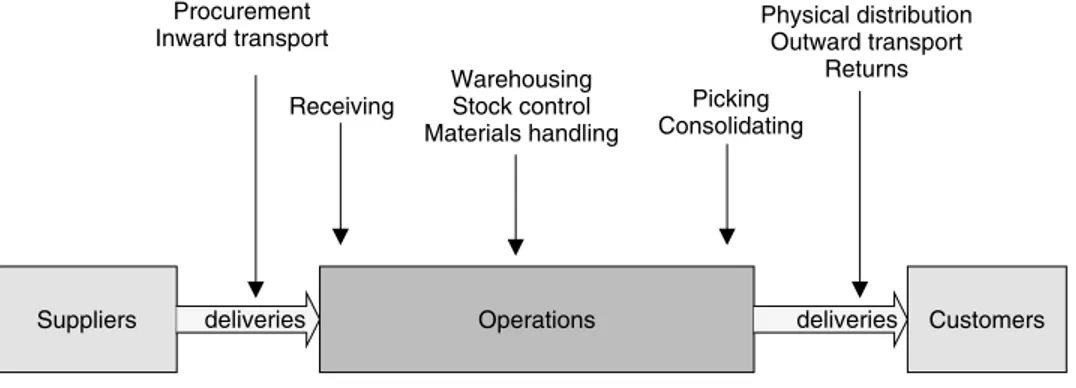
Logisticsorsupply chain managementis the function responsible for this flow of materials.It is certainly impossible to separate inventory management from other decisions about the supply chain. When we talk about controlling the stock of, say, raw materials, we have to consider the transport of materials, warehousing, purchasing and other activities of supply chain management.
Every product has its own unique supply chain, with materials moving through raw materials suppliers, manufacturers, finishing operations, logistics centres, warehouses, third party operators, transport companies, wholesalers, retailers and a whole range of other operations. In a simplified view, the supply chain for a product consists of tiers of suppliers feeding materials from original sources into its operations, and then tiers of customers moving materials out to the final customers (as shown in Figure 1.5).
There are many variations on this basic model, but the two main features are the supply chain’s length and breadth. Here the length refers to the number of tiers, or intermediaries, that materials flow through between source and destination. When farmers sell their produce directly to final customers there is a very short supply chain; on the other hand, computers combine parts from around the world and have long chains. Supply chain breadth is the number of parallel routes that materials can move through on their way to final customers. Cadbury’s has a broad supply chain, which means you can buy their chocolate in a huge number of retailers; Pigalle et Fils has a very narrow chain and they only sell their chocolate in two shops in Belgium.
A key point is that every organization on a supply chain holds its own stocks. If the supply chain is very long, or very broad, there is a lot of material held in storage and this is likely to move slowly towards final customers. So one factor in the design of a supply chain is the total amount of stock held. An empirical
Organization Supplier
Supplier
Supplier
Supplier
Supplier
Supplier Customer
Customer
Customer Customer Customer Customer
Tiers of suppliers Tiers of customers
First tier
Second tier First tier Second tier
observation suggests that the aggregate amount of stock held in a number of locations is:
AS(N2)=AS(N1)×
N2
N1
where:
N2=number of planned future facilities
N1=number of existing facilities
AS(Ni)=aggregate stock with Nifacilities
Worked example
AJT Transport of Manchester is planning to increase its services to mainland Europe. It currently has 12 depots with aggregate stock valued at £12 million and plans to expand to 16 depots. With a carrying cost is 20 per cent of value a year, what is the likely cost of this change?
Solution
We know that:
N1=12 depots
N2=16 depots
AS(N1)=£12 million
Then we can substitute these values to get:
AS(N2)=AS(N1)×
N2
N1 =
12×16/12=£13.9 million
The additional depots will raise stock holding costs by:
(13.9−12)×0.2=0.38 million or £380,000 a year
long and broad removes most control from the organization and raises costs, but gives good customer service. As you can see, organizations often have to find the best balance between costs and customer service. This is a common theme in inventory management, and we will return to it several times in the book.
Unfortunately, there is never a single ‘best’ shape for a supply chain, and managers have to look for designs that come closest to achieving their aims. One approach to doing this takes the following steps:
1. The logistics strategy sets the overall direction of logistics (as we shall see in the next chapter) so analyse this and find the aims of the supply chain.
2. Examine current operations, identify their failings and look for ways of overcoming these.
3. Design an outline structure for logistics, finding the number of facilities, best locations, modes of transport, investment in stocks, etc.
4. Make detailed plans, setting the size of each facility, stock holdings, mate-rial handling equipment, systems to develop, people to employ, transport needs, etc.
5. Get final approval from senior managers and agree the funding.
6. Finalize building designs, purchase land, choose contractors and build.
7. Finalize equipment design, choose equipment, suppliers and purchase. 8. Finalize systems design, for ordering, inventory control, billing, goods location,
monitoring and all other systems.
9. Fit out facilities, install all equipment, systems, staff and test operations.
10. Open and receive stock, run final tests of all systems, finish training and begin operations.
11. Sort out teething problems and get things running smoothly.
12. Monitor and control, ensuring that everything works as planned, measure performance, revise targets, etc.
This is, of course, only a guideline to suggest the decisions in designing a supply chain. You can clearly see how decisions about the broader supply chain affect the stocks by, for example, setting the location, space available, handling facilities, systems and investment. You can also see how, conversely, attitudes towards stocks affect the design of the supply chain. If, for example, organizations accept that large stocks of finished goods must be kept near to customers, they will design supply chains to feed into these stocks. We will return to this theme in the next chapter.
fewer, larger facilities. Within the European Union, for example, efficient transport links mean that companies can replace a series of national warehouses by a single European logistics centre. Finding the best locations for these centralized stores can be very difficult. They might be near to factories, customers, transport, other facilities – or in areas with development grants. If an organization wants fast delivery, it has warehouses close to final customers; if it wants the lowest costs, it concentrates stocks in very large, centralized warehouses that are inevitably some distance from customers; if it imports and exports a lot of materials it might use warehouses near to ports, airports or rail terminals; if it manufactures goods, it has a stock of finished products near the factory. Here we cannot deal with details of the design of supply chain, but you should remember that these decisions include some of the key issues for inventory management. Again, we will discuss some of these in the next chapter.
Co-operation within a supply chain
A traditional view has each organization in a supply chain working largely in isolation and concerned only with its immediate suppliers and customers. This short-sighted view ignores the obvious point that the success – and survival – of the whole supply chain depend on its ability to satisfy final customers. Organiza-tions in a supply chain increasingly recognize that they share a common overall objective, and should not compete with each other, but should co-operate to get final customer satisfaction. Competitors are not other organizations within the same supply chain, but are organizations in other supply chains. As Christopher (1996) says, ‘supply chains compete, not companies’.
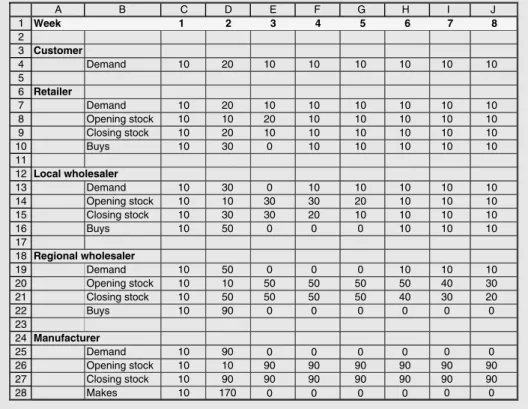
We can easily demonstrate the kind of problem that arises if organizations in a supply chain do not co-operate. Imagine a retailer who notices that demand for a product rises by 10 units in a week. When it is time to place the next order, the retailer assumes that demand is rising, and orders 20 extra units to make sure it has enough. The local wholesaler sees demand rise by 20 units, so it orders an extra 30 units to meet the growth. The regional wholesaler sees demand rise by 30 units, so it orders another 40 units. As this movement travels back through the supply chain, a relatively small change in final demand is amplified into a major variation for early suppliers. When demand from final customers moves down a bit, this is amplified into a collapse in demand for early suppliers.
Worked example
Solution
The spreadsheet in Figure 1.6 shows these results. For each tier you can see:
ž
demand – which equals the amount bought by the following tier of customers;ž
opening stock at the beginning of the week – which equals its closing stock in the previous week;ž
closing stock at the end of the week – which must equal demand in the week;ž
number of units bought – which equals demand plus any change in stock:buys=demand+(closing stock−opening stock)
In week 1 everything is going smoothly, with the usual 10 units flowing through the supply chain. Then in week 2 customer demand goes up to 20 units. The retailer must buy 20 units to meet this demand, plus an additional 10 units to raise its closing stock to 20 – so it buys 30 units from the local wholesaler. The local wholesaler has to supply this 30 units, plus an additional 20 units to raise its closing stock to 30 units – so it buys 50 units from the regional wholesaler.
1
The regional wholesaler has to supply this 50 units, plus another 40 units to raise its closing stock to 50 units – so it buys 90 units from the manufacturer.
In week 3 we get the reverse effect as customer demand returns to 10 units. The retailer now reduces closing stock to 10 units, so it can meet all demand from stock and does not have to buy anything from the local wholesaler. This gives a demand of zero for all other tiers of suppliers. The stocks slowly returns to normal over following weeks, but a variation in customer demand of 10 units in one week, makes manufacturing jump by 160 units. The total amount of stock in the supply chain rises from 40 units to 190 units, and this will take 15 weeks to return to normal. Of course, we could criticize the inventory control policies here, but we will return to this theme in later chapters.
Any uncertainty in the supply chain – such as the jump in demand seen in the worked example – encourages organizations to hold higher stocks to give themselves a margin of safety. These extra stocks clearly increase costs. They also make the chain slow to react to changing conditions – when, for example, final customers start demanding a new product, all the stocks of old products in the supply chain have to be sold before the new ones appear. The way to avoid such problems is to co-ordinate the stocks and flow of materials. This brings a series of benefits, which include:
ž
lower costs – with lower stocks, less expediting, balanced operations, economies of scale, etc.;ž
improved performance – with more stable operations, better planning, higher productivity of resources, etc.;ž
improved material flow, with co-ordination giving faster and more reli-able movements;ž
better customer service, with shorter lead times and faster deliveries;ž
more flexibility, with organizations reacting faster to changing conditions.Christopher (1999) again summarizes the situation by saying that, ‘Most oppor-tunities for cost reduction and/or value enhancement lie at the interface between supply chain partners’.
Achieving co-operation in the supply chain
As you would imagine, there are many practical difficulties with achieving this co-operation. Many organizations simply do not trust other members of the supply chain, and they are reluctant to share information. Even with sufficient trust, there can be problems with different priorities, competition, data exchange, appropriate systems, skills, security, the complexity of systems, and so on. This raises the obvious question of how to achieve integration.
can only benefit at the expense of the other. If the organization gets a good deal, it automatically means that the supplier is losing out; if the supplier makes a good profit, it means that the organization pays too much. This adversarial attitude has major drawbacks. Suppliers set rigid conditions and, as they have no guarantee of repeat business, they see no point in co-operation and try to make as much profit from each sale as possible. At the same time, organizations have no loyalty, and they shop around to get the best deal and remind suppliers of the competition. Each is concerned only with their own objectives and will – when convenient to themselves – change specifications and conditions at short notice. The result is uncertainty about the number and size of orders, constantly changing suppliers and customers, changing products and conditions, different times between orders, no guarantee of repeat orders and changing costs.
To avoid these problems, organizations have to recognize that it is in their own long-term interest to replace conflict by co-operation. There are several ways of organizing this. The simplest appears when an organization has a good experience with a supplier and continues working with them over some period, developing a valuable working relationship. The key point with such informal arrangements is that there is no commitment. This has the advantage of being flexible and non-binding, but it has the disadvantage that either party can end the co-operation without warning and at any time that suits them.
Many organizations prefer a more formal arrangement, with a written contract setting out the obligations of each party. These are common when organizations see themselves as working together for some time, such as an electricity company agreeing to supply power at a fixed price for the next three years, provided a customer buys some minimum quantity. More formal agreements have the advantage of showing the details of the commitment, so that each side knows exactly what it has to do. On the other hand, they have the disadvantage of losing flexibility and imposing rigid conditions.
When an organization and a supplier are working well together, they may both feel that they are getting the best possible results and neither could benefit from trading with other partners. Then they might look for a long-term relationship that will guarantee their mutual benefits continue. This is the basis of astrategic allianceorpartnership. Ellram and Krause (1994) prefer the termsupplier partnering which they define as ‘an ongoing relationship between firms, which involves a commitment over an extended time period, and a mutual sharing of information and the risks and rewards of the relationship’.
when Toyota had formed partnerships with its 250 suppliers, General Motors was still working separately with 4,000.
Despite the clear evidence of benefits from co-operation in the supply chain, some people are not convinced, and say that each organization should indepen-dently pursue its own aims. You can imagine these different views in an example. Suppose a supplier has been delivering a product to an organization for some time, and has recently improved its operations to reduce the cost by 2 per cent. When it is time to negotiate this year’s deliveries, what price should it quote? At one extreme is the view that the supplier has been working happily with the old level of profit, and should pass on all the savings in a lower price to make sure that it remains competitive and keeps the organization’s custom. At the other extreme is the view that the supplier should maximize its own profits by keeping all the savings and increasing the price by (at least) the rate of inflation. In the middle is a compromise view which says the supplier should somehow share the benefits of lower costs with the organization. The final decision depends on aims, competition, power in the supply chain, and so on. Some formula for sharing the benefits is likely to give the best long-term results.
Summary
Inventory management can be viewed as one of the tasks of logistics. It is very closely related to other activities in the supply chain. As materials move through a supply chain, stocks are held at various points. The best results come when organizations within the same supply chain co-operate to ensure final customer satisfaction. There are several ways of achieving this co-operation, ranging from informal trading relationships through to partnerships.
Review questions
1.7 What is a supply chain?
1.8 Good customer service comes when stocks of finished goods are as close as possible to final customers. Do you agree with this?
1.9 Why should organizations within the same supply chain work together? 1.10 A company can only increase its profits by paying its suppliers less or
charging its customers more. Do you think this is true?
Trends affecting stock
and management of stock. We cannot look at all of these changes in detail, but will mention some of the most significant. The following list is, of course, nowhere near exhaustive and all kinds of changes are now affecting stocks.
Improving communications
Organizations are always introducing more sophisticated technology. Much of this affects the movement and storage of materials – with electronic identification of packages, satellite tracking of deliveries, automatic systems for moving goods, and so on. However, the greatest impact in recent years has come from improved com-munications. Consider, for example, the effect on purchasing materials. When a company wanted to buy something, it traditionally had to generate a description of the item, request for price, purchase order, order confirmation, contract terms, ship-ping papers, financial arrangements, delivery details, special conditions, invoices, and so on. All of these – and mountains of other paperwork – had to be printed and posted between organizations. By the 1990s technology had revolutionized these communications, withelectronic data interchangeorEDIallowing the direct exchange of data between remote computers. Supermarkets were among the first users of EDI, when they linked their stock control systems directly to suppliers’ order processing systems. Then supermarket checkouts could record sales of each item, and when stocks got low the system automatically sent a message asking for another delivery. This use ofEPOS– electronic point-of-sales – data gave less paperwork, lower transaction costs, faster communications, fewer errors, more integrated systems and closer business relations.
By 1997 about 2000 companies in the UK were using EDI (Stafford-Jones, 1997), and over the next few years electronic trading became more sophisticated and widespread. The mushrooming of e-mail was followed by all kinds of e-business, e-commerce – and soon ‘e-anything’. The efficient transfer of information has been particularly useful for purchasing, which has developed intoe-purchasingor e-procurement. This comes in many forms, with the two main versions based onB2B (business-to-business, where one business buys materials from another business) and B2C(business-to-customer, where a final customer buys from a business). By 2002 around 83 per cent of UK suppliers were using B2B (MRO Software, 2001), and the worldwide value of B2B trade was over US$2 trillion (The Gartner Group, 2002).
Two associated technologies supported EDI. The first isitem coding, which gives every package of material moved an identifying tag. The tag is usually a bar code or magnetic stripe that can be read automatically as the package moves through the supply chain. Then stock control systems know where every package is at any time, and automatic materials handling can move, sort, consolidate, pack and deliver materials as needed. The second technology iselectronic fund transfer or EFT, which automatically debits a customer’s bank account and credits the supplier’s. This completes a loop, with EDI to place orders, item coding to track the movement, and EFT to arrange payment.
outlook, buying, storing, manufacturing, moving and distributing materials in a single, world-wide market. As a result, international trade and competition continue to rise. Organizations used to look for competitors in the same town, but now they are just as likely to come from another continent. This trend is encouraged by free trade areas such as the European Union and the North American Free Trade Agreement.
Improving customer service
Customers have become increasingly knowledgeable about products and suppli-ers, and demand lower costs, higher quality and better service. In the past we might have gone to a local retailer to see what they were selling, but now we can surf the Web to compare the products offered by any company in the world.
To offset the increasing demands from customers, organizations are becoming more competitive. They might simply keep prices down, or they might find some other way of improving customer service. Both of these depend on the management of stocks. Low prices, for example, can only be achieved with low costs, and one significant factor here can be the cost of holding stock. It is normally in everyone’s interests to make this as low as possible, so that customers pay as little as possible and the organization remains competitive. However, we cannot view the stockholding costs in isolation, as it is frequently linked to customer service. If an organization tries to reduce costs by holding less stock, it might find that there are more frequent shortages; or if it closes down a warehouse, the delivery time might rise. Although there is a continuing trend towards better customer service, we have to balance the gains this brings against the cost. As you will see in the rest of this book, finding the best balance between costs and service is a recurring theme in inventory management.
Concentration of ownership
Large companies can find economies of scale, and they have come to dominate many operations. There are, for example, many shops and transport companies, but the biggest ones continue to grow at the expense of small ones. The result is that most industries are dominated by a handful of major companies. This concentration is accompanied by changing power in the supply chain, with very large retail chains, such as Wal-Mart, Tesco, and Toys- R -Us, demanding customized services from their suppliers.
At the same time there is concentration among suppliers, with fewer major companies. However, the effects are less clear here, as each customer is likely to work with a broader range of suppliers. The trend, though, is towards fewer suppliers with long-term commitments.
Outsourcing inventory management
to take over part, or all, of their logistics, leaving them free to concentrate on their core activities. This is called outsourcing with the specialized companies beingthird party operators. A common starting point is to outsource transport to a specialized company. Next steps are to outsource warehousing, purchase of materials, materials handling, and other aspects of inventory management. This can bring significant benefits, which include the following:
ž
lower fixed costs, with organizations only paying for services they use;ž
specialist suppliers who have expertise and use the best systems and practices;ž
third parties can combine work from several customers to get economiesof scale;
ž
guaranteed high, and agreed, levels of customer service;ž
flexible capacity, dealing effectively with peaks and troughs in demand;ž
lower exposure to risk from, say, varying demand;ž
increased geographical cover and local knowledge;ž
a convenient way of working in new markets.Of course, there are disadvantages of outsourced inventory management, includ-ing reduced control, inability to respond to unusual circumstances, more compli-cated communications, conflicting objectives, less control over costs, and so on. Nonetheless, the advantages of third party operations are becoming clearer, with more organizations moving in this direction.
A variation on outsourcing hasvendor managed inventoryorVMIwhere suppliers manage both their own stocks and those held further down the supply chain. In this case the third party operator is an organization higher up the supply chain. This brings the usual benefits of outsourcing, together with much closer co-ordination and control of stocks. A slight variation on this hasco-managed inventorywhere an organization and supplier somehow co-operate to manage stocks jointly.
Cross-docking
A traditional warehouse has materials delivered, it moves them into stock, keeps them until needed, and then delivers them to customers.Cross-dockingco-ordinates the supply and delivery, so that materials arrive at the receiving area and are transferred straight away to the loading area where they are put onto delivery vehicles for customers. Ideally individual packages arrive and are passed on for delivery, but sometimes there is a limited amount of sorting, perhaps breaking down larger deliveries into smaller amounts for each customer. Some people prefer the termflow through stockwhen there is this kind of sorting.
from Hotpoint without ever visiting a Dixon’s warehouse. Methods like this are becoming increasingly common, as more customers buy through the Web, or find other ways of trading with earlier parts of the supply chain, such as mail order, telephone shopping or buying directly from manufacturers. This has the benefits of reducing lead times, reducing costs to customers, having manufacturers talking directly to their final customers, allowing customers access to a wider range of products, and so on.
Any method that avoids putting materials into stock at a warehouse can dramatically reduce stock levels and associated administration. In the extreme, the only stock is within delivery vehicles, giving stock on wheels. This is not, however, a solution for all problems, as the co-ordination can be difficult, and this needs a certain volume of trade to stop the small, frequent deliveries becoming prohibitively expensive. Many parcel delivery services such as FedEx, UPS, Omega and DHL have grown as a way of giving rapid delivery of small amounts of materials at reasonable cost.
Postponement
Manufacturers typically move finished goods out of production and keep them in a store of finished goods until needed. When there are many variations on a basic product, this can give high stocks of similar products. Postponement moves almost finished products into stock, and delays final modifications or customization until the last possible moment. You can imagine this with ‘package-to-order’, where a company keeps a product in stock, but only puts it in a box written in the appropriate language when it is about to ship an order.
Manufacturers of electrical equipment, such as Phillips and Hewlett-Packard, used to build into their products the transformers and plugs needed for different markets. Then they had to keep separate stocks of products destined for each country. Now they make the transformer and cables as separate, external units. They only keep stocks of the basic, standard products, and customize them for different markets by adding the proper transformers and plugs at the last minute. The result, of course, is much lower stocks.
Increasing environmental concerns
recognition that careful management can bring both environmental protection and lower costs.
Summary
Organizations are continually looking for ways to improve their operations. The results have created a series of trends that affect inventory management. Among these are increasing use of technology, improved customer service, global operations, outsourcing, new arrangements for stock management, and so on.
Review questions
1.11 Why do you think that there are currently such rapid changes affecting inventory management?
1.12 Are the effects of these trends independent of each other?
1.13 Several trends in operations are leading to lower stocks. Is it inevitable that stocks will continue to decrease?
Changes to aggregate stocks
Changing views of stock
The trends outlined in the last section show that organizations are changing their attitudes towards stock. This is not new, but is part of a continuing pattern. For most of history, stocks have been considered measures of wealth or well-being and were, therefore, beneficial. The family with the biggest store of food was least likely to starve, the company with most raw materials was insulated from shortages, and the business with most money in the bank was most secure. The obvious conclusion was that stocks should be maximized, as this gives the greatest benefit. At times when the production and distribution of any material are uncertain, it certainly makes sense to avoid problems by collecting as much stock as possible. However, by the turn of the twentieth century industrialized countries had more or less secure supplies of most materials. The uncertainty in supply was greatly reduced, and this brought a new attitude towards stock. Organizations could now buy materials when they were needed – rather than when they were available – and they looked for more rational ways of controlling stock levels. This new outlook suggested that stocks were expensive and needed formal management. In particular, organizations should look for ways of minimizing some aspect of cost. Sometimes people were sidetracked from this aim and in the 1920s, for example, there was a craze for minimizing stocks rather than costs. Unfortunately, many companies hit problems when they reduced stocks to levels that made it impossible to work effectively or maintain any kind of customer service.
you can imagine, a continuing problem has been to find agreement about what ‘optimal’ levels might really be. Are these the levels that minimize total cost, or some aspect of cost, or give high customer service, or minimize stock-outs and disruptions, or give highest return on investment, or maximize stock turnover, or achieve one of dozens of other measures of performance?
For some time, it was felt that a ‘fixed accelerator’ could define an optimal stock level as some fixed proportion of sales (for example, Abramovitz, 1950). In practice, this proved ineffective and there was a move towards a ‘flexible accelerator’ to allow for differences between aims and actualities, time delays, and so on (for example, Lovell, 1961, 1964). Unfortunately, this approach also had its failings, and a more flexible approach was developed, which used a range of models to deal with different circumstances. These models grew increasingly sophisticated, and remained the main approach to inventory management for most of the last century. We will describe some of these models in Chapters 3 to 5.
More recently, new ideas have emerged about inventory management. These do not look for the best policy for dealing with uncertainty in supply and demand, but look for ways of removing the uncertainty. When there is no uncertainty, the stocks can be eliminated, or at least minimized. We will describe approaches of this kind in Chapters 9 and 10.
To summarize this brief review, for most of history, stocks were seen as beneficial and organizations attempted to maximize their holdings; in the last century, organizations realized that stocks were expensive and looked for policies that defined optimal stock levels; most recently organizations have looked for ways of eliminating stocks. This is, of course, only a broad overview and you can find many organizations that work with very high stocks. Shops, for example, keep high stocks so that customers can see a range of goods and do not have to wait for deliveries. In the same way, there are many parts of the world where supplies are still not reliable and when materials become available, organizations buy as much as possible.
Aggregate national stocks
In recent years, organizations have been working to lower stocks without affecting either their own efficiency or customer service. Perhaps we should look for some broad evidence to see how successful they have been. Surveys give some evidence for success, with the Institute of Grocery Distribution finding that stock levels in retail distribution centres fell by 8.5 per cent in the year to 1998 (Institute of Grocery Distribution, 1998), and the Institute of Logistics finding that some UK companies had ‘managed to almost halve the stockholding requirements since the 1995 survey’ (Institute of Logistics, 1998).
0.0 10.0 20.0 30.0 40.0 50.0 60.0 70.0
1949 1951 1953 1955 1957 1959 1961 1963 1965 1967 1969 1971 1973 1975 1977 1979 1981 1983 1985 1987 1989 1991 1993 1995 1997 Year
Stock/GDP (%)
Figure 1.7 Aggregate stock as a percentage of GDP for the UK
declines, sales fall and organizations are left with higher than expected stocks of unsold products. If we consider the aggregate national stock as a proportion of gross domestic product, we get a useful measure that overcomes some effects of changing economic conditions and focuses on the changes which are positively planned. Figure 1.7 shows this result for the second half of the last century (Central Statistics Office, 1966–1983, and 1984–1996).
The figures show a clear pattern. At the end of the 1940s and into the early 1950s there was a rapid decline in stocks as the economy returned to normal after the Second World War. From the early 1950s to the early 1970s there was a steady decline, which gives evidence for improving inventory management. In the early 1970s there was some disturbance caused by a rapid increase in the price of oil, and the economic disruption that followed. At this time, the costs of raw materials rose sharply and there were frequent shortages, while declining sales left finished goods unsold. After this disturbance, the long-term trend continued, with organizations improving their operations and working with ever-lower stocks.
Effects of the business cycle
stock. At some point, industry loses confidence and cuts back on production to reduce the excessive stocks, and the economy contracts. This recession – or at best stagnation – continues until stocks are lower, production is not meeting expected demand, and industry again expands (as shown in Figure 1.8).
Nobody has found a precise cause or explanation for business cycles, and there is a general belief that each cycle is in some ways unique. It is, however, widely accepted that long-term business cycles and stocks are closely related, and that stock levels – as one of the easiest factors to change – tend to fluctuate more than the business cycle itself. One view has variations in stocks as actu-ally causing business cycles. Klein and Popkin (1961) suggest that controlling 75 per cent of the variation in stock levels in the United States between the World Wars would have avoided all recessions. Such findings might encourage governments to prohibit wide fluctuations in stocks by taxes or other means. In practice, such measures have never been tried, mainly because of the dif-ficulties in defining ‘excessive’ fluctuations and finding a reasonable way of preventing them.
As well as the general economic climate, there are specific reasons for aggregate stock to vary. It is, for example, sometimes suggested that high interest rates should lead to low stocks, as it becomes more expensive to finance them. This argument is not really convincing, as finance is only one of the costs of inventory
Value
Production
Sales
Time
Expansion Recession Expansion
Unsold units increasing
stock Demand met
by reducing stock
and the other costs are so high that a small variation in interest rates should have little effect. More significantly, an organization that can work with lower stocks when interest rates are high should always work with lower stocks and reduce its on-going costs.
A more convincing argument shows the effect of inflation. At times of high inflation stock levels rise as organizations buy more materials at the current lower prices to avoid the higher prices that are likely with future orders. At the same time, the book value of stocks increases, raising the value of assets and making stocks more attractive.
Summary
Attitudes to stocks have changed over time. The current trend is towards lower stocks. This can be seen at a national level, where aggregate stocks show a long-term decline as a proportion of Gross National Product. National stock levels are also affected by business cycles, but the details of this relationship are unclear.
Review questions
1.14 Why are organizations moving towards lower stocks?
1.15 Is the objective of minimizing the costs of stock holding the same as mini-mizing stock?
1.16 Why do stock levels tend to fall during periods of recession?
1.17 On a national scale, reducing variations in stock levels would reduce the severity of business cycles. Do you think this is true?
Chapter review
ž
This chapter introduced the ideas behind inventory management, laying the foundations for later chapters. It started by defining some important terms.ž
Every organization holds stock of some kind. There are many different materials held and arrangements for storage, but they all need careful inven-tory management.ž
The main purpose of stocks is to act as a buffer between operations. They allow operations to continue normally through variations and uncertainty in supply and demand.ž
Stocks are held at various points in their supply chains. In the past these stocks have largely been considered as independent, but there are clear advantages in co-ordinated management.ž
Partly as a result of changing operations, organizations have changed their view of stocks. The current view is that they are expensive and should be reduced to the minimum level that can give acceptable customer service.ž
This view has had an effect on aggregate, national stocks, which have been in a long-term decline.Project
The purpose of this project is to get a view of stock holdings at a national level. Figure 1.7 showed the ratio of aggregate stocks to GDP for the UK during the second half of the twentieth century. Do these figures really show that organizations are deciding to work with lower stock levels or are there other explanations?
Update the figures and see if the trend is continuing. Are there any other factors that could be influencing recent figures? Find comparable figures for other countries. How do these compare with the UK? How can you explain any significant differences?
Discussion questions
1.1 Is it true that every organization holds stock?
1.2 Organizations hold stock to give a cushion between operations. But this stock is expensive, so a better approach would solve any problems and do away with the need for this buffering. Does this seem a reasonable suggestion? If it is, how could we do away with the need for buffers?
1.3 Organizations in a supply chain can never really co-operate, as they compete for available money. Customers should use every available means to pay the lowest price for materials; suppliers should charge the highest prices they can. Is this a more realistic view of relationships in a supply chain?
1.4 Many trends in business have a direct impact on stock management. What do you think are the most important trends at the moment?
1.5 Stock levels are inevitably declining. Eventually we will be able to work without any stock at all. Do you think this is true?
1.6 Why have the stocks in some countries fallen faster than in other countries?
References and further reading
Abramovitz, M. (1950)Inventories and Business Cycles. New York: The National Bureau of Economic Research.