Page 95 - 106
Received: September 18, 2016; Revised: October 23, 2016; Accepted: December 13, 2016 1,2 Universitas Padjajaran, Jl. Dipati Ukur, Lebak Gede, Bandung, West Java
GREECE FINANCIAL CRISES AND SUKUK MARKETS:
EXPERIENCE FROM GULF COUNTRIES
Aldrin Herwany1, Erie Febrian2, Imam Buchari3
Abstract. Greece Financial Crises and Sukuk Market: Experience From Gulf Countries. Many studies have been carried out to investigate the impact of recent European inancial crises on the performance of inancial instruments in other regions. Nevertheless, there have been insuicient studies explaining such impact on Islamic inancial instrument. In particular, whether Greece Financial crises have afected performance of Sukuk traded in Gulf Markets needs to be answered. his study is aimed at empirically investigating the causality of credit and liquidity risk on Sukuk Markets in Gulf economies in the period of Greece Financial Crises. We analyzed the Sukuk data by employing Granger casuality test, with all the associated vector autoregression model procedures. Our indings show that Bahrain sukuk market is cointegrated with those of Qatar and UAE in the full period observation. Meanwhile, during the crisis, Qatar Sukuk market is cointegrated with those of UAE Bahrain. We also ind that Bahrain Sukuk triggers market shock in both Qatar and UAE Sukuk markets. Bahrain consistently causes changes in price and spread of UAE Sukuk, both in the context of the full period and the during-crisis period.
Keywords: Greece inancial crises, sukuk markets, gulf countries
Abstrak. Krisis Keuangan Yunani dan Pasar Sukuk: Pengalaman dari Negara-negara Teluk. Banyak penelitian yang telah dilakukan untuk meng-investigasi dampak yang terjadi pada krisis instrumen keuangan di wilayah eropa pada wilayah lain. Meski demikian, sedikit penelitian yang menjelaskan tentang dampak yang terjadi pada instrument keuangan Islam. Khususnya, apakah krisis moneter yunani telah mempengaruhi kelangsungan perdagangan sukuk di pasar gulf membutuhkan jawaban. Penilitian ini secara empiris bertujuan untuk meneliti resiko pada kredit dan likuiditas dalam pasar sukuk di perekonomian teluk pada masa krisis moneter yunani. Kami meneliti data sukuk menggunakan test Granger kasualitas, dengan segala hal yang terkait prosedur model autoregresi. Penelitian kami memperlihatkan bahwa pasar sukuk di Bahrain terkointegrasi dengan Qatar dan UAE dalam masa penelitian penuh. Kami juga menemukan bahwa Suku Bahrain Mengejutkan Pasar pada Qatar maupun UAE. Bahrain secara konsisten menyebabkan perubahan pada harga dan menyebar ke sukuk UAE, dalam konteks masa penuh maupun pada masa krisis terjadi.
Introduction
Some scholars, like Stiglitz (2012), believe that Greece crisis was a contagious impact from the US inancial crisis. he crisis may have broadened to other regions outside Europe through similar process since inancial products traded in Greece market are also traded in other markets outside Europe, and investors have greater and easier opportunities to access overseas markets and form international portfolio. he nature of inancial products and investor characteristics are, among others, factors that explained the smooth transfer of the calamity.
here have been many studies carried out to investigate the transfer of crisis from the USA to Greece and from Greece to other regions, such as Pragidis et.al (2015). Nevertheless, there have been insuicient studies done to elaborate the impact of Greece crisis on other markets or inancial products. his study aims to ill this literature gap. To be more particular, this study intends to assess the contagious impact of Greece crisis to Gulf market, especially in Sukuk markets. We propose an assessment of the contagion issue using data of Islamic inancial/capital products, such as: Sukuk, since this product is believed to be free of interest and, therefore, may relatively be immune to the impact of inancial shock.
Based on the above concern, it is important to check whether there is cointegration and causality among markets in the same region, and which market is the entry gate of shock in the region. By answering these questions, we can reveal long run cointegration between markets in Gulf economies and its magnitude when Greece crisis enters the region. We also need to know whether there are pressures on price and bid-ask spread in a downturn environment, since price and spread relect investor trading behavior in particular inancial product.
Literature Review
Islamic capital products and Islamic inancial system will advance signiicantly, including Sukuk. Sukuk has been perceived to bear relatively lower risk than Bond (Kumar, 2014). Malaysia dominates international Sukuk market by seizing 71% market share. he amazing increase in Ijarah Sukuk trading volume in Malaysia is due to growing perception that Sukuk is immune to crisis. Bhala (2012) explains that Sukuk is more lexible to anticipate the wave of crisis since Sukuk introduces lesse-lessor relationship, instead of lender-borrower relationship. Such a nature of Sukuk helps the holder face uncertainty in more lexible manner.
return trade-of, for instance, may lead investors to diferent buy-sell strategy. Besides, Sukuk bears the issuer’s default risk as unexpected event may occur (Zakaria, et.al, 2012).
Some cointegration tests have been done to explain investment patterns Granger and Hilman (1991). Herwany and Febrian (2008), Febrian and Herwany (2009) have carried out empirical investigation to reveal cointegration among seven markets in Asia. In Latin America, Auyong, Gan and Treepongkaruna (2004) proved causality and cointegration among markets, particularly in the crisis environment starting from Mexico (1994) to Asia (1997), Rusia (1998) and Brazil (1999). Despite contra-argument that introduced by Pragidis et.al. (2015), who found no contagion efects from Greece crisis to other region, using volatility model, the impact of crisis in the long run can be identiied through cointegration and causality test.
Meanwhile, Friewald et.al. (2012) done a similar study using data of corporate bond sduring the 2008 crisis. Aboody, et.al (2014) also conduct a study evaluating contagion impact in bond market during crisis. Using Asia Bond Market, Guillaumin (2009) inds that inancial integration is stronger in the psot-crisis period than during the crisis. Similarly, a study by Shin and Kim (2015) reveal the strong liquidity efect and credit risk in the post-crisis period. In their study, Friewald et.al (2012) introduce the importance of liquidity, represented by bid-ask spread, to explain investor behavior and bond price movement. his study adopts the idea to reveal the inancial crisis contagion to Sukuk Gulf markets by assessing the associated price changes and liquidity.
Methods
In this study, we employ data of Ijarah sukuk issued by three Gulf countries, i.e., Qatar, Uni Arab Emirate and Bahrain. he data, obtained from Bloomberg, consists of sukuk price, bid price, and ask price. Spread igures are the diference between bid and ask prices. As Greek crisis had occured during the period of 2009-2012, we conducted the observation using data from 2012.7 to 2013.12. hus, this study utilized 519 observations. We divided the second observation period based on the decline of Sukuk price, in which the cut-of date is 24 May 2013, as can be seen on the Figure 1 and 2.
Figure 1. Daily Price Series of Qatar, UAE, and Bahrain Sukuk
Source: Processed Data
Figure 2. Daily Spread Series of Qatar, UAE, and Bahrain Sukuk
Source: Processed Data
Figure 3. Price and Spread of Sukuk AL-Ijaraah
Source: Processed Data
After describing big picture of the raw data and particular movements of price and spread of Ijarah Sukuk in the three economies, we checked the correlation between the observed economies. We also conducted cointegration test to estimate the price movements in the long term using Cointegration model and Vector Error Correction Model (VECM), which followed VAR test and Augmented Dickey Fuller (ADF) Test.
In addition to the cointegration test, we also assess causality relationship among the three economies to reveal the impact magnitude of a shock occurring in one country to another. In this process, we followed Granger-Causality test procedure.
Result and Discussion
(standard deviation of 0.0013). Based on the spread (Ask - Bid), Qatar Sukuk shows the highest risk level (0.1069).
Table 1. Price and Spread of Al-Ijarah Sukuk
QATAR
Minimum -0.025 -0.015 -0.009 -0.205 -0.292 -0.576
Std. Dev. 0.002 0.002 0.001 0.047 0.060 0.107
All the above sukuk data is in diferencing and log. Spread is the balance between bid and ask Al Ijarah Sukuk.
he correlation matrix demonstrates that relationship of any two of the three observed economies indicates relatively low correlation with correlation coeicients ranging from 0.44 s/d 0.66. his implies that in the short term, a portfolio involving these Sukuks might be less risky.
Table 2. Correlation Matrix of Al Ijarah Sukuk
QATAR
QATAR PRICE 1.000 0.460 0.615 -0.318 -0.272 -0.070
UAE PRICE 0.460 1.000 0.445 -0.178 -0.074 -0.207
BAHRAIN PRICE 0.615 0.445 1.000 -0.166 -0.109 -0.161
BAHRAIN SPREAD -0.318 -0.176 -0.166 1.000 0.166 0.009
QATAR SPREAD -0.272 -0.074 -0.109 0.166 1.000 0.006
UAE SPREAD -0.070 -0.207 -0.161 0.009 0.006 1.000
Source: processed Bloomberg data
Before testing the causality, we run ADF test on Sukuk price and and Sukuk spread to check the data stationarity. he result of ADF test conirms that all the Sukuk time series is stationary at the irst diferencing with high ADF stat.
All the above sukuk data is in diferencing and log. Spread is the balance between bid and ask Al Ijarah Sukuk.
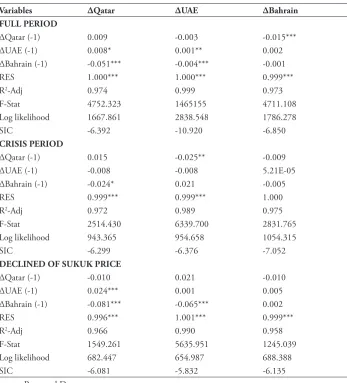
Table 4 shows the results of VEC test in three observation periods, i.e., full period, crisis period and sukuk price decline. he irst column is the change of Qatar sukuk price. he lag 1 of the change of sukuk price of Qatar, UAE, Bahrain and the residual of the original equation become dependent variables. he table indicates that Bahrain Sukuk price consistently and signiicantly puts pressure on those of Qatar and UAE in the full period observation, with coeicients of 0.398 and 0.200, respectively. his pressure also exists in the Crisis observation period and in the Price-Decline observation period.
Table 5 demonstrates longterm equilibrium relationship, obtained from the VEC model test. It can be seen that Bahrain sukuk price is cointegrated with those of Qatar and UAE, signiicantly at 1 %, in the full period observation. Meanwhile, in the crisis-period observation, Qatar Sukuk price is cointegrated with that of UAE and signiianct at 5 % level, and with that of Bahrain and signiicant at 1 % level.
Table 4. VEC Estimated Results Price of Full Period *** at 1% level of Signiicance ** at 5% level of Signiicance * at 10% level of Signiicance
Table 5 and Table 6 illustrate diversity of the results. Pressure to Sukuk price was indicated with positive signs, while pressure to spread is indicated by negative signs. hey imply that when a Sukuk price moves to a particular direction, the other Sukuk would move to the same direction. On the other hand, when a spread of a Sukuk price gets larger, and stimulates liquidity, the other Sukuk would experience smaller spread and enjoy liquidity.
Table 5. VEC Estimated Results Spread of Full Period
Table 6 reveals causality between the observed markets in the full-period observation. Qatar sukuk price stimulates UAE market shock, both in price and spread terms. hese proofs are signiicant at 10% and 5% signiicance level. he reverse is not true. Bahrain Sukuk price triggers price shock in both Qatar and UAE Sukuk markets. Bahrain consistently causes changes in price and spread of UAE Sukuk, both in the context of the observed full period and the observed price-decline period. he reverse is true. he causality and cointegration tests summarize the strong tie between Bahrain and UAE Sukuk markets, meaning that any Sukuk portfolio involving these two Sukuks is relatively risky. Inclusion of Qatar Sukuk in such portfolio may induce risk-reduction. Moreover, none of the observed Sukuk triggers shock on other Sukuk during the crisis period.
Table 6. Engle Granger Causality Test of Price and Spread for Al Ijarah Sukuk
SUKUK CAUSALITY SIGNIFICANCE
Full Period
Price of Sukuk Qatar --- UAE 2.357*
Bahrain --- Qatar 3.743**
Spread of Sukuk UAE --- Bahrain 3.071**
Bahrain --- UAE 5.519***
Qatar --- UAE 3.147**
Crisis Period
Price of Sukuk -
-Spread of Sukuk -
-Declined Of Sukuk Price
Price of Sukuk Bahrain --- UAE 2.685*
Spread of Sukuk
UAE --- Qatar 4.573**
Qatar --- UAE 4.538**
Bahrain --- UAE 6.701***
UAE --- Bahrain 3.387**
Discussion
Low correlation among the observed Gulf Sukuk markets does not prove good potential for forming low risk Sukuk portfolio using Gulf Sukuks, as the investigation results indicate signiicant cointegration coeicients, particularly in the longterm. his study also reveals that Bahrain Sukuk market dominates its relationship with the other two Sukuk markets. Investors in Gulf Sukuk markets may want to avoid putting Bahrain Sukuk in their portfolio if they seek for low risk profolio, as this market triggers price and spread changes in the other two markets. Furthermore, results of this study imply that external shock might enter Gulf economies through Bahrain Sukuk market.
Other interesting issue found is that the three Sukuks are vulnerable to inancial crisis impact, especially in the long run. It is interesting to know that investors will switch to other Sukuk, particularly of one of the Gulf Sukuks, if inancial crisis hits or price of their Sukuks declines. he inding also suggests that investors focus more on Sukuk price rather than on liquidity represented by Bid-Ask spread.
Conclusion
his study aims to conduct empirical investigation to reveal the causality of credit and liquidity risk on Sukuk Markets in Gulf economies in the period of Greece Financial Crises (2010 to 2013). We employed Granger causality test, with all the associated vector autoregression model procedures, using the Sukuk data. We ran the analysis procedure through three observations, such as: (i) full period observation; (ii) before-crisis data observation; and (iii) during-crisis data to show diferent perspectives of the impact.
Our indings show that Bahrain sukuk market is cointegrated with those of Qatar and UAE in the full period observation. Meanwhile, during the crisis, Qatar Sukuk market is cointegrated with those of UAE Bahrain. We also ind that Bahrain Sukuk triggers market shock in both Qatar and UAE Sukuk markets. Bahrain consistently causes changes in price and spread of UAE Sukuk, both in the context of the full period and the during-crisis period. he reverse is true. here has been strong tie between Bahrain and UAE Sukuk markets
References
Aboody. D. et.al. (2014). Corporate Bond Returns and he Financial Crisis. Journal of Banking & Finance. Vol. 40: 42-53.
AuYong, H.H. et.al. (2004). Cointegration and Causality in the Asian and Emerging Foreign Exchange Markets: Evidence from he 1990s Financial Crises.
Bhala, R. (2012). Handbook of Key Global Financial Markets, Institutions, and Infrastructure. Netherlands: Academic Press.
Febrian, E. & A. Herwany. (2009). Volatility Forecasting Models and Market Co-Integration: A Study on South-East Asian markets. Indonesia Capital Market Review (ICMR). Vol. 1 (1): 27-42.
Friewald, N. et.al. (2012). Illiquidity or Credit Deterioration: A Study of Liquidity in the US Corporate Bond Market During Financial Crises. Journal of Financial Economics. Vol. 105 (1): 18-36.
Guillaumin, C. (2009). Financial Integration in East Asia: Evidence from Panel Unit Root and Panel Cointegration Tests. Journal of Asian Economics. Vol. 20 (3): 314-326.
Granger, C.W.J. & J. Hallman. (1991). Long Memory Series with Attractors. Oxford Bulletin of Economics and Statistics. Vol. 53 (1): 11-26.
Herwany, A. & E. Febrian, (2008). Co-integration and Causality Analysis on Developed Asian markets for Risk Management & Portfolio Selection.
Gadjahmada International Journal of Business. Vol. 10 (3): 285-312.
Kumar, R. (2014). Strategies of Banks and Other Financial Institutions: Netherlands: Academic Press.
Pragidis, I.C. et.al. (2015). Contagion Efects During Financial Crisis: Evidence from he Greek Sovereign Bonds Market. Journal of Financial Stability. Vol. 18: 127-138.
Shin, D. & B. Kim. (2015). Liquidity and Credit Risk Before and After the Global Financial Crisis: Evidence from the Korean Corporate Bond Market. Paciic-Basin Finance Journal. Vol. 33: 38-61.
Stiglitz, J. (2012). he price of inequality. United Kingdom: Penguin.