
Usage of Smartphone Apps by Women on their Maternal Life
Jayaseelan R*, Pichandy C and Rushandramani DDepartment of Mass Communication and Journalism, PSG College of Arts and Science, Coimbatore, Tamil Nadu, India
Keywords: E-health; Pregnancy; New media; Mobile-applications;
Smart phonesIntroduction
In today’s technology driven world, electronic devices have become an essential one in everyday life. Whether used for oicial or personal life, these devices inluence and shape the way we think, in both thoughtful and accidental ways. he rapid development of internet and communication technologies in the past twenty years had changed the lifestyle of human beings in the entire world. People who are in city and village can access equal eminence lifestyles. Edward and Bruce observed that, “sources of information and other opportunities available via the new media are increasing exponentially [1]. he communication technology using mobile devices improves education, health and economics of people.
Mobile phone usage has proliferated in recent years. Few places worldwide people are enjoying speedy utilization mobile phone. May and Hearn most of the mobile phones nowadays are addressed as ‘smart phone’, as they are very much advanced in technological factor and being in connected than the ordinary mobile phone [2]. Smart phones has now repositioned as “new information medium” with all the basic facilities like making calls, short message services and multimedia messages. Agarwal and Prasadh explores, smart phones have extended list of information processing functionalities such as managing personal time schedule, accessing Internet contents, editing documents, utilizing location-awareness function, and many other exciting applications [3].
According to Donald women are much more likely than men to read news information found within social media on their smart phones according to the latest mobile media survey. Boston Consulting Group (BCG) report stated, that ‘a large proportion of India’s new internet users is likely to be female who are in rural, regional language speakers, compared with existing users who are mostly young, urban and professional’.
Hyeon and Itekhar in their research they pointed out that Korea showed that only 1% participants are not willing to use an application even though it is useful to them [4]. his research concluded smart phone applications for pregnant women will be an efective educational tool compared to other existing mediators even though frequency or scope of using it would be varied according to the user's age.
Oglivy Action women appear to be taking the lead when it comes to smart phone technology (ST) phone use, with 56 percent owning a
smart phone compared with 51 percent men [5]. his also translates when it comes to using health applications (apps) with around 9 percent women more likely to use these compared with 4 percent men.
Ming-Chuan Kuo says mobile health application becomes a very important tool to provide high quality health services [6]. Smartphone medical applications have a major role to play in women’s health with their roles being very broad, ranging from improving health behaviors to undertaking personalized tests.
Petrie conducted a survey, in which 203 pregnant women found that 94 percent reported that smart phone had changed their life for better, with 65 percent reporting that they had downloaded pregnancy apps, with an average of three being downloaded during the gestation period [7]. Rotheram-Borus in low- and middle-income countries smart phones also provide an excellent platform to support and improve the quality of healthcare systems for women [8].
According to a study from AOL, mothers are using their smart phones 11.4% normally than the regular adult smart phone user, racking up 1,850 minutes per month with their phones [9]. Mothers of young kids aged 5 and under were the most active users, devoting almost 37 hours a month to apps and web browsing on their phones AOL noted that smart phones most likely helped these new mothers adjust to tasks related to their new role, including managing multiple schedules, connecting with friends they had not seen recently, and looking up symptoms- that is, satisfying multidimensional roles mammas enact as parents, teachers, friends, doctors, and more.
Importance of the Study
Technology has been a core player in helping improve healthcare, by reducing costs, improving patient safety and satisfaction, saving time and efort for both patients and clinics alike, and reducing
*Corresponding author: Jayaseelan R, Department of Mass Communication and Journalism, PSG College of Arts and Science, Coimbatore, Tamil Nadu, India, Tel: 0422 430 3300; E-mail: [email protected]
Received July 08, 2015; Accepted July 14, 2015; Published July 24, 2015
Citation: Jayaseelan R, Pichandy C, Rushandramani D (2015) Usage of Smartphone Apps by Women on their Maternal Life. J Mass Communicat Journalism 5: 267. doi:10.4172/2165-7912.1000267
Copyright: © 2015 Jayaseelan R, et al. This is an open-access article distributed under the terms of the Creative Commons Attribution License, which permits unrestricted use, distribution, and reproduction in any medium, provided the original author and source are credited.
Abstract
potential errors [10]. In recent years, mobile technology, in particular, has greatly evolved and become a mature platform, and according to CBS News, there are around 4.6 billion mobile phones worldwide. Because of this, many health organizations such as the World Health Organization and experts from across the healthcare industry are looking to tap into the potential of mobile technology to revolutionize healthcare management and delivery [11].
Sophia Alice Johnson Smartphone applications (-apps) and social media platforms are important elements in the rapidly changing environment around pregnancy and the transition to motherhood [12]. Despite much theoretical research highlighting signiicant changes in digital health technologies, studies analyzing these technologies, their possible implications and the experiences of users are few. his article begins to address the usage of smart phone apps and its role in the everyday life of the pregnant ladies and young mothers.
heoretical Frame Work
A structured survey questionnaire was employed to assess the acceptance of the application from user’s perspective. he survey questionnaire was constructed based on the “Measuring usability with the USE questionnaire” developed by Lund and the “Technology acceptance model for mobile service (TAMM)” proposed by Kaasinen [13,14]. he survey was composed of two sections: (1) mothers’ demographic data and (2) smart phone application usage.
Objective of the Study
To identify is there any diference in usage of mobile phone before and during pregnancy.
To measure the inluence of mobile apps among new mothers.
To measure the nature of association between the users’ demographics (occupation) and the dependent variables (usage of mobile apps).
To study the usage pattern among the users (Do they use mobile apps).
Review of Literature
Rolf Wynn study suggests that the use of cell phones could strengthen the primary healthcare system and increase access to healthcare. Pregnant women accessing cell phones and would increase their utilization of the primary healthcare system and health services [15]. West explains there are a number of ways in which advanced mobile technologies can help improve maternal care and aid in reducing infant mortality [16]. According Dolan mobile phones apps make participation possible for women to access the health care they need, including family planning, birth, child care, and survival [17].
According to Rothman pregnancy and mothering are no longer seen as simply a reading assignment [18]. Sophia explains smart phone revolution over the past few years has had a signiicant impact on our lives, Smartphone applications (-apps) and social media platforms are important elements in the rapidly changing environment around pregnancy. Hearn, Miller and Lester explores young women are frequent users of smart phones and internet technology; they want short, quick answers to their pregnancy and child rearing concerns, and prefer information readily accessible on mobile devices. he Yukon baby smart phone app engages women, men and their families and supports them during pre-pregnancy.
Victoria many of the participants found the pamphlets and lyers
that their doctors gave them, as well as the once popular book "What to Expect When You're Expecting," out-of-date and feels that information should be in diferent base. hey use to see videos and use social network and pregnancy-tracking mobile applications for pregnancy related information.
Shadrack, the researcher explores in the ield of maternal health, mobile technology (-apps) can ofer general health and health-care information to pregnant women, provide emergency-health-care tips and alerts, and supply post-delivery support. he same systems can also be used to ofer information about emerging risks to which women are frequently exposed and remind women of the need for preventive care.
Rodger conducted a survey in his research in which the, 45% women reported the use of at least one pregnancy related smart phone app, with some participants describing them as being more relevant and useful to them than other forms of health communication and receiving information related to pregnancy [19].
One of the most prevalent and natural life situations that may increase the need for more health related information among women is pregnancy. According to the research conducted by Lagan it was suggested that the most sought-ater topics on the smart phone apps by pregnant women were fetal development (57%), nutrition during pregnancy (56%) and pregnancy complications (26%).
It is a daily pregnancy application that guides women, from the baby due date given, gives answers and prepares for baby's birth. he versions available are for smart phones- iPhone, iPod Touch and Android. his targets high-class and tech-savvy users who have the money to buy smart phones and pay for the data charges. My pregnancy app has other features like fetal development images- these are images developed by expert medical illustrators.
Rebekah Kates Lemke in her article says; ater a baby is delivered, the app continues to track the child's development through his or her crucial irst year of life. his keeps families in touch with the health system and gives timely care for mothers and newborns. Community health workers say the apps help them manage their workload as well, so they can focus on counseling families and communicating key health messages. Ming-Chuan Kuo denotes in terms of diary keeping, the apps can provide mother an easy and handy tool within her mobile phone to document her baby’s health status and growth patterns [6]. She can make and keep baby’s vaccination records with this app too. With regard to questions, she can irst search the most frequently asked questions with answers. With help of apps mother can check with the growth trend of her baby and received a routine summary report from service center ater the data were uploaded and managed by nurses under the supervision of physicians.
Tomlinson et al. says smart-phones enable more accurate and precise self-monitoring and tracking the infant development, for example, by prompting users to record an image, text, or audio clip immediately when a behavior occurs. Prompts in real time also allow automatic storing of geo-tagged and time-stamped entries in a personal database. Spatio-temporal traces of behaviors throughout a day, week, or month can tremendously increase an individual’s self-understanding. In addition, these traces can increase clinician or supervisor knowledge of detailed behavioral patterns.
as dependent variables. On the data gathered through the survey method, statistical analyses were performed to ind the relationships between the independent and dependent variables.
Research questions
As detailed earlier, the present study requires measuring the usage smart phone apps among the young mothers and pregnant women before and during their pregnancy period to know information related to their health and infant development. Hence, the following research questions are mooted in this study so as to understand how the young mothers and pregnant women use mobile apps and accordingly research questions are generated below.
1) Is there any perceptional diference among young mothers and
pregnant women in general on using smart phones before and during pregnancy?
2) Whether young mothers and pregnant women difer in their
perception in using mobile apps?
3) Is there any diference in perception in using mobile apps among
young mothers and pregnant women according to their occupation?
In order to answer the above research questions and to understand those intricacies the researcher developed an attitude scale so as to measure those factors which are taken from the study.
he researcher collected a total sample from 371 respondents. Ater careful scrutiny it was found that some of the respondents did not answer some of the questions and some of the items were incomplete. Ater removing those incomplete samples, the inal tally of respondents included in the study is 334.
Sample characteristics
In the above Table 1, it is observed that 136 respondents who are in the age group of 21 to 25 have monthly income as (Up to 10000=08 (18.2%), 10001 to 20000=80 (47.6%), 20001 and above=48 (39.3%), 114 (Up to 10000=16 (36.4%), 10001 to 20000=50 (29.8%), 20001 and above=48 (39.3%) ) respondents belongs to the age group of 26 to 30 and 84 (Up to 10000=20 (45.4%), 10001 to 20000=38 (22.6%), 20001 and above=26 (21.3%) ) respondents belongs to 31 years and above.
Findings
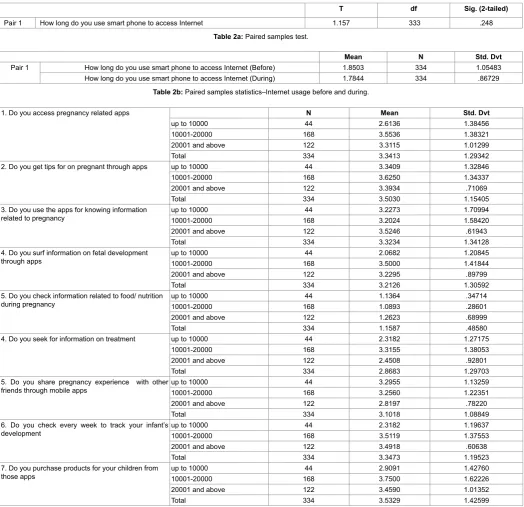
Tables 2a and 2b shows the result of paired sample ‘T’ test on the comparison between the usages of internet through smart phone among pregnant women during the pregnancy and before which indicates there is no signiicance. Table 3a reveals the results of ANOVA for all the nine statements (Table 3b).
Statement 1: he result of one way analysis of variance reveals that there is a signiicant diference towards accessing pregnancy related apps. he Respondents with a monthly income of 10001 to 20000 have a higher mean value of m=3.55.
Statement 2: he table of one way analysis of variance reveals the age of the respondents in terms of getting tips for getting pregnant through apps is not signiicant.
women. Marco explains smart phone (apps) use during pregnancy is a widespread phenomenon as the Internet ofers the opportunity to share apprehensions and doubts with other women [20]. Medical information published on websites cannot be considered a substitute for informed medical advice, and patients should not take any action before consulting with a health care professional.
he key to a healthy pregnancy is proper nutrition. By eating healthy and maintaining an active lifestyle a number of complications, varying in intensity from anemia to miscarriage and stillbirth, can be avoided. Pregnancy applications and websites have provided a multitude of tools and a wealth of information on nutrition and supplements Evan Duderewiz [21].
Victoria indicates antenatal ladies refer Internet to ind answers to their quarries regularly than they would like, say Penn State researchers. Women reported using apps and other search engines because they had a lot of questions at the beginning of pregnancy, before their irst doctor's appointment for treatment. Following the women's irst visit to the obstetrician, many of them still turned to the Internet- in the form of both search engines and social media- to ind answers to their questions on treatment, because they felt the literature the doctor's oice gave them was insuicient.
More than two-thirds of mothers surveyed purchase products online and close to 70 percent plan to do so in the next 12 months. Online shopping for children is most popular with mothers in China (87 percent) and Korea (82 percent). Across the region, the study shows a variety of motivations for online shopping; mothers in Taiwan cited a beneit from the lack of sales pressure, while mothers in India found prices less expensive online, Asia Paciic.
Ayaz reports new mothers are 20% more likely use social media apps for shopping than the general population, and 91% now use social media regularly-a 20% increase since 2010, according to a study of moms' online social habits by Baby Center and Com Score. Moreover, moms expect others to be social as well. Moms were responsible for 32% of total online spending in the last quarter, despite making up only 18% of the total Internet audience. 78% of moms follow a brand for coupons and discounts.
Methodology
his investigation on the ‘Usage of smart phone apps by women on their maternal life’ entails understanding the choice of young women using mobile apps during maternal period. Hence, the researchers has to identify a cross section of pregnant young mothers in Tamil Nadu and know they used or using smart phone applications before, during and ater maternity. It also becomes important to investigate how they use mobile phone before and during pregnancy.
In this process the researcher has to focus on identifying pregnant and young mothers in various hospitals and scan centers to collect data so as to have a representative sample. When the researcher embarked on this study, women both who were pregnant and new mothers were more enthusiastic in knowing their health and infant development. Hence the focus on this study is to know how they use smart phone application to collect various information which they are in need related to their health and their infants.
Demographic variables such as age, and monthly income of the respondents detailed were considered to be independent variables for the study and usage of smart phone applications (apps) was categorized
Age up to 10000 10001-20000 20001 and above Total
21 to 25 8 (18.2%) 80 (47.6%) 48 (39.3%) 136 (40.7%)
26 to 30 16 (36.4%) 50 (29.8%) 48 (39.3%) 114 (34.1%)
31 and above 20 (45.4%) 38 (22.6%) 26 (21.3%) 84 (25.1%)
Total 44 (100%) 168 (100%) 122 (100%) 334 (100%)
T df Sig. (2-tailed)
Pair 1 How long do you use smart phone to access Internet 1.157 333 .248
Table 2a: Paired samples test.
Mean N Std. Dvt
Pair 1 How long do you use smart phone to access Internet (Before) 1.8503 334 1.05483
How long do you use smart phone to access Internet (During) 1.7844 334 .86729
Table 2b: Paired samples statistics–Internet usage before and during.
1. Do you access pregnancy related apps N Mean Std. Dvt
up to 10000 44 2.6136 1.38456
10001-20000 168 3.5536 1.38321
20001 and above 122 3.3115 1.01299
Total 334 3.3413 1.29342
2. Do you get tips for on pregnant through apps up to 10000 44 3.3409 1.32846
10001-20000 168 3.6250 1.34337
20001 and above 122 3.3934 .71069
Total 334 3.5030 1.15405
3. Do you use the apps for knowing information related to pregnancy
up to 10000 44 3.2273 1.70994
10001-20000 168 3.2024 1.58420
20001 and above 122 3.5246 .61943
Total 334 3.3234 1.34128
4. Do you surf information on fetal development through apps
up to 10000 44 2.0682 1.20845
10001-20000 168 3.5000 1.41844
20001 and above 122 3.2295 .89799
Total 334 3.2126 1.30592
5. Do you check information related to food/ nutrition during pregnancy
up to 10000 44 1.1364 .34714
10001-20000 168 1.0893 .28601
20001 and above 122 1.2623 .68999
Total 334 1.1587 .48580
4. Do you seek for information on treatment up to 10000 44 2.3182 1.27175
10001-20000 168 3.3155 1.38053
20001 and above 122 2.4508 .92801
Total 334 2.8683 1.29703
5. Do you share pregnancy experience with other friends through mobile apps
up to 10000 44 3.2955 1.13259
10001-20000 168 3.2560 1.22351
20001 and above 122 2.8197 .78220
Total 334 3.1018 1.08849
6. Do you check every week to track your infant’s development
up to 10000 44 2.3182 1.19637
10001-20000 168 3.5119 1.37553
20001 and above 122 3.4918 .60638
Total 334 3.3473 1.19523
7. Do you purchase products for your children from those apps
up to 10000 44 2.9091 1.42760
10001-20000 168 3.7500 1.62226
20001 and above 122 3.4590 1.01352
Total 334 3.5329 1.42599
Table 3a: One way analysis for 9 statements in terms of monthly income.
F Sig
1. Do you access pregnancy related apps 9.744 .000
2. Do you get tips for getting pregnant through apps 1.933 .146
3. Do you use the apps for knowing information related to pregnancy 2.185 .114
4. Do you surf information on fetal development through apps 23.852 .000
5. Do you check information related to food/ nutrition during pregnancy 4.634 .010
6. Do you seek for information on treatment 22.931 .000
7. Do you share pregnancy experience with other friends through mobile apps 6.701 .001
8. Do you check every week to track your Infant’s development 21.059 .000
9. Do you purchase products for your children from those apps 6.531 .002
Statement 3: he table of one way analysis of variance reveals that there is no signiicant diference in knowing information related to pregnancy.
Statement 4: From the results of the table of one way analysis of variance, it may be understood that the income of the respondents in terms of suring information on fetal development is signiicant. he table of means shows that respondents who earns from 10001 to 20000 have a higher mean value of m=3.50.
Statement 5: he results of the one way analysis of variance show that there is signiicance in terms of checking information related to food/nutrition during pregnancy. he table of mean explains that respondents with up to salary of 10000 have the highest mean value of m= 1.36.
Statement 6: he table of one way analysis of variance reveals that the educational qualiication of the respondents with reference to the statement ‘Do you seek for information on treatment’ is signiicant. he table of means shows respondents with the salary of 10001 to 20000 have the higher mean value of m=3.31.
Statement 7: he results of one way analysis of variance there is signiicance in sharing pregnancy experience with other friends through mobile apps. he table of mean details that the respondents with salary up to 10000 having a mean value of m=3.29 are inluenced by the statement.
Statement 8: From the results of the table of one way analysis of variance, it may be understood that the income of the respondents in terms of tracking the developments on infants is signiicant. he table of means shows that respondents who have monthly income of 10001 to 20000 have a higher mean value of m=3.51.
Statement 9: he table of one way analysis of variance reveals that there is signiicant diference in purchasing products for your children through mobile apps. he table of means shows respondents with income of 10001 to 20000 have higher mean value of m=3.75.
Discussion and Conclusion
Our indings reveal that the Paired ‘T’ test indicates that there is no signiicant diference in using smart phones. his indicates that the level of usage of smart phones among women remains the same before and during pregnancy. Oglivy Action observes that women appear to be taking the lead when it comes to smart phone technology (ST) phone use, with 56 percent owning a smart phone compared with 51% men [5]. his also translates when it comes to using health applications (apps) with around 69% women more likely to use these smart phones both before and during pregnancy.
he results of ANOVA test reveals that there is a signiicant diference in accessing pregnancy related apps among ladies. Women with the family income of 10001 to 20000 are using the apps more frequently while the others use them less. Petrie found that 94% of women reported that smart phone had changed their life for better, with 65 percent reporting that they had downloaded pregnancy apps, with an average of three being downloaded during the gestation period [7]. Rotheram-Borus in low- and middle-income countries smart phones also provide an excellent platform to support and improve the quality of healthcare systems for women [8]. But there is no diference in knowing information related to pregnancy on pregnancy.
In gathering information on fetal development women in the middle class family use smart phone apps more frequently than the others and women who have income less than 10000 use it for checking
information related to food/ nutrition during pregnancy. According to the research conducted by Lagan it was suggested that the most sought-ater topics on the smart phone apps by pregnant women were fetal development (57%), nutrition during pregnancy (56%) and pregnancy complications (26%). Mostly women in the middle class family use the mobile apps more frequently than others for seeking information on treatment during pregnancy. Women who have lesser income are more willing to share their experience with others through mobile apps. According to Marco smart phone (apps) use during pregnancy is a widespread phenomenon as the Internet ofers the opportunity to share experience and doubts with other women.
Again women in the middle class family use the mobile phone more frequently in tracking infant’s development and for online shopping on mobile apps. Asia Paciic concludes in the research that more than two-thirds of mothers surveyed purchase products online and close to 70% plan to do so in the next 12 months [22]. Online shopping for children is most popular with mothers in China 87% and Korea 82%. he overall result of the study reveals that the women in the middle class and lower middle class families use smart phone and its applications more frequently during their pregnancy period for various reasons when comparing to the women in the upper middle class and higher income women.
References
1. Edwards SL (2002) Relective internet searching: An action research model. The Learning Organization 9: 180-188.
2. May H, Heran G (2005) The mobile phone as media. International Journal of Cultural Studies 8: 195-211.
3. Agarwal R, Prasad J (1999) Are individual differences germane to the acceptance of new information technologies? Decision Sciences 30: 361-391.
4. Iftekhar HJ (2016) Comparison on the use of smartphone application between international and Korean pregnant women. International Journal of Information and Education Technology 6: 404-409.
5. Action O (2013) Women taking the lead when it comes to mobile.
6. Ming-Chuan K, Lu YC, Chang P (2012) A newborn baby care support app and system for mHealth. Nurs Inform 2012: 228.
7. Petrie (2013) Pregnancy and the changing world of technology.
8. Rotheram-Borus MJ, Tomlinson M, Swendeman D, Lee A, Jones E (2012) Standardized functions for smartphone applications: Examples from maternal and child health. International Journal of Telemedicine and Applications 2012: 1-16.
9. AOL (2103) Mothers of young children spend most time with smartphones.
10. Leyva (2009) Welcome!
11. Carucci DD (2009) World Health Day: Mobile technology revolutionizes healthcare delivery in developing world.
12. Johnson SA (2014) “Maternal Devices”, social media and the self-management of pregnancy, Mothering and Child Health Societies 4: 330-350.
13. Lund AM (2001) Measuring usability with the USE questionnaire.
14. Kaasinen E (2008) User Acceptance of mobile services. In Handbook of research on user interface design and evaluation for mobile technology.
15. Oyeyemi SO, Wynn R (2014) Giving cell phones to pregnant women and improving services may increase primary health facility utilization: a case– control study of a Nigerian project. Reproductive Health 11: 1-8.
16. West DM (2015) Using mobile technology to improve maternal health and ight ebola: A case study of mobile innovation in Nigeria. Center for Technological Innovation at Brookings.
18. Rothman BK (1986) The tentative pregnancy: Prenatal diagnosis and the future of motherhood. Penguin Books.
19. Rodger D, Skuse A, Wilmore M, Humphreys S, Dalton J, et al. (2013) Pregnant women's use of information and communication technologies to access pregnancy-related health information in South Australia. Australian Journal of Primary Health 19: 308-312.
20. De Santis M, De Luca C, Quattrocchi T, Visconti D, Cesari E, et al. (2010)
Use of the internet by women seeking information about potentially teratogenic agents. Eur J Obstet Gynecol Reprod Biol 151: 154-157.
21. Duderewicz BHE (2011) Mom-O-Meter: A self-help pregnancy android app. Worcester Polytechnic Institute.
22. Paciic A (2010) The Secret online lives of mothers in Asia revealed. Microsoft Advertising.
Citation: Jayaseelan R, Pichandy C, Rushandramani D (2015) Usage of Smartphone Apps by Women on their Maternal Life. J Mass Communicat Journalism 5: 267. doi:10.4172/2165-7912.1000267
Submit your next manuscript and get advantages of OMICS Group submissions
Unique features:
• User friendly/feasible website-translation of your paper to 50 world’s leading languages • Audio Version of published paper
• Digital articles to share and explore Special features:
• 400 Open Access Journals • 30,000 editorial team • 21 days rapid review process
• Quality and quick editorial, review and publication processing
• Indexing at PubMed (partial), Scopus, EBSCO, Index Copernicus and Google Scholar etc • Sharing Option: Social Networking Enabled
• Authors, Reviewers and Editors rewarded with online Scientiic Credits • Better discount for your subsequent articles
![PENGARUH PEMBINAAN, PELATIHAN, DAN PENGEMBANGAN TERHADAP KINERJA KARYAWAN (STUDI PADA KARYAWAN PENGGUNA KOMPUTER DENGAN SISTEM OPERASI UBUNTU DI PT. PEGADAIAN [PERSERO] KANWIL I MEDAN).](data:image/gif;base64,R0lGODlhAQABAIAAAP///wAAACH5BAEAAAAALAAAAAABAAEAAAICRAEAOw==)