Corresponding author: [email protected]
Plasma DNA as a potential biomarker for
breast cancer detection
Dewajani Purnomosari1, Ulfah Dian Indrayani2, Irianiwati3, Dian Caturini Sulistyoningrum4
1Department of Histology and Cell Biology, 3Department of Pathology, Faculty of Medicine, 4Department of Health Nutrition Universitas Gadjah Mada, Yogyakarta, and 2Departement of Histology Universitas Islam Sultan Agung, Semarang, Indonesia
DOI: http://dx.doi.org/10.19106/JMedSci004804201603
ABSTRACT
Breast cancer is a major malignancy among Indonesian women. It is often diagnosed in the later stages of cancer, which leads to poor prognosis and survival of the patients. This study investigated plasma DNA concentration as a potential biomarker for breast cancer. The beneit of using this detection is the cost-effectiveness and the samples can be collected from patients using non-invasive methods. Plasma samples were obtained from healthy controls (n=18) and cancer patients (n=22). Each sample was split into two equal portions for DNA isolation using two different methods for the NaI method and a commercially available kit (Qiagen/ QA) method. The DNA concentration was determined by using a GeneQuant spectrophotometer (Pharmacia). The t-test was used for statistical analysis, which was performed using the SPSS 17.0 software. Compared to the commercial method, extraction using NaI yielded higher DNA concentration, both from samples of healthy controls and cancer patients (p=0,008 and p=0.000, respectively). Furthermore, regardless of the isolation method used, the plasma DNA concentration was higher in healthy controls than in cancer cases (p=0,032 and p=0.005, for NaI and QA methods, respectively). In conclusion, isolation methods signiicantly affect DNA concentrations. The plasma DNA concentration of healthy controls is signiicantly higher than those of the cancer cases, suggesting that plasma DNA concentration might be a potential biomarker for breast cancer detection with less invasive sampling method than tissue biopsies.
ABSTRAK
maupun pasien kanker payudara (p=0.000). Sejalan dengan hasil di atas, konsentrasi DNA plasma pada individu sehat lebih tinggi daripada penderita kanker payudara menggunakan 2 metode yang berbeda (NaI p=0.032 dan kit komersial p=0.005). Dapat disimpulkan bahwa metode ekstraksi DNA menentukan konsentrasi DNA yang diperoleh. Terdapat perbedaan bermakna antara konsentrasi DNA individu sehat dan penderita kanker payudara. Hal ini semakin memperkuat potensi DNA plasma sebagai penanda biologis untuk deteksi kanker payudara yang kurang invasif dibandingkan biopsi jaringan.
Key words : plasma DNA – biomarker – detection - breast cancer
INTRODUCTION
Breast cancer is a major malignancy among women in Indonesia and rest of the world. The incidence of breast cancer is increasing in developing countries, and the majority of the cases are diagnosed at an advanced stage, leading to poor therapeutic outcomes.1 Early
and accurate diagnosis of breast cancer can
increase therapeutic eficacy.2 Therefore,
early detection of circulating analytes may help clinicians in providing optimal therapy. Plasma DNA can be detected in the blood circulation. Several studies have reported that plasma DNA of cancer patients present genetic
and epigenetic changes that are speciic to the
type of cancer, indicating that this DNA is tumor-derived. Although the precise source of this DNA is still being investigated, it is expected to come from a combination of apoptosis, necrosis, and release by the tumor cells.3 Quantitative changes in plasma
DNA has been observed in several cancers, including the prostate cancer,4,5 lung cancer,6
pancreatic cancer,7 colon cancer,8,9 ovarian
cancer,10 and breast cancer.11 High plasma
DNA concentration has been correlated with tumor metastasis,12 response to therapy,
and relapse.13 This suggests that the plasma
DNA has the potential to be a tumor-speciic
biomarker for diagnosis, prognosis, and early
using the different kits produced by various manufacturers that offer convenience and
more eficient time. However, these methods differ in their eficiency. Therefore, in this
study we analyzed the performance of a simple manual method of extraction and
compared it effectiveness, eficiency, and
cost-effectiveness to that of a commercially available method in the isolation and
quantiication of plasma DNA. This study is important to ind a possible alternative
biomarker for early detection of cancer diagnosis, prognosis, and therapy monitoring compared to the invasive methods, such as
tissue biopsy. Furthermore, the indings of this
study can be used to identify the difference of plasma DNA concentration between healthy controls and cancer cases.
MATERIALS AND METHODS
Study participants
Clearance, number KE/FK/625/EC, issued by the Health and Medical Research Ethics Committee of the Faculty of Medicine, Universitas Gadjah Mada, Yogyakarta), stated that this research meets all ethical requirements. Written informed consent was obtained from all participants included in this study.
Plasma DNA Isolation
Ten mL of blood samples were withdrawn from study participants by using a vacutainer with EDTA. Plasma samples were isolated by centrifuging the vacutainer at 1200 g
for10 minutes. Each sample collected from the controls and patients were divided into two equal portions for extracting DNA using two different methods, namely the NaI method and the extraction method using a commercially available kit (QiaAmp DNA mini kit, cat #51104). The NaI method, which was developed by Ishizawa et al.in 1991,14 involved solubilization of proteins
with a high concentration of NaI (chaotropic reagent) and N-lauryl-sarcosinate, followed by the precipitation of the nucleic acids with isopropanol.
Plasma DNA Quantiication
The plasma DNA isolated was quantiied
by using a Gene Quantspectrophotometer (Pharmacia), and the residual samples were stored at 4°C.
Statistical Analysis
Data analysis was performed by using the SPSS 17.0 software. The Student’s t-test
was used to ind the signiicant differences
between the plasma DNA concentrations obtained using the two isolation methods and
to ind the signiicant differences between the
plasma DNA concentrations of the controls and the cancer patients. For identifying the
signiicant differences between the plasma
DNA concentrations from two isolation methods, a t-test with equal variance was used, whereas a t-test with unequal variance was
used for identifying the signiicant differences
between the plasma DNA concentrations of controls and patients.
RESULTS
The previous reports on the source and mechanisms of the sourcing of plasma DNA into the circulation is often contradictory. Nevertheless, it is thought that originated from different sources, including the apoptotic and necrotic cells.3 It has been suggested that
all living cells actively release DNA into the circulation.15 There are many DNA extraction
kits available currently that offer high
eficiency fast and easy procedures. However,
they are costly. Therefore, we compared the performance of the standardized protocol provided by the commercially available extraction kit from Qiagentothat of the manual protocol developed by Ishikawa.
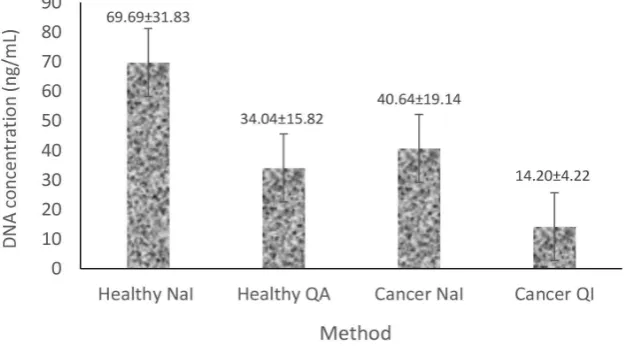
The result of this study showed that the
NaI method is more eficient and cost-effective
than the commercial kit. The NaI method yielded higher plasma DNA concentrations. Furthermore, the results showed that regardless of the isolation method, the plasma DNA concentrations in healthy controls were
signiicantly higher than that in the cancer
TABLE 1. Comparison of plasma DNA concentrations (ng/mL)
Sample Salting out (NaI) Commercially available kit (QA) p
Healthy controls 69.69 ± 31.83 34.04 ± 15.82 0.008*
Cancer cases 40.64 ± 19.14 14.20 ± 4.22 0.000*
p 0.032# 0.005#
*Statistical analysis was performed using Student’s t-test with equal variance #Statistical analysis was performed using Student’s t-test with unequal variance
FIGURE 1. Illustration of plasma DNA concentrations
DISCUSSION
As a highly malignant disease that causes increased mortality rate among women in Indonesia, breast cancer is still a challenge due to the poor diagnosis and prognosis of the disease that could hinder therapy. The routine diagnosis and prognosis of breast cancer typically depends on solid tissue as the source of analysis. Tissue can be harvested only using an invasive surgical methods. It is not always possible to surgically harvest patient’s tissue for monitoring the disease and outcome of the therapy. Therefore, an analyte that circulates in the body can be used for non-invasive or minimally invasive diagnostic, prognostic, and monitoring purposes. Plasma DNA is an
Analysis of plasma DNA is a challenging method due to the high degree of DNA fragmentation and its low concentration in the circulation. An earlier study on the source of circulating plasma DNA revealed that although the concentration of DNA in the serum can be 2 to 24 times higher than that in the plasma, plasma is a better source than serum for the analysis of circulating DNA.16
The higher abundance of DNA in the serum was attributed to the contamination from cells that occur during the clotting process. Therefore, many laboratories recommended the use of plasma as a source of circulating DNA.
methods, there is a signiicant difference
between the plasma DNA concentrations of controls and cancer patients. Further studies are needed to fully understand whether the
plasma DNA concentrations relected DNA
in the tissues or the clinical manifestations. The non-invasive nature of sample collection
and the eficient and cost-effective of its
isolation method enable the use of plasma DNA concentration as a potential biomarker for breast cancer. This biomarker can be used for early diagnosis, prognosis, and therapy monitoring purposes.
Majority of the earlier studies found that DNA concentration in the plasma of cancer patients is higher compared to healthy
controls. This inding contradictive with our
results. The differences in the time elapsed between the sample collection and the start of the isolation procedure likely the reason for this contradiction. The plasma from patients’ blood samples were isolated immediately after receiving the samples, while the samples from healthy controls were isolated 2 to 4 weeks later. Therefore, the higher abundance of plasma DNA in healthy controls was likely due to the release of fragmented DNA from lysed cell during this elapsed time.
Selection of an isolation method that
ensures the extraction of a suficient amount
of high-quality DNA is critical, and pre-analytical factors of blood sampling and processing can strongly affect DNA yield.17
CONCLUSION
The present study shows that isolation
methods signiicantly affected the DNA
concentrations. Furthermore, there is a
signiicant difference between the plasma
DNA concentrations of healthy controls and of cancer cases, suggesting its potential utility as a biomarker for breast cancer that the
sampling method is less invasive than tissue biopsies.
ACKNOWLEDGEMENT
This study was supported by Ministry of Health Republic of Indonesia through Risbin Iptekdok grant in 2009.
REFERENCES
1. WHO. Country cancer proile 2014. Geneva:
World Healt Organization, 2014.
2. Rosenberg J, Chia YL, Plevritis S. The effect of age, race, tumor size, tumor grade, and disease stage on invasive ductal breast cancer survival in the U.S. SEER database. Breast Cancer Res Treat 2005;89(1):47-54. http:// dx.doi.org/10.1007/s10549-004-1470-1 https://doi.org/10.1007/s10549-004-1470-1 3. Jahr S, Hentze H, Englisch S, Hardt D,
Fackelmayer FO, Hesch RD, et al. DNA fragments in the blood plasma of cancer patients: quantitations and evidence for their origin from apoptotic and necrotic cells. Cancer Res 2001;61(4):1659-65.
4. Altimari A, Grigioni AD, Benedettini E, Gabusi E, Schiavina R, Martinelli A, et al. Diagnostic role of circulating free plasma DNA detection in patients with localized prostate cancer. Am J Clin Pathol 2008;129(5):756-62. http://dx.doi. org/10.1309/ DBPX1MFNDDJBW1FL
5. Boddy JL, Gal S, Malone PR, Harris AL, Wainscoat JS. Prospective study of quantitation of plasma DNA levels in the diagnosis of malignant versus benign prostate disease. Clin Cancer Res 2005;11(4):1394-9. http://dx.doi.org/10.1158/1078-0432.CCR-04-1237
https://doi.org/10.1158/1078-0432.CCR-04-1237
patient with synchronous primary breast and lung cancers. Hum Pathol 2014; 45(4):880-3. http://dx.doi.org/10.1016/j.humpath.20145(4):880-3. 10.016
7. Lee KH, Yoon WJ, Lee JK, Ryu JK, Kim YT,
Yoon YB. Quantiication of plasma DNA as
a tumor marker in patients with pancreatic cancer. Korean J Gastroenterol 2005; 46(3): 226-32.
8. Perrone F, Lampis A, Bertan C, Verderio P, Ciniselli CM, Pizzamiglio S, et al. Circulating free DNA in a screening program for early colorectal cancer detection. Tumori 2014;100(2):115-21. http://dx.doi. org/10.1700/1491.16389
9. Diehl F, Li M, Dressman D, He Y, Shen D,
Szabo S, et al. Detection and quantiication
of mutations in the plasma of patients with colorectal tumors. Proc Natl Acad Sci USA 2005;102(45):16368-73. http://dx.doi. org/10.1073/pnas.0507904102
https://doi.org/10.1073/pnas.0507904102 10. Kamat AA, Baldwin M, Urbauer D, Dang D,
Han LY, Godwin A, et al. Plasma cell-free DNA in ovarian cancer: an independent prognostic biomarker. Cancer 2010;116(8):1918-25. http://dx.doi.org/10.1002/cncr.24997
https://doi.org/10.1002/cncr.24997
11. Olsson E, Winter C, George A, Chen Y, Howlin J, Tang MH, et al. Serial monitoring of circulating tumor DNA in patients with primary breast cancer for detection of occult metastatic disease. EMBO Mol Med 2015;7(8):1034-47.
https://doi.org/10.15252/emmm.201404913 h t t p : / / d x . d o i . o r g / 1 0 . 1 5 2 5 2 / e m m m .
201404913
https://doi.org/10.15252/emmm.201404913 12. Dawson SJ, Rosenfeld N, Caldas C.
Circulat-ing tumor DNA to monitor metastatic breast
cancer. N Engl J Med 2013;369(1):93-4. http://dx.doi.org/ 10.1056/NEJMc1306040 https://doi.org/10.1056/NEJMc1306040 13. Hao TB, Shi W, Shen XJ, Qi J, Wu XH,
Wu Y, et al. Circulating cell-free DNA in serum as a biomarker for diagnosis and prognostic prediction of colorectal cancer. Br J Cancer 2014;111(8):1482-9. http://dx.doi. org/10.1038/bjc.2014.470
https://doi.org/10.1038/bjc.2014.470
14. Ishizawa M, Kobayashi Y, Miyamura T, Matsuura S. Simple procedure of DNA isolation from human serum. Nucleic Acids Res 1991;19(20):5792. https://doi. org/10.1093/nar/19.20.5792
https://doi.org/10.1093/nar/19.20.5792
15. Stroun M, Lyautey J, Lederrey C, Mulcahy HE, Anker P. Alu repeat sequences are present in increased proportions compared to a unique gene in plasma/serum DNA: evidence for a preferential release from viable cells? Ann N Y Acad Sci 2001;945:258-64.https://doi. org/10.1111/j.1749-6632.2001.tb03894.x https://doi.org/10.1111/j.1749-6632.2001.
tb03894.x
16. Jung M, Klotzek S, Lewandowski M, Fleischhacker M, Jung K. Changes in concentration of DNA in serum and plasma during storage of blood samples. Clin Chem 2003;49(6 Pt 1):1028-9.https://doi. org/10.1373/49.6.1028
https://doi.org/10.1373/49.6.1028
17. Swinkels DW, Wiegerinck E, Steegers EA, de Kok JB. Effects of blood-processing
protocols on cell-free DNA quantiication in
plasma. Clin Chem 2003;49(3):525-6.https:// doi.org/10.1373/49.3.525