Experience After the First Year
Otmar Issing,Executive Board, European Central Bank
1. INTRODUCTION
On 1 January 1999, 11 of the 15 Member States of the European Union adopted the euro as their single currency. The euro replaced the former national currencies on the basis of conversion rates that were irrevocably fixed on 31 December 1998. The task of defining and implementing the single monetary policy for the “euro area” has been assumed by the European Central Bank (ECB). The Governing Council and the Executive Board govern the Eurosystem, which is composed of the ECB and the 11 national central banks (NCBs) of the participating EU Member States. The ECB and the 15 NCBs of the EU Member States form the European System of Central Banks (ESCB).
The transition to the single currency has required substantial preparatory work. The European Monetary Institute and the NCBs of the EU Member States started at a very early stage to do contingency planning on a number of crucial issues related to the monetary union: from the details of the announcement of central parities to preliminary evaluations of alternative monetary policy strategies. This considerable effort was criticized by sceptics, pointing out the alleged economic inadequacy of the Maastricht criteria, the risks of an early announcement of the conversion rates, and so on and so forth. It is fair to recognize, however, that no hint of turbulence or increase of volatility was recorded in foreign exchange markets between the announcement of the conversion rates, in April 1998, and the beginning of the monetary union.
Address correspondence to O. Issing, European Central Bank, Kaiserstrasse 29, D-60311 Frankfurt, Germany.
I wish to thank Oreste Tristani for his valuable cooperation.
Journal of Policy Modeling22(3):325–343 (2000)
Similarly, no noticeable problems have been experienced so far by the Eurosystem. The single monetary policy has been sailing new uncharted waters without losing track of its objective or reporting any damage. Price stability inherited from the NCBs has been preserved, and the ECB has already earned the credibility to maintain it in the future. Money markets, for example, appear to have adapted quickly to the new environment: the simultaneous use of both standing facilities, intense in the first days of 1999, decreased considerably thereafter, and the overnight (EONIA) interest rate has since tracked closely the interest rate on the main refinancing operations.
This article aims to provide a description of the central charac-teristics of the single monetary policy. Section 2 starts with a discussion of the ECB “contract” (in the terminology of the recent literature on optimal contracts for central bankers: e.g., Persson and Tabellini, 1993; Walsh, 1995). Special emphasis is given to a few details of the institutional mandate and to the issues of independence and accountability. Given this contractual frame-work, Section 3 describes the monetary policy strategy adopted by the ECB to fulfill its statutory objectives. A review of the first year of the single monetary policy is carried out in Sections 4 and 5, which focus, respectively, on the implementation of the strategy and on the degree of credibility it apparently commanded in finan-cial markets. Section 6 contains a few remarks on the issue of transparency, while Section 7 concludes.
2. THE MANDATE
a manner that is consistent with “the principle of an open market economy with free competition,” the Eurosystem, therefore, also fulfills the other part of its mandate.
Academic research strongly supports the view that the best contribution that monetary policy can give to the efficient func-tioning of monetary economies is to ensure price stability. There is consensus among researchers that high rates of inflation are costly for the society (see, e.g., Driffill, Mizon, and Ulph, 1990; Fischer, 1994; Feldstein, 1999), and plenty of evidence of the negative impact of inflation on economic activity (e.g., Barro, 1996; Fischer, 1993; Judson and Orphanides, 1996; Andre´s and Hernando, 1999). The proposition that monetary policy should have price stability as its primary objective is not just proof of the conservativeness of central banks, but one of the very few
tenetsof the economic discipline.
Having defined the objectives to be pursued, the Treaty grants the Eurosystem institutional independence. Independence should allow the decision-making bodies of the ECB to concentrate on the fulfillment of their mandate and to adopt a forward-looking, medium-term orientation, undisturbed by short-term political con-siderations. For a new institution, without a policy record of its own, this is crucial to establish a high degree of credibility, which in turn, is vital for a successful monetary policy.
Accordingly, Article 7 of the Statute guarantees that, when exercising their powers and carrying out their tasks and duties, the ECB, the national central banks, and the members of their decision-making bodies are independent. They are not allowed to “seek or take instructions from Community institutions or bodies, from any government of a Member State or from any other body.” Moreover, these governments, institutions, and bodies are obliged to respect this principle and not to try to influence the members of the decision-making bodies of the ECB or of the national central banks in the performance of their tasks.
that the decision-making bodies of the ECB are thoroughly ac-countable for their deeds.
To start with, the ECB has to fulfill several reporting commit-ments, as laid out in Article 15 of the Statute. Among other things, it is required to produce and publish quarterly reports on the activities of the Eurosystem, and to address to the European Parliament an annual report on the monetary policy of the Euro-system and on the activities of the ESCB, also taking part in the subsequent debate. The President of the ECB and the other members of the Executive Board may also be heard by the compe-tent committees of the European Parliament.
The contract accepted by the Governing Council of the ECB is, therefore, fully consistent with an appropriate structure of in-centives. Nevertheless, the ECB has committed, for accountabili-ty’s sake, to go substantially beyond the letter of the Treaty in two respects.
The first concerns the definition of price stability. Given the legal nature of the document, no operational definition of price stability is given in the Treaty. Upon announcement of the mone-tary policy strategy, the Governing Council decided to specify nu-merically what is to be interpreted as price stability in the euro area: “a year-on-year increase in the Harmonised Index of Con-sumer Prices of below 2 percent.” Through the adoption of the word “increase,” it was made clear that negative rates of change of the HICP are inconsistent with the definition of price stability: the definition is, therefore, symmetric, in the sense that it excludes both negative (deflation) and significantly positive (inflation) rates of change of the price index. The Council further clarified that price stability is to be achieved over the medium term, acknowl-edging the existence of short-term developments in prices that cannot be controlled by monetary policy. The medium term orien-tation also permits a gradual and measured response to economic shocks, so as to avoid introducing unnecessary volatility into inter-est rates or real economic activity.
The different decision of the ECB reflects, first and foremost, the concern of being accountable. A numerical definition provides a benchmark against which performance can easily be monitored. The upper bound of 2 percent, moreover, is in line with implicit or explicit previous goals of most participating NCBs and with past Recommendations of the Council of the European Union, which, since July 1995, has used it to define the rate of inflation compatible with price stability.
For a newly established central bank, a numerical definition of price stability also provides a clearer anchor for agents’ long-term expectations. The latter can more easily be influenced, for an “old” institution, by the reputation arising from the track record. The second way in which the ECB has committed to go beyond the letter of the Treaty is in terms of its reporting requirements. Already since June 1998, the decisions taken by the Governing Council have been announced and justified in a public statement by the President. As from January 1999, the President and the Vice President also hold a press conference at the end of the first Governing Council meeting of each month. The conference is attended by a large number of journalists (over 100), and its transcripts are immediately published on the ECB web site.
3. THE MONETARY POLICY STRATEGY
The stability-oriented monetary policy strategy is the frame-work adopted to achieve price stability. The selection of a strategy is of great importance for a central bank, because it represents both a structure for the filtering and processing of information and a guide for external communication with the public.
message of continuity with the past, to propose itself as the natural heir to the credibility of the most successful participating NCBs. The stability-oriented monetary policy strategy is composed of two pillars. First, a prominent role is assigned to money, in relation to which a quantitative reference value of 4-1/2 percent for the rate of growth of M3 was announced in December 1998. The analysis of money is complemented, in the second pillar, with a comprehensive assessment of the outlook for price developments, which takes into account all the remaining relevant information. The importance of monetary aggregates stems from the relation-ship that exists between money and prices over the long term (e.g., McCandless and Weber, 1995). This correlation is a reminder of the fact that inflation is ultimately a monetary phenomenon, and that significant deviations from price stability are always at-tributable to a certain degree of accommodation of exogenous shocks by the monetary authority. Developments in the amount of money held by the public are, therefore, seen as containing useful information about future price developments.
The special characteristics of the euro area, however, in particu-lar the structural break potentially induced by the changeover to the single currency, have had to be taken into account at the ECB. In the case of the demand for money, a number of institutional factors—ranging from portfolio shifts following the implementa-tion of the new reserve requirement system to the ongoing disinter-mediation and increased competition in the financial sector—were foreseen to potentially exert special influences on the evolution of the broad money stock in the euro area in Stage 3. On the other hand, the available empirical evidence showed that the rela-tionship between area-wide demand for the M3 monetary aggre-gate and its macroeconomic determinants is quite stable and pre-dictable (Coenen and Vega, 1999).
On balance, it was felt that a monetary targeting strategy should be eschewed, without, however, disregarding the information con-tent in monetary aggregates. Hence, the treatment of the estimated rate of growth of M3, which is judged compatible with the mainte-nance of price stability in the medium term, as a “reference value,” rather than as a target.
of all components of money and credit, aimed to monitor those nominal variables that are ultimately linked to the rate of inflation. The analysis of monetary aggregates is complemented by a comprehensive (“broadly based”) assessment of the outlook for price developments and the risks to price stability in the euro area, the “second pillar” of the strategy. The “broadly based as-sessment” brings together the information content of a large num-ber of indicators, which cannot be summarized, if not arbitrarily, in a single number or chart. It includes variables that typically enter the macroeconometric models used for forecasting purposes, such as gap measures, labor cost measures, and international com-modity and energy prices. It also includes the information that can be extracted from asset prices, including the exchange rate. It finally incorporates a number of indicator variables that can prove more difficult to fit in a logically consistent econometric framework, such as survey measures of expectations and confi-dence indicators.
Incidentally, it is perhaps worth stressing that the exchange rate has no autonomous role within the broadly based assessment. Exchange rate developments are relevant to the stability-oriented strategy for their potential impact on the rate of change of the harmonized index of consumer prices. In this framework, the exchange rate is closely monitored, but there is no such thing as a target or favored level of the effective exchange rate of the euro—let alone of the bilateral exchange rate vis-a`-vis the U.S. dollar—for the single monetary policy.
4. THE ECB STRATEGY AT WORK
The main features of the stability-oriented strategy were an-nounced on 13 October 1998. At that point in time, the euro area inflation rate, as measured by the HICP for the area, stood at 1 percent, a level well below the upper boundary of the definition of price stability adopted by the Council. Over 1998, official inter-est rates had declined in most prospective euro area countries, thus reaching levels that were unprecedentedly low in the postwar European history.
Figure 1. ECB interest rates and money market rates.
prices, which had reached 25 percent in some countries with re-spect to themaximaof mid-July. Data signalling a slowdown in production in the third quarter of the year were beginning to be released in the euro area.
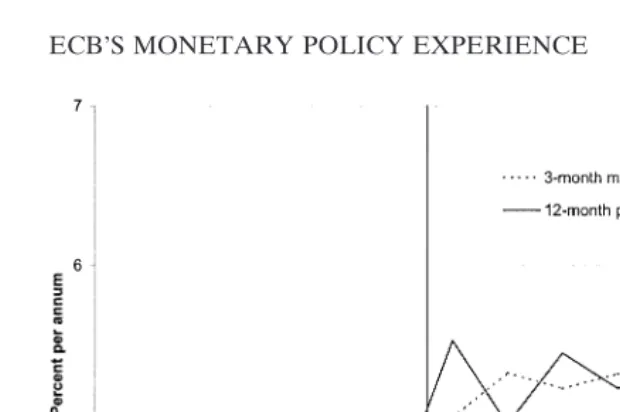
After having reached an agreement in the preceding meeting of the Governing Council, on 3 December the NCBs—still formally responsible of monetary policy in the respective countries— decided to reduce their key central bank rates in a coordinated fashion. The move was confirmed by the Governing Council on 22 December, when deciding on the levels of the ECB’s interest rates for the start of Stage 3 of the Monetary Union: the rate on the main refinancing operations was set, accordingly, at 3 percent; the deposit rate and the marginal lending rate at 2 and 4.5 percent, respectively (Figure 1).
4.1. April’s Interest Rate Cut
Figure 2. Rate of growth of M3 (as observed on 8 April 1999).
the last month for which inflation figures were available at the time of April’s Governing Council meeting.
Monetary Developments. Since the very beginning of the
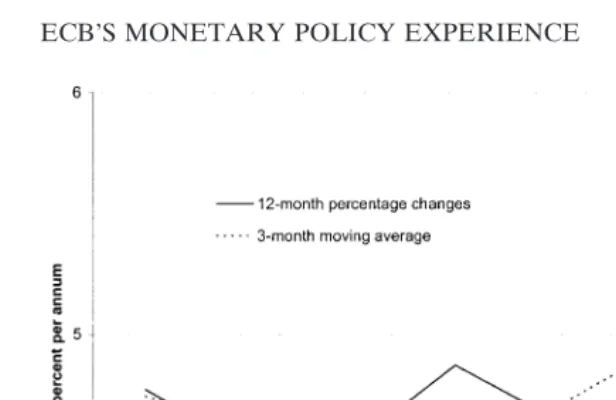
monetary union, M3 growth remained above the reference value. This signal of buoyant money demand indicated low risks of up-ward, rather than downup-ward, pressures on price stability, and should have calmed any worry of further falls in the inflation rate. The assessment of the rate of growth of M3, however, was complicated by the uncertainty related to the behavior of this aggregate in the changeover period. In fact, M3 had been growing at annual rates of between 4.4 and 4.9 percent in the four quarters of 1998, all values broadly consistent with the reference value for money announced by the Governing Council. Then, at the start of Stage 3, money had sharply accelerated: in January 1999, the 12-month rate of increase of M3 had been of 5.6 percent; in February, it had marginally slowed down to 5.2 (Figure 2).
led to some portfolio reallocations. However, the quantitative relevance of these factors remained unclear.
Because the advent of the European monetary union was a largely anticipated event, it appeared unlikely that any desired asset reallocation would be “postponed” to January 1999. It was conceivable, however, that remaining uncertainties about the tim-ing or the successful start of the EMU could have convinced some monetary and financial institutions to wait until January to complete their desired portfolio adjustments.
The increase in the rate of growth in M3 could also have been due to exceptional circumstances, that is, to a temporary shift in liquidity preferences at the beginning of the monetary union, which would plausibly be reversed in the following months.
The Broadly Based Assessment. All forecasting exercises, at
the outset, had to deal with the uncertain outlook for the world economy. Although in the rest of Asia there were increasing signs of a gradual recovery, the economic prospects in Japan remained gloomy, because preliminary figures for the final quarter of 1998 indicated a fall of real GDP of 2.8 percent (year on year). At the same time, the economic recession in Russia was expected to deepen.
According to the principal forecasting institutions, namely the IMF, the OECD and the European Commission, these “rest of the world” variables would not have had too large an impact on the euro area. Supporting this view was the apparent resiliency of economic growth in the United States, which, sustained by the expansion of domestic demand, appeared untouched by external developments. The general reasoning implicit in these economet-ric results was that, as the euro area is relatively closed, it is relatively insulated from real international developments. Thus, as long as the Asian crisis did not turn into a global financial meltdown, its effects on prices and economic activity in Europe were judged to be small and short lived.
The latter had once again worsened, continuing along a decreasing trend initiated at the beginning of 1998.
In the preparation of the meeting of 8 April, the Governing Council was again facing a familiar situation. All inflation forecasts confidently projected the euro-area inflation rate to remain around levels well within the definition of price stability in the following 2 years. These projections were, however, in all cases the result of a sequence of revisions, always in the same downward direction, which were by themselves casting doubts on the reliability of forecasts in this historical period. Hence, the broad assessment led to the conclusion that, while there were no expectations of the euro area inflation rate approaching zero, there was a risk
that—taking into account a potential measurement bias—price developments might hit the “danger zone”.
On 8 April the Governing Council decided to reduce all policy rates: the main refinancing rate and the deposit rate were both reduced by 50 basis points, to 2.5 and 1.5 percent, respectively; the marginal lending rate was reduced by 100 basis points, to 3.5 percent. In the press conference, it was clarified that main forecast scenarios were not indicating prospects of a further fall in the rate of inflation; thus, no further interest rate cuts were foreseen. It was also argued that the size of the cut had brought the interest rates to a level deemed consistent with current and expected economic conditions, so that the policy move should not be inter-preted as a first step towards a renewed declining trend for interest rates. This confirmed the exceptionality of the move, thus stressing that it had to be read as an insurance against the downside risks, and not as an attempt to tackle expected deflation.
4.2. November’s Interest Rate Hike
economies and even in Japan, while activity in the United States continued to expand at a robust pace.
These signs of recovery also appeared to confirm that the dollar-euro exchange rate had been reflecting, over the course of 1999, short- to medium-term expectations of the relative evolution of the business cycles. Since the beginning of the monetary union, the euro had depreciated—although not so as to create concerns for price stability—until July 1999, then started to edge up at the end of the summer. Corsetti and Pesenti (1999) present compelling evidence that movements in the dollar-euro exchange rate have been fully consistent, in recent months, with the changing growth prospects in the Unites Stats and the euro area. Using Consensus data, they show that the progressive widening, in favor of the United States, in the forecasted growth differentials between the two economies was accompanied by a parallel fall of the euro until July 1999. In the following months, signals of inversion in the relative growth of the two areas were mirrored by the slight appreciation of the euro.
Monetary growth also picked up in the course of the summer to levels increasingly in excess of the reference value. Between February and September 1999, the 12-month rate of growth of M3 changed from 5.0 percent (after a slight revision since April) to 6.1 percent (Figure 3). Even if one were willing to concede that the January 1999 jump was spurious, money growth would have remained above the reference value. All other measures of liquidity, from M1 to domestic credit, were also growing at a steady pace.
Figure 3. M3 growth (as observed on 4 November 1999).
be granted that inflation would remain safely below 2 percent. The hypothesis that current levels of interest rates were, given the current pace of economic activity, becoming inconsistent with prospects for price stability could also be supported by various other estimates (including, e.g., simple Taylor rules).
All in all, monetary developments (the first pillar) and the broad assessment (the second pillar) were providing consistent indications that the balance of risks to price stability had shifted towards the upside. In the meeting of 4 November, the Governing Council decided to reverse the April decision, raising the interest rate on the main refinancing operations by 50 basis points and thus bringing it back to the 3-percent level. The deposit rate and the marginal lending rate were both increased by the same amount, thus leaving the width of the “corridor” unchanged.
5. THE ROLE OF CREDIBILITY
signs of concern about the future. In other words, we can already attempt a first assessment of the credibility enjoyed by the ECB in financial markets.
The issue of credibility is a central concern for both central banks and for academic scholars, as shown in a recent survey conducted by the former vice-president of the Fed, Alan Blinder (1999). Credibility is literally defined as the ability to have one’s statements accepted as factual or one’s motives as the true ones. The definition can promptly be applied to the ECB, because its motives, or objectives, are laid down in the Maastricht Treaty. Credibility for the ECB is thus to be interpreted as coinciding with a widespread perception in the economy that risks of devia-tions from price stability in the distant future be negligible.
An estimate of such risks can be extracted from financial market variables, in particular, yields on long-term bonds. If one looks ahead far enough beyond the business cycle frequency, then changes in long-term nominal interest rates will typically reflect markets’ perceptions of long-term inflation. If the central bank is credible, long-term rates will not move far away from levels consistent with maintained prospects of price stability. They will quickly jump to higher levels if credibility is lost.
Prices of long-term bonds denominated in euros show that the ECB already enjoys a considerable level of credibility. Long-term interest rates appear fully consistent with a prolonged period of price stability. In particular, the inflation rate implicit in index-linked bonds has been consistently in line with price stability for the foreseeable future.
In the days following the interest rate cuts of December 1998 and April 1999, bond yields decreased slightly or remained broadly unchanged. Financial markets appeared to fully understand the motivations for easing monetary conditions and to consider the moves appropriate, given the state of the economy. Similar devel-opments—in particular, a significant fall of implied forward over-night rates at very long maturities—could be observed at the time of the decisions of 4 November.
mechanism, which is only imperfectly known. A second source of uncertainty relates to statistical data, because of the methodologi-cal innovations and short time span of many macroeconomic time series that are central to the formulation of monetary policy (above all, the HICP for the euro area).
The high degree of credibility enjoyed by the ECB is especially remarkable for an entirely new institution. As emphasized by Blinder, academics and central bankers agree that, when it comes to establishing credibility, the only route available is the old-fashioned one of building a track record of living up to one’s word. In the case of a new institution such as the ECB, however, the track record is simply missing. The current level of credibility is mainly a result of the fact that financial markets, and the public at large, have understood the precommitment expressed through the announcement of the stability-oriented strategy, and they be-lieve the strategy to be appropriate to fulfill the mandate of the Treaty.
6. TRANSPARENCY
The ECB has stressed from the very outset that it aspires to be among the most transparent and accountable central banks. This aspiration reflects the conviction that transparency enhances policy effectiveness and reduces uncertainty as to the future course of monetary policy. In practice, transparency must translate into a painstaking attempt to describe and clarify the main characteris-tics of the strategy and operating procedures and the motivation behind policy decisions.
Since 1 January 1999, a constant effort to communicate has been made,inter alia, through the official publications of the ECB. Each month since January 1999, the Monthly Bulletin has provided in-depth accounts of the characteristics of the euro-area economy and of the tools that are currently an integral part of our policy analysis. Special effort has been devoted to the description of some key variables, such as money and credit aggregates.Ad hoc
the assessment of future prospects for, and risks to, price stability and with explanations of the policy decisions.
The evolution of financial market prices before the interest rate increase on 4 November lends support to the hypothesis that agents already interpret quite well the communication language of the ECB. An interest rate move had gradually been “priced in” short-term money market rates since the end of September. By the end of October, the different evolution of 1-month EURIBOR spot and future rates was consistent with a 50 basis points increase of interest rates in one of the two meetings of the Governing Council in November. The release, on 27 October, of the latest M3 growth figure, which was higher than consensus forecasts in financial markets, focused the expectations of a policy move on 4 November. The day before, the 1-month EURIBOR interest rate stood at 3.02 percent, thus anticipating the imminent decision of the Governing Council.
The one chosen by the ECB is the hard, but probably the only, route to transparency. Contrary to this view, however, the academic literature has recently identified some “quick fixes” for transparency. The ECB cannot be considered “transparent,” it is argued, unless it discloses its internal economic forecasts and publishes detailed, attributed minutes of the Governing Council meetings.
Let me first comment on the issue of economic forecasts. It is often assumed that a “true” and unique internal forecast can ultimately be attained, and that the large amount of information analyzed by the central bank can be summarized in such a way as to adequately convey the underlying level of uncertainty. The reality of central banking is, however, more complex than assumed in this simple characterization. As eminently clear from the afore-mentioned description of the evolution of inflation forecasts dur-ing 1999, no forecast is ever able to subsume all the relevant information.
Forecast results will always have to be analyzed jointly with a host of other indicators, and there is no mathematical way, given the state of our knowledge, capable of synthetically and objectively summarizing the degree of uncertainty central banks face. Ulti-mately, policy decisions are the results of a complex evaluation of raw evidence, theoretical reasoning, empirical results—including
When it comes to communication to the public, I, therefore, maintain that the most transparent, although admittedly still im-perfect, representation of this complex decision-making process can only be a discussion of the information provided by all the available indicators, as described through a combination of evi-dence (both “raw” and coming from econometric models) and arguments. The relevant information may well be organized around forecasts, as in the current practice of other central banks. Forecast figures, however, will ultimately remain a simplified and necessarily incomplete summary of all the quantitative analyses and judgmental inputs that contribute to the assessment of the prospects for price stability. Among other limitations, they are typically builtby assumptionon the basis of an incomplete infor-mation set, because of the standard conditioning on an unchanged path for policy rates. If forecasts are published, great care must taken to avoid creating confusion in the public and undermining the credibility of the central bank.
The second issue that is often raised relates to the publications of the minutes and voting records of the meetings of the Governing Council. This appears to be largely a matter of definition. The typical content of official minutes can be recovered, in the ECB case, from the monthly press releases and conferences. During the latter, the President summarizes and explains the decisions of the Governing Council—immediately after it is adjourned—and the reasoning behind them. Moreover, the President and the Vice-President are available for extensive questioning, transcripts of which are made available on the ECB Web site. I regard this practice as highly transparent, and comparable to that of publish-ing—at a later date—official minutes of a debate that takes place within closed doors. As to the publication of individual voting records, I have already argued elsewhere (Issing, 1999) that this practice would seriously undermine the functioning of the Govern-ing Council. In the context of the Eurosystem, it would subject NCB Governors to national and other pressures and would be detrimental to a frank and constructive exchange of views.
7. CONCLUSIONS
degree of independence, and its accountability requirements—are carefully specified in the Statute of the ECB, which is an integral part of the international Treaty of Maastricht.
Given this legal framework, one of the first decisions taken by the Governing Council has been to devise and announce a mone-tary policy strategy, to be used both as a framework to filter and interpret the relevant information and as a means to communicate policy decisions to the general public.
The experience of the first year of the single monetary policy appears to show that financial markets and the public at large begin to understand the strategy of the ECB, and that they consider it appropriate to fulfill the statutory objective of price stability. For a newly established institution, the ECB has enjoyed a remarkably high degree of credibility, as demonstrated by the evolution of long-term bond yields. This helped to ensure that the outlook for future inflation remained at all times consistent with the Council’s definition of price stability, and that the ECB sailed through new uncharted waters without ever being forced off route.
REFERENCES
Andre´s, J., and Hernando, I. (1999) Does Inflation Harm Economic Growth? Evidence from the OECD. InThe Costs and Benefits of Price Stability(M. Feldstein, Ed.). Blinder, A. (1999) Central Bank Credibility: Why Do We Care? How Do We Build It?
NBER Working Paper No. 7161.
Barro, R. (1996) Inflation and Growth, Federal Reserve Bank of St. Louis.Review78:153– 169.
Coenen, G., and Vega, J.-L. (1999) The Demand for M3 in the Euro Area. ECB Working Paper No. 6.
Corsetti, G., and Pesenti, P. (1999) Stability, Asymmetry and Discontinuity: The Outset of European Monetary Union.Brookings Papers on Economic Activity(forthcoming). Driffill, J., Mizon, G.E., and Ulph, A. (1990) Costs of Inflation. InHandbook of Monetary Economics(B.M. Friedman and F.H. Hahn, Eds.). Amsterdam: North Holland, vol. 2.
Feldstein, M. (1999)The Costs and Benefits of Price Stability.Chicago and London: Univer-sity of Chicago Press.
Fischer, S. (1993) The Role of Macroeconomic Factors in Growth.Journal of Monetary Economics32:485–512.
Fischer, S. (1994) Modern Central Banking. InThe Future of Central Banking(F. Capie and A. Lamfalussy, Eds.). Cambridge: Cambridge University Press.
Issing, O. (1999) The Eurosystem: Transparent and Accountable or “Willem in Euroland.”
Judson, R., and Orphanides, A. (1996) Inflation, Volatility and Growth. Federal Reserve Board, Finance and Economics Series Discussion Papers No. 96-19.
McCandless, G.T., and Weber, W.E. (1995) Some Monetary Facts. Federal Reserve Bank of Minneapolis.Quarterly Review19:2–11.
Persson, T., and Tabellini, G. (1993) Designing Institutions for Monetary Stability. Carne-gie-Rochester Conference Series on Public Policy39.
Walsh, C. (1995) Optimal Contracts for Central Bankers.American Economic Review