An analysis of coastal land conflict in the North of Jakarta
coastal area: (A general algebraic modelling system approach)
Rudianto&Andi Gusti Tantu
Received: 2 August 2013 / Accepted: 15 October 2013 #Springer Science+Business Media Dordrecht 2013
Abstract This research was motivated by a never-ending questions, which arose in coastal land use conflict especially in Indonesian and generally in developing countries. Policy makers and others stakeholders both in central and local governments concerned with resolution conflict occurred in coastal areas. Squatters, who live and built houses in illegal land, were forced to move out to theirs origin home lands. Such conflicts occurred again and again without clear solution among parties involved. Such conflict shows that both squatters and land owners have no benefits in their conflict. Such condition could decrease their economic productivity. As a consequence the economic performance of coastal area become declining. The aim of this research is to analyse coastal land use conflict between squatters and land owners. It includes to formulate conflict resolution based on land optimation. To solve the coastal land conflicts, an economics approach is needed with assumption that conflict is a concept. As a concept, conflict could be measured by using economic variables called benefits and costs to be taken into account. GAMS (General Algebraic Modelling System) is a computer language which permit formulating economic equilibrium models as systems of nonlinear equations. In this research GAMS was used to calculate the value of land rents. The results of GAMS operation produces that the coastal land area should be maintained, expanded and added of Squatters.
KeywordGeneral Algebraic Modelling System (GAMS) . Coastal land conflict analysis . Resolution conflict
Introduction
Coasts are indeed unique places, especially in places which combine freshwater and salt water in coastal estuaries. Coasts create some of the most productive and richest habitat on earth. Furthermore, most coasts are assets of incalculable value, and they are important part of the national heritage and have a very real economic value. Coastal lands are very valuable and greatly attractive in many other ways. They are used for port and harbor facilities, settlements, as well as recreation. All of which capture the large monetary benefits associated with waterborne commerce. Coastal lands are appropriate locations for industrial processes which require water cooling, such as power generation plants. Squatters have also built their houses on the land owned by the state in swamp areas.
As a result, conflicts among users mainly related with competition for ocean or coastal space are common (Choudury and Junaid2000). In fact, competition over coastal lands are occured in north Jakarta. The municipalities of north Jakarta cover 7,133.51 km2which consists of 6,994.4 km2of vast ocean and only 154.11 km2of land areas (The North Jakarta Local Government 2001). In addition, land owners have no clear land boundaries in the coastal area, and the type of land use conflict is varied.
Sjafi (2008) reported that one type of coastal land use conflict concerns conflict over ownership involving land owners with illegal settlers. Therefore, research is needed to find out how the use of coastal land could be managed properly. In order to avoid unclear and change land use function, it is necessary to use land more efficient.
In addition, land use conflict occurs because it is assumed that there is not enough land to all of the multipurpose activities which people want to do on the land. However, Conning et al. (2001) proposed that coastal land conflict could be reduced by maximizing the use of coastal land.
Rudianto
Faculty of Fishery and Marine Science, University of Brawijaya, Malang 65145, Indonesia
e-mail: [email protected]
A. G. Tantu (*)
Fishery Departement, Faculty of Agriculture, 45 University of Makassar, Makassar 90145, Indonesia
Squatters are used as a research object, because there are often conflict in the north Jakarta area, especially in the area of coastal land, between squatters and security forces of north Jakarta municipalities. Squatters settlement spread along north Jakarta. They illegally occupy land owned by the state or by private citizens. There are 3 characteristics of squatters which will be considered in this research. Firstly, the research will consider physical problems. Squatters settlements occupy illegal coastal land with minimum social infrastructure services, such as water supply, sanitation, electricity, road, drainage, and health centers. Secondly, there are social issues. Squatters have minimum income, as they work as labour or perform other work in the informal sector. Thirdly, there are legal problems as they have built their houses without legal ownership of the land. Finally,
Accordingly, squatters illegally occupy coastal lands which stretch along the north Jakarta coastal land areas, including riverbanks, coastal land reclamation areas, railway banks or land owned by Indonesian railway enterprises; Thus, squatters are interesting phenomenon, because they are related with the urbanization process which is increasing yearly.
The conflict solution will be used game theory. Game theory is a mathematical approach for formulating competitive and conflict situations among stakeholders with varied interests to achieve equilibrium (Rasmusen1989). The type of conflict is varied, like conflict related with the disturbance of livelihoods, disturbance of their places to move to other places.
To optimize coastal land use will implement GAMS model for formulating, solving and analysing nonlinear complementary problems to study this issue. GAMS is a fortran based programme designed for linear programming, non linear, dynamic, as well as mixed-integer programming. Application model of GAMS as systems of nonlinear equations, complementary problems or variational inequalities will be used to analyse conflict resolution between squatter and land owner which may be the government or a private citizen or company (Rutherford and Thomas1995).
Materials and methods
There are two steps to solve conflicts. The first step is used the deterministic approach which is called nash bargaining solution (Rasmusen1989). The objective of nash bargaining solution is to analyse the differences interest between land owners and squatters. The interest of squatters are to use coastal land which is owned by private or by government to build non and semi permanent houses, while private or gove rnment lands owned has interest to use their property for other purposes. The sources of conflicts are derived from difference perception between land owners and squatters in coastal land use planning (Rober and Alder1999).
In order to solve such conflicts, the land owners and squatters need negotiation based on mutual benefits. They try to achieve pareto optimal, which each actors must agrees with each solution offers by themselves. To formulate conflict solution, it is referred to objective function by raised some questions as follows (King2001): (a) how to formulate policy with or without squatters in coastal area owned by private or government; (b). how to utilize coastal land by private or government owner to conserve or rehabilitate land for protection area. Therefore, to answer two questions above, it is necessary to calculate total economiv value (TEV) by divided between benefits and costs in which lands are occupied by squatters (Max2002).
In order to formulate coastal land use policy to optimize land, the mathematic equation could be stated as follows (Rasmusen1989):
a: type of user; b: type of industry; Aj : area in which activity occurs, Lj : extens, X: output of resources (benefits), P: price, C: Cost, N: number of population.
X*P: total acceptance and X*C : total cost.
The second steps, GAMS will be used to breakdown above equations. In order to do that, there are four steps that it should be taken into considerations (Fauzi2000). First, GAMS will identify which coastal lands are categorised efficient and inefficient, so regression analysis is needed with the two curve shapes which is drawn variable cost for law enforcement and order with unit Rp per year. It draws exponential function and land value which is occupied by squatters with unit Rp per square meter. It based on analysis from logarithmic function. Second, it is necessary to draw efficient production boundaries called land rent frontier. Third, it is needed to
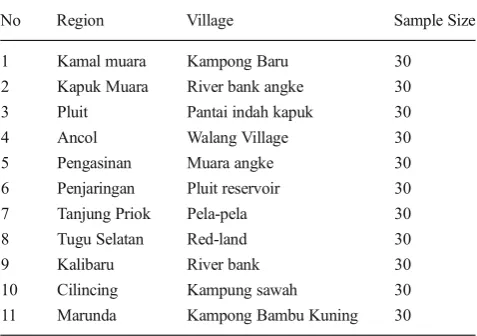
Table 1 Samples location in North Jakarta
No Region Village Sample Size
1 Kamal muara Kampong Baru 30
2 Kapuk Muara River bank angke 30
3 Pluit Pantai indah kapuk 30
4 Ancol Walang Village 30
5 Pengasinan Muara angke 30
6 Penjaringan Pluit reservoir 30
7 Tanjung Priok Pela-pela 30
8 Tugu Selatan Red-land 30
9 Kalibaru River bank 30
10 Cilincing Kampung sawah 30
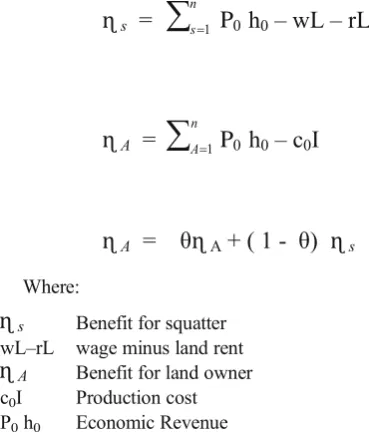
calculate rent optimal in each sample coastal land use. Then, it is needed to formulate nash equilibrium equation, which is stated as follows:
P
P
Where:
Benefit for squatter wL–rL wage minus land rent
Benefit for land owner c0I Production cost P0h0 Economic Revenue
Finally, the formulation of conflict resolution is implemented by using GAMS.
In order to select sample areas for this research, the calculation number of respondents is decided 330 squatters and the samples location can be seen in following Table1.
Results and discussion
To point out which 11 samples location is categorized win-win, win-lose, lose-win and lose-lose, various regression analysis is needed to create action to manage conflict. There are 4 regressions types to stimulate frontier curve coastal land used. They area: (a). Execution Cost for Squatter (ECS) variable and land value; (b). ECS with land rent; (c). ECS with interest land and (d). Population density with land value and land rent as well as building density with land value and land rent. In other to give some figures regarding four variables mentioned, some examples given as follows. Figure below shows regression analysis for curve between cost for law and order with rent value. According to Blair (1991) rent value is the benefit for land and it is decided by the relationship between supply and demand. Table2 below shows various equation Figs.1,2and3.
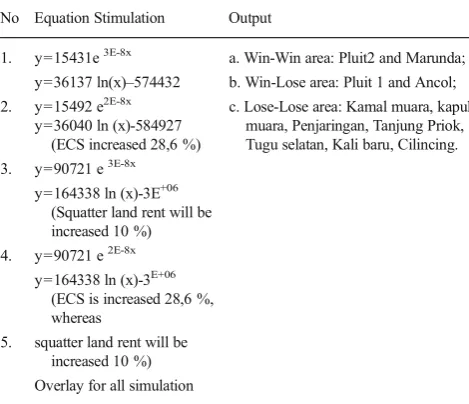
Table3above indicates that area of Pluit 2 and Marunda are categorized into win-win solution. It means that there is an interest balance between squatters and land owners. In the
Fig. 1 Map of Western Jakarta
Table 2 The relationship between ECS and land value
No Axis X Axis Y Equator
1 ECS Rp. 250 million/year Land Value (Rp/m2) 1. Y=82454 e3E-8x(exponential)
2. Y=149035 Ln(x)-2E+06(logarithmic)
2 ECS with Rp. 350 million/year Land Value (Rp/m2) 1. Y=82473 e2E-8X(exponential)
2. Y=149398 Ln(x)-2E+06(logarithmic)
3 ECS Rp. 250 million/year Land Value (Rp/m2) with assumed
increase 10 % (Rp/m2)
1. Y=90721 e3E-8x(exponential) 2. Y=164338 Ln(x)-3E+06(logarithmic) 4 The cost of law and other (BP) total
Rp. 350 million million/year Overlay 1–4
Land Value (Rp/m2) with assumed
increase 10 % (Rp/m2)
1. Y=90721 e3E-8x(exponential)
theory of nash equilibria such win-win condition is the main objectives to be achieved by each stakeholders. Therefore, land conflict between squatter and land owners could be avoided. To comprehend consistency between the various ECS and land value analysis, it is needed simulation by increasing ECS become Rp. 350 million per year. Such various simulation will give detail information whether there are location change in win win area namely Pluit 2 and Marunda. Table4 shows the summary of four equations as states above in which Pluit 2 and marunda are still consistence as win-win area.
In above table, it can be stated that Pluit 2 and Marunda can achieve nash equilibrium. whereas, the remaining area is included as win-lose and lose-lose area. The function of edgeworth box is to make differentiation which land efficient and inefficient, edgeworth box show below that Marunda and Pluit 2 are pareto optimal.
The further question how squatter is efficient toward land rent frontier, it is necessary to make some regressions simulation analysis as shown Table5below.
It showed that efficient area is kapuk muara. Whereas area above land frontier like Kalibaru and Penjaringan are assessed
unattainable. Area below land frontier is assessed unefficient. To know which area is categorized“rent optimal”, it is needed justification as shown Table6.
Rent optimal value shows that value RO for North Jakarta Rp. 106.984/m2/year. Whereas maximum value the figure is Rp. 3.940.000/m2/year.If we observe between rent to be paid by Squatter with optimal rent value indicated the big differences. It means that land occupied by squatter is inefficient. From 11 sample location, the average of rent optimal value for north Jakarta is indicated value Rp. 1.369.279/m2/year. The figure below give information that optimal rent value is Pluit 2 with location in Kampong Pengasinan Muara Angke. Rationally valueα(Rent differential) under 1.
After analysed the interaction among variables with various curve as shown above, resolution conflict should be approached by game theory. Game theory is mathematical approach to formulate competitive situation and conflict among stakeholders. How to create win-win solution between squatters and land owners.
In order to operationalize concept resolution with GAMS, resolution concept will be approached with two approaches namely market perfectness and government interventions (Fauzi2000). The first approach is from market perfectness. In this approach squatters must move location to other sides by receiving compensation from land owners or government build new apartements for squatters. From government sides, they have opportunity to make clear the boundary of their own lands as well as construct some infrastructures for control flooding, roads, water supply and sanitation. The government also supply some compensation to squatters to move other places or come back to squatters village. From private point of view, they are also to make clear the boundary of their lands and give compensation to squatters. To make easily calculation, private will give.
The second approach is from government intervention. Firstly, from squatters point of compensation as same as the
Group of Squatter
Group of Squatter
Government Land
Private Land
Land is assessed with market price with compensation Rp. 1 million and Squatter spend their money Rp. 200.000,-Land is assessed with market price with compensation Rp. 1 million Land is assessed with market price and there is compensation Rp. 5 million
Land is assessed with market price
Land is assessed by using survey price and rent
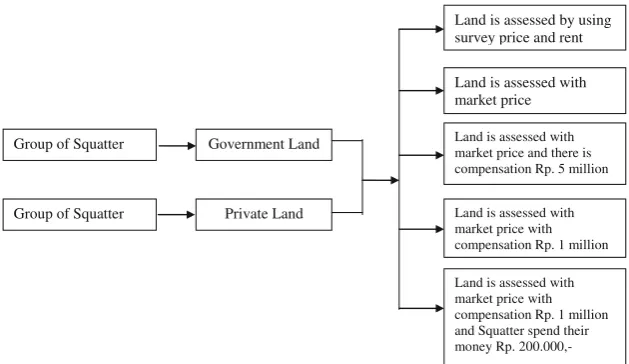
Fig. 3 Preparation of the model based on the relationship squatters occupying government land and private
government compensation. view that they should be given simetry information related with land squatters occupy including relocation plans (or transmigration programs) or going back to village program. The government will give land price based on rational calculation on local tax object sale price. The governments tasks after squatters left their illegal land is to maintain and rehabilitate environment and make buffer zone. Moreover, private role is also to give information openly to squatters and give compensations to them individually or as a groups.
To formulate optimal solution by using GAMS, it is designed 10 models with various assumptions (Rutherford and Thomas
1995). Model 1 is discussed assessment land by using survey price; Model 2 is discussed assessment land by using market
price; model 3 is discussed assessment land by using market price and squatter received compensastion Rp. 5 million.
Model 4 is discussed with assumptions squatters received compensation Rp. 5 million. Model 5 is discussed assessment land by using market price and Squatters received compensation Rp. 1 million and they spend their money Rp. 200.000. Model 6 is discussed conflict optimal solution in land owned by private by assumption that price decision is based on survey price. Model 7 is discussed conflict optimal solution in land owned by private by assumption that price decision is based on market price. Model 8 is discussed conflict optimal solution in land owned by private by assumption that squatters received compensation from private Rp. 5 million per households. Model 9 is discussed conflict optimal solution in land owned by private by assumption that squatters received compensation from private Rp. 1 million per households. Model 10 is discussed assessment land by using market price and squatters received compensation Rp. 1 million and they spend their money estimated Rp. 200.000,-.
Table 4 Summary in various equation simulation between ECS and squatter land rent
No Equation Stimulation Output
1. y=15431e3E-8x a. Win-Win area: Pluit2 and Marunda; y=36137 ln(x)–574432 b. Win-Lose area: Pluit 1 and Ancol; 2. y=15492 e2E-8x c. Lose-Lose area: Kamal muara, kapuk
muara, Penjaringan, Tanjung Priok, Tugu selatan, Kali baru, Cilincing. y=36040 ln (x)-584927
(ECS increased 28,6 %) 3. y=90721 e3E-8x
y=164338 ln (x)-3E+06 (Squatter land rent will be increased 10 %) 4. y=90721 e2E-8x
y=164338 ln (x)-3E+06 (ECS is increased 28,6 %, whereas
5. squatter land rent will be increased 10 %)
Overlay for all simulation
Table 5 Land use value (efficient) with land rent frontier
No Axis X Axis Y Equation
1. Population density in person er m2
Land Value (Rp/m2) Y=−7497.6 Ln (x)+148307 2. Population density in
person per m2
Land rent (Rp/m2) Y=3033.1 Ln (x)+42142 3. Rent value in Rp/m2 Land Value (Rp/m2) Line frontier 4. Building density in unit per m2 Land Value (Rp/m2) Y=23460 Ln
(x)+173805
5 Buidling density in unit per m2 Land rent (Rp/m2) Y=339.2 Ln (x)+37436 6 Rent value in Rp/m2 Land Value (Rp/m2) Land Rent
Frontier
Table 6 Calculation for optimal rent (RO) value
Location NS-sq NS-nsq Cx NL LT RO
Kamal Muara 25.000 35.000 0.714 180.000 18.10 1.041.872 Kapuk Muara 45.700 95.000 0.481 200.000 18.23 1.754.239
Pluit 1 12.400 130.000 0.095 55.000 20.39 106.984 Pluit 2 36.250 45.000 0.806 175.000 9.61 1.354.340 Penjaringan 47.844 62.000 0.772 210.000 13.45 2.179.176 Ancol 24.000 33.000 0.632 120.000 11.22 850.672
Tanjung Priok 32.800 55.000 0.596 130.000 6.94 538.130 Tugu Selatan 21.000 90.000 0.233 140.000 13.03 425.720 Kali Baru 75.000 120.000 0.625 320.000 19.70 3.940.000
Cilincing 28.200 50.000 0.564 150.000 6.87 581.284 Marunda 33.000 50.000 0.660 155.000 22.38 2.289.403
Source: From Calculation
NS-sqsquatter rent value (Rp/m2);NS-nsqnon squatter rent value (Rp/ m2);Cxrent differential calculation from NS-sq/NS-nsq;NLland value; LTTime Squatter Living (year);RORent Optimal (Rp/m2/year)
Table 3 Squatter location inside and outside Nash Equilibrium Curve with ECS Rp. 250 million with Land Value
No Squatter
1 Kamal Muara 21,000 180 V
2 Kapuk Muara 22,000 200 V 3 Pluit 1 14,000 55 V
4 Pluit 2 26,000 175 V
5 Penjaringan 25,000 210 V 6 Ancol 18,000 120 V
7
8 Tanjung Priok 12,000 130 V
9 Tugu Selatan 16,000 140 V 10 Kali Baru 55,000 320 V 11 Cilincing 18,000 150 V
Conclusion
The study shows that Pluit 2 and Marunda is categorized win-win, whereas Pluit 1 and Ancol is assessed win-lose, and the rest Kamal Muara, Kapuk Muara, penjaringan, Tugu Selatan, Kalibaru, Cilincing is assessed lose-lose. Such results is used as input by Government and local private to formulate Public policy to reduce conflict. Pluit 2 can increase squatter 534 household and Marunda can increase 7.813 household. In area squatter must move out as follows: Kapuk muara (418 households), Penjaringan (2334 housedhold), Pluit (440 household), Ancol (114 household), Priok (174 household), Tugu Selatan (67 household). Public policy program should be prepared by Jakarta government include: (a). program to move squatter back to their origin village; (b). empowerment program for squatter by giving them training, supply credit and strengthen of capital for micro, small and medium business; (c) land consolidation to improve environment; (d). building flats planning for squatters.
Acknowledgments The corresponding author are gratefully to thank mayor of North Jakarta Goverrment to give permission for local survey. I also would like to thank Professor Dr. Ir. Akhmad Fauzi whose help me to introduce and teach me about GAMS
References
Blair JP (1991) Urban and regional economics. The Book Press Inc, USA Choudury, Junaid K (2000) Sustainable management of coastal mangrove forest devepopment and social need. In: Mangrove and Other Coastal Forest http://www.eepsea.org/publications/research, pp. 267–286.
Conning J, James H, Robiuson A (2001) Cond reform and the political organization of agriculture. Paper presented for seminar London school of economics, London
Fauzi A (2000) Economic valuation of coastal verouvres. Paper presented in the Training Management for Coastal Area and Small Island the Cooperation Project between IPB-New Guinea University of Technology, Bogor
King W (2001) Strategy and conflict. An introductory sketch of gaml theory Max P (2002) Value conflict and kind the planning: An example at rural/ urban interface. Center for the environment ruval sociology department.Corvell university.USA
Rasmusen E (1989) Games and information an introduction to game theory. Cambridge University Press, UK
Rober K, Alder J (1999) Coastal planning and management, E&FN Span. An imprint of Rouhedge, USA
Rutherford, Thomas F (1995) Extension of GAMS for complementary problems avising. Applied Journal of Economic Dynamics and control 19:1299–1324
Sjafi E (2008) The space use analysis of manado bay coastal zone, North Sulawesi. PKSPL-IPB. 241 hal