ABSTRACT
Anjarmoko, Matius Hebi. 2009. Designing a Set of Web-based English Vocabulary Supplementary Materials for the First Grade Students of Sekolah Menengah Atas Negeri 9 Yogyakarta. Yogyakarta: English Education Study Program, Sanata Dharma University
Vocabulary learning is important in English learning because by learning English vocabulary, the students will have a greater chance to understand and use English. The problems for students when they are learning English vocabulary are that they do not have enough time to practice, the materials are not various, and the vocabulary exercises are not interesting. Seeing the problems, the writer tried to make use of computer alongside with Macromedia Dreamweaver™ as the programming software to create a website which serves more attractive and interesting English vocabulary learning materials. The materials in the study are developed based on School Based Curriculum or KTSP (Kurikulum Tingkat Satuan Pendidikan) since the materials are supplementary materials which mean that the materials are used to supplement or add the existing vocabulary materials in school. The abstract will elaborate the problems formulated in problem formulation.
There are two problems formulated in the study, first is that how a set of web-based English vocabulary supplementary materials for the first grade students of Sekolah Menengah Atas Negeri 9 Yogyakarta is designed and what a set of web-based English vocabulary supplementary materials for the first grade students of Sekolah Menengah Atas Negeri 9 Yogyakarta looks like.
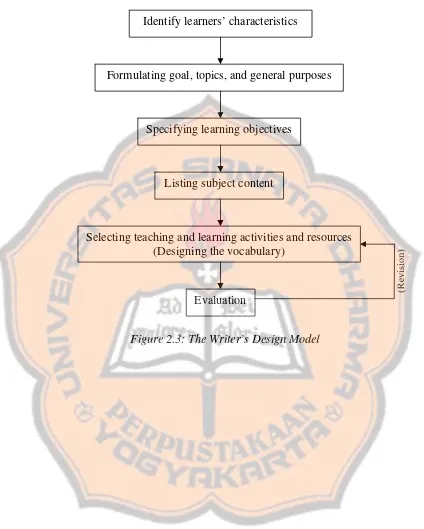
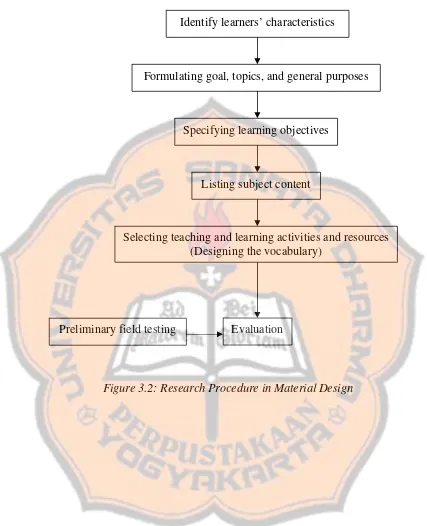
To answer the first question, the writer used the six (6) steps which were adapted from the Research and Development (R & D) and Kemp instructional design. Research and Development in this study is used as the umbrella for the design, while Kemp is used as the umbrella for the material design. The result of the adaptation was (1) Identifying learners’ Characteristics, (2) Formulating goal, topics, and general purposes, (3) Specifying learning objectives, (4) Listing subject content, (5) Selecting teaching and learning activities and resources, and (6) Evaluating-Preliminary field testing. The writer also made use of survey study using questionnaires to gain respondents’ opinion(s), suggestion(s), and comment(s). The result of the survey study will be used to revise and improve the design materials.
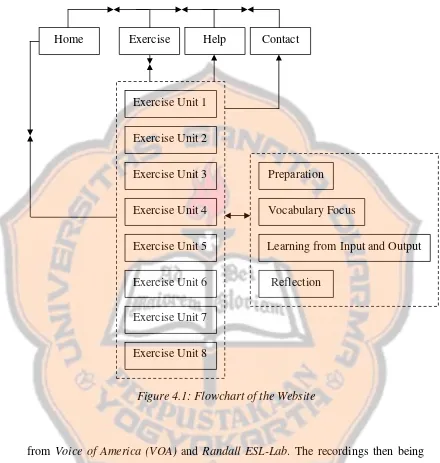
The second question is answered through the presentation of the design materials. There are 8 units in the design, each unit is divided into 4 subject content, and they are Preparation, Vocabulary Focus, Learning from Input and
Output, and Reflection.
As the final remark, the writer hopes that the design of a set of web-based English vocabulary supplementary materials for the first grade students of Sekolah Menengah Atas Negeri 9 Yogyakarta will be useful for students to improve and enrich their English vocabulary and also for teachers in teaching English vocabulary.
ABSTRAK
Anjarmoko, Matius Hebi. 2009. Designing a Set of web-based English vocabulary supplementary materials for the first grade students of Sekolah Menengah Atas Negeri 9 Yogyakarta. Yogyakarta: Program Pendidikan Bahasa Inggris, Universitas Sanata Dharma
Pembelajaran kosakata merupakan hal yang penting dalam belajar Bahasa Inggris, karena dengan belajar kosakata Bahasa Inggris, siswa memiliki kesempatan yang lebih besar untuk memahami konteks Bahasa Inggris. Masalah yang dihadapi siswa dalam belajar kosakata Bahasa Inggris disebabkan oleh beberapa hal, yaitu karena kurangnya waktu belajar kosakata, materi tidak bervariasi dan kegiatan pembelajarannya tidak menarik. Berawal dari masalah tersebut, penulis mencoba menggunakan komputer dan program Macromedia Dreamweaver™ untuk menciptakan sebuah website yang dapat memenuhi keinginan siswa akan materi pembelajaran kosakata Bahasa Inggris yang menyenangkan dan menarik. Materi yang digunakan dalam studi ini semuanya didasarkan pada KTSP (Kurikulum Tingkat Satuan Pendidikan), hal ini dikarenakan materi yang disajikan merupakan materi tambahan yang berarti materi yang digunakan berupa sajian tambahan untuk materi kosakata yang diajarkan di sekolah. Abstrak ini akan membahas mengenai dua masalah yang ada pada rumusan masalah.
Dalam studi ini disajikan dua (2) masalah utama, yaitu bagaimana cara merancang seperangkat materi kosakata tambahan berbasis web untuk siswa kelas X Sekolah Menengah Atas Negeri 9 Yogyakarta dan bagaimana penyajian seperangkat materi kosakata tambahan berbasis web untuk siswa kelas X Sekolah Menengah Atas Negeri 9 Yogyakarta.
Guna menjawab pertanyaan pertama, penulis menggunakan 6 langkah yang diadaptasi dari Research and Development (R & D) dan Kemp instructional design. Pada studi ini Research and Development digunakan sebagai payung utama pada perancangan desain, sedangkan Kemp digunakan sebagai payung untuk merancang materi pada desain. Hasil dari adaptasi R and D dan Kemp adalah sebagai berikut: (1) Melaksanakan identifikasi karakteristik siswa, (2) Merumuskan tujuan khusus, topik, dan tujuan umum, (3) Menentukan tujuan pembelajaran, (4) Membuat urutan subjek isi, (5) Menentukan jenis kegiatan belajar mengajar, (6) Evaluasi-Uji coba lapangan awal. Penulis juga melaksanakan survei menggunakan kuesioner untuk mendapatkan opini, pendapat, dan komentar dari responden. Hasil dari survei sangatlah penting untuk memperbaiki dan menyempurnakan desain materi.
Selanjutnya, penulis menyajikan bentuk desain materi yang telah disusun guna menjawab pertanyaan kedua. Ada 8 unit yang disajikan dalam desain ini dan semuanya dibagi menjadi 4 subjek isi, yaitu Persiapan, Fokus pada Kosakata, Belajar dari Input dan Output, dan Refleksi.
Sebagai penutup, penulis berharap bahwa desain seperangkat materi kosakata tambahan berbasis web untuk siswa kelas X Sekolah Menengah Atas Negeri 9 Yogyakarta dapat berguna bagi siswa untuk mengembangkan dan
memperkaya kosakata Bahasa Inggris mereka dan bagi guru dalam pengajaran kosakata Bahasa Inggris.
DESIGNING A SET OF WEB-BASED
ENGLISH VOCABULARY SUPPLEMENTARY MATERIALS FOR THE FIRST GRADE STUDENTS
OF SEKOLAH MENENGAH ATAS NEGERI 9 YOGYAKARTA
A THESIS
Presented as Partial Fulfillment of the Requirements to Obtain the Sarjana Pendidikan Degree
in English Language Education
By
Matius Hebi Anjarmoko Student Number: 041214138
ENGLISH LANGUAGE EDUCATION STUDY PROGRAM DEPARTMENT OF LANGUAGE AND ARTS EDUCATION FACULTY OF TEACHERS TRAINING AND EDUCATION
SANATA DHARMA UNIVERSITY YOGYAKARTA
DESIGNING A SET OF WEB-BASED
ENGLISH VOCABULARY SUPPLEMENTARY MATERIALS FOR THE FIRST GRADE STUDENTS
OF SEKOLAH MENENGAH ATAS NEGERI 9 YOGYAKARTA
A THESIS
Presented as Partial Fulfillment of the Requirements to Obtain the Sarjana Pendidikan Degree
in English Language Education
By
Matius Hebi Anjarmoko Student Number: 041214138
ENGLISH LANGUAGE EDUCATION STUDY PROGRAM DEPARTMENT OF LANGUAGE AND ARTS EDUCATION FACULTY OF TEACHERS TRAINING AND EDUCATION
SANATA DHARMA UNIVERSITY YOGYAKARTA
2009
S
K
abar tak perlu tunggu mur.
alau mau ekarang saatnya atihan
s
u
l
KOMPAS
ACKNOWLEDGEMENTS
I would like to thank to GOD the ALMIGHTY for His blessing and love
so that I can finish my thesis and continue my life.
I would also like to give my gratitude to my major sponsor, Drs. Y.B. Gunawan, M.A. for his time, support, and guidance so that I can finish my thesis. I am also grateful to Gregorius Punto Aji S.Pd., M.Hum., Nugraha Krisdiyanta, S.Pd., M.Hum., and Tri Raharjo, S.Pd. for their suggestions that are very useful for me to accomplish this thesis.
My gratitude also goes to my family, my beloved Bapak, Ibu, Mbak Anis
and Mas Aji for taking care of me and giving their love, especially for their financial support to me.
I also like to give my grateful to Neng for her assistance. Thanks for giving different colors to my day.
My thankfulness also belong to my PBI friends, Rikko, Bernard, Agnes, Dita, Mayora, Ayu, Dika, Pebny, Esti, Ronnie, Seno, Etsa, Susan, Bekti, Santi, Venci, Silvie, Sigit, Alit, Hana, Tika, Mira, Putri, Dewi, Titis, and Mamo (who is in Myanmar right now). Also to my friends, Soko, Deni, Lola, Yossie, Teja, Mitro. Thanks for filling my day with joy.
Lastly my appreciation is for those whose names could not be listed, who
have supported me during the process of making the thesis. Thank you very much
for everything.
Matius Hebi Anjarmoko
TABLE OF CONTENTS
Page
TITLE PAGE………. i
PAGES OF APROVAL………... ii
DEDICATION PAGE……… iv
STATEMENT OF WORK’S ORIGINALITY……… v
ACKNOWLEDGEMENTS………... vi
TABLE OF CONTENTS………..…… vii
LIST OF TABLES………..….. xii
LIST OF FIGURES………..… xiii
ABSTRACT……….. xiv
ABSTRAK……….. xvi
CHAPTER I: INTRODUCTION A.The Background of the Study………. 1
B. Problem Identification………. 4
C. Problem Limitation………. 6
D.Problem Formulation……….. 6
E. Research Objectives………... 7
F. Research Benefits………... 7
G.Definition of Terms……… 7
CHAPTER II: THEORETICAL REVIEW
A. Theoretical Description………. 11
1. Instructional Design Model………... 12
a. The Nature of Kemp’s Model……….... 12
2. Teaching and Learning Vocabulary………... 18
a. Background to the teaching of Vocabulary……… 19
b. Principles for Teaching Vocabulary……….. 20
c. Selecting Vocabulary………. 22
d. The Importance of Students’ Native Language………. 23
3. English Curriculum……… 24
4. Supplementary Materials……… 26
5. Computer Assisted Language Learning (CALL)………... 27
a. The Advantages of Computer in Language Teaching……… 27
b. The Role of Teacher and Computer in CALL……… 28
c. Web-based Learning……….. 31
d. Web Evaluation………. 34
6. Macromedia Dreamweaver™ Application……….... 37
B. Theoretical Framework………. 38
CHAPTER III: METHODOLOGY A. Research Method………... 42
B. Research Participants………. 46
C. Research Instruments………. 48
E. Data Gathering……….. 49
F. Data Analysis……… 50
G. Research Procedures………. 53
CHAPTER IV: RESEARCH RESULTS AND DISCUSSION A. The Elaboration of the Steps in Designing the Materials………... 56
1. Identifying Learners’ Characteristics………. 56
2. Formulating Goals, Topics, and General Purposes……… 59
3. Specifying Learning Objectives………. 60
4. Listing Subject Content……….. 63
5. Selecting Teaching and Learning Activities and Resources……….. 65
6. Evaluating-Preliminary Field Testing……….... 65
B. The Development of the Website……….. 66
1. Flowcharting……….. 66
2. Collecting Materials………... 67
3. Making User Interface………... 69
4. Scripting……….... 75
C. The Result of Survey Study on Respondents’ Opinion……….... 75
1. The Description of the Respondents………. 75
2. Data Presentation……….. 76
3. Respondent Comment(s) and Suggestion(s)………. 78
D. Discussion……….... 78
E. Presentation of the Website Design Final Version………... 81
CHAPTER V: CONCLUSIONS AND SUGGESTIONS
A. Conclusions……….. 82
B. Suggestions……….. 83
1. For English Teachers……… 83
2. For Other Programmers……… 84
REFERENCES……… 85
APPENDICES
Page
Appendix 1: Permission Letter……….. 85
Appendix 2: Questionnaire for Pre-Design Research ………….………. 88
Appendix 3: Questionnaire for Post-Design Research………... 92
Appendix 4: Website Evaluation Checklist……….. 96
Appendix 5: Syllabus……… 99
Appendix 6: The Design Materials………... 109
LIST OF TABLES
Table Page
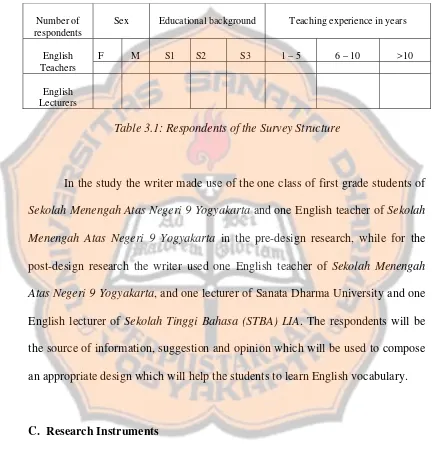
Table 3.1 Respondents of the Survey Structure……… 48
Table 3.2 Descriptive Statistic of the Respondents……….. 52
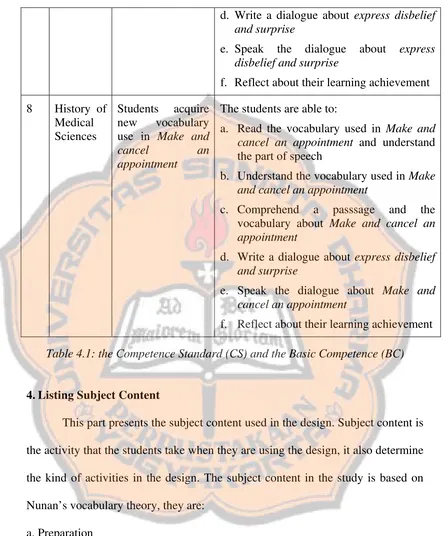
Table 4.1 The Competence Standard (CS) and the Basic Competence
(BC)………..…… 60
Table 4.2 Description of the Respondents……… 76
Table 4.3 Data Presentation……….. 77
LIST OF FIGURES
Figure Page
Figure 2.1 Diagram of Kemp’s Model………... 17
Figure 2.2 Farrington’s Triangular Model………. 30
Figure 2.3 The Writer’s Design Model………. 41
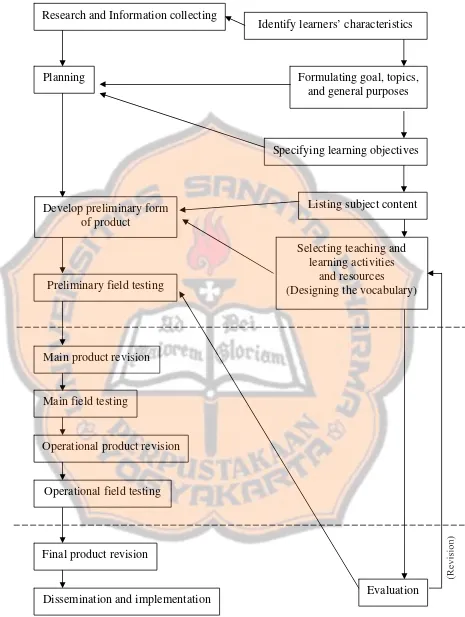
Figure 3.1 Comparison between R & D and the Steps Adapted from
Kemp’s Model………. 45
Figure 3.2 Research Procedure in Material Design……….. 55
Figure 4.1 Flowchart of the Website……… 68
ABSTRACT
Anjarmoko, Matius Hebi. 2009. Designing a Set of Web-based English Vocabulary Supplementary Materials for the First Grade Students of Sekolah Menengah Atas Negeri 9 Yogyakarta. Yogyakarta: English Education Study Program, Sanata Dharma University
Vocabulary learning is important in English learning because by learning English vocabulary, the students will have a greater chance to understand and use English. The problems for students when they are learning English vocabulary are that they do not have enough time to practice, the materials are not various, and the vocabulary exercises are not interesting. Seeing the problems, the writer tried to make use of computer alongside with Macromedia Dreamweaver™ as the programming software to create a website which serves more attractive and interesting English vocabulary learning materials. The materials in the study are developed based on School Based Curriculum or KTSP (Kurikulum Tingkat Satuan Pendidikan) since the materials are supplementary materials which mean that the materials are used to supplement or add the existing vocabulary materials in school. The abstract will elaborate the problems formulated in problem formulation.
There are two problems formulated in the study, first is that how a set of web-based English vocabulary supplementary materials for the first grade students of Sekolah Menengah Atas Negeri 9 Yogyakarta is designed and what a set of web-based English vocabulary supplementary materials for the first grade students of Sekolah Menengah Atas Negeri 9 Yogyakarta looks like.
To answer the first question, the writer used the six (6) steps which were adapted from the Research and Development (R & D) and Kemp instructional design. Research and Development in this study is used as the umbrella for the design, while Kemp is used as the umbrella for the material design. The result of the adaptation was (1) Identifying learners’ Characteristics, (2) Formulating goal, topics, and general purposes, (3) Specifying learning objectives, (4) Listing subject content, (5) Selecting teaching and learning activities and resources, and (6) Evaluating-Preliminary field testing. The writer also made use of survey study using questionnaires to gain respondents’ opinion(s), suggestion(s), and comment(s). The result of the survey study will be used to revise and improve the design materials.
The second question is answered through the presentation of the design materials. There are 8 units in the design, each unit is divided into 4 subject content, and they are Preparation, Vocabulary Focus, Learning from Input and
Output, and Reflection.
As the final remark, the writer hopes that the design of a set of web-based English vocabulary supplementary materials for the first grade students of Sekolah Menengah Atas Negeri 9 Yogyakarta will be useful for students to improve and enrich their English vocabulary and also for teachers in teaching English vocabulary.
ABSTRAK
Anjarmoko, Matius Hebi. 2009. Designing a Set of web-based English vocabulary supplementary materials for the first grade students of Sekolah Menengah Atas Negeri 9 Yogyakarta. Yogyakarta: Program Pendidikan Bahasa Inggris, Universitas Sanata Dharma
Pembelajaran kosakata merupakan hal yang penting dalam belajar Bahasa Inggris, karena dengan belajar kosakata Bahasa Inggris, siswa memiliki kesempatan yang lebih besar untuk memahami konteks Bahasa Inggris. Masalah yang dihadapi siswa dalam belajar kosakata Bahasa Inggris disebabkan oleh beberapa hal, yaitu karena kurangnya waktu belajar kosakata, materi tidak bervariasi dan kegiatan pembelajarannya tidak menarik. Berawal dari masalah tersebut, penulis mencoba menggunakan komputer dan program Macromedia Dreamweaver™ untuk menciptakan sebuah website yang dapat memenuhi keinginan siswa akan materi pembelajaran kosakata Bahasa Inggris yang menyenangkan dan menarik. Materi yang digunakan dalam studi ini semuanya didasarkan pada KTSP (Kurikulum Tingkat Satuan Pendidikan), hal ini dikarenakan materi yang disajikan merupakan materi tambahan yang berarti materi yang digunakan berupa sajian tambahan untuk materi kosakata yang diajarkan di sekolah. Abstrak ini akan membahas mengenai dua masalah yang ada pada rumusan masalah.
Dalam studi ini disajikan dua (2) masalah utama, yaitu bagaimana cara merancang seperangkat materi kosakata tambahan berbasis web untuk siswa kelas X Sekolah Menengah Atas Negeri 9 Yogyakarta dan bagaimana penyajian seperangkat materi kosakata tambahan berbasis web untuk siswa kelas X Sekolah Menengah Atas Negeri 9 Yogyakarta.
Guna menjawab pertanyaan pertama, penulis menggunakan 6 langkah yang diadaptasi dari Research and Development (R & D) dan Kemp instructional design. Pada studi ini Research and Development digunakan sebagai payung utama pada perancangan desain, sedangkan Kemp digunakan sebagai payung untuk merancang materi pada desain. Hasil dari adaptasi R and D dan Kemp adalah sebagai berikut: (1) Melaksanakan identifikasi karakteristik siswa, (2) Merumuskan tujuan khusus, topik, dan tujuan umum, (3) Menentukan tujuan pembelajaran, (4) Membuat urutan subjek isi, (5) Menentukan jenis kegiatan belajar mengajar, (6) Evaluasi-Uji coba lapangan awal. Penulis juga melaksanakan survei menggunakan kuesioner untuk mendapatkan opini, pendapat, dan komentar dari responden. Hasil dari survei sangatlah penting untuk memperbaiki dan menyempurnakan desain materi.
Selanjutnya, penulis menyajikan bentuk desain materi yang telah disusun guna menjawab pertanyaan kedua. Ada 8 unit yang disajikan dalam desain ini dan semuanya dibagi menjadi 4 subjek isi, yaitu Persiapan, Fokus pada Kosakata, Belajar dari Input dan Output, dan Refleksi.
Sebagai penutup, penulis berharap bahwa desain seperangkat materi kosakata tambahan berbasis web untuk siswa kelas X Sekolah Menengah Atas Negeri 9 Yogyakarta dapat berguna bagi siswa untuk mengembangkan dan
memperkaya kosakata Bahasa Inggris mereka dan bagi guru dalam pengajaran kosakata Bahasa Inggris.
CHAPTER 1 INTRODUCTION
This chapter covers the description of the topic; the problems of the study,
the focus of the study and the advantages of the study. Systematically, chapter one
covers The Background of the Study, Problem Identification, Problem Limitation,
Problem Formulation, The Objectives of the Study, The Benefits of the Study, and
The Definition of Terms.
A. The Background of the Study
“Vocabulary is central to language and of critical importance to the typical
language learner” (Coady, 1997, p.5). It means that vocabulary is not just a matter
of understanding words and its implementation but more on the main concern in
English as a Second Language (ESL). Learning vocabulary can be the first step
for ESL students to learn the basic of English, because by having the ability to
master English vocabulary, students will be easier to understand and use English.
Students nowadays demand their learning activities to be more interactive and
interesting so they will be easier to learn English vocabulary. The challenge is to
provide the students with the method which is appropriate to their expectations.
Computer may become the answer, using computer, students will be provided
with more attractive features in learning English, they will be able to perform
self-learning activities and these features will help them to be independent
learners. Using computers, teachers may put any materials which are appropriate
to objectives and they can create an easier way of teaching which is based on the
present curriculum. Using computer as the basis for exercises, students will be
easier to absorb the materials because the learning activities will take place on the
computer instead of inside the traditional class which mostly makes them lack of
motivation to learn.
The basis for learning and exercising vocabulary to improve students’
achievement is by means of computer. The computer is hoped to help students to
create motivation toward vocabulary learning. Using computer the students can
also expose themselves more on the vocabulary materials they are learning.
Computer was first designed for military purpose to protect highly important
documents from their opponents. With the end of the war world II, people were
trying to develop computer for other purposes. Since then, computer was
developing very fast and now computer has become a part of human activities and
used for numerous aspects in life. For many years, people are trying to develop a
technique to teach English to students and finally, they come up with the use of
computer to help students in learning English. Started from 1960s, computers
were used for language teaching “Computers have been used for language
teaching since the 1960s” (Warschauer and Healey, 1998, p.57), but it was only
used for certain educational purposes. Starting from that moment, people were
trying to develop technology which could help students and teachers to find
suitable method to teach and learn English. Then, researchers proposed the
Computer Assisted Language Learning (CALL). Through CALL the teaching and
computer has been a way to solve students’ problem in learning languages.
Nevertheless, technology is made to help humans accomplish their duties.
The learning process through the use of computer will be in two (2) ways,
online and offline. Using the online process, the students will need to connect
their computers to Internet Service Provider (ISP) or other computers which have
the Internet Service Provider. The online connection allows students to use the
design anytime and anywhere they want, this is because the materials are already
provided in the website and students are only to open the address of the website.
Besides the online connection, the offline connection is also being used in the
design. Offline connection demands the students to use their computers only
without having to connect their computer to the Internet Service Provider. Offline
connection allows student to learn using their computers. The form of the software
will still be in form of a website page but it is bundled into Compact Disc (CD),
this is done to make the students easier to use the website. In the design, the
features used in online and offline connection are the same; there are no extreme
distinctions used in both connections.
The focus of the research is that the designing application using the
programming software used to teach vocabulary for the first grade students of
Sekolah Menengah Atas Negeri 9 Yogyakarta provides the features needed to create a more attractive vocabulary learning design and help the students to have
more exposure on vocabulary materials so that they can do exercise themselves to
achieve better vocabulary mastery. There are many programming softwares that
Macromedia Flash™, Java scripting™, Delphi™, which each has its own
characteristics. The programming software used in the study is the Macromedia
Dreamweaver™. The writer uses the Macromedia Dreamweaver™ as the
programming software because the software is easy to apply, it has the features to
create a more attractive design, and moreover, it has the characteristics which
allow beginner users to learn the software independently. The programming
software also enables teachers to design their own materials based on students’
needs and the present curriculum.
B. Problem Identification
The lack of vocabulary materials in class has created teacher to have less
focus on the vocabulary teaching and learning. Teachers tend to use the
vocabulary which is included in the book, teachers exercises their students mainly
using the vocabulary exercises in the book. This situation has undervalued
vocabulary teaching and learning in class and it will create the analogy that
vocabulary is difficult. This is because of when the vocabulary is being
undervalued, vocabulary teaching and learning will tend no to be maximum and
students will have many problems dealing with English vocabulary.
“Teaching and learning of vocabulary have been undervalued in the field
of second language acquisition (SLA) throughout its varying stages and up to the
present day” (Zimmerman as cited by Coady, 1997, p.1). Since vocabulary is
undervalued and considered the second, the teaching and learning of vocabulary is
when they are teaching vocabulary to their students which makes the students
unmotivated to learn. When students are not motivated, they seldom understand
materials they are learning. Creating attracting materials can help the situation
from happening. Zimmerman also explains that:
Most second language learners have traditionally been taught by methods that gave minimal attention to vocabulary. Consequently, it seems reasonable to expect that most teachers will also continue to neglect vocabulary, whether it is because of the methods by which they have learned or the method by which they are teaching. (Zimmerman as cited by Coady, 1997, p.273 – 274)
The perception is clear, in the implementation of vocabulary learning, most
teachers and learners neglect the vocabulary learning for they think it is not very
important no matter what method they are using. They always consider that
vocabulary is just learning and memorizing list of words.
For most students of senior high school, vocabulary is regarded difficult.
“In learning a second language, you will find that vocabulary is comparatively
easy, inspite of the fact that it is vocabulary that students fear most. The harder
part is mastering new structure in both content comprehension” (Gleason as cited
by Carter, 2000, p.184). It is true that vocabulary is difficult for students who are
lack of exposure in comprehending vocabulary, they seldom get any
comprehension activities which are very helpful in learning vocabulary. “It is
exceptionally difficult to teach an organized syllabus of both grammar and lexis at
the same time.” (Sinclair and Renouf, 1998 as cited by Coady, 1997, p.273). They
say that we cannot do grammar and vocabulary teaching at the same time for it is
little exposure to vocabulary teaching and learning, which will lead the students to
the inability to understand and master the vocabulary for their English learning.
C. Problem Limitation
The study deals with the designing of a set of web-based English
vocabulary supplementary materials for the first grade students of Sekolah Menengah Atas Negeri 9 Yogyakarta. It covers the materials and the activities used in the study. The study also focuses on the kinds of exercises which are used
in the design using the software. The design of vocabulary exercise activities will
be the main issue in the study to serve more attractive and interesting learning
activities.
D. Problem Formulation
The formulation of problems which are concluded from the main problems
of the design is as following:
1. How is a set of web-based English vocabulary supplementary materials for
the first grade students of Sekolah Menengah Atas Negeri 9 Yogyakarta
designed?
2. What does a set of web-based English vocabulary supplementary materials
for the first grade students of Sekolah Menengah Atas Negeri 9 Yogyakarta
E. Research Objectives
The objectives of the study are based on the questions in the problem
formulation. First, is to answer how a set of Web-based English vocabulary
supplementary materials for the first grade students of Sekolah Menengah Atas Negeri 9 Yogyakarta to create more attractive and motivating vocabulary learning activities for students is designed. Second, the writer intends to present the design
of a set of web-based English vocabulary supplementary materials for the first
grade students of Sekolah Menengah Atas Negeri 9 Yogyakarta.
F. Research Benefits
The study will give benefit to teachers and the first grade students of
Sekolah Menengah Atas Negeri 9 Yogyakarta. The benefits of the study are it can help teachers to create more attractive and motivating vocabulary teaching
activities and help students to be more motivated in learning vocabulary which in
turn will help them understand and use English. Another benefit of the study is
that a set of web-based English vocabulary supplementary materials for the first
grade students of Sekolah Menengah Atas Negeri 9 Yogyakarta would create different learning atmosphere and increase students’ achievement toward English
vocabulary.
G. Definition of Terms
The study includes some terms related to the design and it is important for
Exercise, Vocabulary, First Grade Students of Senior High, Computer Assisted
Language Learning (CALL), and Software.
1. Design
‘The entire process of analysis or learning need and goal and the
development of a delivery system to meet the needs; includes development
of instructional materials and activities; and try out and revision of all
instruction and learner assessment activities” (Briggs, 1977, P.xx). Design
is very important in the study because it determines the materials and helps
in the process of designing the English vocabulary materials. The writer
has the main role to elaborate the vocabulary materials in order to achieve
the main purpose of the study.
2. Web-based
Ritter & Stevens gives the description of web-based as “The delivery of
and access to a co-ordinated collection of learning materials over an
electronic medium using web server to deliver materials, a Web browser to
access them…” (Ritter and Stevens, 2000, p.8). Web Based is the way to
help students to learn language, in this case English language, through the
use of online service.
3. Vocabulary
Vocabulary is one of the English elements which help students to achieve
the language skills. In this study, vocabulary is a list of words which
that vocabulary is more than lists of target language words. As part of the
language system, vocabulary intimately interrelated with grammar.
4. First Grade Students of Senior High
First Grade Students of Senior High is defined in KTSP / School Based
Curriculum as the X grade students. The first grade student of senior high
is about 15 – 16 of age. They are considered to have the basic skill of
English from their previous educational level.
5. Computer Assisted Language Learning
“Computer assisted language learning or CALL is defined as the search for
and study of applications of the computer in language teaching and
learning” (Levy, 1997: 58). The implementation can be in form of online
and offline connection. Online connection is the condition where your
computer is connected to the internet “If you have and internet connection,
you can use the wide range of online connection” (Ivens,
http://books.google.co.id/books?id=wACFGD3cIfoC&pg=PT334&dq=wh
at+is+online+connection%3F&lr=). Offline on the other hand is the
condition where the computer is not connected to a network of computers
or internet service.
6. Software
Software is defined as “Any program or routine or any sequence of
machine-readable code that is designed to cause a computer to perform a
desired function or set of functions, and the documentation required to
http://books.google.co.id/books?id=wA8prxoGgvYC&pg=PA1207&dq=c
CHAPTER II THEORETICAL REVIEW
This chapter discusses the theories underlying the study. In this chapter,
the writer serves two major points of the discussion. The first deals with the
Theoretical Description which includes the instructional design, the teaching and
learning of vocabulary, the senior high school English curriculum grade X,
computer assisted language learning (CALL), and Macromedia Dreamweaver™
application. The second part deals with Theoretical Framework in designing a set
of web-based English vocabulary supplementary materials for the first grade
students of Sekolah Menengah Atas Negeri 9 Yogyakarta.
A. Theoretical Description
This part serves the theoretical background of the instructional design, the
teaching and learning of vocabulary, the senior high school English curriculum
grade X, computer assisted language learning (CALL), and Macromedia
Dreamweaver™ application. The theory of instructional design is be used to show
the plan of the instruction used in the design and to give illustration about the
elements which are going to be used in the instruction. The theory on vocabulary
deals with the teaching and learning of vocabulary and also the theory on
Computer assisted Language Learning (CALL). The curriculum presents in this
part is the School Based Curriculum or the Kurikulum Tingkat Satuan Pendidikan (KTSP) and it is used as the basis in creating the design.
1. Instructional Design Model
In this part, the study uses Kemp’s model of instructional design. The
model will contribute to the instructional design in the designing of the
instructions used in the study.
a. The Nature of Kemp’s Model
The instructional design approach by Kemp (Kemp, 1977: 8-9) is the
model which supplies the approach and procedures in order to design instructions
used in all educational level. The design of the approach is the first step before
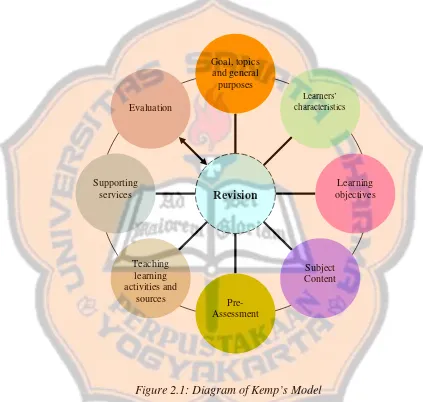
conducting the teaching activities. There are 8 elements that need to be required in
planning the instructional design. The eight elements are flexible, meaning that
you can start with the element that you are ready with and you can follow the
sequence or just pick an element and start to work on it. The eight elements are
(a) Goal, Topics, and General Purposes, (b) Learners characteristics, (c) Learning
Objectives, (d) Subject Content, (e) Pre-Assessment, (f) Teaching or Learning
Activities and Resources, (g) Support Services, and (h) Evaluation. The
explanations of the 8 steps are as follows:
1) Goal, Topics, and General Purposes
The designer starts with the goal of the instructional design. The goal is
required in developing the educational system to achieve the purpose of
the activity. After finding the goal, the next step is to list the topics. The
topic then becomes the basis for the instruction. General purposes are used
to explain the topic and then to serve the objectives in order to understand
2) Learners characteristics
The importance of knowing learners’ characteristics in the instruction is
very important. The information will be a great help in implementing the
instruction and to assist the students. Learning learners’ characteristics is
by identifying learners’ characteristics, capabilities, needs, interests, etc.
That information obtained from the students will affect the choice of
topics and sequencing the objectives. Other factors which may affect the
design are learning condition and learning style. Learning condition refers
to groups of factors that can affect a person’s ability to concentrate,
absorb, and retain information. Those learning conditions which are
needed to be considered in designing the learning activities are physical
environment (light, sound, etc), the emotional environment (responsibility
and individual motivation), sociological environment (preference of group
work, etc, and students physiology (need of food, weakness and strength).
Learning style refers to the method used by students in their learning
activities.
3) Learning Objectives
The designer decides that the learning objectives are needed to plan the
behavioral objectives that want to be achieved and to be determined in
order to fulfill what we want to accomplish with the learning. Objectives
are also important to make the students understand about the achievement
and the performance of the learning activities. It is also to make the
the most important part in designing instructional design because it
decides the instructional activities in class and roles as the main control of
the activities. There are three Objectives in learning; they are cognitive
domain, psychomotor domain, and affective domain. Cognitive domain
mainly concerns at the area of knowledge or information, and thinking.
This area covers the brain which learners use to save their knowledge or
information they receive. Psychomotor domain covers the movement part
and this part requires the use and coordination of skeletal muscle, and the
physical activities hold the role of performing, manipulating, and
constructing. While the affective domain concerns about attitudes,
appreciations, values, and all emotions.
4) Subject Content
The designer lists the subject content which is closely related to the
objectives and the students’ needs. Subject content is considered as the
traditional starting point for teachers. Kemp gives four questions to help
selecting the subject content. The four questions are: first, what
specifically must be taught or learned in this topic?. This question
specifies the materials that the students need to gain the objective. Second,
what facts, concepts, and principle relate to this topic?. The question
contains about the basis for the process and to make sure that the process
that we have is on the appropriate basis. Third, what steps are involved in
necessary procedures relating to this topic?, the question implies the
about the ‘track’ of the process. Fourth is what techniques are required in
performing essential skills? After having all the three criteria above, the
designer will have to state the technique or techniques to be used in the
process.
5) Pre-Assessment
The designer makes pre-assessment in order to know students’
achievement level on a subject. Pre-assessment is meant to identify
students’ knowledge and to help planning the learning activities using the
data gained from the pre-test. Pre-assessment also serves as a tool to help
teachers organizing learning materials so the students will not waste their
time on things they already know. Kemp suggests that it is important to
consider on what extent each student has acquired the necessary
prerequisites for studying the topic and what the students may have
already mastered about the subject to be studied. The designer needs to
know the level of the learners before continuing the process, whether they
have the prerequisite requirement before stepping to the next level. The
second is to make sure that the students will not learn the same thing twice
which will be kind of wasting time. By knowing their background
knowledge, designer can just simply reinforce the knowledge they already
have.
6) Teaching Learning Activities and Resources
The next step is deciding the teaching learning activities and resources that
must determine the most efficient and effective methods and then select
materials to provide learning experiences that will utilize the content
associated with each objective. Choosing the methods and strategies may
become something difficult because one method may work for particular
students, but if it is used in other group of students, it might not work.
Kemp provides 10 principles in learning taken from B.E Skinner and
colleagues who both are psychologists. The principles are pre-learning
preparation, motivation, individual differences, instructional conditions,
active participation, successful achievement, knowledge of results,
practice, rate of presenting material, instructors’ attitude
7) Support Services
Support services are the supplementary elements in designing the learning
activity. Some designers often neglect the use of services until they are
ready to use it. Support services include funds, facilities, equipment, and
personnel. Those services are very crucial in the implementation of the
program so the program will not be a monotonous program. To use the
support services, we need to consider the instructional plan. This is to
create a supporting service which will work with the instruction.
8) Evaluation
The designer sets the evaluation to judge students’ achievement on the
subject. Evaluation is conducted when the students have finished the
purposed materials and they are ready to do the evaluation. Evaluation also
objectives. Once you are satisfied with the extent and completeness of the
learning objective, you are ready to work on ways to evaluate them.
The eight (8) elements are related to one another and they are coherent in terms of
the implementation in the instructional activity or learning activity.
Evaluation
Supporting services
Teaching learning activities and
sources Pre- Assessment
Subject Content
Learning objectives Learners’
characteristics Goal, topics
and general purposes
Revision
use of Ke tional model to deal
with th mp’s mo
theoretical framework
Figure 2.1: Diagram of Kemp’s Model
In this study the writer made mp’s Instruc
e materials which are presented in the design. Ke del is chosen for
its flexibility since the writer may start from any cycle in the model. Further
2. Teaching and Learning Vocabulary
“The most fundamental guiding principle [for] those who are anxious to be
this: Memorize perfectly the largest number
ss attractive. Students often
find th
proficient in foreign conversation… is
of common and useful word-groups!” (Palmer as cited by Nunan, 2003, p.130). The statement states that vocabulary teaching and learning is important in
the acquisition of any language because of by having sufficient vocabulary,
students will be able to acquire the intended language better. The same way will
also happen in learning English language, we need to learn the English vocabulary
since it is the central point in acquiring the English language and by doing so
learners will have greater chances to acquire English language. By understanding
the vocabulary used in English, students will find it easier to absorb the materials
and if they do, it will motivate them to learn English.
The problem faced in teaching and learning vocabulary is that the
materials used in teaching and learning materials are le
at their vocabulary learning activities are boring since the materials and
media used are less attractive to students, this situation creates students with less
motivation. When students have little motivation toward the activities that they
are working with, they will tend to put less attention to the activities. Another
problem which is being faced is the lack of exposure. In class, students seldom
have vocabulary exercise activities as their vocabulary exposure and they also
have little time to practice themselves learning vocabulary during their English
a. Background to the Teaching of Vocabulary.
In teaching vocabulary, we need to consider four (4) strands of teaching
vocabulary; the four strands are (Nunan, 2003, p.133-134):
at least three-quarter
that does not include in the
1). Learning from meaning- focused input
This involves the ability to know most of the words that are
going to be used in the activity. By knowing
of the words, the other words
uarter part will be understood by guessing from its context.
This first steps involves learning from listening and reading.
iberate language-focused learning
Deliberate learning is the activity of focusing the
vocabulary learning to factors outside the context, like so
pronunciation, spelling, gramma
s will help learners to understand, especially to memorize
words easily.
rning from meaning-focused output
Learning from meaning-focused output involves the
activity of us
vocabulary is not just reading from
hrough the implementation of the words. When we learn
vocabulary by producing it, the words that we are learning will stay
written way; learners will be able to memorize it well through their
experience of using it.
eloping fluency
Developing flu 4). Dev
ency is done through the four skills,
g, reading, and writing. Those four skills need to
be used
Learners need to focus their vocabulary learning on the most useful
the high frequency words are
words
listening, speakin
in developing fluency, but in the implementation, learners
have to develop independently on each skill. In developing
fluency, learners need to use the language items (grammar,
spelling, etc). Learners need to notice th t in the process of
developing fluency, they have to do it in steps meaning that they
have to make it one step faster then the previous practice.
or Teaching Vocabulary
port the four strands in teaching vocabulary, there are princ
teaching vocabulary. Principles for teac
g vocabulary is applied to help students to learn English. The principles
are:
1) Focus on the most useful vocabulary first.
vocabulary first. The useful vocabulary or
which are often used in texts rather than low frequency words.
“Teaching useful vocabulary before less useful vocabulary gives learners
the best return for their learning effort” (Nunan, 2003, p.135). For
do for you?, indicating purpose as in go for a walk, indicating destination as in Is this bus for Chicago?, indicating reason as in Please take care of her for my sake, etc. Compare the word for with the word glee, it is used to express a feeling of great delight that makes one want to laugh, for
example He chuckled with glee at the little joke he was about to make
(Hornby, 1995, p.459 and 502).
Focus on the vocabulary in the most appropriate way.
Focusing on the strategy in le
2)
arning vocabulary can be a good way
using word parts,
guessin
3)
order for learners to be able to involve communicatively on the
four strands (listening, reading, speaking, and writing). to achieve more vocabulary. Those strategies are
g from context, using word cards, and using dictionaries. Using
word parts like prefixes and suffixes to help learner to understand low
frequency words. The next strategy is guessing from context. Using high
frequency words, the learners are able to guess the words which are
included in low frequency words. Cards can also be used to learn
vocabulary, learner may use card to write the vocabulary on one side and
the other side is for the translation. Then the card is kept and can be used
anytime learners want to read or learn the vocabulary. The last strategy is
using dictionaries to acquire vocabulary.
Give attention to the high frequency word across the four strands of a
course.
The four strands in English should pay attention the high frequency
4) Encour
rning. “Taking the
of
options
c. Selec
selecting what words to teach. The selection is done on the idea that the words
should be appropriate and useful for their English
easily test (e.g. a, the, of,
then to choose every tenth word if this will give age learners to reflect on and to take responsibility for learning.
The final principle suggests learners to be responsible on their own
learning since they are the main part of vocabulary lea
responsibility requires (1) the knowledge of what to learn and the range
for learning vocabulary, (2) skill in choosing the best options, and
(3) the ability to monitor and evaluate progress with those option” (Nunan,
2003, p.140).
ting Vocabulary
The initial step for conducting the vocabulary teaching and learning is
which students will learn
language acquisition. Selecting the vocabulary used in the exercises need careful
attention because it will affect the output of the design.
In order to have good selection of words, we need to pay attention to the
following steps as proposed by Nation:
1) First, we must exclude all the words that cannot
be, etc). In fact the test will be easier to make if we test only nouns, verbs, adjectives, and adverbs.
2) Second, after we have excluded the words we cannot test, we must find a
good way of choosing the test items from the words left. The best way is
to number the words and
d. The
ard the use of students’ native language in
the vocabulary learning. It says that teaching vocabulary using students’ native
ther tongue takes time which
could b
unimportant word in a reading text. When teacher’ goal is to help the
the unimportant word in text, translation
2)
various types of words will be easier
ber of translation to help students to
3)
they have understood something which was presented in another way. The
Importance of Students’ Native Language
There are some criticisms tow
language will be a waste of time “The use of the mo
etter be spent in using English” (Nation, 1990, p.52-53). It surely states
that using students’ mother tongue will cut the time allocation used to teach
vocabulary. Despite the criticism above, Nation has found some advantages of
that using the students’ native language to teach vocabulary. Those advantages
are:
1) Translation can de done quickly
The speed of translation is an advantage if teacher wants to pass over an
students by avoiding explaining
using students’ native language will be a good way because teacher can
save time used to explain the unimportant word so the important word will
have greater time to be explained.
Translation is not limited
It can be used to explain many different types of words. Using students’
native language the teaching of
because it allows unlimited num
understand the English vocabulary.
use of students’ native language will help teacher to decide whether the
teaching process of vocabulary is successful or not, because using students‘
From
greate
langua
tudy the writer made use of principles in teaching and learning
as cited by Gargiulo, http://books.google.co.id
C&pg=PA208&lpg=PA208&dq=curriculum%3Bdefniti
on&sou
native language, students will be easier to give respond and comment to the
teacher.
the above advantages it is clear that learning English vocabulary will have
r chances to be acquired by students if the usage of students’ native
ge is considered important in the teaching and learning process.
In the s
vocabulary proposed by Nation. The theory will be the basis in developing the
materials in the design
3. English Curriculum
“A series of carefully planned and designed activities, events, and
experiences intentionally organized and implemented to reach specified objectives
and goals…” (Dunst
/books?id=Qkdp_O35Xig
rce=bl&ots=SDwJp7jQf2&sig=Gj0iAm-WQIepmgCua9y60C9Vw&hl=id
&ei=ete1SeiYJpz-6QOl7ZSiCQ&sa=X&oi=book_result&resnum=5&ct= result).
Curriculum plays major role in learning process because curriculum provides
constraints and rules to design syllabi which will be used to develop learning. In
designing a syllabus, we need to refer to curriculum in order to create a design
which appropriate to the curriculum’s objectives and the level of students.
their own curriculum which is appropriate to their schools’ condition, this to
create an effective curriculum because each school has different condition and
demand. By using their own curriculum, the schools can achieve the objectives of
learning. KTSP also demands the learning process to be more student-centered, meaning that the materials and activity is directed to help students to be more
active and independent. The purposes of KTSP are to develop communicative competence in written and spoken to achieve informational literacy level, to
understand the importance of English in order to enhance competitiveness in the
global society, and to develop students’ understanding on the correlation between
language and culture. From the purpose above we can conclude that KTSP is directing material designers to help learners to understand English language
merely not as a new input to their knowledge of language but it is more on how
the language connects them to the real world and to broaden their knowledge
about the variety of cultures the English language has. KTSP also helps the teaching and learning activities of English to be more effective by not only
focusing on how to us English in written and spoken but it gets deeper to that the
learners will learn the basic construction of English language through its culture
and its use in global scope.
Teaching vocabulary in school using computer as the assisted exercise media will
be based on the objectives of KTSP. The implementation of the design will help the students gain more vocabulary which will help them learn English better. The
program is designed in order to help students to have more attractive materials
The pr
ocabulary since the materials are the same with the materials they
are lear
The design uses the supplementary materials to indicate its materials since
the materials designed in the study are the additional materials to the students’
main materials which they have learned in class. The basis for developing the
supplementary materials is to help the students to have more exposure on their
o, the writer designs materials which accomodates ogram is also designed to help students to have more exposure to
vocabulary materials in form of exercises. It is also to help students to compete in
global society. By having broader knowlegde of vocabulary, students will be
easier absorbing new vocabulary in English since they have already had the
competence.
In this study the writer made use of the School Based Curriculum or
Kurikulum Tingkat Satuan Pendidikan (KTSP) for the first grade students of senior high school to acquint the design with the objectives stated in KTSP. The purpose is to help the students to achieve the same result and to ease them in
learning the v
ning in class.
4. Supplementary Materials
English vocabulary and to do s
their vocabulary materials which they have learnt in class. Desingning
supplementary materials will also make sure that the students will achieve the
same objectives with the school.
In the study the writer made use of supplementary materials since the
students have learnt in class. Desigining the supplementary materials will also
help the students to learn more on the English vocabulary because the students are
plications of computers for
ent implies that the use of
mpu
1) Computer gives individual attention to learners
generally adapts the
ear of being ridiculed exercising the same topic they have learnt in class.
5. Computer Assisted Language Learning (CALL)
“Recently, though, computers have become so widespred in schools and
homes and their uses have expanded so dramatically that the majority of language
teachers must now begin to think about the im
language learning” (Warschauer, 1996, p.1). The statem
co ters in school is possible, this makes teachers start to give signal to the
implemention of computer in their teaching and learning process. Below we will
see the advantages of computer in language teaaching and also the role of
computer in CALL
a. The Advantages of Computer in Language Teaching
The use of computer in language teaching offers several advanteges as stated
by Kenning (Kenning, 1983, p.2-3). The advantages are:
2) It guides the learners toward the correct answers and
material to his or her performance
3) It offers privacy, which relieves learners from the f
for the mistakes by their classmates.
4) Computer is patient and will tirelessly go over the same points for as long
5) Computer is consistent, unbiased, and has no “Off days”
6) For teachers, computer offers the opportunity to make better use of their
we can see that the implementation of computer in
and students.
The use of computers in class has brought technology as a tool to help
learners to achieve better result in their learning in their effort to acquire English
language. “Chapelle and Jamieson have long suggested that research on
ant in language acquisition”
(Warsc
“To function as a tutor in some subject, the computer must be computer presents some subject material, the student responds, the computer evaluates the response, and from the results of the evaluation, time and expertise
Seeing the advantages above,
vocabulary teaching will provide many advantages to the teachers
b. The Role of Teachers and Computer in CALL
computers incorporate the areas known to be relev
hauer and Healey, 1998, p.63). Using computer to acquire English
language is by means of CALL. CALL is one of the form which computer is
applied in the language teaching and learning. the use of CALL provides the
learning activities with a program/software to enhance the learning process.
Computer in CALL is developed to help students by providing independent
exercises and useful feedbacks. The materials and exercises used in CALL are
made on the basis of students’ level. The process in CALL promotes learners to
be independent with their learning process and helps providing enough practises.
The role of computer in call is divided into 3 functions, as tutor, tool, and
tutee.
determines what to present next. At its least, the computer keeps complete records of each student being tutored...
To function as a tool, the computer need only have some useful capability programmed into such as statistical analysis, super calculation, or word
It is cl
tutoring the students but also as tool and tutee. As tutor, computer helps students
to lear
merely he program. Computer
“assisted”, i.e. a servant, since it functions only as an assistant in language
the teacher’s position, it is totally dependent on the teacher in many ways: for an to tation the teacher. That is, it is the teachers who can make various roles. Without the teacher, the computer will
w 0
Using
loose
processing. The learner can then use it to help them in a variety of subjects...
To use the computer as tutee is to tutor computer, for that, the student or teacher doing the tutoring must learn to program, to talk to the computer in a language that is understands.” (Levy, 1997, p.83)
ear that the function of computer used in CALL is not only a matter of
n language and evaluate their performance, as tool, computer is used as
a device to analyze students’ progress and to run t
as tutee helps both teachers and students to create a program which supplies their
needs, this will need sufficient programming skill. The role of computer in
learning process will influence the process and also the output of the learning.
The role of teachers in Computer Assisted Language Learning is not
completely being omitted.
As the name Computer-Assisted Language Learning suggests it is
learning. Its role in education is that of a medium. Far from threatening
example, it is unable to created educational materials without a hum direct it. All the language material and instructions for its presen must be specified by
the computer assume
be powerless. (Jia Yi-Dong, ww.linguist.org.cn/doc/uc2007 8/uc 20070811.pdf)
computer as the main part of the activities does not mean that teachers
contrib
implem L depends very much on the extent to which the teacher
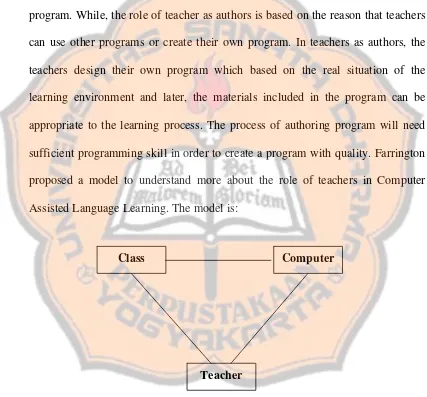
Figure 2. 2: Farrington’s Triangular Model (Levy, 199, p. 101)
arrington’s Triangular model illustrates that there are class, computer, and
odel proposed that the role of computer is as tool and it enables utor and author. Teachers as contibutors mean that their “Actual
entation of CAL
has been envisioned as having a significant role to play” (Levy, 1997, p.100).
Teachers as contributor contributes to the process of learning by providing
suggestions, and additional explanation which computer does not include in the
program. While, the role of teacher as authors is based on the reason that teachers
can use other programs or create their own program. In teachers as authors, the
teachers design their own program which based on the real situation of the
learning environment and later, the materials included in the program can be
appropriate to the learning process. The process of authoring program will need
sufficient programming skill in order to create a program with quality. Farrington
proposed a model to understand more about the role of teachers in Computer
Assisted Language Learning. The model is:
Class Computer
Teacher
F
teacher to have full control over the learning process and teacher holds most of the
learning
styles, it is certainly not a complete substitute for a teacher since there are ubtleties for any specific learning style. It is the teacher who can cope with different learners in terms of their different motivations,
ers are still playing the important part of the process in
Compu
ls, a Web browser to access them and the TCP/IP and
HTTP protocols to mediate the exchange” (Alan, Ritter and Stevens, 2001, p.8). process.
The role of teacher in CALL is important since teachers provide things
that computer do not.
While the computer is able to accommodate a substantial range of learning
still some s
emotions (e.g. anxiety), learning strategies, etc. (Jia Yi-Dong, www.linguist.org.cn/doc/uc200708/uc20070811.pdf).
It indicates that teach
ter Assisted Language Learning. During the learning process, teachers
the interpersonal and intrapersonal connection with their students which
ll the gap where computers can only exercising and giving feedback.
Implementing CALL to support language learning process to learners should not
neglect the role of teachers and other elements in traditional classroom.
In the study the writer made use of Computer Assisted Language Learning
(CALL) as the theory in developing the computer program which will be applied
in class. The theory of CALL underlies the role of computer in class and the most
important thing is it states the role of teacher in class since the activities
c ter as the media.
c. Web-based Learning
The tem web-based learning is defined as “The delivery of and access to a
co-ordinated collection of learning materials over an electronic medium using web
The above citation explains that web-based learning is a way to provide learning
materia
ers accessibility
ss the materials since the
d as the students or learners visit website.
3)
ily update their materials in
th the students’ or learners’ needs.
4)
ust to run
hey will be able to open or run the ls to student through the use of internet services. Using the internet
services the students would be able to access the materials anywhere and anytime
where internet services are available. Website also offers students with sources
which serve less cost of learning since students do not have to buy books or
programs to access the learning materials. This is also the main concern in the
implementation of web-based learning in vocabulary learning since students
would be able to access the vocabulary materials online and offline. Web-based
learning is implemented in the study to create a more attractive and interesting
vocabulary materials.
The reasons for applying web-based learning are:
1) Increased client base
Using website the number of potential users is increased since it allows
anyone or specific users to use the materials.
2) Increased learn
Students or learners will be easier to acce
materials are presente
Easy of updating the learning materials
Using website, teachers or designer can eas
their website in order to pace wi
Platform independence
Students or learners do not have to install or buy new program j
materials through internet services.
Increased learner effectiveness 5)
sity of the students or learners can be taken into
6)
rt features like electronic bulletin and also
7)
laced online and made accessible using indexing
8)
’s learners will expect some type of web-based support for the
9)
s
ifelong learning, and web-based learning is
10)
s that the primary learning institution is no
longer in primary importance. The situation will create more competition
to create a good website for learning. Using website the diver
account in terms of experience, skills, explanation, opportunity to proceed
at their own pace, etc.
Administrative support
Website can be set up to suppo
information about the results, tutor lists, timetables, grades, and other
resources
Resource and reference
The materials can be p
programs and utilities, allowing students or learners to have equal access
Increased learner expectations
Tomorrow
typical learning event
Changing nature of knowledge
Knowledge is increasing rapidly and will be obsolete in five years. Thi
means that there is a need for l
a convenient and cost-effective way of providing learning.
Increased competition