130
The Point of Zero Charge of Coal Fly Ash due to Chicken Manures
Addition and Incubation Time
Agus Hermawan
1+, Sabaruddin
2, Marsi
2, and Renih Hayati
21
Graduate Student, Agricultural Sciences, Sriwijaya University
2
Lecturer of Graduate Program, Sriwijaya University
Abstract.
Fly ash as a coal combustion residue of thermal power plants has been regarded as a problematic solid waste all over the world. Due to the environmental problems created by large-scale fly ash generation, efforts are being made to recycle these materials. Generally, fly ash is a ferro-alumino-silicate mineral containing considerable quantities of Ca, K, and Na. They may, however, contain considerable quantities of minerals (aluminosilicate minerals like Mullite), which dissolve under strongly acidic conditions to provide liming function. Because of their chemical characteristics, fly ash have the potential to ameliorate soil chemical properties, such as the point of zero charge (PZC). Mixing fly ash with organic manure may enhanced the quality of the amelioran to improve the soils chemical properties. In the present study, the possibility to improving the status PZC in fly ash (FA) and chicken manure (CM) mixtures was investigated. Fly ash was mixed with organic matter in the form of cow chicken manure at 0:4, 1:3, 2:2, 3:1 and 4:0 ratios and incubated for 60 days. The FA+CM mixture with incubation time tended to decrease of the PZC status compared with the FA or CM alone. Among the different compositions of FA+CM mixtures, the 2:2 mixture at 45 days incubation time appeared to exhibit the lowest of the PZC compared with the other treatments. This composition could be use as an amelioran to improve the soils chemical properties in terms of soil fertility and lowering PZC, and it is necessary for further research.Keywords
:
chicken manure, coal fly ash, point of zero charge (PZC)1.
Background
Coal fly ash is a combustion by-product that is produced during the combustion of coal at thermal power stations during the generation of electricity. Fly ashis the residue from coal combustion that enters the flue gas stream and collected from gas stack using specialized devices. It is composed predominantly of fine particles, and is either collected in emission control devices, such as electrostatic precipitators or mechanical filters, or released from the stack (Carlson and Adriano, 1993). The fly ash generation is expected to grow further as coal would continue to remain as major source of energy. It is estimated that approximately 600 million tons of fly ash is produced globally every year out of which only 20 to 25% is utilised in the construction industry largely as a replacement of cement for concrete production, fill material for embankments and as grout (Shafiq et al., 2007). The disposal of such a huge amount of fly ash is one of the major problems of developing countries and is usually disposed in basins or landfills near the power plants. Due to the environmental problems created by large-scale fly ash generation, efforts are being made to recycle these materials (Kishor et al., 2010).
Fly ash is a heterogeneous mixture of amorphous and crystalline phases and is generally contain considerable quantities of minerals, eg up to 40 % aluminosilicate minerals like Mullite (El-Mogazi et al., 1988; Yunusa, 2006). Chemically, fly ash contains oxides, hydroxides, carbonates, silicates, and sulfates of calcium, iron, aluminum, and other metals in trace amount i.e. almost all the nutrients present in the soil with exception to nitrogen (Carlson and Adriano, 1993; Kishor et al., 2010). Composition of some oxides contained in coal fly ash is as follows: SiO2 54,59 %; Al2O3 31,69 %; MgO 4,38 %; CaO 4,27 % dan Fe2O3
3,19 % (Jumaeri et al., 2007). All the fly ash products contain very fine particles of which more than 80% fell within the fine sand – silt category (<0.02 mm), suggesting they easily react with the soil (Yunusa et al., 2006). Because of its physico-chemical characteristics (as explained above), fly ash has a vast potential for use as a soil amelioran that may improve soils physical, chemical and biological properties.
+
131 US-EPA has determined that coal ash is not a hazardous waste (non-hazardous). The chemical constituents of coal ash are commonly found in many everyday products and natural materials. They are
present in soil, rock and other parts of the earth‘s crust. The ranges of major elements in coal fly ash and soils have been evaluated .The comparison shows that the constituents in coal fly ash fall within the typical ranges of those in soils (American Coal Ash Association Educational Foundation, 2009). Various research results indicate that coal fly ash is relatively safe to use as ameliorant on agricultural land and is known to increase crop production (Mitra et al., 2003; Aggarwal et al., 2009; Kishor et al., 2010; Pandey and Singh, 2010).
Numerous studies revealed that the lower coal fly ash incorporation in soil modifies the physico-chemical, biological and nutritional quality of the soil. However, the higher dosage of coal fly ash incorporation results in heavy metal pollution and hinders the microbial activity (Pandey and Singh, 2010). The use of fly ash as an ameliorant can be enhanced by blending it with organic matter such as chicken manure. The latter contains significant amounts of N and P. Consequently, fly ash may serve as a composting ingredient, along with organik manures (Sajwan et al., 2006). The benefits may include better nutrient balance, reduction in toxins or contaminants, improved moisture content, improved economic value, improved soil conditioning effects, etc (Hanani et al., 2010).
Several studies focused mainly on the general characteristics of ashes that are essential for the soil treatments and their benefits to the growth and yield of crops. Therefore, the objectives of this study were to evaluate the effect of coal fly ash and chicken manure mixtures on the changes of the the point of zero charge (PZC) of the mixtures. Soil surface charge is often characterized by net positive charge, therefore, cations are easily leached and soil fertility conditions deteriorate. Theoretically, cation loss can be prevented by developing negative surface charge and thus creating additional cation exchange capacity (CEC) (Uehara and Gillman 1981; Marcono-Martinez and McBride, 1989). This can be obtained either by raising soil pH or lowering the PZC. PZC is a point, where the net charge of variable charge components is zero due to the equal H+ and OH- adsorption on them (Sakurai et al., 1988). Soil amendments that may affect these soil properties include the application of the material with low PZC such as lime, phosphate, silicate and organic matter. Through this study are expected to be obtained by the composition of the mixture of coal fly ash and chicken manure that has a low PZC and will hopefully be used as ameliorant to improve soil chemical properties and crop production, particularly soils with high PZC such as Ultisol.
2.
Methods
This research was conducted in the Laboratory of Chemistry and Soil Fertility, Soil Department, Faculty of Agriculture, Sriwijaya University in November 2012 through March 2013. Coal fly ash obtained from Bukit Asam power plant, Tanjung Enim, South Sumatra. Chicken manure obtained from chicken farms in the area Inderalaya, Ogan Ilir, South Sumatra. Fly ash was mixed with organic matter in the form of chicken manure at 0:4, 1:3, 2:2, 3: 1 and 4:0 ratios and incubated for 60 days. Each treatments arranged in completely randomized design (CRD) with 3 replications. The mixture of coal fly ash and chicken manure in every pot is equivalent to 1 kg on the basis of absolute dry weight.
Analysis of the chemical characteristics of the mix include: pH H2O and pH KCl (1:1), C-organic
(Walkley-Black), cation exchange capacity (CEC) (1 N NH4OAc pH 7) and available P (Bray I). pH
measurement is done by using a pH meter, P and CEC with a spectrophotometer (Sulaiman et al., 2005). Value of the point of zero charge (PZC) for each treatment carried out by salt titration methods (Sakurai et al., 1988). Determination of P sorption is done with reference to the Fox and Kamprath (1970).
3. Results and discussion
3.1. The characteristics of coal fly ash and chicken manure
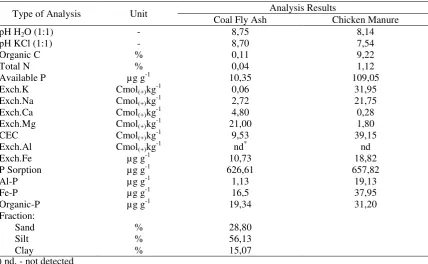
Results of laboratory analysis of samples of coal fly ash and chicken manure are presented in Table 1. The fly ash used in this study is alkaline (pH 8.75), with the content of bases such as Na, Ca, Mg and K were relatively high. Cation exchange capacity (CEC) (9.53 cmol(+)kg
-1
132 nitrogen levels in ash produced has collapsed (Bhattacharya and Chattopadhyay, 2004). Meanwhile, available P levels in coal fly ash is relatively low, and most of the P is in the form of bonds with Al, Fe and P-organic, as well as the P sorption capacity of 626.61 µg g-1. P content in coal fly ash is generally low and therefore the efforts are needed to increase the P availability in their utilization for crop production (Kumar
et al., 1998; Bhattacharya and Chattopadhyay, 2002). In addition, the used of coal fly ash is dominated by silt and clay-sized particles (71.20%), suggesting that they easily react with the chicken manures.
Table 1. The results of a preliminary analysis of coal fly ash and chicken manure
Type of Analysis Unit Analysis Results
Coal Fly Ash Chicken Manure
pH H2O (1:1) - 8,75 8,14
pH KCl (1:1) - 8,70 7,54
Organic C % 0,11 9,22
Total N % 0,04 1,12
Available P µg g-1 10,35 109,05
Exch.K Cmol(+)kg-1 0,06 31,95
Exch.Na Cmol(+)kg-1 2,72 21,75
Exch.Ca Cmol(+)kg-1 4,80 0,28
Exch.Mg Cmol(+)kg-1 21,00 1,80
CEC Cmol(+)kg-1 9,53 39,15
Exch.Al Cmol(+)kg-1 nd* nd
Exch.Fe µg g-1 10,73 18,82
P Sorption µg g-1 626,61 657,82
Al-P µg g-1 1,13 19,13
Fe-P µg g-1 16,5 37,95
Organic-P µg g-1 19,34 31,20
Fraction:
Sand % 28,80
Silt % 56,13
Clay % 15,07
*) nd. - not detected
Furthermore, chicken manure used in this study also had a relatively alkaline pH (pH 8.14), levels of P-available and high bases, solubility of Al, Fe and C/N ratio is low. Cation exchange capacity (CEC) of chicken manure used is relatively high (31.95 cmol(+)kg
-1
). Meanwhile, the P sorption capacity of chicken manure used is relatively high (657.82 µg g-1). Despite this, P availability is high and most of P are in the form of a bond as Al-P, Fe-P and organic-P. Mixing of coal fly ash and chicken manure with relatively different characteristics is expected to be able to improve its quality as ameliorant to improve soil quality and crop production.
3.2. Some Chemical Charactheristics of Coal Fly Ash and Chicken Manure Mixture
Changes in pH, organic C, cation exchange capacity (CEC), and avilable P in different combinations of fly ash-chicken manure mixture are presented in the Table 2. The mixed of fly ash-chicken manure had a lower pH, which may be due to the accumulation of organic acids from microbial metabolism during decomposition processes (Sajwan et al., 2006).
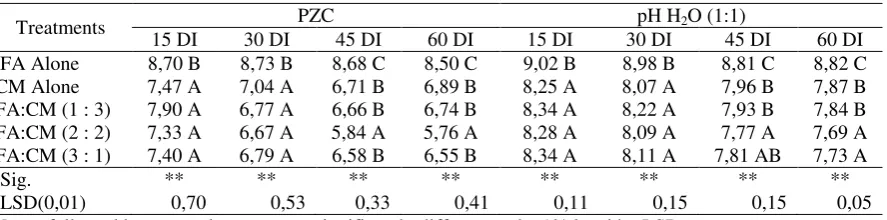
The pH values for all treatments tend to decreased with incubation time, and the decrease in pH was greater with higher rates of chicken manure. pH decreased up to 45 days of incubation is relatively larger than the decrease in pH at 60 days of incubation. The results suggest that chicken manures and fly ash play a significant role in decomposition processing, which tend to increase up to 45 days of incubation. In 45 and 60 days of incubation, solution pH for the composition of fly ash-chicken manure 2:2 was the lowest (7.77 – 7.69) compared to other treatments. In this pH range, the solubility of trace elements would be low, as adsorption and precipitation reactions would decrease their solubilities (Sajwan et al. 2006).
133 to increase with increasing ratio of chicken manure added up to the composition of the 1:3 mixture. Microorganisms activity were reported to increased with the addition of organic matter and caused the increases of plant nutrients availability (Bhattacharya and Chattopadhyay, 2002; Sajwan et al., 2006).
Table 2. Some chemical characteristics of the coal fly ash and chicken manure mixture at each incubation time
Treatments
15 DI 30 DI
pH (1:1) C-org CEC P-avail pH (1:1) C-org CEC P-avail H2O KCl (%) (Cmol+ kg-1) (µg g-1) H2O KCl (%) (Cmol+ kg-1) (µg g-1)
A Alone 9,02 8,91 0,11 12,75 6,00 8,98 8,85 0,14 13,05 14,45 CM Alone 8,25 8,07 9,22 35,25 98,40 8,07 7,76 8,50 38,75 124,05 FA:CM (3 : 1) 8,34 8,07 2,62 18,00 44,40 8,22 7,97 2,77 19,15 49,65 FA:CM (2 : 2) 8,28 8,13 4,25 23,50 77,70 8,09 7,83 4,47 23,50 83,70 FA:CM (1 : 3) 8,34 8,09 6,91 28,73 88,65 8,11 7,76 6,91 32,20 97,80
45 DI 60 DI
A Alone 8,81 8,70 0,14 14,70 14,25 8,82 8,80 0,12 15,23 17,40 CM Alone 7,96 7,62 9,93 45,68 133,95 7,87 7,63 9,93 39,15 134,10 FA:CM (1 : 3) 7,93 7,70 2,98 19,28 51,55 7,84 7,64 2,69 17,40 68,55 FA:CM (2 : 2) 7,77 7,45 4,82 26,10 94,80 7,69 7,42 4,75 21,75 88,35 FA:CM (3 : 1) 7,81 7,48 7,80 39,15 118,35 7,73 7,45 7,62 30,45 105,45 DI =Days of Incubation
In addition, levels of available P, organic C and CEC on chicken manure is relatively high (Table 1), thus contributing to the increased availability of P, C-organic content and CEC value of the mixture. Composting of coal fly ash and organic manure has been an effective way to improve the nutritional status of the mixture, via increases in cation exchange capacity (CEC) and by provision of some essential nutrients (Carlson and Adriano, 1993; Bhattacharya and Chattopadhyay, 2002; Sajwan et al., 2006).
3.3. pH and Point of Zero Charge (PZC) of Coal Fly Ash and Chicken Manure Mixture
One of the obstacles in the soil with heavy weathering intensity has a high value of PZC and at low pH tend to have a positive charged. Therefore, cations are easily leached and soil fertility conditions deteriorate. Theoretically, cation loss can be prevented by developing negative surface charge and thus creating additional cation exchange capacity (CEC) (Uehara and Gillman 1981). This can be obtained either by raising soil pH, increasing the electrolyte concentration in the soil solution or lowering the PZC. PZC is a point, where the net charge of variable charge components is zero due to the equal H+ and OH- adsorption on them. If the pH of a soil is above its PZC the soil surface will have a net negative charge and predominantly exhibit an ability to exchange cations (CEC— exchange of one positive ion by another), while the soil will mainly retain anions (electrostatically) if its pH is below its PZC (AEC—exchange of one negative ion for another) (Sakurai et al., 1988). Soil amendments that may affect these soil properties include lime, phosphate, silicate and organic matter application. Fly ash is considered to be a rich source of Si, thereby potentially for lowering the value of PZC. Organic matters have a low PZC value, so it can function to lower the PZC and increasing negative charge (Uehara and Gillman, 1981). In addition, the ionization of functional groups of organic compounds can produce a number of negative charge on the surface of colloidal so PZC value will decrease (Stevenson, 1982).
134 by oxide-hidrus Al and Fe (Ali and Sufardi, 1999). This indicates that manure can reduce the status of PZC, increasing the amount of negative charge and CEC after 45 days of incubation. Overall these studies showed that mixture of fly ash and chicken manure (2:2) as a soil amendment could provide benefits in terms of soil fertility and lowering PZC.
Table 3. pH and point of zero charge (PZC) value of the coal fly ash-chicken manure mixture at each incubation time (Days of Incubation)
Treatments PZC pH H2O (1:1)
15 DI 30 DI 45 DI 60 DI 15 DI 30 DI 45 DI 60 DI FA Alone 8,70 B 8,73 B 8,68 C 8,50 C 9,02 B 8,98 B 8,81 C 8,82 C CM Alone 7,47 A 7,04 A 6,71 B 6,89 B 8,25 A 8,07 A 7,96 B 7,87 B FA:CM (1 : 3) 7,90 A 6,77 A 6,66 B 6,74 B 8,34 A 8,22 A 7,93 B 7,84 B FA:CM (2 : 2) 7,33 A 6,67 A 5,84 A 5,76 A 8,28 A 8,09 A 7,77 A 7,69 A FA:CM (3 : 1) 7,40 A 6,79 A 6,58 B 6,55 B 8,34 A 8,11 A 7,81 AB 7,73 A
Sig. ** ** ** ** ** ** ** **
LSD(0,01) 0,70 0,53 0,33 0,41 0,11 0,15 0,15 0,05
Means followed by a same letter are not significantly different at the 1% level by LSD
4. Conclusion
The coal fly ash and chicken manure mixture with incubation time tended to decrease of the PZC status compared with the coal fly ash and chicken manure alone. Among the different combinations of coal fly ash and chicken manure mixtures, the 2:2 mixture at 45 days incubation time appeared to exhibit the lowest of the PZC compared with the other treatments. This composition could be use as an amelioran to improve the soils chemical properties in terms of soil fertility and lowering PZC, and it is necessary for further research.
5. Acknowledgements
The data presented at the this paper is a subset of the data from the research activities funded by the Competitive Research Featured, Sriwijaya University for Fiscal Year 2013, for that we say thank you. Thanks are also extended to Mr. Yuda Nopriandi and Ricky F Sembiring, a graduate student in the Department of Soil Science, Agricultural Faculty Sriwijaya University, who have helped and are directly involved in the implementation of this study.
6. References
[1] Aggarwal, S, G.R. Singh and B.R. Yada. 2009. Utilization of fly ash for crop production: Effect on the growth of wheat and sorghum crops and soil properties. J. Agricultural Physics, 9:20-23.
[2] Ali, S. A. dan Sufardi. 1999. Pengaruh beberapa amandemen tanah terhadap muatan koloid dan sifat fisikokimia tanah typic haplohumults (ultisols). J. Tanah Tropika. 8:139-152.
[3] American Coal Ash Association Educational Foundation. 2009. CCP Fact Sheet 2: Coal Combustion Products: Not a Hazardous Waste. ACAA.
[4] Bhattacharya, S. S. and G. N. Chattopadhyay. 2002. Increasing bioavailability of phosphorus from fly ash through vermicomposting. J. Environ. Qual. 31:2116-2119
[5] Bhattacharya,S.S and G.N. Chattopadhyay. 2004. Transformation of nitrogen during vermicomposting of fly ash. Waste Manag Res. 22; 488.
[6] Bilski, J. J., K. Alva and K. S. Sajwan. 1995. Fly Ash. In: Rechcigl, J.E. (Editor). Soil Amendments and Environmental Quality. Boca Raton, Florida: Lewis Publisher.
[7] Bloom, P.R., Skyllberg, U.L, and M.E. Sumner. 2005. Soil acidity. In Tabatabai, M.A, and D. L. Sparks (Eds). Chemical processes in soils, SSSA Book series 8. Soil Science Society of America, Inc, Madison, WI.
[8] Carlson, C.L. and D.C. Adriano. 1993. Environmental impacts of coal combustion residues. J. Environ. Qual. 22:227-247.
135 [10] Hanani, M.N, I.C. Fauziah, A.W. Samsuri and S. Zauyah. 2010. Formulation of Coal Fly Ash and Sewage Sludge
Mixtures to Reduce Impacts on the Environment When Used as Soil Ameliorant for Acidic Tropical Soils. Malaysian Journal of Soil Science. 14: 53-70.
[11] Jumaeri, W. Astuti dan W.T.P. Lestari. 2007. Preparasi dan karakterisasi zeolit dari abu layang batubara secara alkali hidrotermal. Reaktor, 11(1):38-44.
[12] Kishor P, A.K. Ghosh and D. Kumar. 2010. Use of flyash in agriculture: A way to improve soil fertility and its productivity. Asian Journal of Agricultural Research, 4(1):1-14.
[13] Kumar, A., A.K. Sarkar, R.P. Singh, and V.N. Sharma. 1998. Characterization of fly ash from steel plants of eastern India. J. Indian Soc. Soil Sci. 46:459–461.
[14] Marcano-Martinez, E., and M.B. McBride. 1989. Comparison of the titration and ion adsorption methods for surface charge measurements in Oxisols. Soil Sci. Soc. Am. J. 53:1040–1045.
[15] Mittra, B. N., S. Karmakar, D. K. Swain, and B. C. Ghosh. 2003. Fly ash - a potential source of soil amendment and a component of integrated plant nutrient supply system. 2003 Internasional Ash Utilization Symposium. University of Kentucky, Paper #28.
[16] Pandey, V.C and N. Singh. 2010. Impact of fly ash incorporation in soil systems. Agriculture, Ecosystems and Environment. 136:16–27.
[17] Sajwan, K.S, S. Paramasivam, A.K. Alva and S.V. Sahi. 2006. Fly ash-organik byproduct mixture as soil amandment. Soil and Water Pollution Monitoring, Protection and Remediation, 3–23.
[18] Sakurai, K., Y. Ohdate and K. Kyuma. 1988. Comparison of salt titration and potentiometric titration methods for the determination of zero point of charge (ZPC). Soil Sci. Plant Nutr.,34 (2):171-182.
[19] Shafiq, N, Nuruddin, M.F., and I. Kamaruddin. 2007. Comparison of engineering and durability properties of fly ash blended cement concrete made in UK and Malaysia. Advances in Applied Ceramics.106 (6):314-318.
[20] Stevenson, F.T. 1982. Humus Chemistry. John Wiley and Sons, New York.
[21] Sulaeman, Suparto, dan Eviati. 2005. Petunjuk Teknis Analisis Kimia Tanah, Tanaman, Air, dan Pupuk. Balai Penelitian Tanah, Balitbangtan, Departemen Pertanian.
[22] Uehara, G and G.P. Gillman. 1981. The mineralogy, chemistry and physics of tropical soils with variable charge clays. Westview Press. Colorado.