LAMPIRAN
MATERI
AKADEMIK
Topic
1
•
Review
of
Basic
English
Structure
•
English
Question
Words
Review
of
Basic
English
Structure
English Question Words
Question words are used to ask about specific qualities, times, places, people, etc. They are
different from yes / no questions (Do you live in France?). This chart provides question words, the
use and example sentences. Study the question words, understand the uses and then look at the
examples. Try to think of a few examples of your own. At the end, take the on the next page testing
question words.
Who
Use: Asking about people Examples:
Who do you like?
Who studies Russian?
What
Use: Asking about things or activities Examples:
What does he do at weekends?
What is that?
What kind of / type of
Use: Asking about specific things or characteristics Examples:
What type of car do you drive?
What kind of person is he?
What time
Use: Asking for a specific time Examples:
What time is it?
What ... like
Use: Asking about characteristics Examples:
What was the weather like?
What is Mary like?
When
Use: Asking about general or specific times Examples:
When do you like going out?
When does the bus leave?
Where
Use: Asking about places Examples:
Where do you live?
Where did you go on vacation?
How
Use: Combined with many words to ask questions about specific characteristics, qualities, quantities, etc. For example: How much (price, quantity), How long (length), How often (frequency)
Examples:
How often do you go to the movies?
How long was the film? How much does it cost?
Which
Use: Asking to specify a thing or person from a number of things or people
Examples:
Which book did you buy?
Which boy won the race?
References:
http://esl.about.com/library/vocabulary/bI_commonphrases.htm
BASIC EXPRESSIONS IN MATHEMATICS CALCULATION (1):
Write down the English expressions for the following mathematics terms:
No. Indonesia English
1. Penambahan Summation, addition
2. Tambah Add, plus
3. Pengurangan Subtraction
4. Kurang Subtract, minus
5. Perkalian multiplication
6. Kali Multiply, times
7. Pembagian Division
8. Bagi Divided by
9. Pangkat Power
10. Akar root
11. 8y Eight way
12. 16
y Sixteen over way, sixteen divided by
13. 4 + s Four plus s
14. 9 — x Nine minus ex
15. 46 Four to the sixth power
what is 4? Base
What is 6? Exponent
16. 42 Four square
17. 53 F i v e c u b e d
18. Logaritma logarithm
19. Akar‐pangkat Square root
20. Bentuk Shape
21. Fungsi function
Topic 2
•
Basic
Expressions
in
Mathematics
calculation
(2)
•
Introduction
to
Teaching
Skills
BASIC EXPRESSIONS IN MATHEMATICS CALCULATION (2):
Write down the English expressions for the following mathematics terms:
No. Indonesia English
1. Persamaan Equation
2. Sama dengan (=) Equal
3. < ‐5 < ‐4 Less than minus five is less than minus four
4. Is Less than or equal
5. Is greater than or equal
6. > ‐4 > ‐5 greater than minus four is greater than minus five
minus four is to the right of minus five
7. Berbagai cara membaca penambahan:
6 + x Six plus x
y + 8 The sum of y and 8
n + 5 Five more then n
x+7 x is added by seven x increased by seven
8. Berbagai cara membaca pengurangan:
5 —y Five minus y
x — 4 Four less than x
7 —n The difference of seven and n
n ‐ 9 n decreased by nine
9. Berbagai cara membaca perkalian
9x Nine times x / Nine x
10n ten multiplied by n
3y The product of 3 and y
10. Berbagai cara membaca pembagian:
n/4 N divided by four n over four
7/x The quotient of 7 and x
11. Bilangan bulat Integer
12. Bilangan negatif Negative number 13. Bilangan positif Positive number
Teaching
skills
Teachers need to master 4 teaching skills, namely set induction, stimulus and variation, questioning and reinforcement, and set closure skills.
Format of the learning‐teaching activity
Set induction : greeting, reference to past, relevance to new, present objective
Main teaching activity : describing & explaining, discussing, questioning & answering, evaluating, etc. suitable and encouraging learning‐teaching situation, through 4 points of importance, namely greetings, reference to past learning, relevance between the previously‐learned subject and the new one, introduction of the objective of the new subject/topic.
The teacher shows the relation between the subject/topic he taught previously/the week before and the new subject/topic he is going to teach; This is to show the students the
Task 1 Classroom Language
In pairs, discuss and write down all the expressions or phrases you can think of which you might need to use in the classroom. Write them in Indonesian language in the left column and in English in the right column. Then, present the result of your discussion to class.
No. Indonesian English
Classroom
Language
• Good morning/afternoon/evening, everybody.
• Hello, everyone.
• Hello there, Dian.
2. Asking students' condition
• Who isn't here today?
• What's the matter with Riski today?
• What's wrong with Jim today?
• Why were you absent last Friday, Nina?
• Do you feel better today?
• Are you better now?
• Have you been ill?
• What was the matter?
7. Giving sympathy
• I am sorry to hear that.
• I hope you will get well soon.
8. Reviewing the previous materials or Brainstorming the new materials
• What did you remember about our last week materials?
• What do you know about ...?
• Do you know what ... means?
• Have you ever heard about ...?
9. Stating the objectives of the course meeting The objective of today's lesson is ...
• The purpose of this lesson is ...
10. Asking the late comers
• Excuse me, can I talk to you for a minute?
• Where have you been?
• We started ten minutes ago. What have you been doing?
• Did you miss your bus?
• Did you oversleep?
Task 3
Look at a video on how some teachers open a lesson. W your reflection on how to open a lesson, especially related to your subject of teaching.
Topic 3
•
Basic
Expressions
in
Mathematics
calculation
(3)
•
Classroom
Language
for
Delivery
and
Stimulus
Variation
BASIC EXPRESSIONS IN MATHEMATICS CALCULATION (3):
Write down the English expressions for the following mathematics terms:
No. Indonesia English
Classroom Language for Delivery and Stimulus Variation
Main Purpose:
It is the teacher's skills to stimulate the students, increase their active participation, enthusiasm and spirit of study, to avoid boredom and apatism
A. Teacher Movement
The teacher's overall physical movement with the purpose of covering the whole class and creating better and more intimate atmosphere in the teacher‐student interrelationship
How?
Usually, I move around the class when students do the exercise. I observe what they do
with their computer and give some comments or answer their questions.
B. Teacher Gesture
T h e t e a c h e r ' s g e s t u r e s ‐ t h e t e a c h e r ' s b o d y m o v e m e n t s ‐ w h i c h c o m m u n i c a t e c e r t a i n meaningful ideas to the students.
How?
C. Teacher Voice
How?
Our voice should be loud enough for whole class
D. Teacher Silence.
How?
Teacher should be keep silence after explaining and give students the moment to absorb
the knowledge.
Teacher keeps silence after give the question to whole class or to person so they can
understand what the meaning is.
E. Interaction Style
There are three interaction styles worth noticing, use them invariably at the right
time and situations; do not stick to one style only all the time;
1) Teacher‐Students Interaction Style
The teacher has‐ a dialogue with the whole class, communicates to the
students as a whole, not to individual students;
2 ) Teacher‐Student Interaction Style
The teacher has a dialogue with a certain student, communicates the students as
individuals;
3 ) Students‐Students Interaction Style
The teacher is not involved in the students' activities; functioning as an observer, he
lets the students discuss in groups;
F. Eye Contact & Movement
As part of teacher gestures, eye contact and movement is stressed on the
controlling interaction between the teacher and the students through emotional
expressions
G. Focussing 1) Verbal Focusing
2) Gestural Focusing
Examples:
3)Switching Sensory Channel Please give examples:
Topic 4
•
Basic
Expressions
in
Mathematics
calculation
(4)
•
Classroom
Language
for
Questioning
and
reinforcement
skill
BASIC EXPRESSIONS IN MATHEMATICS CALCULATION (4):
Write down the English expressions for the following mathematics terms:
NO Indonesia English
1. BIlangan prima Prime number
Membaca dan menyelesaikan Reading and finding solutions of the problems
Classroom
Language
for
Questioning
and
Reinforcement
Skill
a. REINFORCEMENT OF STUDENT PARTICIPATION
Main Purpose:
To help the teacher show a positive feedback to the students, or to help communicate the teacher's approvals/disapprovals towards the students, resulting in the students' feeling reinforced to participate more actively and better in the teacher's teaching‐learning interaction
b. QUESTIONING SKILLS
Main Purpose:
1. To increase the students' participation in their teaching‐learning interaction; 2. To arouse the students' interest and their curiosity in the topic they are
QUESTIONS SEEN FROM THEIR PURPOSES
1. COMPLIANCE QUESTIONS/PERTANYAAN PERMINTAAN
Examples :
Could you open the door, please? Do you mind standing for a while?
2. RHETORICAL QUESTIONS/PERTANYAAN RETQR1KAL
Example:
"Why is swimming important?", the teacher asks, "Because it is good for our health." the teacher answers.
3. PROMPTING QUESTIONS/PERTANYAAN PENUNTUN
4. PROBING QUESTIONS/PERTANYAAN PENGGALI
Example:
"What is the difference between a turtle and a tortoise?" "Can you explain the difference in details?"
"What about the ways they lay eggs? Is there any difference?" "And how about their ways of
1. RECALL/KNOWLEDGE QUESTIONS/PERTANYAAN INGATAN
Example:
"Who Is the second president of Indonesia?"
"What is the name of the capital city of Indonesia?"
2. COMPREHENSION QUESTIONS/PERTANYAAN PEMAHAMAN
Example:
"Can you explain the difference between 'supper' and 'dinner'?" "Why is Yogyakarta called Daerah Istimewa Yogyakarta?"
3. APPLICATION QUESTIONS/PERTANYAAN PENERAPAN
Example: "Can you make a sentence showing one's habitual action?"
4. ANALYSIS QUESTIONS/PERTANYAAN ANALISA
Example: "Why is the sentence,' I and John have gone to Jakarta yesterday.' wrong?"
5. SYNTHESIS QUESTIONS/PERTANYAAN SINTESA
Example:
"Seeing the increase of the value of dollars upon rupiahs in the present days, do you think the Indonesia government will devaluate their rupiah value upon dollars?"
6. EVALUATION QUESTIONS/PERTANYAAN MENILAI
Example: Do you think it is wise enough to increase the school fee in such a situation?"
QUESTIONS BASED ON THEIR SCOPES
1. NARROW QUESTIONS/PERTANYAAN MENYEMPIT
1.a. DIRECT NARROW QUESTIONS/LANGSUNG
Example: "When did Indonesia declare its independence?"
1.b. CENTERED NARROW QUESTIONS/MEMUSAT
Example: "What are the difference between the 'simple present tense' and the 'simple past tense'?"
2.a. OPEN‐ENDED QUESTIONS/TERBUICA
Example: "What would you do if you became the president of Indonesia?" "How would you solve the problem of poverty in YOgyakarta?"
2.b. VALUEING QUESTIONSAIENILAI
Example: "what is your opinion aboLit the ldss of PSSI in SEA Games VIII?" "What do you think about John, our new manager?"
FACTORS IMPORTANT IN QUESTIONING SKILLS
1. Clarify and Relevance
2. speed and daises
3. di§tribution of questions
4. relhforcerneht techniques
Task 6 Classroom Language: questioning and reinforcement
In pairs, discuss and write down all the expressions or phrases you can think of which you
might need to use in the classroom to ask and reinforce your students. Write them in
Indonesian language in the left column and in English in the right column. Then, present
the result of your discussion to class.
No. Indonesian English
,
Classroom Language (3)
Responding to questions
• Yes, that's right.
The Langauge of Error C.Orrection (Reinforcement skill)
• Unfortunately not
• I'm afraid that's not quite
• You were almost right • That's almost right
Sort of yes • Your pronunciation is very good. pronunciation.
Topic 5
•
Basic
Expressions
in
Mathematics
calculation
(5)
•
Classroom
Language
for
Set
Closure,
Spontaneous
Situations
and
Exam
BASIC EXPRESSIONS IN MATHEMATICS CALCULATION (5):
Write down the English expressions for the following mathematics terms:
No. Indonesia English
26. Kerucut Terpancung
27. Segi n
Set
Closure
No. lndonesian English
The End of the Lesson 1. Concluding Remarks
• To conclude today we learned basic calculations in arithmetic.
• So, ... and this is the conclusion of our lesson today.
• Daniel, what have we learned today?
2. Reference to the new topic:
• After you know about integers, next week we will see fractions.
• After understanding "function", we will observe similar concept next week, namely "function" with limited value of ....
3. Assignment
• This is your homework for tonight.
• Do exercise 10 on page 23 for your homework.
• Prepare the next chapter for Monday. Read Chapter 15 on page 102.
• There is no homework tonight.
• Remember your homework.
• Take a worksheet as you leave.
• Exercise 15 is your next assignment. Do it.
4. Closing:
• Goodbye, everyone.
• See you again next Wednesday.
• See you tomorrow afternoon.
• See you in room 7 after the break.
• Have a good holiday.
• Enjoy your vacation.
• We'll do the rest of this chapter next time.
• We'll finish this exercise next lesson.
• We've run out of time, so we'll continue next lesson.
Some other expressions that can be used in ending the lesson: Time to stop
• It's almost time to stop.
• I'm afraid it's time to finish now.
• We'll have to stop here.
• There's the bell. Its time to stop.
• That's all for today. You can go now.
Not time to stop
• The bell hasn't gone yet.
• There are still two minutes to go.
• We still have a couple of minutes left.
• The lesson doesn't finish till five.
• Your watch must be fast.
• We seem to have finished early.
• We have an extra five minutes.
• Sit quietly until the bell goes.
Wait a Minute
• Hang on a moment.
• Just hold on a moment.
• Stay where you are for a Moment.
• Just a moment, please.
• One more thing before you go.
• Back to your places.
Classroom
Language
Language
of
spontaneous
situations
Classroom
Language
Expressions
used
in
exam:
Opening:
Good morning. Is it right that this is algebra 1 exam with Ibu Kus?
We will start the exam now. Put everything away from your desk, except your pen, pencil, correction pen, calculator, ruler, and eraser. Don't forget to prepare the examination card. I will distribute the question sheets and answer sheets.
You have ... minutes to do the test. No cooperation, in any forms, is tolerated.
Please sign the attendance list twiceYou can stait doing the exam now. Your time is from now.
You still have 5 minutes.
5 More minutes (5 menit lagi) Vs 5 minutes more (tambahan waktu 5 menit lagi)
Relative
clause
Klausa ini tidak bisa berdiri sendiri karena selalu butuh induk klausa. Fungsinya adalah untuk menjelaskan suatu frase dalam bentuk klausa.
Examples:
1. The girl talks a lot in my class. She is sitting in the last row. The girl who is sitting in the
last row talks a lot in my class. The girl that is sitting in the last row talks a lot in my class. The girl sitting in the last row talks a lot in my class.
2. The students are still confused about the logarithm problems. We discussed them
last week. The students are still confused about the logarithm problems which we discussed last week. The students are still confused about the logarithm problems that we discussed last week. The students are still confused about the logarithm problems we discussed last week.
Noun clause
Klausa ini berfungsi untuk menggantikan frase. Examples:
Let us discuss it.
How can we use a copy statement? Let us discuss how we can use a copy statement. Exercise:
Translate the following sentences:
1. Tolong jelaskan bagaimana kamu bisa mendapatkan jawaban pertanyaan itu
2. Mahasiswa yang baru saja datang silakan maju ke depan.
3. Bisakah dijelaskan factor apa saja yang perlu kita perhatikan dalam mengambarkan bangun ini.
Quiz‐1
Name:
A. Make questions from the following sentences based on the answer which is shown by the underlined.
1. Automobiles and trains had not yet been invented.
2. Horse‐drawn vehicles traveled on unpaved roads.
3. Many changes have occurred in the last two hundred years.
4. The invention of machines has brought most of We changes.
5. You should think of the days of George Washington. v e 0 k \ / ( 1 H i l
II. Translate the following calculations and sent ences.
1.
2. 2x + 3y‐z = 3z/4x
3. 5 ‐ y
3. Guru meminta siswa untuk menggambar 5 lingkaran dengan berbeda bentuk.
4. Guru meminta siswa untuk mengukur diameter masing‐masing lingkaran,
5. Selesaikan masalah ini:
x = 4 2x3 + 2
C. Write a complete mini lesson of a certain topic from the opening, the whilst activities, and the closing
Topic 6
•
Basic
Expressions
in
Mathematics
calculation
(6)
•
Components
of
a
Lesson
Plan
•
Review
of
Basic
English
Sentences:
Making
Questions
2
BASIC EXPRESSIONS IN MATHEMATICS CALCULATION (6):
Write down the English expressions for the following mathematics terms:
No. Indonesia English
1. Pertidaksamaan
2. Perkalian silang
3. Pecahan sama nilai
4 . Hasil perkalian silang
5. Bilangan genap
6. Bilangan ganjil
7 Pohon faktor
8. Kebalikan
9. Rata‐rata
10.
11. modus
12. Nilai tengah
13. probabilitas
14. busur
15. jangka
16. penggaris
17. 45,035
18. 385,023,865,015
19. 2,0.6, ‐0.0047
(Bilangan nyata)
14 (Bilangan tidak
nyata)
21. Pembulatan (decimal)
22. Tangen
23. Segienam
24. Segitujuh
25. Pecahan
27. Bilangan irasional
28 Bilangan bulat
Components
of
A
Lesson
Plan
Below is a format of a lesson plan used in Senior High School (SMA) which is based on School based
Curriculum (KTSP).
Rencana Pelaksanaan Pembelajaran
Mata Pelajaran : ___________________________________________________
Kelas/Semester : ____________________________________________________
Pertemuan Ke‐ : ____________________________________________________
Alokasi Waktu : ____________________________________________________
Standar Kompetensi : ____________________________________________________
Kompetensi Dasar : ____________________________________________________
Indikator : ____________________________________________________
I. Tujuan Pembelajaran : ____________________________________________________
II. Materi Ajar : ____________________________________________________
III. Metode Pembelajaran : ____________________________________________________
IV. Langkah‐langkah Pembelajaran
A. Kegiatan Awal : ____________________________________________________
B. Kegiatan Inti : ____________________________________________________
C. Kegiatan Akhir : ____________________________________________________
V. Alat/Bahan/Sumber Belajar: ____________________________________________________
VI. Penilaian : ____________________________________________________
Lesson Plan
Subject : ____________________________________________________
Class/Semester Meeting : ____________________________________________________
Time Allocation : ____________________________________________________
Competence Standard :____________________________________________________
Basic Competence : ____________________________________________________
Indicator(s) : ____________________________________________________
I . Learning Goals : ____________________________________________________
I I . Materials : ____________________________________________________
Ill. Learning Methods : ____________________________________________________
IV. Learning Activities
A . Pre‐activities : ____________________________________________________
B . Main activities : ____________________________________________________
C. Post activities : ____________________________________________________
V. Media/Sources : ____________________________________________________
VI. Assessment : ____________________________________________________
The following is an example of a lesson unit plan used in the English Education Study Program of Sanata
Dharma University.
Lesson Unit Plan
Credit : ____________________________________________________
Time Allocation : ____________________________________________________
Study Program : ____________________________________________________
Course Coordinator : ____________________________________________________
Lecturers : ____________________________________________________
Grading Policy :
Assessment Aspects Percentage
Attendance 5%
Independent Tasks 15%
Progress Test 1 25%
Progress Test 2 25%
Final Project 30%
3 . References
Dubin, Fraida, and Olshtain, Elite. 1994. Course Design. Cambridge: Cambridge University Press. Etc.
4 . Schedule, Materials, and Learning Activities
Wk Basic
Competence
Topics Sub topics Learning Activities
indicators Media References
1 Learners Introduction to Curriculum and Curriculum Development, Concepts and Models of Curriculum, Concepts and Kinds of Syllabus, Syllabus and Lesson Unit Development. Test I values 25% of the final score.
Progress Test 11 includes materials from meeting 6 up to meeting 8 covering Competency‐Based Education and Competency‐based Curriculum, Curriculum 2006 and its implementation. Test II values 25% of the final score.
Task 8 Terms used in a Lesson Plan
In pairs, discuss and write down all components of a lesson plan. Write them in Indonesian language in the left column and in English in the right column. Then, present the result of your discussion to class.
No. Indonesian English
Mata pelajaran
Kelas
Waktu
Topic
Standar kompetensi
Kompetensi dasar
indikator
Tujuan Pembelajaran
Langkah‐langkah Pembelajaran
Pendahuluan
Kegiatan inti
Penutup
Referensi
Evaluasi
Mata kuliah
Semester
Kompetensi dasar
indikator
Tujuan Pembelajaran
Langkah‐langkah Pembelajaran
Pendahuluan
Kegiatan inti
Penutup
Referensi
Evaluasi
Task 9 Writing Learning Indicators
a. Choose a topic of teaching and write down the indicators of achievement. Write them in Indonesian language and in English. Then, present the result of your discussion.
b.Look at the following Standar Kompetensi and Kompetensi Dasar taken from the
School based Curriculum for Senior High School. Write them in English. Write
also the learning indicators of achievement. Then, present the result of your
discussion.
Kelas X, Semester 1
Aijabar
Standar Kompetensi Kompetensi Dasar
1. Memecahkan masalah yang berkaitan
dengan bentuk pangkat, akar, dan
logaritma
1.1 Menggunakan aturan pangkat, akar,
dan logaritma
1.2 Melakukan manipulasi aljabar dalam
perhitungan yang melibatkan pangkat,
akar, dan logaritma
Topic 7
•
Basic
Expressions
in
Mathematics
calculation
(7)
•
Action
verbs
used
in
lesson
plan
BASIC EXPRESSIONS IN MATHEMATICS CALCULATION (7):
Write down the English expressions for the following mathematics terms:
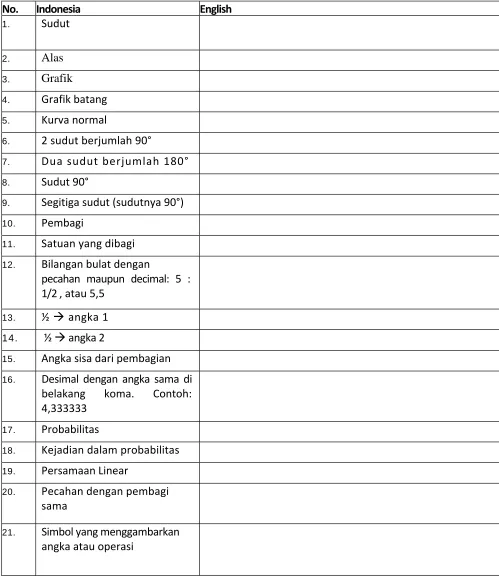
No. Indonesia English
1. Sudut
belakang koma. Contoh: 4,333333
17. Probabilitas
18. Kejadian dalam probabilitas
19. Persamaan Linear
20. Pecahan dengan pembagi
sama
21. Simbol yang menggambarkan
angka atau operasi
Action Verbs
(For asking questions and making indicators of achievement)
Task 10 Action Verbs
Read the sets of action verbs below and write down the Indonesian equivalents of
these action verbs. Notice that the sets of words correspond to the different levels
of Bloom's Taxonomy.
SET A
English Indonesian Equivalents
Show
English Indonesian Equivalents
Set C
English Indonesian iquivalents
Write
English Indonesian Equivalents
Examine
English Indonesian Equivalents
Formulate SET F
English Indonesian Equivalents
Predict
Defend
Estimat
Justify
Value
Task 11 Action Verbs for Teaching
Choose 8 action verbs in the list and write achievement indicators for your lessons
using these verbs. Please see the additional information on action verbs as
reference.
No. Action Verb Sentence
1.
2.
3.
4.
5.
6.
7.
8.
Action verbs
KNOWLEDGE SKILLS ATTITUDES
Analyze select accept
Argue state associate
Break‐down write be aware
Classify judge change
Combine adjust decide
Compare align derive
Contrast replace determine
Define apply develop
Demonstrate assemble influence
Describe close listen
Discuss connect perceive
Evaluate construct receive
Explain disassemble reject
Formulate disconnect state
Identify insert
Justify load
List manipulate
Name measure
organize open
predict operate
recall remove
recognize repair
record tune
relate turn off
reproduce
List of action terms for use in preparing performance objectives
Adapted from Bloom's Taxonomy of Educational Objectives (1956)
Knowledge Comprehension Application
List of action terms for use in preparing performance objectives. (n.d.).
Analysis Synthesis Evaluation
analyze
determine the factors
visualize
write
References
Retrieved December 02, 2002, from The University of North Carolina Online Instruction
Group (01G)
Web site:
http://www.sph.unc.eduhiskig/service_center/content_deviquickguides/word_list.ht
nn
Teacher science lesson plan. (n.d.) Retreived 2 December 2002 from the World Wide Web:
http://www.educ.drake.edu/gerlovich/EDUC%20125,%20225/Course%20Description%20files/Lesson %20Plan%20Form.
Program‐Based Review and Assessment:
Tools and Techniques for Program Improvement
Office of Academic Planning and Assessment
University of Massachusetts Amherst
http://www.umass.edu/oapa/assessmentionlinehandbooks/ch2/
Last modified: October 17, 2003
URL: http://www.rupert.id.au/TD700‐1/action‐verbs.html
Topic 8
•
Basic
Expressions
in
Mathematics
calculation
(8)
•
Preparing
a
lesson
Plan:
Writing
a
mini
scripted
lesson
1
BASIC EXPRESSIONS IN MATHEMATICS CALCULATION (8):
Write down the English expressions for the following mathematics terms:
No. Indonesia English
1. Sempoa
2. Garis bilangan
3. Sisi berdampingan
4. Sudut berdampingan
5. Sudut lancip
6. Sudut siku
7. Sudut tumpul
8. Sudut refleks
9. Sudut berseberangan
10. Sudut dalam
11. Sudut padanan
12. Satu putaran penuh
13. Jumlah sudut
14. Kaki sudut
15.
Gerakan searah jarum jam16. Gerakan berlawanan
arahjarum jam
17. Garis miring
18. Ketinggian (bends tdk hidup)
19. Kedalaman
20. Lebar
21. Keliling lingkaran
22. Titik tertinggi atau puncak
23. Lengkung atau busur
No. Indonesia English
25. Urutan nilai semakin lama
semakin naik atau besar (dari
kecil ke besar)
26. Urutan nilai semakin
lamasemakin turun atau kecil
(dari besar ke kecil)
27. Dadu
28. Neraca
29. Neraca lengan
30. Irisan runjung
Preparing
Lesson
Plan
Task 12 Preparing a Lesson Plan: Preparing a Lesson Plan: Developing Materials (Finding
English sources, translating excerpts)
Based on the basic competence, standard competence andkarning objectives you have
developed, select the materials you want to use. If it is not possible to use materials that
are already available in English, translate the excerpts of the Indonesian material into
English.
Task 13 Preparing a Lesson Plan: Teaching Learning Activities (set induction,
main activities, set closure)
Based on the basic competence, standard competence, learning objectives, and
materials you have developed, plan the teaching learning activities. You may use the
f ll i f t id
Phase Materials Teaching Learning Activities
Set Induction
Main Activities
Set Closure
Writing Mini Scripted Lesson
penambahan pecahan wajar. Murid‐ proper fraction.
dikehendaki membaca soalan yang Teacher asks students to read the
dipamerkan dan coba and solve it.
"Baiklah, murid‐murid, baca soal ini
beramai‐ ramai."
"Class, read this question"
"Apakah jawaban kamu?" "What is your answer?"
"Siapa mau menerangkan bagaimana dia "Who can tell the class how you got the
mendapat jawaban." answer"
SET B
English Translation
Guru meminta siswa menggambar lima Teacher ask students to draw five circles lingkaran yang berlainan ukuran. difrrent sizes
"Baiklah, saya ingin setiap kelompok "I want every group to draw five circles of
menggambar lima lilaran yang
berlainan ukuran."
diffrent sizes"
Siswa diminta mengukur panjang lilitan Teacher asks students to measure the
diameter setiap bulatan tersebut. circumstance and diameter of each
"Seterusnya kamu periu "Next, measure the circumstance and
"Tuliskan ukuran‐ukuran tersebut dalam "Record your measurements in the given
jadual yang disediakan." table"
Procedure Classroom Language
Teacher gets students into groups Okay students, please get into your groups. Teacher instructs students as to how the
table is to be filled.
Alright, this is a table with three headings
— Type of Pollution, Sources, and
Environments and Health Problem.
I want you to work in your group and
complete the table.
After fifteen minutes teacher reviews
Okay pupils, listen. Take one worksheet only
from your group leader.
I want you to look at the groups of numbers
very carefully
I want you to arrange the numbers in
ascending or descending order.
remember ascending order means that the
Right, children, have you finished?
Let's look at the answer together.
Let's look at question 1, Which number
Topic 9
•
Preparing
a
lesson
Plan:
Writing
a
mini
scripted
lesson
2
•
Review
of
Basic
English
Sentences:
Making
questions
4
Review: Making questions
1. What do you know about types of questions that we can use in teaching?
2. Give examples of each type.
Task: Please write another scripted lesson on a different topic from the previous one.
Task 14 Scripting a Lesson
Based on the lesson plan you have prepared, list the steps of procedures to teach the
materials. Script the language you will use in implementing each step or procedure in
the classroom.
Subject :
Learning Outcome(s) :
Student are able to :
________________________________________________________________
________________________________________________________________
________________________________________________________________
_______________________________________________________________
Procedure Classroom Language
. ,.
Practice Teaching Task 15 Practice Teaching
Please make use of the lesson plan and the scripted lesson that you have developed for
practice teaching. You will be given the opportunity to try‐out the lesson plan in a simulated
classroom situation the time provided for each is 30 minutes. During the practice teaching,
other teachers are encouraged to evaluate their peer's teaching using the Checklist for Peer
Feedback. The facilitator will also provide feedback to improve teachers' performance.
QUIZ 2
N a m e :
1. Write the terms in English
a. Sebutkan berbagai macam sudut
b . S e b u t k a n b e r b a g a i m a c a m b a n g u n
c. Sebutkan berbagai peralatan untuk matematika
2. Write 6 different questions for finding information on the students'
3 . W r i t e 6 d i f f e r e n t q u e s t i o n s t o f i n d i n g i n f o r m a t i o n o n t h e
s t u d e n t
a. knowledge on a certain topic
b. Comprehension on a certain topic
c. A p p l i c a t i o n o n a c e r t a i n t o p i c
d. Analysis on a certain topic
e. Synthesis on a certain topic
f. Evaluation on a certain topic
4 . W r i t e a s e n t e n c e ( s ) f o r
a. Opening the class
b. Focusing the attention
c . Giving instruction
d . Concluding and closing the class
4. Write the format a Lesson PIan
5 . W r i t e i n d i c a t o r s f o r a c e r t a i n t o p i c .
LAMPIRAN
INSTRUMEN
UNTUK MICROTEACHING
IN
ENGLISH
•
Checklist
for
Peer
Feedback
•
Format
of
lesson
plan
Practice Teaching Checklist for Peer Feedback
Name :
Subject : Topic :
Use this scale :
4 strongly agree 2 disagree
3 agree 1 strongly disagree
ITEMS
General Language Competence 1 2 3 4
1. Teacher’s language is clear and easy to understand 1 2 3 4
2. The teacher is fluent 1 2 3 4
3. The language used is grammatically accurate 1 2 3 4
4. The teacher’s pronunciations is comprehensible 1 2 3 4
5. The teacher hardly uses Bahasa Indonesia 1 2 3 4
6. The teacher is able to use correct technical terms 1 2 3 4
The teacher is able to use appropriate language 1 2 3 4
7. To set induction 1 2 3 4
8. To deliver the material 1 2 3 4
9. To elicit students understanding 1 2 3 4
10. To question and respond to students’ question 1 2 3 4
11. To set closure 1 2 3 4
Interesting expressions used:
………
Alternative expressions that could have been used:
………
………
General comments:
………
………
Format of Lesson Plan
Subject : ____________________________________________________
Class/Semester Meeting : ____________________________________________________
Time Allocation : ____________________________________________________
Competence Standard :____________________________________________________
Basic Competence : ____________________________________________________
Indicator(s) : ____________________________________________________
I I I .Learning Goals : ____________________________________________________
I V. Materials : ____________________________________________________
Ill. Learning Methods : ____________________________________________________
IV. Learning Activities
D . Pre‐activities : ____________________________________________________
E. Main activities : ____________________________________________________
F . Post activities : ____________________________________________________
V. Media/Sources : ____________________________________________________
VI. Assessment : ____________________________________________________